
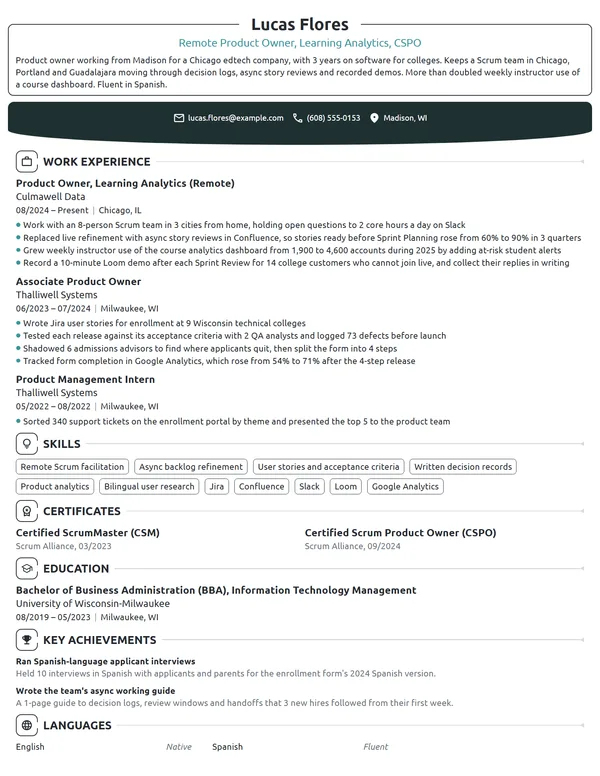
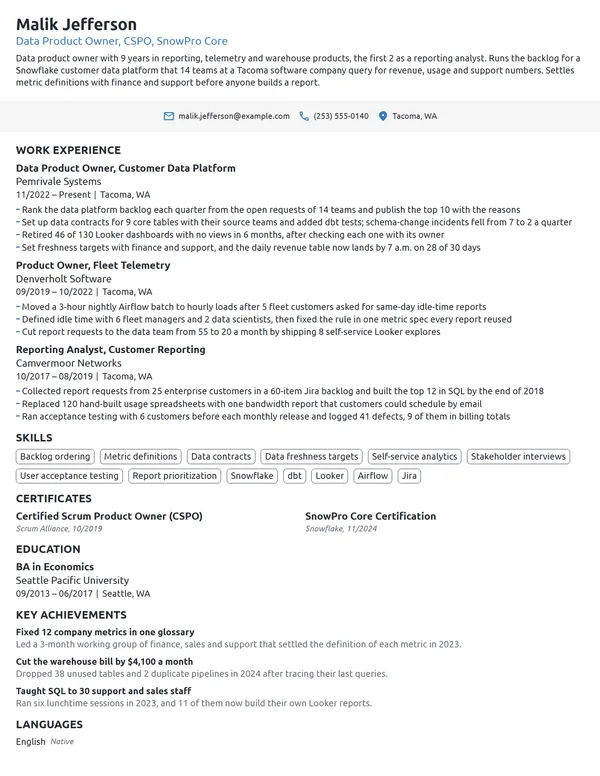
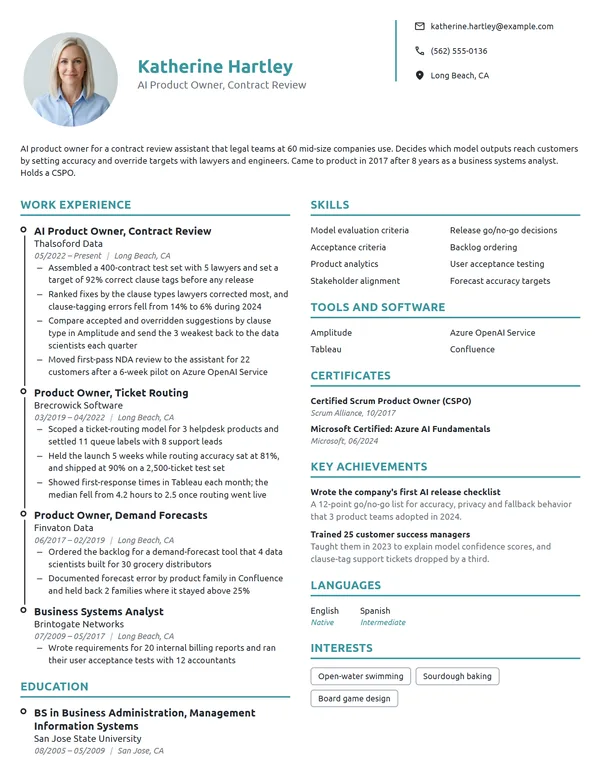
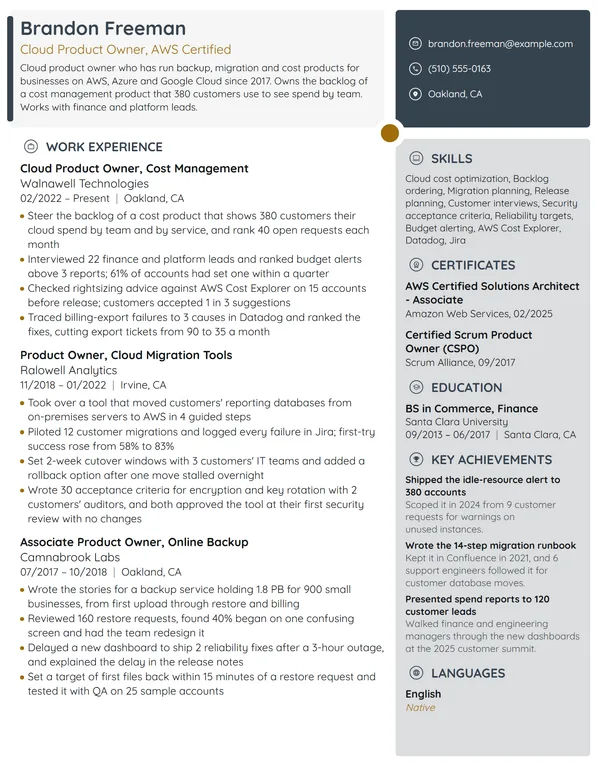
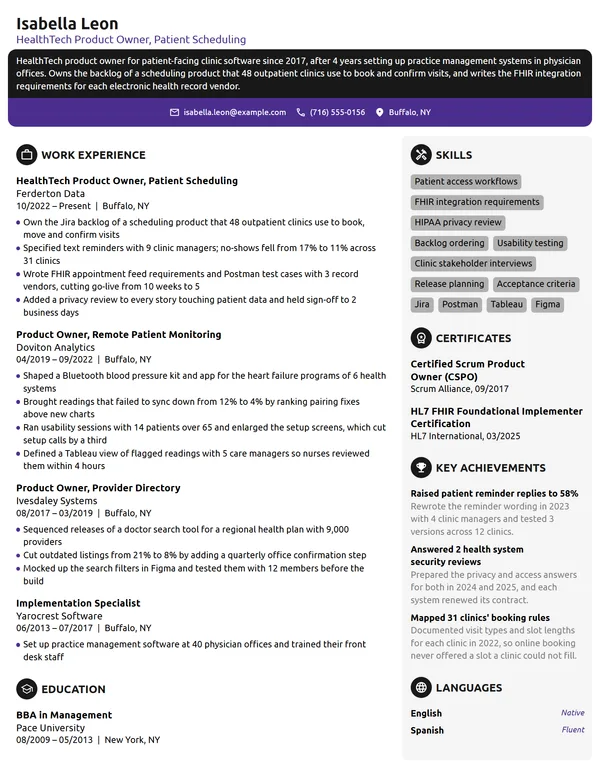
A product owner decides what the team builds next and why. The resume should show backlog ownership, clear user stories, steady releases and results users actually noticed. That is harder to convey than it sounds, since so much of the work happens in Jira tickets, sprint reviews and stakeholder meetings that nobody outside the team sees.
How to Write a Product Owner Resume - Key Takeaways
- Keep to reverse-chronological order on 1 page, moving to 2 only once you have 10+ years or several products behind you.
- Put the product and its users in your job title line, such as Product Owner, Claims App, so the reader knows what you owned.
- Open with a 2- to 3-line summary naming your years as a product owner, the product, your tools and your best delivery or user result.
- Give each bullet a backlog, sprint, release or user number, and say which decision of yours produced it.
- List CSPO, PSPO I or SAFe POPM under Certificates with the issuer and the month and year earned.
- Leave personal details off, then check the file with an ATS resume checker before you apply.
What hiring managers look for in a product owner resume
A head of product or delivery lead reads your resume for 2 things: whether you can keep a backlog in order, and whether the order you chose paid off. The 2020 Scrum Guide makes the product owner accountable for maximizing the value of the product, which in practice means writing the Product Goal, creating and ordering backlog items, and keeping the backlog visible to everyone. It also says the product owner is one person who may represent many stakeholders, so the reader will look for the calls you made between them.
Lay those calls out in sections that applicant tracking software reads cleanly:
- Name, headline (Product Owner, CSPO, for example) and contact details
- A short summary under your name, 2 to 3 lines and unlabeled
- Work Experience, newest role first
- Skills, with Jira and your other tools named
- Certificates
- Education
- Space permitting, Languages, then Key Achievements (or, instead, Volunteer Experience)
Best format for a product owner resume
Go with the reverse-chronological resume format: your current role on top, then each earlier one with its title, the company, its city and the MM/YYYY start and end. Many product owners arrive from business analysis, QA, support or project coordination, and newest-first order lets the reader see that step and everything you have owned since. A career changer keeps the same order and moves the strongest product work into the first bullets.
- Best for most product ownersReverse-chronologicalYour jobs, newest first, with your results under each one.Best for: A steady work history in your field
- FunctionalSkills grouped up top, with a short work history below.Best for: Gaps or very little experience
- CombinationA skills section first, then your full work history.Best for: A career change with strong skills
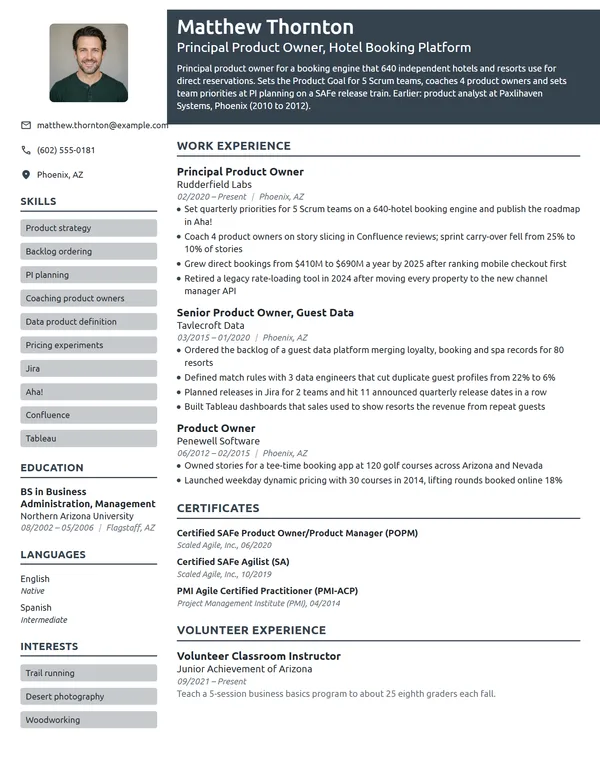
One page covers most product owners with under 10 years of experience. A 2-page resume fits a senior product owner who has owned several products or worked across a scaled setup with many teams, provided the first page holds the last 2 roles and their numbers.
| Setting | What to use |
|---|---|
| Length | 1 page; 2 once you pass 10 years or several products |
| Job title line | Title plus product or domain: Product Owner, Merchant Payments |
| Dates | MM/YYYY throughout; Present marks your current post |
| Typeface | One clean sans serif, 10.5 to 12 pt in the body |
| Photo, age and ID numbers | Most US and Canadian resumes skip the photo; leave off your age, family status and Social Security number |
| File type | A PDF, or a .docx when the application portal asks for one |
Most US and Canadian resumes carry no photo, and a software company's tracking system reads the words in your title line and bullets, not the page design.
Product owner resume summary vs. objective
Here is the test: if you have held the product owner title, or done the job under another title for at least a year, write a resume summary with your years, the product, your tools and 1 result. If you are going for your first product owner role, switch to a resume objective: the role you want plus the closest product work you have done. Draft it last, taking its figure from your strongest bullet.
Product owner resume summary formula
Title with X years on product and its users, working in tools. Best delivery or user outcome, in figures. Certification.
Example
Product owner with 4 years on insurance claims software, working in Jira and Confluence. Moved 2 Scrum teams from a release every 6 weeks to one every 2 weeks and cut claims-intake time from 11 to 4 minutes. CSPO and PSPO I certified.
Don't
Results-driven product owner passionate about agile and delivering value to customers.
Do
Product owner with 4 years on a field-service app used by 3,000 technicians, working in Jira and Azure DevOps. Put offline mode first on the roadmap and cut sync errors 35% in 2 quarters. CSPO.
This version gives the product, its users, the tools, a decision and a measured outcome.
How to write product owner work experience bullets with numbers
Give your current role 3 to 4 bullets and older roles 1 to 3, each opening with a verb. A product owner's work leaves a trail of countable things: backlog items, sprints, releases, stories reopened, and what users did after each release. Turn those into achievements on your resume rather than a list of ceremonies you attended.
| Area | What to count | Example bullet |
|---|---|---|
| Backlog health | Items, item age, items retired | Trimmed a 210-item backlog to 90 by closing stories nobody had asked about in 12 months. |
| Sprint goals | Goals met, work carried over | Met the Sprint Goal in 18 of 20 sprints after limiting each sprint to 1 objective. |
| Releases | Cadence, releases per quarter, rollbacks | Shipped 4 releases a quarter across 3 mobile apps with no rollback. |
| Story quality | Stories reopened, defects traced to unclear criteria | Brought stories reopened for vague acceptance criteria down from 12 to 3 a quarter. |
| User outcomes | Activation, adoption, support tickets | Raised new-user activation from 41% to 56% by moving onboarding fixes to the top of the backlog. |
| Stakeholders | Groups aligned, reviews run, requests declined | Ran a quarterly roadmap review with 5 department heads and published the ranked backlog after each one. |
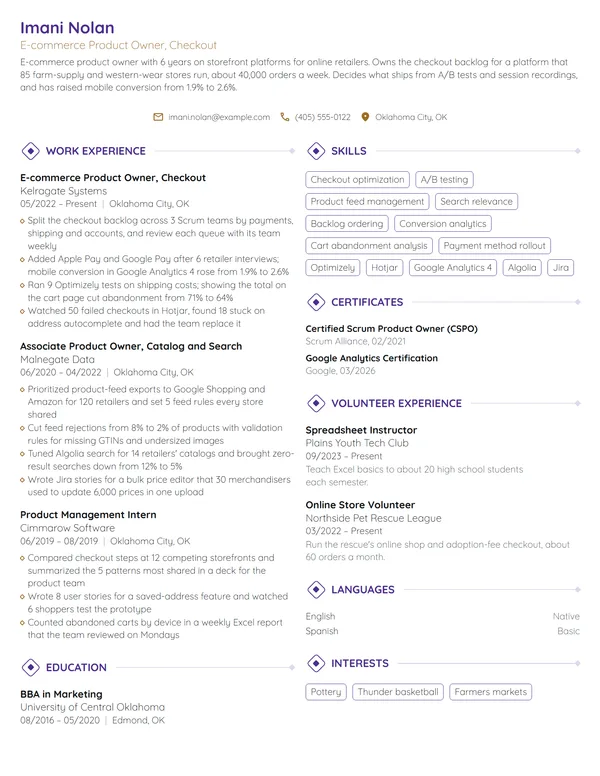
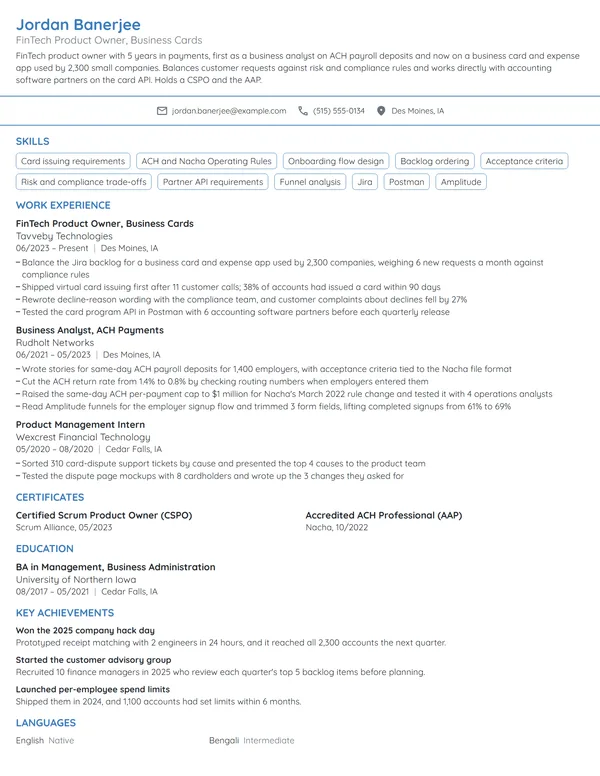
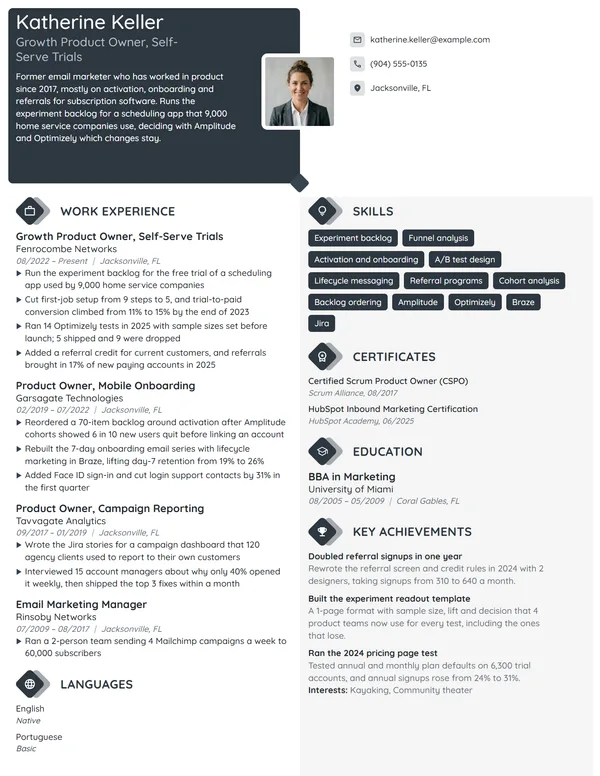
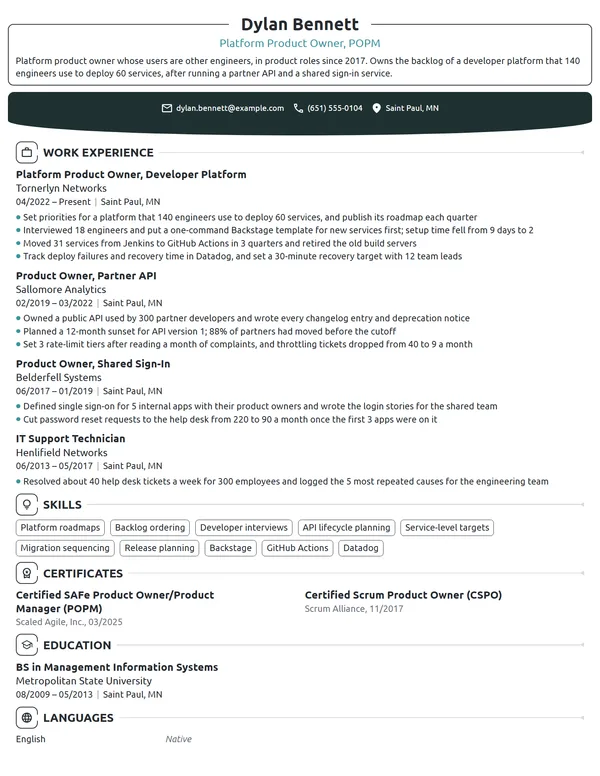
Here is how one product owner's entry reads with figures like these. Most bullets pair a decision with what it changed, and the earlier analyst role gets 2 lines.
Work Experience
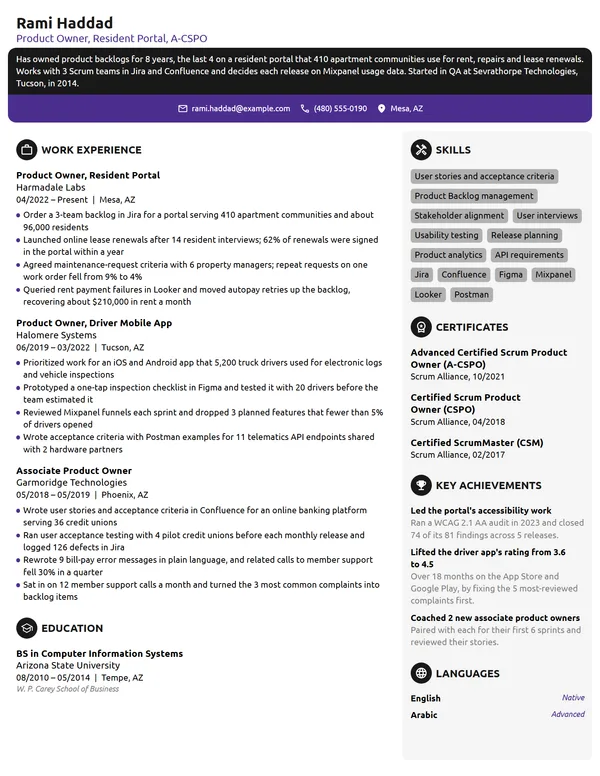
- Own the backlog for 2 Scrum teams of 7 developers; cut it from about 140 items to 85 by retiring stories with no user evidence behind them.
- Moved releases from every 6 weeks to every 2 weeks by planning each sprint around 1 goal; the teams met it in 22 of 26 sprints.
- Cut median claims-intake time in the policyholder app from 11 to 4 minutes by ordering photo upload and prefilled policy details ahead of a redesign.
- Write about 38 user stories a quarter with acceptance criteria that developers and QA agree in refinement.
- Wrote 60 requirements documents for rating and billing changes in 3 states.
- Stood in as proxy product owner for 2 releases of the agent portal.
Don't
Managed the product backlog and attended all sprint ceremonies.
Do
Split 9 blocked stories into smaller slices during refinement, and the team cleared all of them within 2 sprints.
Every product owner manages a backlog; the rewrite shows what you did to it and what it unblocked.
Don't
Worked with stakeholders to improve the checkout experience.
Do
Reduced checkout drop-off from 18% to 11% over 3 releases by putting guest checkout ahead of 2 requested loyalty features.
Product owner skills and tools for your resume
Choose 6 to 8 hard skills for your resume that the posting asks for and your bullets already back up. Backlog management, user stories and prioritization belong on nearly every product owner resume; pricing, API work or compliance only where you have done them.
Hard skills for product owners
- Product Backlog management
- User stories and acceptance criteria
- Backlog refinement
- Sprint planning and Sprint Review
- Release planning
- Prioritization (WSJF, MoSCoW)
- Product roadmaps
- User interviews and usability testing
- Product analytics and A/B tests
- SQL for product data
Soft skills delivery leads value
- Decisiveness
- Saying no with a reason
- Clear writing
- Facilitation
- Negotiation with stakeholders
- Availability to the team
O*NET has no product owner occupation and files product manager titles under Marketing Managers, where it flags Atlassian Jira, SQL and Microsoft Excel as in-demand technology and Confluence, Figma and Google Looker as hot technology. List the ones you use with your skills, then show each in a bullet, such as the Jira board you restructured or the SQL query behind a prioritization call. If a posting names Azure DevOps, Productboard or Amplitude and you have worked in it, use that exact name.
On a platform or data product, your technical skills on a resume carry more weight: reading API documentation, writing acceptance criteria for an integration, or checking a release against the logs. Put that in a bullet with its result rather than in a long list of languages you have only seen.
CSPO, PSPO and SAFe POPM: how to list product owner certifications
No license is needed to work as a product owner, but many job ads ask for a Scrum credential, and recruiters search for the acronym. List certifications on your resume in the Certificates section with the issuer and the month and year, and put your main one in your headline, such as Product Owner, CSPO. Scrum Alliance and Scrum.org both run product owner tracks, and companies working in SAFe often ask for Scaled Agile's POPM.
| Credential | Issued by | What it takes |
|---|---|---|
| CSPO (Certified Scrum Product Owner) | Scrum Alliance | Complete a CSPO course; renew every 2 years with the renewal fee and Scrum Education Units. |
| A-CSPO (Advanced Certified Scrum Product Owner) | Scrum Alliance | A CSPO, at least 12 months of product owner work in the past 5 years, and an A-CSPO course. |
| CSP-PO (Certified Scrum Professional Product Owner) | Scrum Alliance | An A-CSPO, at least 24 months of product owner work in the past 5 years, and a CSP-PO course. |
| PSPO I (Professional Scrum Product Owner I) | Scrum.org | Pass Scrum.org's PSPO I assessment. |
| SAFe POPM (SAFe Product Owner/Product Manager) | Scaled Agile, Inc. | Pass a 90-minute multiple-choice exam with at least 82%, then earn 12 continuing education units a year. |
How to list a certification that needs renewal
Write the month and year you first earned each credential, and keep only the ones that are current, since a CSPO lapses after 2 years without renewal and a POPM needs its yearly units. An exam you have booked goes on its own line with the word scheduled and the date. Scrum Alliance notes that once you earn A-CSPO or CSP-PO, renewing it renews your CSPO automatically, so both stay current and both can stay on the list.
Certificates
- Certified Scrum Product Owner (CSPO), Scrum Alliance, 03/2022
- Professional Scrum Product Owner I (PSPO I), Scrum.org, 09/2024
- SAFe Product Owner/Product Manager (POPM), Scaled Agile, Inc., scheduled 12/2026
How to list education on a product owner resume
No single degree leads to the role: business, information systems, computer science and engineering graduates all become product owners, and plenty move in from the domain they know, such as insurance or logistics. List education on a resume as the degree, the school and its city, then the month you finished, with a GPA only if it is 3.5 or above and you finished in the last 2 or 3 years.
Once you have a product owner or analyst role behind you, Education drops below Work Experience and stays at 1 or 2 lines. A capstone earns a line only when it was product work, such as a requirements study or an app your team shipped.
Education
Senior capstone: requirements and user testing for a campus parking app.
Associate, career-change and remote product owner resumes
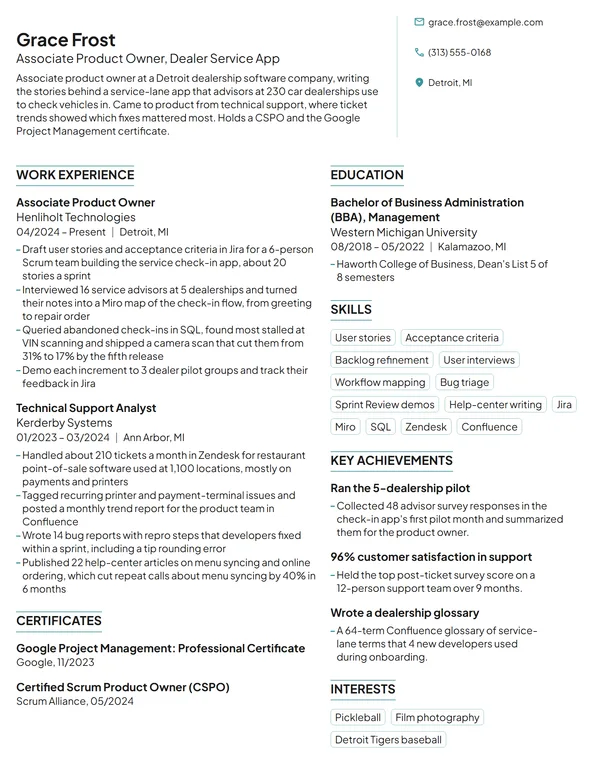
For an associate product owner role, lead with any work where you decided what got built or fixed first, whatever your title was. Give each item a number, just as you would for a product owner job.
- Business analyst work: requirements written, user stories drafted, releases where you stood in for the product owner.
- QA or support roles: defects triaged, ticket trends you turned into backlog items, and what changed after they shipped.
- Scrum master or project coordinator roles: sprints run, blockers cleared, and any backlog you helped order.
- A domain you know: years in claims, freight, clinics or retail, written as user knowledge the product needs.
Don't
Motivated professional seeking a product owner role to grow my agile skills.
Do
Customer support lead with 6 years on a scheduling platform, seeking an associate product owner role. Turned support trends into 2 feature requests the team shipped, and passed PSPO I in 2026.
Even a first-role objective should carry evidence: a domain, a shipped change or a credential.
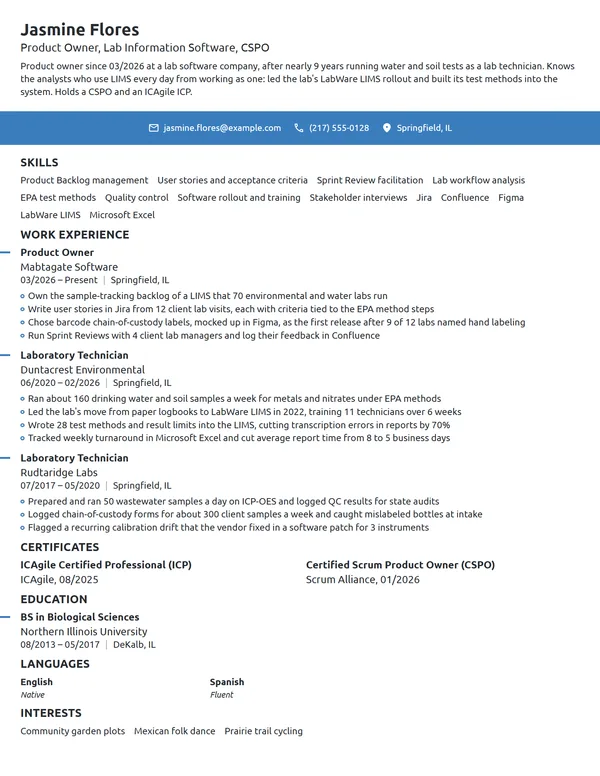
Changing careers from a field outside software, such as environmental work, operations or teaching, keep newest-first order and start with an objective that names the users you understand and the product role you want. A career-change resume works best when the first bullets under your current job are the ones closest to product work, such as a process you redesigned or a tool you rolled out. Why you are switching is a cover letter topic, and our cover letter guide shows how to frame it in a few sentences.
For a remote product owner role, show that you keep a team moving in writing: the backlog and decision records you maintain, how many time zones your developers sit in, and how you run refinement and Sprint Reviews on video. Name the async tools you use, such as Confluence or Slack, inside those bullets.
Product Owner resume FAQ
What is the difference between a product owner and a product manager resume?
A product owner resume centers on the backlog and the team: stories written, sprints planned, releases shipped and what users did next. A product manager resume leans on strategy, market research and the roadmap across teams. Many companies blend the 2, so match the posting's words and lead with whichever side it stresses.
Should I list CSPO or PSPO on my product owner resume?
Yes, if you hold either one. Put it under Certificates with the issuer, Scrum Alliance or Scrum.org, and the month and year, and add the acronym to your headline. If the posting asks for SAFe and you hold POPM, list it too, since recruiters often search for that exact term.
How long should a product owner resume be?
One page while you have under 10 years of experience. A second page is fine for a senior or principal product owner who has owned several products or worked across many teams, as long as page 1 shows your last 2 roles and their strongest numbers.
What metrics should a product owner put on a resume?
Use numbers your team already tracks: backlog size and age, sprint goals met, release cadence, stories reopened, and user outcomes such as activation, adoption or support tickets after a release. Give each one its base and time frame, such as 18 of 20 sprints or from 41% to 56% in 2 quarters.
Do product owners need technical skills on their resume?
Some, and more on technical products. Every product owner should show Jira or a similar backlog tool and the ability to write testable acceptance criteria. For API, data or platform products, add SQL, reading documentation or checking logs, each proven in a bullet. Leave coding languages off unless you use them in the role.
Can I become a product owner with no product experience?
Yes, usually through an associate role or an internal move. Show the closest work you have done, such as requirements, ticket triage or a process you redesigned, with numbers, and add a CSPO or PSPO I to show you know the accountability. Domain knowledge of the product's users counts too.
How do I show product owner work if my title was business analyst?
Keep your real title, and let the bullets show the product owner work: backlogs you ordered, stories you wrote and accepted, and releases where you stood in for the product owner. You can add the role in parentheses, such as Business Analyst (proxy product owner), only if your team used that term.
How do I write a remote product owner resume?
Show that you lead in writing and across distance. Name the decision records and backlog notes you keep, how many time zones your team covers, and how you run refinement and reviews on video. Add (Remote) to the title of each remote job so the reader sees your track record at a glance.
Should a product owner list Scrum events on a resume?
Only as part of a result. Attending Sprint Planning or a Sprint Review is expected of every product owner, so a bullet that lists them says nothing new. Write what came out of them instead, such as a Sprint Goal met, a scope call that saved a release or a review that changed the roadmap.
Next steps
Pick the example closest to your level and product, keep its structure, and swap in your own backlog, sprint and release numbers. Build it in our resume builder or start from one of the resume templates, and let your cover letter open on the product decision you are proudest of.