
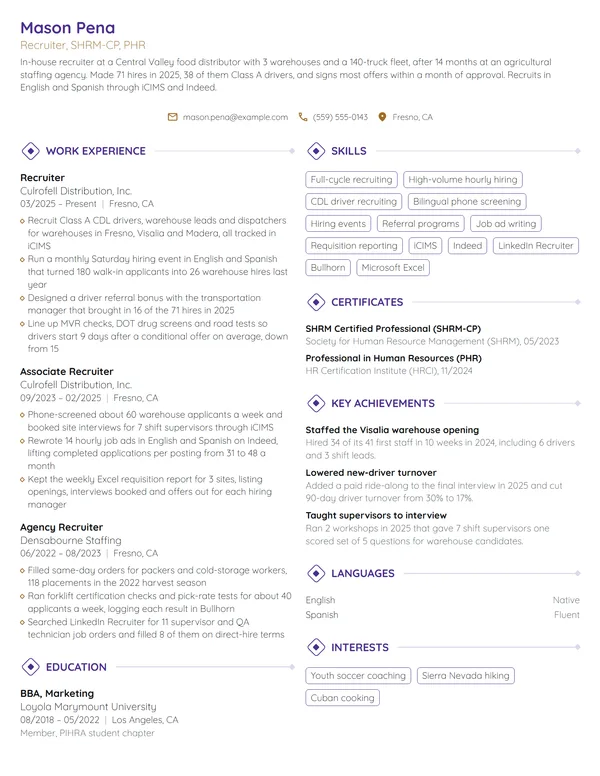
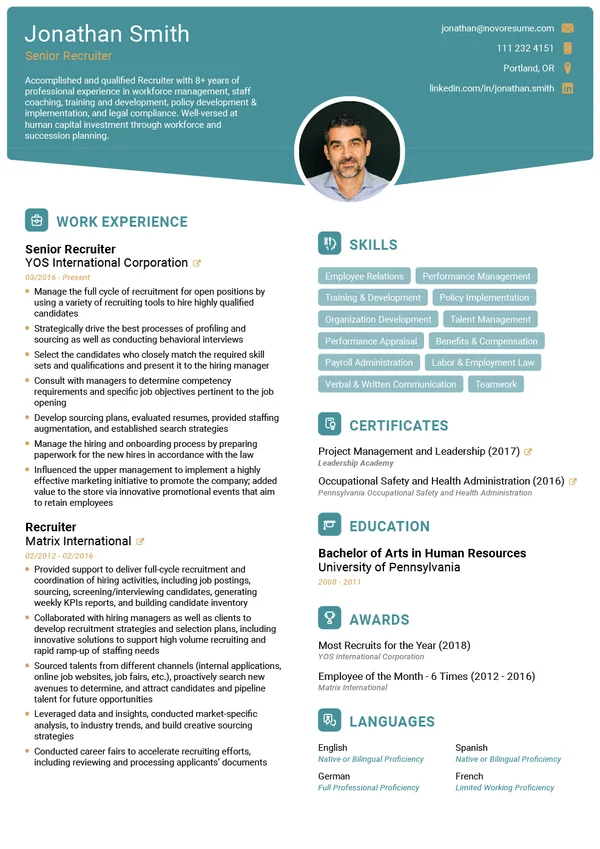
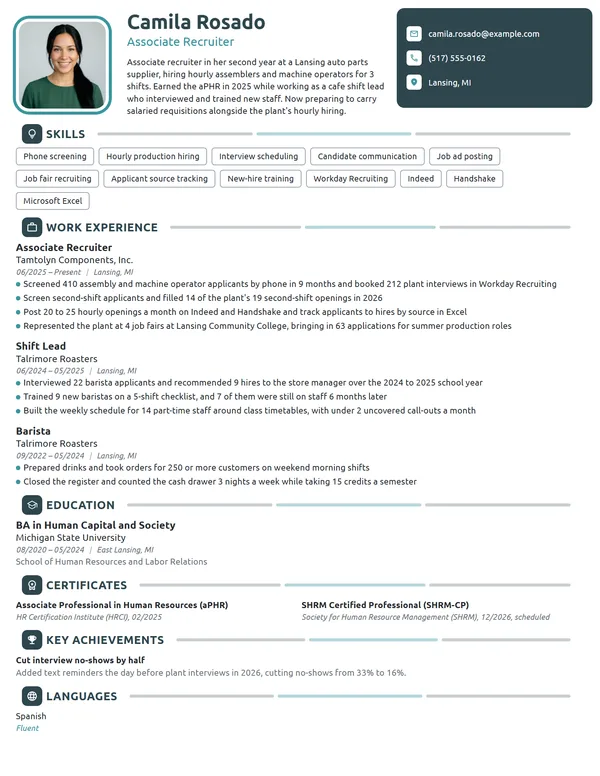
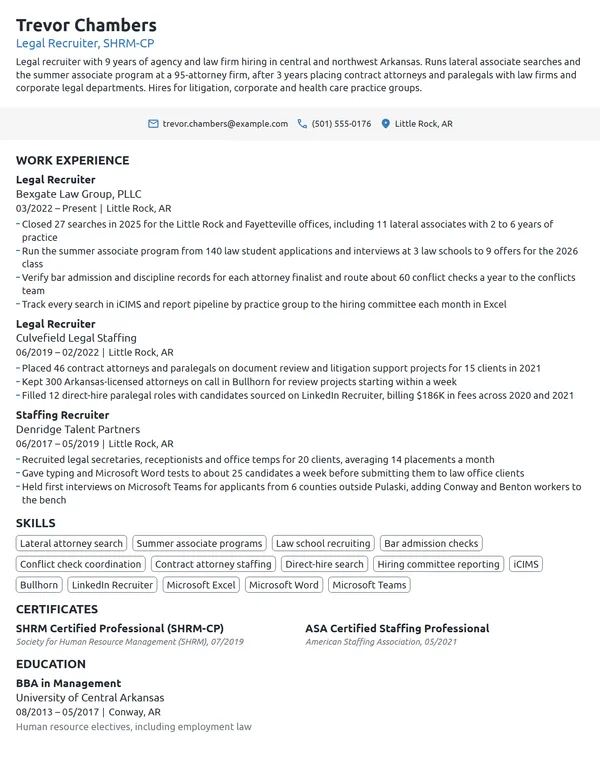
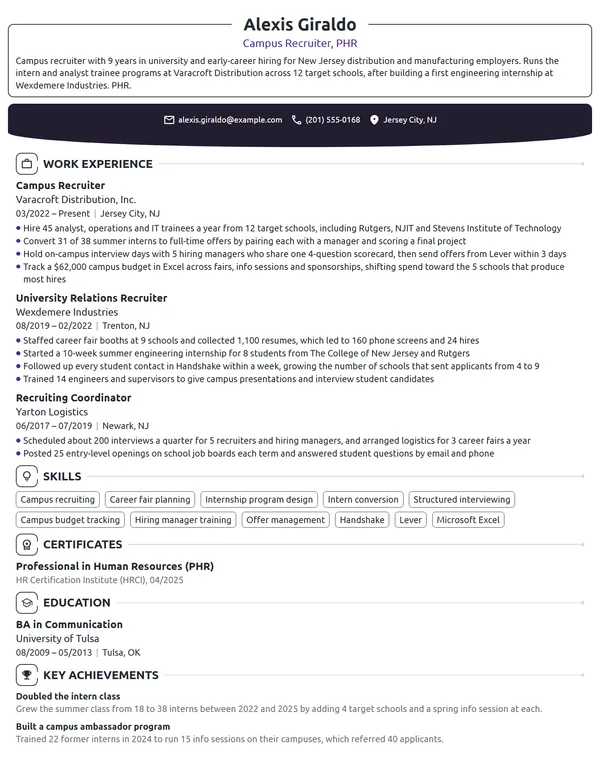
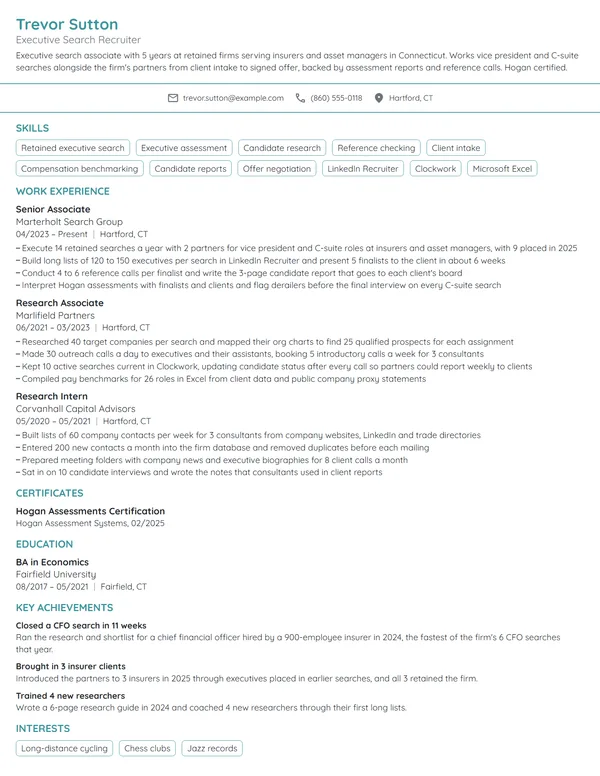
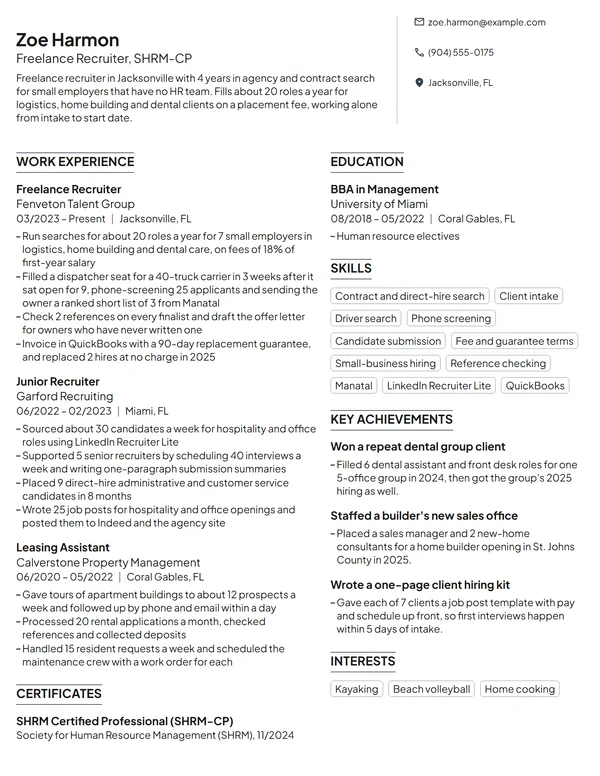
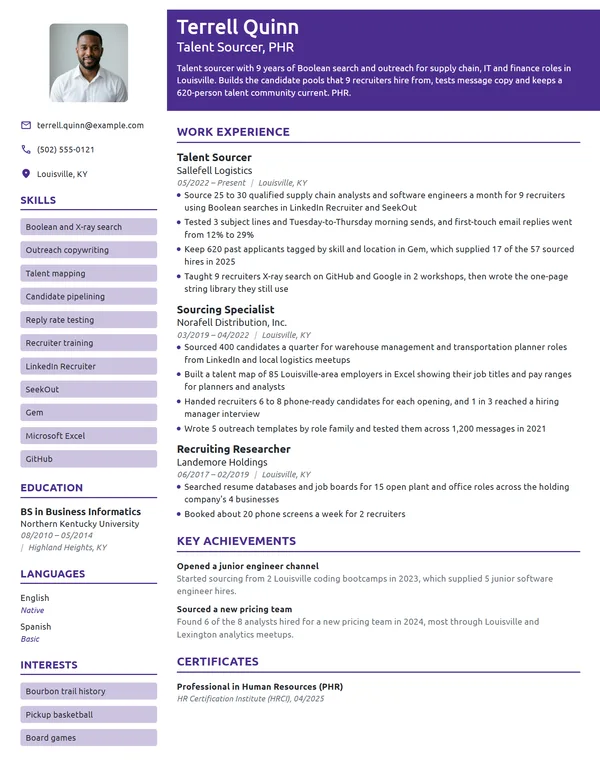
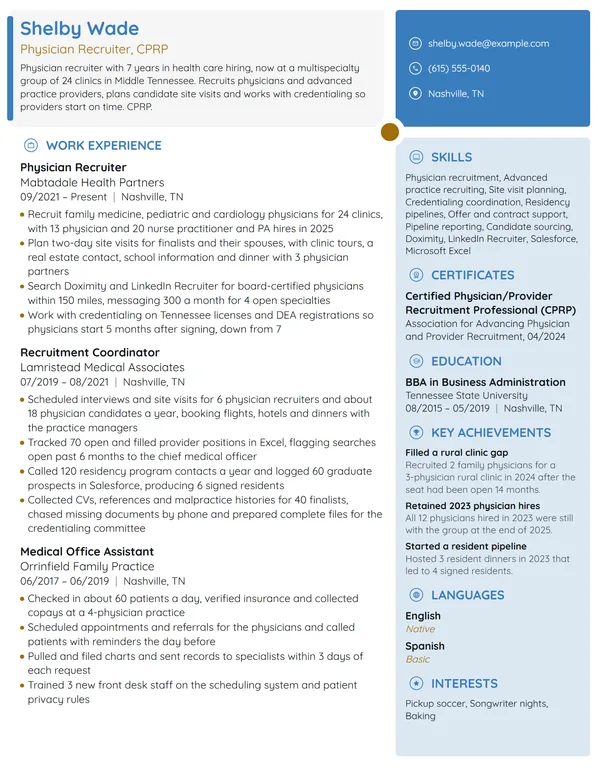
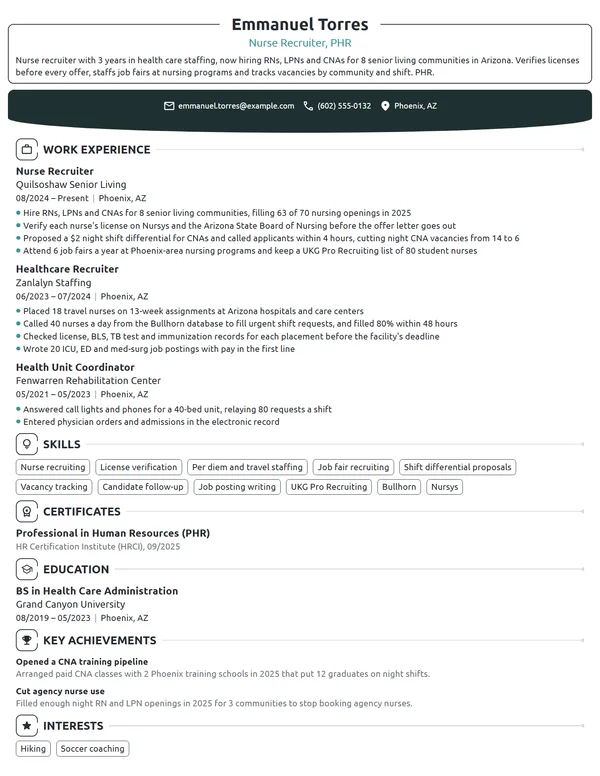
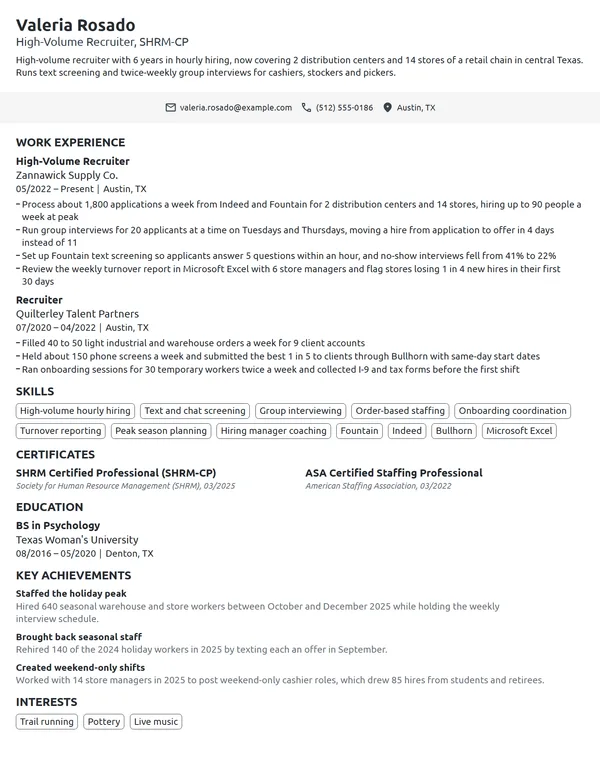
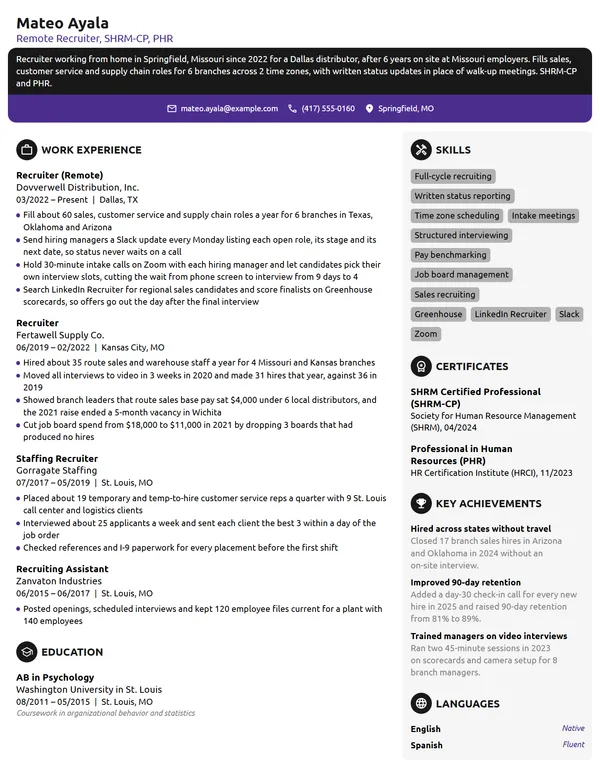
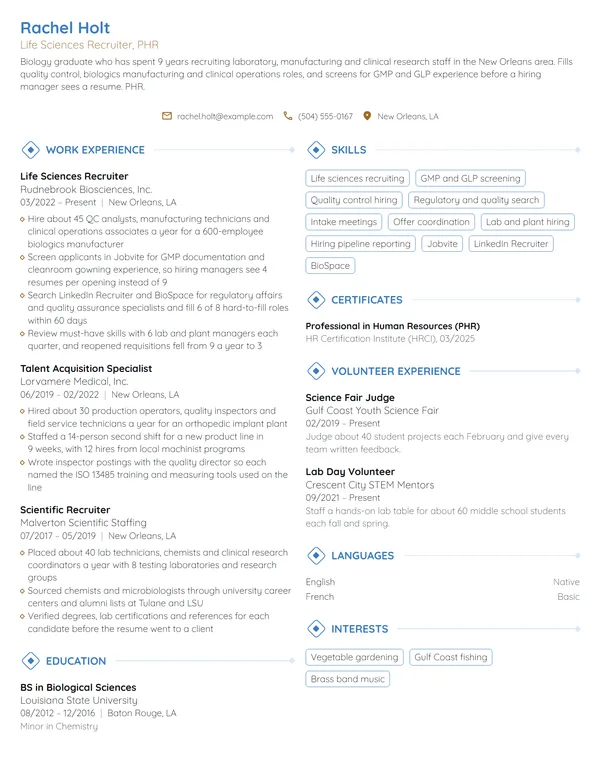
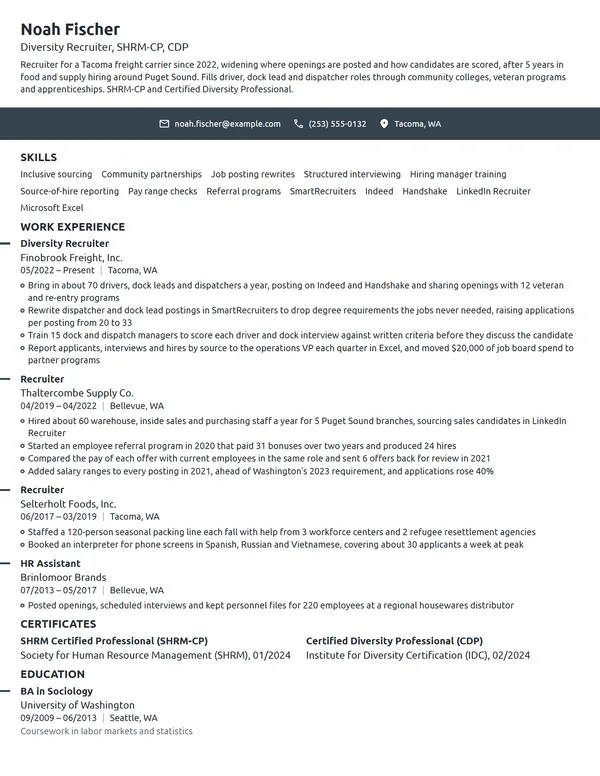
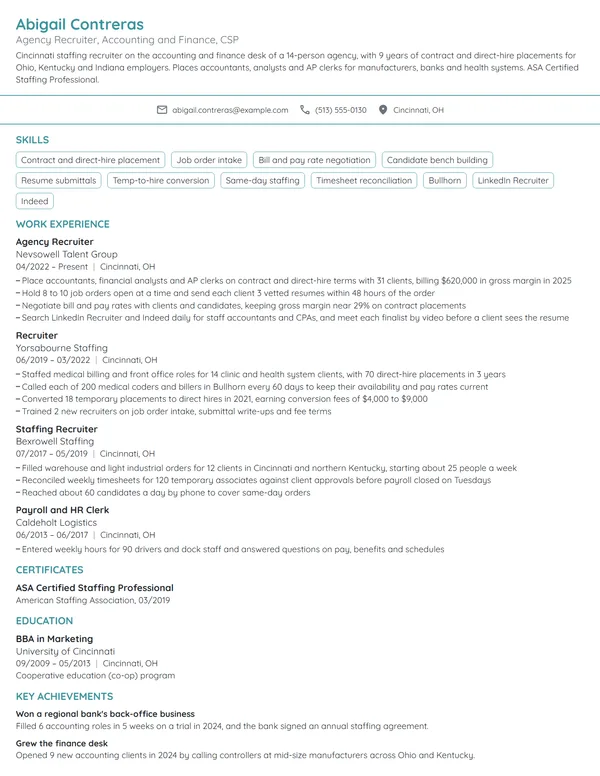
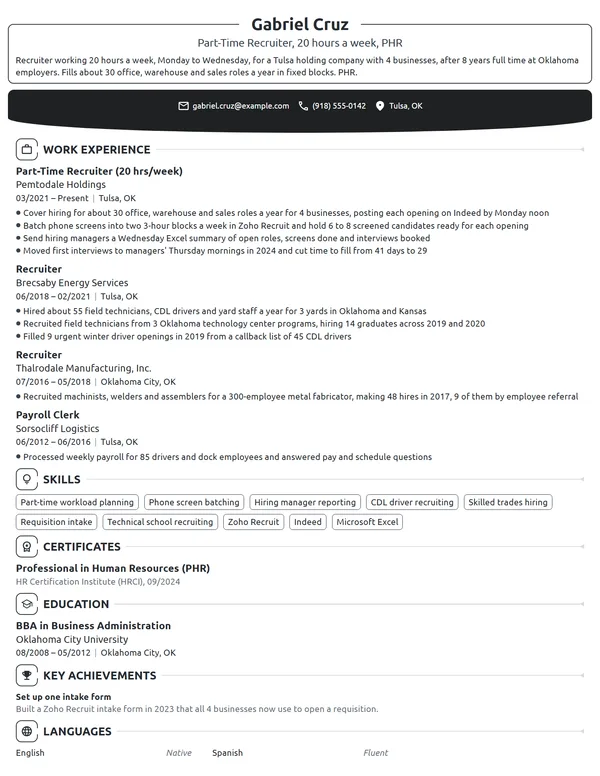
Recruiters judge other people's resumes all day, so yours goes to readers who know every shortcut and every padded line. Whoever hires you will check which roles you fill, how many hires you make in a year, how fast you close them and whether those hires stay. Most of that already sits in your ATS as time to fill, offer acceptance and requisition load. A recruiter resume built from those figures, with the tools you used, answers most of their questions before the first call.
How to Write a Recruiter Resume - Key Takeaways
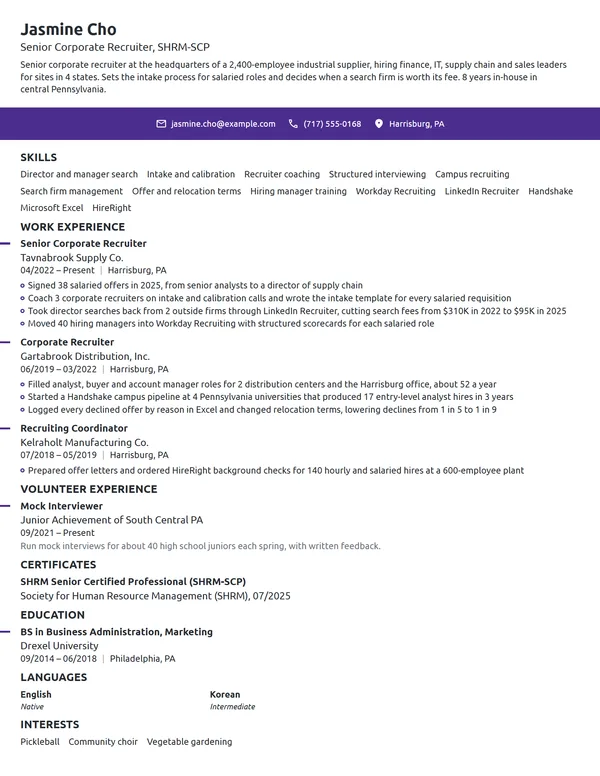
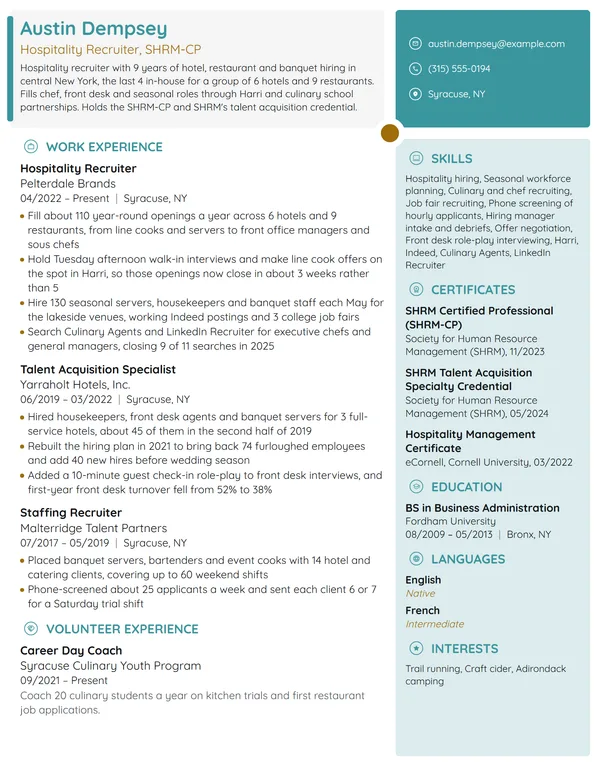
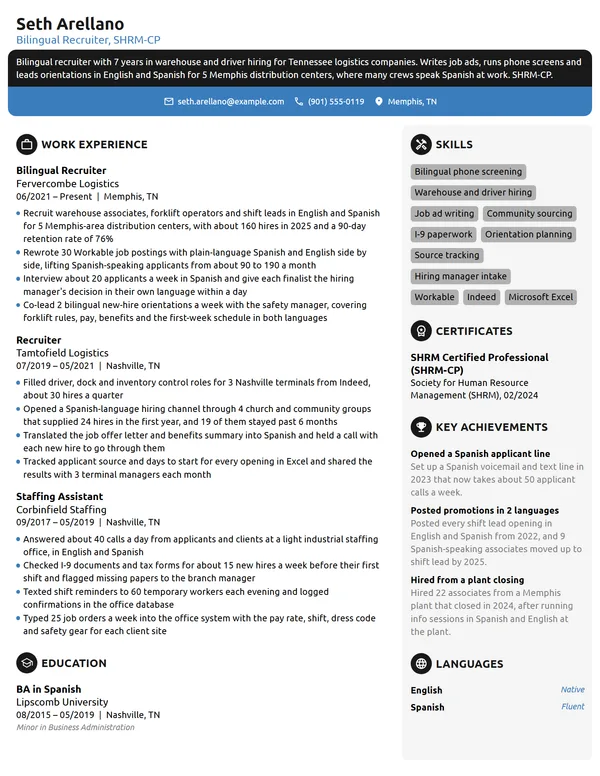
- Keep the history in reverse-chronological order on 1 page, moving to 2 only after about 10 years or once you lead a recruiting team.
- Open with a 2- to 3-line summary that names your years, agency or in-house, the roles you fill and 1 hiring result backed by a figure.
- Give every bullet a recruiting metric: hires, open requisitions, time to fill, offer acceptance, 90-day retention or placements.
- Name your ATS and sourcing tools exactly as the posting does, such as Workday, Greenhouse or LinkedIn Recruiter, and prove each one in a bullet.
- List SHRM, HRCI and staffing credentials under Certificates, each with its issuer and month, and mark a booked exam as scheduled.
- Add your LinkedIn URL to the contact line, then check the PDF in an ATS resume checker before you send it.
What talent acquisition leads look for in a recruiter resume
The person screening you is usually a talent acquisition manager, an HR director or the owner of a staffing agency, and they read for the kind of roles you fill, your volume, and the quality of the hires you make.
Each of those has a count behind it, and your reader knows the counts by heart. Lay the page out with these sections:
- Name, headline with your desk or credential (such as Technical Recruiter, SHRM-CP), phone, email, city and LinkedIn URL
- A 2- to 3-line opening summary, printed without a section label
- Work Experience, opening each job with the roles you recruited for
- Skills, with your ATS, CRM and sourcing tools inside
- Certificates
- Education
- Extras if they fit: Languages, Interests, plus Key Achievements or a Volunteer Experience section (pick 1)
Best format for a recruiter resume
Choose the reverse-chronological resume format, which puts your newest job first and gives each one a title, an employer with its city, and MM/YYYY start and end months. Recruiting careers move from coordinator to recruiter, then to senior recruiter, lead or talent acquisition manager, and a reader who builds those ladders for a living will look for yours. A combination layout, with skills above your history, only makes sense if you are moving into recruiting from sales, teaching or hospitality.
- Best for most recruitersReverse-chronologicalYour jobs, newest first, with your results under each one.Best for: A steady work history in your field
- FunctionalSkills grouped up top, with a short work history below.Best for: Gaps or very little experience
- CombinationA skills section first, then your full work history.Best for: A career change with strong skills
One page covers most recruiters with under 10 years in the field. A senior recruiter who has run full-cycle desks at both an agency and a corporate team, or led other recruiters, can use 2 pages, provided the current role and its numbers sit on page 1.
| Setting | What to use |
|---|---|
| Length | 1 page early on; 2 after about 10 years or once you lead recruiters |
| Headline | Title plus desk or credential: Technical Recruiter, SHRM-CP |
| Agency jobs | The agency as employer; client industries and role types in bullet 1 |
| Contact line | Phone, email, city and state, and a LinkedIn profile URL |
| Dates | MM/YYYY for each role, with Present for your current post |
| Headshot and personal data | No photo is the US and Canadian norm; leave off age, marital status and any ID numbers |
| File type | PDF, unless the application portal asks for a Word document |
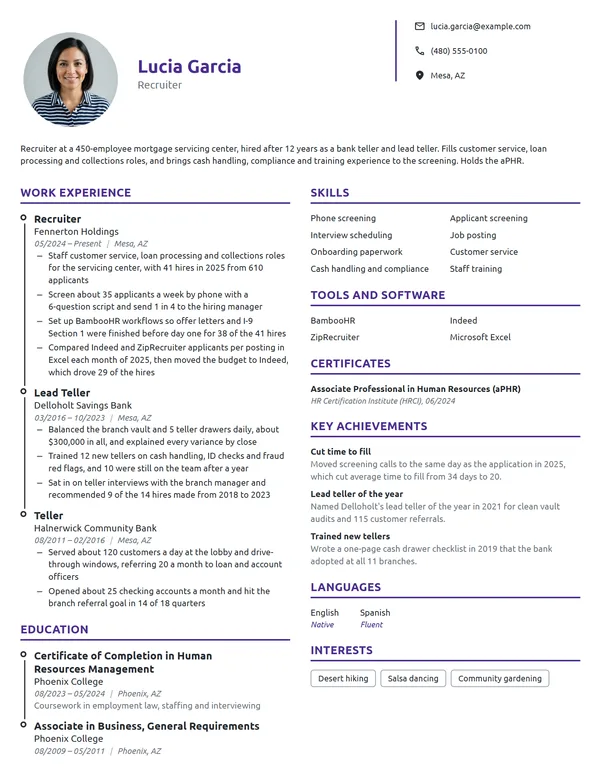
Most US and Canadian resumes carry no photo. Recruiters also know the EEOC's guidance that employers should not ask applicants for a photograph, so a headshot is optional at most, and a clean, parseable page matters far more.
Recruiter resume summary vs. objective
Ask yourself whether you have owned requisitions from intake to offer. If you have, write a resume summary with your years, agency or in-house, the roles you fill and 1 hiring figure. If you have not, write a resume objective: the recruiting role you want plus the closest proof you have, such as an internship, phone screens or a sales quota. Draft it after your bullets so the number comes from them.
Recruiter resume summary formula
Title with X years in agency or in-house recruiting for the roles you fill. Hires or placements in a year, plus 1 speed or quality result. Your ATS and sourcing tool; credential.
Example
Recruiter with 7 years in agency and in-house recruiting for insurance claims, underwriting and IT roles. Filled 58 roles in 2025 with a median of 33 days to fill. Works in Greenhouse and LinkedIn Recruiter; SHRM-CP.
Don't
People-person recruiter with a passion for connecting top talent with great opportunities.
Do
In-house recruiter with 4 years hiring for healthcare and logistics teams, carrying 14 open requisitions at a time with an average of 31 days to fill in iCIMS. aPHR, preparing for the PHR.
This version shows the setting, the load, the speed, the system and the credential.
How to write recruiter work experience bullets with numbers
Give your current job 3 to 4 bullets and each older one 1 to 3, each one led by a verb. Open the first bullet with the roles and teams you recruited for, then use the metrics your manager already reviews in the ATS. When you list work experience on a resume, write what changed because of you, since a recruiter can tell a copied job description from a result in one line.
| Area | What to count | Example bullet |
|---|---|---|
| Volume | Hires a quarter or year, open requisitions carried | Hired 22 people a quarter while carrying 12 to 15 open requisitions for operations and finance. |
| Speed | Time to fill, time to hire, days to first slate | Brought time to fill for warehouse supervisors from 61 to 44 days by holding weekly intake calls with 5 site managers. |
| Slate quality | Submittals per hire, slates that reach interviews | Averaged 3 submittals per hire, with 2 of every 3 first slates going on to manager interviews. |
| Offers and retention | Offer acceptance, 90-day or first-year retention | Held offer acceptance at 84% for the year, with 93% of hires still on staff after 90 days. |
| Sourcing | Outreach response rates, referral share, channel mix | Raised InMail response from 19% to 31% and referral hires from 14% to 27% of the total. |
| Agency desk | Placements, gross margin or spread, client accounts | Made 64 placements in 2025 and billed $410K in gross margin across contract and direct-hire roles. |
Here is how one recruiter's history reads with those metrics in place. The in-house job leads with load and hires, and the agency job before it names its clients by industry, not by company.
Work Experience
- Recruit for claims, underwriting and IT teams at a 1,300-employee insurer, carrying 16 to 20 open requisitions and closing 58 hires in 2025.
- Cut time to fill for claims adjusters from 47 to 33 days by building a 210-candidate pool of past finalists in Greenhouse.
- Lifted offer acceptance from 78% to 91% by making verbal offers within 24 hours of the final interview.
- Filled about 35 light-industrial and office roles a quarter for 12 client accounts in manufacturing and distribution.
- Kept 86% of placements on assignment past 90 days through check-in calls in weeks 1, 4 and 8.
Don't
Sourced candidates using LinkedIn and job boards.
Do
Sourced 90 Python engineers through LinkedIn Recruiter and GitHub searches, producing 11 hires for the data platform team in 8 weeks.
The second version names the talent pool, the tools, the hires and the time frame.
Don't
Extended offers and negotiated with candidates.
Do
Won back 6 of 9 declined offers in 2025 by returning to each candidate within 2 business days with revised compensation data.
Agency or in-house: how to label the job
Some organizations hand recruiting and placement work to outside firms, the BLS says, and readers on both sides want to know which one you worked for. At an agency, list the agency as your employer and name your clients by industry and size, never by company, since a client may not want its hiring plans made public. In-house, name the business units you hired for and the headcount you supported.
Recruiter skills, ATS and sourcing tools for your resume
Choose 6 to 8 hard skills for your resume that your bullets already back up, beginning with those the posting names twice. Full-cycle recruiting, sourcing and interviewing belong on nearly every recruiter resume; campus programs, executive search, contract staffing or high-volume hiring only where you have done them.
Hard skills for recruiters
- Full-cycle recruiting
- Boolean and X-ray sourcing
- Intake meetings with hiring managers
- Phone and video screening
- Structured and behavioral interviewing
- Offer negotiation
- Job ad writing
- Pipeline and requisition reporting
- Campus and job fair recruiting
- EEO and fair hiring compliance
Soft skills hiring teams value in recruiters
- Persuasion
- Active listening
- Follow-through
- Discretion with candidate data
- Handling rejection
- Managing several hiring managers at once
List your systems inside Skills, then show each one in a bullet. In O*NET's data for human resources specialists, the group the BLS counts recruiters in, applicant tracking software is an in-demand technology, Workday is both in-demand and hot, and Excel and Outlook are in demand. O*NET also lists Oracle Taleo, TempWorks recruiting and staffing software and vendor management systems, with Salesforce as a hot CRM. If the posting names Greenhouse, iCIMS, Bullhorn or LinkedIn Recruiter and you have used it, write that exact name.
Fair hiring is a skill readers check too. The EEOC says it is illegal to publish a job ad that shows a preference for or discourages someone because of a protected trait such as age, and gives "recent college graduates" as an example. If you rewrote job ads or interview guides to remove wording like that, it earns a bullet.
SHRM, HRCI and staffing certifications on a recruiter resume
The BLS says certification is usually voluntary for this work, though some employers prefer or require it. List certifications on your resume under Certificates with the full name, the issuer and the month earned, and add your strongest one to the headline. Corporate postings usually name SHRM or HRCI credentials, while a staffing firm may also value the American Staffing Association's credential, which centers on employment law.
| Credential | Issued by | What it takes |
|---|---|---|
| aPHR (Associate Professional in Human Resources) | HR Certification Institute (HRCI) | An exam with no HR experience required, aimed at people starting out in HR. Valid for 3 years. |
| SHRM-CP (SHRM Certified Professional) | SHRM | An exam you can sit without an HR title, a degree or earlier HR experience. |
| PHR (Professional in Human Resources) | HR Certification Institute (HRCI) | 4 years in a professional-level HR role, or 2 years plus a bachelor's degree, or 1 year plus a master's. Valid for 3 years. |
| SHRM-SCP (SHRM Senior Certified Professional) | SHRM | At least 3 years of strategic-level HR work, counting 1,000 hours or more per calendar year. |
| ASA Certified Staffing Professional | American Staffing Association | A 2-hour online exam of 100 true-or-false and multiple-choice questions on federal employment and labor law. |
Write a booked exam under Certificates with the word scheduled and the month, and keep its letters out of your headline until you pass. Holding both a staffing and an HR credential is worth listing in full, because agency and corporate postings ask for different ones.
Certificates
- ASA Certified Staffing Professional, American Staffing Association, 10/2020
- SHRM Certified Professional (SHRM-CP), SHRM, 06/2024
- Professional in Human Resources (PHR), HR Certification Institute (HRCI), scheduled 03/2027
How to list a degree on a recruiter resume
The BLS says HR specialists, the group that includes recruiters, typically need a bachelor's degree to enter the field. Business, human resources, psychology and communications degrees are the usual fits, and any degree works when your bullets show the hiring. Follow the standard rules for listing education on a resume: the degree name first, then the school and its city, then the month you finished.
Name a concentration or minor when it is in HR or business, since that is the line an in-house reader scans for. A GPA belongs only on a resume from the first 2 years after graduation, and only at 3.5 or above.
Education
Entry-level and career-change recruiter resumes
Plenty of recruiters start right after college or move over from sales, so readers are used to weighing proof from outside the field. With no recruiting job yet, use an entry-level resume layout with Education placed above Work Experience, and count everything the same way a recruiter would:
- HR or campus recruiting internships: phone screens held, career fairs staffed, interviews scheduled.
- Sales, call center or customer service jobs: calls a day, quota reached, accounts kept.
- Student organization recruitment: new members signed, events run, retention through the year.
- Hiring you did as a shift lead or manager: people interviewed and hired, and how long they stayed.
- The aPHR or SHRM-CP: under Certificates, since neither requires HR experience.
Don't
Outgoing recent graduate looking to start a career in recruiting.
Do
Psychology graduate with a summer campus recruiting internship, seeking a recruiting coordinator or junior recruiter role. Staffed 6 career fairs, ran 40 phone screens and earned the aPHR in 08/2026.
Even a first recruiting objective carries proof: an internship, a count and a credential.
Coming from sales, teaching or restaurant management, keep the reverse-chronological order and move the people work to the top of each job: interviews run, staff hired, quotas met through outreach. A career-change resume works best when the objective states the recruiting role you want and your top bullet shows a hiring or pipeline number. Add a LinkedIn profile that matches your resume, since hiring teams check it, and save the reason for the switch for your cover letter, as the human resources cover letter examples show in 2 or 3 sentences.
Recruiter resume FAQ
Should an agency recruiter put placement or revenue numbers on a resume?
Yes. Placements, fill rate and gross margin or spread are how an agency owner measures a desk, so give each a year and a base, such as 64 placements in 2025. Leave out bill rates or a client's own figures.
How do I list agency clients on a recruiter resume?
By industry and size, not by name. Write the agency as your employer, then use your first bullet for the client types and roles, such as 12 manufacturing and distribution accounts hiring light-industrial and office staff. A client may not want its hiring plans made public.
Which ATS should I list on a recruiter resume?
The ones you have run requisitions in, written exactly as the job ad writes them, such as Workday, iCIMS, Greenhouse or Bullhorn. Add your sourcing tools, like LinkedIn Recruiter, and back each system with a bullet about what you did in it.
Do recruiters need a certification?
No, but it helps. The BLS says certification is usually voluntary and that some employers prefer or require it. The aPHR and SHRM-CP need no HR experience, which makes them a practical first credential, and staffing firms may ask for the American Staffing Association's credential.
How long should a recruiter resume be?
Use 1 page if you are like most recruiters. Move to 2 pages after about 10 years, or once you have led recruiters or run several desks, and keep your current job with its hires and time to fill on page 1.
Can I become a recruiter with no HR experience?
Yes. Many recruiters start in sales, customer service or campus jobs. Show outreach volume, quotas, interviews you ran and people you hired, open with an objective stating the recruiting role you want, and add the aPHR or SHRM-CP, since neither asks for HR experience.
Should a recruiter resume include a LinkedIn URL?
Yes. Your profile works as a sample of your recruiting: the people hiring you will look at it, at your network and at how you write. Put the URL in the contact line and make sure your titles and dates there match your resume.
How much do recruiters make?
The BLS counts recruiters among human resources specialists, whose median annual wage was $75,940 in May 2025. Keep pay out of the resume and raise it once an interview is under way.
Next steps
Pick the example nearest your desk and level, copy its structure, and replace the figures with your own hires, requisition load, time to fill and offer numbers from your ATS. Build it in our resume builder, or take one of the resume templates as your base, and open your cover letter with the hiring result you are proudest of.