
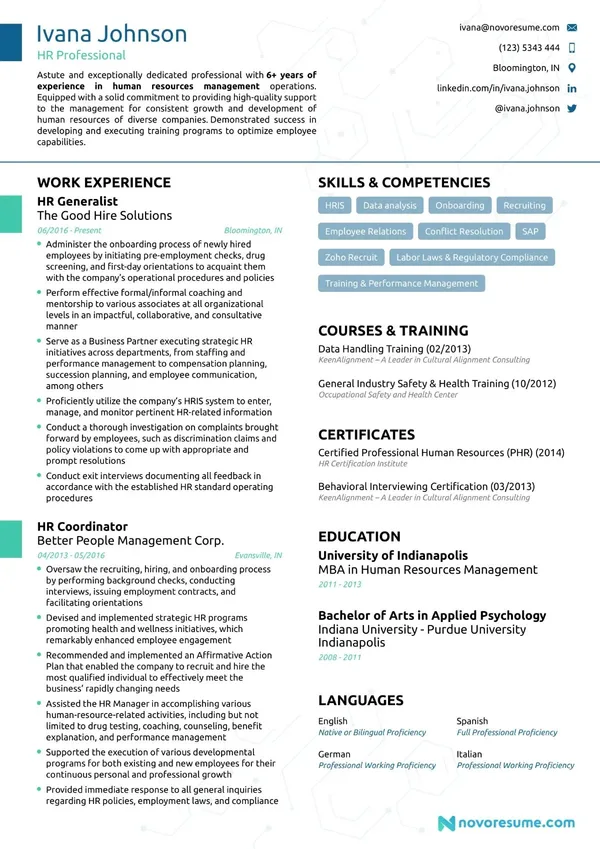
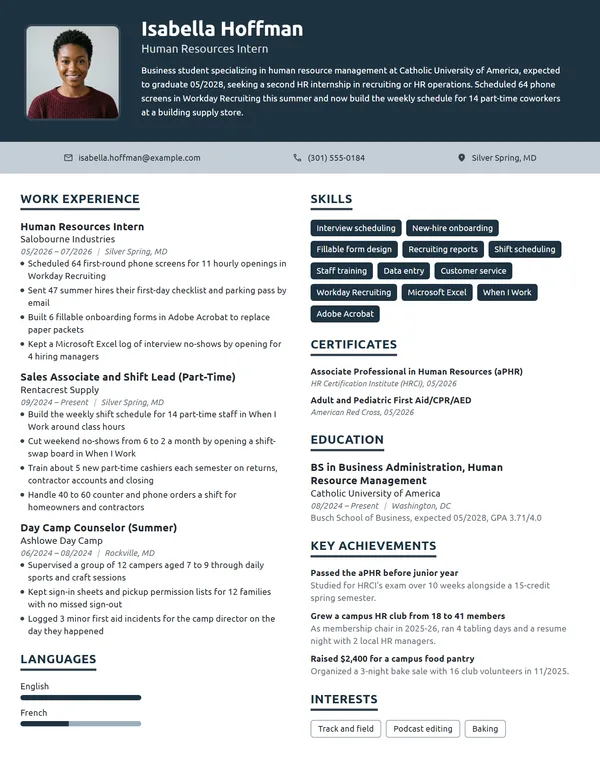
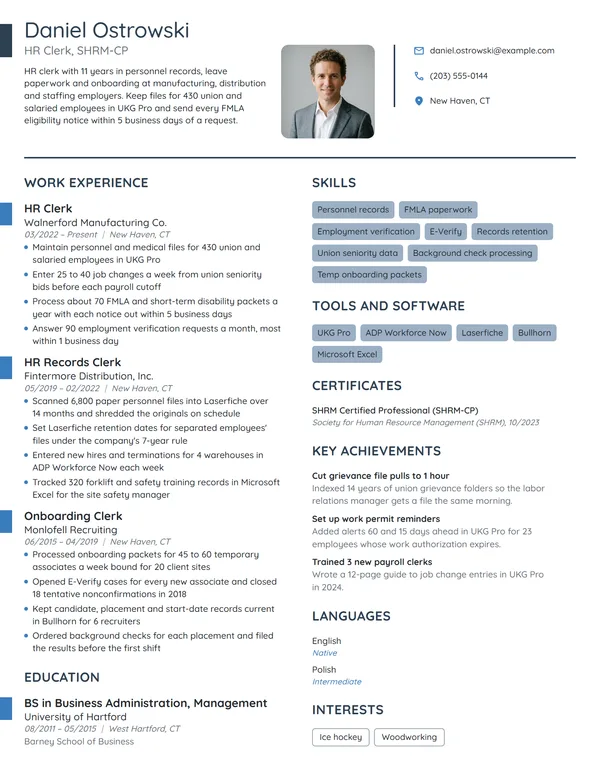
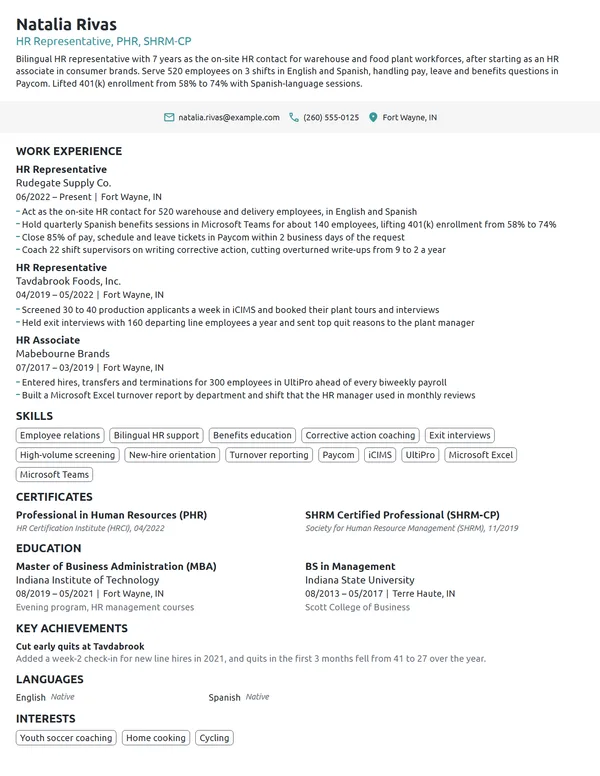
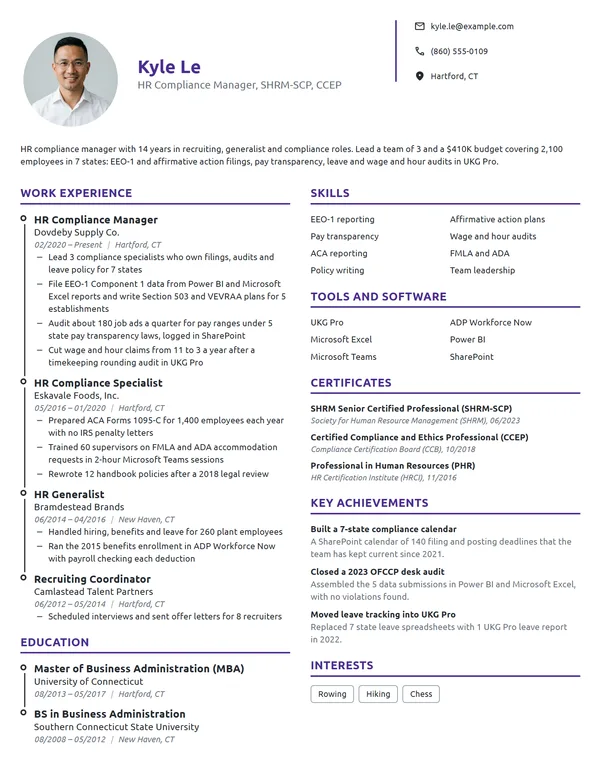
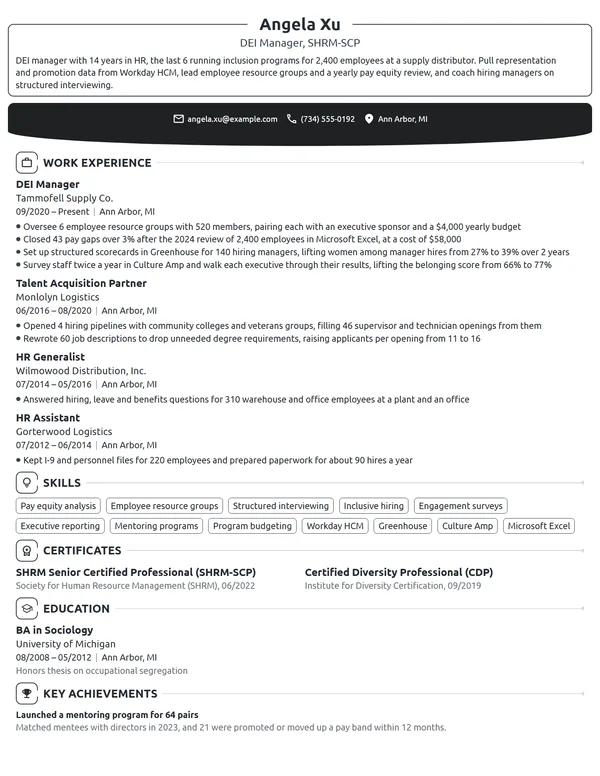
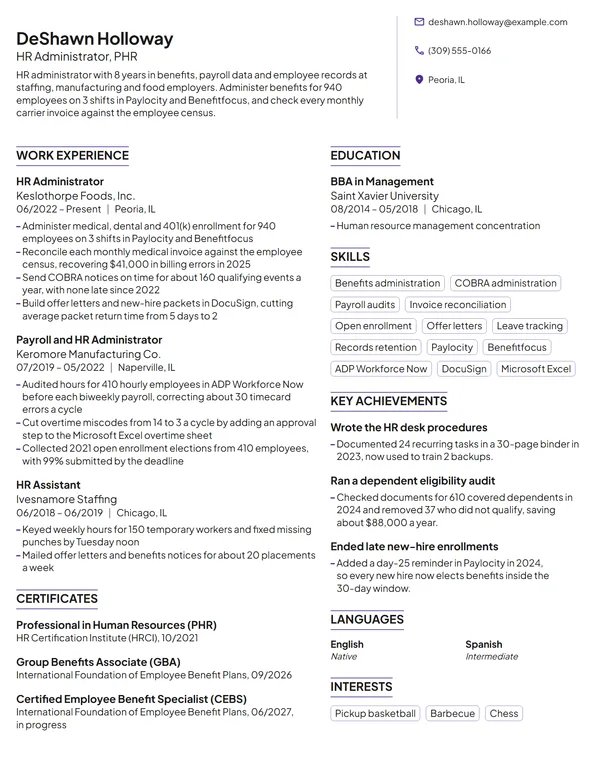
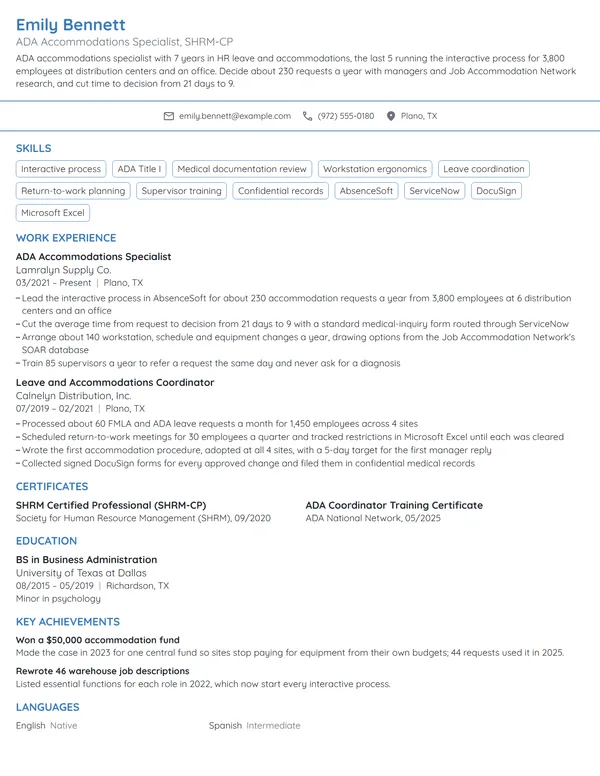
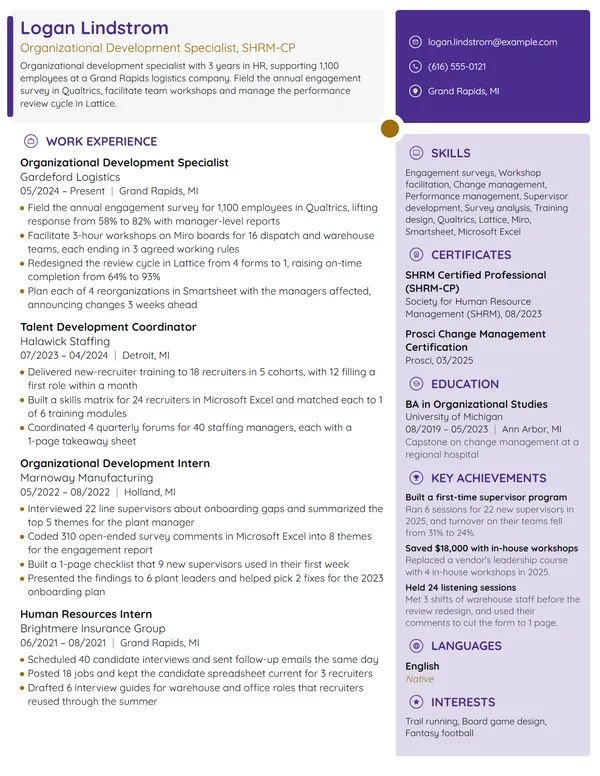
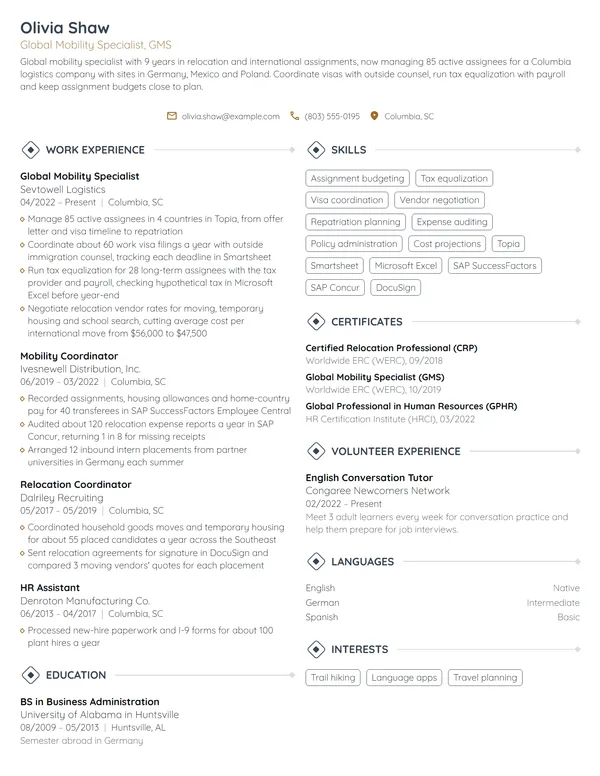
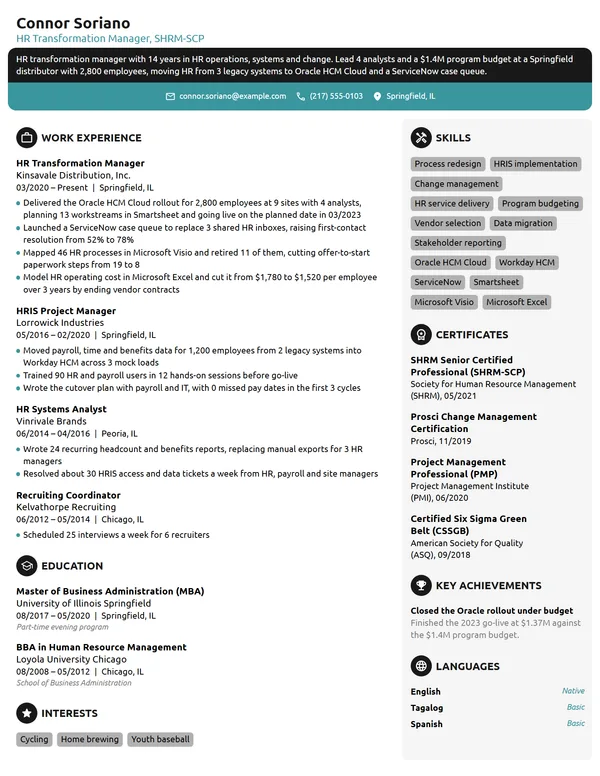
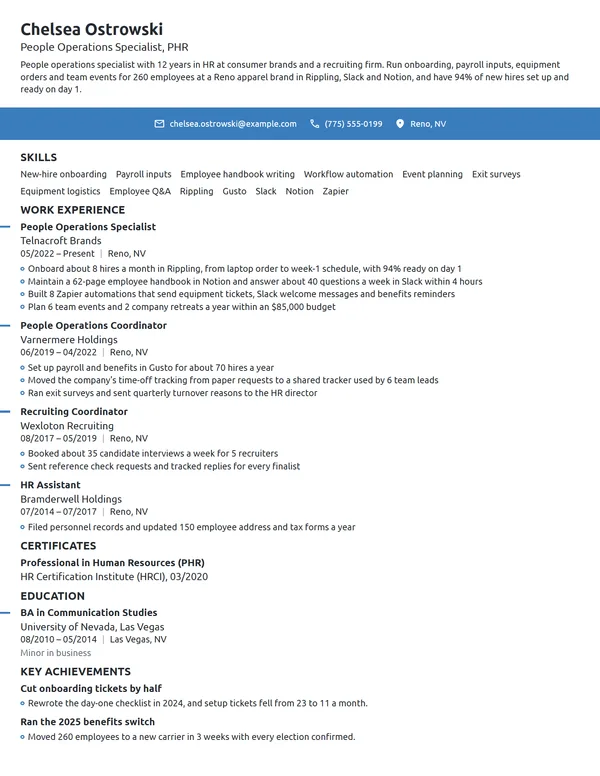
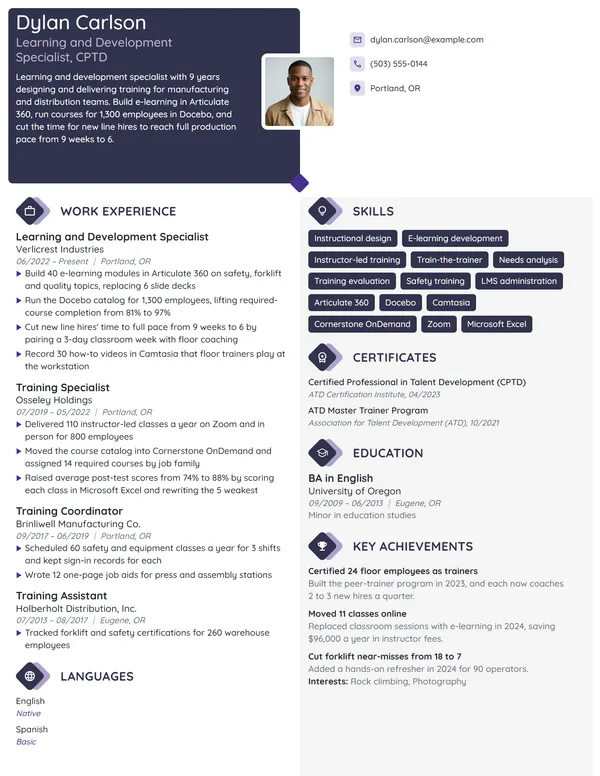
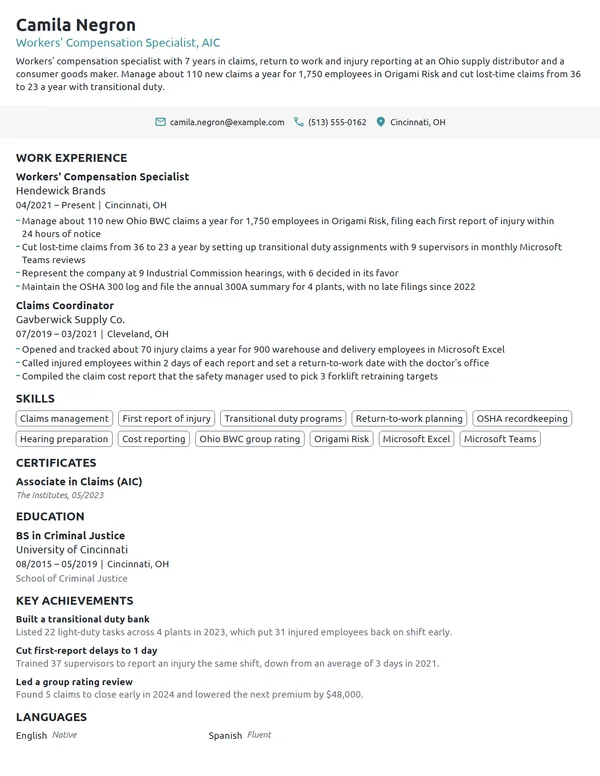
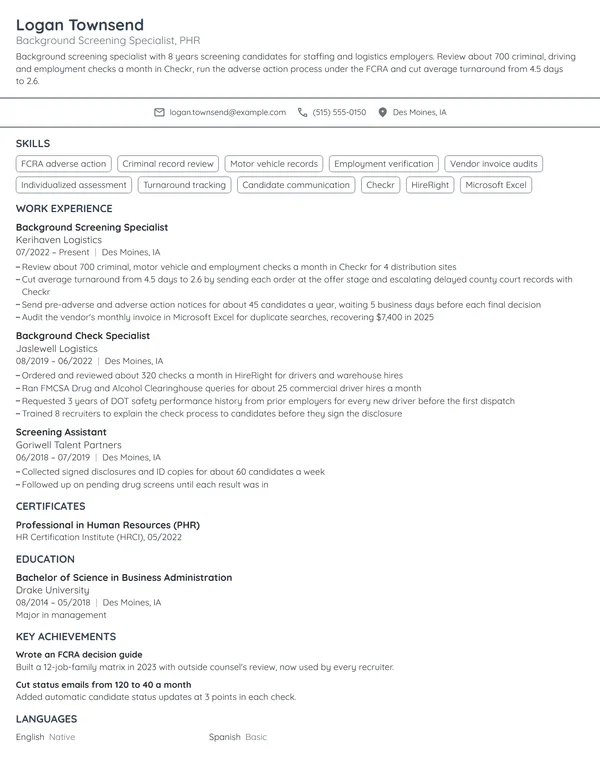
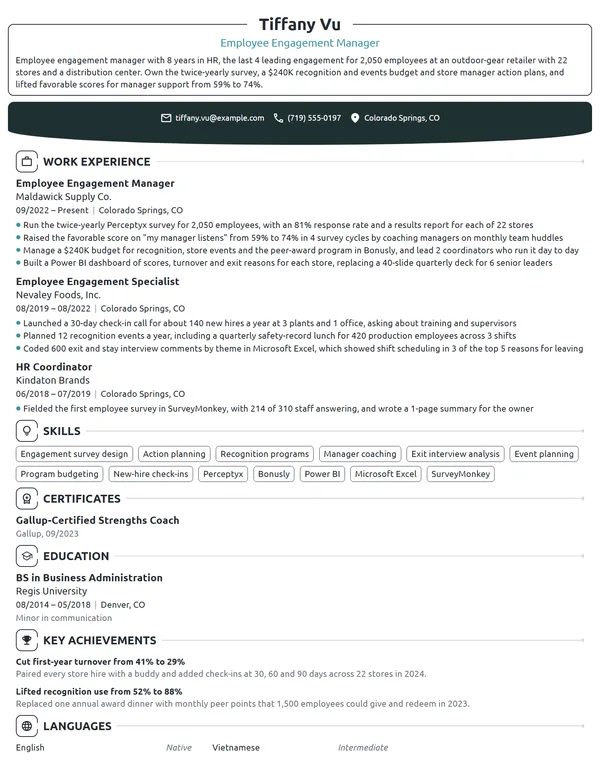
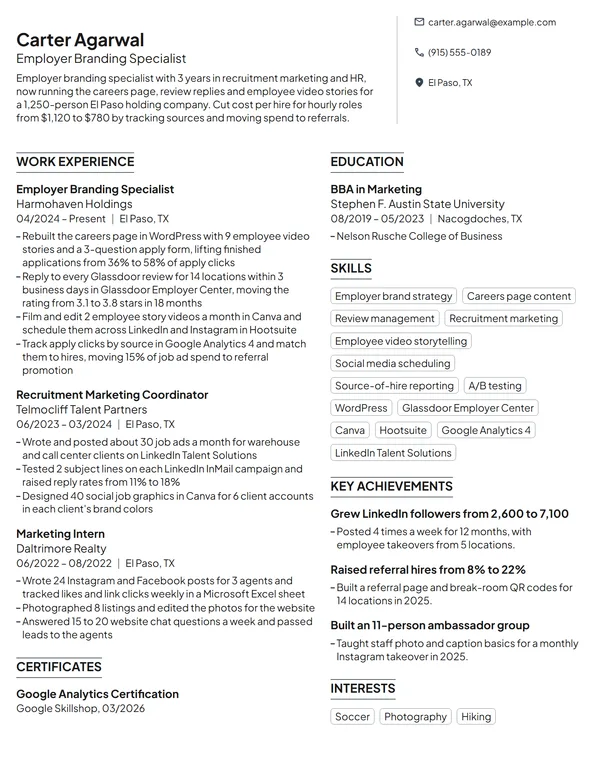
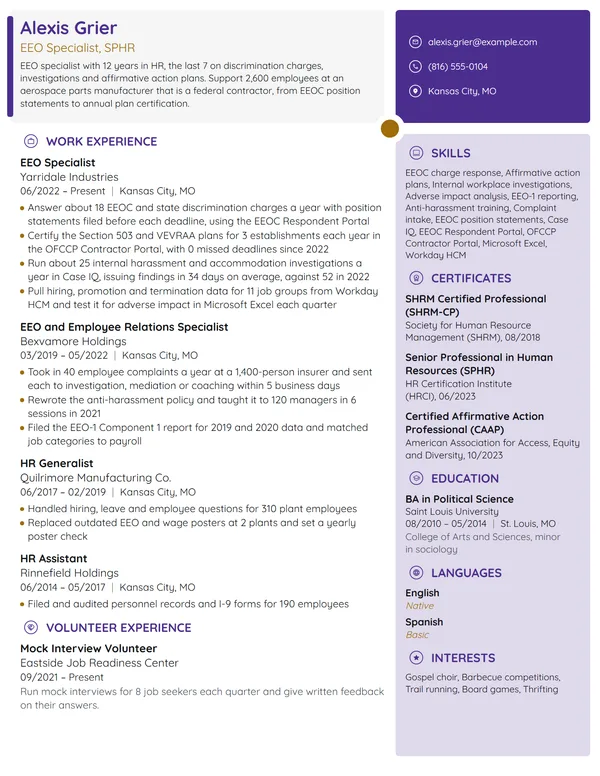
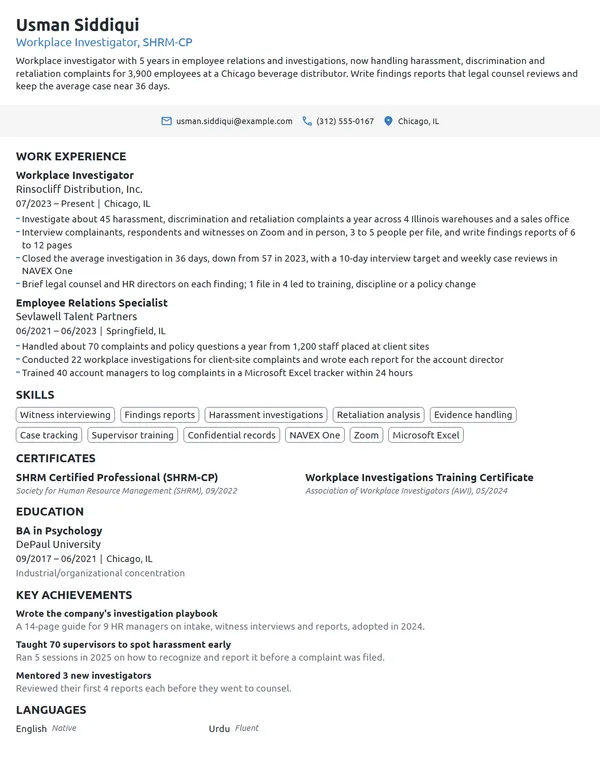
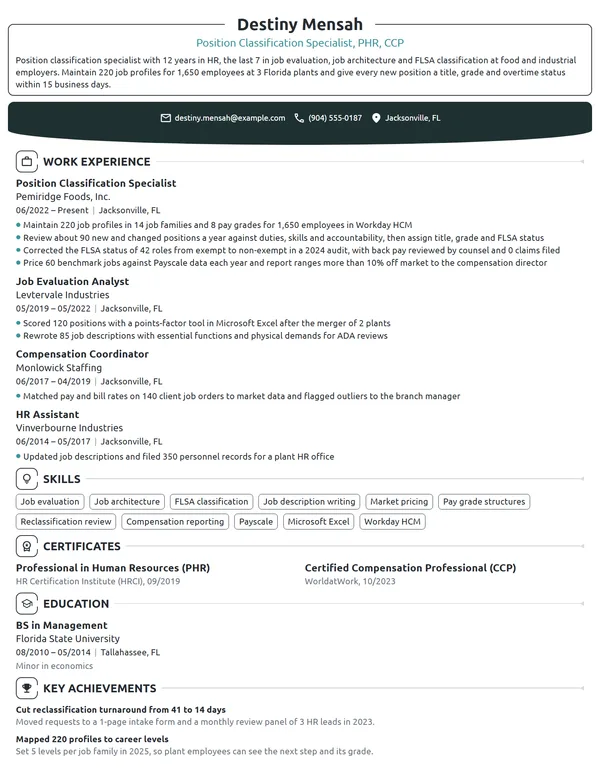
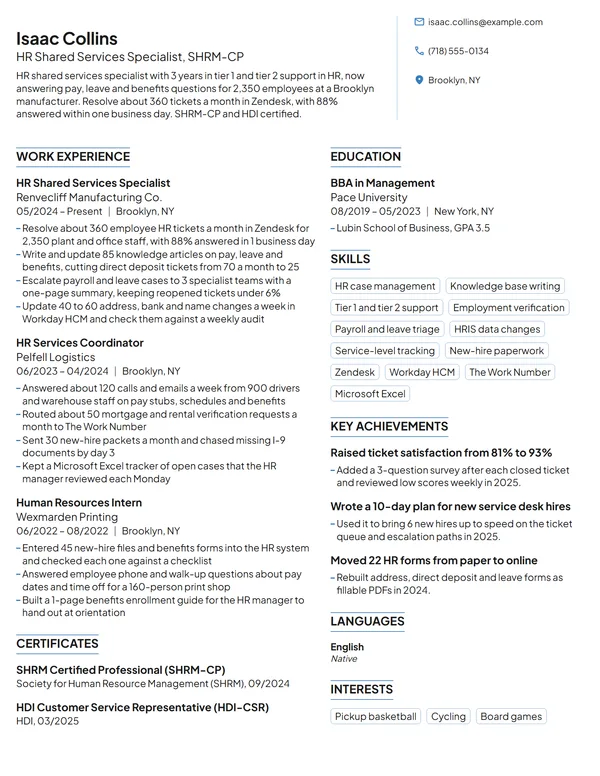
People trust HR with their pay, their benefits and their private information, so an HR resume has to show you deserve that trust. A strong one shows what you handled yourself: hiring, onboarding, benefits, employee relations and the HR systems that keep records accurate. Much of HR is confidential or hard to measure, and the easy fallback is a list of duties that says nothing about how well you did them. Both problems have practical fixes.
How to Write an HR Resume - Key Takeaways
- Use the reverse-chronological format on 1 page, moving to 2 once you have 10+ years or have led an HR team.
- State the headcount you supported in your current HR job, since every other number reads against it.
- Count your work in time to fill, hires onboarded, cases closed, enrollment completion or files audited, never in duties.
- Describe employee relations as counts and outcomes, with no names, departments or case details.
- List SHRM-CP, SHRM-SCP, aPHR, PHR or SPHR under Certificates with the issuer and the month you earned it.
- Name your HR systems exactly, such as Workday Recruiting or ADP Workforce Now, then test the file with an ATS resume checker.
What HR hiring managers look for in an HR resume
An HR manager reads your resume to learn 3 things: how large a workforce you supported, which parts of HR you handled on your own, and whether you can be trusted with records nobody else sees. O*NET lists interpreting HR policies and employment laws, hiring and processing new-hire paperwork, keeping employment records in HR software and handling employee relations issues such as complaints and harassment allegations as core tasks. The BLS adds that generalists cover every area while specialists focus on one, such as training or retirement plans.
So say which kind you are. A generalist shows range across recruiting, onboarding, benefits and policy; a specialist shows depth in one, with bigger numbers inside it. Build the page from these sections:
- Name, headline (such as HR Generalist, SHRM-CP) and contact details
- A 2- to 3-line summary under your name, printed without a label
- Work Experience, starting with your current role and its headcount
- Skills, with your HRIS and applicant tracking systems
- Certificates, for SHRM and HRCI credentials
- Education
- Optional: Languages, Interests, and one of Volunteer Experience or Key Achievements
Best format for an HR resume
Pick the reverse-chronological resume format: your current role on top, then each earlier one with its title, employer and city, dated in MM/YYYY form. HR careers usually climb from assistant or coordinator to generalist, then to manager or business partner, and this order makes that climb easy to follow. If you moved between generalist and specialist roles, the dates also show how long you spent in each.
- Best for most HR professionalsReverse-chronologicalYour jobs, newest first, with your results under each one.Best for: A steady work history in your field
- FunctionalSkills grouped up top, with a short work history below.Best for: Gaps or very little experience
- CombinationA skills section first, then your full work history.Best for: A career change with strong skills
Fit early-career HR resumes on 1 page. Move to 2 pages after 10+ years, or once you have managed HR staff or run HR for several sites, and keep your current job and your credentials on page 1. At the level of an HR manager, readers want scope first and detail second.
| Setting | What to use |
|---|---|
| Length | 1 page early on; 2 after 10+ years or once you lead HR staff |
| Headline | Your title plus your top credential: HR Generalist, SHRM-CP |
| Employer size | Headcount and sites in your current job's first bullet |
| Dates | MM/YYYY for every role; Present for your current post |
| Typeface | 1 clean font, 10.5 to 12 pt in the body, bold only for job titles |
| Photo, age and ID numbers | Most US and Canadian employers expect none; leave off age, marital status and Social Security number |
Most US and Canadian resumes carry no photo. An HR reader also knows that age, race and family status have no place in a hiring decision, so leave out anything that shows them.
HR resume summary vs. objective
Use one test: have you held a job with HR in the title or as most of your duties? If yes, write a resume summary with your years, the size and type of employer, your systems and 1 result. If no, write a resume objective: the HR role you want, your coursework or credential, and the closest thing to HR work you have done. Either way, draft it after your bullets and borrow its number from them.
HR resume summary formula
HR title with X years at type of employer, supporting up to headcount employees in HR system. Your strongest hiring, retention, benefits or compliance result, with a number. Credential, or the one you are working toward.
Example
HR generalist with 7 years at warehouse and healthcare employers, supporting up to 640 employees in Workday. Cut time to fill for hourly roles from 38 to 24 days. SHRM-CP, sitting for the PHR in 02/2027.
Don't
People-focused HR professional with a passion for fostering a positive workplace culture and supporting employees.
Do
HR coordinator with 4 years in a 1,900-employee hospital system, scheduling about 120 physician recruits a year through Oracle Taleo. aPHR-certified and studying for the PHR.
The second version names the employer's size, the volume and the next credential.
How to write HR work experience bullets with numbers
Write 3 to 4 bullets for your present HR role and 1 to 3 for each older one, each opening on an action verb. In your current job, open the first bullet with the headcount and the number of sites you supported, then pick results HR already tracks: time to fill, new hires onboarded, cases closed, enrollment completion or audit findings. Write achievements on your resume rather than the tasks from your job description: an HR reader has written dozens of those and skims straight past them.
| Area | What to count | Example bullet |
|---|---|---|
| Recruiting | Open requisitions, time to fill, offer acceptance | Carried 14 open requisitions at a time and raised offer acceptance from 71% to 86% by sending offers within 48 hours of the final interview. |
| Onboarding | Hires a month, paperwork done before day 1 | Onboarded about 35 hires a month with every I-9 and tax form complete by day 1 for 9 straight months. |
| Employee relations | Cases, average days to close, policy changes | Investigated 31 employee complaints in a year and brought the average close from 33 to 19 days. |
| Benefits | Employees enrolled, completion rate, enrollment window | Ran open enrollment for 1,150 employees and reached 96% completion in a 2-week window. |
| Compliance and training | Policies updated, states covered, training completion | Wrote handbook addenda for 4 new states and reached 98% completion of required harassment training. |
| HRIS and data | Records migrated, reports built, errors at go-live | Migrated 2,300 employee records to the new HRIS with 0 payroll errors in the first pay cycle. |
Here is how one generalist's entry reads with those numbers in place. The headcount comes first, compliance work carries a count, and the employee relations bullet gives totals with no detail about anyone.
Work Experience
- Support 640 employees across 3 distribution centers, answering about 45 policy and leave questions a week.
- Cut time to fill for warehouse associates from 38 to 24 days by running 2-day hiring events with offers made on site.
- Led the annual I-9 self-audit of 512 files and corrected 61 Section 2 errors before the next audit cycle.
- Closed 28 employee relations cases in 2025, each within 30 days and with written findings.
- Onboarded 210 new hires across 9 clinics, from offer letter to first paycheck.
- Moved open enrollment for 380 employees from paper forms to ADP Workforce Now.
Federal rules give many HR bullets a ready-made measure. USCIS requires employers to complete Section 2 of Form I-9 within 3 business days of the date of hire, so an on-time rate is a fair number to claim. The Department of Labor's FMLA rules cover private employers with 50 or more employees and allow up to 12 workweeks of leave in a 12-month period, so leave cases you tracked are countable too.
Don't
Handled employee relations issues.
Do
Investigated 17 employee relations cases in 2025 with an average close of 22 days; 2 led to updated attendance and remote-work policies.
This version counts the volume, the speed and what changed, with nothing about the people involved.
Don't
Managed the onboarding process for new employees.
Do
Rebuilt the onboarding checklist in Workday, cutting the time from offer to start date from 11 to 4 days and lifting 90-day retention from 68% to 79%.
HR skills and HRIS software for your resume
Choose 6 to 8 hard skills for your resume that your bullets already prove, starting with the ones the posting repeats. Recruiting, onboarding and employment law belong on most HR resumes; compensation analysis, workers' compensation or affirmative action plans only when you have done them.
Hard skills for HR professionals
- Full-cycle recruiting
- Onboarding and offboarding
- Benefits administration
- Employee relations investigations
- FMLA and leave administration
- Form I-9 and E-Verify
- EEO and ADA compliance
- HRIS data management
- Payroll coordination
- Policy and handbook writing
Soft skills HR managers value
- Discretion with confidential records
- Calm, neutral communication
- Fairness in investigations
- Clear writing
- Coaching managers
- Follow-through on deadlines
List your HR systems with your skills, then prove each one in a bullet. In O*NET's technology data for HR specialists, Workday is both an in-demand and a hot technology, and applicant tracking software, Oracle HRIS and Microsoft Excel are in demand. O*NET also lists ADP Workforce Now, Oracle Taleo, Oracle PeopleSoft and Kronos Workforce Timekeeper. For Excel, name what you built, such as a turnover report or a headcount pivot table.
SHRM-CP, PHR and other HR certifications on a resume
HR has no state license, so certification is the credential readers look for. According to the BLS, certification is usually voluntary, but some employers prefer or require it. The 2 main issuers are SHRM and the HR Certification Institute (HRCI). List certifications on your resume under Certificates with the full name, the issuer and the month you earned it, and put the abbreviation after your title in the headline.
| Credential | Issued by | What it takes |
|---|---|---|
| aPHR (Associate Professional in Human Resources) | HR Certification Institute (HRCI) | No HR experience required; built for people starting in HR or managing people without HR training. Valid for 3 years. |
| SHRM-CP (SHRM Certified Professional) | SHRM | No HR title, degree or prior HR experience required to apply; SHRM recommends a working knowledge of HR practice. |
| PHR (Professional in Human Resources) | HR Certification Institute (HRCI) | 1 year in a professional-level HR role with a master's degree, 2 years with a bachelor's, or 4 years without; covers US laws and regulations. Valid for 3 years with 60 recertification credits. |
| SHRM-SCP (SHRM Senior Certified Professional) | SHRM | At least 3 years of strategic-level HR work, with 1,000+ hours in each calendar year, or 3 years holding the SHRM-CP while working at a strategic level. |
| SPHR (Senior Professional in Human Resources) | HR Certification Institute (HRCI) | 4 years in a professional-level HR role with a master's degree, 5 with a bachelor's, or 7 without. |
How to list an HR exam you have booked
Put an HR exam you have booked under Certificates with the word scheduled and the month, and keep its letters out of your headline until you pass. If you meet the eligibility rule but have not booked, leave it off and mention it in your cover letter instead. When you hold both a SHRM and an HRCI credential, list both: some postings name one issuer only.
Certificates
- SHRM Certified Professional (SHRM-CP), SHRM, 11/2023
- Professional in Human Resources (PHR), HR Certification Institute (HRCI), scheduled 02/2027
How to list an HR degree or a related one
The BLS says HR specialists typically need a bachelor's degree in human resources, business, communications or a related field, so a psychology or English degree can serve as that related field when your bullets show the HR work. Follow the general rules for listing education on a resume: degree, school, city and graduation month.
Students and recent graduates can add 1 line naming HR courses such as employment law or compensation, plus a GPA of 3.5 or above. Once you have 2 to 3 years in HR, cut the entry back to the degree, school and date, and let Certificates carry your HR training.
Education
HR courses: Employment Law; Compensation and Benefits.
Entry-level and career-change HR resumes
According to the BLS, some HR jobs ask for related experience, and people often gain it as HR assistants or customer service representatives. So an HR clerk, payroll or front-desk job counts, and so does an internship. As a student, use an internship resume layout with Education near the top, and give each item below the numbers a full HR job would get.
- HR internships: the files you processed, the hires you scheduled and the system you used.
- Office, payroll or front-desk jobs: records kept, onboarding steps you handled, confidential files you managed.
- Training or scheduling a team: how many people, how often, and what improved.
- Student organizations: members recruited or events staffed.
- The aPHR: under Certificates, since it needs no HR experience.
Don't
Motivated graduate eager to start a career in human resources and help employees thrive.
Do
Business graduate with a 12-week HR internship at a regional manufacturer, seeking an HR assistant role. Audited 150 new-hire files for missing forms and earned the aPHR in 08/2026.
Even a first-job objective needs proof: an internship, a count and a credential.
Moving into HR from management, operations, teaching or customer service, keep reverse-chronological order and pull your people work to the top of each job: hiring you did, schedules you built, staff you trained, disputes you settled. A career-change resume reads best with an objective that names the HR role you want and the credential you hold or are booked for. Give the reason for the move in a short paragraph of your letter, as our human resources cover letter examples do.
HR resume FAQ
Should I get a SHRM or HRCI certification for my HR resume?
Either works, and many postings accept both. SHRM-CP has no degree or experience requirement to apply, while HRCI's PHR asks for professional-level HR experience and focuses on US employment law. Check which one your target postings name, and list whichever you hold under Certificates with its issuer and date.
Do I need a degree in human resources to work in HR?
No. The BLS says HR specialists typically need a bachelor's degree in human resources, business, communications or a related field. With a degree in another subject, let your bullets and a SHRM or HRCI credential show the HR side.
How do I write about employee relations work without breaking confidentiality?
Give totals and outcomes only: the number of cases, the average days to close and any policy that changed as a result. Leave out names, departments, dates of single incidents and the nature of any complaint, even in the interview.
What HR software should I put on my resume?
Put the HRIS, payroll and applicant tracking systems you have used, by their exact names, such as Workday, ADP Workforce Now or Oracle Taleo. Add the module where it helps, and back each one with a bullet about what you did in it.
How long should an HR resume be?
1 page for interns, assistants, coordinators and most generalists. Go to 2 pages after 10+ years in HR or once you manage HR staff, and keep your current job, its headcount and your certifications on page 1.
Can I get an HR job with no HR experience?
Yes, usually at the assistant, clerk or coordinator level. Lead with work that overlaps HR, such as hiring for a store, keeping confidential records or scheduling staff, and add the aPHR or SHRM-CP, neither of which asks for HR experience.
Should I list an aPHR on my resume?
Yes, if you are a student, a new graduate or moving into HR. It shows you have studied HR basics before your first HR job. Once you earn the PHR or SHRM-CP, keep the newer credential and drop the aPHR.
How do I show I was an HR department of one?
Say it in your first bullet with the headcount, such as sole HR generalist for 180 employees at 2 sites. Then give 1 bullet each to the areas you ran alone, such as hiring, benefits, leave and policy, so the reader sees range instead of a vague title.
What is the median salary for HR specialists?
Human resources specialists had a median yearly pay of $75,940 in May 2025, according to the BLS. Your pay will depend on your state, the employer's size and your credentials, so leave salary off your resume and raise it at the offer stage.
Next steps
Open the example nearest to your level and type of HR work, keep its outline, and put in your own headcount, hiring numbers, case counts and credentials. Build it in our resume builder or begin from one of our templates, then send a cover letter whose first lines carry your strongest HR result.