
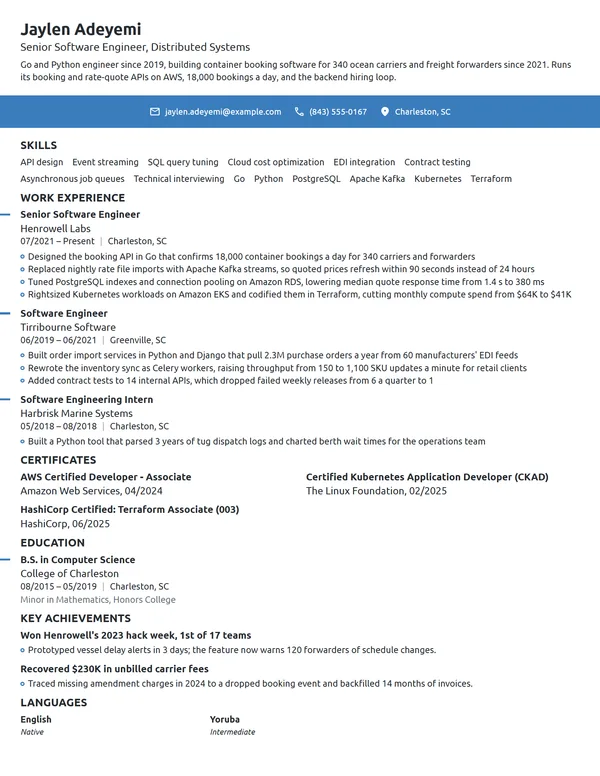
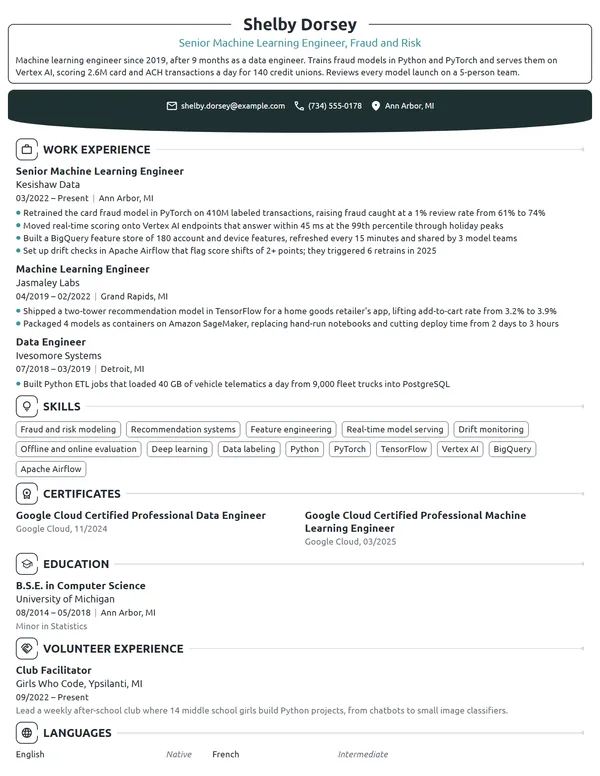
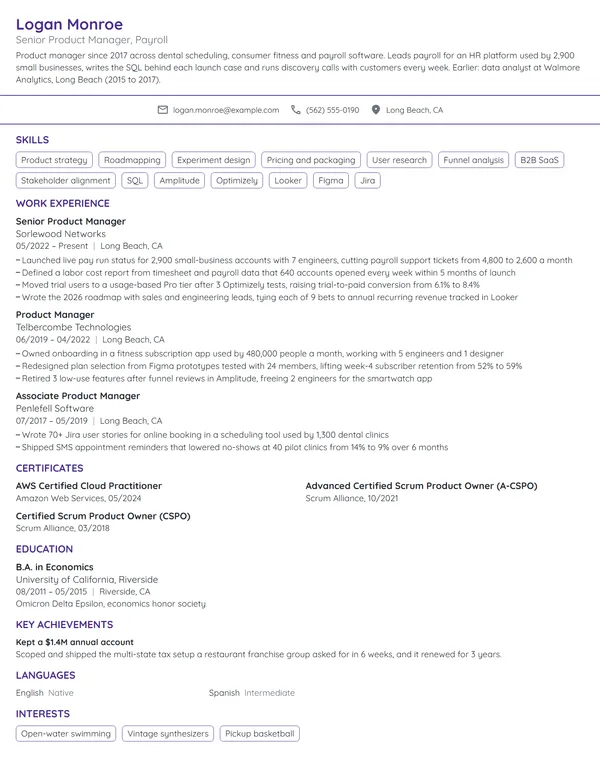
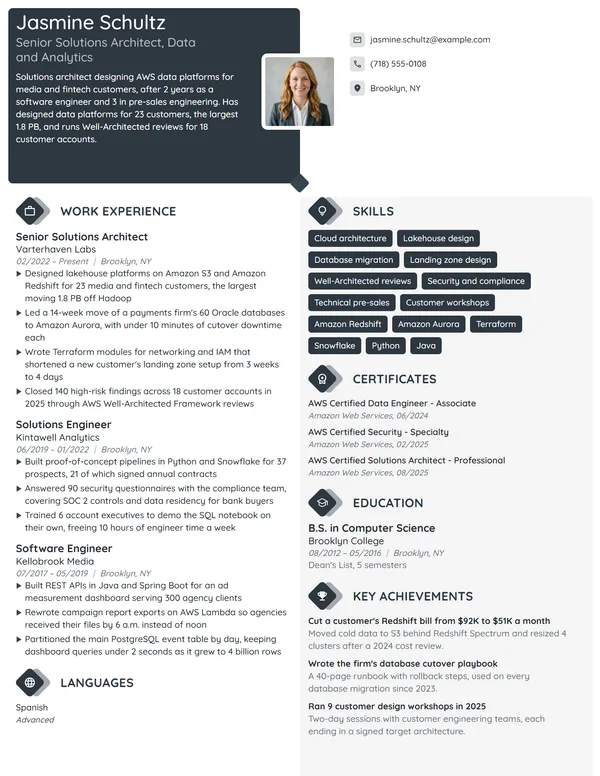
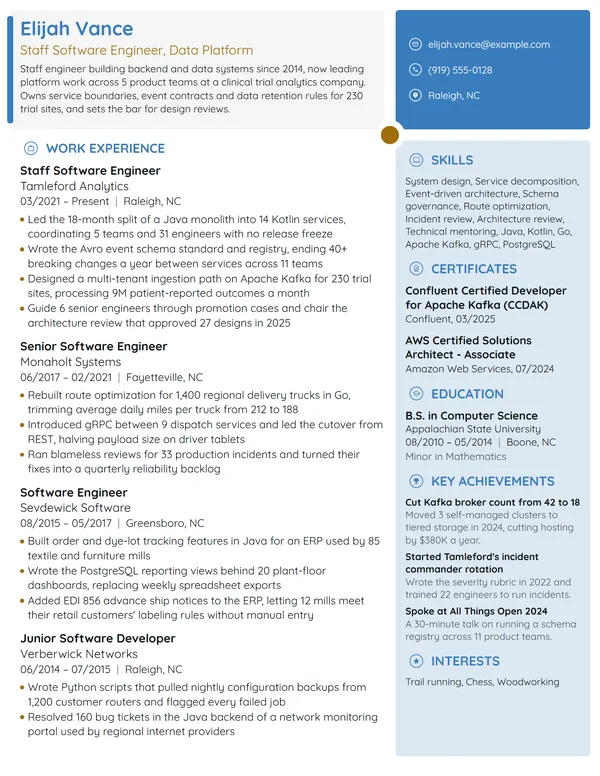
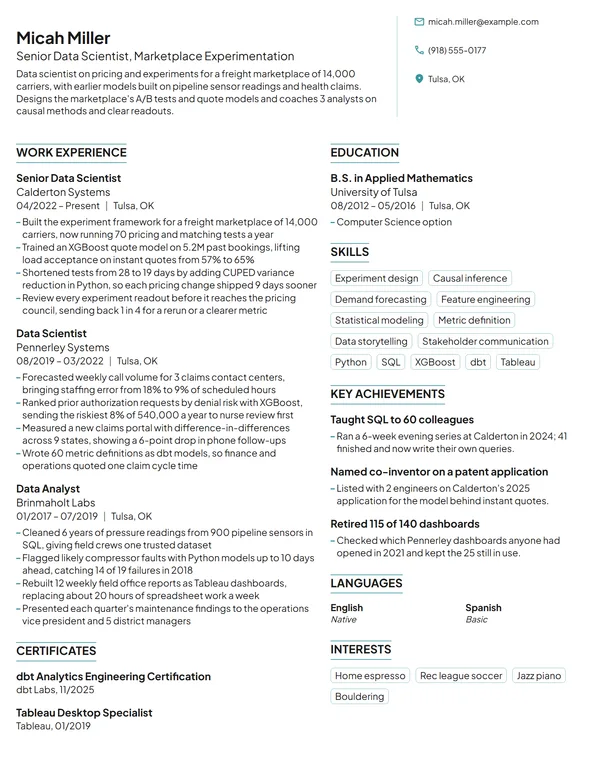
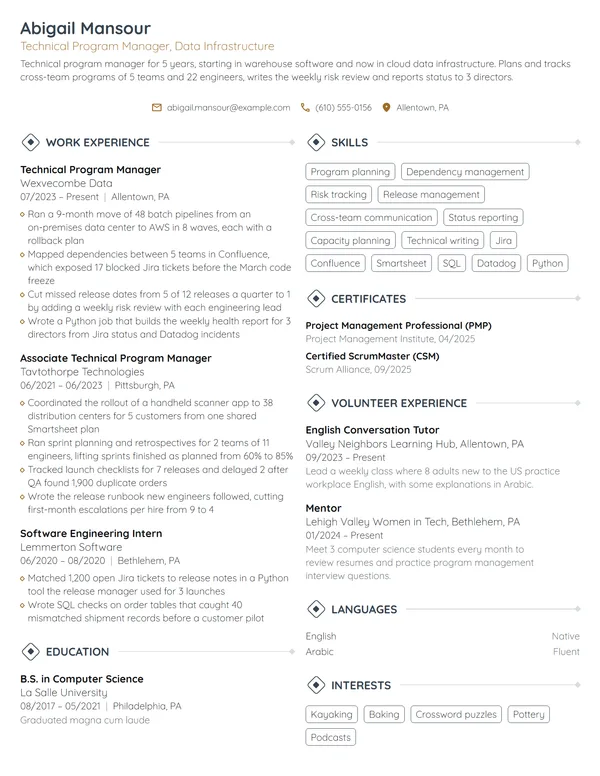
FAANG stands for Facebook (now Meta), Amazon, Apple, Netflix and Google, the companies many engineers and product people aim for at some point. Their recruiters first check that you meet each qualification in the posting, then look at how big your work was and what changed because of it. Experience at a smaller company still competes when its bullets carry users, requests, data volume or revenue. Getting there means trading each duty on your page for a scale and an outcome.
How to Write a FAANG Resume - Key Takeaways
- Use the reverse-chronological format and keep it to 1 page until you pass 10 years in the field.
- Prove every minimum or basic qualification in the posting with a summary line, a bullet or your Education, in the posting's own words.
- Give each bullet a scale and a before-and-after number: users, requests a second, latency, cost, adoption or retention.
- Write your plain title and show your scope in bullets instead of internal level codes such as L5, E5 or SDE II.
- List cloud certifications such as AWS Certified Solutions Architect (Professional) under Certificates with the month earned, mainly for solutions architect and ML roles.
- Name languages and frameworks exactly as the posting spells them, then test the file in an ATS resume checker before you apply.
What FAANG recruiters look for in a resume
Big-tech postings split their requirements in 2. Google lists Minimum qualifications and Preferred qualifications, and its careers site tells applicants to make sure the resume clearly shows every minimum one. Amazon's postings use Basic and Preferred qualifications and count experience precisely, such as 3+ years of non-internship professional software development. Read those lists first and check that each line is proved somewhere on your page, using the posting's keywords on your resume rather than your own synonyms.
After the checklist comes impact. Google asks applicants to include data and, for any leadership role, to say how big the team was and what the scope of the work was. Amazon publishes 16 Leadership Principles, from Customer Obsession to Dive Deep and Deliver Results, and Netflix's culture memo asks managers for context, not control. You never need to quote these values: bullets that show an owner's decisions and a measured result already speak to them. What a reader checks first depends on the track you apply for.
| Role | What the reader checks first | Where to show it |
|---|---|---|
| Software engineer | Systems you built or own, their traffic or data volume, and your languages | The first 2 bullets of your current job, then Skills |
| Staff software engineer | Designs other teams adopted, cross-team projects you led, engineers you guided | Summary and the opening bullets; see the staff software engineer page for that level |
| Machine learning engineer | Models running in production, the metric they moved, training data size and serving speed | Bullets, with frameworks such as PyTorch or TensorFlow under Skills |
| Product manager | Launches, the user or revenue metric each one moved, experiments run, the size of the team you worked with | Bullets that name the product area and the metric |
| Solutions architect | Customer workloads designed or migrated, their size, and current cloud certifications | Bullets plus Certificates; the solutions architect page covers the role in depth |
Whatever the track, the page carries the same core sections, under headings any ATS can parse:
- Name, headline with your track (Senior Software Engineer, Backend) and contact details, plus a GitHub or portfolio link if it shows real work
- A 2- to 3-line summary under the headline, which needs no section title
- Work Experience, newest first, with 3 to 4 bullets on the current job
- Skills, holding your languages, frameworks and cloud tools
- Education
- Certificates, if you hold a current cloud credential
- Optional: Key Achievements for a ranked contest result or a patent, or Languages
Best format for a FAANG resume
Use the reverse-chronological resume format: your current role first, each entry with title, employer, location and dates in MM/YYYY form. Recruiters at these companies compare your experience in years against the posting, and this order lets them count it at a glance. A combination format hides those years, so keep it for a switch from an unrelated field, and even then keep your dated history below the skills block.
- Best for most FAANG applicantsReverse-chronologicalYour jobs, newest first, with your results under each one.Best for: A steady work history in your field
- FunctionalSkills grouped up top, with a short work history below.Best for: Gaps or very little experience
- CombinationA skills section first, then your full work history.Best for: A career change with strong skills
Google says it has no length requirement but that being clear and succinct is key. Under 10 years in the field, 1 page holds everything a recruiter needs. With 10+ years, several products or a move into staff and principal work, 2 pages are fine when page 1 holds your 2 latest roles and your strongest numbers.
| Setting | What to use |
|---|---|
| Length | 1 page under 10 years; 2 pages only when the second one adds staff-level scope |
| Headline | Plain title plus track: Software Engineer, Infrastructure; Product Manager, Payments |
| Links line | GitHub, a portfolio or a published paper, and only if the linked work is current and public |
| Dates | MM/YYYY on every entry, Present on the current one, so the years in each qualification add up |
| Layout | Standard section headings and real text, never text inside images or charts |
| Photo and personal details | Usually no photo in the US and Canada; birth date, marital status and Social Security number stay off the page |
| File type | PDF, unless the application portal asks for another format |
Most US and Canadian resumes carry no photo, so space on the page is better spent on 1 more measured bullet.
FAANG resume summary vs. objective
If you have held a paid role in the track you are applying for, write a resume summary. Name your track, your years, your main stack or product area and your largest result. If you are a student, a new graduate or changing fields, write a 2-line objective that names the target role and your best proof so far.
FAANG resume summary formula
Title with X years building type of system or product in main languages or platform. Your biggest result, with its scale and a before-and-after number. Scope beyond your own code: people guided, teams that use your work.
Example
Senior software engineer with 7 years building commerce and data backends in Go and Java on AWS. Led a checkout service rewrite that cut p99 latency from 840 to 310 ms at 2,400 requests a second. Mentors 3 engineers and wrote the design doc template 4 teams now use.
Don't
Passionate software engineer with a strong background in scalable systems, eager to join a top tech company.
Do
Backend engineer with 5 years on a ride-booking platform, working in Kotlin and PostgreSQL on Google Cloud. Owns the dispatch service that matches 60,000 trips a day and brought failed matches down from 4.1% to 2.7%.
The second version gives the reader a domain, a stack, a scale and a result instead of an ambition.
How to write FAANG resume bullets with scale and impact numbers
Start each bullet with a verb, name what you built or changed, and end on the number that proved it worked. Big-tech readers look for 2 things in that number: the scale the system ran at and the change you caused. Write achievements on your resume, not the duties your team was assigned, and keep 3 to 4 bullets on your current job and 1 to 3 on older ones.
| Area | What to count | Example bullet |
|---|---|---|
| Scale | Daily active users, requests a second, records or bytes processed | Built the notification fan-out for a messaging app with 1.2M daily active users. |
| Performance and cost | Latency percentiles, query cost, compute spend | Cut warehouse query cost by 55% across 3 PB by partitioning the 20 largest tables. |
| Reliability | Availability targets, incidents, on-call load | Kept the payments API at its 99.95% availability target for 6 straight quarters. |
| Product metrics | Adoption, retention, conversion, revenue | Shipped saved searches; 22% of weekly users adopted it within 8 weeks. |
| Machine learning | Offline metrics, online lift, model size, training data | Raised recall on the spam classifier from 0.71 to 0.79 without adding false positives. |
| Scope and leadership | Teams that adopted your work, engineers guided, customers served | Set up the shared build cache 8 teams use, saving $410K a year in compute. |
Here is how one senior engineer's history reads with those numbers in place. The current role carries scope beyond the engineer's own code, and the earlier one stays short.
Work Experience
- Led the rewrite of the checkout service in Go, cutting p99 latency from 840 ms to 310 ms at 2,400 requests a second.
- Moved 46 services from virtual machines to Kubernetes on AWS over 9 months with no customer-facing outage.
- Reduced on-call pages from 31 to 9 a month by adding alert budgets and runbooks for the 6 noisiest services.
- Wrote the design doc template now used by 4 teams and mentor 3 engineers through their first design reviews.
- Built a feature flag service in Java that 12 teams used to ship behind toggles, cutting release time from 5 days to 1.
- Raised test coverage on the order pipeline from 41% to 78% before a peak season.
Don't
Worked on improving the performance of the search service.
Do
Rebuilt the search index pipeline in Apache Spark, cutting the nightly build from 6 hours to 70 minutes for a 900 GB catalog.
The rewrite names the tool, the scale and the time saved.
Don't
Responsible for A/B testing new features.
Do
Ran 14 A/B tests on onboarding screens over 2 quarters; 3 shipped and lifted 7-day retention from 38% to 43%.
How to show internal tools and confidential projects
Describe an in-house system by what it does, not its code name: a recruiter elsewhere has never heard of it. For work under a nondisclosure agreement, keep the public outline and the size and drop the client or product name, as in "Built a fraud model for a top-10 US card issuer" only where that ranking is public. Round any figure your employer has not published, such as 2M+ users instead of an exact internal count.
Technical skills and tools for a FAANG resume
Your Skills section needs 6 to 8 technical skills for your resume, each one named in the posting and proved in a bullet. The BLS describes software developers as people who analyze users' needs and design how each piece of a system fits together, so pair your languages with the design skills you actually used, such as distributed systems or API design.
Hard skills for big-tech roles
- Distributed systems design
- API design
- Data structures and algorithms
- Cloud infrastructure
- Performance tuning
- Large-scale data processing
- Machine learning in production
- A/B testing and experiment design
- Observability and incident response
- Code review
Soft skills big-tech teams value
- Clear written design docs
- Ownership of outcomes
- Working across teams
- Mentoring
- Comfort with ambiguity
- Direct, constructive feedback
List your languages, frameworks and platforms inside Skills, then name each one again in a bullet that shows it at work. O*NET marks TensorFlow, Apache Spark, Amazon DynamoDB and GraphQL as hot technologies for software developers, and Git, TypeScript, React, Apache Kafka and PostgreSQL as in demand. Write them with their exact spelling, and keep a product manager's list to tools such as SQL, an experimentation platform and an analytics suite you have used.
Cloud certifications on a FAANG resume
For software and product roles, shipped work outweighs any credential, so a certificate earns space only where the posting names it. It matters most on solutions architect, cloud consulting and ML platform tracks. List certifications on your resume under Certificates, naming the issuer and the month you earned it, and keep only those still valid: AWS certifications, for example, are valid for 3 years.
| Credential | Issued by | What it takes |
|---|---|---|
| AWS Certified Solutions Architect (Professional) | Amazon Web Services | Recommended: 2 or more years designing and running cloud solutions on AWS. A 180-minute exam of 75 questions for $300; valid for 3 years. |
| AWS Certified Machine Learning Engineer (Associate) | Amazon Web Services | Recommended: at least 1 year with Amazon SageMaker and other AWS machine learning services. Valid for 3 years. |
| Professional Machine Learning Engineer | Google Cloud | Recommended: 3+ years of industry experience, including 1+ year designing and managing solutions on Google Cloud. A 2-hour exam for $200. |
Put the credential you hold that the posting names first, and give each one its full name with the level, the issuer and the month you earned it.
Certificates
- AWS Certified Solutions Architect (Professional), Amazon Web Services, 09/2024
- AWS Certified Machine Learning Engineer (Associate), Amazon Web Services, 05/2025
Computer science degree or equivalent experience on a FAANG resume
The BLS names a bachelor's degree in computer and information technology, or a related field, as the usual entry route for software developers. Google's software engineering postings read "Bachelor's degree or equivalent practical experience", and an Amazon software development posting from October 2026 lists "Bachelor's degree or equivalent", so years of shipped work can stand in for the degree line. When listing education on a resume, write the full degree name, then the school, its city and your graduation month.
A GPA of 3.5 or more is worth a line for 2 to 3 years after graduation, and not after that. A capstone, thesis or research paper earns a line when it matches the team you are applying to, such as a distributed systems project for an infrastructure role. With 3+ years of work, cut Education to 2 lines and move it below Work Experience.
Education
GPA 3.6. Capstone: a room-booking web app built with 4 classmates, used by 2,000 students.
FAANG resumes for new grads, interns and career changers
Google's own advice for recent graduates and anyone with limited experience is to include school projects or coursework that show relevant skills. Use an entry-level resume layout with a short objective and Education placed above Work Experience, and give each project the numbers a full-time job would carry.
- Internships: listed under Work Experience with the team, the system you touched and a shipped result.
- Projects with users: a separate Work Experience entry when real people used the work, with the user count.
- Open-source contributions: merged pull requests to a named project, with the feature or fix they delivered.
- Contest results: a ranked ICPC regional or a hackathon win, under Key Achievements with the rank and the field size.
- Research: a paper or a lab project, under Education, when it matches the team's field.
Don't
Computer science student looking for a software engineering internship at a top tech company.
Do
Computer science senior seeking a new-grad software engineer role. Built a course-scheduling app in React and Node.js that 1,800 students use each term, and finished a 12-week backend internship.
Even an objective needs proof, such as an internship, a project with users or a contest rank.
Moving in from QA, IT support, data analysis or another engineering field, keep reverse-chronological order and lead each job with its most technical work: the scripts you wrote, the pipelines you ran, the systems you debugged. A career-change resume reads best when your summary names the target track and 1 result that already looks like it. Use the cover letter for the reason behind the move; these software engineer cover letter examples show how to do it in a short paragraph.
FAANG resume FAQ
Which companies count as FAANG?
Facebook, Amazon, Apple, Netflix and Google. Facebook's parent company renamed itself Meta in October 2021, so the F now points to Meta. Recruiters and job seekers also use the term loosely for other large tech employers with selective hiring.
How long should a FAANG resume be?
Use 1 page for under 10 years of software, product or cloud work. Google says it has no length requirement but wants resumes clear and succinct, so a second page only makes sense when it adds staff-level scope or several large systems.
Do FAANG companies require a cover letter?
Not Google, which says it does not require one and suggests putting the time into your resume. Other companies vary by posting, so add one only when the application asks for it or you need to explain a career change or a relocation.
Should I mention Amazon's Leadership Principles on my resume?
No, not by name. Writing Customer Obsession or Dive Deep in a bullet reads as keyword stuffing. Show the behavior instead, with a decision you owned and its measured result, and keep the principle names for your interview stories.
Do I need a computer science degree to work at a FAANG company?
Not always. The BLS gives a bachelor's in computer and information technology or a related field as the usual route for software developers, while Google's software engineering postings accept a bachelor's degree or equivalent practical experience. Without the degree, let your shipped work and its numbers carry the page.
Should I put my internal level, such as L5 or E5, on my resume?
No. Level codes differ between companies and mean little to an outside recruiter. Use your plain title, such as Senior Software Engineer, and show the level through scope: systems owned, teams you worked across and engineers you mentored.
Should I list LeetCode or competitive programming on a FAANG resume?
Only a ranked contest result. A problem count on a practice site proves preparation, not work, so leave it off. An ICPC regional placing or a top finish in a large contest belongs under Key Achievements with the rank and the number of entrants.
How do I write a FAANG resume if I already work at one of these companies?
Write it for a reader who has never seen your internal tools. Replace code names with what the system does, turn level codes into plain titles, and round any figure your employer has not published. The numbers still need a base and a before-and-after.
Next steps
Start from the example nearest your track and level, keep its order, and swap every figure for your own scale and results. Check each line of the posting against your page, build it in our resume builder or from one of the resume templates, and send a different version for each role you apply to.