
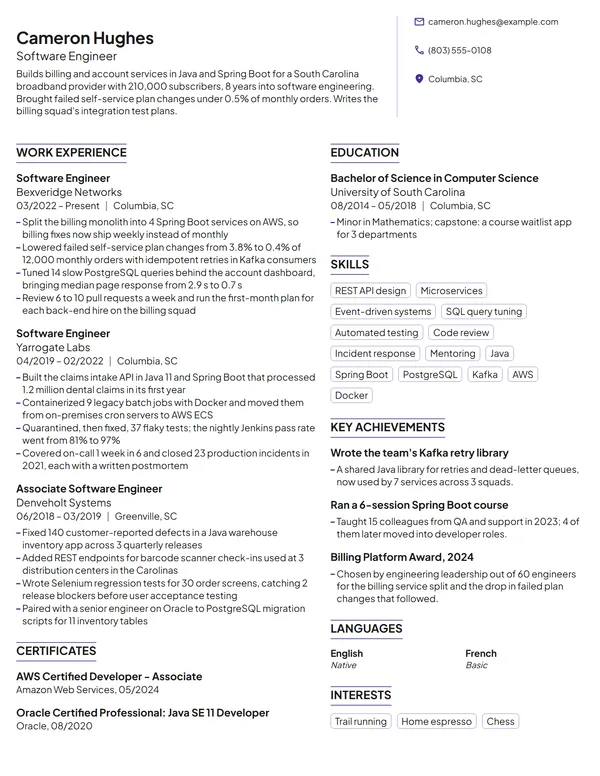
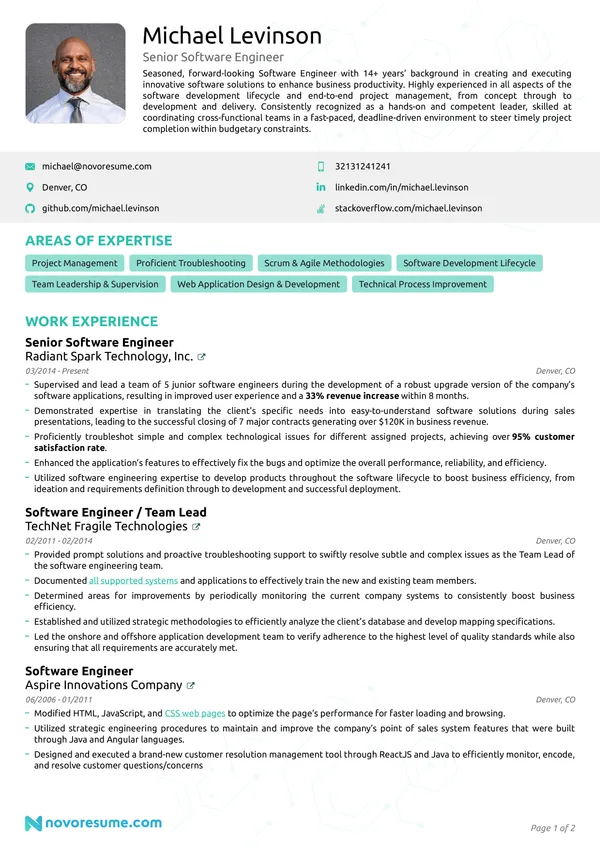
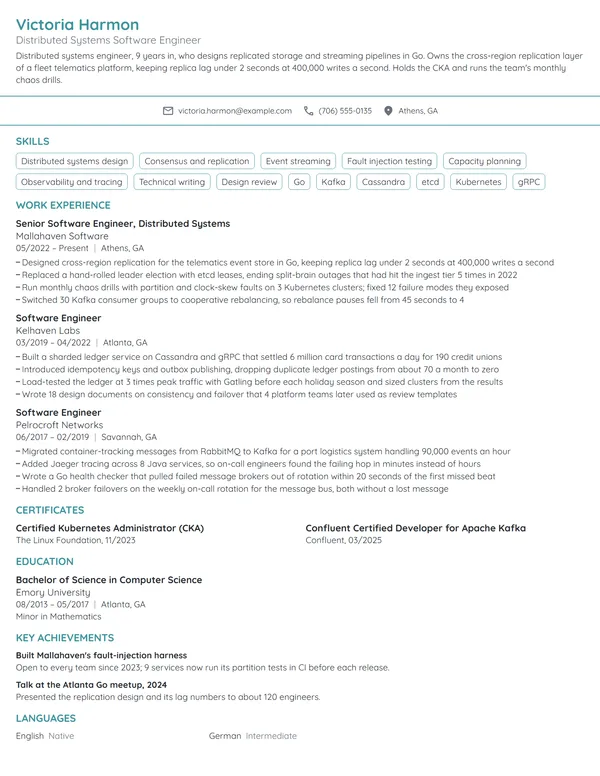
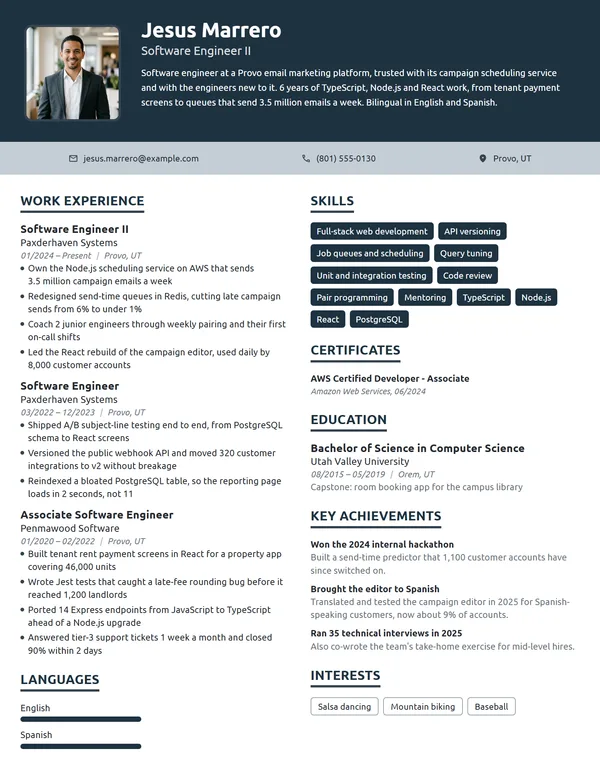
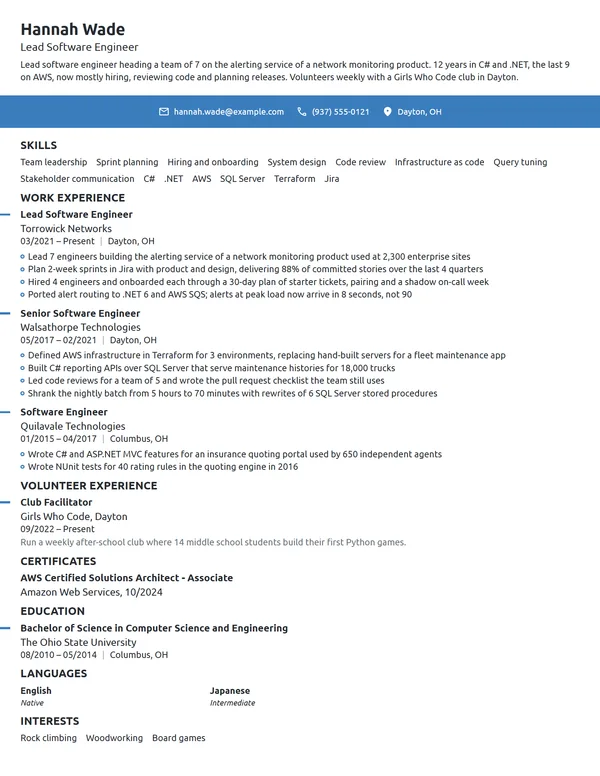
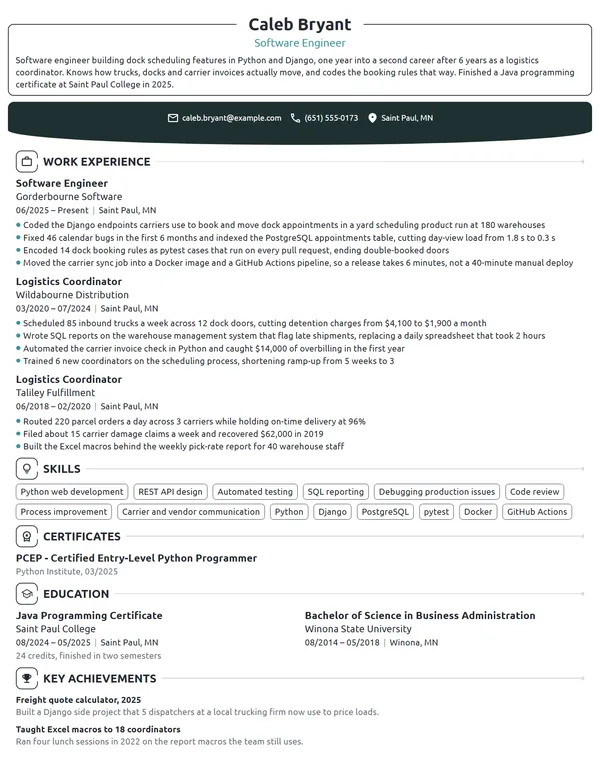
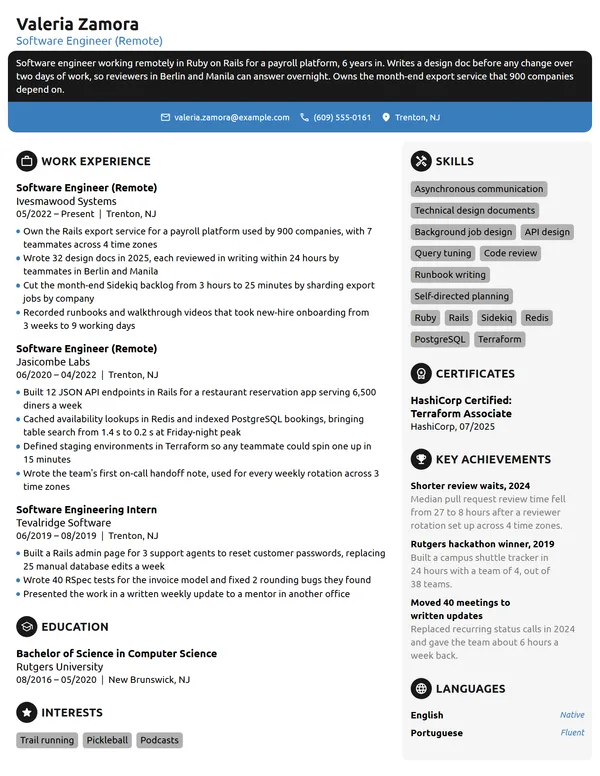
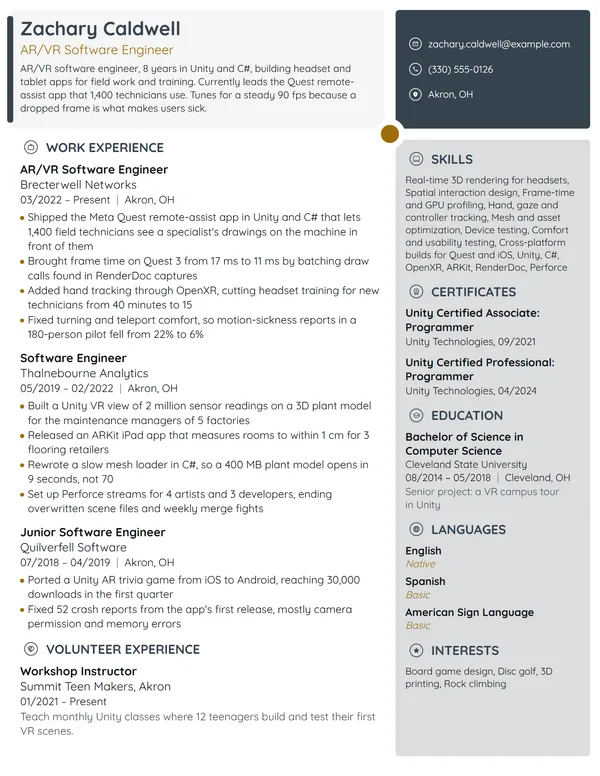
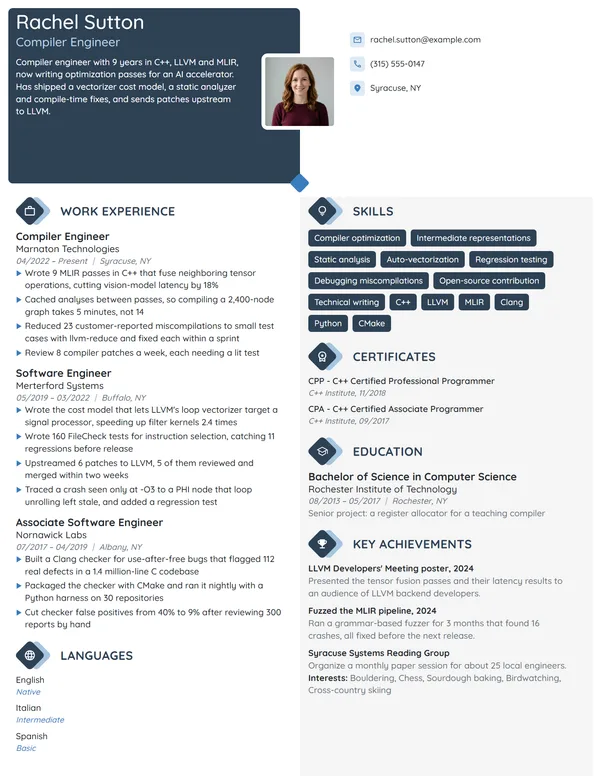
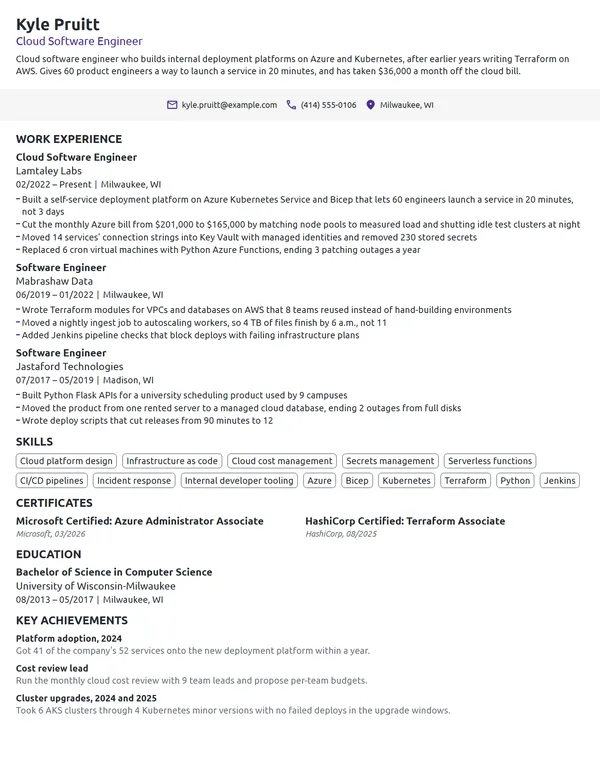
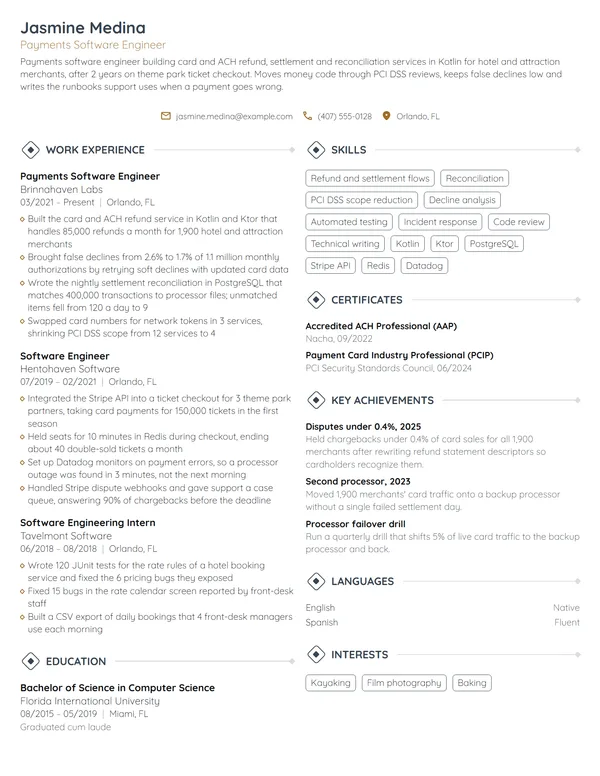
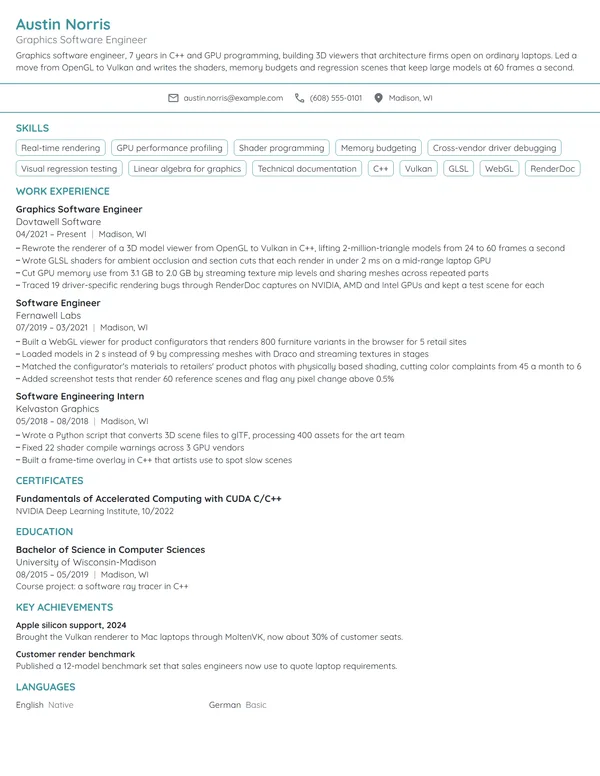
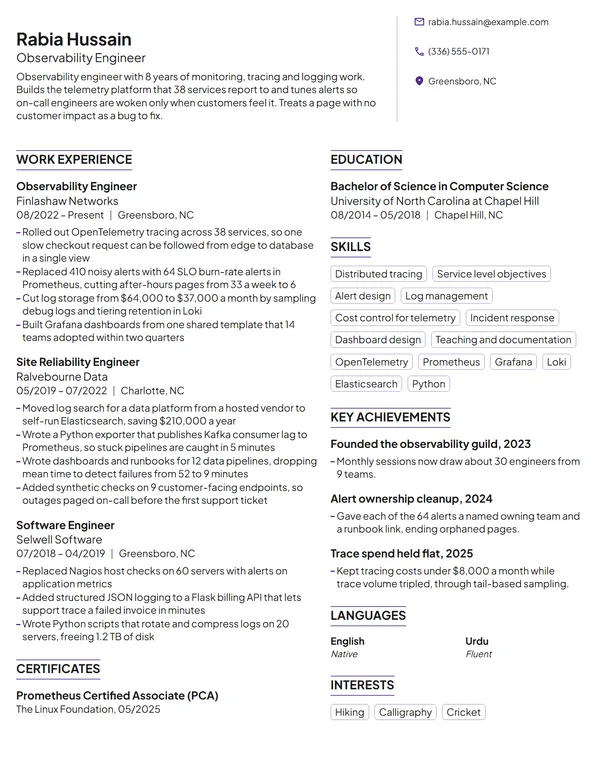
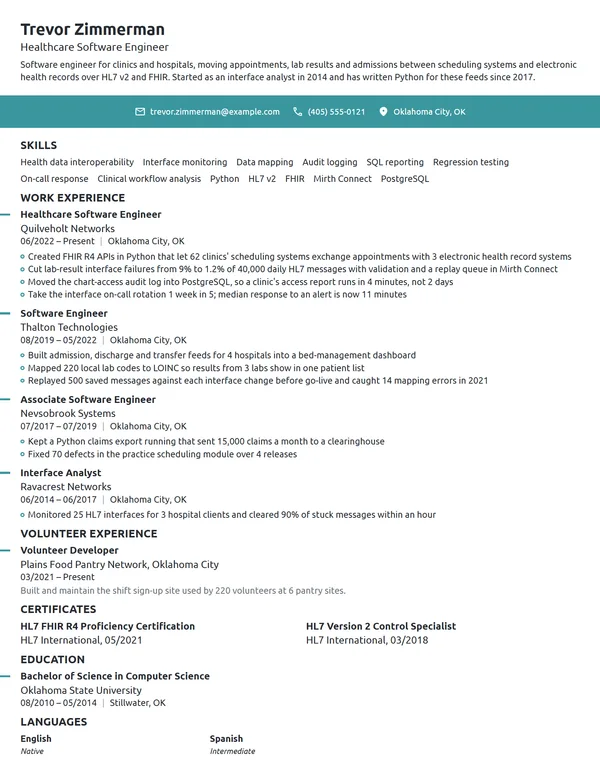
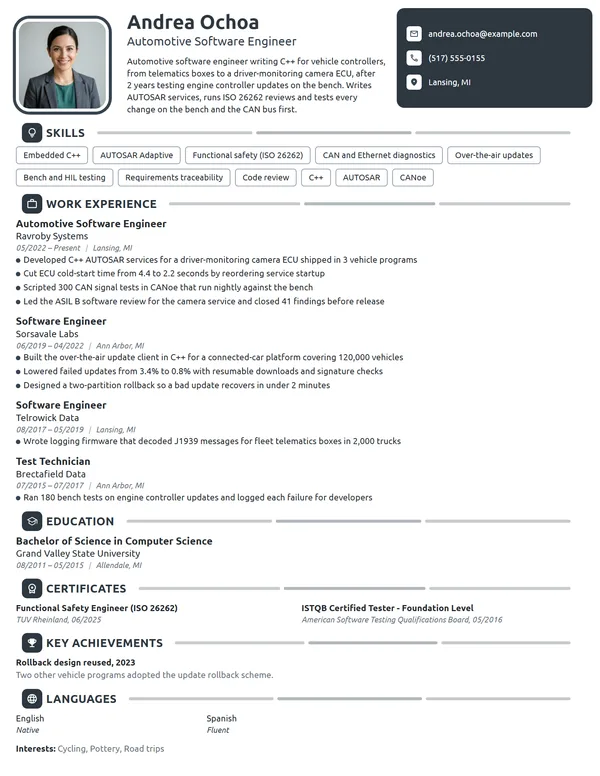
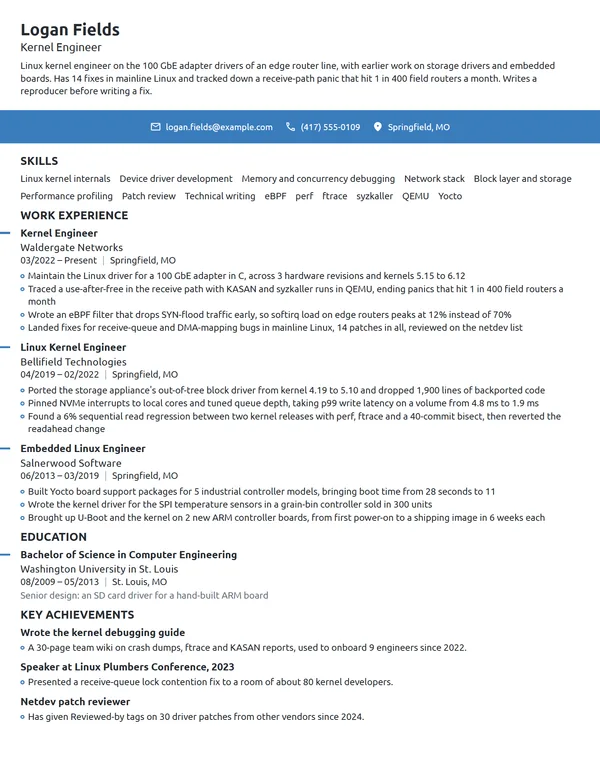
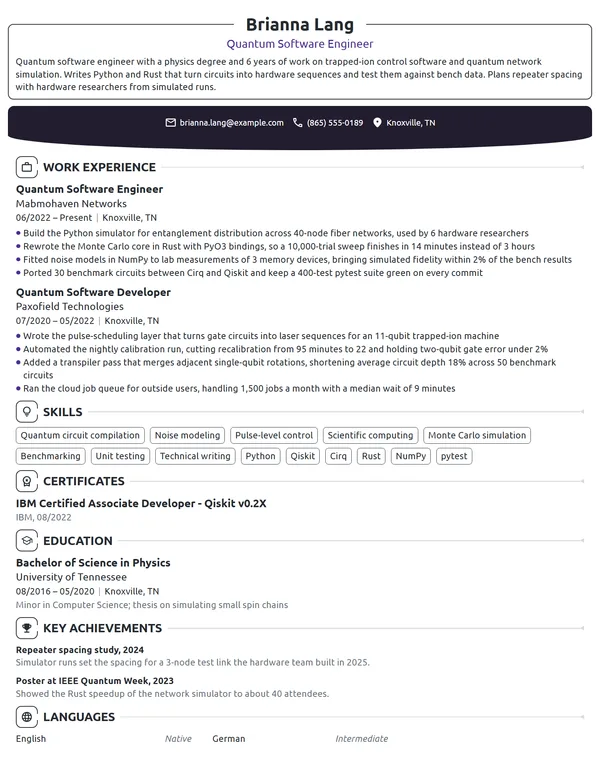
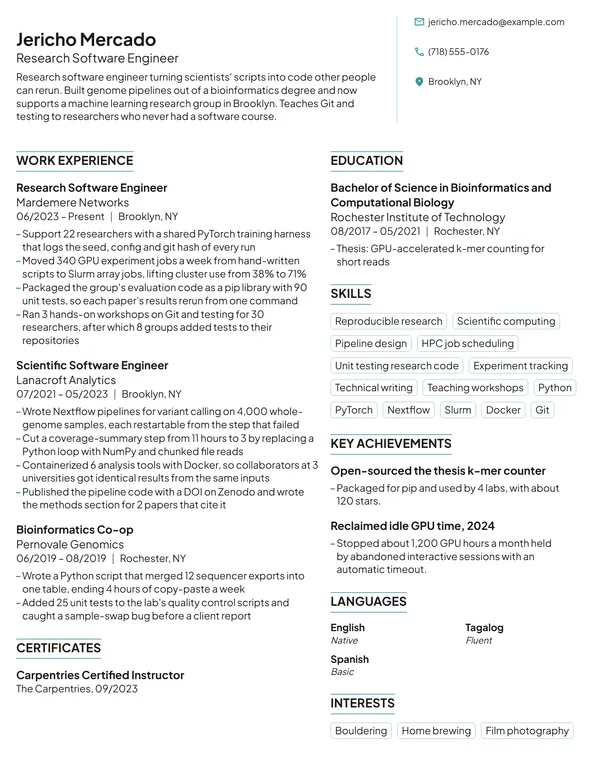
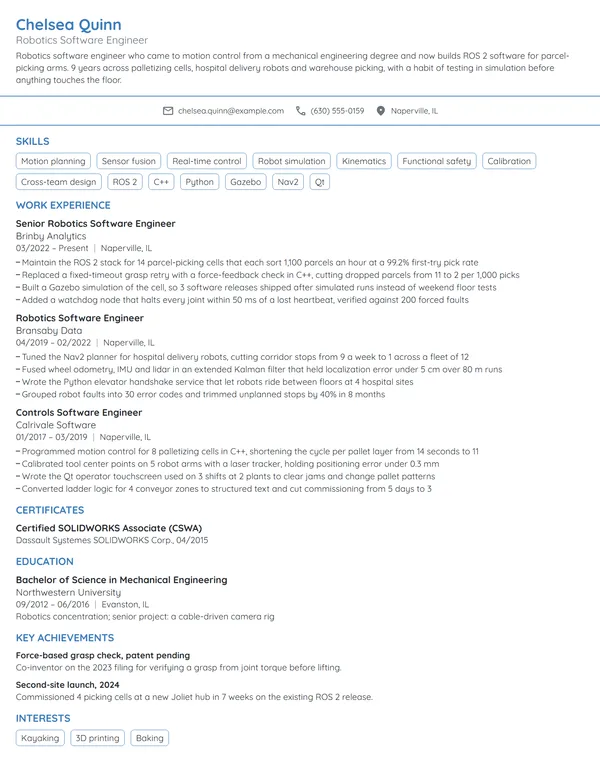
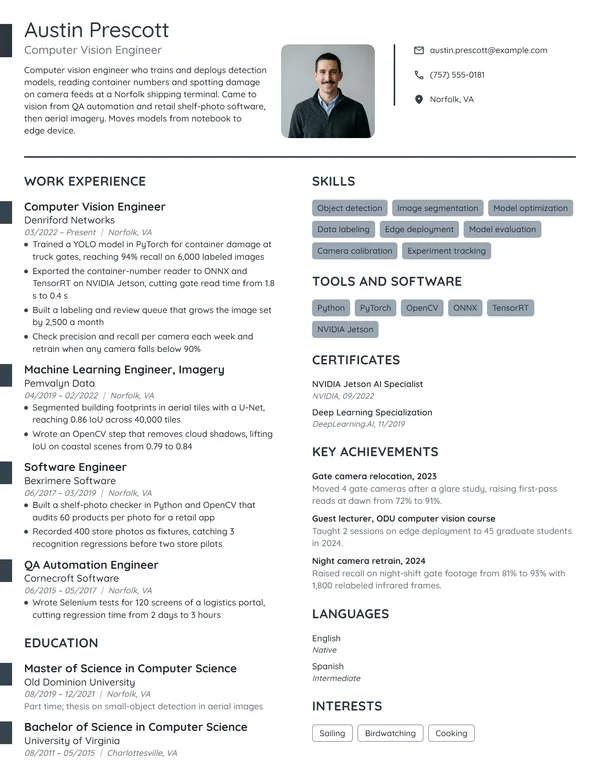
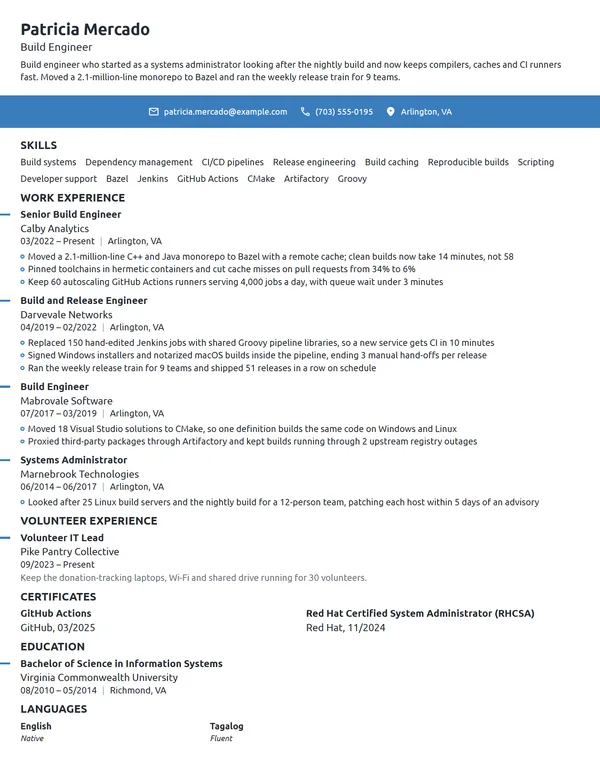
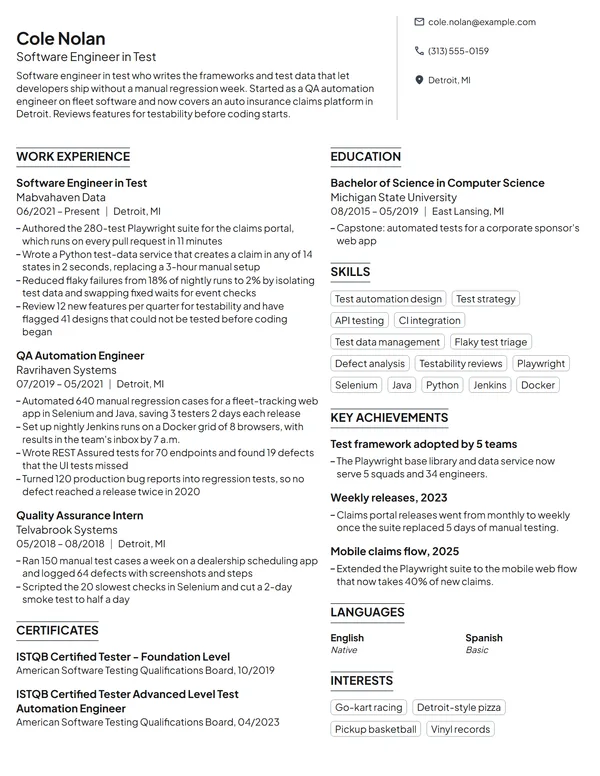
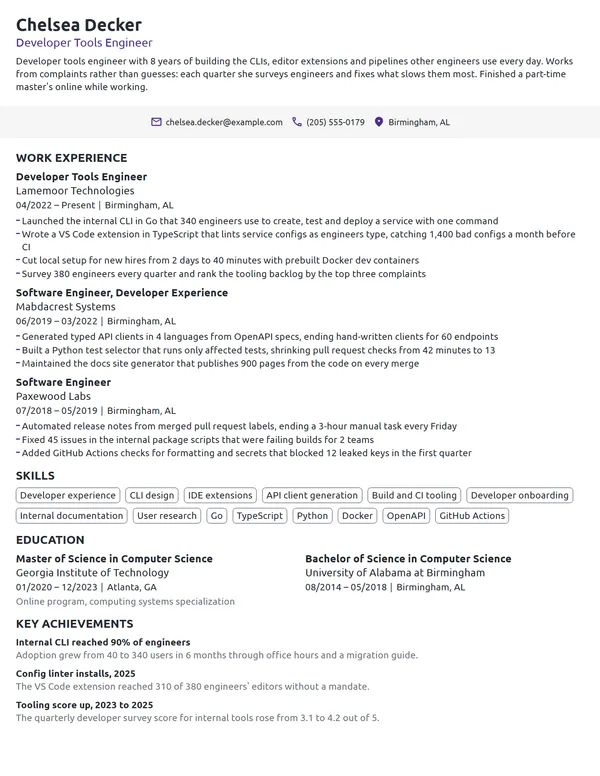
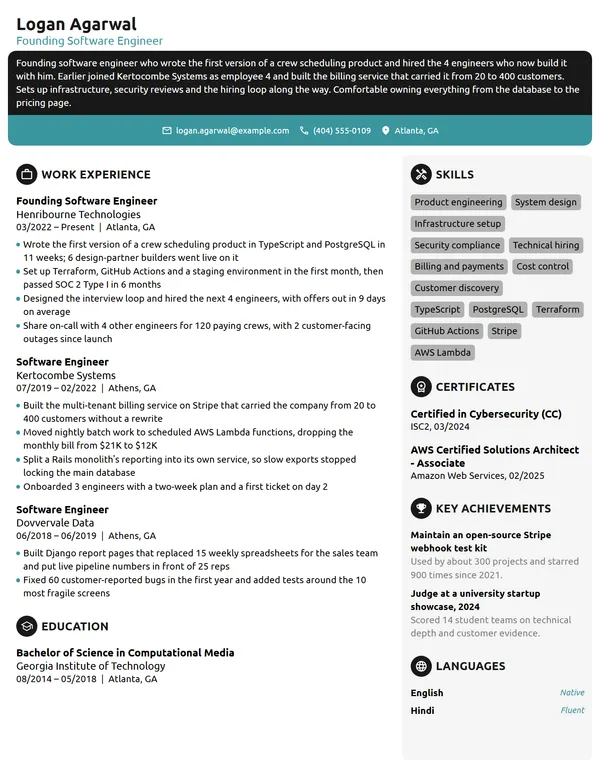
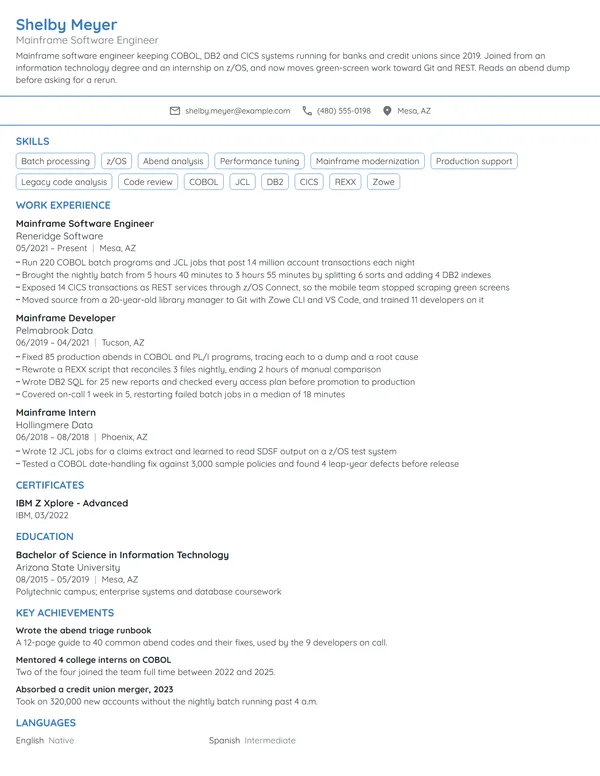
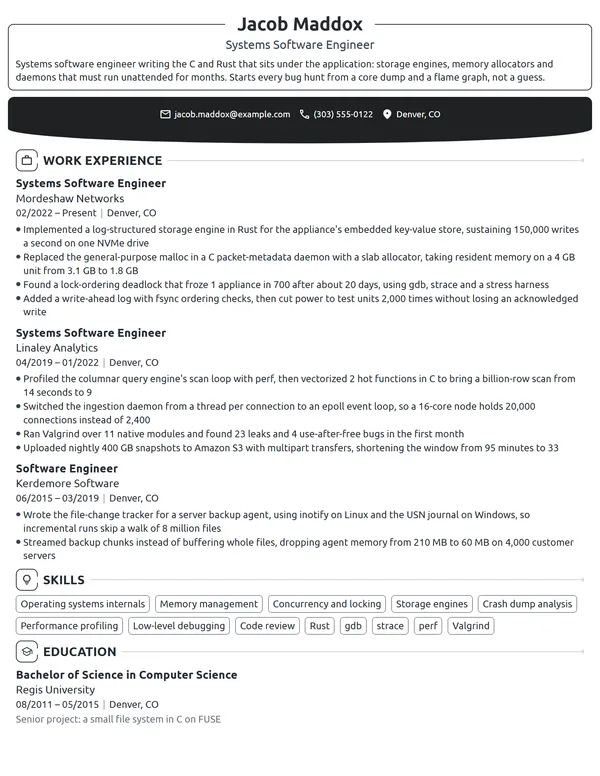
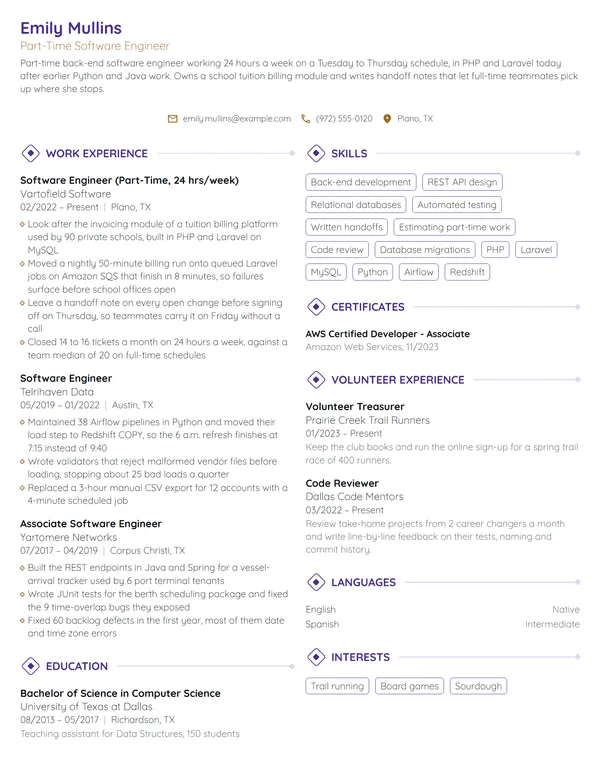
What you ship, and how well it runs, is what gets a software engineer hired. Expect a quick scan for the languages and frameworks you use every day, the systems you built or improved, and numbers worth trusting, such as faster load times, higher uptime or fewer bugs. Your best work sits in a codebase no reader will open, so each bullet has to explain it on its own. Where your stack goes, how to word each bullet and how to give every number a base are all covered.
How to Write a Software Engineer Resume - Key Takeaways
- Pick a reverse-chronological layout and hold it to 1 page until you reach about 10 years of engineering work.
- Open with 2 to 3 lines that name your level, your main languages, the kind of systems you build and 1 measured result.
- Give each bullet a number with its base: p95 latency, requests a day, uptime, deploy frequency, escaped defects or cloud cost.
- Name the language or framework inside the bullet that used it, and list only tools you could pick up again on day 1.
- Add cloud or Kubernetes certifications under Certificates with the issuer and date; most software roles call for no license.
- Put a shipped side project under Key Achievements, then check the PDF with an ATS resume checker before you apply.
What hiring managers look for in a software engineer resume
The first reader matches your resume against the posting's stack. The second, usually an engineering manager or a senior engineer, checks whether you built something real and how big it was. The BLS describes the core of the job as analyzing users' needs and then designing and developing software to meet them, and O*NET adds weighing designs against time and cost and modifying existing software to fix errors and improve performance. Show both in your bullets: new systems and the code you made better.
Build the page from these sections, with plain headings that resume parsers read without errors:
- Name, headline (Software Engineer, Back End, or Senior Software Engineer) and contact details
- A short profile at the top, 2 to 3 lines, which needs no heading
- Work Experience, starting with your current role
- Skills, with your languages, frameworks and cloud tools in the same block
- Certificates, if you hold a cloud or Kubernetes credential
- Education
- Optional: Languages and Interests, plus a Key Achievements block or a Volunteer Experience entry
Best format for a software engineer resume
Use the reverse-chronological resume format: your current role first, then each earlier one with its title, employer, location and dates in MM/YYYY form. Engineering ladders are easy to read in that order, from Software Engineer I or II to senior, staff and lead, and a hiring manager wants to see the most recent stack first. A combination layout, with a skills block above your history, only helps when your past jobs were outside software.
- Best for most software engineersReverse-chronologicalYour jobs, newest first, with your results under each one.Best for: A steady work history in your field
- FunctionalSkills grouped up top, with a short work history below.Best for: Gaps or very little experience
- CombinationA skills section first, then your full work history.Best for: A career change with strong skills
Keep it to 1 page while you have under 10 years of engineering work. After that, 2 pages can suit a senior software engineer who has led several systems or teams, as long as page 1 holds your 2 latest roles and your best numbers.
| Setting | What to use |
|---|---|
| Length | 1 page under 10 years of engineering work; 2 pages after that |
| Dates | MM/YYYY for every job, and Present for the one you hold now |
| Job title line | Your title as your employer wrote it, plus the area: Software Engineer II, Payments |
| Tech stack | Named inside the bullets and again in Skills, spelled the way the posting spells it |
| Photo, birth date and ID numbers | Most US and Canadian resumes skip the photo; leave off your SSN, birth date or marital status too |
| File type | A text-based PDF, or a .docx file if the careers portal asks for one |
Most US and Canadian resumes carry no photo. Keep the layout simple enough for a parser to read your section headings and job titles in order, since a careers portal may run a keyword search before an engineer sees the file.
Software engineer resume summary vs. objective
If you have held a software job, paid internships included, write a resume summary: your level, your main languages, the kind of systems you build and 1 measured result. If you have not, write a resume objective that names the role you want and the strongest code you have shipped so far. Write it after your bullets, so its number is one you can defend in an interview.
Software engineer resume summary formula
Title with X years building kind of systems in main languages and platform. Your strongest shipped result, its number and its scale. Certification, domain or focus area.
Example
Software engineer with 6 years building logistics and healthcare APIs in Go, TypeScript and PostgreSQL on AWS. Cut p95 latency on a tracking API serving 2.3M requests a day from 820 ms to 310 ms. CKAD certified since 2025.
Don't
Passionate full-stack developer with strong problem-solving skills, eager to build innovative solutions on a fast-moving team.
Do
Back-end engineer with 4 years in Python and Django at a payments startup, owning 3 payment integrations used by 600 merchants. Carries a weekly on-call rotation and writes the team's incident reviews.
This one names the level, the stack, the domain and the scale of what this engineer owns.
How to write software engineer work experience bullets with numbers
Your current role gets 3 to 4 bullets; each older role, 1 to 3. Start each with a verb, name the technology, and end with what changed: speed, scale, reliability, delivery or cost. Engineering teams already track these in dashboards and incident reviews, so most of your achievements on a resume can carry a figure your next manager reads the same way.
| Area | What to count | Example bullet |
|---|---|---|
| Performance | Page load, p95 or p99 latency, query time | Cut checkout page load on mobile from 4.1 s to 1.6 s by deferring 3 third-party scripts. |
| Scale | Requests, events, users or data volume | Built a Kafka consumer that indexes 18,000 product events a second for site search. |
| Reliability | Uptime, incidents, time to recover | Held the orders service at 99.95% uptime for 6 quarters and brought on-call recovery from 47 to 12 minutes. |
| Delivery | Deploy frequency, lead time, release size | Shortened merge-to-production lead time from 5 days to 1 day by moving the team to trunk-based releases. |
| Quality | Test coverage, escaped defects, flaky tests | Brought escaped defects down from 31 to 9 a quarter with integration tests on 5 legacy PHP endpoints. |
| Cost | Monthly cloud spend, compute hours | Trimmed $9,400 from a $38K monthly AWS bill by rightsizing 60 EC2 instances. |
Here is how those numbers sit in one engineer's history. The current role carries the scale and the team work, and the first job gets 2 lines.
Work Experience
- Rebuilt the shipment-tracking API in Go and PostgreSQL, taking p95 latency from 820 ms to 310 ms at 2.3M requests a day.
- Moved 11 services from one shared Jenkins job to per-service GitHub Actions pipelines, raising deploys from 2 a week to 6 a day.
- Wrote contract tests for 26 carrier integrations that caught 17 breaking changes before release in 2025.
- Mentored 3 new hires through onboarding; each shipped a production change within 10 days.
- Built 9 React screens for a scheduling app used by 140 clinics.
- Raised unit test coverage on the booking service from 41% to 78%.
Don't
Improved the CI pipeline.
Do
Cut CI build time from 22 to 9 minutes for 40 engineers by caching dependencies and splitting the test suite into parallel jobs.
Now the reader sees the before and after, who it helped and how it was done.
Don't
Worked on the Android app.
Do
Rewrote 3 Android modules in Kotlin, lifting crash-free sessions from 97.2% to 99.6% over 2 releases.
Software engineering skills, languages and tools for your resume
Choose 6 to 8 entries for Skills from the posting, picking only ones a bullet of yours backs up, and let the work itself show the soft skills below. Our list of technical skills for a resume helps you name each one precisely; here, that means a language or a practice such as system design, not a vague word like coding.
Hard skills for software engineers
- Data structures and algorithms
- System design
- REST and GraphQL API design
- Distributed systems
- Relational and NoSQL databases
- Cloud infrastructure
- CI/CD pipelines
- Automated testing
- Containers and orchestration
- Performance profiling
- Application security
Soft skills engineering managers value
- Code review
- Technical writing
- Breaking down vague requirements
- Mentoring
- Working with product and design
- Estimating and scoping work
Put your languages, frameworks and cloud tools in the same Skills block, then repeat each one in the bullet where you used it. O*NET flags TypeScript, React, Spring Boot, Apache Kafka, PostgreSQL, Git, Jenkins, Terraform, Python, Java, Go, Docker, Kubernetes and AWS as hot and in demand for software developers. Write the version the posting writes, such as Node.js, C# or Google Cloud, and leave out a language you have only seen in a tutorial.
AWS, Kubernetes and cloud certifications on a software engineer resume
Most software engineering jobs in the US call for no license: NCEES, which writes the Professional Engineer exams, offers none in software engineering, and the BLS lists a degree, not a credential, as the usual entry point. Certifications help most for cloud, platform and DevOps roles. Add certifications to your resume under Certificates with the issuer and the month and year you earned them, and only ones you hold or have booked.
| Credential | Issued by | What it takes |
|---|---|---|
| AWS Certified Developer (Associate) | Amazon Web Services | A 65-question, 130-minute exam; AWS recommends 1 or more years of hands-on development on AWS. Valid for 3 years. The DVA-C02 exam runs until November 30, 2026, then DVA-C03 replaces it. |
| Certified Kubernetes Application Developer (CKAD) | The Linux Foundation, with the Cloud Native Computing Foundation | A 2-hour, online, proctored exam solved on a command line, with no prerequisites. Valid for 2 years. |
| Professional Cloud Developer | Google Cloud | A 2-hour exam of 50 to 60 questions, no prerequisites; Google recommends 3+ years in the industry, with 1+ year building on Google Cloud. |
Where side projects and open source go on a software engineer resume
Place each side project by what it was. A side project with real users goes under Key Achievements, with its stack and 1 number. Unpaid open-source work goes under Volunteer Experience with the project's name, and paid freelance work gets its own Work Experience entry with dates.
Certificates
- Certified Kubernetes Application Developer (CKAD), The Linux Foundation, 03/2025
- AWS Certified Developer (Associate), Amazon Web Services, scheduled 01/2027
How to list a computer science degree, bootcamp or self-taught path
The BLS lists a bachelor's in computer and information technology or a related field as the usual entry requirement, and 85% of the workers O*NET surveyed say a bachelor's degree is required. When you list education on a resume, give the degree name in full, then the school, its location and your graduation month. A GPA of 3.5 or higher earns a place only in the first 2 to 3 years after graduation.
A degree in math, physics or electrical engineering reads well if your bullets show production code. A coding bootcamp goes under Education with its name, length and completion date, below any degree you hold. With no formal training, let Work Experience and Key Achievements carry the proof, and add a certification if the role is cloud-heavy.
Education
Entry-level and career-change software engineer resumes
Without a full-time engineering job yet, use an entry-level resume layout: an objective, Education high on the page, followed by every piece of code someone else relied on. The BLS notes students can gain experience through internships, and a software engineer intern role belongs under Work Experience like any other job.
- Internships and co-ops: the feature you shipped, its users and the stack, written as Work Experience bullets.
- A side project people use: under Key Achievements, with the language, the users or downloads, and 1 result.
- Open-source contributions: merged pull requests and the project's name, under Volunteer Experience.
- Teaching or tutoring jobs: a computer science TA or lab assistant role, with the course and the number of students.
Don't
Self-taught programmer looking for an opportunity to grow as a software engineer.
Do
Warehouse supervisor with 14 years in operations, moving into back-end engineering after building 2 Python tools now used by 35 shift leads. Finished a 12-week full-stack course in 2026.
Code in use, who uses it and the training behind it make this objective worth reading.
Changing careers from IT support, QA, data analysis or a non-tech job, keep your history in reverse-chronological order and open with the code you already write at work. A career-change resume works best when the opening bullets for your present job are scripts, automations or tools other people use. Leave the why of the switch to the letter that goes with it: our software engineer cover letter examples show how to cover it in a short paragraph.
Software Engineer resume FAQ
Should I put my GitHub on my software engineer resume?
Yes, if your pinned repositories show code you would walk an interviewer through, with a README and recent commits. Add the link next to your email. Skip it if the profile holds only course exercises or forks, and let your bullets carry the proof instead.
How long should a software engineer resume be?
1 page for most engineers with under 10 years of experience, including new grads. With 10+ years, several systems you led or a move into staff or lead roles, 2 pages work if page 1 holds your 2 latest roles and your strongest figures.
Which programming languages should I list on my resume?
The ones you could write production code in this week, led by those the posting names. For most engineers that is 2 to 4 languages, each backed by a bullet. Mention a language you are learning in your profile rather than in Skills.
Do software engineers need a license or certification?
Usually neither. NCEES offers no Professional Engineer exam in software engineering, and the BLS points to a bachelor's as the typical entry route. Cloud certifications such as AWS Certified Developer (Associate) or CKAD are optional and help most for cloud, platform and DevOps roles.
How do I write a software engineer resume with no experience?
Lead with an objective and your Education, then list internships under Work Experience, a side project with real users under Key Achievements and merged open-source work under Volunteer Experience. Give each the numbers a job bullet would get: users, requests, test coverage or response time.
Should I list every framework I have used?
No. List the frameworks the role uses and the ones you have shipped with in the last few years, and drop the rest. A reviewer who sees 25 tools assumes you know none of them well, while 8 tools with a bullet each read as depth.
How do I show AI coding tools on a software engineer resume?
Name the tool, such as GitHub Copilot, in the bullet where it changed something: a migration finished sooner, test coverage raised, review time cut. Add it to Skills only when a job ad requests it, and keep the credit for the design and the result with your own work.
Should I include my salary expectations on a software engineer resume?
No. Keep pay for the recruiter screen or the offer stage. For reference, the BLS puts the median yearly pay of software developers at $135,980 as of May 2025; offers vary with your level, your city and the size of the company.
Should a software engineer put a GPA on their resume?
Only as a new grad or intern with a GPA of 3.5 or higher. Once you are 2 to 3 years out of school, your shipped systems and their numbers say more, so drop the GPA and keep only the degree line with its school and date.
Next steps
Start from the example nearest your level and stack, follow its layout, and swap every figure for your own latency, scale, uptime and delivery numbers. Build it in our resume builder, or take one of the resume templates as a base, then write a letter to go with it whose first paragraph names the system you are proudest of.