
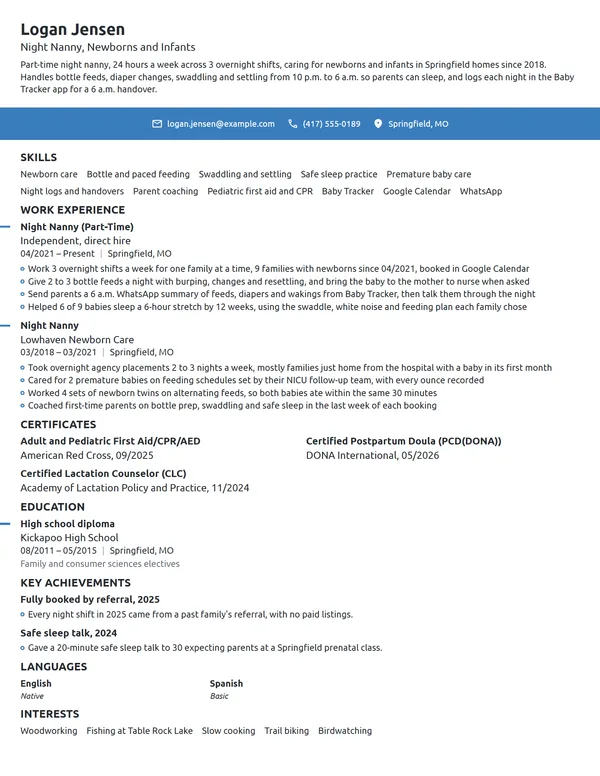
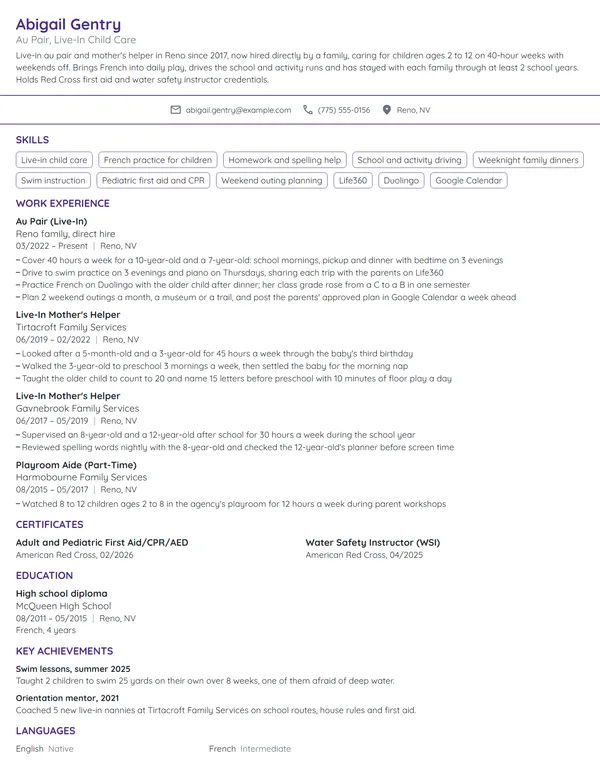
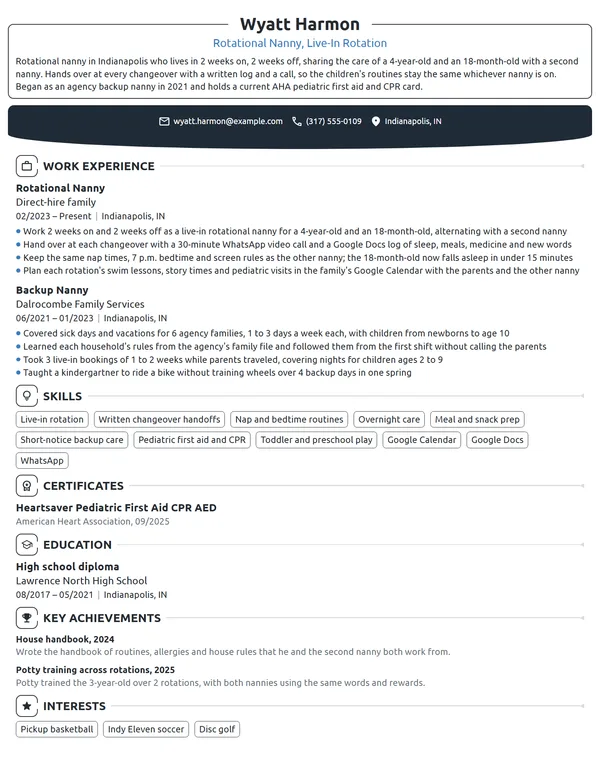
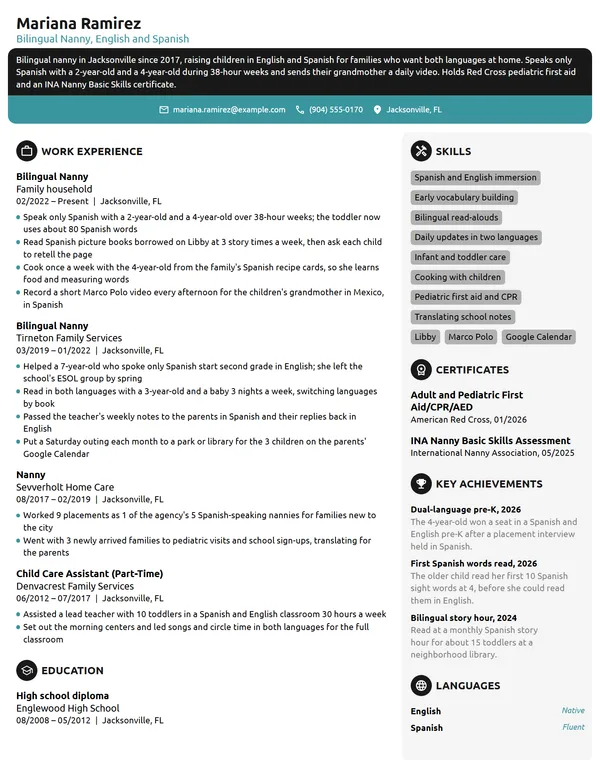
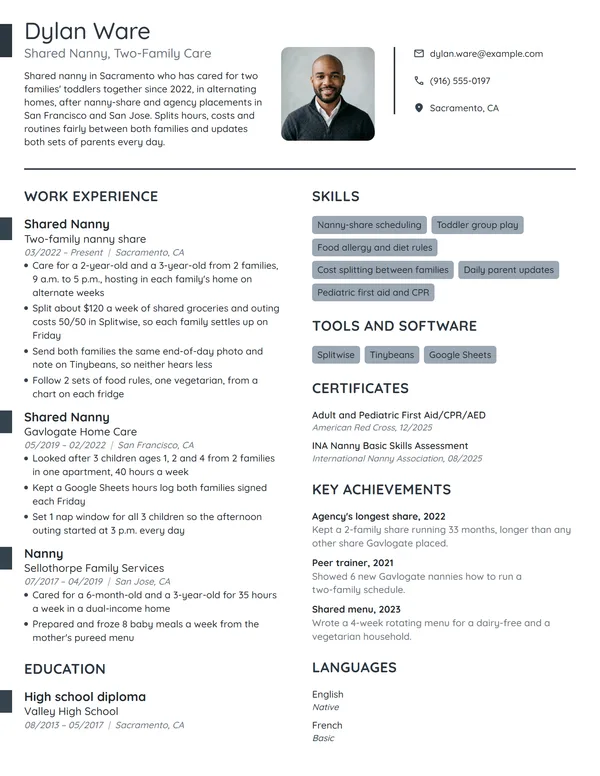
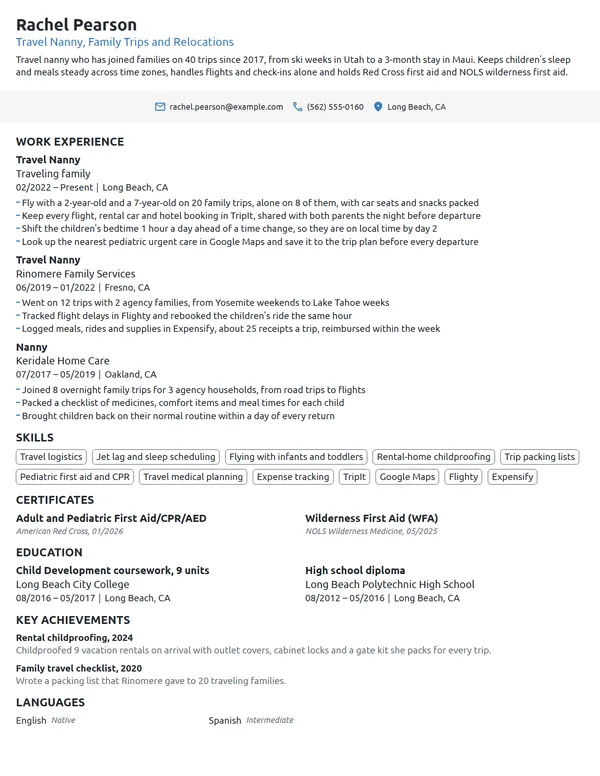
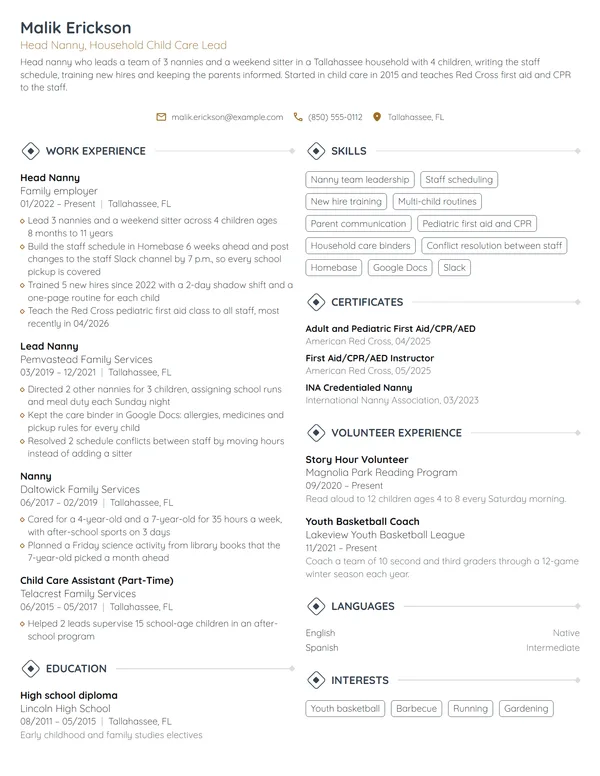
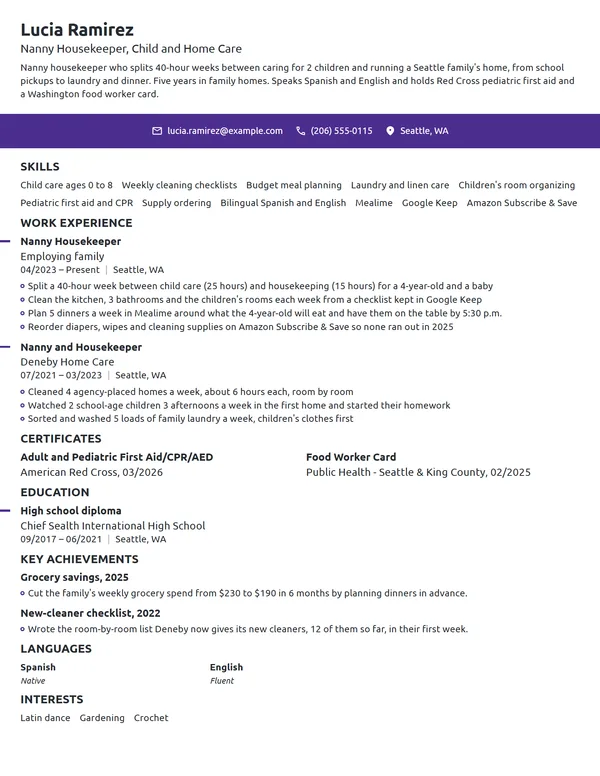
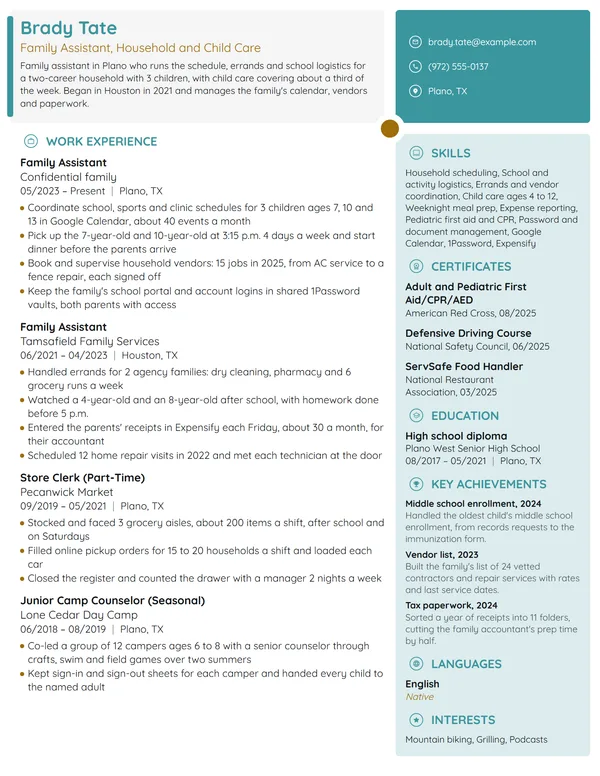
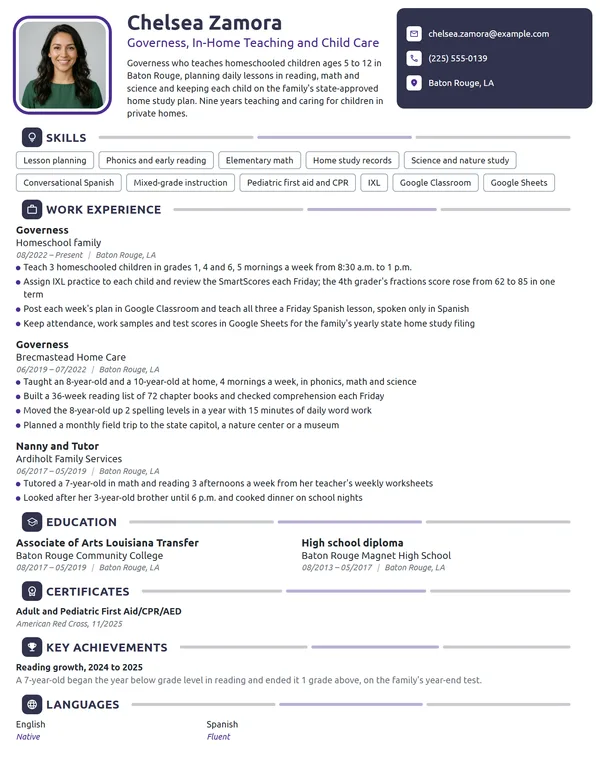
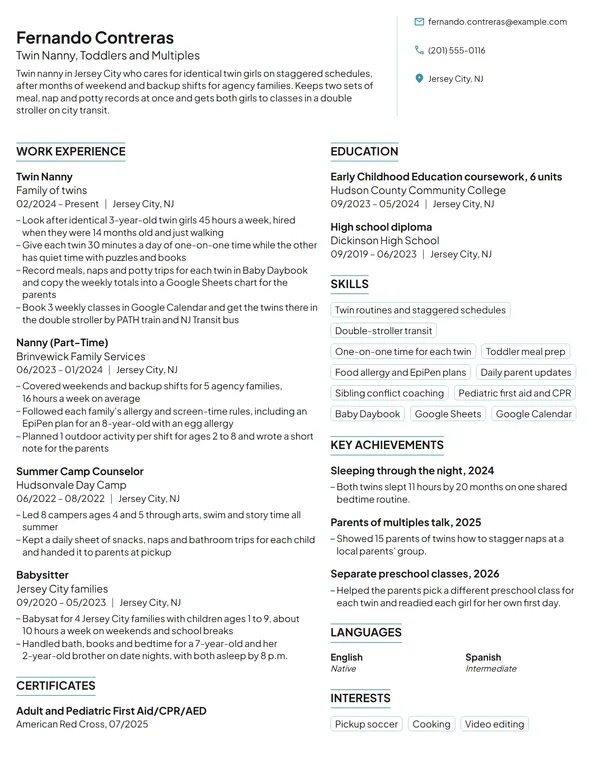
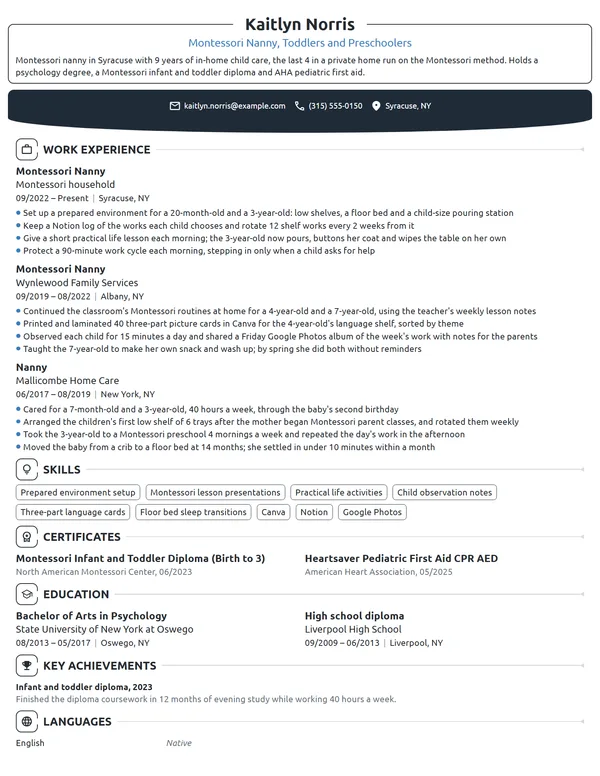
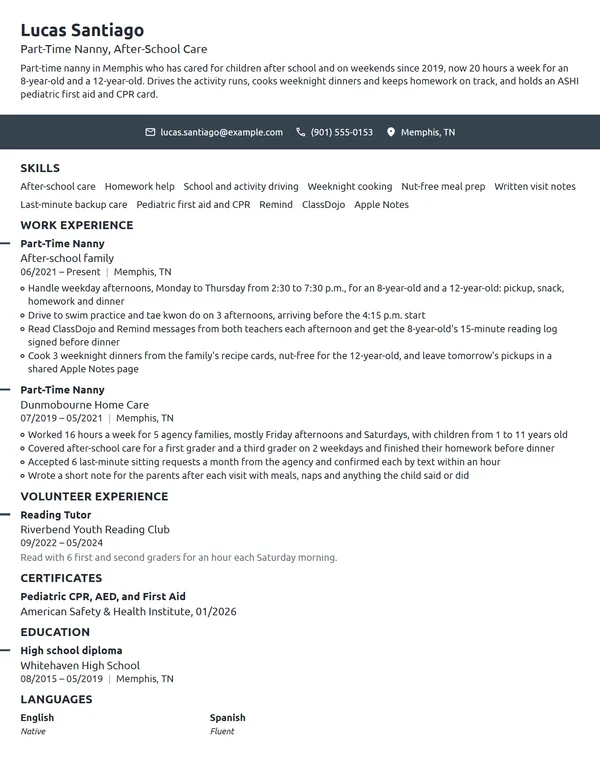
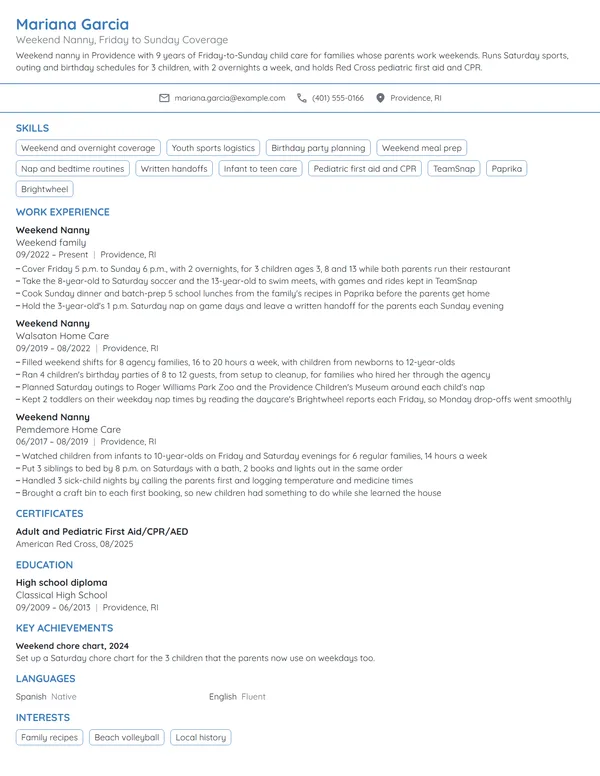
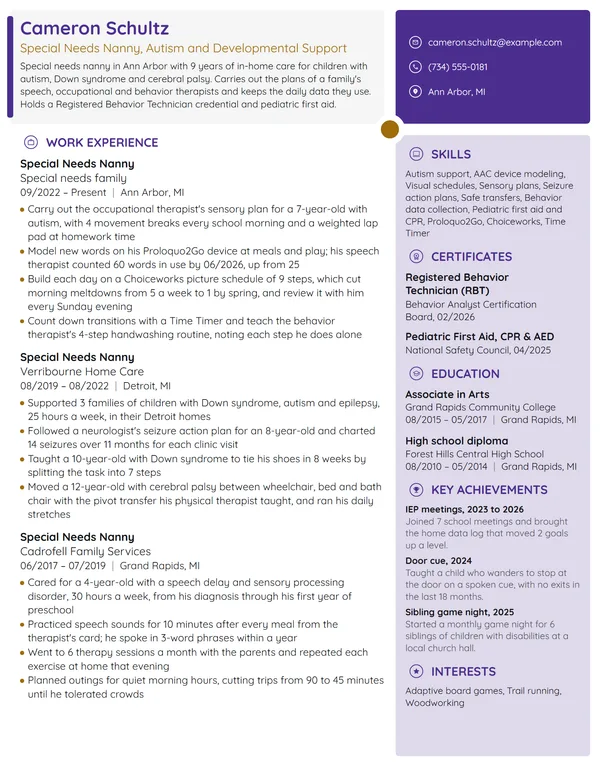
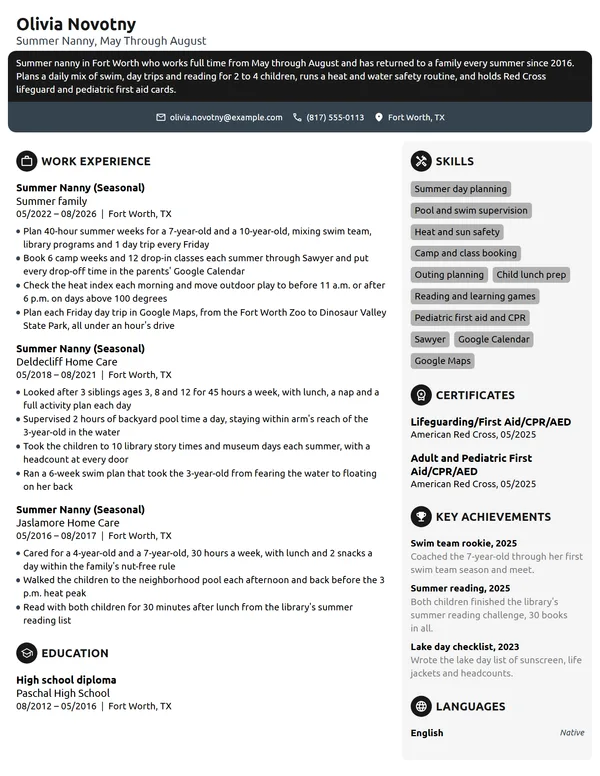
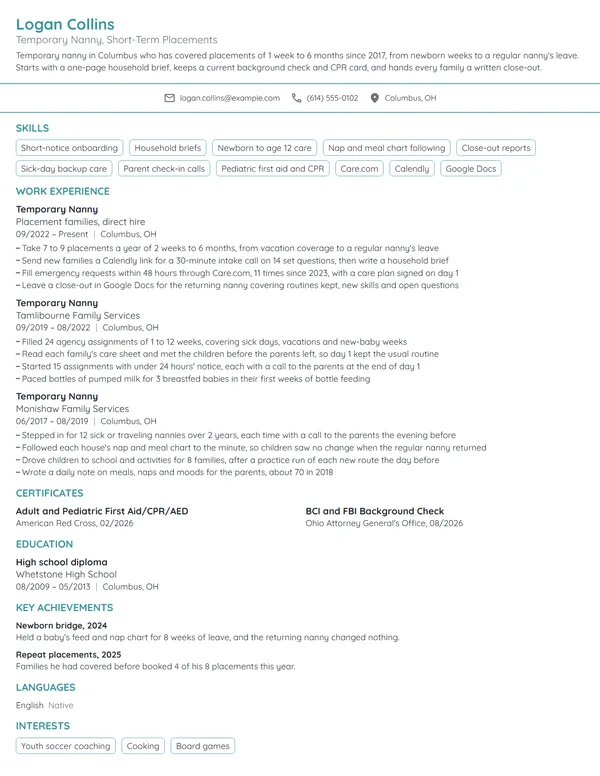
Families hiring a nanny are deciding who to trust with their children, and that decision starts with your resume. Parents and agencies look for the ages you have cared for, the routines you kept, your first aid and CPR training and how long you stayed with each family. Nanny work happens in a private home, with no job titles or performance reviews attached. Each family can still be written up like any other job, with dates, duties and results.
How to Write a Nanny Resume - Key Takeaways
- List jobs newest first on 1 page, writing each family as Private family with its city instead of the parents' names.
- Start the first bullet under every nanny job with the number of children, their ages and your hours a week.
- Give bullets numbers a parent notices: naps and bedtimes, school runs, meals cooked, milestones such as potty training.
- Put pediatric first aid and CPR first under Certificates, with the issuer and date, then any INA credential or car seat training.
- Name the household duties the job covered, such as cooking, the children's laundry or errands, because family postings list them.
- Test your file with an ATS resume checker before you upload it to an agency or a job site.
What families and nanny agencies look for in a nanny resume
A parent reading your resume wants to know 3 things: have you cared for children the age of theirs, will you keep the routines they set, and can you handle an emergency. The BLS says nannies work in the homes of the families whose children they care for, most often full time for 1 family, and may drive the children to school, appointments and activities. O*NET adds core tasks: setting nap and rest schedules, preparing balanced meals and snacks, and performing first aid or CPR when needed.
Agencies read the same resume to match you with a family, so they scan for ages, hours, live-in or live-out work and driving. Build it from these sections:
- Name, headline (for example, Nanny, Infant and Toddler Care) and contact details
- 2 to 3 opening lines on your years, the ages you know best and 1 result
- Work Experience, newest family first
- Certificates, with pediatric first aid and CPR at the top
- Skills, including household duties such as cooking or errands
- Education
- If space allows: Languages, and either Volunteer Experience or a Key Achievements block
Best format for a nanny resume
Use the reverse-chronological resume format: your current family first, then each earlier job with its title, the employer line, the city, and dates written MM/YYYY. Parents care about how long you stayed, and this order puts your tenure with each family in plain view. Short summer or backup jobs can sit together in 1 entry so they do not crowd out your longest placements.
- Best for most nanniesReverse-chronologicalYour jobs, newest first, with your results under each one.Best for: A steady work history in your field
- FunctionalSkills grouped up top, with a short work history below.Best for: Gaps or very little experience
- CombinationA skills section first, then your full work history.Best for: A career change with strong skills
Keep it to 1 page. A nanny with 10+ years and several long placements can run to 2, as long as the current family, the children's ages and your first aid card sit on page 1.
| Setting | What to use |
|---|---|
| Length | 1 page; 2 only with 10+ years across several families |
| Employer line | Private family | City, ST, or the agency that placed you |
| Job title line | Nanny, plus Live-In, Live-Out, Part-Time or Night where it applies |
| Dates | MM/YYYY for start and end, Present for the family you work for now |
| Typeface | 1 clean font in every section, with body text no smaller than 10 pt |
| Photo, age and family details | A photo is rare in the US and Canada; no date of birth, Social Security number, marital status or the children's names |
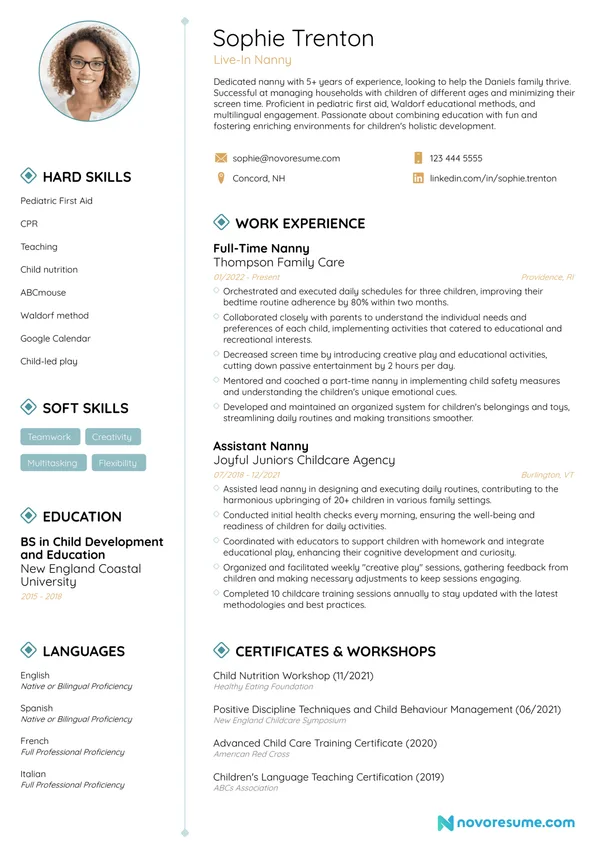
Most US and Canadian resumes carry no photo. Nanny agencies often build a profile of you for families to browse, so if one asks for a picture, upload it to that profile.
Nanny resume summary vs. objective
Ask yourself one question: have you been paid to look after children? If yes, write a resume summary with your years, the ages you know best, the kind of household and 1 result. If this would be your first nanny job, write a resume objective that names the role you want, such as after-school care, and your strongest childcare evidence. Write either one last, once your bullets are done.
Nanny resume summary formula
Title with X years in childcare, Y of them with number and ages of children in type of household. 1 result you can count. Credential or training.
Example
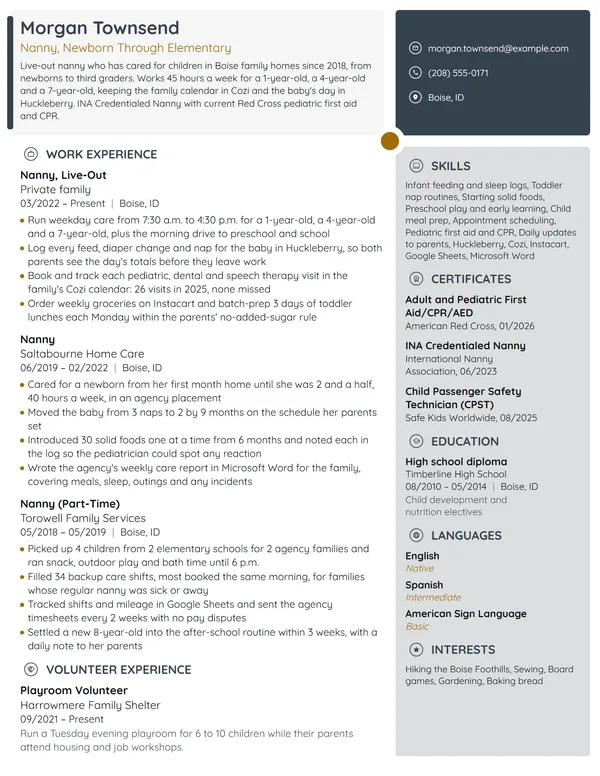
Nanny with 7 years in childcare, the last 4 in a private home with twin toddlers and a first grader. Ran the school, activity and nap schedule for 3 children while 2 working parents covered hospital shifts. INA Credentialed Nanny with a current pediatric first aid and CPR card.
Don't
Loving and responsible nanny who treats every child like my own.
Do
Live-out nanny with 5 years of infant and toddler care, including newborn twins from week 2. Holds a pediatric first aid and CPR card and a clean driving record.
Ages, years and training come first here, in the order a parent checks them.
How to write nanny work experience bullets with numbers
Under your current family, write 3 to 4 bullets; older jobs get 1 to 3. Open with the children, their ages and your hours, since every other line reads against that load: full-time nannies may work more than 40 hours in a week to cover the parents' commutes, the BLS points out. Then turn duties into achievements on your resume by counting what changed while you were there: a new sleep routine, a milestone, homework handed in on time.
| Area | What to count | Example bullet |
|---|---|---|
| Children and hours | Number of children, ages, hours a week, live-in or live-out | Cared for 4 children ages 1 to 9 through 55-hour weeks as a live-out nanny. |
| Sleep and routines | Night wakings, nap schedules, bedtimes kept | Cut a 10-month-old's night wakings from 4 to 1 in 6 weeks, following the parents' sleep plan. |
| Learning | Reading levels, homework, minutes of practice | Read with a first grader 20 minutes a day; she moved up 3 reading levels during the school year. |
| Household | Meals cooked, budgets, laundry, errands | Planned and cooked 12 family dinners a week on a $250 grocery budget. |
| Driving and outings | School runs, activities a week, children driven | Drove 3 children to 7 activities a week across 2 school districts. |
| Health and safety | Medications given as directed, allergies, appointments | Gave a 5-year-old a daily asthma inhaler as the parents directed and logged every dose for the pediatrician. |
| Tenure | Years with 1 family, ages you stayed through | Stayed 6 years with 1 family, from newborn care through kindergarten for 2 children. |
Here is a full entry built that way. The children and hours come first, the results follow, and the older center job keeps a single line.
Work Experience
- Care for 2-year-old twins and their 6-year-old brother for 50 hours each week while both parents work hospital shifts.
- Potty trained both twins in 5 weeks with a sticker chart the parents kept going on weekends.
- Drive 3 school and activity runs a day, with both car seats installed and checked to CPST standards.
- Cook 10 lunches and snacks a week around the 6-year-old's peanut allergy, with 0 allergic reactions in 4 years.
- Led a classroom of 9 toddlers with 1 co-teacher and sent each family a written daily report.
Don't
Helped with homework.
Do
Supervised homework 4 afternoons a week for a 9-year-old and an 11-year-old; both finished the school year with no missing assignments.
Now the ages, the routine and a report-card outcome are all there.
Don't
Responsible for meals and snacks.
Do
Planned weekly menus for 2 children, one gluten-free, and cooked breakfast and lunch on a $180 weekly food budget.
Nanny skills and household duties for your resume
Pick 6 to 8 skills from the posting that a bullet of yours can back up, starting with the ages it names: newborn care and toddler routines are different jobs to a parent. Patience and discretion count as much as the hands-on skills, but soft skills on a resume need a bullet behind them, such as a family you stayed with for 5 years.
Hard skills for nannies
- Infant and toddler care
- Potty training
- Nap and bedtime routines
- Meal planning and child nutrition
- Age-appropriate play and early learning
- Homework help
- Pediatric first aid and CPR
- Safe driving and car seat installation
- Medication given as parents direct
- Children's laundry and household organization
Soft skills parents look for
- Patience
- Discretion
- Clear updates to parents
- Consistency with house rules
- Calm in an emergency
- Flexibility with schedules
Software matters less here than on most resumes, but it still counts. O*NET lists Microsoft Word and Microsoft Excel as software nannies use, along with scheduling software, so name the shared calendar or the meal and expense spreadsheet you kept for a family, with the bullet that shows it. A clean driving record belongs in your Skills section or summary when the job ad mentions driving.
Pediatric CPR, INA and other nanny certifications on a resume
No state license exists for nannies, and BLS data shows that states do not regulate their education. Families and agencies still look for training, starting with pediatric first aid and CPR, since O*NET lists performing first aid or CPR among a nanny's core tasks; the BLS adds that some states require CPR and first aid for staff in licensed childcare. List certifications on your resume in the Certificates section, each with its issuer and the month you earned it.
| Credential | Issued by | What it takes |
|---|---|---|
| Heartsaver Pediatric First Aid CPR AED | American Heart Association | A classroom or blended course on illness and injury in infants and children; the card is valid for 2 years. |
| INA Credentialed Nanny (Nanny Credential Exam) | International Nanny Association | 75 multiple-choice questions, 75% to pass, current first aid and infant and child CPR; 2,000 hours of in-home childcare recommended. The credential does not expire. |
| INA Nanny Basic Skills Assessment | International Nanny Association | A 40-question timed online assessment; a score of 75% or better earns a certificate. |
| Child Development Associate (CDA), Infant-Toddler | Council for Professional Recognition | A high school diploma or GED, 120 hours of early childhood training, and 480 hours with children under 3 in a center-based setting within 3 years of applying. |
| Child Passenger Safety Technician (CPST) | Safe Kids Worldwide | National CPS Certification Training; worth adding when the job includes driving young children in car seats. |
INA credentialed, not certified: how to word nanny credentials
The International Nanny Association states that passing its Nanny Credential Exam does not make you a Certified Nanny, so write INA Credentialed Nanny. Copy your first aid course name exactly as the card prints it, and add a background check only where the posting asks; in California, families may ask for TrustLine, the state's registry for nannies and babysitters, run by the Department of Social Services with fingerprint checks against state and FBI records.
Certificates
- Heartsaver Pediatric First Aid CPR AED, American Heart Association (AHA), 03/2026
- Child Passenger Safety Technician (CPST), Safe Kids Worldwide, 04/2025
- INA Credentialed Nanny, International Nanny Association, 09/2024
How to list a high school diploma or early childhood degree on a nanny resume
A high school diploma or GED is a complete Education entry for a nanny. Childcare workers with college coursework or an early childhood education credential may qualify for higher-level positions, per the BLS, so an associate degree in early childhood education or child development is worth its own entry with the school and date. Follow the basics of listing education on a resume, and add 1 line on a practicum only while you are new to the job.
A CDA earned in a child care center goes under Certificates, not Education. The Council for Professional Recognition counts its experience hours in a center-based setting, so a CDA usually comes from daycare or preschool work before or between nanny jobs.
Education
Practicum: 1 semester in a 2s classroom.
Nanny resumes with no experience, after parenting or from another career
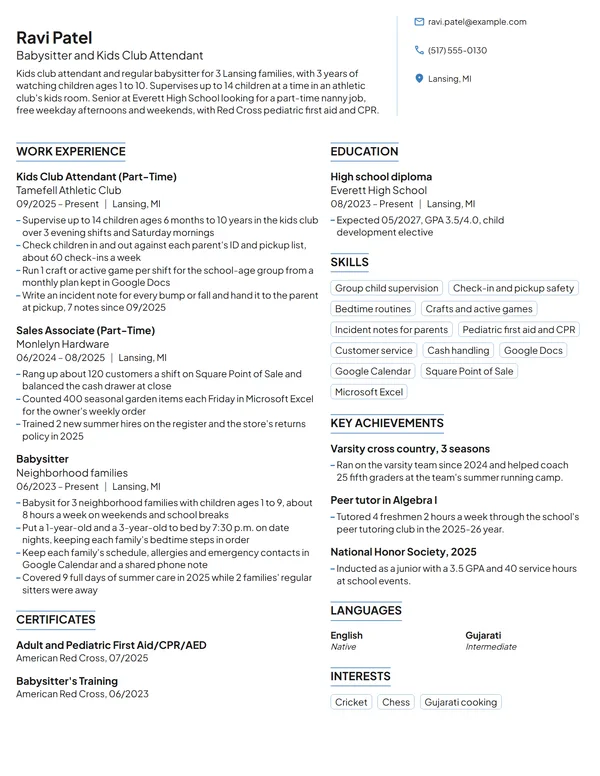
Paid babysitting is childcare experience, and so is summer camp work. List each as a Work Experience entry with the ages, the number of children and how often you sat, and use the babysitter resume examples if most of your work so far is evenings and weekends. Families hiring a first-time nanny often look for these:
- Babysitting: regular families, the ages you watched and hours a week, written like a job.
- Camp counselor or after-school aide: group size, ages and the activities you ran.
- Coaching or church nursery work: under Volunteer Experience, with how many children and how often.
- Pediatric first aid and CPR: earn the card before you apply, since many postings name it.
Don't
Hardworking person who loves kids and is looking for a nanny position.
Do
Early childhood education student seeking a part-time afternoon nanny role for school-age children. 3 summers as a day camp counselor for groups of 10 campers, with a current pediatric first aid and CPR card.
A first-time objective still needs ages, a count and a credential.
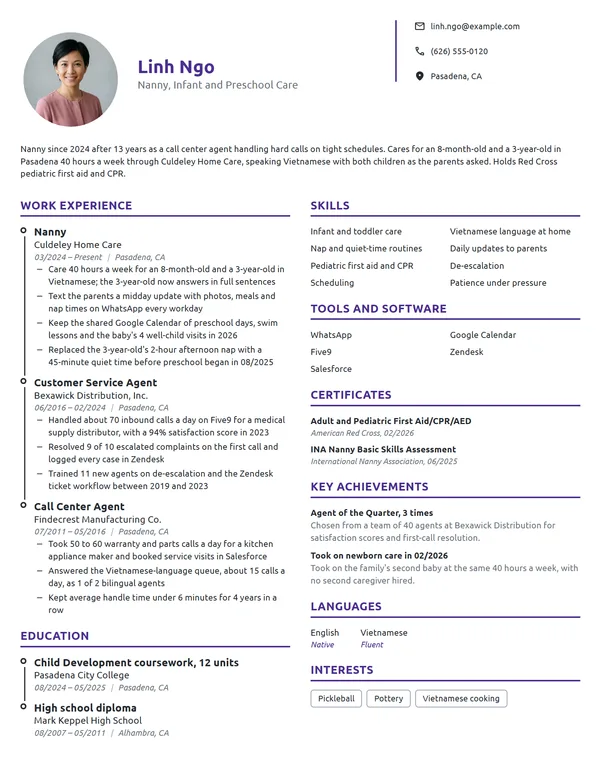
If you are coming back to work after raising your own children, the years at home can sit as 1 dated line, and the tips for parents returning to work cover how to explain the gap. Moving in from another career, keep newest-first order, put your first aid card and any childcare work at the top, and keep the older bullets that carry over: calm with upset customers, keeping a schedule, record keeping. The career-change resume examples show the layout, and a short cover letter is where you tell the family why you chose this work.
Nanny resume FAQ
Should I name the family I worked for on a nanny resume?
No. Write Private family and the city as the employer, and describe the children by age, not by name. Give the parents' names and phone number on a separate reference list once a new family or agency asks for it.
Do you need a certification to be a nanny?
No state license or certification is required to work as a nanny, and the BLS says states do not regulate nanny education. Families and agencies often ask for a current pediatric first aid and CPR card, so earn one before you apply.
Can I call myself a certified nanny after passing the INA exam?
No. The International Nanny Association says its Nanny Credential Exam does not make you a Certified Nanny. Write INA Credentialed Nanny under Certificates, with the month you passed, and use the same wording in your headline.
How do I list several families or short nanny jobs on a resume?
Give every family you stayed with for a year or longer its own entry. Group shorter placements, summer jobs or backup care under 1 entry, such as Nanny, Short-Term Placements, with the overall dates and 1 bullet per family giving the ages and length.
Can I put babysitting on a nanny resume?
Yes, when it was regular and paid. Write it as a job titled Babysitter, with the dates, the number of families, the ages and how many hours a week, so a parent can see how much childcare you have done.
Should I list cooking, laundry and errands on a nanny resume?
Yes, if the job included them. Family postings often list meal prep, the children's laundry and errands as duties, so a bullet with a count, such as dinners cooked a week, shows you can take them on without being asked.
Should I mention my driving record on a nanny resume?
Only if the job includes driving. Nannies may drive children to school, appointments and activities, the BLS says, so write clean driving record in Skills or the summary, and show the school runs in a bullet.
Should I mention a background check on my nanny resume?
Only when the job ad requests one. Name the check and the month it cleared in your summary, such as TrustLine registered in California, and never attach the report itself to your application.
How long should a nanny resume be?
1 page for almost every nanny. Go to 2 only after 10+ years across several families, keeping your current family, the children's ages and your first aid card on page 1.
How much do nannies make?
Childcare workers, the group that includes nannies, earned a median hourly wage of $16.82 in May 2025, per the BLS. Nanny pay varies with your city, live-in or live-out work and the number of children; keep it off your resume and settle it with the family before you start.
Next steps
Choose a nanny example that matches the ages and hours of the job you want, keep its order, and swap in your own families, routines and first aid card. Our resume builder and templates handle the layout; send the finished file with a short note on why this family's job suits you.