
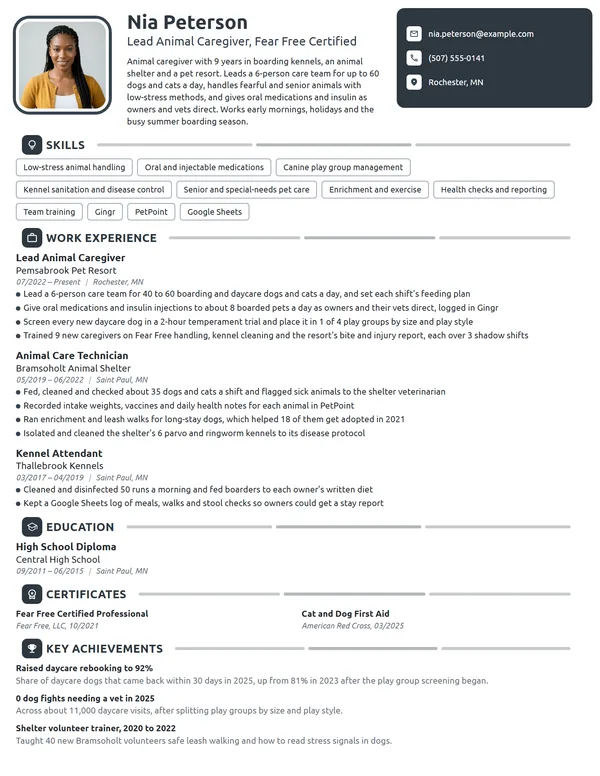
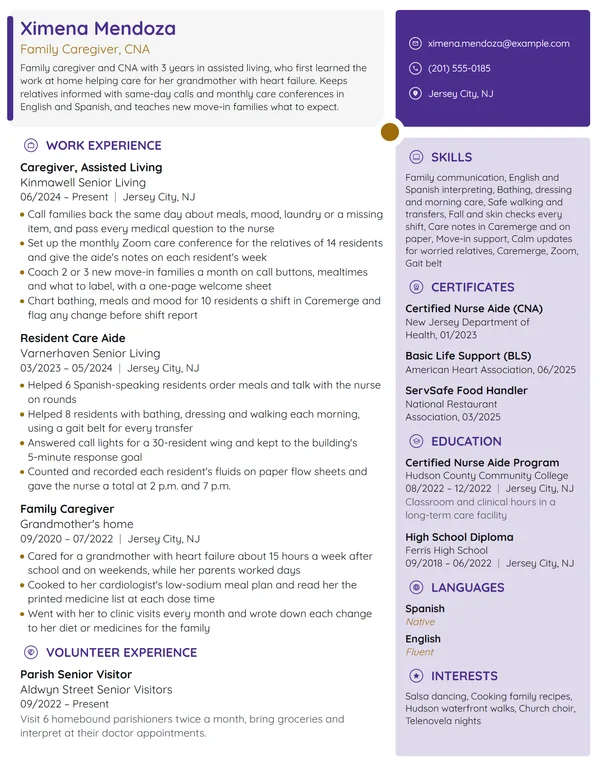
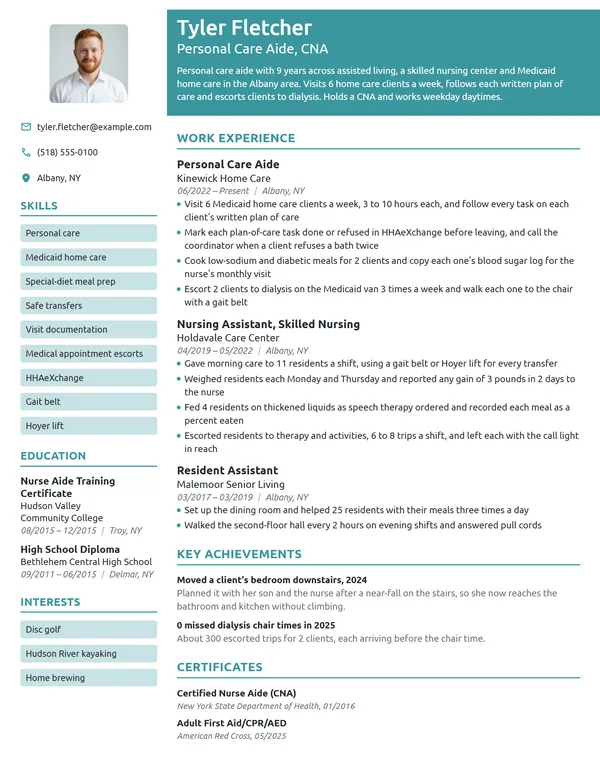
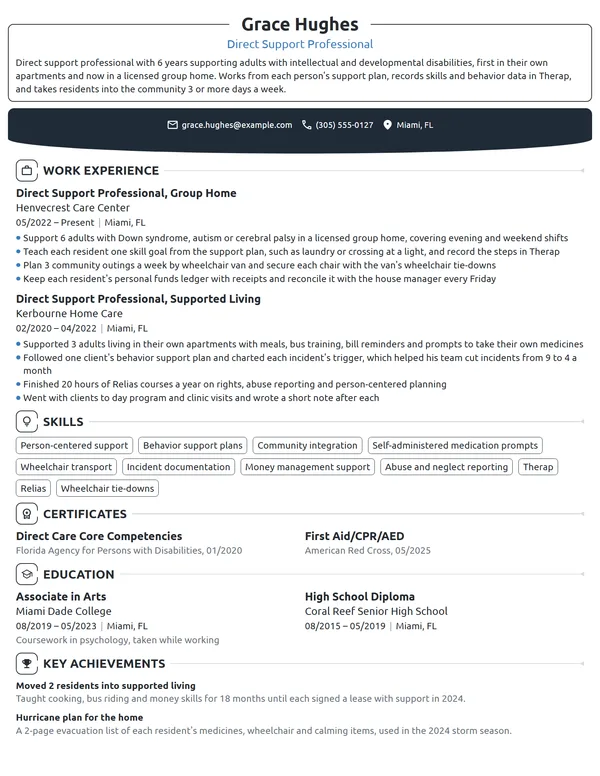
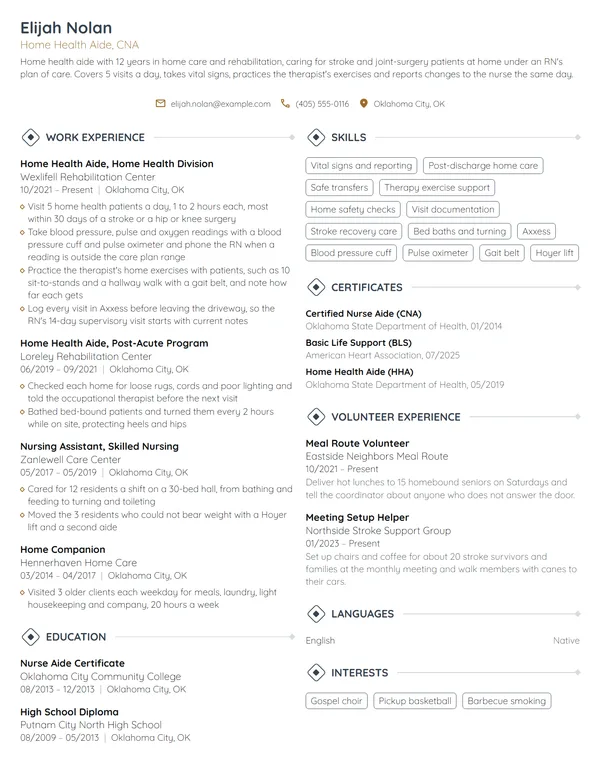
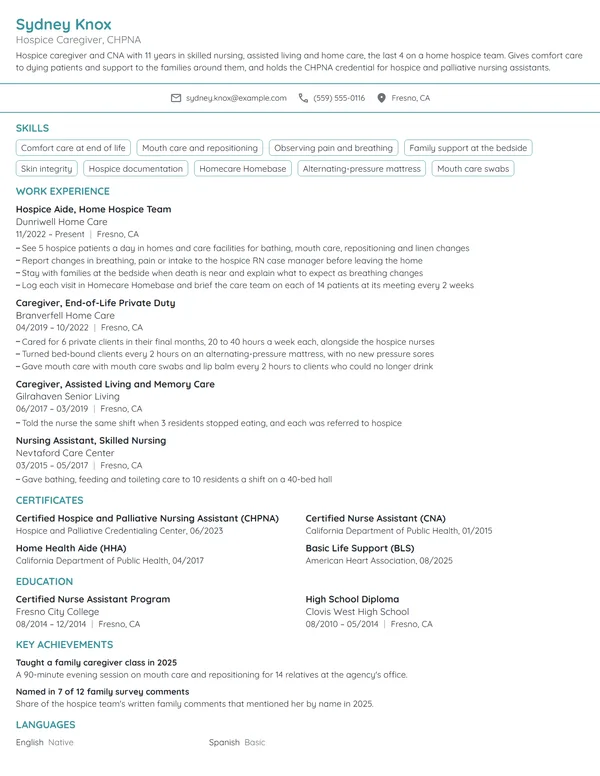
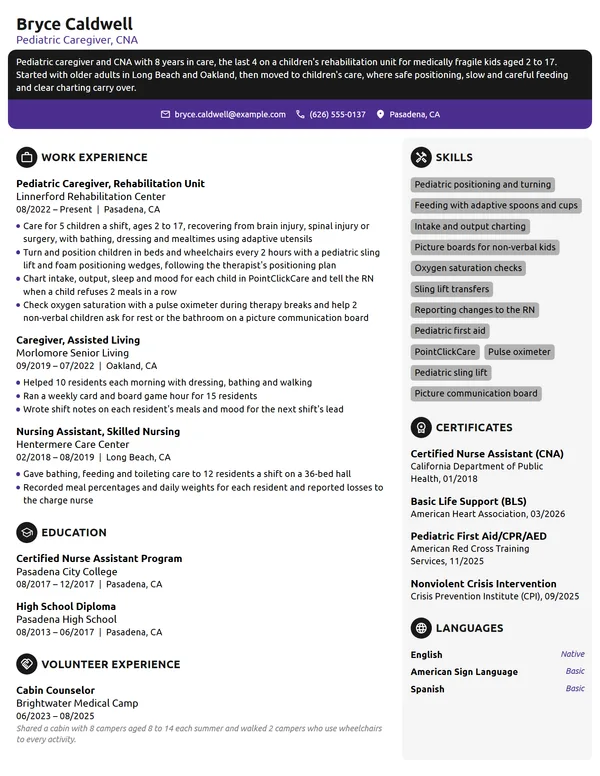
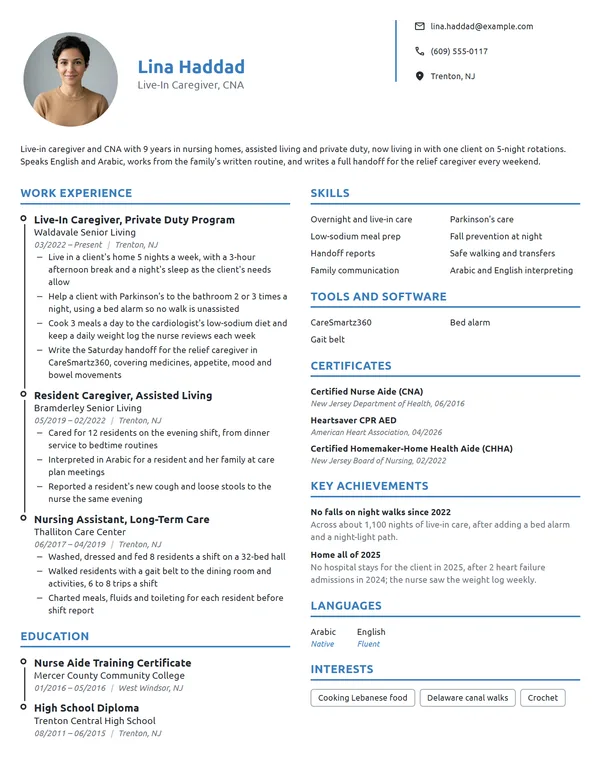
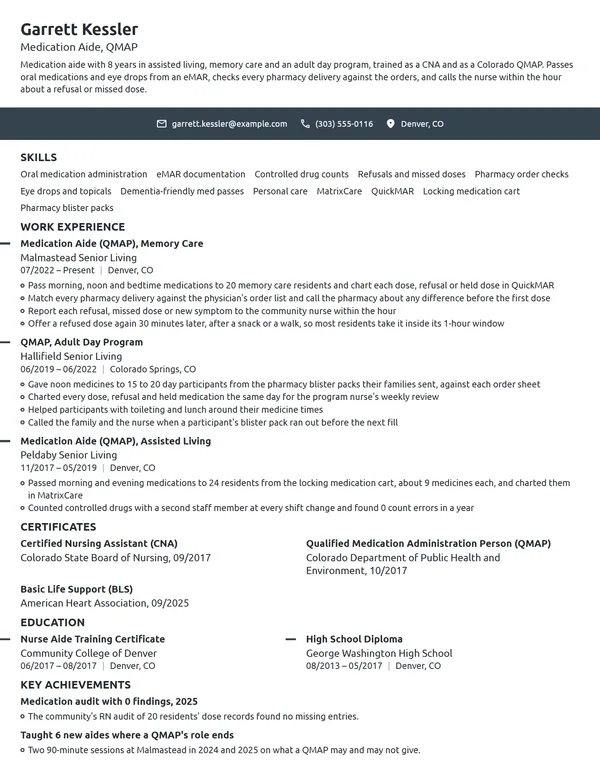
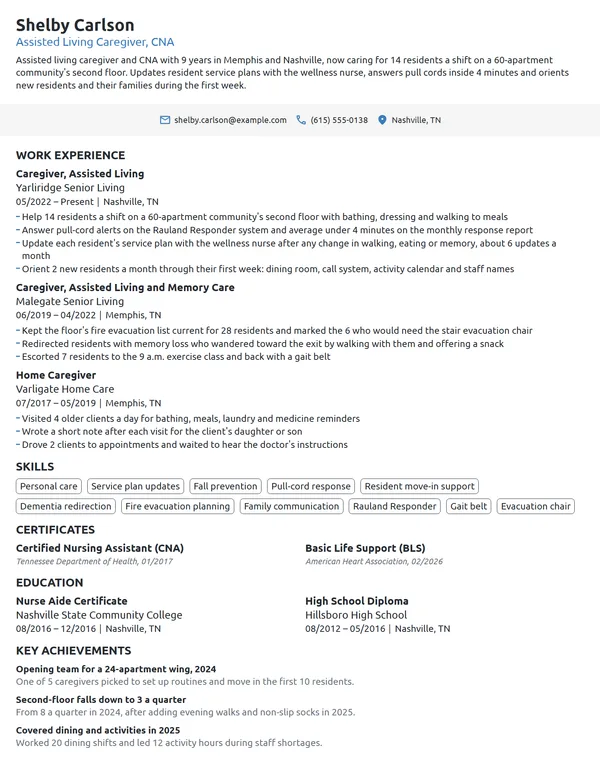
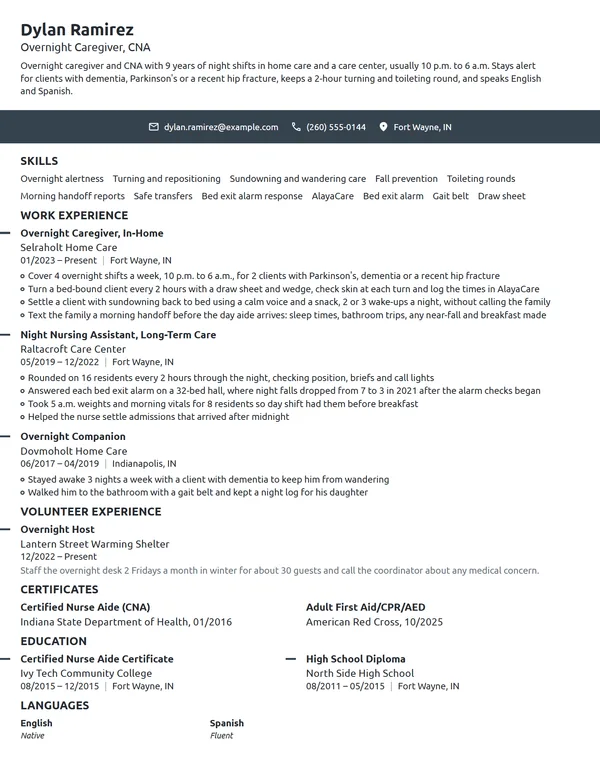
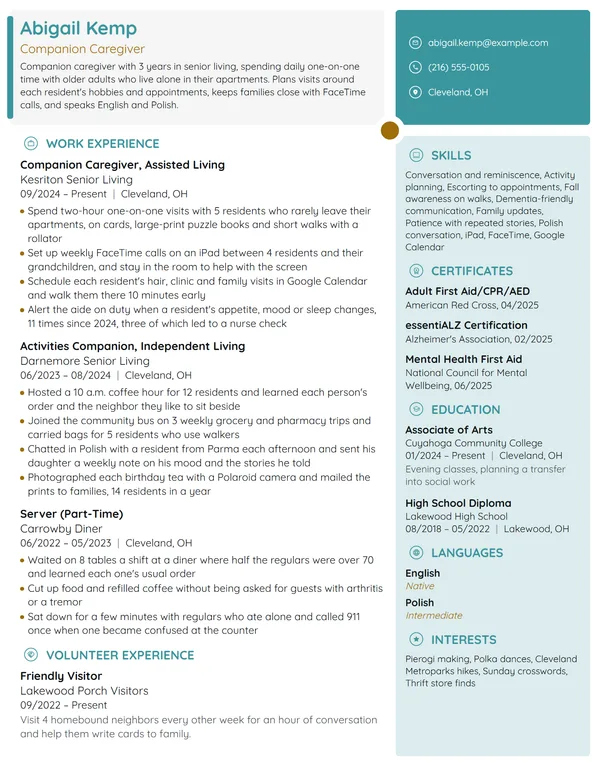
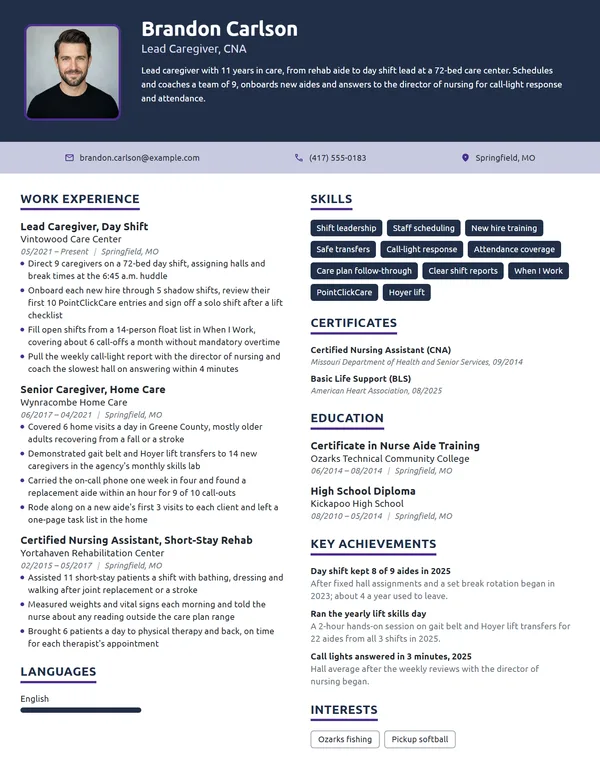
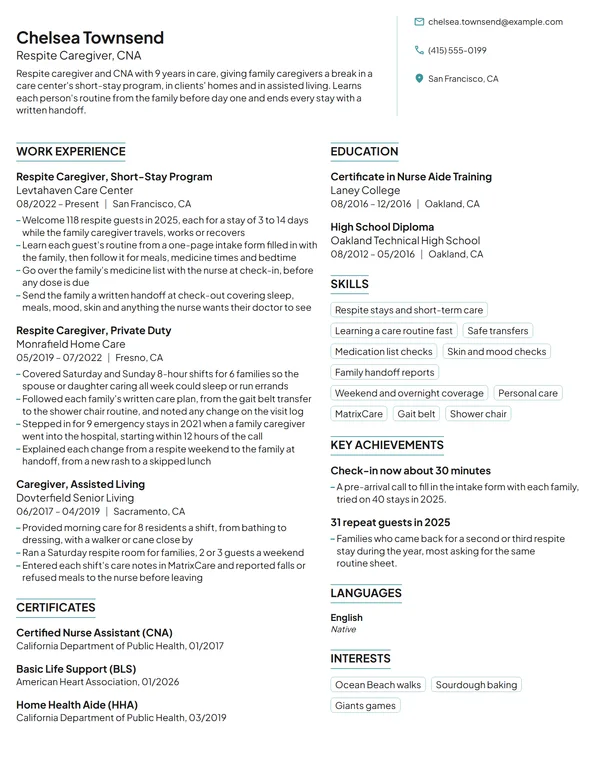
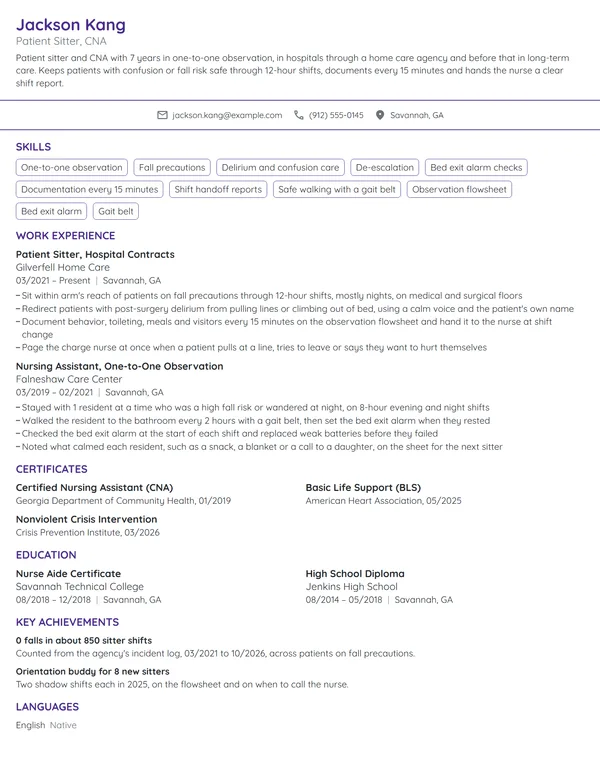
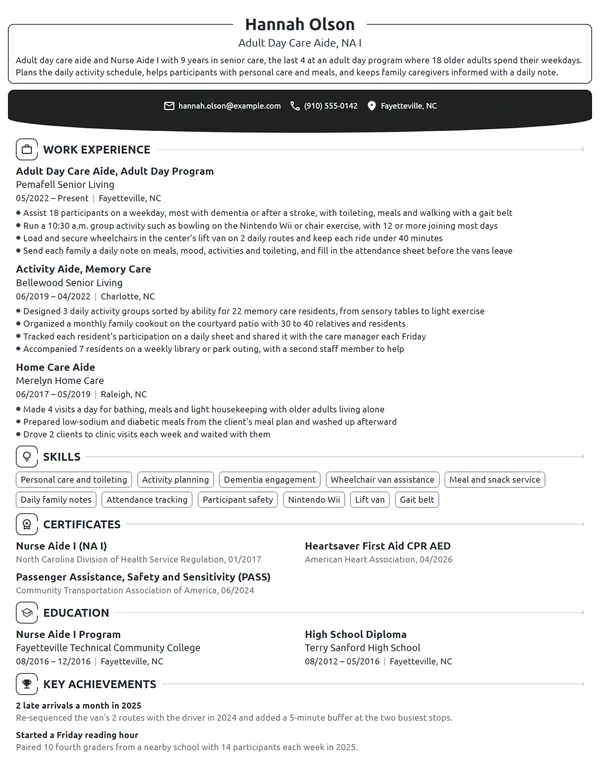
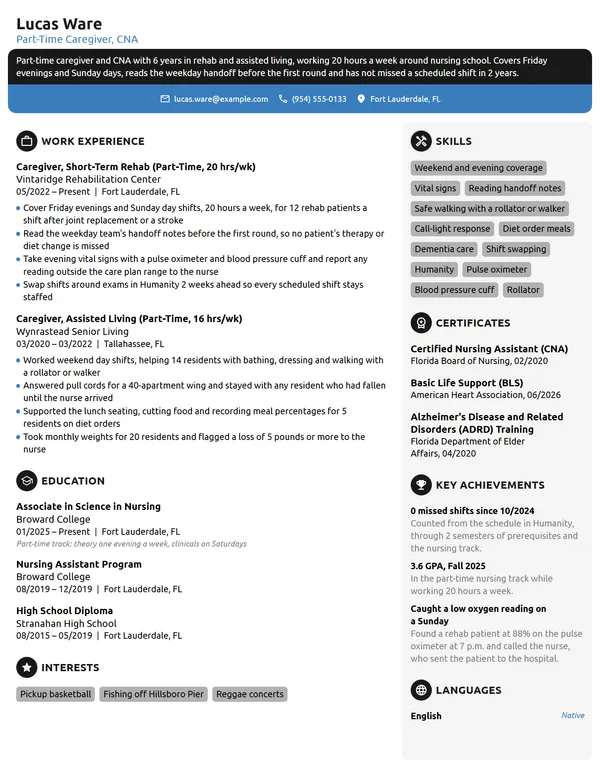
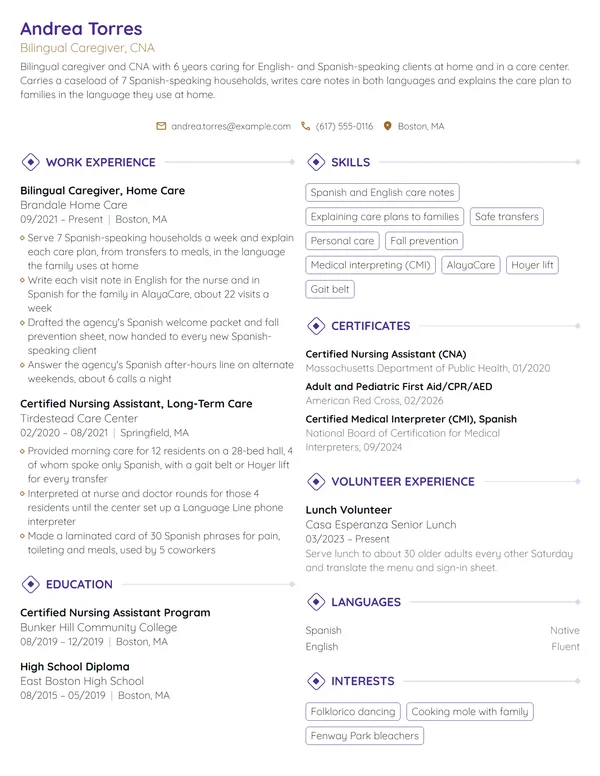
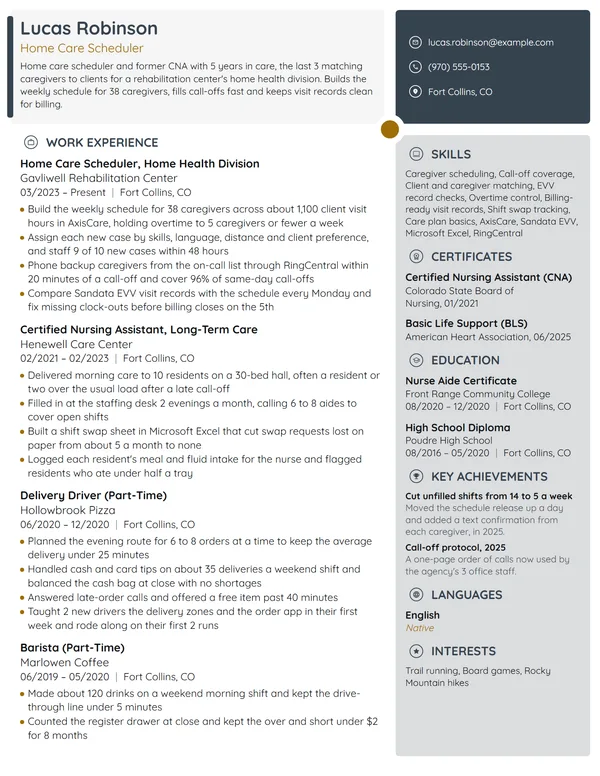
Caregivers are trusted with someone's health, comfort and daily routine, often in that person's own home. Whether an agency or a family is hiring, the question underneath is simple: can they rely on you? A steady work history helps answer it, along with the kind of care you do well, any certificate you hold and the shifts you can cover. Patience and kindness count most in this work, and they are the hardest qualities to write down. Specific details about your clients and routines show them instead.
How to Write a Caregiver Resume - Key Takeaways
- List jobs newest first on 1 page, with the setting (in-home, adult family home, assisted living) in each job title line.
- Describe each client group by age and needs, such as older adults with dementia or a young adult after a spinal injury, never by name.
- Give bullets numbers an agency tracks: clients, hours a week, visits, transfers, falls, care notes and open shifts you covered.
- List your state credential first under Certificates, such as a CNA or home care aide certification, then BLS or CPR and any dementia training.
- Write medication reminders as reminders; claim administration only where your role and your state allowed it.
- Run the file through an ATS resume checker before you apply through a home care agency's online portal.
What home care agencies look for in a caregiver resume
A home care scheduler or care home manager reads your resume to match you to a client: can you handle this person's needs, are you trained for them, and will you arrive for every shift. The BLS lists helping clients with bathing and dressing, housekeeping, arranging transportation to appointments, and shopping and cooking to a client's diet among an aide's duties. O*NET adds keeping records of client progress and reporting changes in a client's condition to a supervisor.
That makes your resume a record of the people you have cared for and the work you did for them. Give each job its client group, its setting and its hours, then the results. Build it from these sections:
- Name, headline (for example, Caregiver, CNA or Home Care Aide, Dementia Care) and contact details
- A short summary at the top, 2 to 3 lines and no heading
- Work Experience, latest job on top, each title naming its setting
- Certificates: your state credential first, then BLS, CPR or first aid, then dementia training
- Skills, with the care tasks the posting names
- Education
- Optional: Languages, Volunteer Experience or Key Achievements
Best format for a caregiver resume
Use the reverse-chronological resume format: your current or latest job first, then each earlier one with its title, employer, city and dates written as MM/YYYY. Agencies want to know what you are doing now and whether you stay with clients, and this order answers both at a glance. If you worked privately for families, list that as its own entry with the dates and the kind of care you gave.
- Best for most caregiversReverse-chronologicalYour jobs, newest first, with your results under each one.Best for: A steady work history in your field
- FunctionalSkills grouped up top, with a short work history below.Best for: Gaps or very little experience
- CombinationA skills section first, then your full work history.Best for: A career change with strong skills
Keep it to 1 page. Caregiving jobs are often short, so if you have more than 4 roles, combine short agency placements into 1 entry and drop jobs older than 10 years that have nothing to do with care.
| Setting | What to use |
|---|---|
| Length | 1 page for nearly every caregiver |
| Dates | MM/YYYY for each role, and Present for the one you are in today |
| Job title line | Title plus setting: Caregiver, In-Home Care or Resident Caregiver, Memory Care |
| Client privacy | Age group, needs and setting only; no client names, addresses or photos |
| Font and size | Arial, Calibri or a similar clean font, with 11 pt body text |
| Photo and private details | Most US and Canadian resumes carry no photo; no birth date, family status or SSN either |
| File type | PDF by default; a Word file only when the agency's form asks for one |
If a family hiring you privately asks for a photo, send it as a separate file.
Caregiver resume summary vs. objective
One question decides it. If you have been paid to care for clients, write a resume summary with your years, the clients you know best, the setting and 1 result. If this would be your first paid caregiving job, write a resume objective with your training, any family care you have given and the shifts you want.
Caregiver resume summary formula
Title or credential with X years caring for client group in setting. 1 outcome you can count. Training, certification or language.
Example
Certified home care aide with 5 years supporting older adults at home and in an adult family home. Kept the same 3 long-term clients for over 2 years without a missed visit. Trained in dementia care and fluent in Spanish.
Don't
Caring and compassionate caregiver who loves helping people and making a difference.
Do
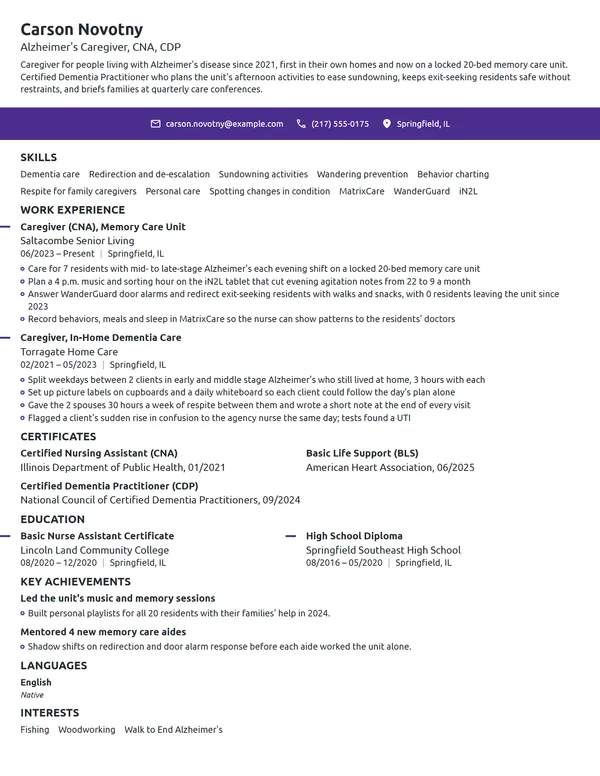
Caregiver with 4 years in memory care, assisting 9 residents a shift with meals, hygiene and transfers. essentiALZ certified, with current CPR.
The better version names the setting, the load and the training a memory care manager screens for.
How to write caregiver work experience bullets with numbers
Your current job gets 3 to 4 bullets; each older one gets 1 to 3. Open with your load: how many clients or residents, the hours a week or the visits a day, and the setting. Then show results the agency or care home already records, the way you would write achievements on any resume: falls avoided, changes reported in time, shifts covered, families trained.
| Area | What to count | Example bullet |
|---|---|---|
| Client load | Clients, hours a week, visits a day, residents a shift | Covered 3 home visits a day, 2 to 4 hours each, for older adults living alone. |
| Mobility and transfers | Transfers, lift use, 1- or 2-person assists | Completed Hoyer lift transfers for 2 bed-bound clients twice a day with no skin tears in 14 months. |
| Home safety | Falls, incidents, hazards removed | Ran a safety check in each new client's home and cleared trip hazards in 11 homes in a year. |
| Documentation | Care notes, visit records, changes reported | Wrote a care note after every visit, more than 1,200 in 2025, with none returned for correction. |
| Reliability | Open shifts covered, call-outs, years with one client | Picked up 40 open shifts in a year so no client went without a visit. |
| Family support | Family members trained, care plan meetings | Showed 3 family members how to use a gait belt and shower chair before a client came home from rehab. |
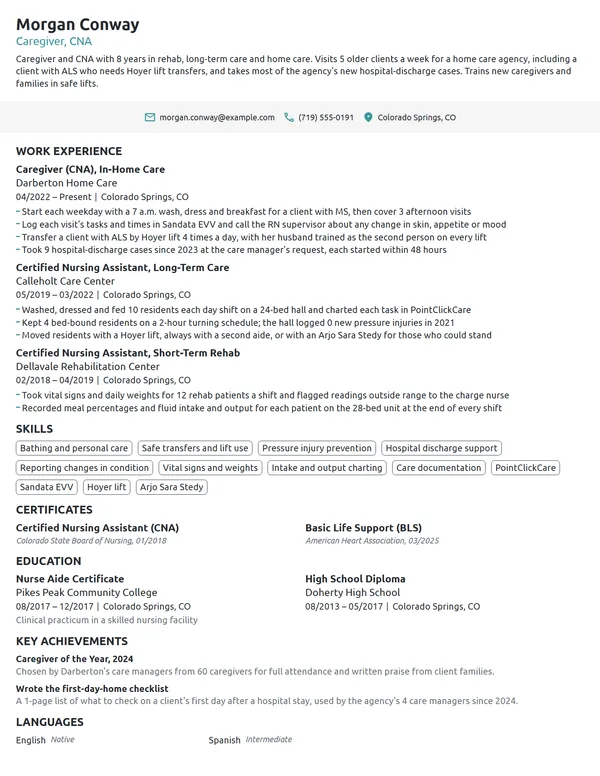
Here is how 2 jobs read once the counts are filled in. The current role leads with its load, the condition report shows judgment, and the older job keeps a single line.
Work Experience
- Support 4 clients across 32 scheduled hours a week with bathing, dressing, meals and medication reminders.
- Clock in and out of every visit in the agency's EVV app, with 0 late or missed visit records in 2025.
- Reported new ankle swelling in a client with heart failure to the RN case manager the same shift; her doctor saw her within 24 hours.
- Walked a client through her home exercise plan after a hip replacement, from 50 to 300 feet a day over 6 weeks.
- Cared for 6 residents on day shift, with transfers by gait belt and Hoyer lift.
Don't
Helped clients with activities of daily living.
Do
Assisted 3 clients a day with bathing, dressing and toileting, using a gait belt on every transfer, with no client falls on shift in 2 years.
The rewrite says how many people, which tasks, how you kept them safe and what came of it.
Don't
Responsible for giving clients their medications.
Do
Gave medication reminders from a weekly pill organizer set up by the client's nurse and logged each dose in the care notes for 18 months.
It calls reminders what they are and leaves the medicine itself to the nurse who set it up.
Medication reminders vs. medication administration
O*NET describes personal care aides monitoring vital signs and medication under the direction of registered nurses, and what an unlicensed caregiver may do with medicines depends on the state and the employer. Write exactly what your role allowed: reminders, help opening containers, or administration under a nurse's delegation if your agency trained and authorized you for it. A manager who reads administered medications on a companion care resume will ask, and the answer should match your bullet.
Caregiver skills and software for your resume
Pick 6 to 8 skills from the posting that your bullets prove, starting with the care tasks it names. On a caregiving resume, soft skills such as patience and dependability matter as much as the hands-on ones, but each needs a bullet behind it, like a client you stayed with for years or shifts you covered.
Hard skills for caregivers
- Bathing, dressing and grooming
- Safe transfers and gait belt use
- Fall prevention
- Dementia care
- Incontinence and toileting care
- Meal planning and preparation
- Medication reminders
- Vital signs
- Light housekeeping and laundry
- Care notes and visit documentation
Soft skills care managers value
- Patience
- Dependability
- Clear reports to nurses and families
- Respect for privacy and dignity
- Calm in an emergency
- Healthy boundaries with families
Name the software you used on shift. Under the 21st Century Cures Act, Medicaid.gov states that every state must use electronic visit verification (EVV) for Medicaid personal care services, so write the EVV or scheduling app your agency used by its name. O*NET flags MEDITECH as a hot technology for personal care aides, which matters if you charted in a facility, and it also lists FaceTime and email software, which fits a bullet about keeping a client in touch with family.
CNA, HHA and home care aide certifications on a caregiver resume
The BLS notes that aides may need to meet requirements specific to the state where they work, and that aides at certified home health or hospice agencies complete formal training and pass a standardized test. Many postings also ask for first aid and CPR, which the BLS says aides may be required to hold. List certifications on your resume with the exact name, the issuer and the month earned, your state credential first.
| Credential | Issued by | What it takes |
|---|---|---|
| Certified Nursing Assistant (CNA), or your state's title | Your state's health department or board of nursing | A state-approved program of at least 75 clock hours, 16 of them supervised practical training, and the state's competency exam. |
| Home health aide (HHA), at a Medicare-certified agency | The agency's training and competency program | A competency evaluation by an RN, usually after at least 75 hours of classroom and supervised practical training, and 12 hours of in-service training every 12 months. |
| Home Care Aide Certification (Washington) | Washington State Department of Health | 75 hours of DSHS-approved training and the certification exam within 200 days of hire, then 12 hours of continuing education a year. |
| Basic Life Support (BLS) | American Heart Association | A provider course; the BLS Provider eCard stays valid for 2 years. |
| First Aid/CPR/AED | American Red Cross | A first aid and CPR course that covers the requirement many home care postings list. |
| essentiALZ Certification | Alzheimer's Association | Dementia care training followed by a certification exam passed at 90% or higher; valid for 2 years. |
The federal training figures come from Medicare's rules for home health agencies (42 CFR 484.80) and nursing homes (42 CFR 483.152). Washington is one example of a state rule: its Department of Health exempts certified nursing assistants from the home care aide certification, so a CNA there lists the CNA alone. If you are still finishing a credential, list it with its status, such as exam scheduled 11/2026, and never write the title as if you already hold it.
Certificates
- Home Care Aide Certification, Washington State Department of Health, 11/2021
- essentiALZ Certification, Alzheimer's Association, 04/2025
- Basic Life Support (BLS), American Heart Association, 01/2026
How to list a high school diploma, GED or caregiver training
The BLS says aides typically need a diploma from high school or the equivalent, so a diploma or GED is a full Education entry, not something to hide. Follow the basics of listing education on a resume: the credential, the school, the city and the month you finished.
Training from a community or technical college, such as a nurse aide training certificate, goes under Education with the college's name; the state credential it leads to goes under Certificates. Agency-run classes and short courses belong under Certificates only. Leave out a GPA and coursework once you have a year of paid care.
Education
Caregiver resumes with no experience, family care or a career change
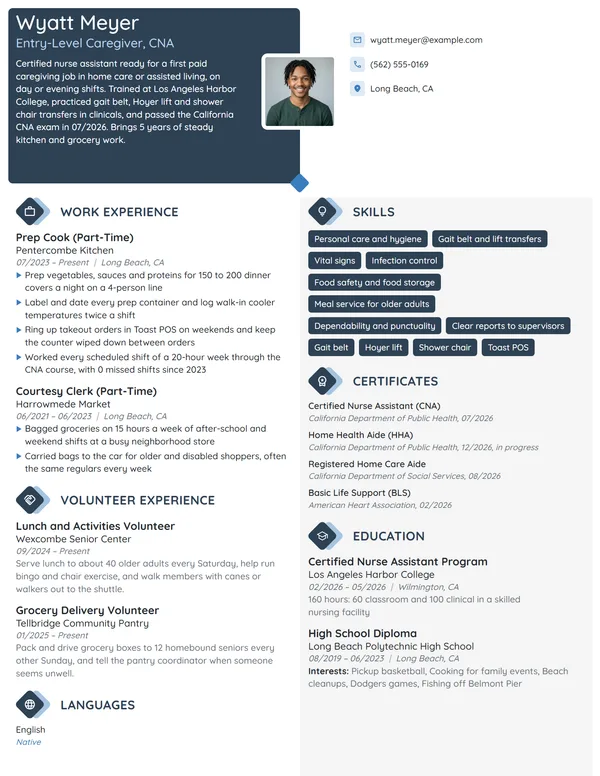
Caring for a parent, grandparent or sibling is caregiving experience. List it under Work Experience with the title Family Caregiver, the dates and the city, and describe the care in the same numbers a paid job would use. O*NET lists training family members in bedside care as a caregiver task, so the care you gave at home already counts as experience. For a first job, the entry-level resume layout keeps your training near the top.
- Family caregiving: who you cared for by relationship and need, the hours a week, and the tasks, such as transfers, meals or appointments.
- Restaurant, retail or cleaning jobs: keep bullets about food safety, cleaning standards, cash handling and never missing a shift.
- Training in progress: the program, its hours and the month you finish or test, listed under Certificates with its status.
- Hospital, senior center or hospice volunteering: under Volunteer Experience, with the hours and what you did, written the way you would write volunteer experience on a resume.
Don't
Seeking a caregiver position where I can use my compassion to help others.
Do
Home care aide trainee who finished 75 hours of DSHS-approved training in 09/2026, after 2 years caring for a grandparent after a stroke. Seeking weekday shifts with older adults in Pierce County.
An objective with no paid experience still needs hours, dates and a kind of client.
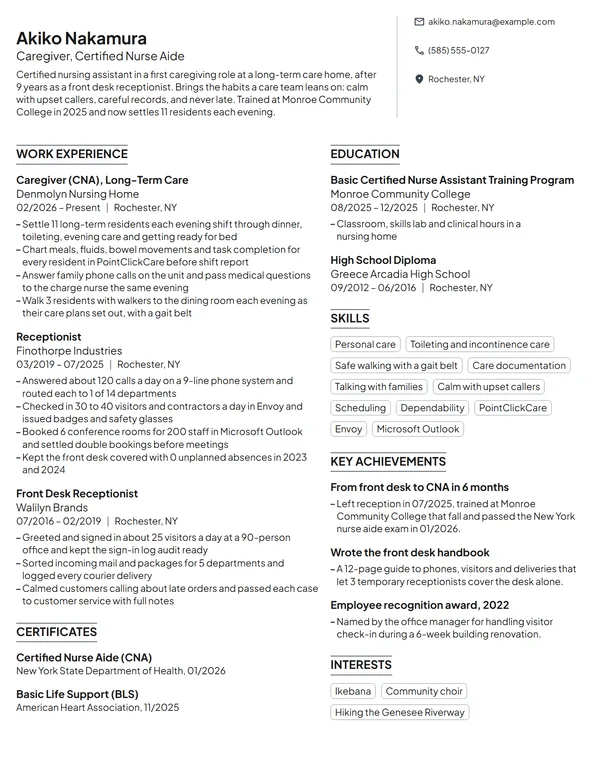
If you are moving into caregiving from another field, stay with newest-first order and put your new certificate and any family care at the top. Under older jobs, keep the bullets that carry into care: physical work, keeping to a schedule, dealing calmly with upset customers, safety rules. The career-change resume examples show that layout. Use the cover letter to say why you chose care work, and the healthcare cover letter examples show how to keep that reason to 2 or 3 sentences.
Caregiver resume FAQ
Do you need a certification to work as a caregiver?
Not always. Companion and personal care roles may only need agency training, but home health agencies that bill Medicare require aides to pass a competency evaluation, usually after at least 75 hours of training, and some states, such as Washington, certify home care aides. Check your state's rules and list whatever you hold under Certificates.
Can I put caring for a family member on my resume?
Yes. List it under Work Experience as Family Caregiver with the dates and city, then write 2 or 3 bullets with the hours, the tasks and any training you did for it. Describe the person by relationship and needs, never by name or full diagnosis.
What is the difference between a caregiver and a home health aide resume?
A home health aide resume leads with the federal or state training, the agency type and health tasks done under a nurse, such as vital signs. A caregiver resume can center on personal care, meals, companionship and household help. Use the title your employer used and match the posting's wording in your summary.
Can I write medication administration on a caregiver resume?
Only if your role allowed it. Many caregivers give medication reminders or help open containers, which is what the bullet should say. If your agency trained you to administer medicines under a nurse's delegation, write that, with the training under Certificates.
How do I list several private clients on a caregiver resume?
Group them under 1 entry titled Private Caregiver, Self-Employed, with the city and the overall dates. Then give each client a bullet with their needs, the hours a week and how long you stayed. Ask a family you worked for to serve as a reference.
How do I show live-in or overnight caregiving on a resume?
Put the schedule in the job title line, such as Live-In Caregiver or Overnight Caregiver, and give the days on and off in your opening bullet. Then show what the nights involved: repositioning, toileting, wandering checks or calls you made to a nurse.
What skills should I put on a caregiver resume?
Choose 6 to 8 from the posting: safe transfers, personal care, dementia care, meal preparation, medication reminders and care notes are the usual core. Add a language if you speak one with clients, and leave off any skill your bullets do not show.
How long should a caregiver resume be?
1 page. Even with 10+ years of care work, an agency needs your current setting, your credentials and 2 or 3 recent jobs. Combine short placements and drop old jobs unrelated to care before you think about a second page.
What is the average caregiver salary?
The BLS puts the May 2025 median for home health and personal care aides at $35,800 a year. Pay changes with your state, the setting, your credentials and overnight or live-in work; leave it off your resume and raise it when you discuss the offer.
Next steps
Pick the example closest to the clients you care for and the setting you work in, and replace its numbers with your own: clients, hours, visits and results. Set it up in our builder or on one of our templates, then tell the agency in a short letter which shifts suit you.