
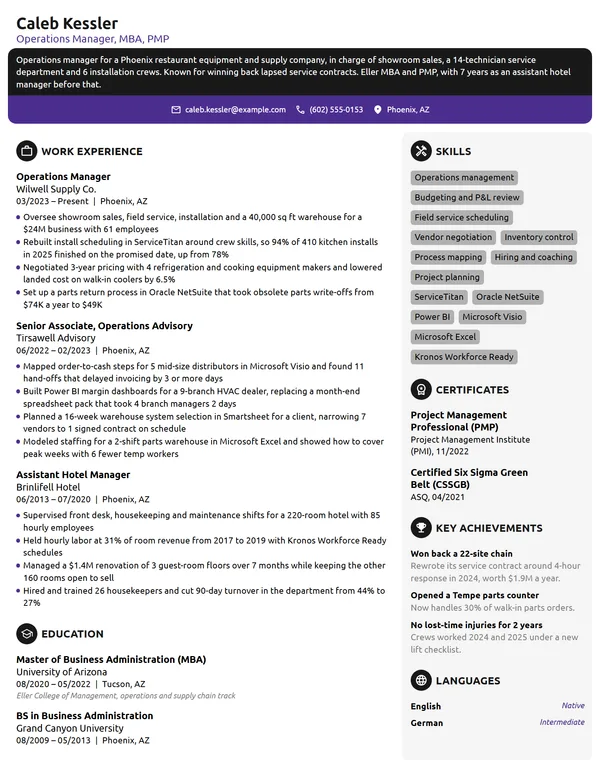
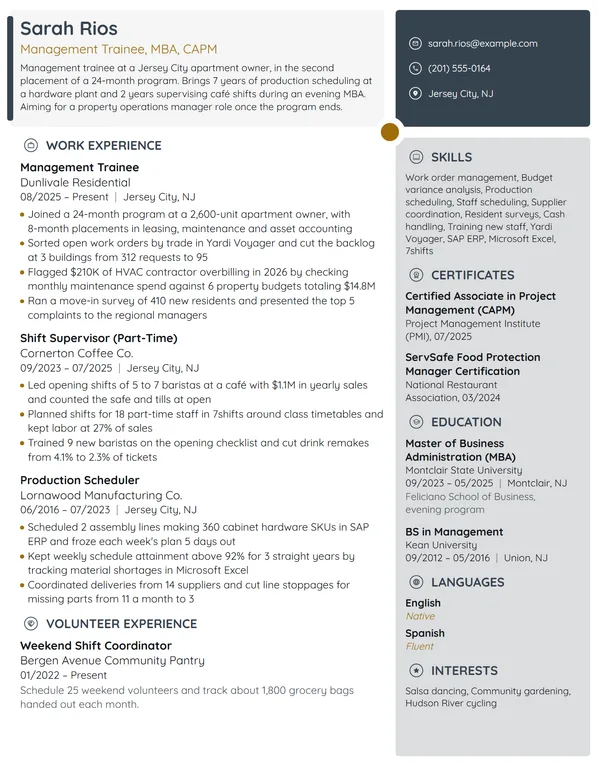
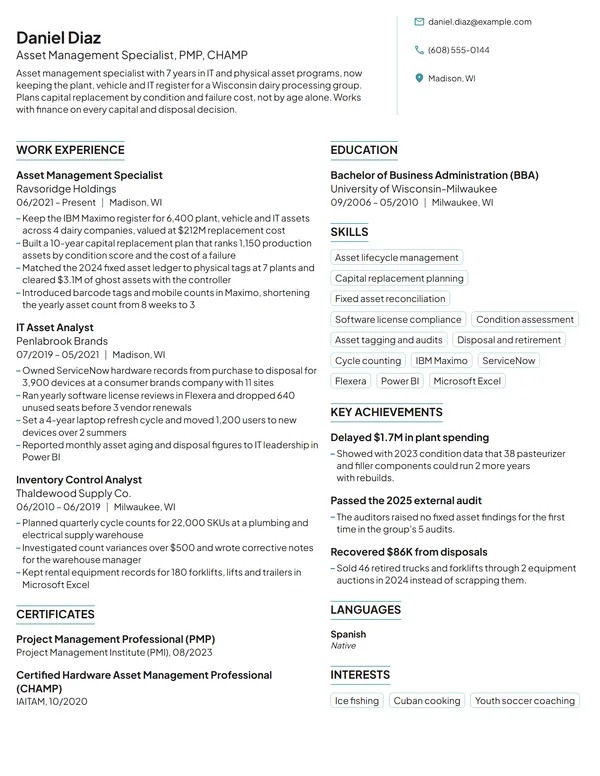
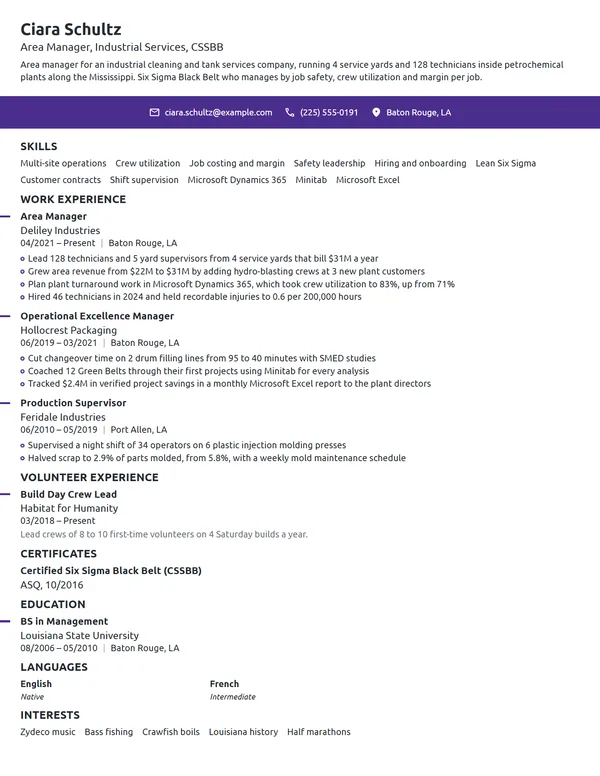
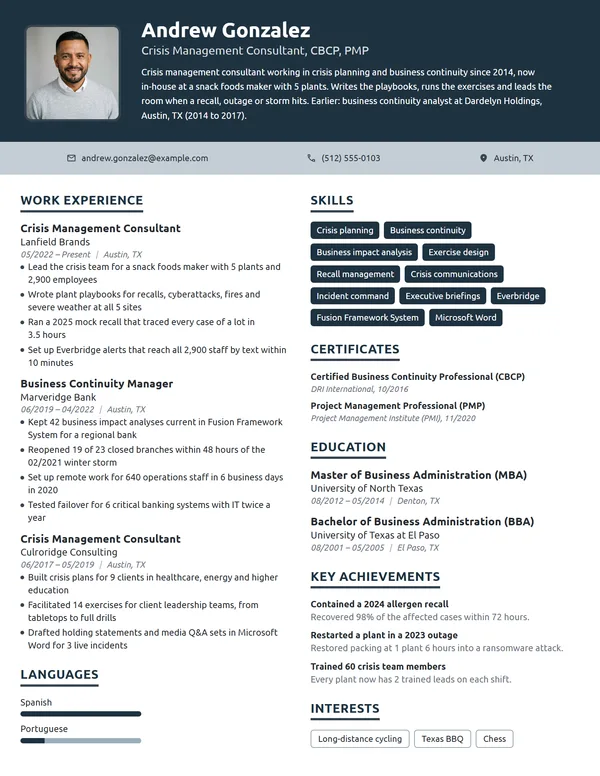
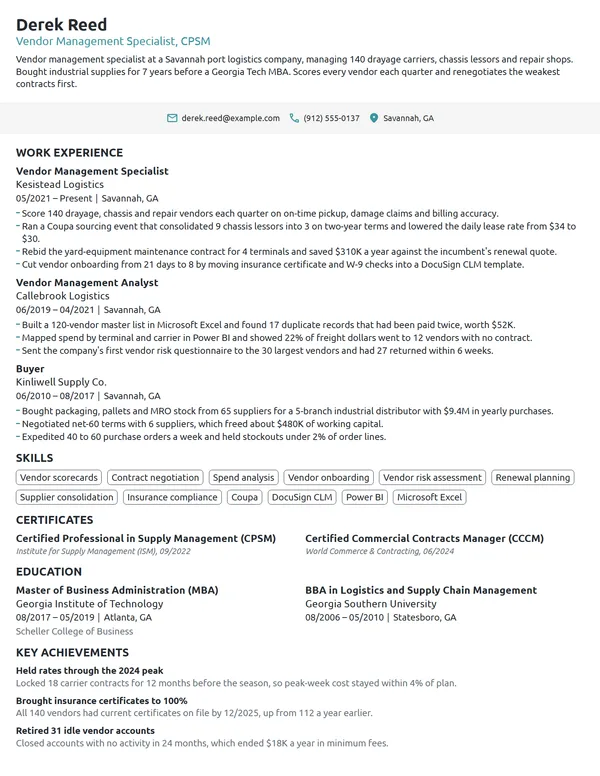
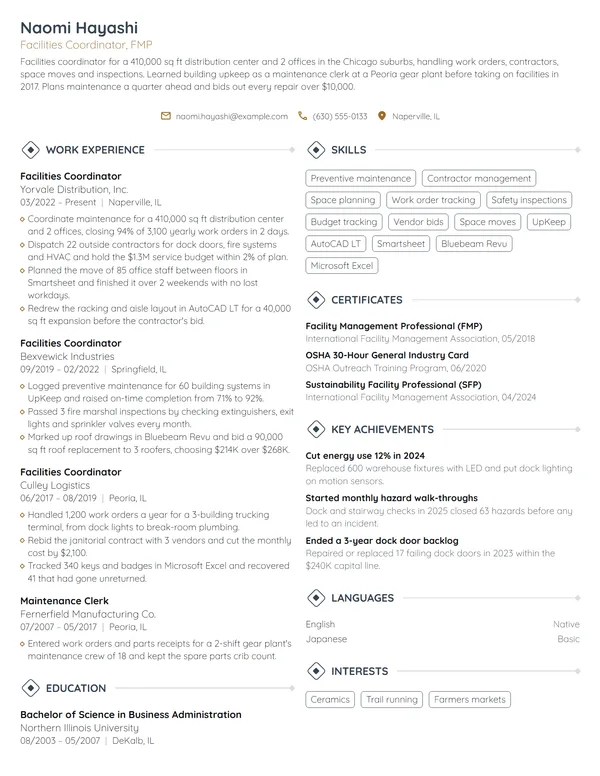
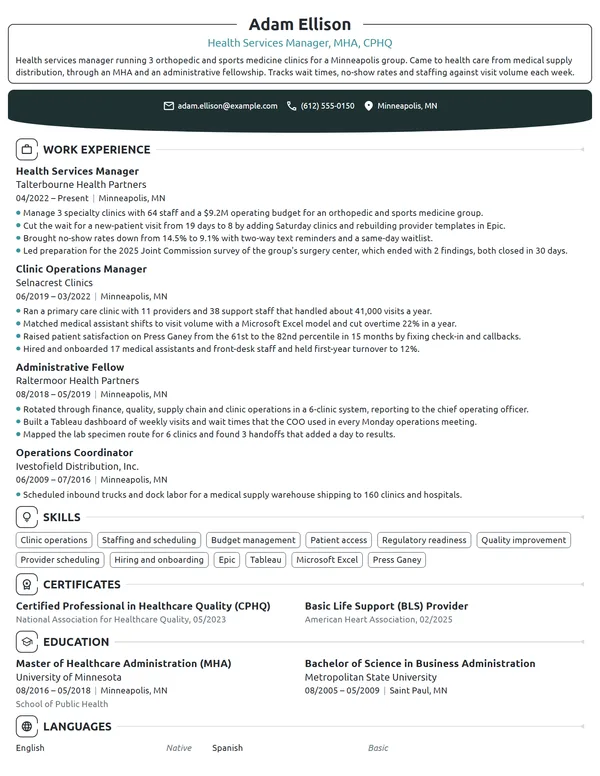
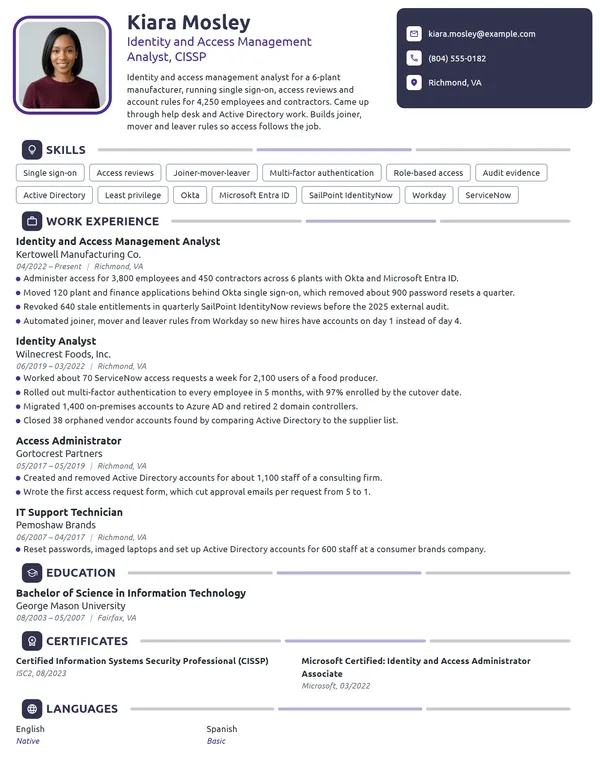
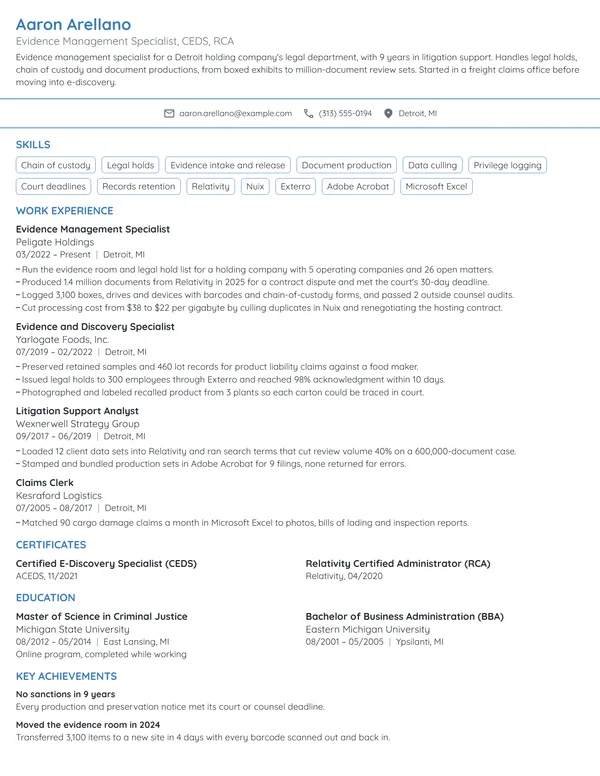
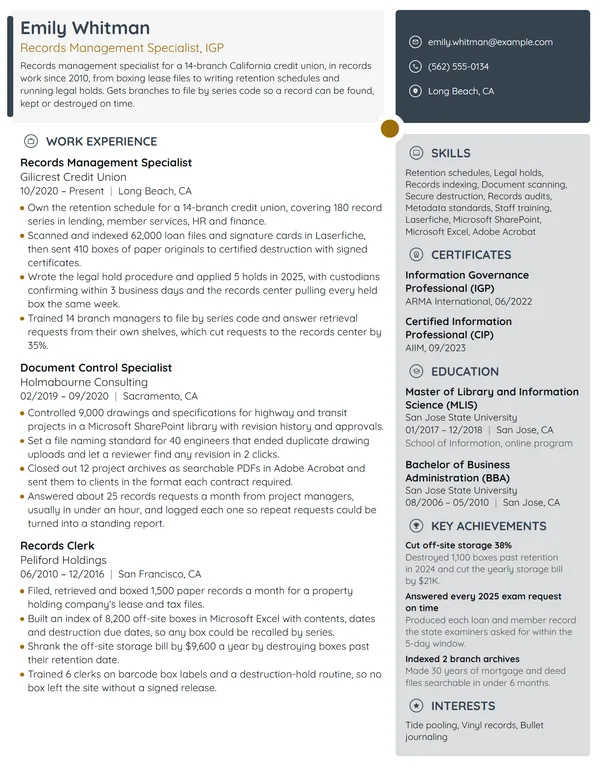
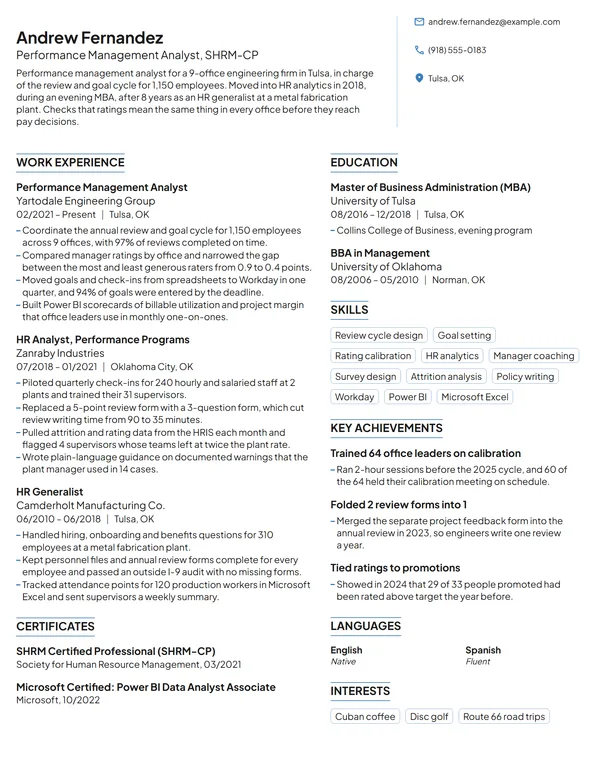
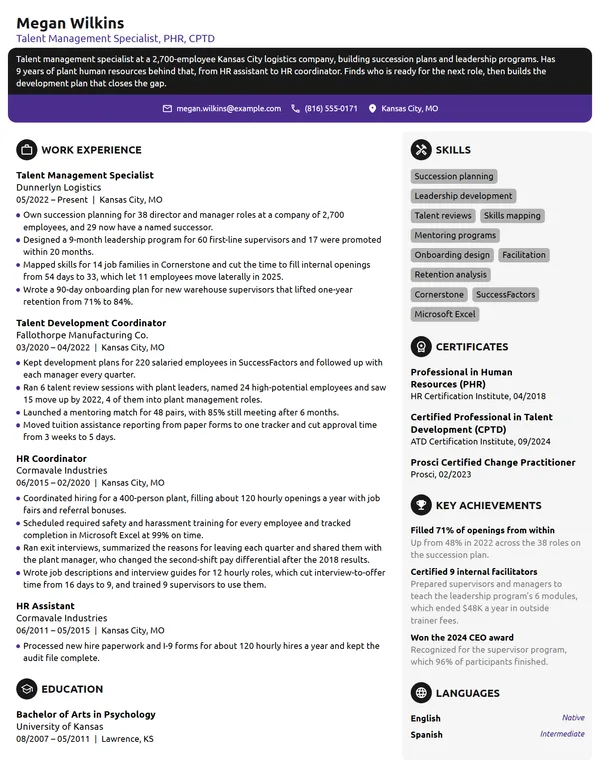
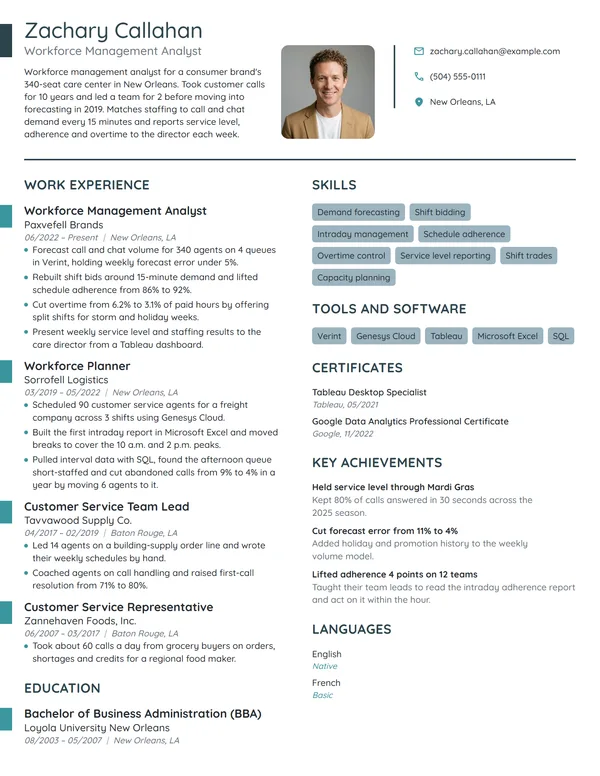
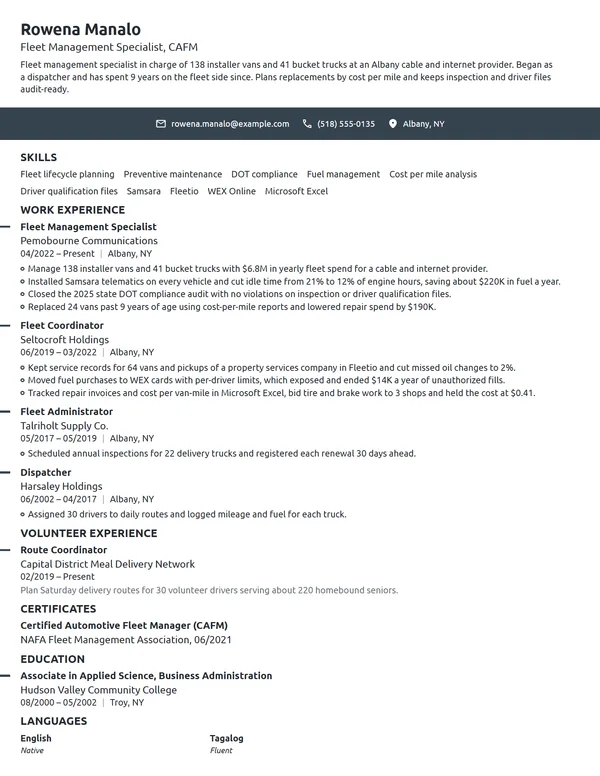
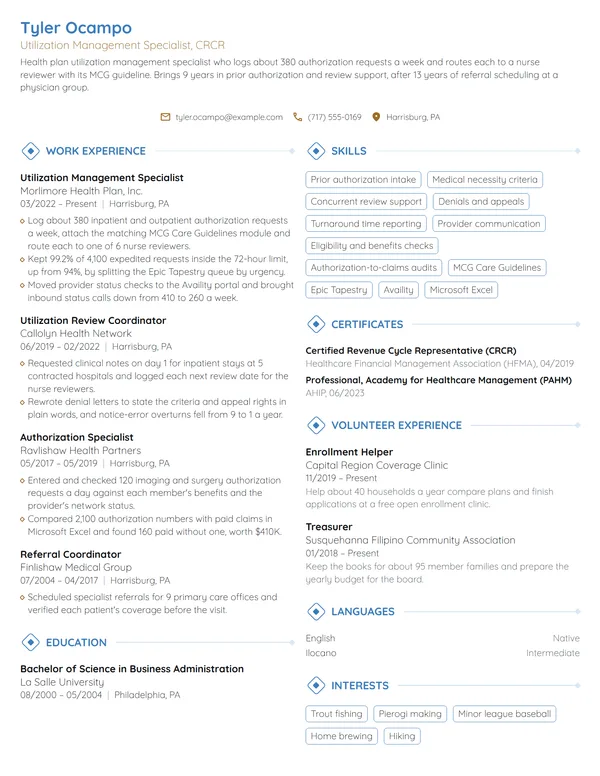
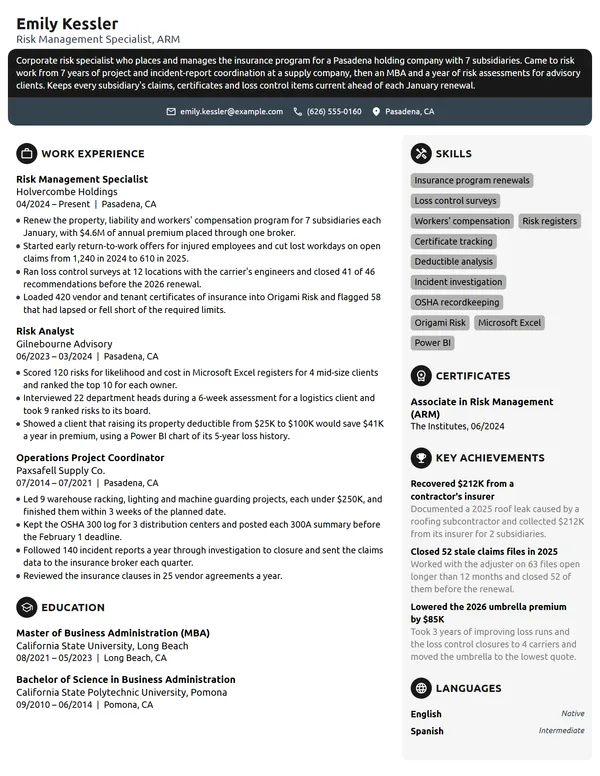
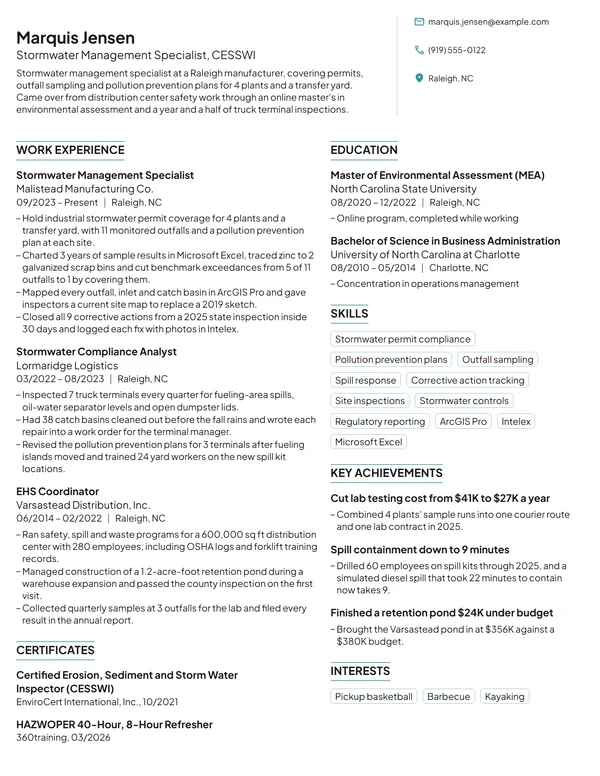
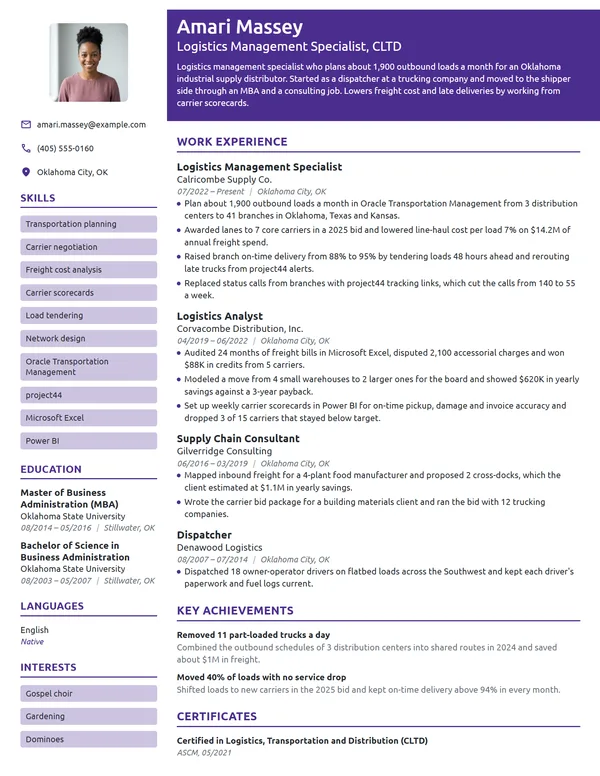
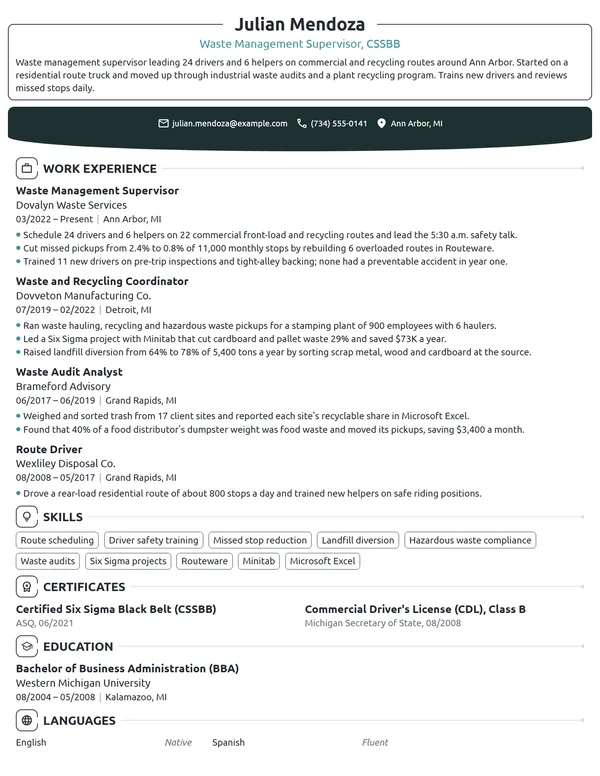
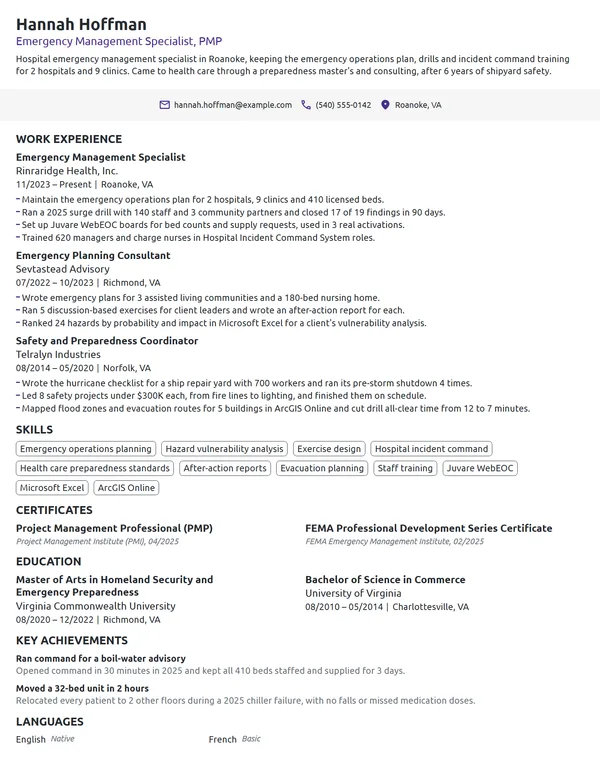
Management covers a lot of ground. One person runs 6 stores across a region, another keeps track of a company's equipment or its risk, and a third is halfway through a trainee program. Whoever reads the resume asks each of them what was in their charge and how big it was. A job title with the word management in it rarely answers that alone, so a strong resume names what you managed and puts a number next to it.
How to Write a Management Resume - Key Takeaways
- Put your newest job first and fit everything on 1 page, moving to 2 after about 10 years or several sites.
- Keep your official job title, then say in the first bullet what you managed: people, sites, a budget, assets, risk or a change program.
- Give each bullet the number a reader in your kind of management tracks, such as headcount, sites, dollars, assets or recovery time, with a before and an after.
- Choose a summary once you have been accountable for a team, a budget or a portfolio, and an objective if a trainee program is your way in.
- List CAPM, PMP, CBCP or CMQ/OE under Certificates with the issuer, and mark any exam you have not passed as scheduled.
- Run the finished file through an ATS resume checker before you send it.
What employers look for in a management resume
A management resume is read for responsibility first and results second. The BLS describes general and operations managers as overseeing work too diverse to fit one area of management, from staff schedules and work assignments to making sure projects get finished. O*NET adds reviewing financial statements and performance data to find where costs can come down, and handling selection, training and evaluation of staff.
Not every management job comes with direct reports, though. An asset management specialist or a crisis management consultant may lead no one and still answer for millions of dollars of equipment or a company's recovery plan. Before you write a bullet, decide which of these you managed, because each one is measured differently:
- People: direct reports, the total team under them, hires and promotions.
- Sites or a region: number of locations, states, square footage or routes.
- A budget or P&L: the dollar figure you owned and how you finished against it.
- Assets: equipment, fleet, IT devices or property, counted and valued.
- Risk, continuity or crises: plans written, exercises run, incidents handled and how fast operations came back.
- Change or projects: rollouts, departments moved, users trained, deadlines met.
Then build the page from the sections every Novoresume design prints, so an applicant tracking system reads each one under a heading it expects:
- Name, a headline that carries your title and top credential, and contact details
- A 2- or 3-line summary or objective under your name (it needs no heading)
- Work Experience, current role first
- Skills, with the software you run the operation in
- Certificates
- Education
- Key Achievements or Volunteer Experience, and Languages, when each adds proof
Best format for a management resume
Use the reverse-chronological resume format: your current role first, then each earlier one, with title, employer, city and dates in MM/YYYY form on every entry. Management careers are judged by how the scope grew, from a shift or a single site to a department, a region or a portfolio, and only this order shows that growth at a glance. Career changers keep this order too, as the last section of this guide explains.
- Best for most management rolesReverse-chronologicalYour jobs, newest first, with your results under each one.Best for: A steady work history in your field
- FunctionalSkills grouped up top, with a short work history below.Best for: Gaps or very little experience
- CombinationA skills section first, then your full work history.Best for: A career change with strong skills
A single page holds most management careers for their first decade. Past that point, 2 pages are fine for an area or district manager with several sites, or anyone whose scope changed often, as long as page 1 carries your current role in full. Roles older than 15 years can shrink to the title, the employer and the years.
| Setting | What to use |
|---|---|
| Length | 1 page early on; 2 pages after about 10 years or several sites |
| Title line | The employer's title, word for word; the scope goes in bullet 1 |
| Scope words | Team, sites, budget, assets or program, with a number for each |
| Dates | MM/YYYY for every role, and Present for the one you are in |
| Photo, birth date, ID numbers | Photos are uncommon in the US and Canada; birth date, marital status and Social Security number stay off |
| File type | PDF, or Word when the application system names .docx |
Most US and Canadian resumes carry no photo. Keep the space for a headline that names your level and credential, such as Branch Operations Manager, PMP.
Management resume summary vs. objective
Ask whether you have already answered for a team, a budget or a portfolio. If you have, write a resume summary that names what you managed, how big it was and your strongest result. If a trainee program or a first management job is your next step, write a resume objective instead: the role you want plus the proof you already have. Draft it after your bullets so its number matches one of them.
Management resume summary formula
Title with X years in industry, managing what: people, sites, budget, assets or risk. Scope with a number. Best result, with a before and an after. Credential.
Example
Branch operations manager with 10 years in distribution, managing a $38M branch for the last 5. Leads 3 supervisors and 52 staff across a yard, a warehouse and 11 trucks. Raised on-time deliveries from 87% to 96% in 14 months. PMP.
Don't
Dynamic management professional with proven leadership abilities and a track record of exceeding goals.
Do
Operations manager with 8 years in senior living, running 2 communities with 140 residents and 75 staff. Lifted occupancy from 84% to 93% in 18 months. Certified Manager of Quality/Organizational Excellence (ASQ).
The rewrite says what was managed, how large it was and what improved.
How to write management work experience bullets with numbers
Your current role gets 3 to 4 bullets and each older one gets 1 to 3, every one starting with a verb. Open with the scope, then spend the rest on what changed: write achievements on your resume with a before, an after and a time frame, because a reader in management compares results, not duties. Pick the measures your kind of management already reports on.
| Kind of management | What to count | Example bullet |
|---|---|---|
| People and teams | Headcount, hires, turnover, promotions | Grew a 14-person team to 23 during a contract ramp-up and kept first-year turnover under 15%. |
| Sites and regions | Locations, states, gaps between the best and worst site | Oversaw 6 locations in 2 states and narrowed the labor-cost gap between the top and bottom store from 9 to 4 points. |
| Budget or P&L | Dollars owned, margin, finish against plan | Owned a $5.6M P&L and returned the unit to a 7.2% operating margin from 4.8% in 2 years. |
| Assets | Items tracked, idle units retired, annual cost | Tracked 2,300 fleet and IT assets and retired 340 idle units, saving $420K a year in lease and maintenance costs. |
| Risk and crises | Plans, exercises, incidents, recovery time | Ran 4 tabletop exercises a year and cut recovery time for order systems from 36 to 8 hours. |
| Change and projects | Departments moved, users trained, weeks to go live | Moved 9 departments to a new scheduling system in 10 weeks, with 210 users trained. |
The entry below belongs to a branch manager who started in a trainee rotation. The current role opens with its scope, the results follow, and the trainee period sits under the first employer with its own title and dates instead of a separate entry.
Work Experience
- Run a $38M-a-year branch with 3 supervisors and 52 staff across the yard, the warehouse and 11 delivery trucks.
- Raised on-time deliveries from 87% to 96% in 14 months by planning routes the evening before and adding a 6 a.m. load check.
- Brought cycle-count accuracy from 93.8% to 98.9% and wrote off $61K less shrink in 2025 than in 2023.
- Finished fiscal 2025 $112K under a $2.7M operating budget while adding a second forklift shift.
- Took over the night shift of 19 associates at the end of the trainee rotation.
- Lowered mis-picks from 1.4% to 0.5% of lines shipped with a scan check at packing.
- Rotated through receiving, inventory control, dispatch and customer service over 18 months.
Don't
Managed daily operations of the department.
Do
Ran daily operations for a 31-person claims intake unit and cleared a 2,400-file backlog in 9 weeks without overtime.
Size, a deadline and a constraint turn a duty into a result.
Don't
Responsible for company assets and inventory.
Do
Audited 1,850 laptops and phones across 5 offices, recovered 120 unassigned devices and cut the next year's purchase order by $96K.
Management skills and software for your resume
Choose 6 to 8 hard skills for your resume that match the posting and that a bullet already proves. Budgeting and scheduling belong on most management resumes; asset tracking, business continuity or change management only where that was your job.
Hard skills for management roles
- Budgeting and forecasting
- P&L management
- Staff scheduling and labor planning
- KPI reporting
- Process improvement
- Vendor and contract management
- Asset lifecycle tracking
- Business continuity planning
- Change management
- Hiring and performance reviews
Soft skills employers look for in managers
- Decision-making with incomplete data
- Clear direction to a team
- Calm in a crisis
- Negotiation
- Coaching
- Accountability for results
Put your software inside the Skills section, then show each tool doing something in a bullet. For general and operations managers, O*NET marks Microsoft Excel, Microsoft PowerPoint and the Office suite as in-demand technology. It also lists Kronos Workforce Timekeeper for timekeeping, Yardi for property operations, Oracle PeopleSoft, Microsoft Visio for process maps, Oracle Primavera for project portfolios and Atlassian JIRA for workflow tracking as hot technologies. Name the exact product the posting names, and only ones you have worked in.
PMP, CAPM, CBCP and CMQ/OE: certifications for management
No license is needed to work in management, so a credential helps most when it matches the kind of management in the posting. Add certifications to your resume under Certificates, each with its issuer and the month and year you earned it, and put the one the posting asks for in your headline.
| Credential | Issued by | What it takes |
|---|---|---|
| CAPM (Certified Associate in Project Management) | Project Management Institute (PMI) | No experience required: a secondary degree, such as a GED, and 23 hours of project management education before the exam. |
| PMP (Project Management Professional) | Project Management Institute (PMI) | 35 hours of project management training, plus 3 years of experience managing projects with a bachelor's degree, 4 with an associate's degree or 5 with a secondary diploma. |
| CBCP (Certified Business Continuity Professional) | DRI International | More than 2 years of experience, practical work in 5 of DRI's subject areas, and a qualifying exam passed with at least 75%. |
| CMQ/OE (Certified Manager of Quality/Organizational Excellence) | ASQ | 10 years of full-time, paid work in its Body of Knowledge, 5 of them with authority over projects or processes; a bachelor's degree waives 4 years and a master's waives 5. |
Credentials in progress and ones you have outgrown
List an exam you have booked but not passed with the word scheduled and its month, never as earned. Once you hold the PMP, the CAPM can come off, since the higher credential covers it. A trainee with only a CAPM should keep it, because it shows project training before the first management job.
Certificates
- Project Management Professional (PMP), Project Management Institute, 09/2023
- Certified Manager of Quality/Organizational Excellence (CMQ/OE), ASQ, exam scheduled 04/2027
How to list a business degree or MBA on a management resume
Top executives typically need a bachelor's or master's degree related to their field, the BLS reports, and those at large corporations may hold an MBA. Listing education on a resume works the same here as anywhere: the degree name, then the school with its city, then the month you finished, with the MBA above the bachelor's degree. Once you have managed for a few years, Education sits under Work Experience and stays to 1 or 2 lines per degree.
A trainee or recent graduate can add a capstone, a business case competition or a GPA of 3.5 or higher. With 5 or more years in management, drop all three and let the degree line stand on its own.
Education
Management trainee, entry-level and career-change resumes
Many top executives move up inside their own organizations, the BLS observes, and most general and operations managers hired from outside need lower-level supervisory or management experience in a related field. A trainee or entry-level resume therefore has to show responsibility you carried before the title: start with an objective, put Education near the top, and count every piece of evidence the way a manager would.
- Shift lead or key holder jobs: people scheduled, hours covered, cash or inventory you were trusted with.
- Internships: the project, its budget or deadline, and what the team used afterward.
- Student organizations: members led, events run, a budget raised or spent.
- Volunteer roles: volunteers coordinated and hours or meals delivered, listed under Volunteer Experience.
Don't
Motivated graduate seeking a management trainee position with room for growth.
Do
Business graduate seeking a management trainee role in distribution. Led a 12-person student orientation team for 2 years and built weekly schedules for 40 workers as a part-time grocery lead.
An objective for a trainee program still needs people or numbers you were responsible for.
Moving into management from a specialist job, teaching, the military or nursing? Stay with newest-first order and lead each past role with the bullets that show a team, a budget or a project you ran. Name the transferable skills the posting asks for in your summary, and see how a career-change resume handles the first few bullets. Your cover letter can explain the move; these management cover letter examples show it done in a short paragraph.
Management resume FAQ
How do I show management experience if nobody reported to me?
Name what you were accountable for instead of a team. Asset, risk, quality and change roles answer for equipment, plans, audits or rollouts, so open each job with that scope in numbers, such as assets tracked, sites covered or users trained, and follow it with results.
How do I list a management trainee program on my resume?
Write it inside the employer's Work Experience entry with your official title and dates. Name the departments you rotated through and the length of the program, then give 1 or 2 results from the rotation, such as a process you fixed or a shift you took over.
Should I use my official title or describe what I managed?
Use the official title, because employers verify it with references and background checks. If it undersells the job, explain the real scope in your first bullet and your summary, for example the number of sites, the budget or the portfolio you ran.
How do I show area or multi-site management on a resume?
Put the number of locations, the states or region and the combined staff or sales in your first bullet. Then compare sites in your results: the gap you closed between the best and weakest location tells a regional director more than an average does.
Which certification fits a management resume?
The one that matches your kind of management. PMI's PMP and CAPM fit project and change work, DRI International's CBCP fits business continuity and crisis roles, and ASQ's CMQ/OE fits quality and operations leaders with 10 years of experience, or fewer with a degree waiver.
Do I need an MBA to work in management?
No. The BLS says top executives typically need a bachelor's or master's degree related to their field and that those at large corporations may have an MBA. Below the executive level, the resume still has to prove your scope and results, with or without the degree.
How long should a management resume be?
Keep it to 1 page while you have under about 10 years of experience. With more years, or several sites and promotions to show, 2 pages work if page 1 holds your current role and its strongest results.
How much do general and operations managers make?
Half of general and operations managers earned more than $105,770 a year in May 2025, the BLS reports. Keep salary off your resume and discuss it during the hiring process instead.
Next steps
Choose the example closest to your kind of management and your level, keep its layout, and replace every scope line and result with your own numbers. Build it in our resume builder, or pick one of the resume templates as a base, and pair it with a cover letter whose first line names the biggest thing you have managed.