
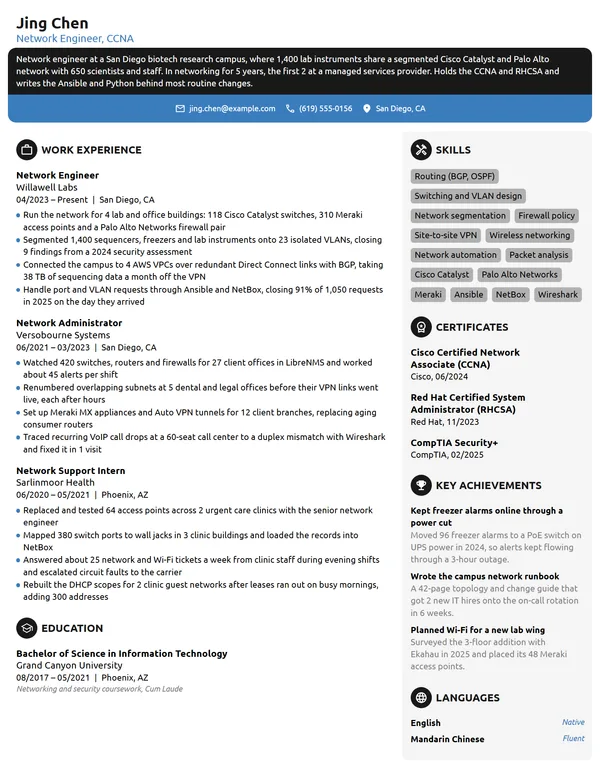
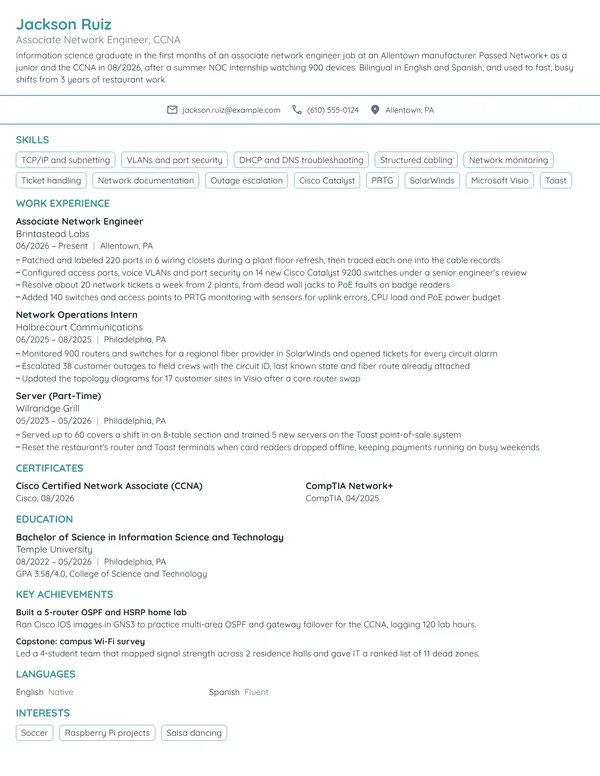
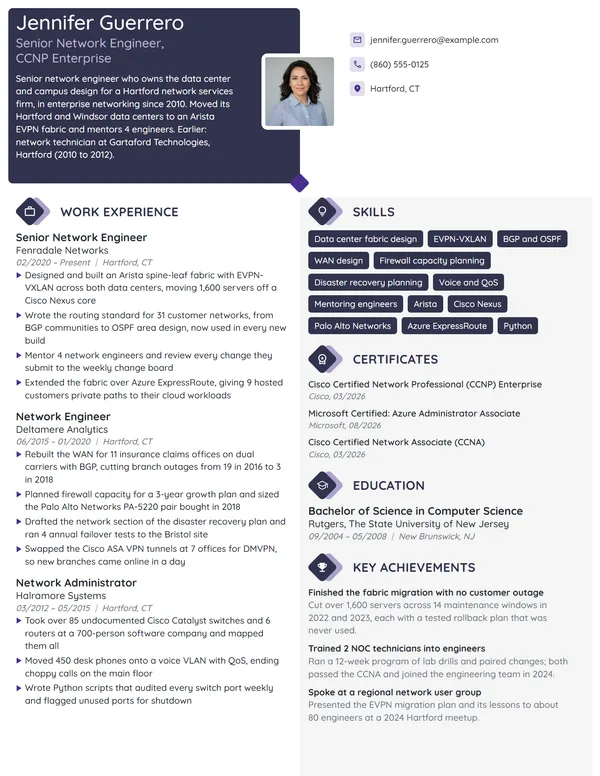
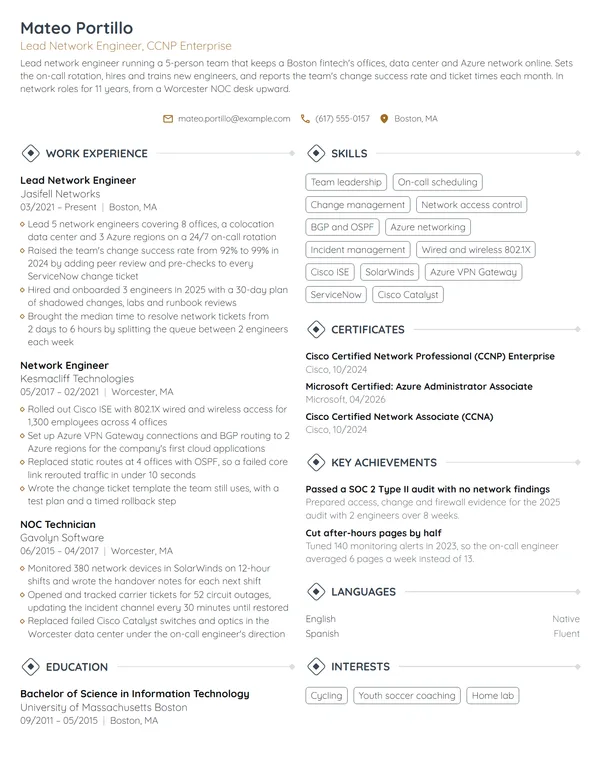
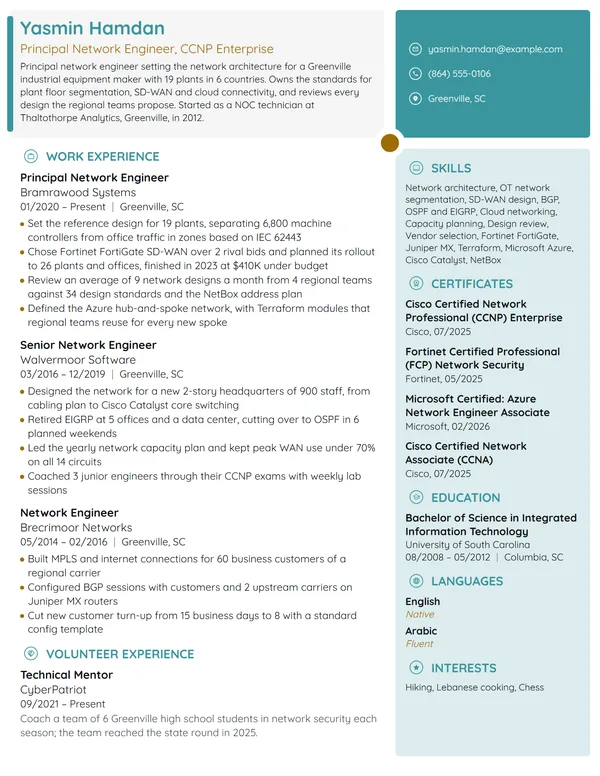
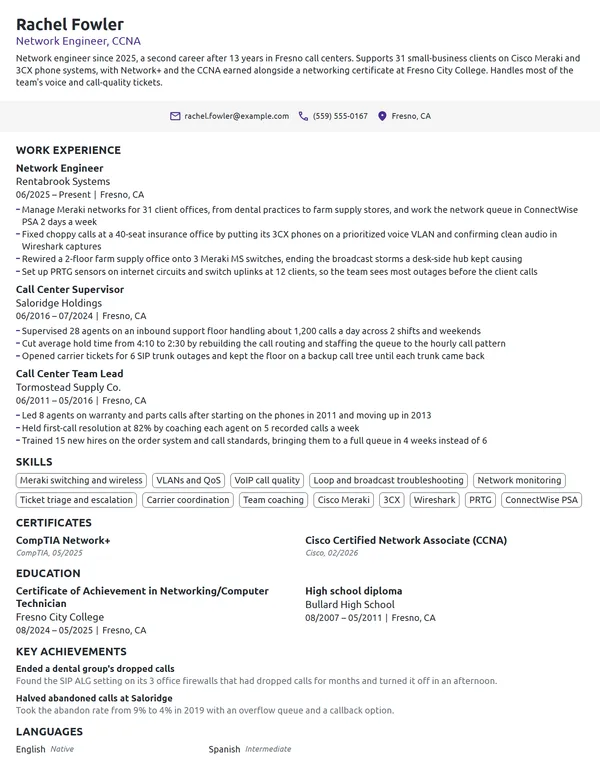
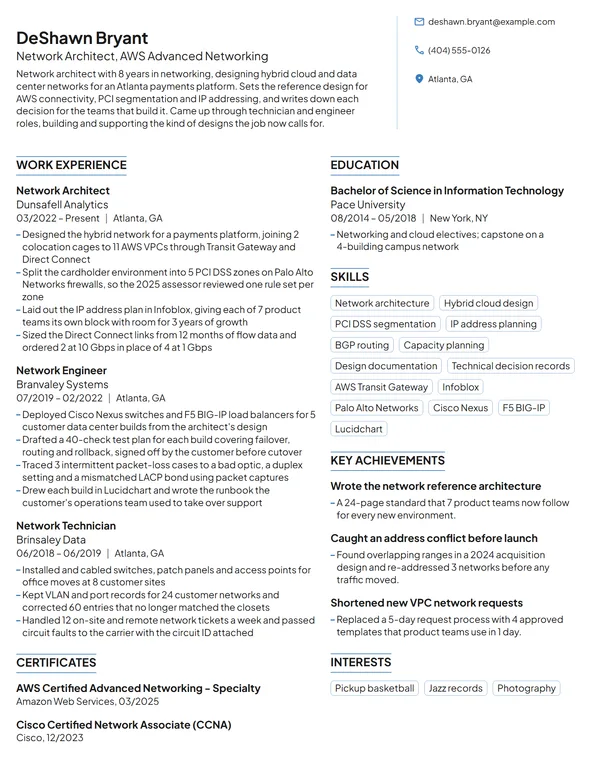
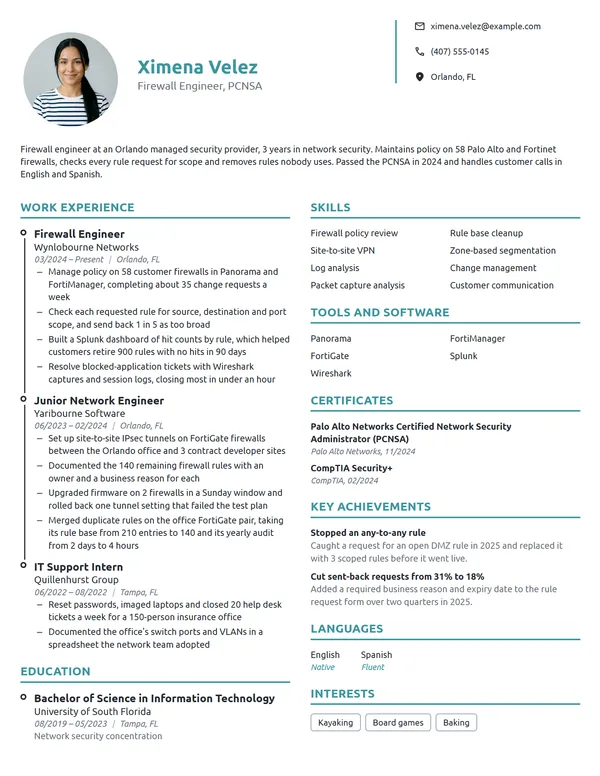
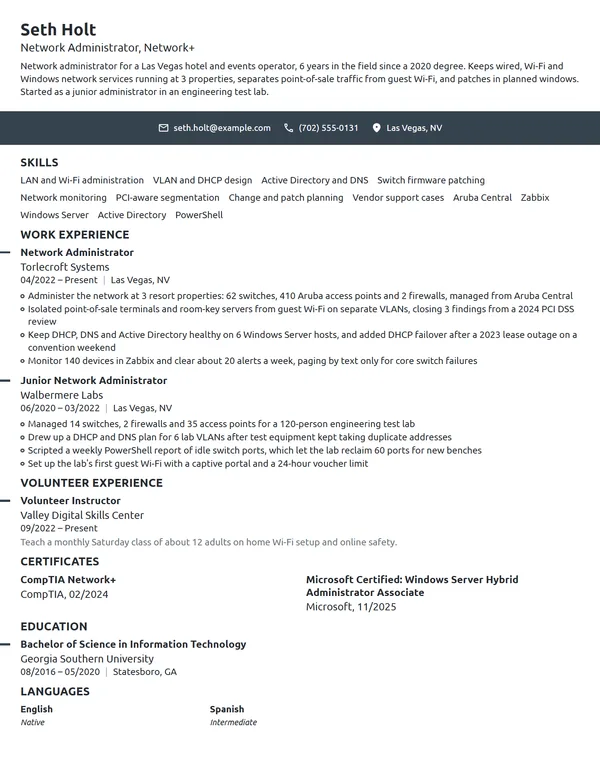
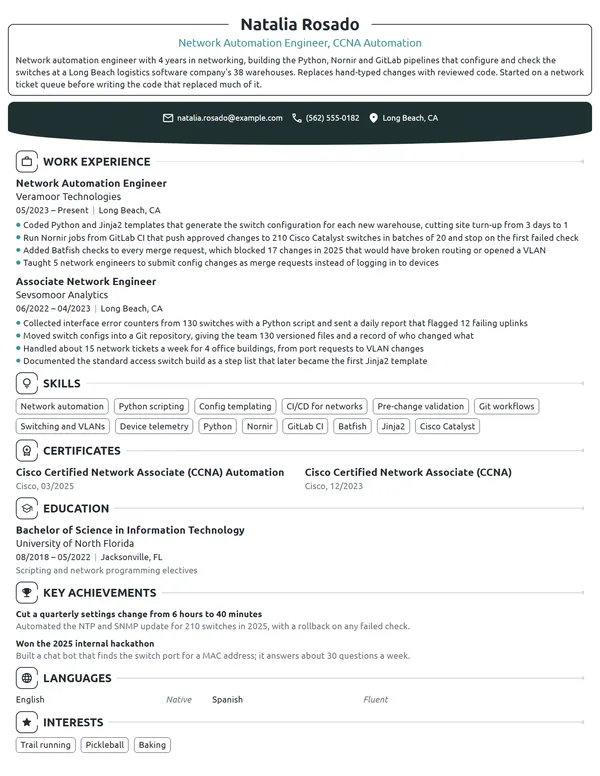
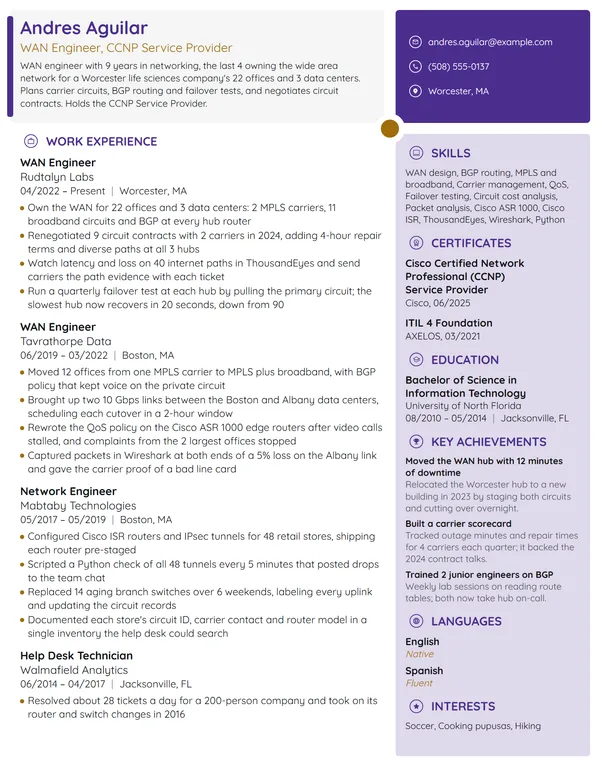
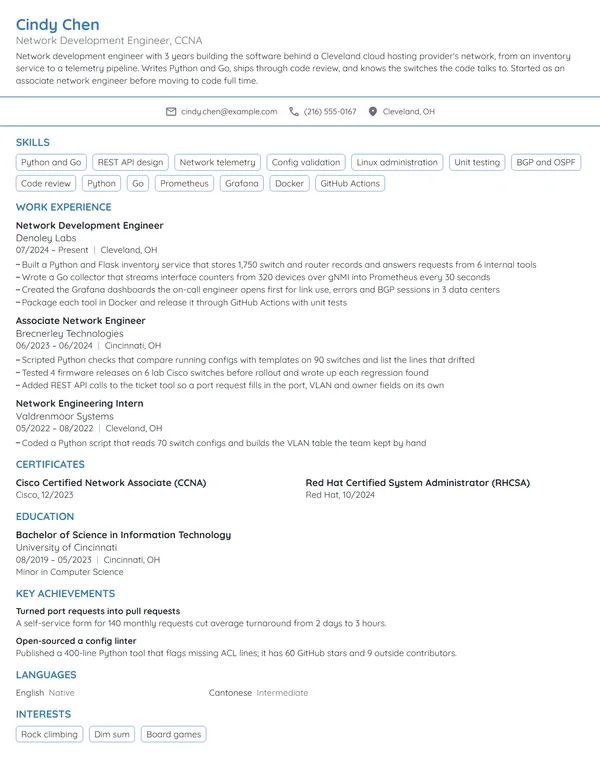
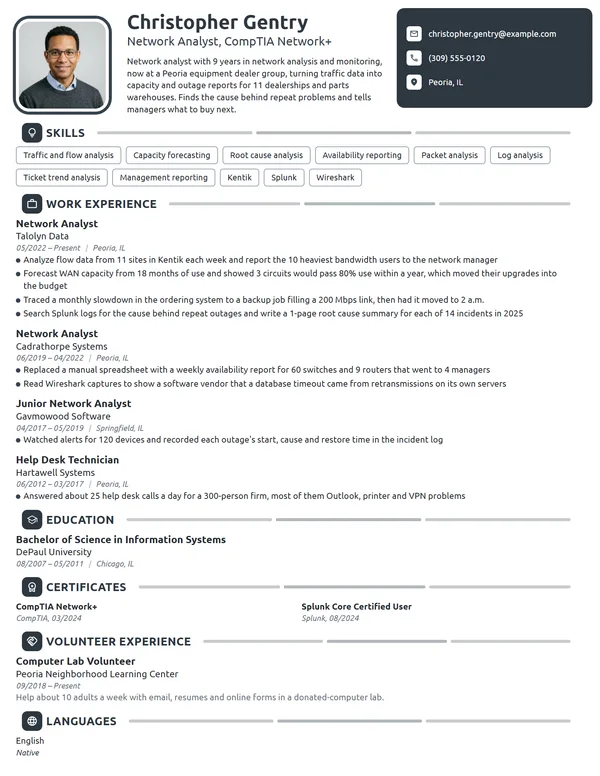
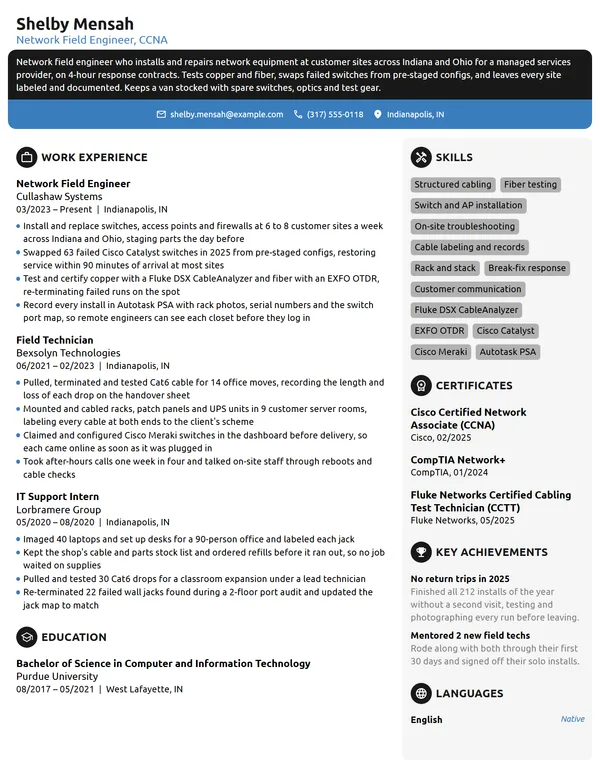
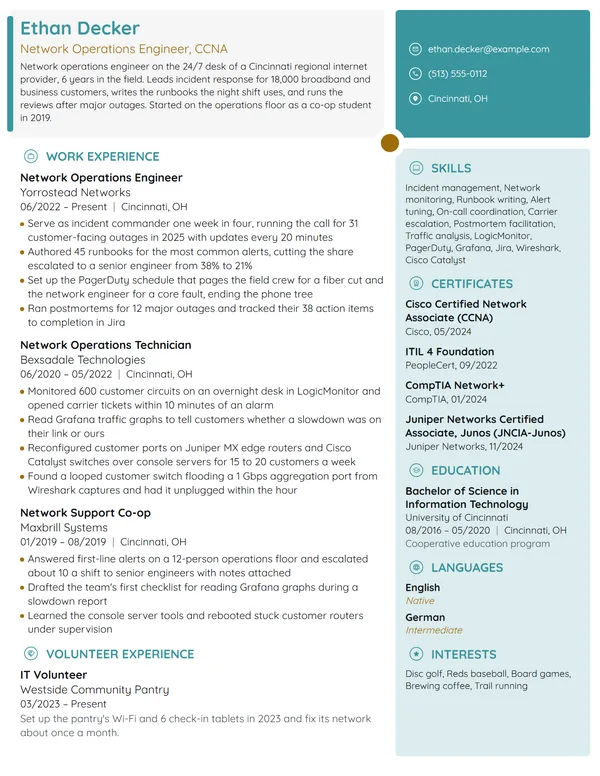
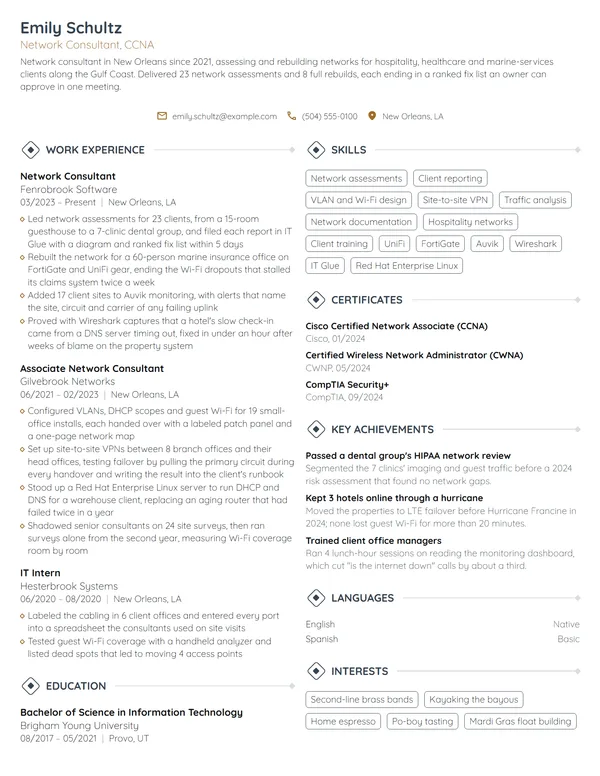
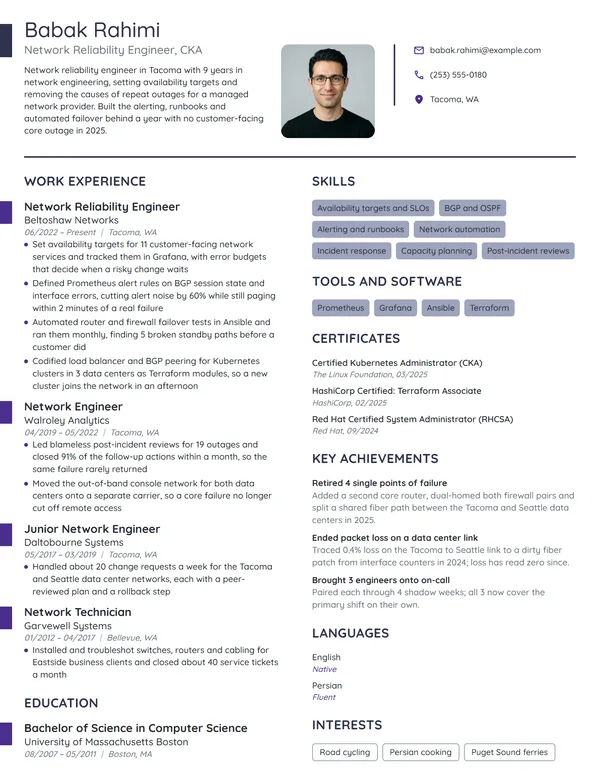
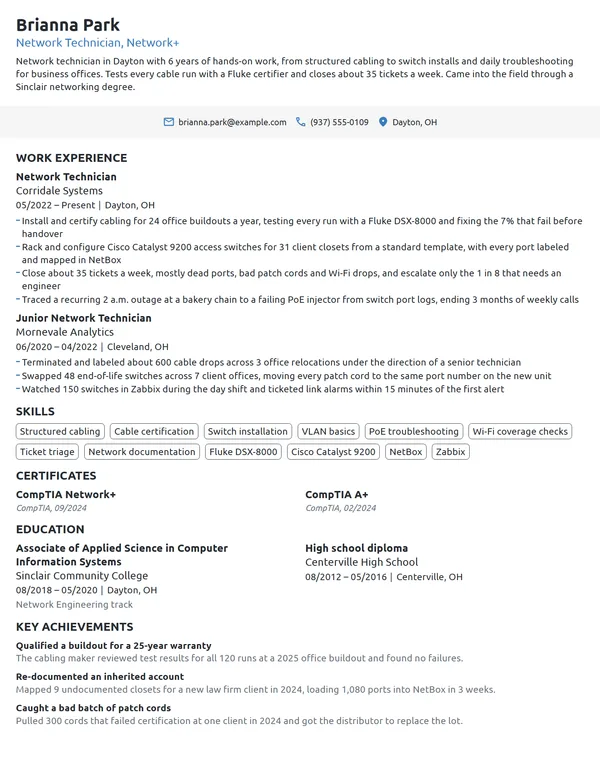
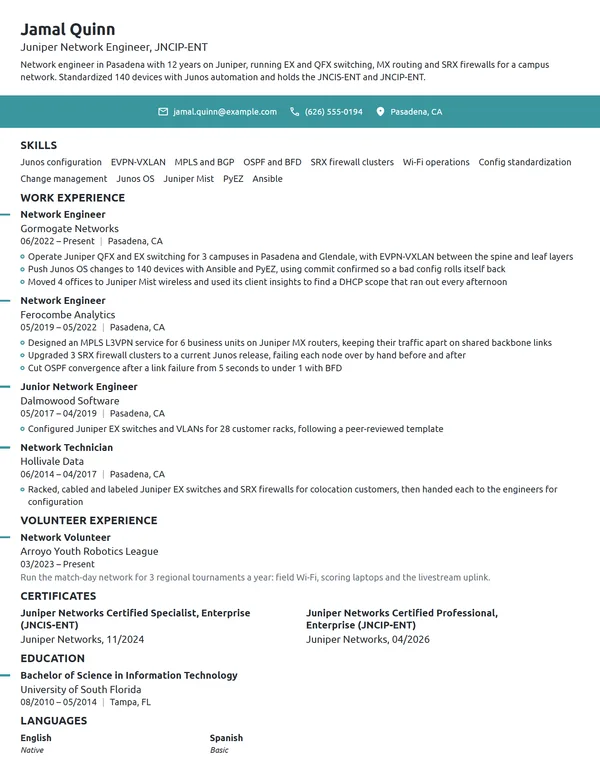
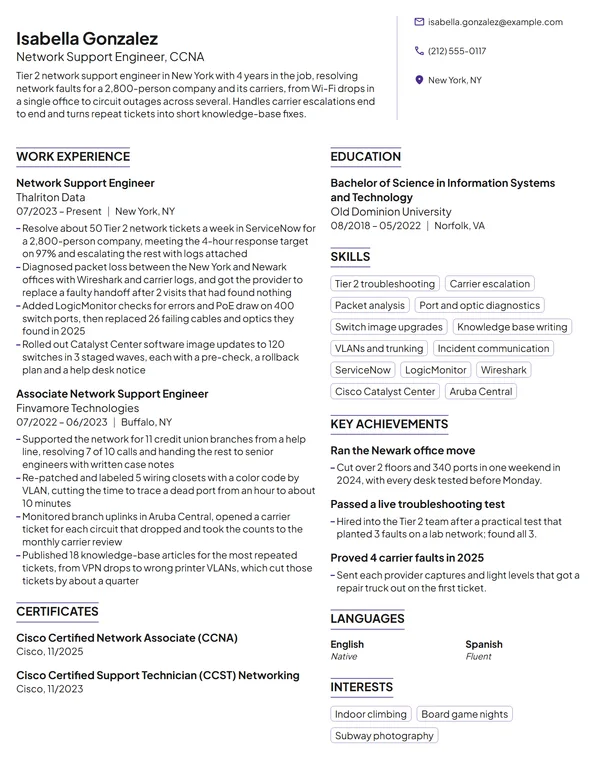
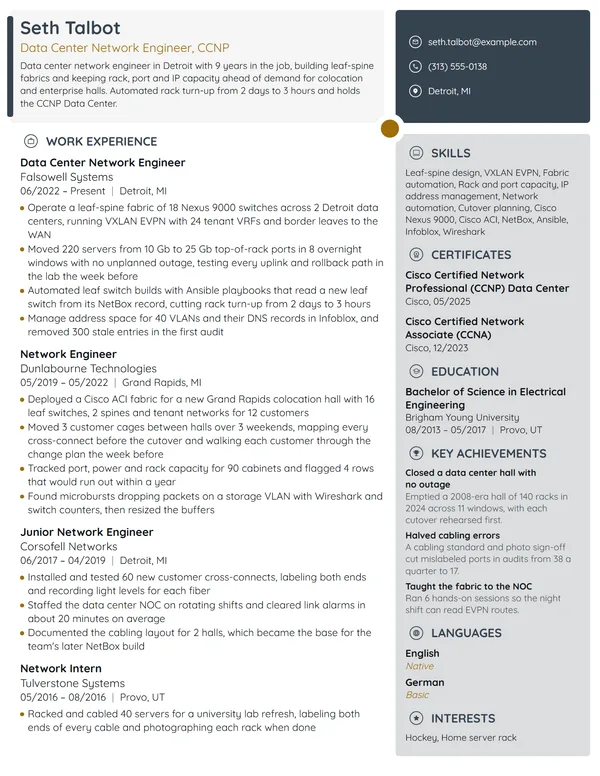
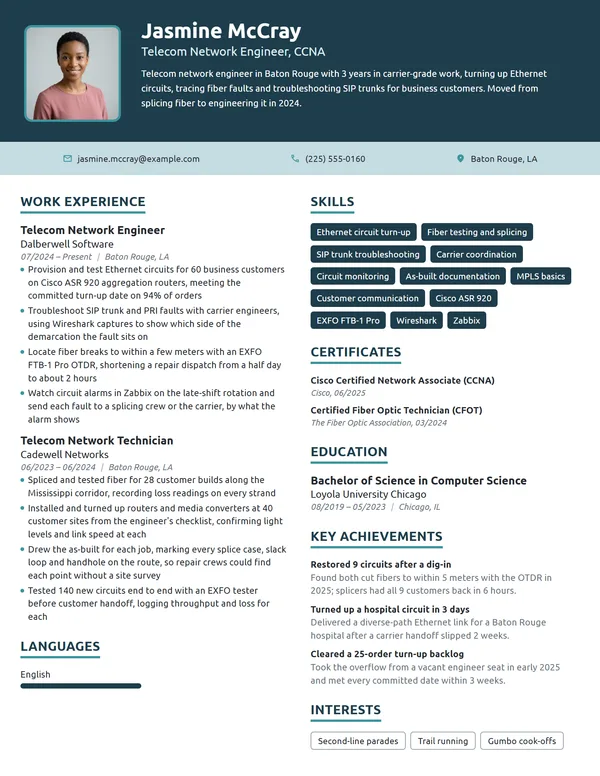
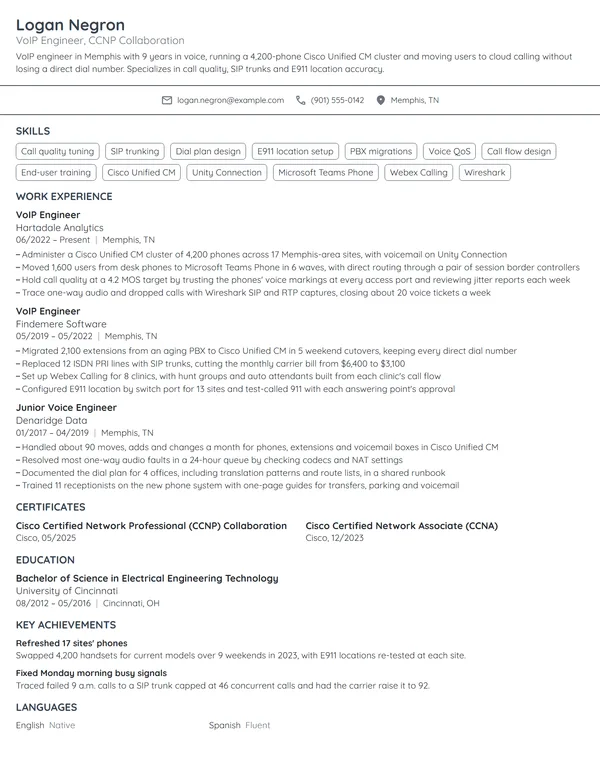
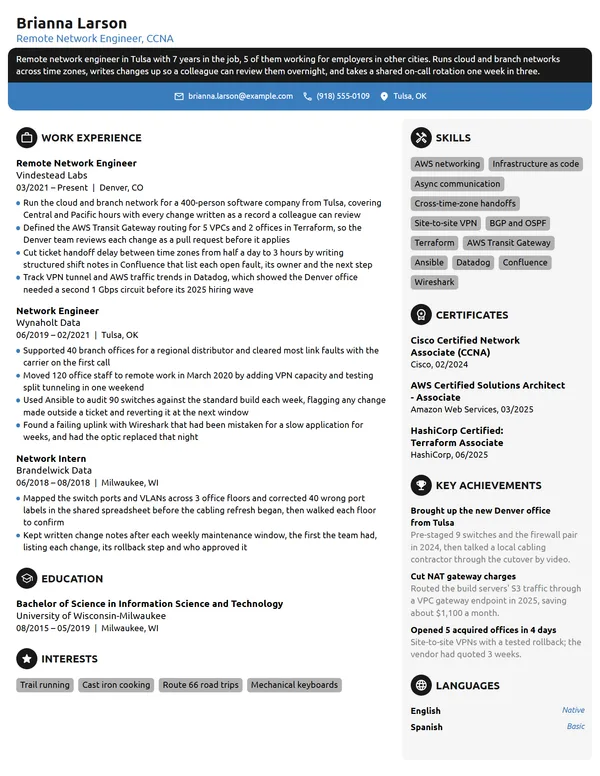
Network engineers are judged on whether the networks they build and run stay up. The person hiring you will look for what you built or ran, how big it was, which vendors and protocols you know, and the certifications behind them. CCNA, BGP and a dozen product names fit on a page in seconds, and they mean little until each network has a size and each change has a result. Give every job both, and keep your credentials where a recruiter finds them at a glance.
How to Write a Network Engineer Resume - Key Takeaways
- Keep reverse-chronological order on 1 page, moving to 2 only once you have 10+ years and several large migrations to show.
- Open with a 2- to 3-line summary that names your years, the kind of network you run, its vendors and your best uptime, migration or automation result.
- Size every network in your bullets: sites, switches, firewalls, access points or users, plus a result such as uptime, restore time or cost.
- List protocols and platforms by the names the job ad uses, such as BGP, OSPF, Cisco Catalyst or Palo Alto, and prove each one in a bullet.
- Put active certifications such as CCNA, CCNP Enterprise or Network+ under Certificates with the issuer and the month and year earned.
- Before you apply, run your resume through an ATS resume checker, since IT postings are screened for vendor and certification keywords.
What network managers look for in a network engineer resume
A network manager or IT director reads your resume for what kind of network you worked on, how large it was, and whether you designed it, built it or kept it running. The BLS describes the work as creating plans and layouts for data communication networks, deploying and testing them, and upgrading routers and other hardware and software as needed. O*NET adds recommending security measures such as firewalls, monitoring performance for capacity planning, and writing disaster recovery plans.
Each of those tasks has a number attached in real life, and the reader expects to see it. Organize the page with section names that screening software parses cleanly:
- Name, headline (for example, Network Engineer, CCNP Enterprise) and contact details
- A 2- or 3-line summary at the top, printed without a heading
- Work Experience, starting with your current role
- Skills, with protocols, platforms and automation tools
- Certificates, active ones only
- Education
- If space allows: Key Achievements (or Volunteer Experience instead), Languages, Interests
Best format for a network engineer resume
Choose the reverse-chronological resume format: newest job first, with your title, the employer, its location and MM/YYYY start and end dates. Network careers usually climb from help desk or NOC work to network administrator, engineer, senior engineer and architect, and a newest-first layout puts that climb at the top. A combination format, with a skills block above your history, suits only someone switching in from outside IT.
- Best for most network engineersReverse-chronologicalYour jobs, newest first, with your results under each one.Best for: A steady work history in your field
- FunctionalSkills grouped up top, with a short work history below.Best for: Gaps or very little experience
- CombinationA skills section first, then your full work history.Best for: A career change with strong skills
Keep it to 1 page with under 10 years in networking. A system administrator moving up or an engineer with 2 or 3 jobs fits easily on 1 page; senior, lead and principal engineers with data center builds, WAN migrations and team leadership can use 2, as long as page 1 holds the 2 latest roles.
| Setting | What to use |
|---|---|
| Length | 1 page under 10 years; 2 pages for senior engineers with large builds |
| Dates | MM/YYYY start and end dates; Present on your current role |
| Job title line | Your title plus your focus where it helps: Network Engineer, Data Center |
| Skills order | Routing and switching protocols first, then platforms, then automation and cloud |
| Photo, age and ID numbers | No photo on most US and Canadian resumes; never your age, marital status or SSN |
| File type | PDF, or a Word file if the employer's portal requests one |
Most US and Canadian resumes carry no photo. On a network resume, that space goes further as room for the gear and protocols a hiring team is screening for.
Network engineer resume summary vs. objective
If you already hold a networking job, write a resume summary: your years, the type and size of network, your main vendors and 1 result. If your experience so far is help desk, NOC or lab work, write an objective instead: the network engineer role you want, plus your best proof so far. Draft it after your bullets, then lift its number from them.
Network engineer resume summary formula
Title with X years designing, building or running type of network on vendors or platforms. Best uptime, migration or automation win, in figures. Top certification and year.
Example
Network engineer with 8 years running hospital and clinic networks on Cisco and Fortinet. Moved 14 sites from MPLS to SD-WAN and cut circuit spend by $96K a year. CCNP Enterprise, 2024.
Don't
Results-driven network engineer with strong troubleshooting skills and a passion for technology, seeking to contribute to a dynamic team.
Do
Network engineer with 4 years supporting a 3-campus university network of 1,900 access points and 260 switches on Aruba and Juniper. Cut repeat Wi-Fi tickets by 40% after a channel and power redesign. CCNA and JNCIA-Junos.
Scale, vendors, a measured fix and 2 credentials replace 4 adjectives.
How to write network engineer work experience bullets with numbers
Your current job gets 3 to 4 bullets and earlier jobs 1 to 3, each opening on an action verb and closing on an outcome. When you list work experience on a resume for a network role, the size of the environment does a lot of the work: sites, devices and users tell a manager at once whether your network looks like theirs. Then add what changed because of you.
| Area | What to count | Example bullet |
|---|---|---|
| Availability and incidents | Uptime, outages, mean time to restore | Cut mean time to restore for WAN outages from 3 hours to 50 minutes with runbooks and PRTG alerts. |
| Refreshes and migrations | Sites, devices, cutover windows, rollbacks | Migrated 9 branch offices to Juniper EX switches in 3 overnight windows with no rollbacks. |
| Routing and WAN | Sites, circuits, BGP peers, carrier costs | Added a second internet circuit with BGP failover at headquarters, removing a single-carrier point of failure. |
| Wireless | Access points, buildings, users, complaints | Redesigned coverage for 640 access points in 3 buildings, dropping coverage complaints from 25 a month to 4. |
| Security | Firewall rules, VPN users, audit findings | Removed 1,150 unused rules from 4 Palo Alto firewalls before a PCI DSS audit. |
| Automation | Scripts, devices covered, minutes saved | Wrote a Python and Netmiko job that backs up 340 device configs every night. |
This sample entry puts those numbers to work. The current role shows scale, a migration, automation and availability; the older support role is shorter and shows volume.
Work Experience
- Replaced 41 end-of-life access switches across 6 clinics with Cisco Catalyst 9300 stacks over 4 weekends, with 0 unplanned downtime during clinic hours.
- Moved WAN links for 14 sites from MPLS to FortiGate SD-WAN, cutting circuit costs by $96K a year.
- Built 22 Ansible playbooks for VLAN and ACL changes, shortening a standard change from 45 to 10 minutes.
- Held core network availability at 99.98% across 2 data centers in 2025, tracked in SolarWinds NPM.
- Closed about 30 tickets a week for 85 small-business clients running Cisco and Meraki equipment.
- Configured site-to-site IPsec VPNs for 37 client offices.
Don't
Responsible for maintaining the company network.
Do
Maintained a 3-site network of 74 switches, 12 routers and 2 firewall clusters for 1,100 users, with 99.95% uptime in 2025.
The second bullet tells a manager the size of the job and how well it went.
Don't
Worked on the firewall migration project.
Do
Led the cutover from 6 Cisco ASA firewalls to Palo Alto, converting 2,300 rules over 5 weeks with 1 rollback.
Network engineer skills, protocols and tools for your resume
Choose 6 to 8 technical skills for your resume that appear in the job ad and that your bullets back up. Routing and switching basics belong on nearly every network engineer resume; wireless, data center, cloud or security depth only where you have done that work.
Hard skills for network engineers
- Routing (BGP, OSPF, EIGRP)
- Switching, VLANs and spanning tree
- Firewall configuration and policy
- Site-to-site and remote access VPN
- SD-WAN
- Wireless design and site surveys
- Network monitoring and capacity planning
- Network automation
- TCP/IP, DNS and DHCP troubleshooting
- Disaster recovery planning
Soft skills network managers value
- Calm troubleshooting during outages
- Clear change documentation
- Planning around maintenance windows
- Working with vendors and carriers
- Explaining risk to non-technical staff
- On-call reliability
Name your tools inside Skills, then use each one in a bullet so the reader sees what you did with it. O*NET marks Border Gateway Protocol (BGP), Terraform, Ansible, Python, Linux, AWS and Microsoft Azure as hot and in-demand technology for computer network architects, and firewall software as in demand. Add vendor platforms from the ad, such as Cisco Catalyst, Juniper, Arista, Palo Alto Networks, Fortinet or Meraki, only if you have configured them, and write each name exactly as the ad does.
CCNA, CCNP and other networking certifications on a resume
Employers may require or prefer certification in the products they use, the BLS says, so place vendor credentials where a recruiter can find them in one look. Put certifications on your resume under Certificates, each with the issuer and the month and year earned, and repeat your highest one in your headline. Cisco's CCNA, CCNP and CCIE form one vendor ladder from associate to expert; Network+ is CompTIA's vendor-neutral option, and JNCIA-Junos is Juniper's entry credential.
| Credential | Issued by | What it takes |
|---|---|---|
| CCNA (Cisco Certified Network Associate) | Cisco | 1 exam (200-301 CCNA) covering network fundamentals, access, IP connectivity, IP services, security and automation. No prerequisites; valid 3 years. |
| CCNP Enterprise (Cisco Certified Network Professional) | Cisco | The 350-401 ENCOR core exam plus 1 concentration exam of your choice, such as 300-410 ENARSI. No prerequisites; valid 3 years. |
| CCIE Enterprise Infrastructure | Cisco | The same ENCOR core exam plus an 8-hour lab exam. Valid 3 years. |
| CompTIA Network+ | CompTIA | 1 exam (N10-009). CompTIA recommends A+ and 9 to 12 months of hands-on experience; good for 3 years from the exam date. |
| JNCIA-Junos (Junos, Associate) | Juniper Networks | 1 exam (JN0-106) for beginner to intermediate networking professionals. No prerequisite; valid 3 years. |
How to list expired or in-progress networking certifications
Every credential in the table lasts 3 years, so check each date before you apply. List only active ones under Certificates. Cisco renews a CCNA when you pass a higher-level Cisco exam, so a CCNP earned later can keep it current; write the renewal date beside it. For a certification you are still working on, list the exam you passed with its date and the next one with its scheduled month.
Certificates
- Cisco Certified Network Professional (CCNP) Enterprise, Cisco, 05/2024
- Cisco Certified Network Associate (CCNA), Cisco, 08/2021; renewed 05/2024
- CCIE Enterprise Infrastructure, Cisco: ENCOR core exam passed 05/2024; lab exam scheduled 03/2027
How to list a computer engineering or IT degree
The BLS describes the usual path for network architects as a 4-year degree in a computer-related field, such as computer and information technology or engineering, plus several years of IT experience, often after time as a network or systems administrator. When you list education on a resume, give the degree, the school, its city and the graduation month and year.
The BLS adds that some employers consider candidates without a bachelor's degree, so current certifications and hands-on years can stand in for one. Add your GPA only if it is 3.5 or above and you finished in the past 2 to 3 years. Once you have 2 network jobs behind you, move Education below Certificates and keep it to 2 lines.
Education
Entry-level and career-change network engineer resumes
If your path runs through support work, an entry-level resume here usually leads with an objective, then Certificates and Work Experience, with Education close to the top if you graduated recently. Count everything the way you would on a full-time network job.
- Help desk or IT support jobs: tickets closed a week, sites supported, network issues you escalated or fixed yourself.
- NOC shifts: devices monitored, alerts handled per shift, outages you opened and closed.
- Internships: switches or access points deployed, cabling or closet projects, the gear you configured.
- Lab work under Education: Cisco Networking Academy courses or a lab you built, only with real protocols named, such as OSPF across 4 routers.
Don't
Motivated IT graduate looking for an opportunity to grow as a network engineer.
Do
Help desk technician with 18 months supporting 15 branch offices, seeking a junior network engineer role. Closed 2,400 tickets, many of them switch port and VPN issues, and earned the CCNA in 2026.
Even a first-role objective carries a volume, a network detail and a certification.
Coming from systems administration, field technician work or military communications, stay with reverse-chronological order and move your most network-heavy duties, such as VLAN changes, firewall rules or circuit turn-ups, to the top of each job. A career-change resume works best with a current certification on the headline line. Save the story of your move for the letter you send with it; our IT cover letter examples show how to keep that to 2 or 3 sentences.
Network Engineer resume FAQ
Should I put an expired CCNA on my resume?
Not under Certificates. Cisco certifications last 3 years, and a recruiter who checks one that has lapsed may doubt the rest. If you passed a higher Cisco exam before it lapsed, that exam renewed it, so list it with the renewal date.
How long should a network engineer resume be?
Use 1 page if you have under 10 years in networking. Senior, lead and principal engineers with several large builds or migrations can use 2 pages, provided the first page covers their 2 most recent roles.
Do I need a degree to become a network engineer?
Usually, though not always. The BLS lists a 4-year degree in a computer-related field as the usual requirement for network architects, and notes that some employers hire without one. If you have no degree, lead with your certifications and years of hands-on network work.
Which certification should a network engineer list first?
Your highest active one, and the one the posting names. For most Cisco shops that is CCNP Enterprise or CCNA; for a Juniper network it is a JNCIA-Junos or higher. Put that same credential in your headline under your name.
How do I show cloud networking on a network engineer resume?
Name the platform and what you built in it. A bullet such as connecting 3 offices to AWS with site-to-site VPNs, or writing Terraform for Azure virtual networks, shows more than listing AWS and Azure under Skills on their own.
What separates a network engineer resume from a network administrator resume?
Scope. An administrator resume centers on keeping an existing network running: tickets, patches, user moves. An engineer resume should also show design and projects, such as migrations, new sites, routing changes or automation, with their size and result.
How much do network engineers make?
The BLS, which groups network engineers with computer network architects, puts the median pay for that group at $134,050 a year in May 2025. Keep pay off your resume and discuss it during the interview stage.
Next steps
Pick the example closest to your level and replace every figure with your own sites, devices, uptime and change results. Check that each certification on it is still active. Put it together in our resume builder or adapt one of the resume templates, and open your cover letter on your biggest project.