
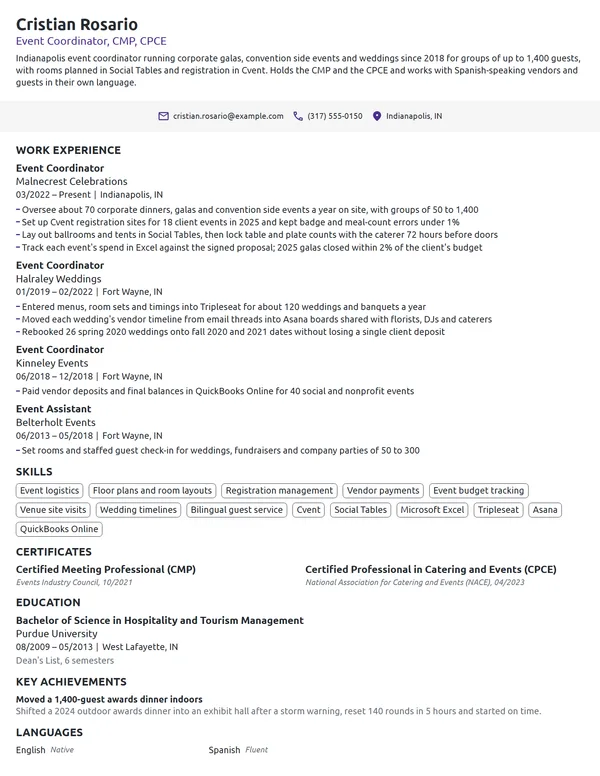
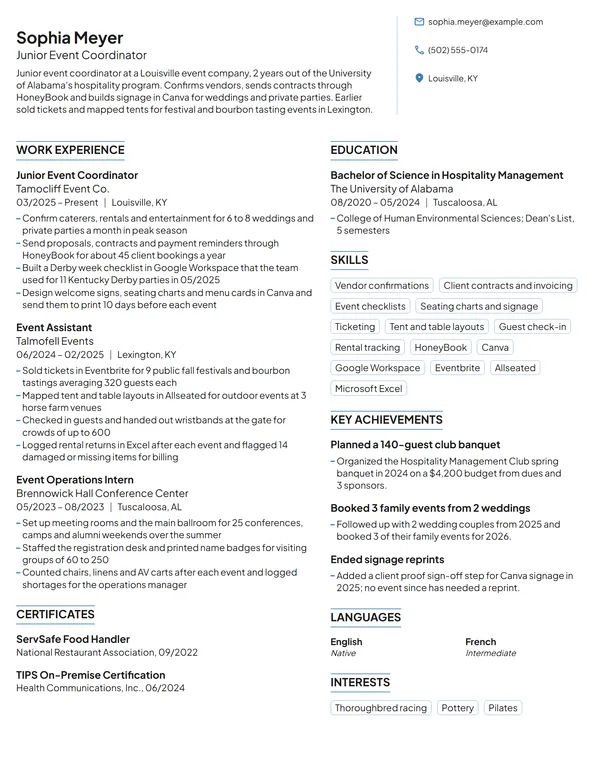
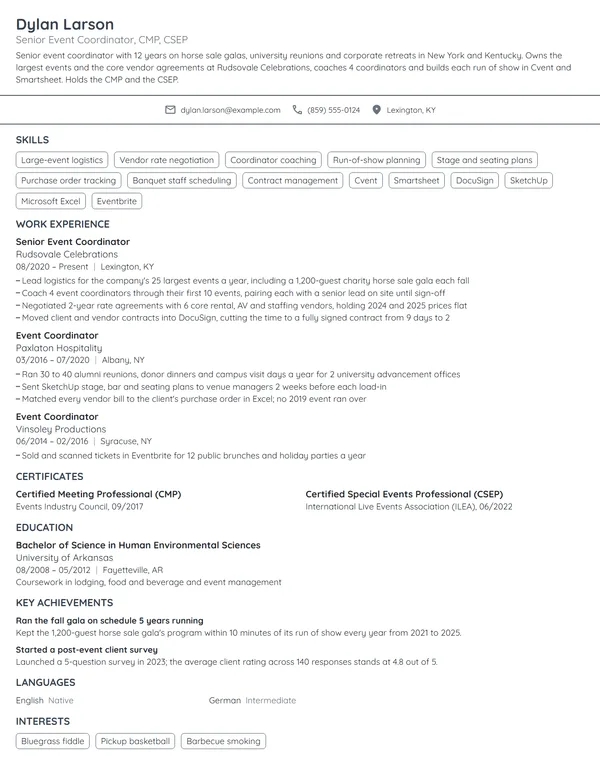
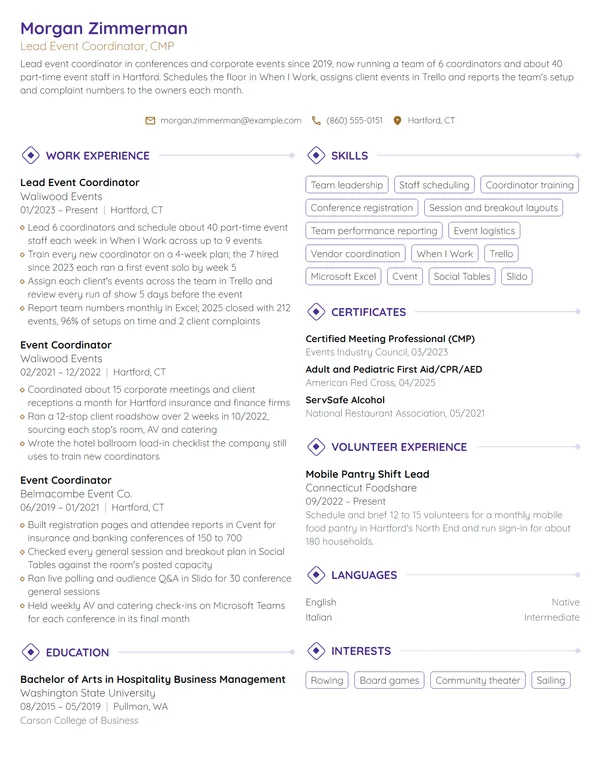
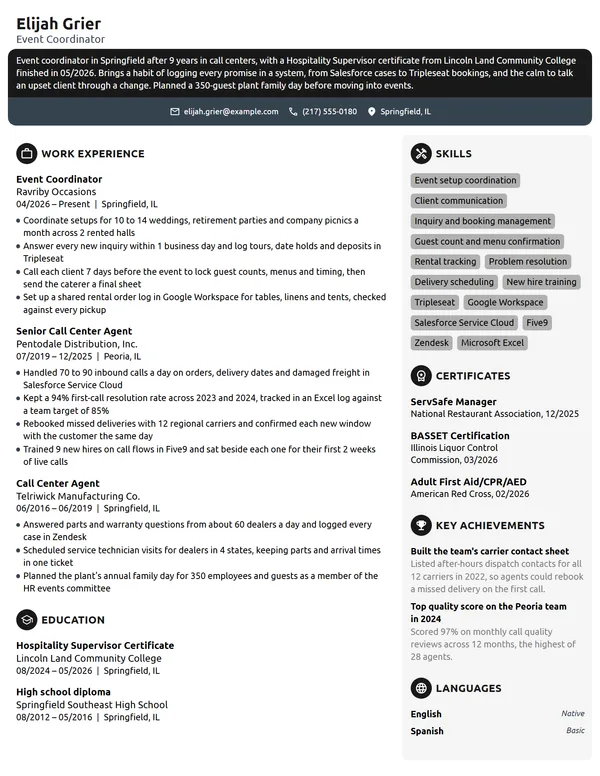
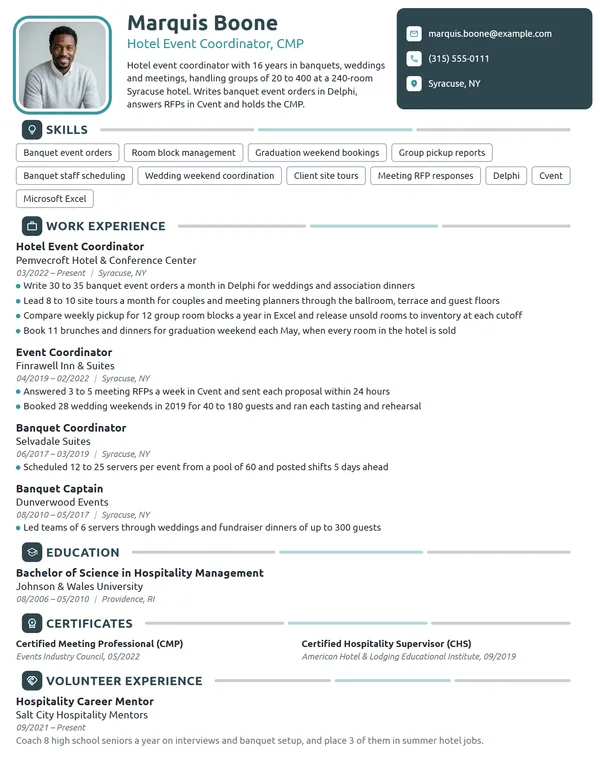
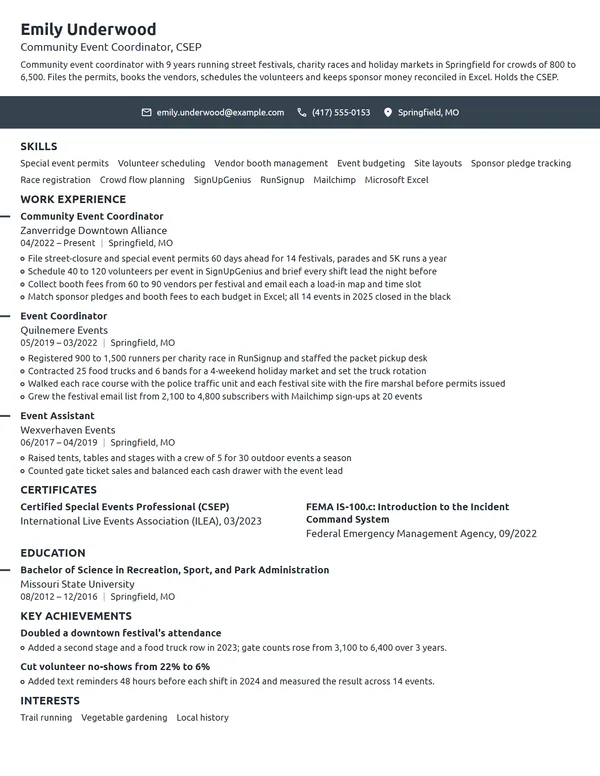
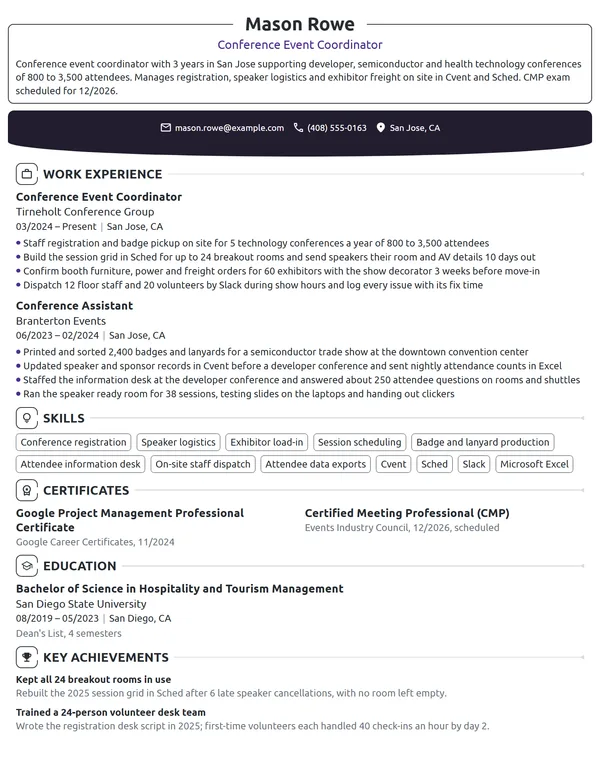
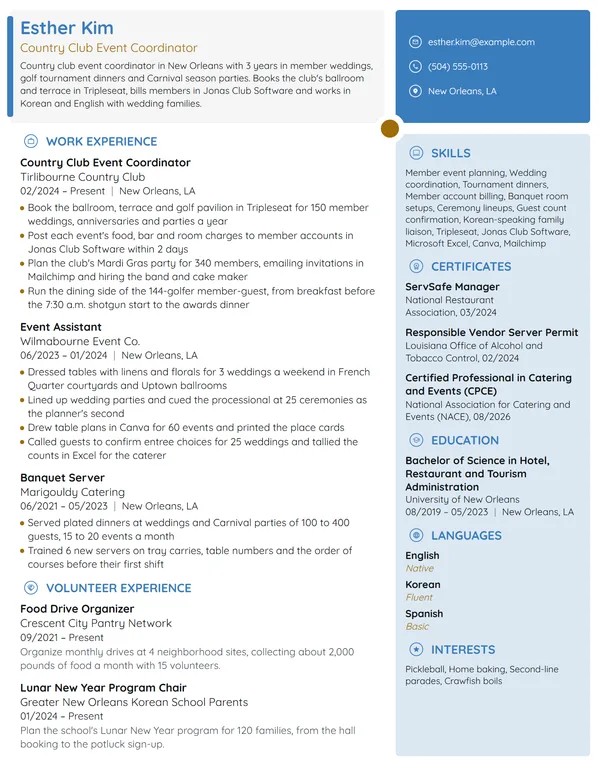
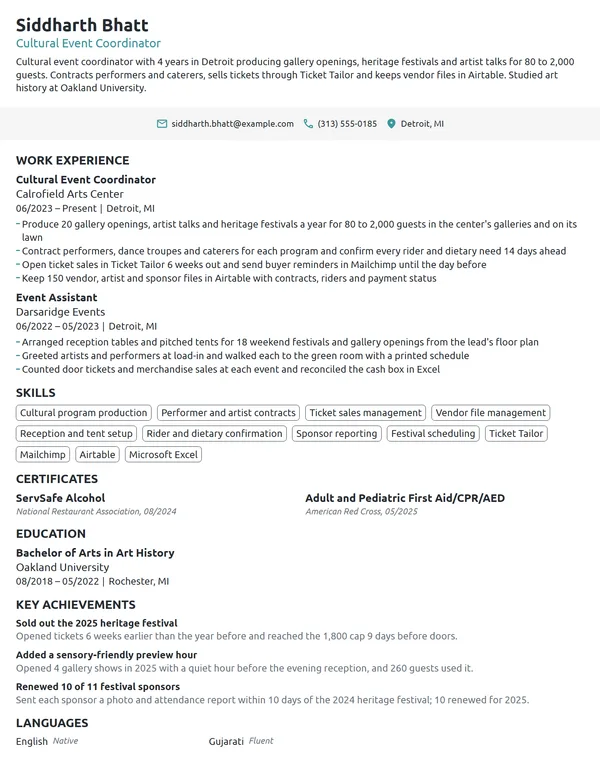
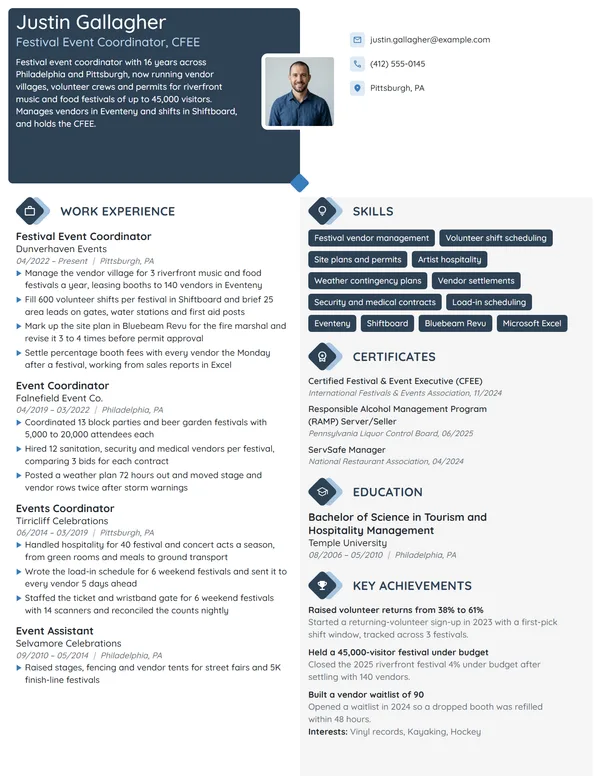
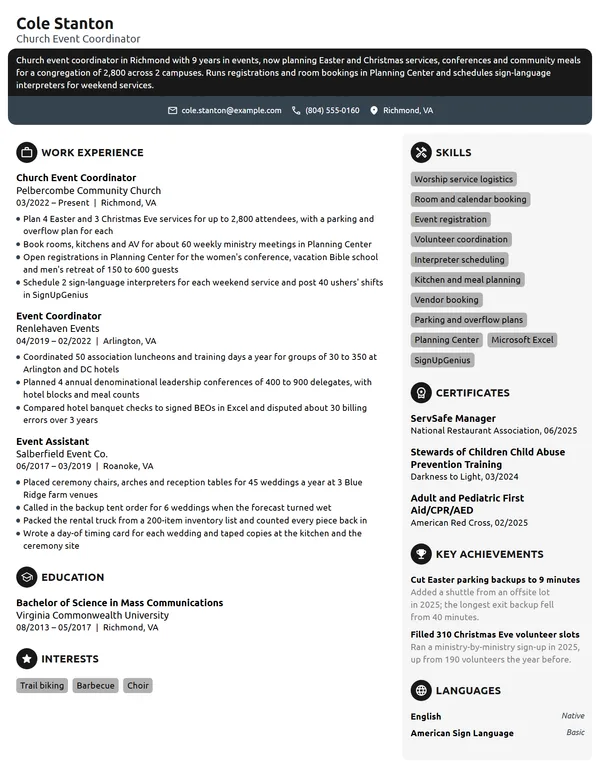
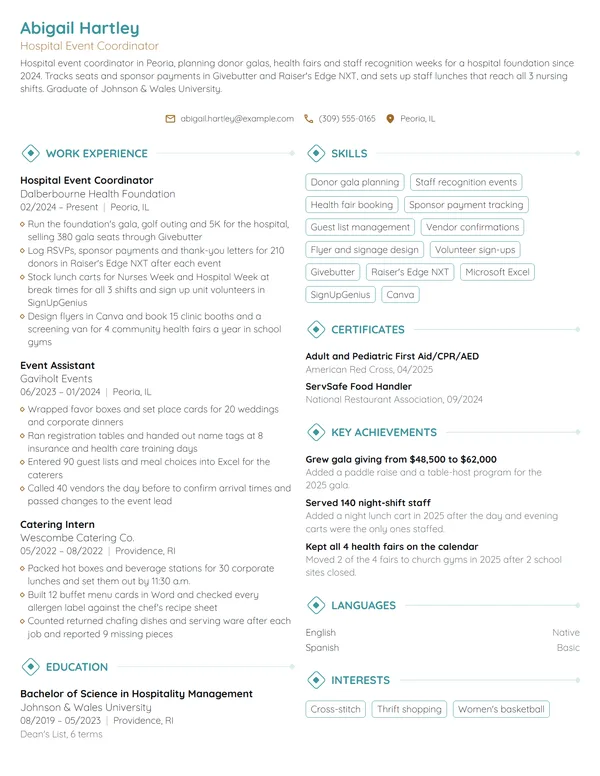
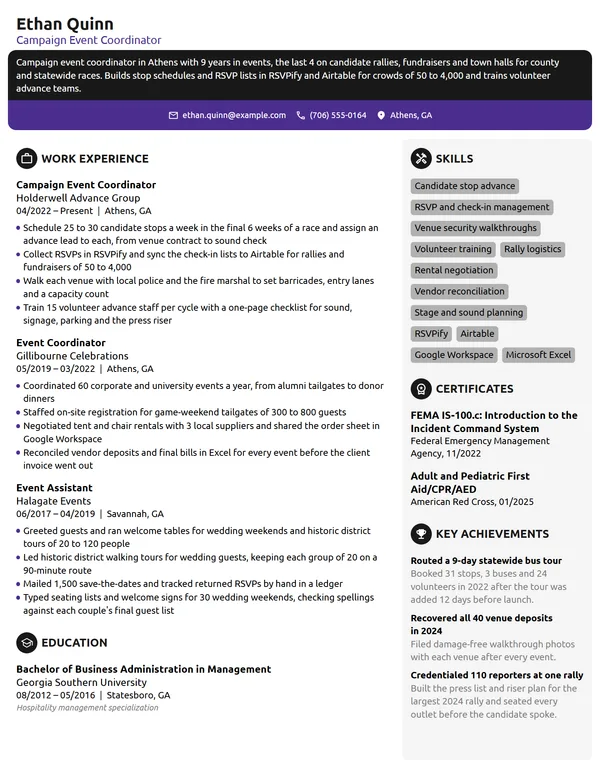
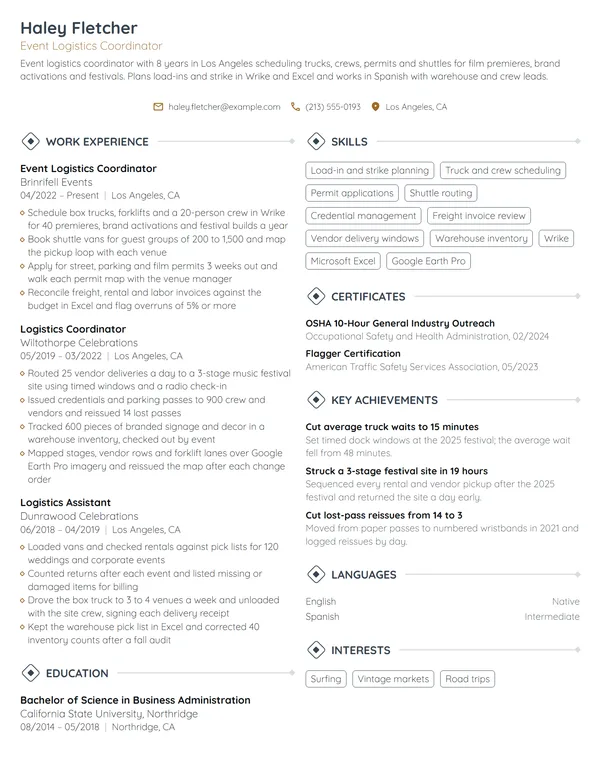
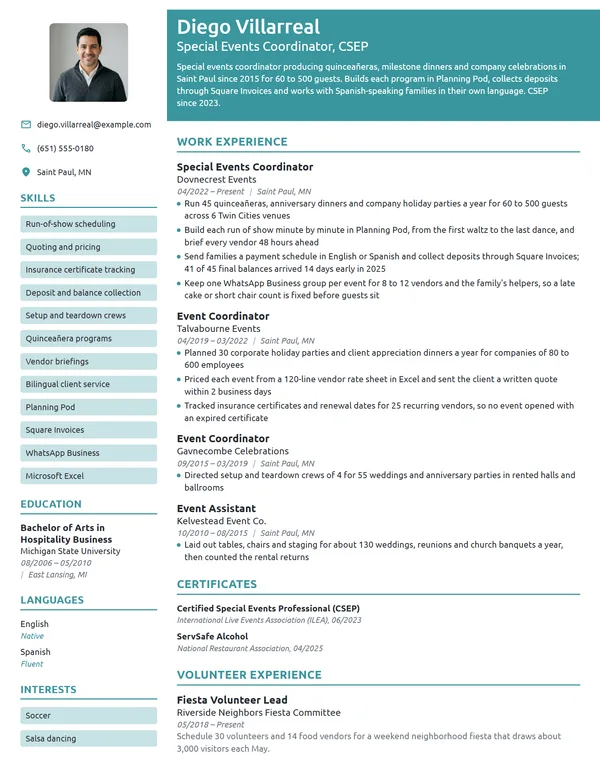
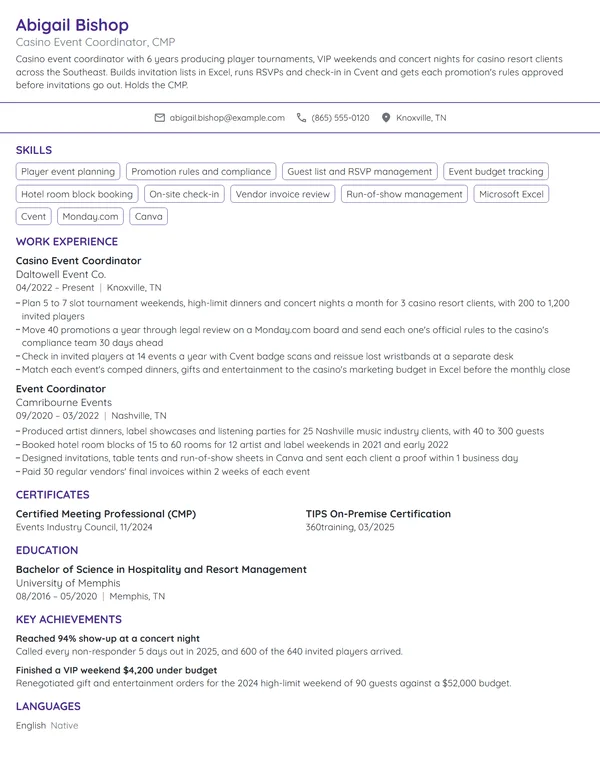
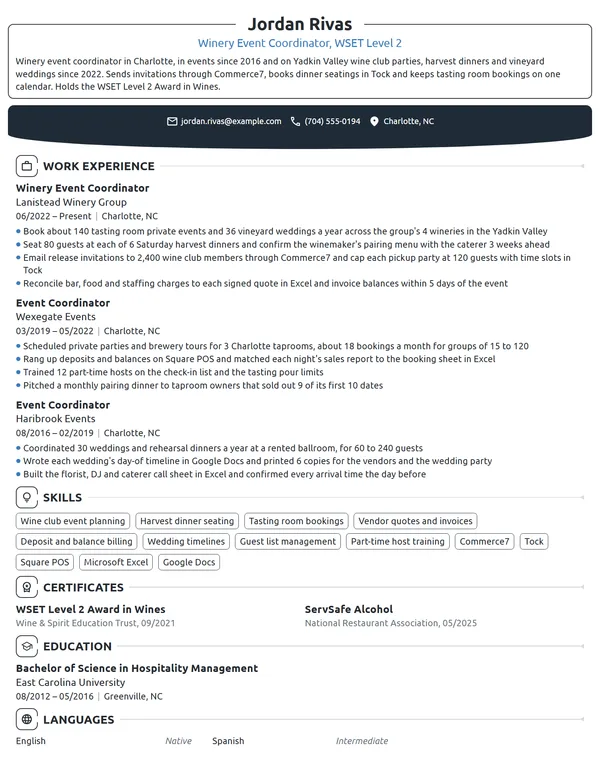
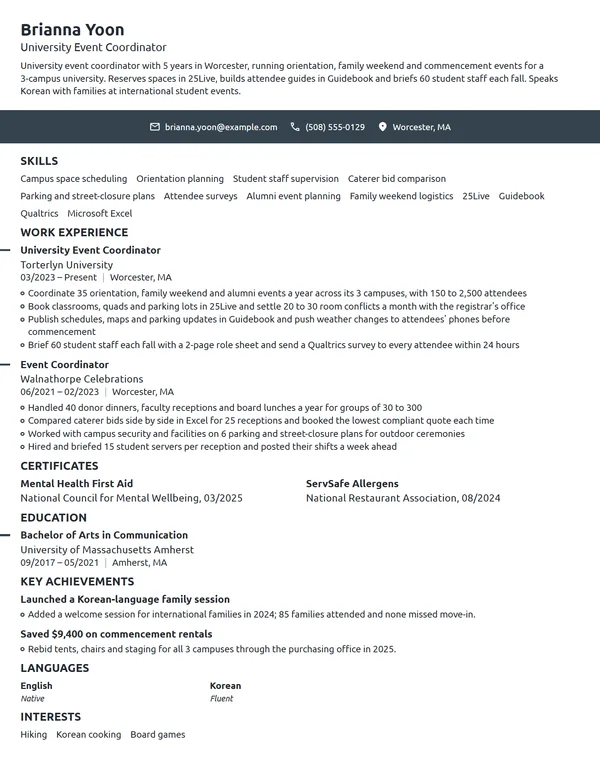
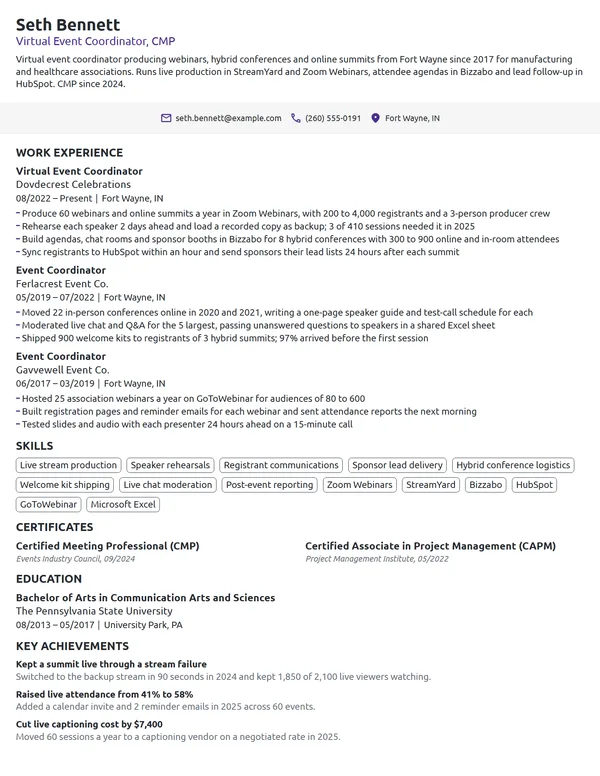
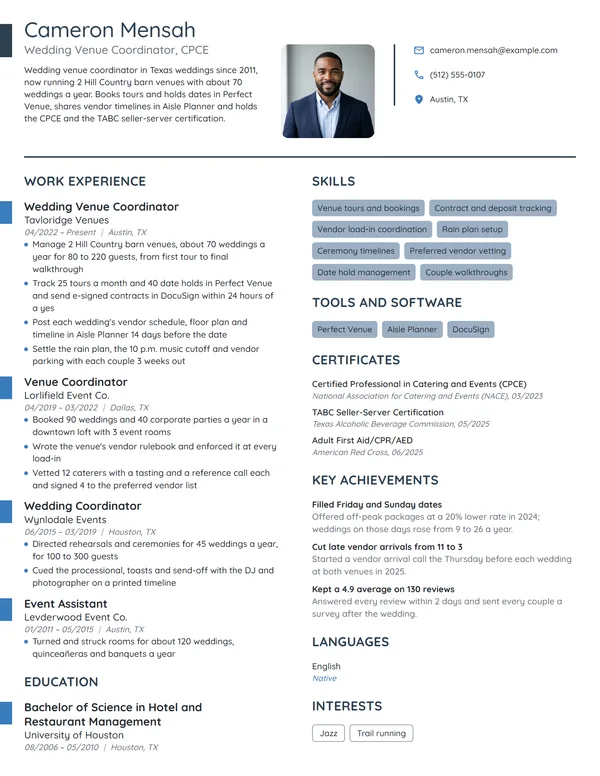
Event coordinators turn a plan into something real: vendors confirmed, rooms set, guests checked in and bills paid. Venues, agencies and in-house teams check that you have run events their size, on their kind of budget and software. A coordinator usually works inside a plan that a manager or client owns, so your share of a great event is easy to undersell. Counts, dollar figures and the right credentials are how you claim it.
How to Write an Event Coordinator Resume - Key Takeaways
- List your jobs newest first in reverse-chronological order, on 1 page, or 2 once you have 10+ years and several event types.
- Open with 2 to 3 lines naming your event types, your usual group size, your software and the biggest event you ran logistics for.
- Put a coordination number in each bullet: events supported, attendees, rooms set, vendor invoices, registrations or survey scores.
- Copy software names from the posting, such as Excel, Outlook or SketchUp, into Skills and into at least 1 bullet.
- Put CMP, CPCE or CSEP under Certificates, naming the issuing body and the year, and keep the letters off your name line until you have earned them.
- Leave private details such as your date of birth out, and scan the final file with an ATS resume checker.
What employers look for in an event coordinator resume
A hotel sales office, an agency or a company's in-house events team reads your resume for logistics you can be trusted with. BLS career data lists soliciting bids from venues and service providers, inspecting venues, coordinating rooms, transportation and food, and reviewing event bills as core duties. O*NET adds arranging audio-visual equipment, signage and displays, and conferring with venue staff to settle the details.
Each job entry should make clear which events you worked on, how many people attended and which pieces you owned. These sections cover it:
- Name, a headline such as Event Coordinator, CMP, and your contact details
- A 2- to 3-line summary under your name, with no section title
- Work Experience, latest job on top
- Skills, with your event and office software
- Certificates
- Education
- Optional, if you have them: Languages, Key Achievements or Volunteer Experience
Best format for an event coordinator resume
Use the reverse-chronological resume format: your current job first, each entry with the title, the employer, its city and your start and end months. Coordinator careers move from event assistant to coordinator, senior or lead coordinator and events manager, and from small meetings to conferences and galas. That order lets a reader follow both climbs at a glance.
- Best for most event coordinatorsReverse-chronologicalYour jobs, newest first, with your results under each one.Best for: A steady work history in your field
- FunctionalSkills grouped up top, with a short work history below.Best for: Gaps or very little experience
- CombinationA skills section first, then your full work history.Best for: A career change with strong skills
Fit your resume on 1 page if you have under 10 years in events. A senior coordinator with several venues, employers or event types can run to 2 pages, provided page 1 holds the 2 latest roles and the largest events. If your work is mostly design and full event plans for clients, compare it with an event planner resume before you choose a title.
| Setting | What to use |
|---|---|
| Length | 1 page; 2 only with 10+ years across several event types |
| Dates | MM/YYYY start and end months, with Present on your current role |
| Job title line | Your title plus the event type when it helps: Event Coordinator, Corporate Meetings |
| Portfolio link | In the contact line, pointing to event photos or a floor plan you have permission to share |
| Photo | Most coordinators in the US and Canada leave it off; skip your date of birth, family status and SSN as well |
| File type | PDF by default; a .docx only when an online application form demands one |
Most US and Canadian resumes carry no photo. Event work is visual, but the pictures that help you show the events, and they belong behind your portfolio link rather than on the page.
Event coordinator resume summary vs. objective
If you have coordinated events as a paid job, write a resume summary: 2 to 3 lines with your event types, years, group size, software and one standout event. If your event experience comes from school, volunteering or another field, write an objective: the role you are after, plus the most convincing event you have already helped run. Draft it after your bullets and reuse their strongest number.
Event coordinator resume summary formula
Title with X years in event types, working in software. The largest event you ran logistics for, or a vendor or budget result, with a number. Certification or the next one you are working toward.
Example
Event coordinator with 8 years in corporate meetings, sales conferences and hotel banquets, working in Excel and SketchUp. Ran logistics for a 1,150-attendee national sales meeting across 14 breakout rooms and recovered $18,400 in vendor overcharges in 2025. CMP since 2024.
Don't
Creative and detail-oriented event professional passionate about creating unforgettable experiences for every client.
Do
Event coordinator with 4 years in a university conference office, running 60 to 70 academic and alumni events a year for groups of 30 to 400. Manages catering, AV and parking for 25 regular vendors.
Setting, yearly volume, group size and supplier load say more than any adjective.
How to write event coordinator bullets around logistics, vendors and budgets
Write 3 to 4 bullets for the job you hold now and other recent roles, and keep older or short jobs to the 1 to 3 with the best numbers. Open every bullet with a verb and close it on a result. Coordination leaves countable traces at every stage: rooms set, contracts checked, invoices closed, guests registered. Write achievements on your resume with those counts instead of tasks anyone in the role would share.
| Area | What to count | Example bullet |
|---|---|---|
| Events supported | Events per month or year, smallest and largest | Coordinated 85 events in 2025, from 20-person board dinners to a 900-guest gala. |
| Setups and BEOs | Banquet event orders, rooms turned, changeover times | Wrote 210 banquet event orders in 2025 and turned the main ballroom from lunch to gala in 75 minutes. |
| Vendor invoices | Bills reviewed, errors caught, days to close | Checked 140 vendor invoices against signed quotes and caught $9,800 in overbilled labor. |
| Registration and check-in | Registrants, badge errors, wait times | Processed 2,300 registrations for a 3-day expo with 4 badge reprints in total. |
| Transportation and rooms | Shuttle routes, airport transfers, hotel rooms | Ran 12 shuttle routes and 30 event staff for a 2-day trade show split across 2 hotels. |
| Attendee feedback | Survey scores, response rates, repeat clients | Raised post-event survey ratings from 3.9 to 4.6 out of 5 across a season of client retreats. |
In the entry below, each bullet sets the scale with meetings, attendees, rooms or dollars.
Work Experience
- Coordinate 9 to 12 internal and customer meetings a month for groups of 40 to 600, from site visit to final invoice.
- Built the room plan, AV orders and catering counts for a 3-day national sales meeting of 1,150 attendees across 14 breakout rooms.
- Audit vendor bills against about 22 signed contracts a quarter; recovered $18,400 in duplicate AV and catering charges in 2025.
- Cut check-in wait times from 15 minutes to 4 by moving badge printing to 6 self-serve kiosks.
- Drew floor plans in SketchUp for about 160 weddings and social events a year across 5 ballrooms.
- Kept a 300-entry vendor contact sheet in Excel, with each vendor's insurance certificate tracked to its expiry date.
Don't
Responsible for coordinating events and working with vendors.
Do
Booked catering, AV and transportation for 34 client events in 2025 and closed every vendor invoice within 30 days of the event date.
The second bullet shows how many events, which suppliers and how tightly the money was closed out.
Don't
Helped plan the annual fundraising gala.
Do
Sold 42 sponsor tables for a 480-guest fundraising gala and brought decor and catering in $6K under the $95K budget.
Event coordinator skills and software for your resume
Pick 6 to 8 hard skills for your resume from the posting, keeping only those your bullets prove. The BLS names communication, interpersonal, negotiation, organizational and problem-solving skills as the qualities planners need; prove your organizational skills with timelines met and events delivered, not with the word itself.
Hard skills for event coordinators
- Event logistics and timelines
- Venue sourcing and site visits
- Vendor booking and contract review
- Event budget tracking and invoice review
- Banquet event orders (BEOs)
- Hotel room block management
- Registration and badge management
- Floor plans and room layouts
- Run-of-show and on-site management
- Post-event surveys and reporting
Soft skills event managers value
- Calm problem-solving on event day
- Clear updates to clients and vendors
- Negotiation
- Attention to detail
- Juggling several event dates at once
- Client relationship building
Put your software in Skills, then show it at work in at least 1 bullet. In O*NET's technology list for meeting, convention and event planners, Microsoft Excel, Outlook and PowerPoint carry the in-demand flag, and Microsoft Project, Adobe InDesign and Trimble SketchUp Pro are marked as hot technology. If a posting asks for Cvent or another event platform you have used, copy its exact name and say what you built in it: a registration site, a room diagram or an attendee report.
Event coordinator certifications: CMP, CPCE and CSEP
The BLS describes event planning certifications as voluntary, so none is a legal requirement for the job; add one when a posting names it. List certifications on your resume under Certificates with the full name, the body that issued it and the year. The Events Industry Council counts more than 12,000 meeting professionals in 55 countries with the CMP designation.
| Credential | Issued by | What it takes |
|---|---|---|
| CMP (Certified Meeting Professional) | Events Industry Council | Qualification based on professional experience, education and an exam; the current rules are in the council's CMP Handbook. |
| CPCE (Certified Professional in Catering and Events) | National Association for Catering and Events (NACE) | 3 years of full-time catering and events experience within the last 5 (2 years for recent graduates), 30 continuing education hours and a 175-question exam. |
| CSEP (Certified Special Events Professional) | International Live Events Association (ILEA) | A voluntary program for special events professionals who meet ILEA's standards, tested by an exam that can be taken with remote proctoring. |
Which certification fits the events you coordinate
Match the credential to your calendar. The CMP suits meetings, conferences and conventions; the CPCE suits hotel, venue and catering work, where banquet event orders and food counts fill your week; the CSEP suits galas, festivals and other special events. If you are still preparing, give the exam its own Certificates line with the month you are scheduled to sit it, and keep the letters out of your headline until you pass.
Certificates
- Certified Meeting Professional (CMP), Events Industry Council, 11/2024
- Microsoft Office Specialist: Excel Associate (Office 2019), Microsoft, 02/2020
How to list your degree on an event coordinator resume
A bachelor's degree is the usual starting point for meeting, convention and event planners, the BLS says, with business, communications and social science among the common majors. It adds that graduates of meeting, event or hospitality management programs may start with greater responsibilities, so write that major out in full if it is yours.
Keep the entry to the basics of listing education on a resume: the degree name, the school, its city and the month you graduated. A GPA of 3.5 or above and an event internship are worth a line in your first 2 years out of school; after that, your events carry the weight and Education moves below Work Experience.
Education
Entry-level and career-change event coordinator resumes
Without a coordinator title yet, use an entry-level resume layout: an objective, Education near the top, then the event work you have done in any setting. The BLS points to experience at hotels, convention centers or convention bureaus, and to coordinating university or volunteer events, as useful preparation. Count each one as you would a paid job.
- Hotel, banquet or venue jobs: events set up or served, guest counts and the room or ballroom sizes you worked.
- Campus events: the club or office, the number of events, attendance and the budget you managed.
- Nonprofit fundraisers and community events: tickets sold, sponsors signed and volunteers you scheduled, under Volunteer Experience.
- Event internships: the venue or agency, the season and how many events you supported on site.
Don't
Motivated individual seeking an event coordinator position to grow my skills.
Do
Hospitality management graduate seeking an event coordinator role, with 2 summers as a wedding venue assistant setting up 70 receptions for 80 to 200 guests.
Proof belongs in an objective too: a setting, a count and a group size.
Moving over from customer service, a call center, retail, administration or teaching, keep the reverse-chronological order and lead each older job with the transferable skills events use, such as scheduling, calming upset customers, ordering supplies or running a school function. A hospitality or event management certificate from a community college goes under Education with its completion date. A career-change resume leaves the story of the switch to your letter, and these tips on how to write a cover letter help you tell it in a short paragraph.
Event Coordinator resume FAQ
Should I use Event Coordinator or Event Planner as my resume title?
Use the title the job ad uses, as long as it matches the work you did. O*NET files event coordinator, event planner, meeting planner and conference planner titles under one occupation, Meeting, Convention, and Event Planners, so the skills carry over. Keep your real job titles in Work Experience.
How do I show my work on an event a manager or client led?
Name the part you ran and give it its own number. Write "handled registration for 2,300 attendees" or "booked 14 vendors for a gala the events director planned", so the reader sees your share without you claiming the full event.
Which certification should an event coordinator get first?
The one that matches your events. The CMP from the Events Industry Council fits conference and meeting work, the CPCE from NACE fits venue and catering work, and the CSEP from ILEA fits special events. All 3 are voluntary, so experience still gets you hired.
How do I list event work I did as part of another job?
Keep your real title and put the event work in your first bullets under that job, with counts, such as an office manager who ran 6 client open houses a year for 150 guests each. Name the event skills again in your summary and Skills.
Should I mention weekend and evening availability on an event coordinator resume?
Only if the job ad asks for it, and then in 1 line of your summary or cover letter. The BLS notes that planners may work weekends during events and may travel regularly to event sites, so a bullet showing a weekend wedding season or a multi-city event already makes the point.
Should I include my salary expectations on an event coordinator resume?
No, keep pay off the page and raise it on the application form or in the interview. BLS figures put the median pay for meeting, convention, and event planners at $61,160 a year in May 2025; offers vary with the city, the employer type and your event experience.
Next steps
Choose the example nearest your level and event type, keep its layout, and swap in your own event counts, headcounts, vendor numbers and budgets. Build it in our resume builder, or take one of the resume templates as your base, and open your cover letter with the event you are proudest of.