
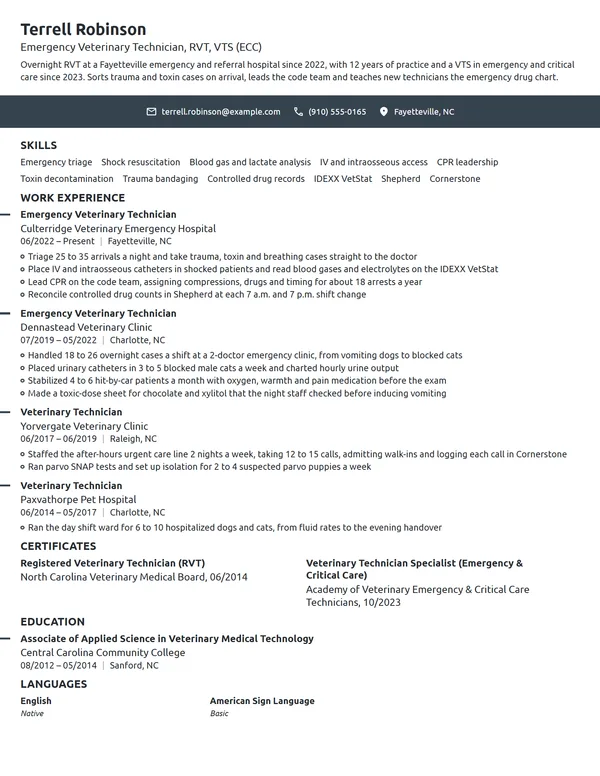
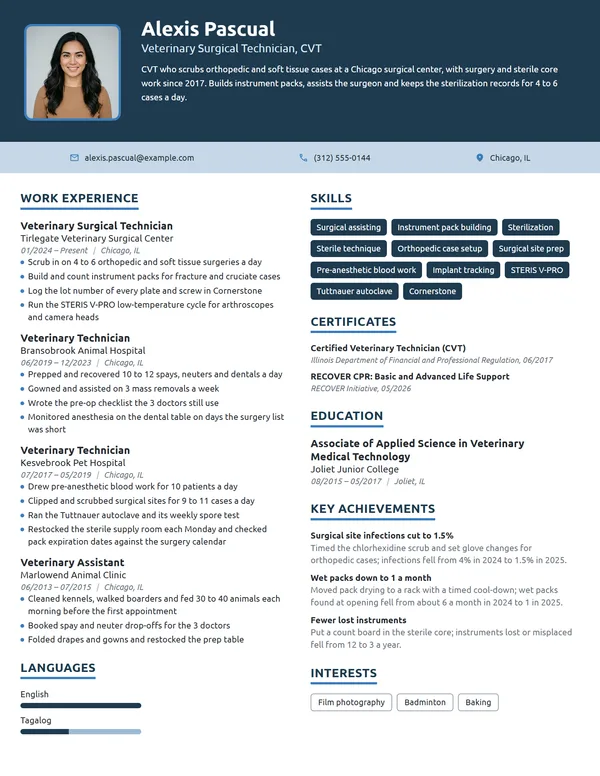
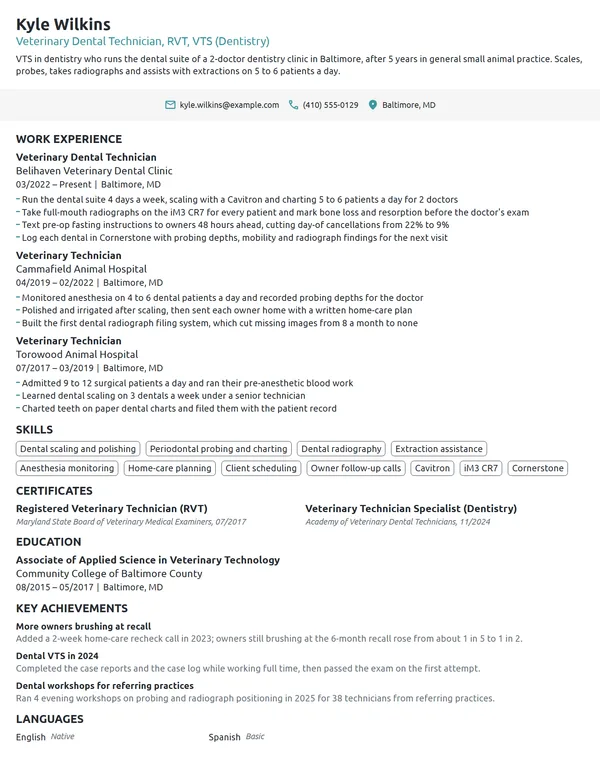
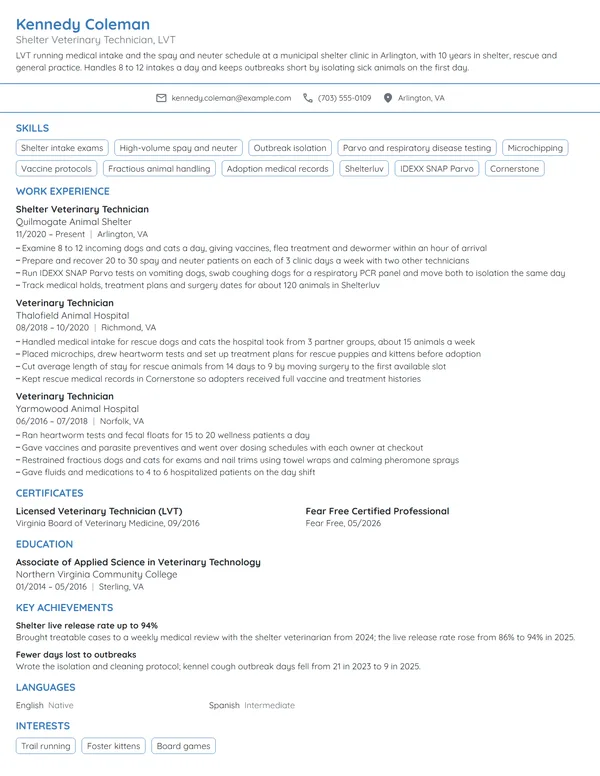
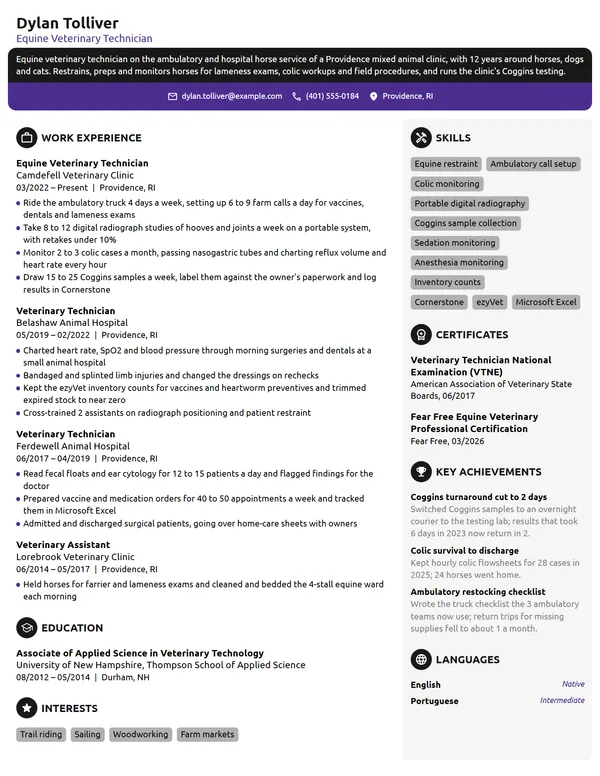
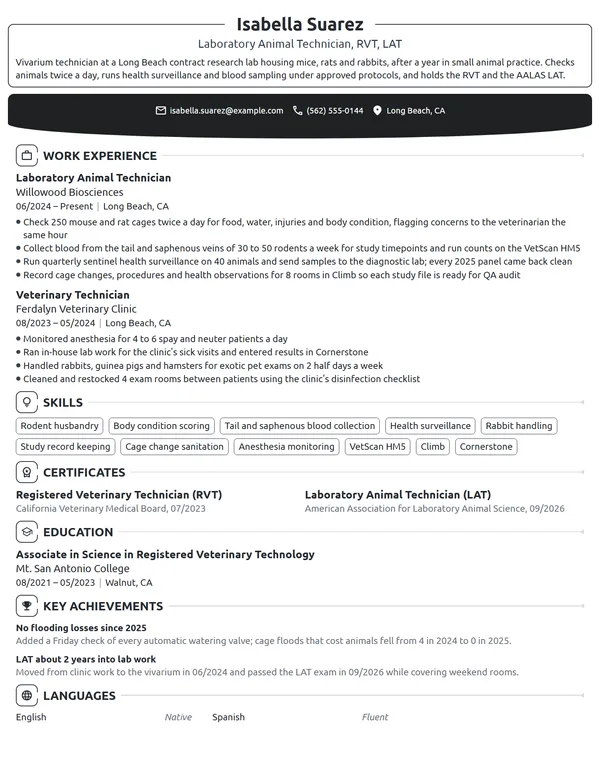
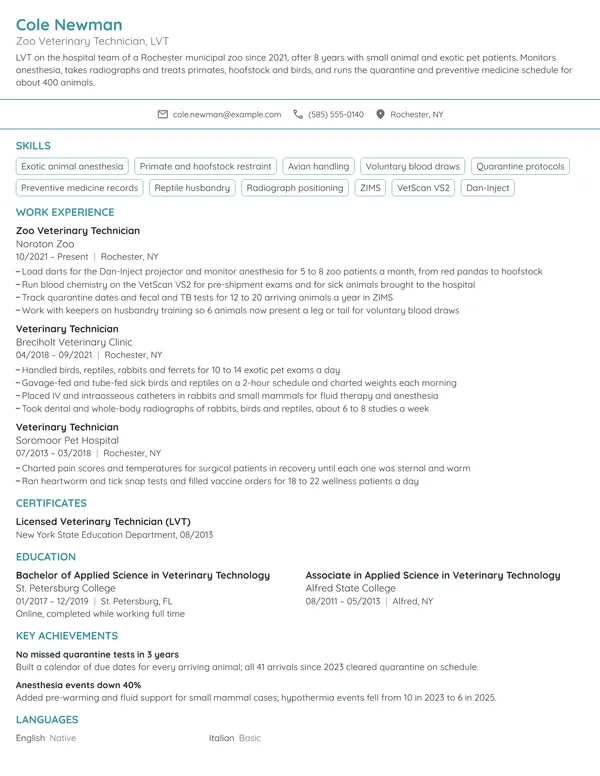
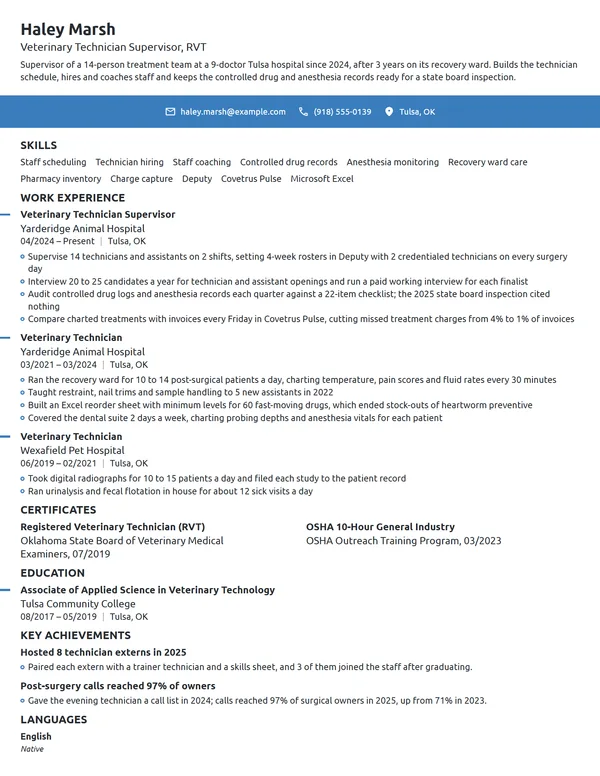
Vet tech work runs from anesthesia monitoring to lab samples to explaining discharge instructions, often for the same patient. A veterinarian hiring for the role wants to know which of those you can handle without a doctor beside you, and on which species. Every applicant lists the same duties, so vet tech resumes tend to read alike. Your caseload sets yours apart: procedures monitored, dental cleanings done, lab samples run and patients cared for each day.
How to Write a Veterinary Technician Resume - Key Takeaways
- Order jobs newest first on 1 page, and allow a second page only after 10+ years, a VTS or a lead role.
- Name the practice type, its size and the species you treat in your current vet tech job.
- Attach a count to every bullet: anesthetic procedures, dental cleanings, lab samples, patients a day or staff trained.
- List your state credential first under Certificates, written exactly as your state board issues it: CVT, RVT, LVT or veterinary technician license.
- Name your practice management software, such as AVImark, and prove it in a bullet.
- Scan your PDF with an ATS resume checker, since hospital groups and corporate practices screen for credential and procedure keywords.
What veterinarians and practice managers look for in a veterinary technician resume
Start with the duties a hiring vet expects to see. The Bureau of Labor Statistics lists administering anesthesia and monitoring the animal's response, taking x-rays, running lab tests such as urinalyses and blood counts, and giving medications and vaccines a veterinarian prescribes as core duties. O*NET adds keeping the controlled drug inventory and its log books, and dental work such as cleaning and polishing teeth.
Each of those duties should appear in a bullet with a number attached. Lay out the resume with these sections, using the headings a hiring system expects:
- Name, headline (for example, Credentialed Veterinary Technician, RVT) and contact details
- A short summary under your name, 2 to 3 lines long and without its own heading
- Work Experience, most recent practice first, with the practice type and species in your bullets
- Certificates: your state credential first, then Fear Free, RECOVER CPR or a VTS
- Skills, with your practice management software
- Education
- Optional extras: Languages, plus Volunteer Experience for shelter work or Key Achievements for awards
Best format for a veterinary technician resume
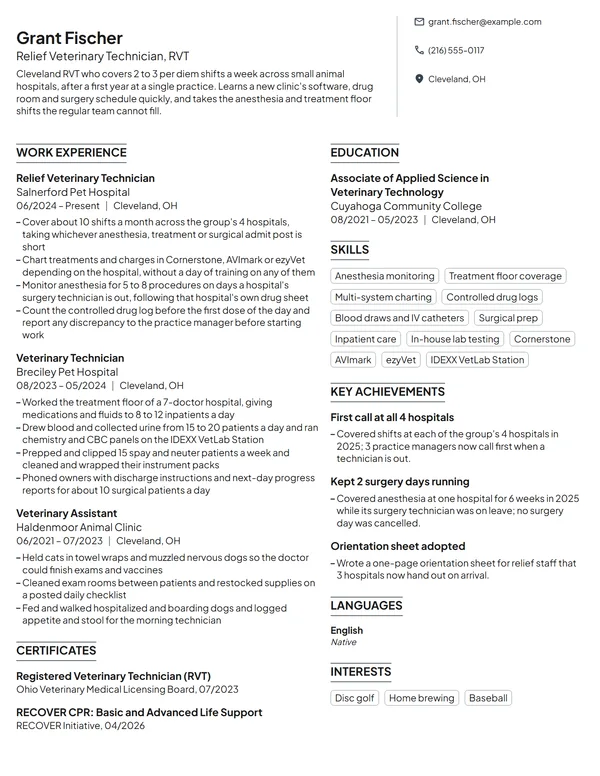
Choose the reverse-chronological resume format: your latest practice at the top, each job with its title, the practice name, the city and the MM/YYYY dates. Vet tech careers usually grow in skill rather than in title, from general practice into anesthesia, dentistry or emergency work, and newest-first order lets a reader follow that growth practice by practice. Relief or per diem shifts at a second clinic get their own entry beside your main job.
- Best for most vet techsReverse-chronologicalYour jobs, newest first, with your results under each one.Best for: A steady work history in your field
- FunctionalSkills grouped up top, with a short work history below.Best for: Gaps or very little experience
- CombinationA skills section first, then your full work history.Best for: A career change with strong skills
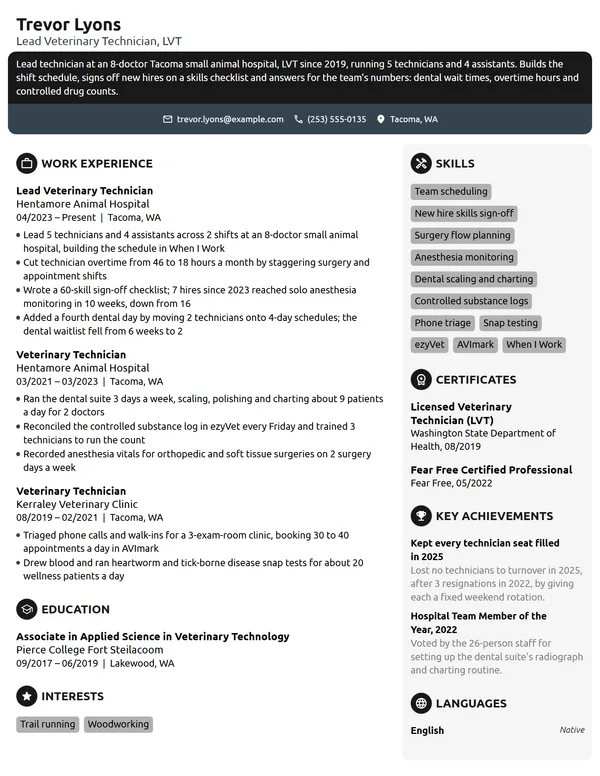
One page covers most vet techs for their first decade in practice. Move to 2 pages only after 10+ years, a VTS or a lead role, and keep your credential and current practice on page 1.
| Setting | What to use |
|---|---|
| Length | 1 page; 2 only with 10+ years, a VTS or a lead role |
| Dates | MM/YYYY for start and end, Present for the practice you work at now |
| Headline | Your title plus the credential your state issues: Veterinary Technician, LVT |
| Species and practice type | Small animal, exotics, equine, mixed or emergency, stated in your first bullet |
| Photo, age and ID | Photos are uncommon in the US and Canada; skip your date of birth, family status and SSN too |
| File type | PDF, or a Word file when the hospital group's application portal asks for one |
Most US and Canadian resumes carry no photo. Corporate practice groups and university hospitals often read your file into an online form, so plain section headings and a single column of dates help it arrive intact.
Veterinary technician resume summary vs. objective
Once you hold a state credential and have worked as a technician, open with a resume summary: your years, the practice type, the procedures you handle and 1 result. Still a student, waiting on your VTNE score or moving up from a veterinary assistant job? Write a resume objective instead, naming the role you want, your exam status and your externship hours.
Veterinary technician resume summary formula
Credential title with X years in practice type, focused on procedures you handle. 1 caseload or outcome figure. Certification, or the VTS or credential you are working toward.
Example
Licensed veterinary technician with 7 years in small animal general practice, focused on anesthesia and dentistry. Monitored anesthesia on about 1,500 procedures a year at a 5-doctor hospital. Fear Free certified and building a case log toward the VTS (Dentistry).
Don't
Compassionate vet tech who loves animals and is dedicated to providing quality care to every pet.
Do
Emergency veterinary technician with 4 years at a 24-hour hospital, triaging 20 to 30 walk-ins a night and placing about 15 IV catheters a shift. RECOVER BLS and ALS certified.
Every applicant loves animals; the rewrite shows the setting, the pace and the skills.
How to write veterinary technician work experience bullets with numbers
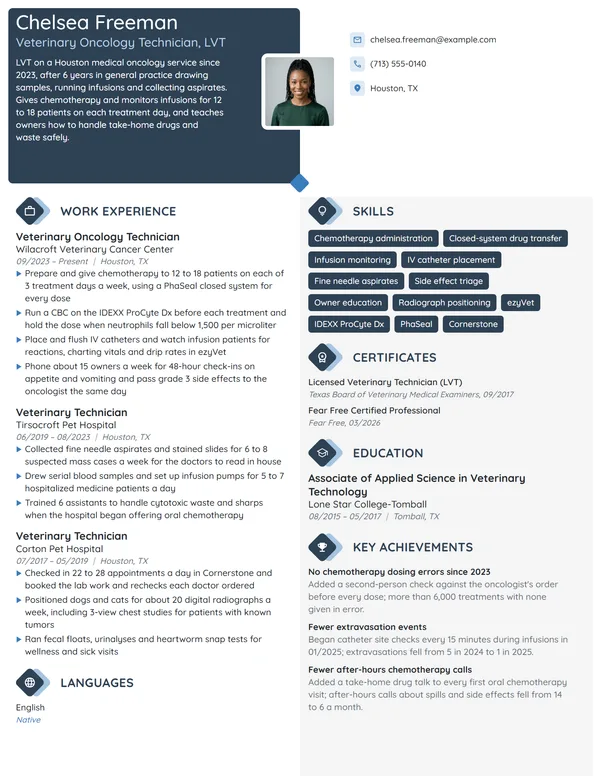
Your current job takes 3 to 4 bullets; each earlier one, 1 to 3. Open with the size of the practice and your share of its caseload, because every other figure is read against it. Then pick achievements with a number the practice already records in its software or logs: anesthesia sheets, lab runs, dental charts, inventory counts.
| Area | What to count | Example bullet |
|---|---|---|
| Anesthesia | Procedures monitored, patient risk level, complications | Monitored anesthesia on 1,100 procedures in 2025, including 140 patients rated ASA III or higher. |
| Laboratory | Samples a day, tests moved in-house, turnaround | Brought fecal and urine testing in-house, running about 60 tests a week that had gone to an outside lab. |
| Dentistry | Cleanings, radiographs, charts completed | Took full-mouth dental radiographs on 400 patients a year for the doctors' treatment plans. |
| Client education | Clients a day, treatment plans accepted | Raised dental treatment acceptance from 41% to 58% by walking owners through their pet's dental chart. |
| Training | Assistants and students trained, skills signed off | Trained 6 new veterinary assistants in restraint, vaccine prep and sample handling in 1 year. |
| Inventory | Stock value, expired product, controlled drug counts | Took over pharmacy ordering at a 4-doctor practice and cut expired-stock write-offs from $3,200 to $900 a year. |
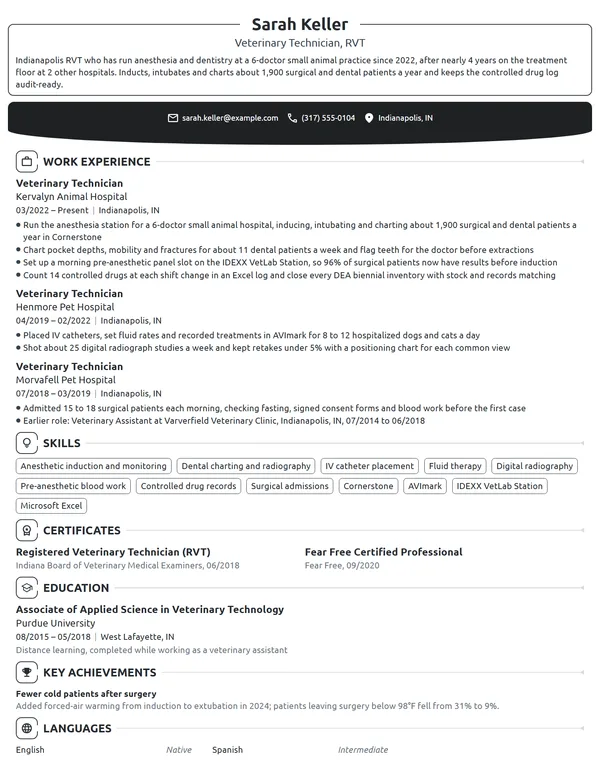
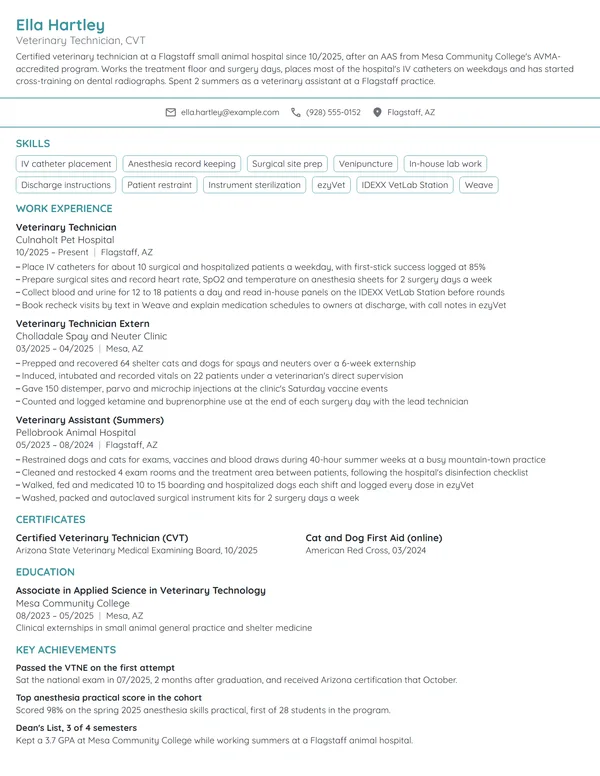
Here is how that looks for one technician in small animal practice. The current job carries the procedures and a result, and the first job keeps 1 line.
Work Experience
- Monitor anesthesia for 6 to 9 surgical and dental procedures a day at a 5-doctor small animal hospital, recording vitals every 5 minutes.
- Run CBCs, chemistry panels and urinalyses on about 35 samples a day, with results to the doctor within 20 minutes.
- Clean teeth and take full-mouth radiographs for 12 to 15 dental patients a week.
- Rebuilt the controlled drug log around a weekly count; discrepancies at the quarterly audit fell from 7 to 0.
- Roomed 25 to 30 patients a day at a 3-doctor clinic, taking histories and drawing blood for heartworm tests and wellness panels.
Don't
Assisted the doctor with surgeries.
Do
Prepped patients and monitored anesthesia for 8 to 10 spays, neuters and mass removals a day, with no anesthetic deaths in 3 years.
This version shows the caseload, your part in it and the outcome.
Don't
Responsible for client education.
Do
Went over discharge instructions with about 20 clients a day; post-surgical callbacks fell from 12 to 5 a week after the team added written discharge sheets.
Vet tech skills and practice management software for your resume
Choose 6 to 8 hard skills for your resume named in the job ad and proven in your bullets. Anesthesia monitoring and venipuncture fit almost every vet tech resume; dental radiography, ultrasound or large animal restraint belong only where your practice did them.
Hard skills for veterinary technicians
- Anesthesia induction support and monitoring
- IV catheter placement
- Venipuncture and sample collection
- In-house lab work (CBC, chemistry, urinalysis)
- Digital radiography
- Dental cleaning and radiographs
- Surgical prep and instrument sterilization
- Vaccine and medication administration
- Controlled drug logs
- Low-stress restraint and handling
Soft skills veterinarians value
- Calm with frightened animals
- Clear explanations to owners
- Composure in emergencies
- Attention to dosing detail
- Teamwork with doctors and assistants
- Compassion with grieving clients
Name your practice management software under Skills, then prove it with a bullet about the work you did in it, such as charting anesthesia or sending reminders. O*NET lists AVImark and veterinary practice management software among the tools vet techs use, and flags Microsoft Excel as a hot technology. If your clinic ran another system, such as Cornerstone or ezyVet, write its exact name, since recruiters search for the system rather than the category.
CVT, RVT, LVT and VTS: how to list vet tech credentials
The Bureau of Labor Statistics notes that each state regulates veterinary technicians differently, and that most require an exam. That exam is usually the Veterinary Technician National Examination (VTNE), which the American Association of Veterinary State Boards (AAVSB) owns and administers; AAVSB says most states and provinces require a passing score before a technician is credentialed, and the credential itself comes from the state. The title it gives you depends on the state: O*NET lists Certified (CVT), Licensed (LVT) and Registered (RVT) Veterinary Technician as names for the same job. List certifications on your resume after the state credential, each with its issuer and date.
| Credential | Issued by | What it takes |
|---|---|---|
| State credential (CVT, RVT, LVT or veterinary technician license) | Your state's veterinary board | In most states a veterinary technology program and a passing VTNE score, plus any requirements of your own state. |
| Registered Veterinary Technician (RVT), California | California Veterinary Medical Board | A degree from an AVMA CVTEA-accredited program or an alternate route, PAVE or out-of-state path, and the VTNE through AAVSB. |
| VTS (Internal Medicine) | Academy of Internal Medicine Veterinary Technicians | At least 3 years and 6,000 hours as a credentialed technician in internal medicine within the last 5 years, plus 40 hours of continuing education. |
| Fear Free certification (Canine and Feline) | Fear Free | An online program on reducing fear, anxiety and stress in pets, renewed every year as a membership. |
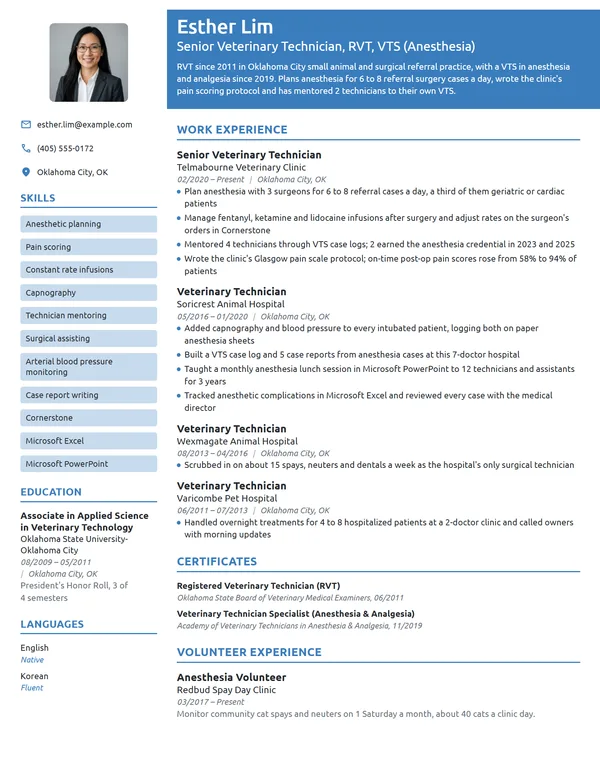
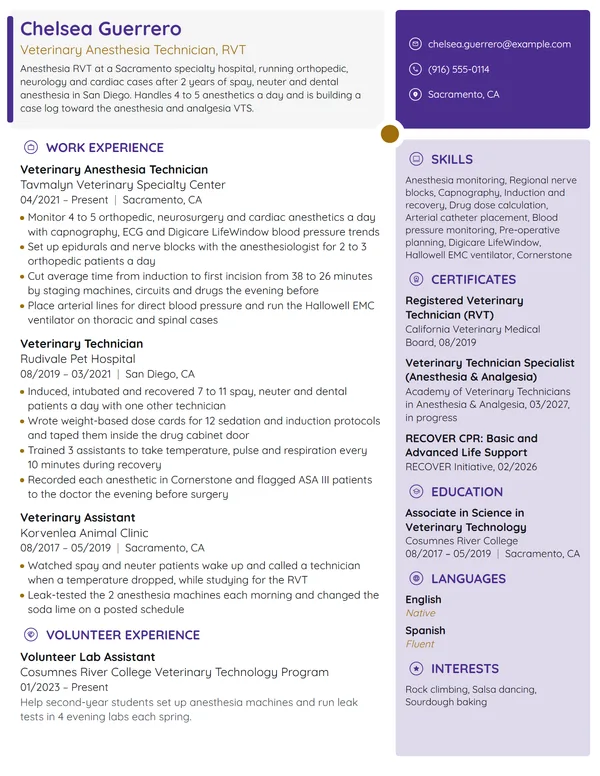
A VTS is the field's specialist credential: NAVTA recognizes 16 specialty academies, among them anesthesia and analgesia, dentistry, and emergency and critical care. Each academy sets its own hours, case logs and exam, so name the academy and the specialty in full.
How to write your state credential line
Write the credential's full name as your board issues it, the state, the board and the month it was issued, and leave the number off. Put the short form after your name in the headline only once the state has issued it; before then, give your VTNE status and date in your objective instead. Georgia, for example, issues a veterinary technician license, so a Georgia technician writes exactly that.
Certificates
- Veterinary Technician License, Georgia, Georgia State Board of Veterinary Medicine, 07/2019
- Fear Free Veterinary Professional Certification (Canine and Feline), Fear Free, 03/2023
- RECOVER CPR: Basic and Advanced Life Support, RECOVER Initiative, 10/2025
How to list a veterinary technology degree on your resume
According to the Bureau of Labor Statistics, veterinary technicians usually hold a 2-year associate's degree in veterinary technology, while technologists usually hold a 4-year bachelor's degree and often work in research. State boards such as Georgia's ask for a program accredited or approved by the AVMA's Committee on Veterinary Technician Education and Activities (CVTEA), so write the degree under its official name, such as Associate of Applied Science in Veterinary Technology.
When listing education on a resume, give the degree name, then the college with its city, then the month you graduated. In your first 2 years, add 1 line with your externship sites and hours; after that, the degree, school and date are enough.
Education
Clinical externships in small animal surgery and at a 24-hour emergency hospital, 320 hours.
Student, new grad and career-change veterinary technician resumes
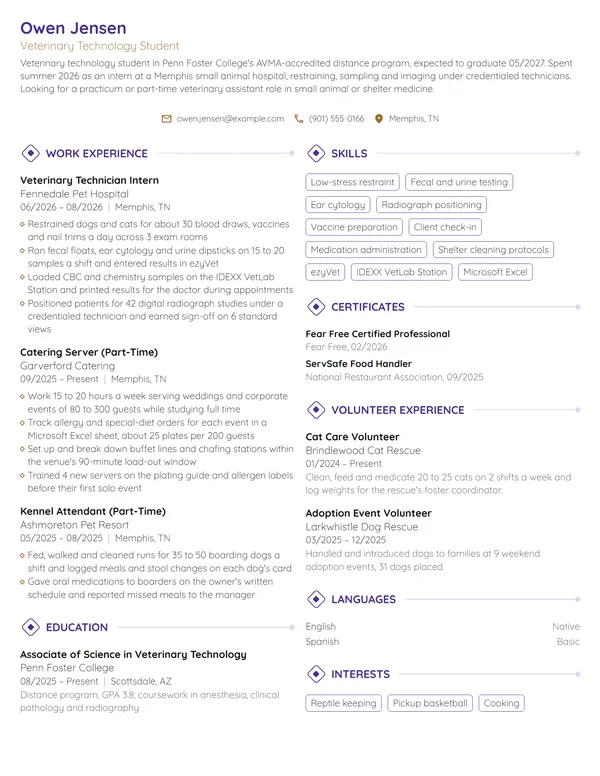
While you are still in a program or waiting on your VTNE result, your clinical hours are your experience. Open with an objective naming the practice type you want and your exam status with a date, and give each externship or internship site a full entry with the species, the procedures you assisted and your hours. The entry-level resume layout works if you have no animal care job yet.
- Externships and internships: the practice type, the species, your hours and the procedures you were signed off on.
- Veterinary assistant or kennel jobs: a full Work Experience entry with patients a day, restraint, sample handling and cleaning protocols.
- Shelter or rescue volunteering: under Volunteer Experience, with animals cared for, vaccines given under supervision or adoption events staffed.
- Lab animal, farm or grooming work: 1 entry with the species and the handling skills that carry over.
Don't
Recent vet tech graduate looking for a position where I can use my skills and my love of animals.
Do
Veterinary technology graduate (AAS, 05/2026) who passed the VTNE in 08/2026, seeking a small animal or emergency role. Completed 3 clinical externships totaling 240 hours, 80 of them in anesthesia.
The stronger version trades feelings for an exam date, a setting and hours.
Moving up from veterinary assistant, list jobs newest first as usual and put your new credential and degree in the headline and Certificates. Under the assistant job, keep the bullets that already show technician work, such as restraint, lab samples or surgical prep, with counts. Your cover letter can explain the step up in 1 short paragraph, and our healthcare cover letter examples show that structure; changing fields altogether, start from the career-change resume layout.
Veterinary Technician resume FAQ
What is the difference between CVT, RVT and LVT on a resume?
The job is the same; the title depends on your state. Each state board decides whether it certifies, registers or licenses veterinary technicians, so write the exact title your board issued, with the state and the month, and never swap it for another state's term.
Can I write CVT or RVT after my name before I pass the VTNE?
No. Use the credential only after your state issues it. Until then, put your exam status in your objective, such as VTNE scheduled for 11/2026 or VTNE passed, state credential pending.
How long should a veterinary technician resume be?
1 page for students, new graduates and most practicing technicians. A second page suits 10+ years, a VTS or a lead role, as long as your state credential and current practice sit on page 1.
Should I list the species I have worked with on a vet tech resume?
Yes. Name them in your headline or first bullet: small animal, feline only, exotics, equine, food animal or laboratory species. Handling skills do not transfer automatically between them, so a hiring vet looks for a match with the patients they see.
How do I move from veterinary assistant to veterinary technician on a resume?
Lead with your new degree and state credential, then keep the assistant job as a full entry. Pick the bullets that show work a technician does, such as restraint, sample collection or surgical prep, and give each a count so the experience reads as a head start.
Which practice management software should a vet tech resume name?
Name the system your clinic ran, exactly as it is spelled, such as AVImark, Cornerstone or ezyVet. Put it in your Skills section and in 1 bullet about your work in it, such as building estimates or running vaccine reminders.
What is the median salary for a veterinary technician?
Veterinary technologists and technicians earned a median $47,380 a year in May 2025, per the BLS. Pay varies with your state, your credential, the practice type and any specialty, so leave it off your resume and discuss it once you have an offer.
Next steps
Pick the example closest to your practice type and career stage, follow its structure, and replace the details with your own species, credential, caseload and results. Put it together in our resume builder, or adapt one of our templates, and add a cover letter naming the practice and the procedure count you are proudest of.