
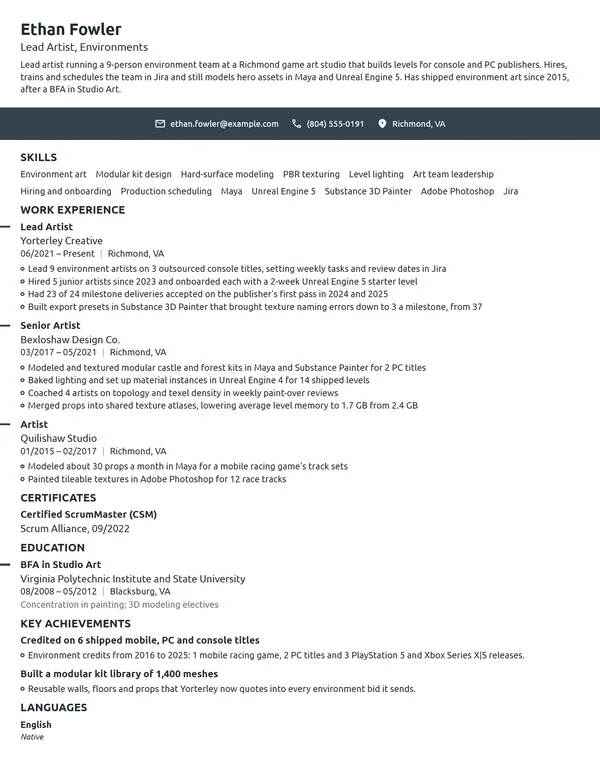
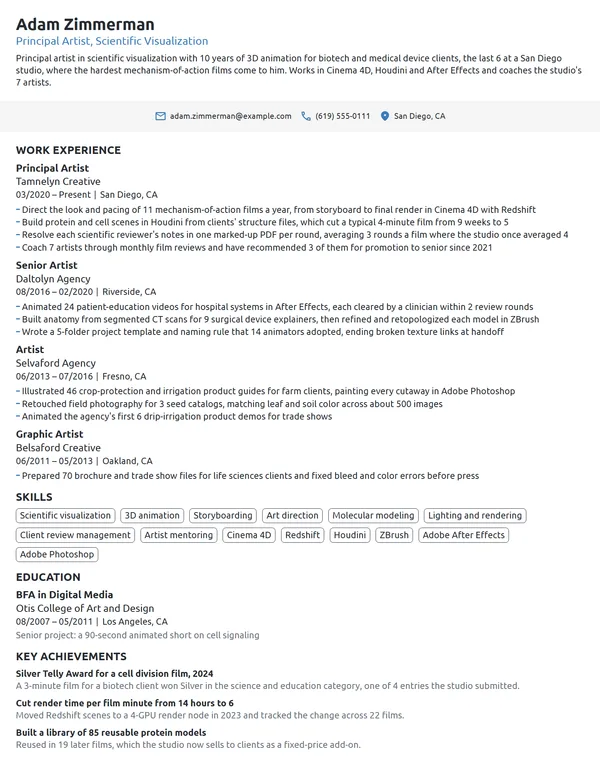
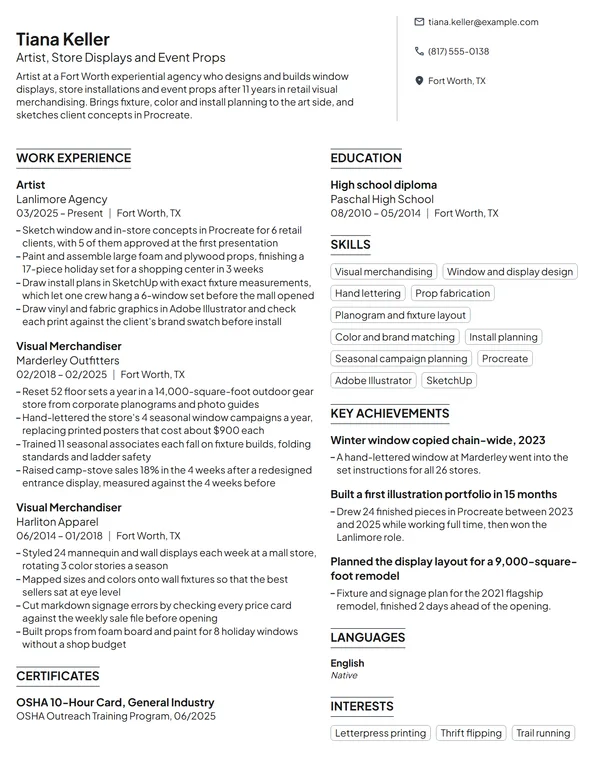
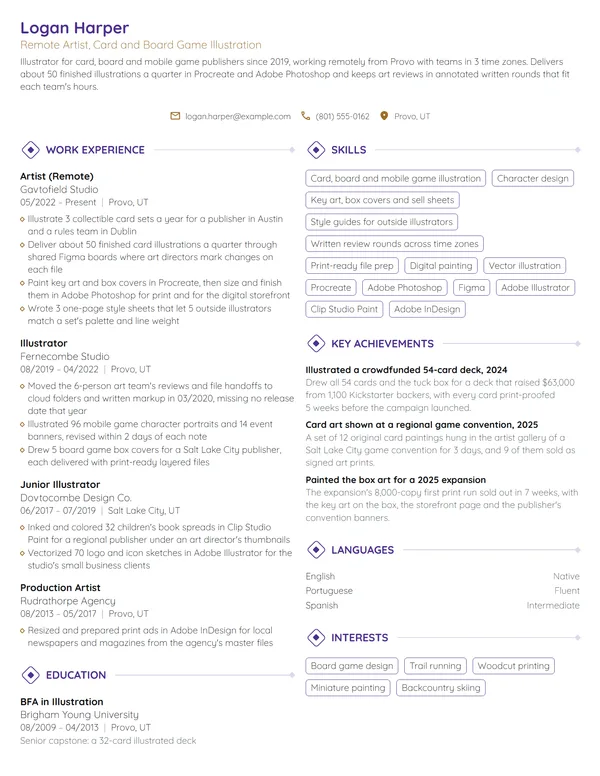
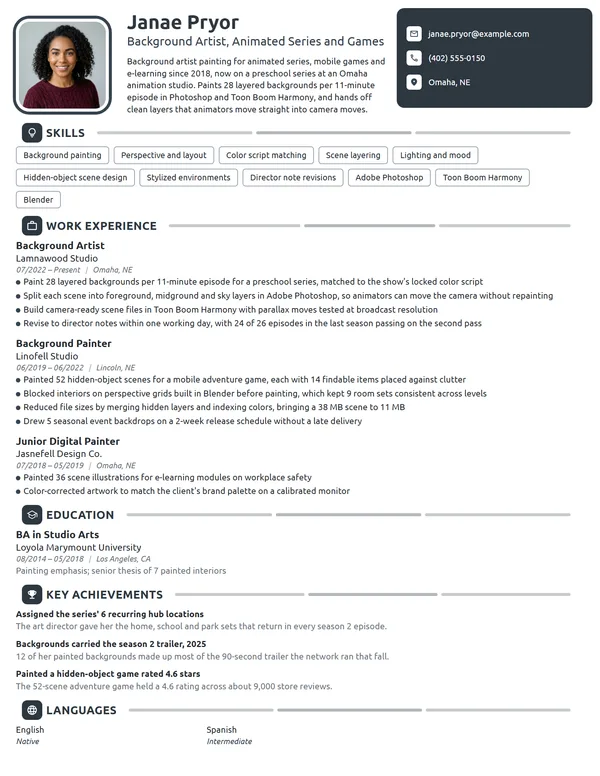
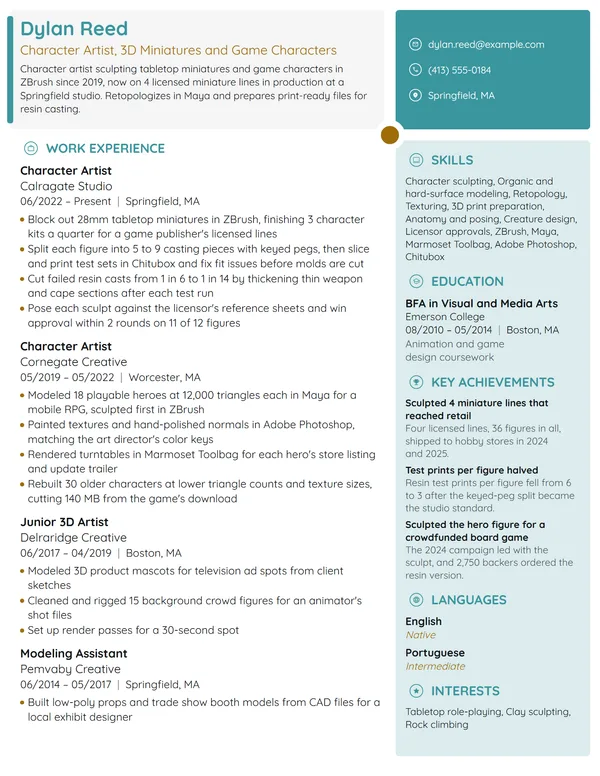
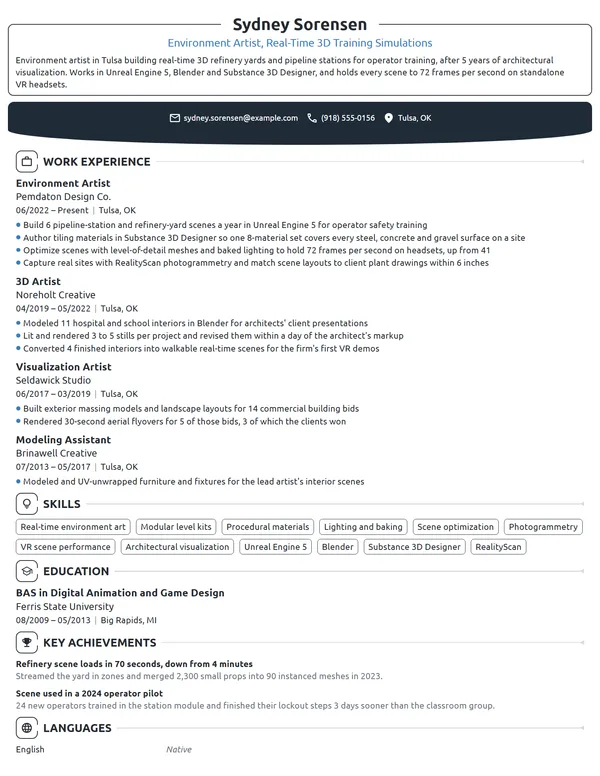
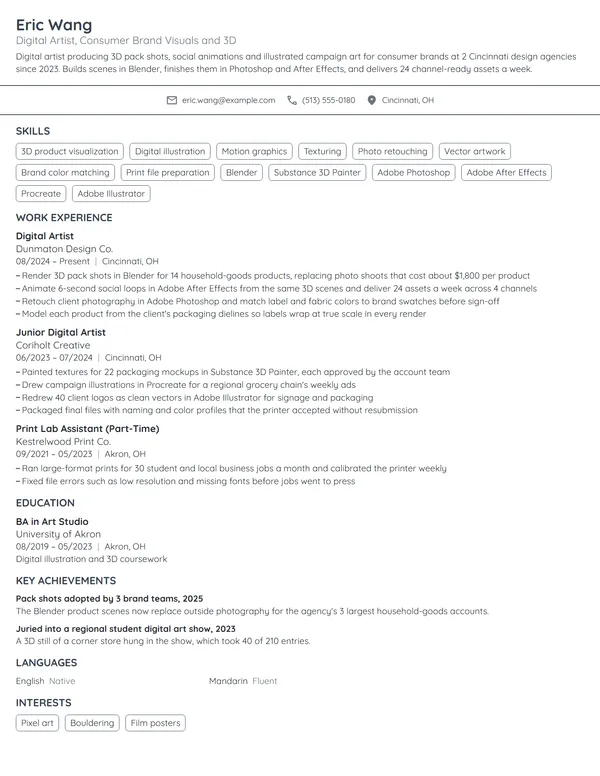
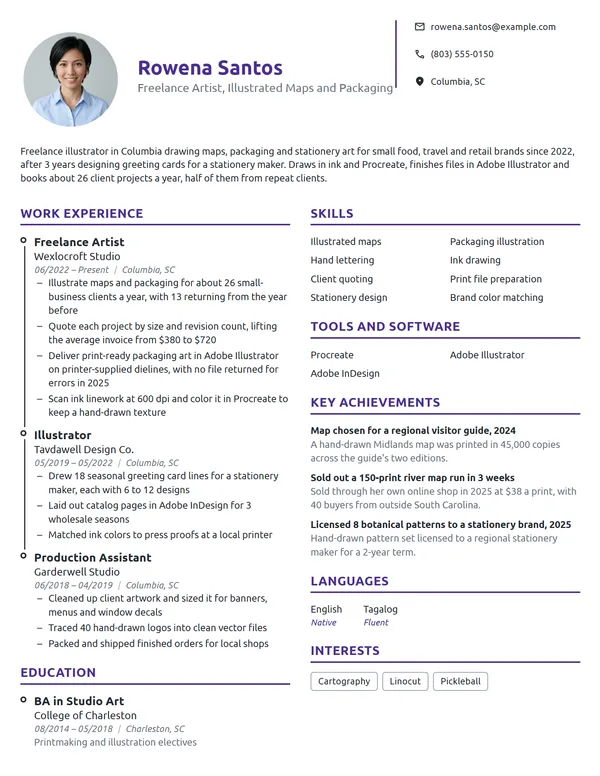
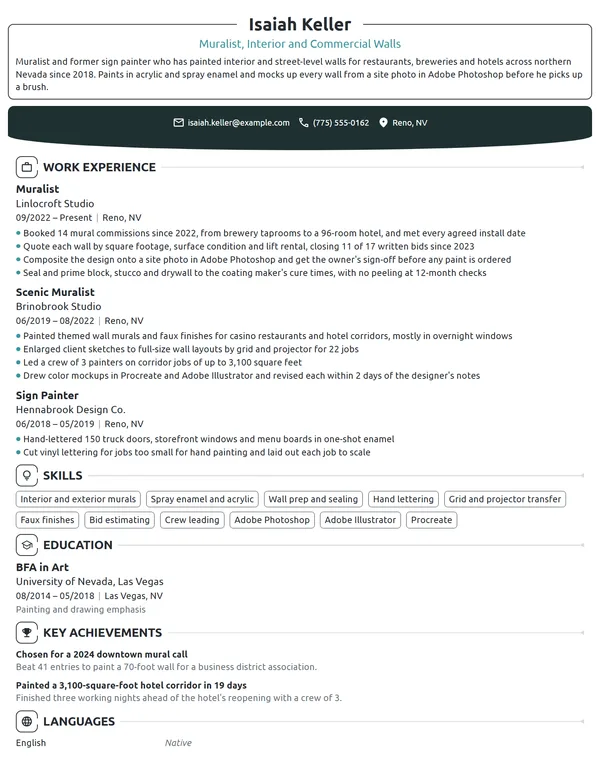
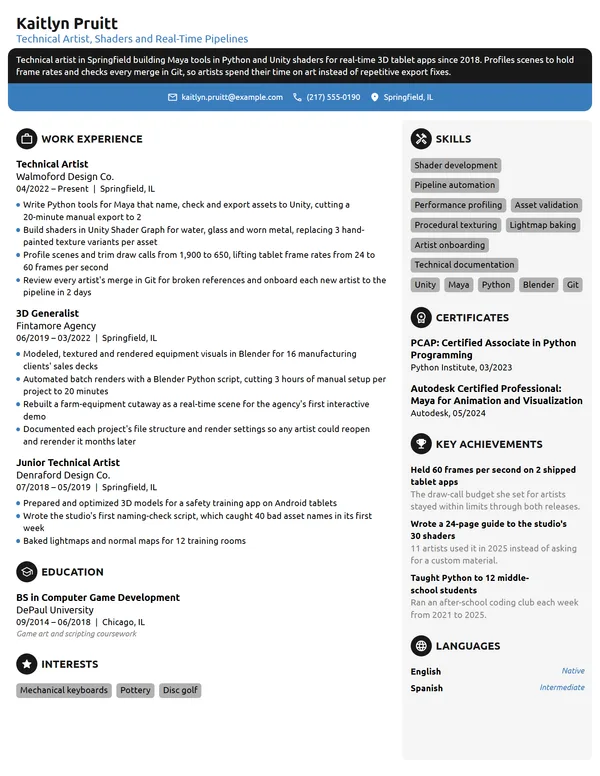
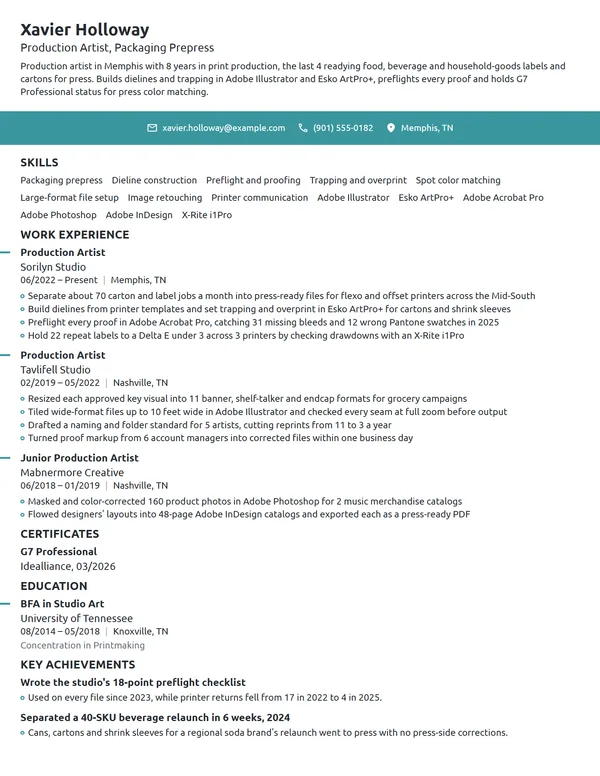
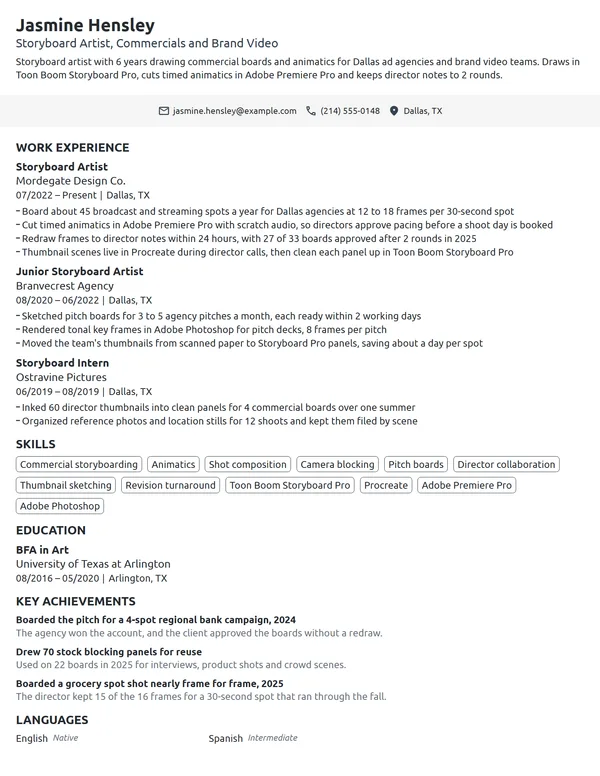
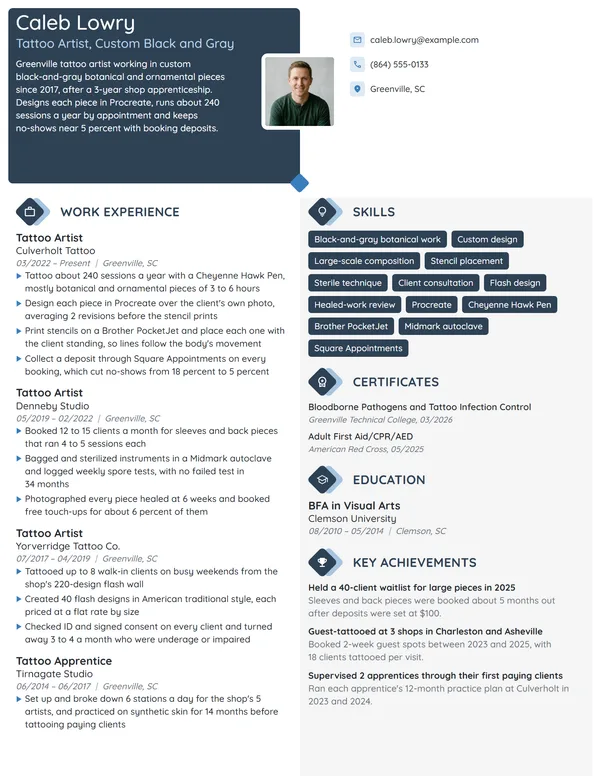
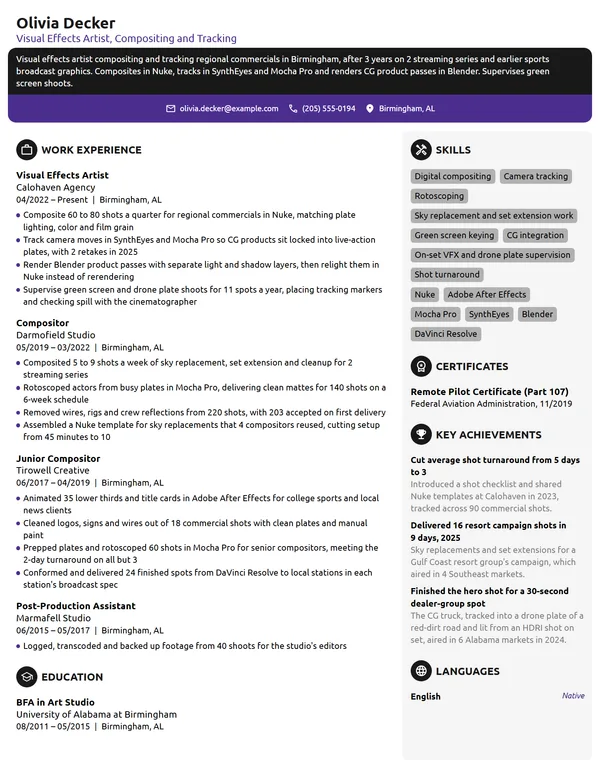
Art directors, studios and clients often read an artist's resume before opening the portfolio, so the page decides whether your work gets a look. They want the media and software you use, the projects you delivered, and signs that you hit deadlines and stay on budget. Turning creative work into plain, specific language is where many artists stall, and bullets drift into task lists. Concrete details, like the client, the format and the turnaround, send the reader on to your work.
How to Write an Artist Resume - Key Takeaways
- Use reverse-chronological order on a 1-page resume; a senior or lead artist with 10+ years of shipped work can run to 2.
- Open with 2 to 3 lines that name your specialty, your years, your main media or software and 1 project with a number.
- Count your output in every bullet: pieces delivered, review rounds, deadlines met, square feet, editions, works sold or budgets.
- List media and software among your skills, such as acrylic, Adobe Photoshop or Autodesk Maya, and use each one in a bullet.
- Put selected exhibitions, residencies and grants in a short Key Achievements section and keep the full show list for galleries that ask for it.
- Put the portfolio link with your contact details and in your cover letter, then run the finished PDF through an ATS resume checker before you apply.
What art directors look for in an artist resume
The BLS calls portfolios essential because art directors, clients and others look at them, and your resume is the index to that portfolio. The BLS lists creating sketches or models to guide the work, selecting materials by color, texture and strength, and completing grant proposals among an artist's core duties. O*NET adds conferring with clients and art directors, submitting artwork for approval and developing project budgets.
This resume has 2 kinds of readers. A studio hiring a staff artist checks your specialty, your software and how fast your work clears review. A client, gallery or arts center hiring you for a commission checks scale, budget and whether you deliver on the agreed date. Write for the reader of the job you are applying to, using these sections:
- Name, headline (such as Muralist and Studio Artist, or Lead Environment Artist) and contact details with your portfolio URL
- A 2- to 3-line summary under your name; it needs no heading
- Work Experience, including self-employed commission work, newest first
- Skills, with your media and software
- Key Achievements for selected exhibitions, residencies and grants, or Volunteer Experience for community art
- Education
- Optional: Certificates, Languages and Interests
Best format for an artist resume
Use the reverse-chronological resume format, starting with your latest role and giving each one a title, the studio or client, its location and the dates as MM/YYYY. Staff artists move from junior to senior to lead and commissions grow in size and budget; newest-first order shows both. Choose a combination format, with a skills block above your history, only if your art so far comes from coursework and personal projects rather than paid work.
- Best for most artistsReverse-chronologicalYour jobs, newest first, with your results under each one.Best for: A steady work history in your field
- FunctionalSkills grouped up top, with a short work history below.Best for: Gaps or very little experience
- CombinationA skills section first, then your full work history.Best for: A career change with strong skills
Fit an artist resume on 1 page unless you have 10+ years of studio or commission work, and keep the design calm so the portfolio does the showing. A layout from our creative resume templates can carry 1 accent color and clear headings; leave hand lettering, textures and image backgrounds for the work itself.
| Setting | What to use |
|---|---|
| Length | 1 page; 2 only for 10+ years of studio or commission work |
| Dates | MM/YYYY for each role, and Present for the job you hold now |
| Job title line | Your title plus specialty: Artist, Murals and Public Art, or Senior Artist, Environments |
| Portfolio | In your contact details and cover letter; the resume names the pieces the reviewer will see there |
| Photo, birth date and ID numbers | In the US and Canada, usually none; keep your Social Security number, marital status and date of birth off the page |
| File type | A text-based PDF; never a flattened image export from your design software |
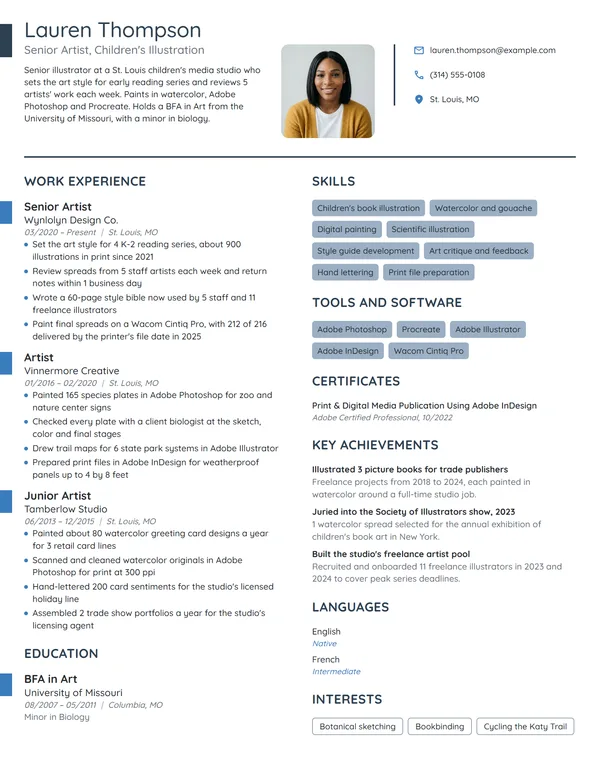
Most US and Canadian resumes carry no photo. Your images belong in the portfolio, so keep thumbnails of your art off the resume.
Artist resume summary vs. objective
Use 1 test: if anyone has paid you for art, on staff, on commission or as a freelancer, write a resume summary that names your specialty, your years, your media and 1 project with a number. If nobody has paid you yet, a resume objective names the role you want and the best evidence you have, such as an internship, a thesis show or a juried student exhibition.
Artist resume summary formula
Title with X years in specialty or medium for client or studio type, working in media or software. 1 project with its scale, deadline or budget. Exhibition, residency or credential.
Example
Muralist and studio artist with 7 years in large-scale commissions for cities and hotels, working in acrylic, spray paint and Procreate for mockups. Painted 9 exterior murals of up to 2,600 square feet, each within its contracted window. Shown in 2 juried regional exhibitions since 2024.
Don't
Passionate, creative artist with a unique vision, looking to bring my talents to an inspiring team.
Do
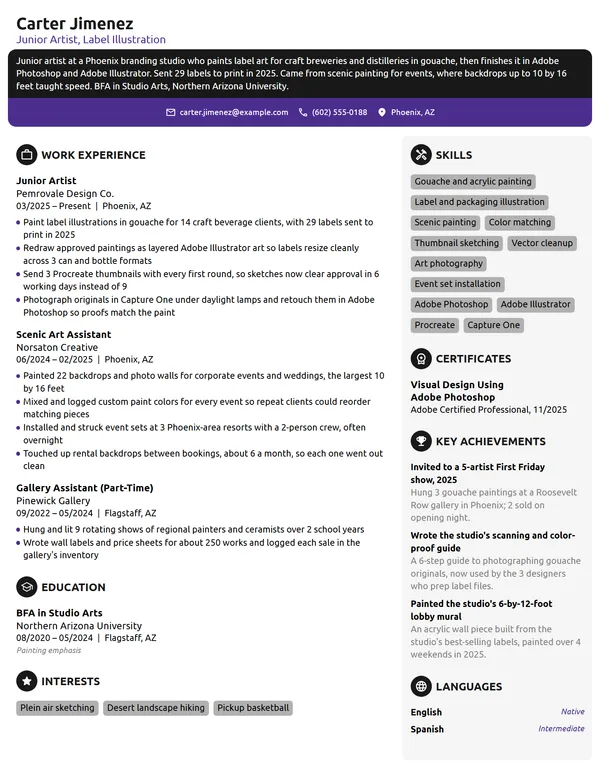
In-house artist with 4 years of surface pattern design for a home goods brand, working in gouache and Adobe Illustrator. Painted 220 pattern repeats a year across 6 seasonal collections, with 180 approved on the first round.
The good line adds a setting, the media, a yearly volume and a first-round approval count.
How to write artist work experience bullets with numbers
Your current role gets 3 to 4 bullets and each earlier role gets 1 to 3, every one opening with a verb and closing on a result. Art directors and clients think in pieces, review rounds, deadlines, square feet and dollars, so most of your bullets can carry one of those. The basics of listing work experience on a resume apply to commission work too: if you have worked for yourself, give it 1 entry with a title such as Independent Artist, your city and the dates, and count the commissions inside it.
| Area | What to count | Example bullet |
|---|---|---|
| Commissions | Pieces, size, budget, delivery date | Completed 6 private commissions at $8K to $15K each, all installed on the contracted date. |
| Studio production | Assets or pieces per month, review rounds | Delivered 45 environment props a month at an average of 2.1 review rounds each. |
| Exhibitions and sales | Shows, works shown, works sold | Showed in 3 group exhibitions in 2025 and sold 16 of 24 works on view. |
| Prints and editions | Edition size, runs, error rate | Pulled a 26-print screen edition with no sheet rejected for registration. |
| Teaching and workshops | Sessions, students, finished pieces | Taught an 8-week figure drawing workshop for 14 adults at a community arts center. |
| Production art | Files prepared, reprints, turnaround | Prepared 300 packaging files a quarter for print with 0 reprints for file errors. |
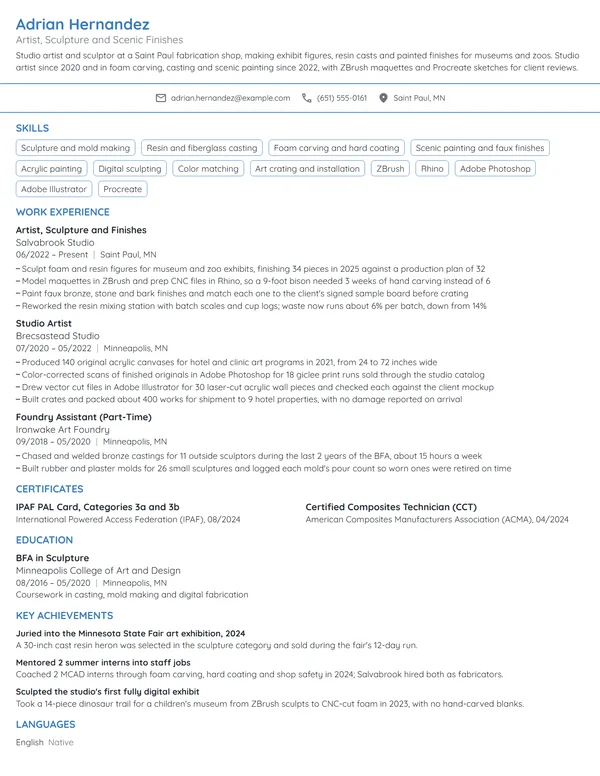
Here is how one muralist's entry reads once the counts go in. The current role carries the scale, the approval record and the budget; the earlier studio job gets 2 lines.
Work Experience
- Painted 9 exterior murals from 400 to 2,600 square feet for hotels, schools and a city parks department, each finished within its contracted window.
- Turned 38 client briefs into scaled sketches and color studies in Procreate; 31 were approved by the second review.
- Built material, lift and scaffold budgets for commissions up to $42K and closed 8 of 9 projects under budget.
- Trained 3 studio assistants in grid transfer, surface prep and spray blending for walls over 1,000 square feet.
- Printed about 1,200 sheets a year across 60 screen print editions for 15 visiting artists.
- Cut registration errors from 1 in 25 sheets to 1 in 80 by rebuilding the studio's hinge and jig setup.
Don't
Created custom artwork for clients.
Do
Painted 3 oil portraits on commission for $2,400 each, delivering every one within the agreed 6 weeks.
The rewrite names the medium, the volume, the price and the deadline.
Don't
Responsible for character art on several game projects.
Do
Drew 120 character turnarounds for 2 mobile game titles and returned art-director revisions within 48 hours.
Artist skills, media and software for your resume
Choose 6 to 8 hard skills for your resume that the posting names and your bullets back up. For an artist, a skill is usually a medium or a technique, such as oil painting, figure drawing or screen printing, so name it as plainly as a gallery label would. Let your results carry the soft skills below.
Hard skills for artists
- Figure and gesture drawing
- Color theory and composition
- Oil and acrylic painting
- Digital painting
- Large-scale mural layout
- Screen printing and printmaking
- Sculpture and mold making
- 3D modeling and texturing
- Concept sketching and thumbnails
- Art handling, framing and installation
Soft skills art directors value
- Taking feedback without losing the idea
- Meeting deadlines
- Client communication
- Visual problem solving
- Self-promotion
- Working with a production team
List your software with your skills, then name each program again inside a bullet so the reader sees what you made in it. O*NET flags Adobe Photoshop, Adobe Illustrator and Autodesk Maya as in-demand technology for fine artists, and also lists Adobe After Effects, Adobe InDesign, Unity, Unreal Engine and Perforce Helix. Game and animation studios search for their pipeline by name, so if you have used ZBrush, Blender or Substance 3D, write that exact name; a fine artist can list Procreate for sketches and mockups.
Certificates, exhibitions and residencies on an artist resume
Most artist roles need no license, so Certificates is optional and earns its place only when a credential matches the job ad. List certifications on your resume with the issuer and the date: an Adobe exam for a production or digital role, or a safety course for a muralist who works on lifts and scaffolds.
| Credential | Issued by | What it takes |
|---|---|---|
| Adobe Certified Professional: Visual Design Using Adobe Photoshop | Adobe | Pass the Photoshop exam, online or at a test center; Adobe recommends 150 hours of experience with the app. |
| Adobe Certified Professional: Graphic Design & Illustration Using Adobe Illustrator | Adobe | Pass the Illustrator exam; the same 150-hour experience guideline applies. |
| Adobe Certified Professional: Visual Effects & Motion Graphics Using Adobe After Effects | Adobe | Pass the After Effects exam; useful for motion and production artist roles. |
| OSHA 10-Hour Outreach Training | An OSHA-authorized Outreach trainer or online provider, who issues the completion card | A 10-hour class on common job hazards. OSHA calls it voluntary, and it does not replace an employer's required training. |
Where exhibitions, residencies and grants go
Pick your 3 or 4 strongest shows, residencies or grants and list them under Key Achievements, newest first, each with the venue, the city and the year. An artist whose community murals or free classes matter more than their shows lists those under Volunteer Experience instead. The complete record of every show belongs on an artist CV, the longer document galleries and residencies ask for.
Key Achievements
- Solo exhibition, Tidewell Arts Center, Savannah, GA (2026): 14 new works on view; 11 sold during the run.
- Juried group exhibition (2025): 1 of 30 artists selected for a regional show of Southeast painters.
- Juried group exhibition (2024): 2 large-format paintings selected for a coastal Georgia survey show.
- Artist residency (2023): 4-week studio residency producing a 5-panel mural study.
How to list a BFA, BA or art school training
Most fine artists pursue postsecondary education to improve their skills and job prospects, the BLS says, and it adds that school gives artists a chance to build their portfolio. Follow the usual rules for listing education on a resume: the degree as it is printed on your diploma, such as B.F.A. in Painting or B.A. in Studio Art, the school, its city and the graduation date.
An artist's degree line can carry 1 extra line that a hiring manager can picture: the thesis exhibition, its size or a concentration. Add a GPA only within 2 to 3 years of graduating and only if it is 3.5 or higher; once you have paid work, the degree, school and date are enough.
Education
Senior thesis exhibition: 12 large-format oil paintings.
Entry-level, intern and career-change artist resumes
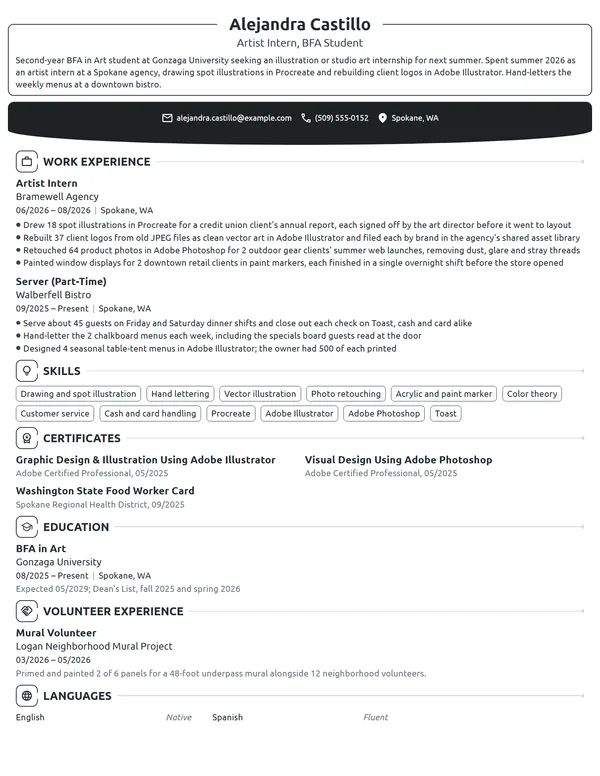
Without a paid art job yet, an entry-level resume layout works: a short objective, Education placed high on the page, followed by everything that shows you can make work on a deadline. Count each item the way you would count a staff job.
- Internships at studios, galleries or agencies: pieces finished, files prepared, installations helped with.
- Student and juried shows: how many works were selected, under Key Achievements.
- Small commissions and markets: pieces sold, average price, repeat buyers, in 1 Independent Artist entry.
- Community murals or free classes: wall size or students taught, under Volunteer Experience.
- Part-time jobs: keep them short, with 1 bullet on the customer, deadline or cash skills a studio also needs.
Don't
Art student seeking an opportunity to grow my skills and gain experience.
Do
BFA student with a 10-week internship at an animation studio, seeking a junior background artist role. Painted 40 background plates in Photoshop and had 1 work selected for a juried student show.
An objective still needs proof: an internship, a count of pieces or a selection.
Coming from graphic design, teaching, tattooing or sign painting, keep newest-first order and start with a summary that names the art you already make for money, such as illustrations, lettering or custom pieces. A career-change resume reads best when the first bullets under your current job are its most art-heavy tasks. Explain the move in your cover letter, using the steps for how to write a cover letter, and put the portfolio link in its first paragraph.
Artist resume FAQ
Should an artist resume include a portfolio link?
Yes. Put the link with your contact details, in the application form's website field and in the first lines of your cover letter, and name the same projects the portfolio opens with, so the reviewer can match a bullet to a piece.
What is the difference between an artist resume and an artist CV?
A resume is a 1-page document for a job, built around roles, skills and results. An artist CV is the longer exhibition record that galleries, residencies and grant panels ask for, listing every show, collection and award. Send whichever document the job ad requests.
How do I list freelance commissions on an artist resume?
Group them under 1 Work Experience entry, such as Independent Artist, with your city and the years you have worked that way. Then count the commissions in bullets: pieces, sizes, budgets and delivery dates. Name a client only when they are happy to be named.
How do I list exhibitions on an artist resume?
Put your 3 or 4 strongest shows under Key Achievements, newest first, with the venue, the city, the year and whether the show was juried, invited or solo. Keep the complete exhibition list for the longer record galleries and residencies request.
Do I need a BFA to work as an artist?
No. O*NET reports that some artist jobs ask for a bachelor's degree and others accept high school or some college. Most fine artists still pursue postsecondary education, per the BLS, and studios hire mainly on the portfolio, so a strong body of work can carry a resume without a degree.
What software should an artist list on a resume?
List the programs the job ad names that you can work in today, such as Adobe Photoshop, Adobe Illustrator, Autodesk Maya or Procreate. Back each one with a bullet that says what you made in it, and leave off programs you have only opened.
How long should an artist resume be?
A 1-page resume covers most artists, including those with 5 to 8 years of work. A senior or lead artist with 10+ years of shipped titles or large commissions can use 2 pages, as long as the first page holds the latest 2 roles.
Should I list teaching or workshops on an artist resume?
Yes, when the job involves clients, teams or the public. A paid teaching role gets its own Work Experience entry with the number of classes and students; free classes at a community center go under Volunteer Experience.
How much do artists make?
BLS figures put the median annual wage for fine artists, including painters, sculptors and illustrators, at $55,490 in May 2025. Staff artists in games, film or advertising are counted in other occupations. Leave pay off your resume and discuss it at the offer stage.
Next steps
Pick the example nearest your level and specialty, keep its structure, and swap in your own pieces, deadlines and budgets. Line your bullets up with the first projects in your portfolio. Build the file in our resume builder, or pick one of the resume templates, and send it along with a cover letter that carries your portfolio link.