
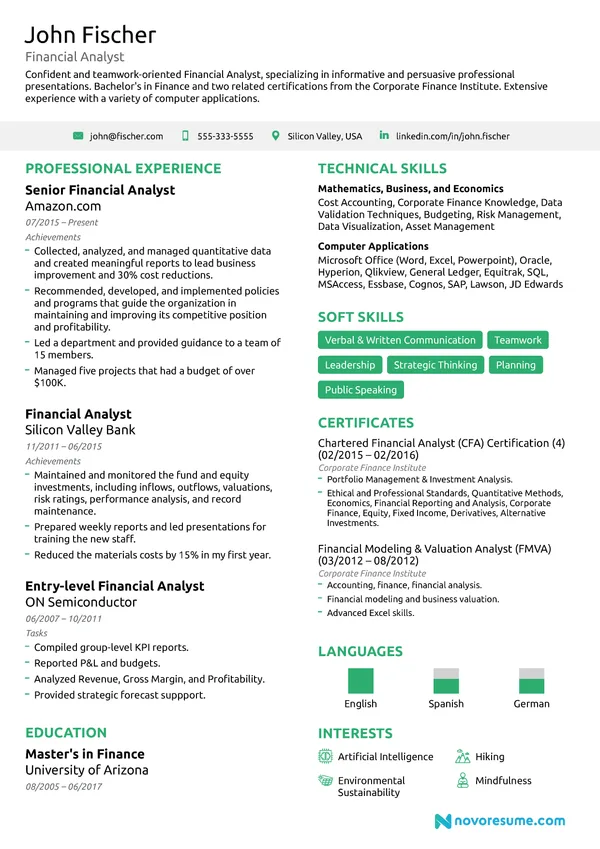
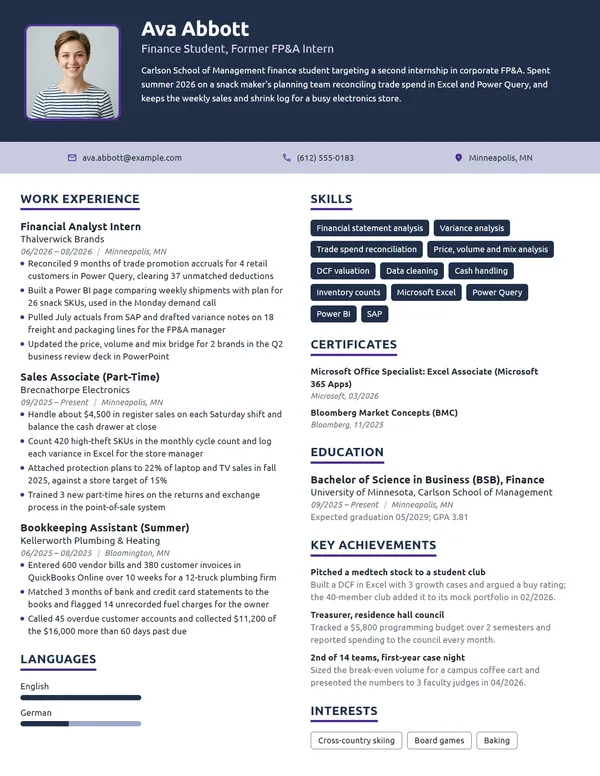
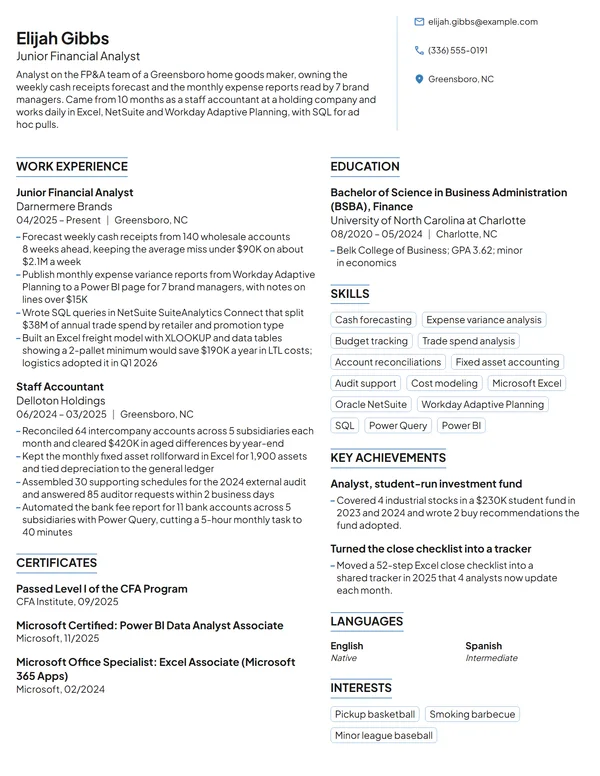
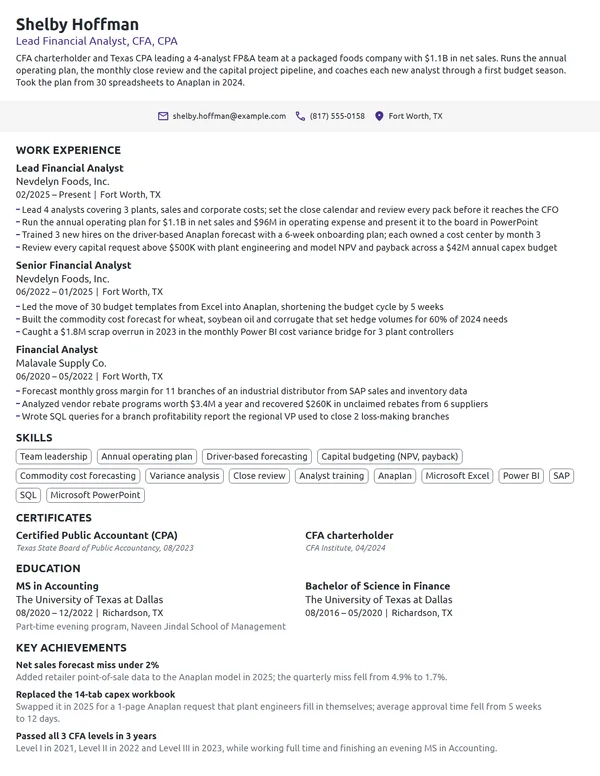
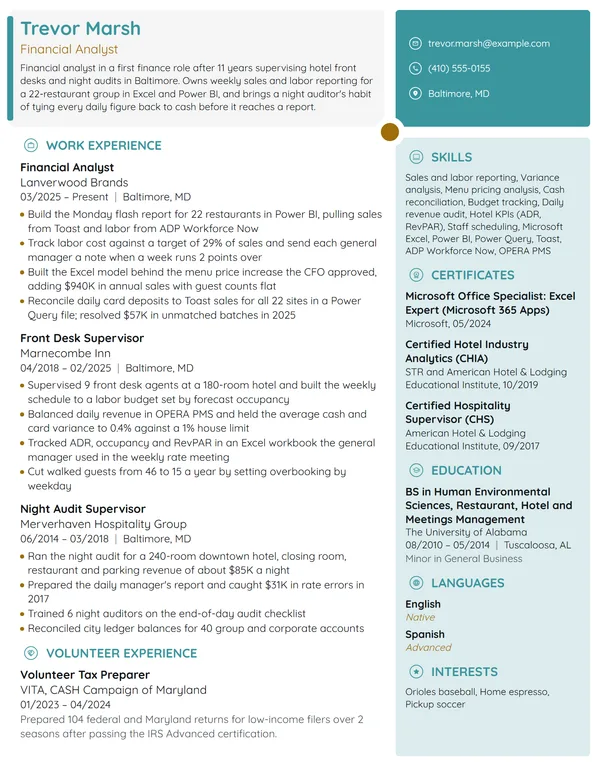
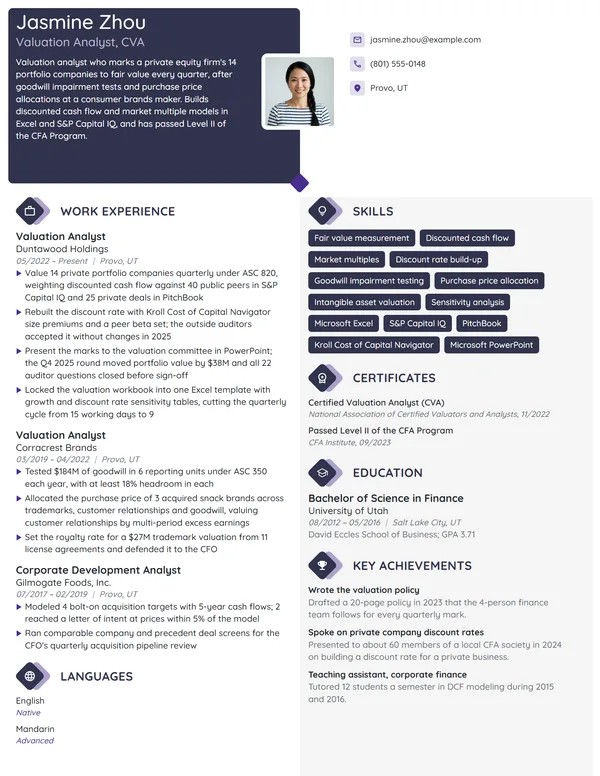
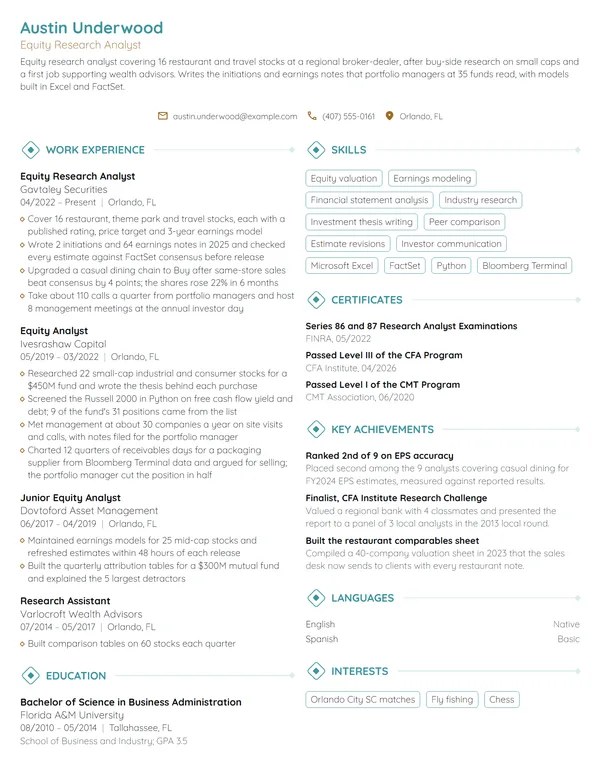
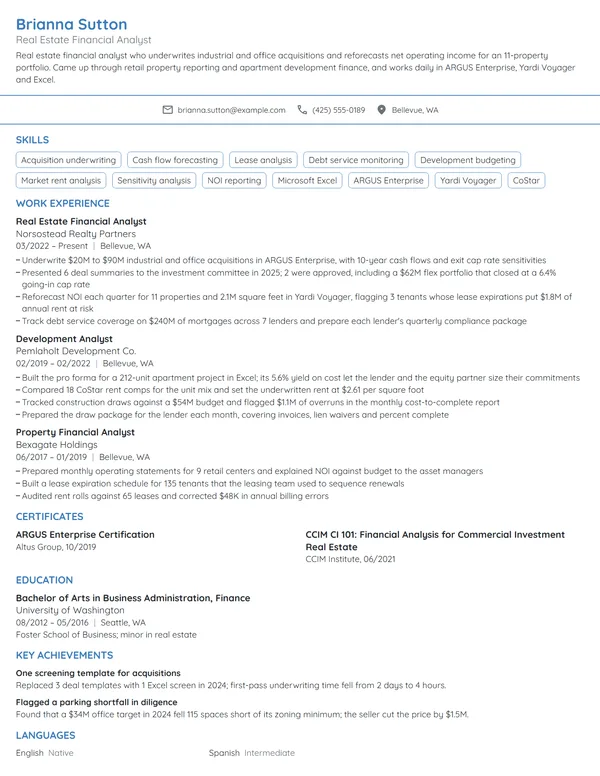
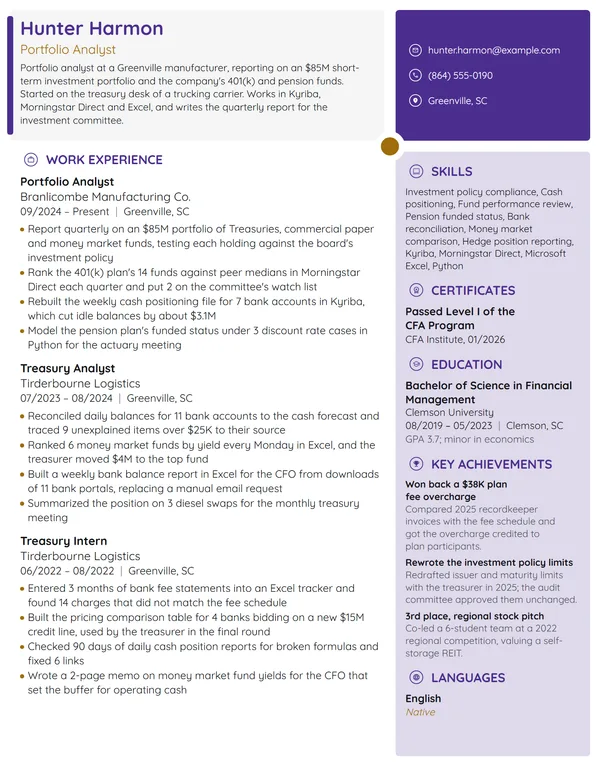
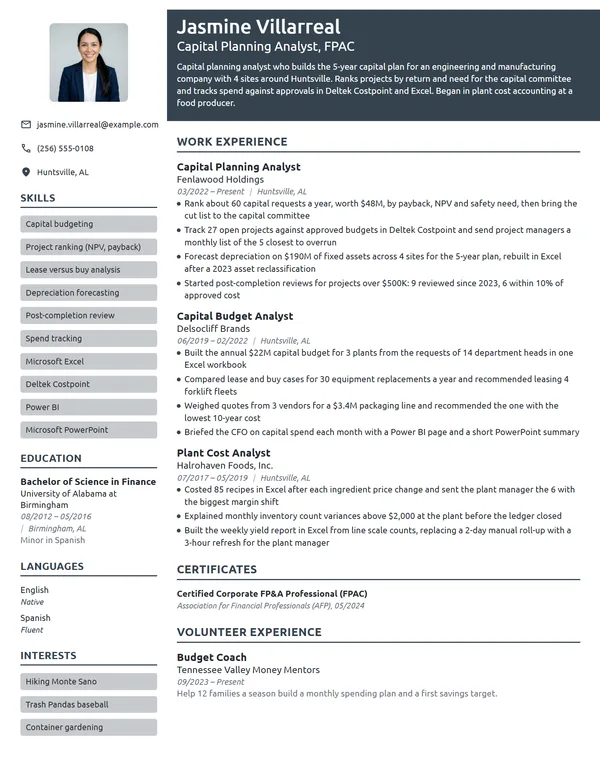
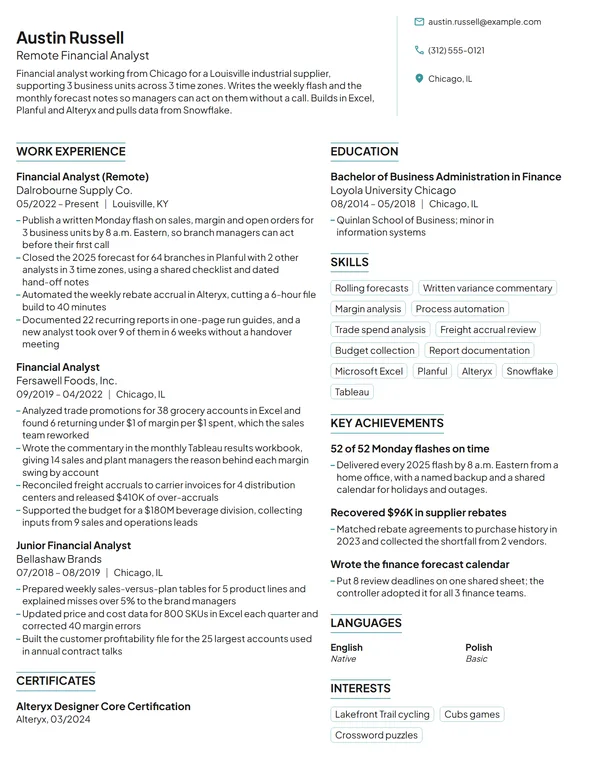
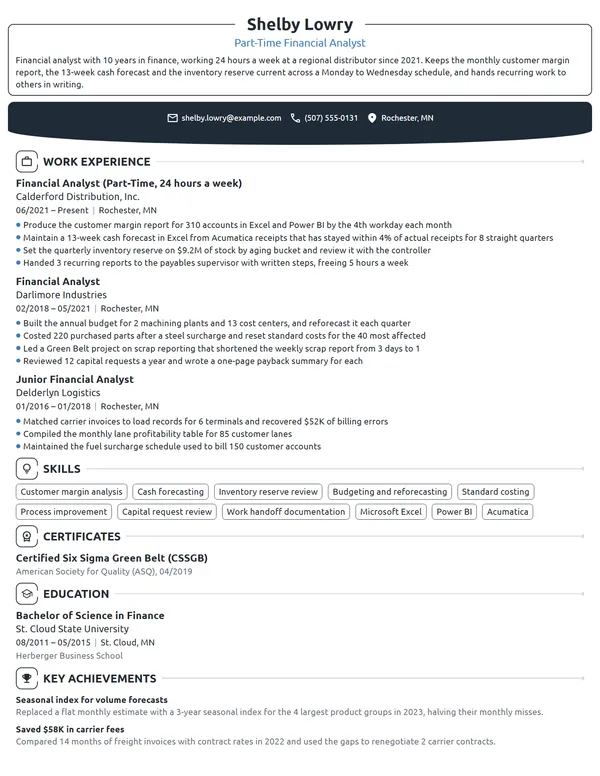
A financial analyst is paid to turn numbers into decisions, so your resume has to answer one question: what changed because of your analysis? Finance managers scan for forecasting and modeling, strong Excel, the planning or BI tools their team already runs, and results with a dollar figure attached. Analyst work is often shared with a team, kept confidential or still in progress, which makes your own part easy to undersell. Naming your piece of the work, with a figure next to it, fixes that.
How to Write a Financial Analyst Resume - Key Takeaways
- Use the reverse-chronological format on 1 page, and move to 2 only with 10+ years or a team of analysts to describe.
- Open with 2 to 3 lines that name your analyst level, the business you support, your main tools and 1 result with a dollar figure.
- Write each bullet as analysis plus outcome: the forecast, budget or model, the number it carried, and what the business did with it.
- Name tools exactly as the job ad does, such as Excel, SQL, Power BI, Tableau or SAP, and prove each one inside a bullet.
- Write CFA progress the way CFA Institute allows, such as Passed Level I of the CFA Program, and keep CFA off your name until you hold the charter.
- Before you apply, run the final file through an ATS resume checker to confirm every section parses.
What finance managers look for in a financial analyst resume
The BLS lists evaluating current and historical financial data, studying economic and business trends, and preparing written reports and presentations among a financial analyst's core duties. O*NET adds employing financial models to solve financial problems or to assess the capital impact of a transaction. A hiring manager reads your resume to see how often you did that work, at what scale, and for whom.
3 questions decide most first reads: which kind of analysis you own (forecasting, budgeting, investment cases or reporting), how large the numbers were, and whether anyone acted on your work. Build your resume from these sections so each answer has an obvious place:
- Name, a headline with your level and focus (for example, Senior Financial Analyst, FP&A) and contact details
- A 2- to 3-line profile under your name, printed without a section title
- Work Experience, current role first
- Skills, with Excel, SQL and your planning or BI tools inside it
- Certificates, for CFA Program progress, the FPAC or a CPA license
- Education, with a master's degree above your bachelor's
- Optional: Key Achievements or Languages, when space remains
Best format for a financial analyst resume
Pick the reverse-chronological resume format: your current role on top, then each earlier one with title, employer, city and MM/YYYY dates. Analyst careers climb in clear rungs, from analyst to senior, lead and FP&A manager, and this order lets a reader see each step and how long it took. A combination layout, with skills above your history, only makes sense when you arrive from a field with no finance work at all.
- Best for most financial analystsReverse-chronologicalYour jobs, newest first, with your results under each one.Best for: A steady work history in your field
- FunctionalSkills grouped up top, with a short work history below.Best for: Gaps or very little experience
- CombinationA skills section first, then your full work history.Best for: A career change with strong skills
With fewer than 10 years behind you, keep to 1 page. A senior financial analyst or team lead with 10+ years, several business units or a systems rollout to describe can use 2 pages, provided the current and previous roles both sit on page 1.
| Setting | What to use |
|---|---|
| Length | 1 page; 2 only with 10+ years or a team you lead |
| Dates | MM/YYYY on each entry, with Present on your current role |
| Dollar figures | Round to $K or $M and keep one style throughout: $1.2M, never $1,200,000 on one line and $1.2 million on the next |
| Confidential numbers | Percentages, ranges or company size where an exact figure is under NDA |
| Photo and personal details | Usually no photo in the US and Canada; leave off age, marital status and any Social Security number |
| File type | PDF, or a Word file when the application portal asks for one |
Most US and Canadian resumes carry no photo, and finance hiring often runs through applicant tracking systems that read plain text more reliably than design elements.
Financial analyst resume summary vs. objective
The test is simple: if analysis has been part of your paid work, in your title or in your weekly tasks, write a resume summary of 2 to 3 lines with your level, the business you support, your tools and 1 result. If you are a student or switching in from another field, write one of these resume objectives instead: the role you want plus the best evidence you already have. Draft it last, borrowing its strongest figure from your bullets.
Financial analyst resume summary formula
Title with X years supporting business or finance function, working in main tools. 1 forecast, budget or model result, with its dollar figure and what it decided. Credential or CFA Program status.
Example
Financial analyst with 7 years in FP&A and commercial credit, now supporting a specialty chemicals maker in Excel, SAP and Power BI. Built the forecast behind a $14M extrusion line approval, which landed within 3% of first-year volume. Passed Level II of the CFA Program.
Don't
Results-driven financial analyst with strong analytical skills and a passion for numbers, seeking to add value to a dynamic team.
Do
FP&A analyst with 4 years at a regional hospital system, working in Excel, SQL and Tableau. Owns the monthly forecast for 9 cost centers and cut forecast error from 8% to 3% in 2 years.
The rewrite gives the reader a level, a setting, the tools and a measured result instead of adjectives.
How to write financial analyst work experience bullets with numbers
Give your current role 3 to 4 bullets and older ones 1 to 3, each opening with a verb. When you list work experience on a resume as an analyst, every line should carry the size of the number you worked with and what happened next: a budget approved, a cost cut, a project funded or stopped. A bullet that ends at the deliverable, such as built a model, leaves the reader guessing whether it mattered.
| Area | What to count | Example bullet |
|---|---|---|
| Forecasting | Forecast error, horizon, revenue covered | Rebuilt the 18-month revenue forecast for a $210M product line, bringing average monthly error from 9% to 4%. |
| Budgeting | Budget size, departments, deadline | Ran the annual budget for 12 departments and $65M in operating spend, finishing 2 weeks before the board deadline. |
| Variance analysis | Lines reviewed, threshold, what you flagged | Wrote monthly commentary on 140 P&L lines for the VP of Finance and flagged $2.3M in unplanned freight costs. |
| Investment cases | Capital amount, IRR or NPV, decision | Modeled a $6M warehouse automation project at a 21% IRR; leadership approved it in Q2. |
| Reporting and automation | Reports moved, hours saved, refresh time | Moved 8 weekly reports from manual Excel files to Power BI, saving the team 11 hours a week. |
| Cost and margin | Savings found, margin points, spend reviewed | Found $780K in duplicate software contracts in a spend review across 5 business units. |
In the entry below, the current FP&A role carries 4 bullets, each with its dollar base, and the earlier credit job keeps 2.
Work Experience
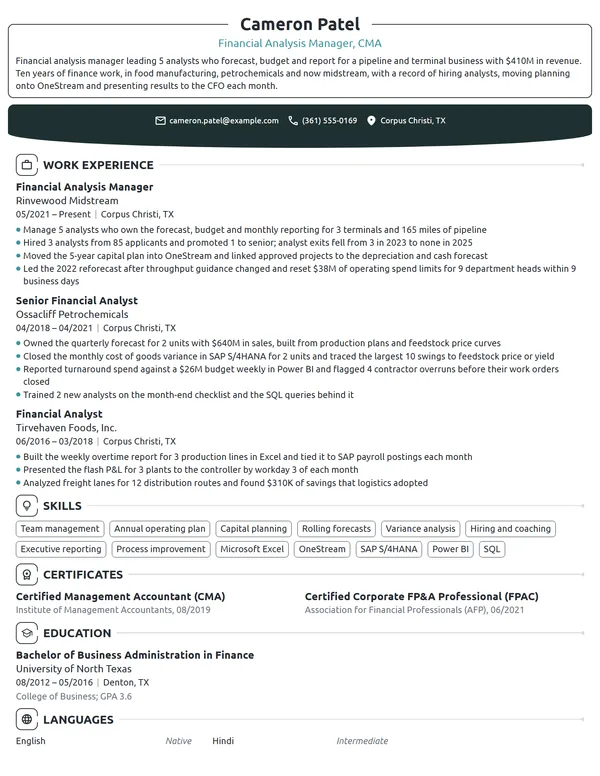
- Own the rolling 12-month forecast for 4 plants and $320M in annual sales, updated monthly from SAP data in Excel.
- Built the capital request model for a $14M extrusion line; first-year volume came in within 3% of the forecast.
- Cut the monthly reporting package from 6 days to 2 by moving 11 plant reports into Power BI dashboards.
- Explain every plant cost variance over $50K to the operations VP, which led to a resin contract renegotiated 6% below the old price.
- Spread financial statements and wrote credit memos for 70 commercial loan requests a year, from $250K to $5M.
- Built a covenant tracking sheet for 120 borrowers that flagged 9 breaches before quarter-end.
Don't
Prepared monthly financial reports for management.
Do
Built the monthly P&L pack for 3 regional managers in Excel and Tableau and moved its delivery from day 8 to day 4 of the month.
The rewrite names who read the report, the tools and the time it saved.
Don't
Responsible for financial modeling and analysis.
Do
Modeled 3 pricing scenarios for a new service plan; the option chosen raised gross margin by 2.4 points over its first 2 quarters.
Financial analyst skills and software for your resume
Choose 6 to 8 hard skills for your resume that appear in the posting and that your bullets already show. Financial modeling, forecasting and variance analysis fit almost any analyst role; valuation, credit or treasury skills belong only where your history includes that work.
Hard skills for financial analysts
- Financial modeling
- Forecasting and budgeting
- Variance analysis
- Three-statement modeling
- DCF, NPV and IRR analysis
- Scenario and sensitivity analysis
- Cost and margin analysis
- Management reporting
- SQL queries
- KPI dashboards
Soft skills finance managers value
- Explaining numbers to non-finance managers
- Healthy doubt about source data
- Prioritizing during close and budget season
- Business partnering
- Concise written commentary
- Discretion with confidential figures
Put your software inside Skills, then use each tool again in a bullet so the reader sees the work behind it. O*NET flags Microsoft Excel, Microsoft PowerPoint, SQL, Microsoft Power BI, Tableau and SAP software as in-demand technology for financial and investment analysts, and lists Alteryx, Workday, Oracle PeopleSoft and VBA as hot technology. For Excel, name what you actually use, such as XLOOKUP, pivot tables, data tables for sensitivity runs or VBA macros, because Excel alone says almost nothing to a finance manager.
CFA, FPAC and CPA: certifications for financial analysts
The BLS notes that certification is not always required but may enhance professional standing, so list certifications on your resume under Certificates with the issuer and the year. The CFA suits investment and research roles, the FPAC suits corporate planning work, and a CPA license helps on reporting-heavy teams. Securities licenses work differently: the BLS says most FINRA licenses require employer sponsorship, so companies do not expect you to hold them before you are hired.
| Credential | Issued by | What it takes |
|---|---|---|
| CFA charter (Chartered Financial Analyst) | CFA Institute | Pass all 3 levels of the CFA Program plus the Practical Skills Modules, log at least 4,000 hours of qualifying investment work over at least 36 months, and become a CFA Institute member. |
| FPAC (Certified Corporate FP&A Professional) | AFP (Association for Financial Professionals) | Pass Exam Part II, with Part I passed or waived, plus 2 or 3 years of FP&A work depending on your degree, all within 5 years of enrolling. You may sit the exams before the experience is complete. |
| CPA (Certified Public Accountant) | Your state Board of Accountancy | Pass the CPA Exam and meet the education, experience and ethics rules of your state, 1 of 55 US jurisdictions with its own board. |
Writing CFA Level I or II on a resume
CFA Institute's own rules settle this. Write each level you passed as Passed Level I of the CFA Program, and use CFA Program candidate only while you are registered for the next exam or waiting for its result. A passed level is not a designation, so it never goes after your name, and CFA with an expected year is not allowed at all.
Certificates
- Certified Corporate FP&A Professional (FPAC), Association for Financial Professionals, 2026
- Passed Level II of the CFA Program, CFA Institute, 2026
- Passed Level I of the CFA Program, CFA Institute, 2024
Finance, economics or accounting degree: the education section
Financial analysts typically need a bachelor's degree in finance or a related field such as business, according to the BLS, and some employers prefer a master's. The same source says a master's in finance or business administration may improve an analyst's chances of advancing, so a finished MSF or MBA goes first in Education, with the bachelor's below it.
Follow the basics of listing education on a resume: degree, school, city and graduation month and year. Add a GPA of 3.5 or more only within 2 to 3 years of graduating, and relevant coursework such as corporate finance, valuation or econometrics only while you have little analyst experience. After your first full analyst role, keep the entry to 2 lines.
Education
Dean's List, 6 semesters.
Entry-level, intern and career-change financial analyst resumes
Without a full-time analyst job yet, build an entry-level resume: a short objective, Education near the top, then every piece of work where you handled real numbers. Each item gets the same treatment as a paid analyst role, with a figure and a result.
- Finance or accounting internships: the models, forecasts or reports you built and the dollar amounts they covered.
- Student-managed investment funds: the fund size, the stocks you pitched and how the positions performed.
- Case competitions and valuation projects: the company you valued and the method, listed under Education.
- Part-time jobs: cash handled, inventory counted, sales tracked or schedules built, each with a number.
Don't
Motivated finance student seeking an internship to grow my analytical skills.
Do
Third-year finance major seeking a summer FP&A internship. Built a 3-statement model of a public retailer in a valuation course and tracks a $40K student fund position in Excel.
An objective still needs proof: a model, a fund, an internship or a number.
Moving in from accounting, banking, sales operations or a supervisor role in hospitality or retail, keep reverse-chronological order and start with an objective that names the numbers you already own, such as nightly revenue, labor cost, budgets or month-end reports. A career-change resume works best when the top bullets of each earlier job are its most analytical tasks, with Excel named where you used it. Keep the story of why you are switching for the letter: these finance cover letter examples show how to explain a move into finance in a short paragraph.
Financial Analyst resume FAQ
Can I put CFA Level I on my resume?
Yes, in CFA Institute's approved wording. Write Passed Level I of the CFA Program under Certificates, with the year. Never write CFA Level I after your name: CFA Institute says a passed level is not a designation, and only charterholder members may use CFA after their name.
How long should a financial analyst resume be?
1 page for most analysts. With 10+ years, a team of analysts or several business units to describe, 2 pages work, as long as your 2 latest roles sit on page 1 and every line still carries a number.
Do I need a FINRA license to work as a financial analyst?
Usually not before you are hired. The BLS says FINRA is the main licensing organization for the securities industry and that most of its licenses require employer sponsorship, so companies do not expect applicants to hold them. Corporate FP&A roles rarely ask for one at all.
Which Excel skills should a financial analyst list?
List the functions and features you use every week, such as XLOOKUP, pivot tables, data tables, Power Query or VBA macros, rather than advanced Excel. Then show one in a bullet, for example a forecast template or a sensitivity model you built.
How do I write a financial analyst resume when my numbers are confidential?
Use relative figures. Write percentages, ranges or the size of the business instead of exact amounts, such as a forecast for a product line above $200M or a cost cut of 6%. Keep client and deal names out unless they are already public.
Do financial analysts need a master's degree or an MBA?
Not to start. The BLS says financial analysts typically need a bachelor's degree in finance or a related field, that some employers prefer a master's, and that a master's in finance or business administration may improve an analyst's chances of advancing.
How is an FP&A analyst resume different from an investment analyst resume?
The numbers change. An FP&A resume leads with budgets, forecasts, variance work and the managers you support; an investment analyst resume leads with the securities or companies you covered, the valuation methods you used and your CFA Program progress.
Should I put salary expectations on a financial analyst resume?
No. Pay belongs in the application form or a later conversation. As a benchmark, the BLS reports that the median annual wage for financial and investment analysts was $102,740 in May 2025; offers vary with your city, industry and level.
Next steps
Choose the example nearest your level, keep its order, and swap each figure for your own forecasts, budgets and models. Write it in our resume builder or on one of the resume templates, then pair it with a letter whose first paragraph names the decision your best analysis moved.