
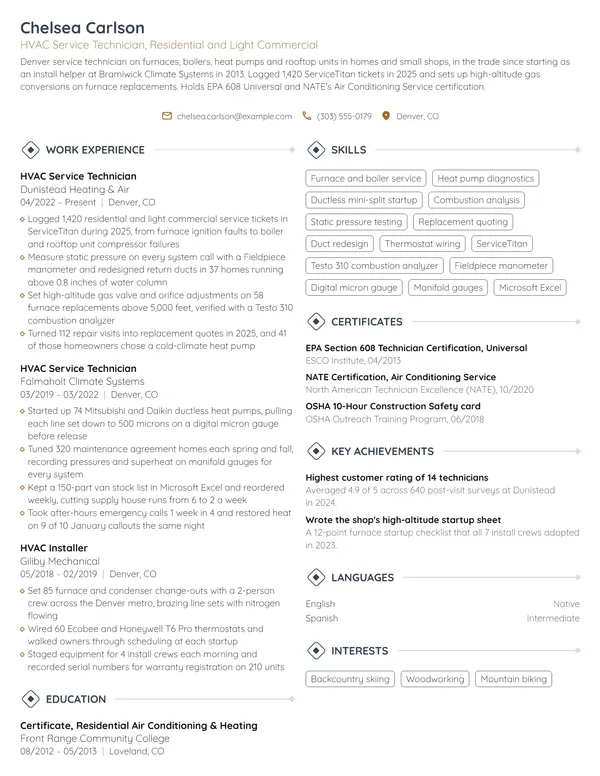
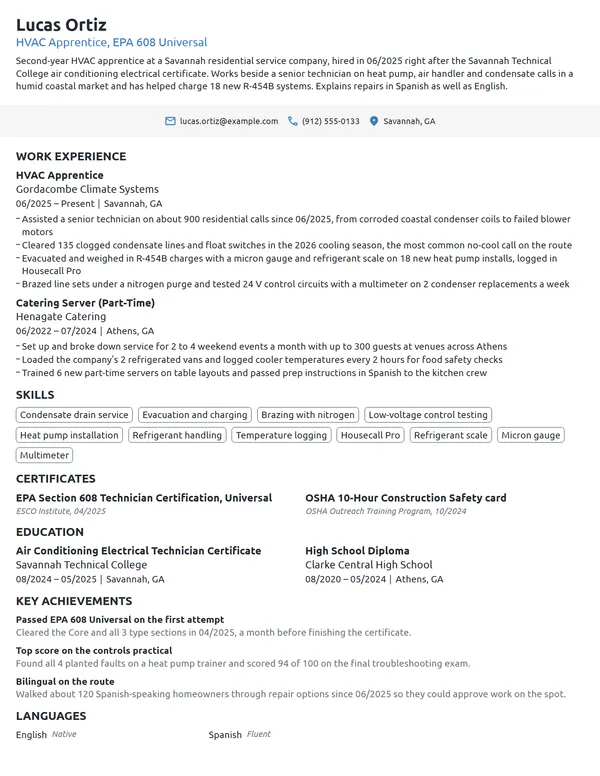
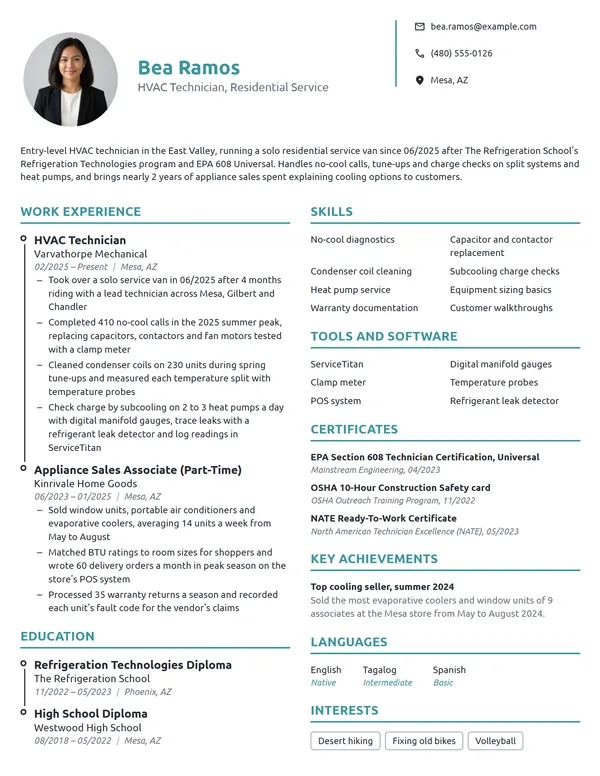
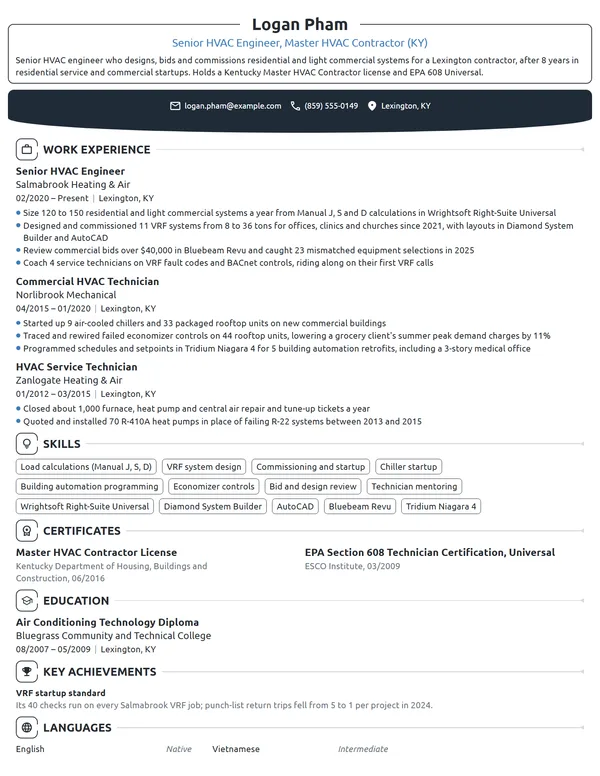
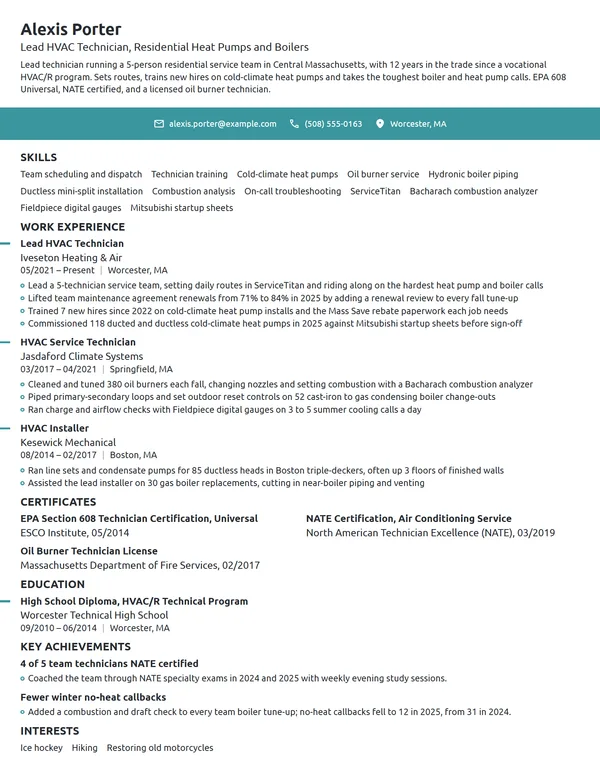
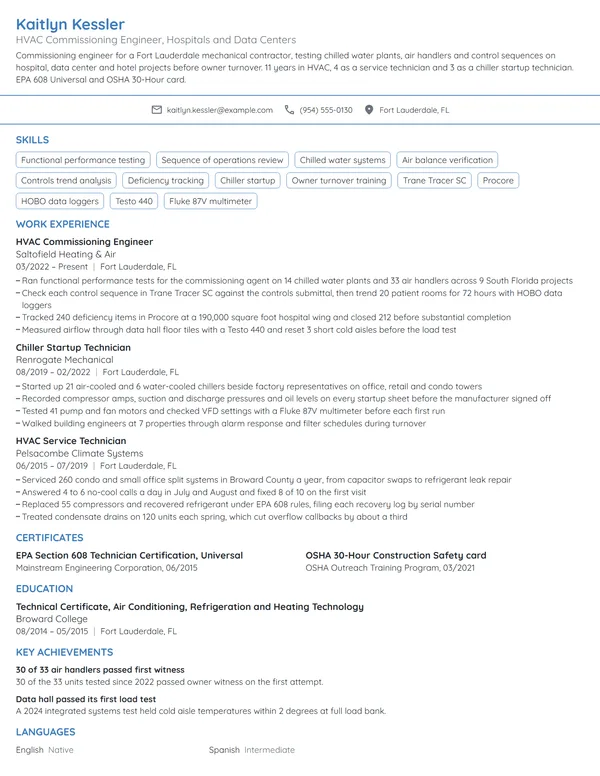
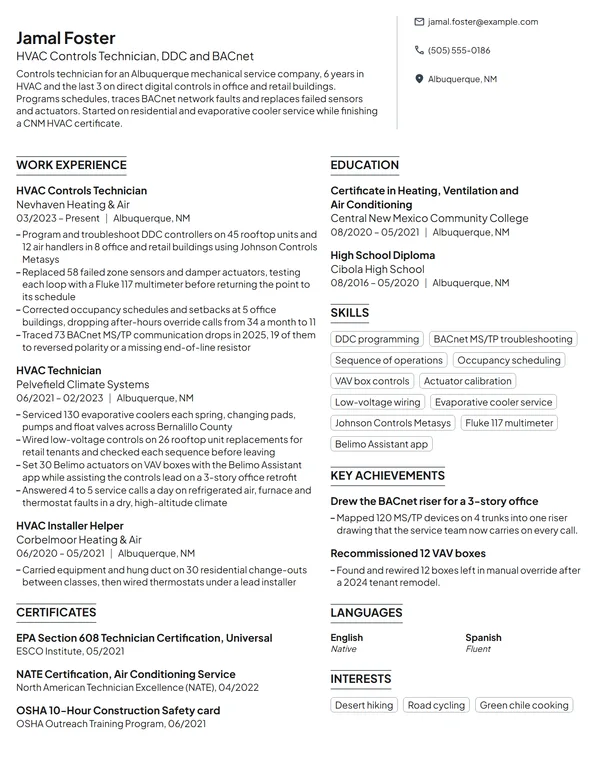
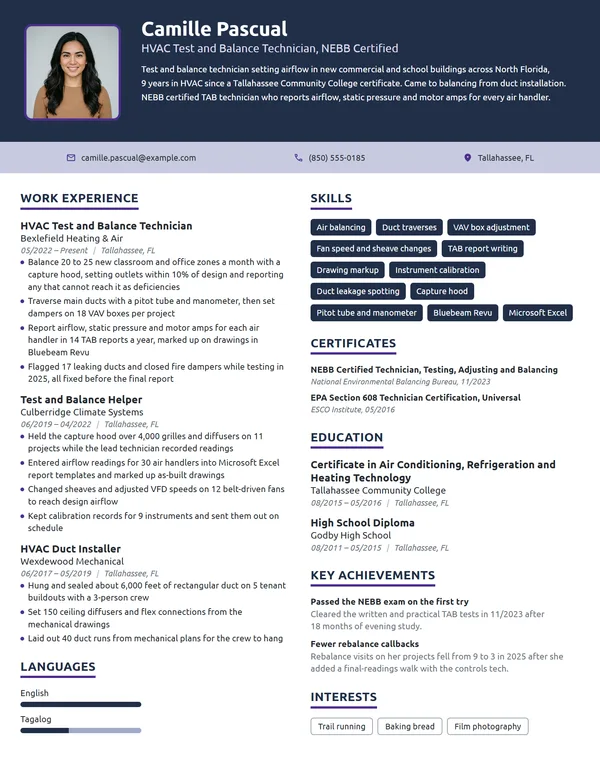
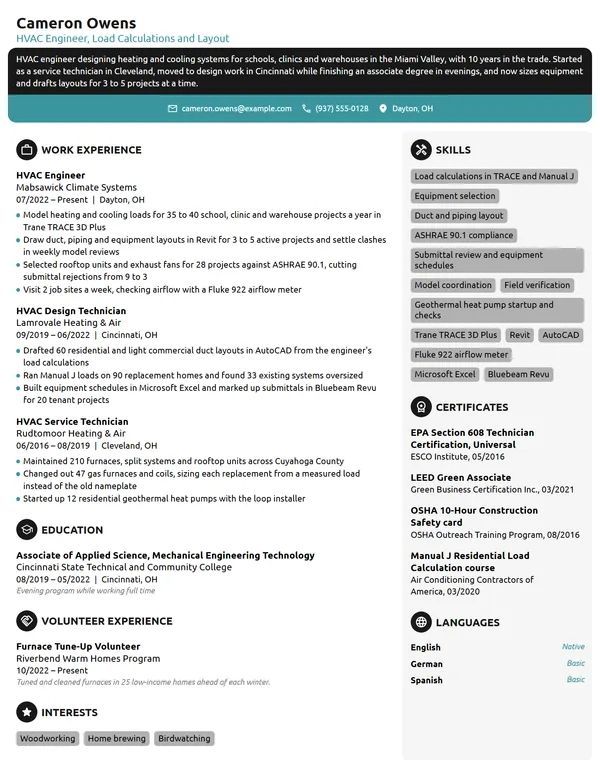
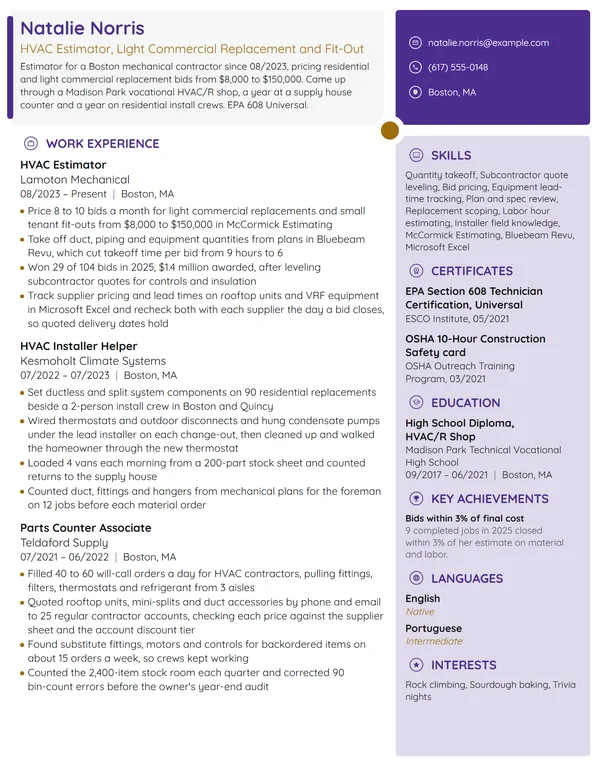
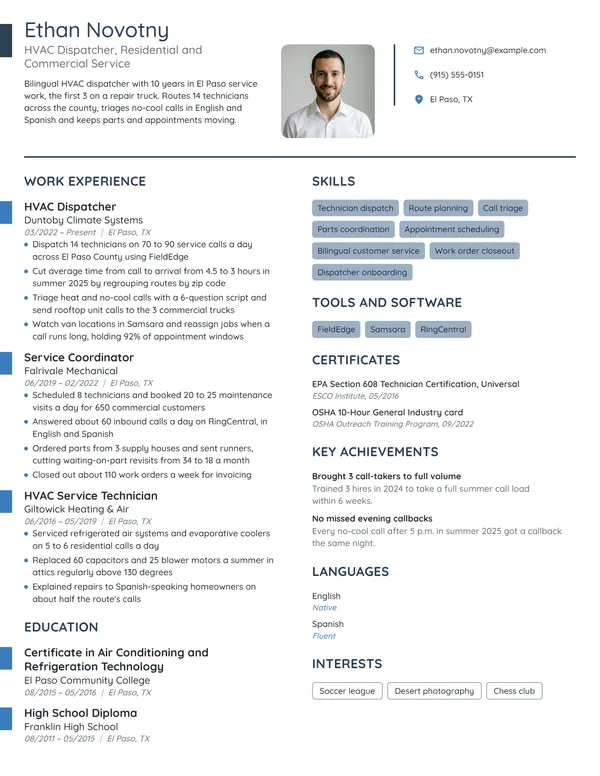
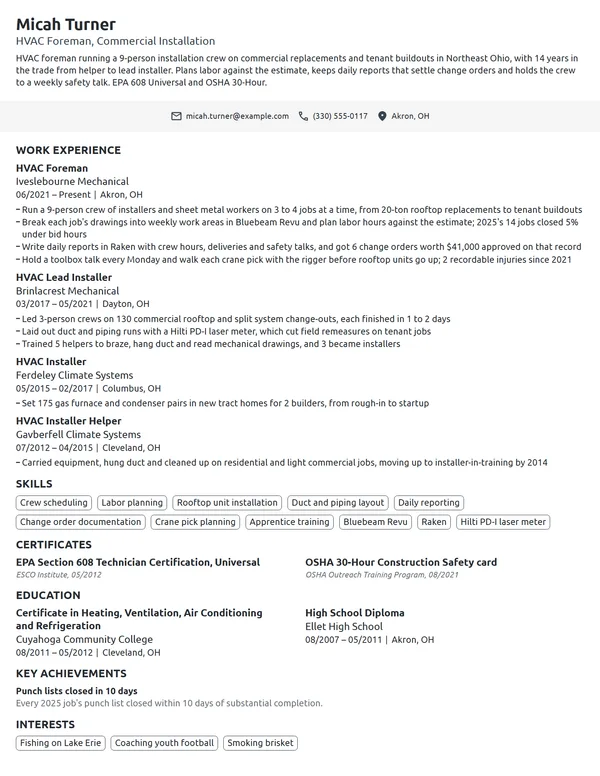
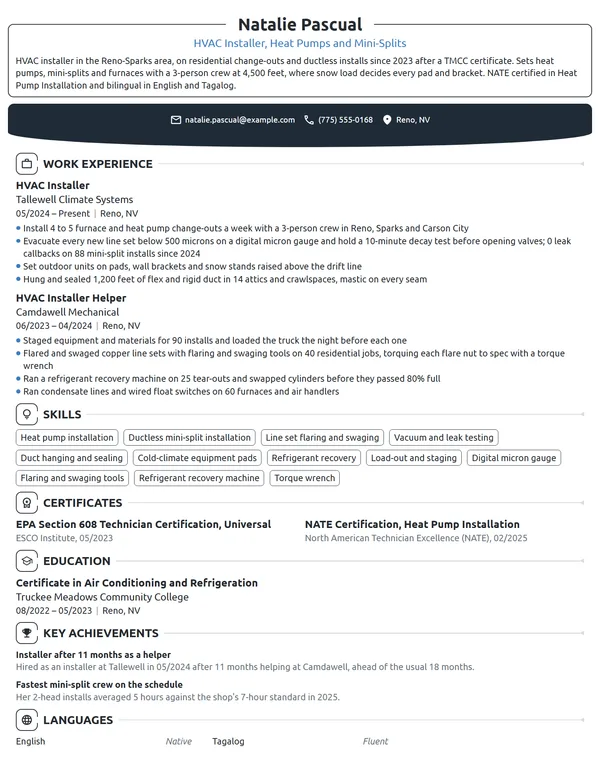
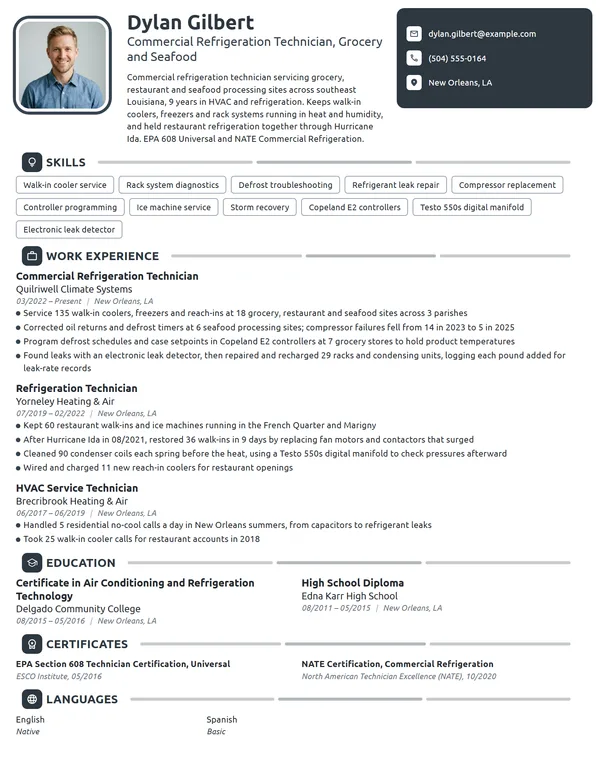
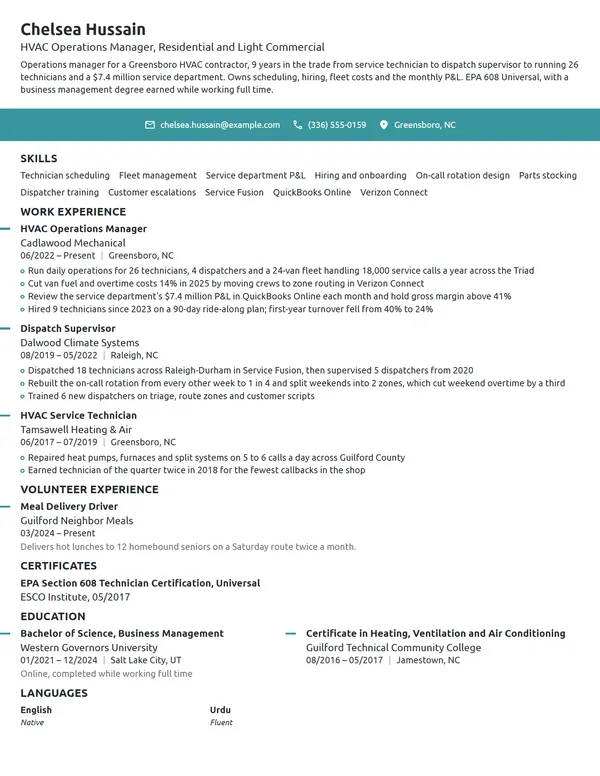
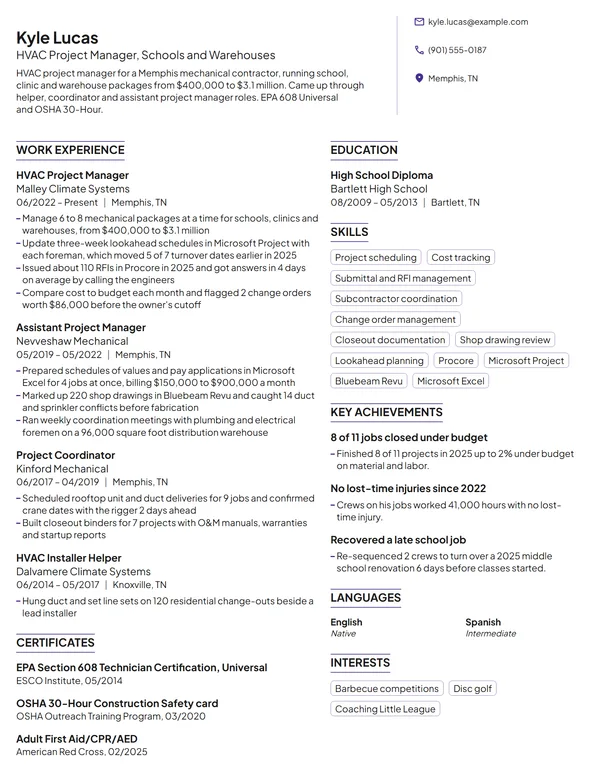
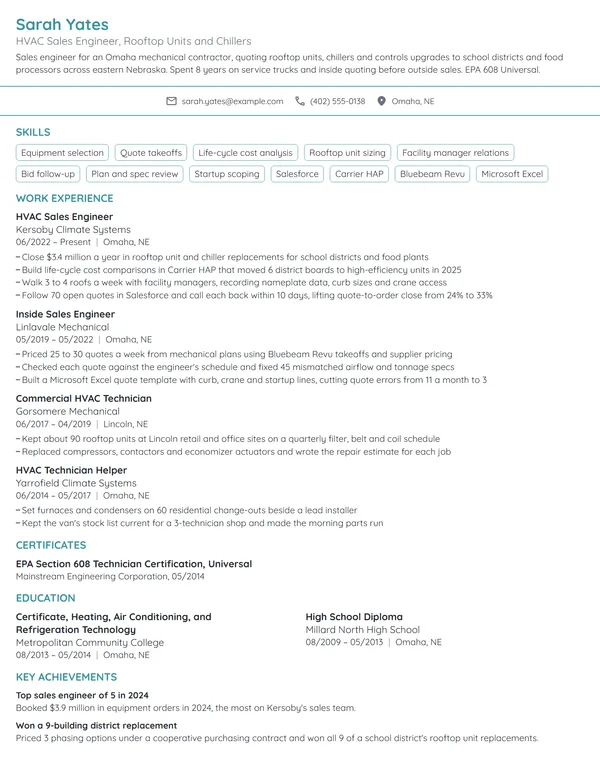
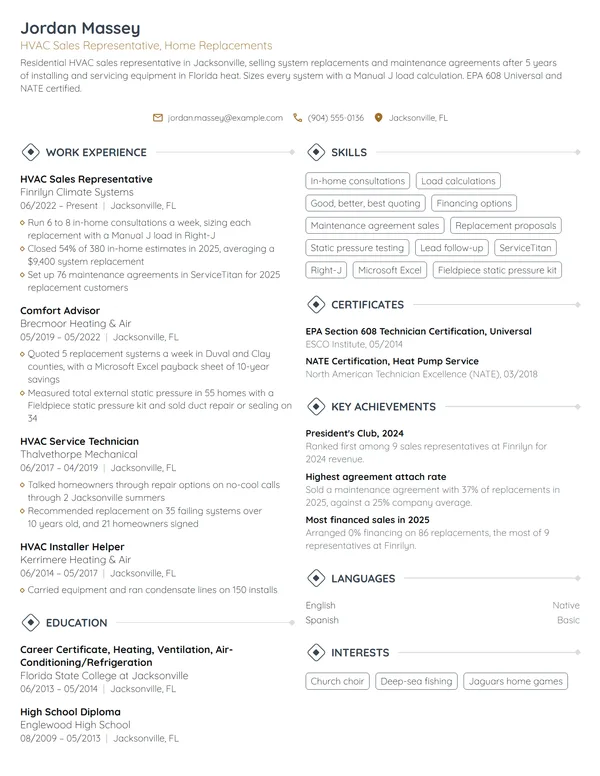
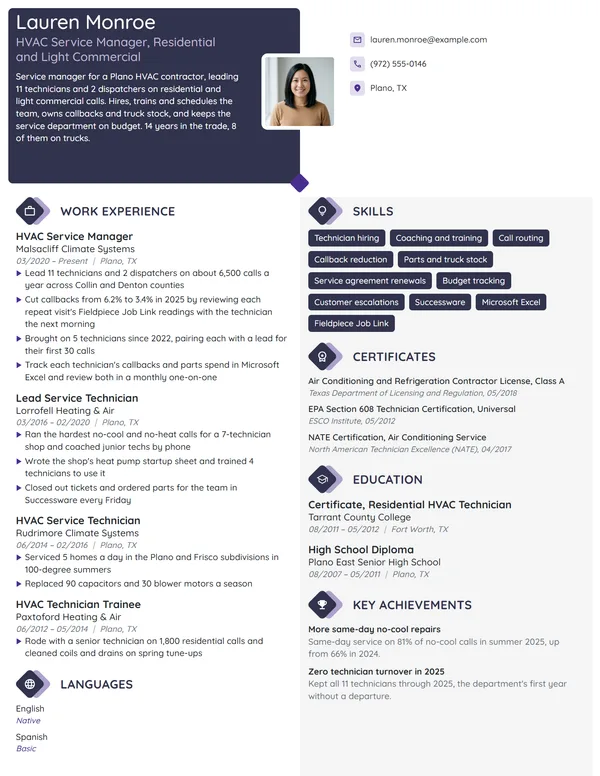
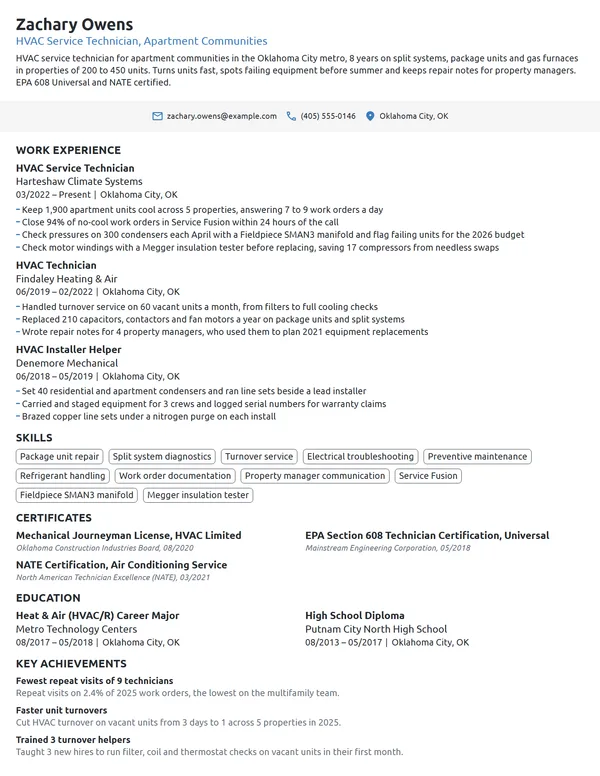
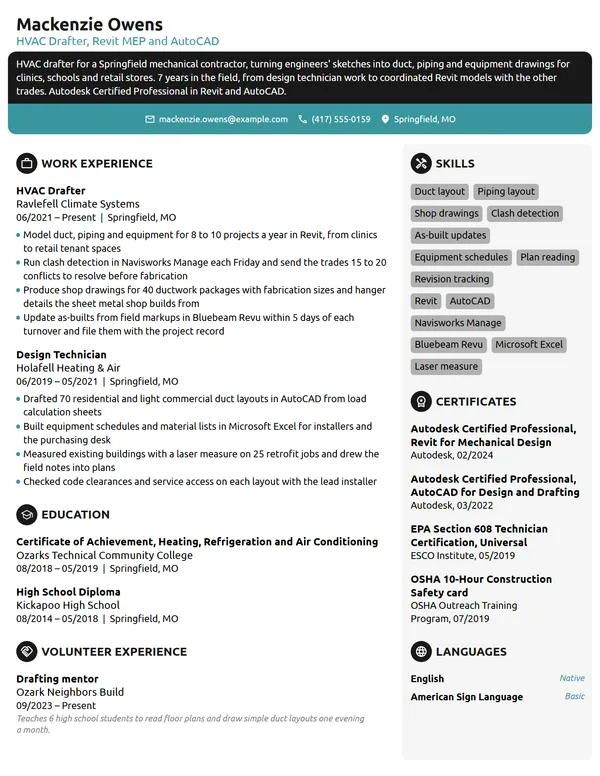
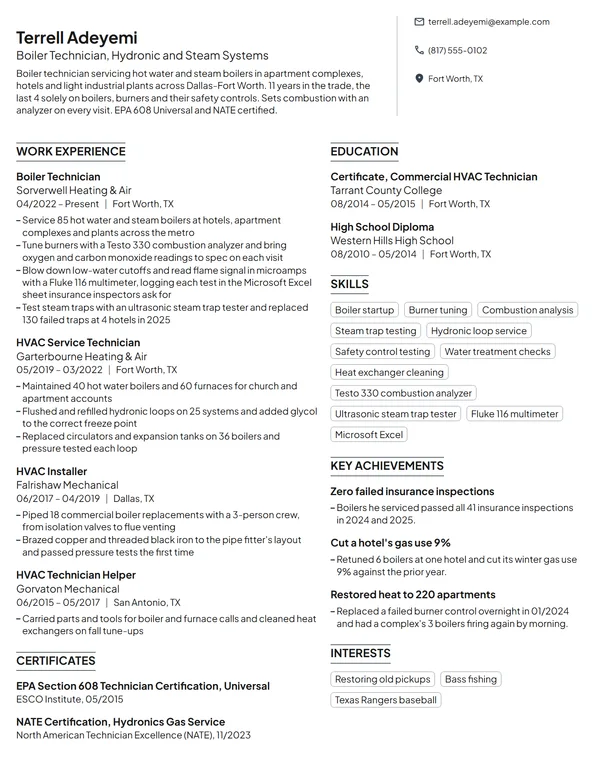
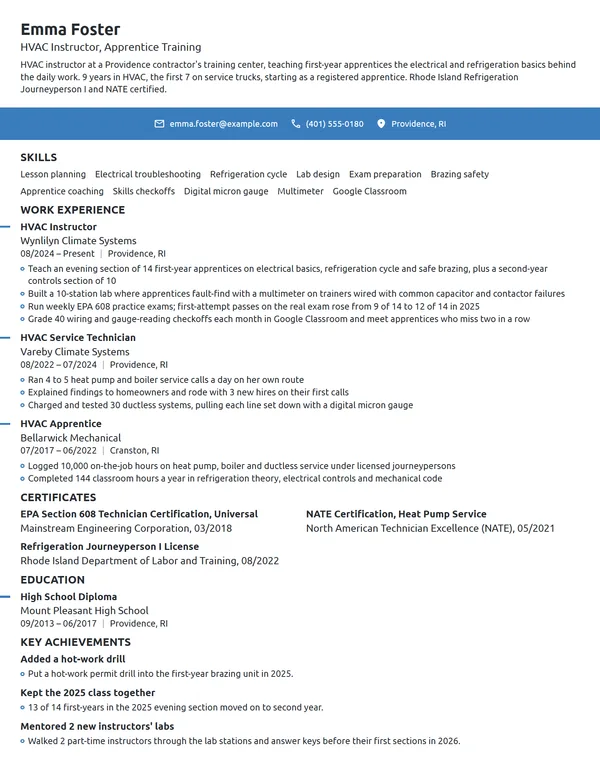
HVAC work is judged by whether the system still runs after you leave. Service managers and contractors check what equipment you have worked on, which certifications you hold and how reliable your repairs are. A list of duties says little about any of that. Calls handled per day, systems installed and how rarely customers had to call you back say a lot more, and so does the EPA certification type on your card.
How to Write an HVAC Resume - Key Takeaways
- Order your jobs newest first (reverse-chronological) on 1 page, and go to 2 only with 10+ years of design, project or supervisory work.
- Open with a 2- to 3-line summary that names your market, the equipment you work on, your best service or install number and your EPA 608 type.
- Give each bullet a number a service manager tracks: calls a day, first-visit fixes, callbacks, systems installed or units on a PM route.
- Under Certificates, list any state license first, then EPA 608 with its type (Universal, Type I, II or III), then NATE specialties.
- List the skills, test instruments and software from the job ad that a bullet on your resume backs up.
- Leave your birth date and other personal details off, then test the file with an ATS resume checker before you apply.
What service managers look for in an HVAC resume
Those checks follow the job itself. The BLS lists installing, maintaining and repairing HVACR systems, inspecting and testing components, discussing malfunctions with customers and keeping records of the work as core duties. O*NET adds testing electrical circuits for continuity and testing pipes and connections for leaks.
BLS figures show that 68% of these technicians work for plumbing, heating and air-conditioning contractors, so most resumes land with a shop that dispatches calls and counts callbacks. Build yours from these sections:
- Name, headline (for example, HVAC Service Technician, EPA 608 Universal) and contact details
- Summary of 2 to 3 lines below your name, printed without a heading
- Work Experience, current job first
- Skills, with your test instruments and software
- Certificates, with any state license and then EPA 608 at the top
- Education, including trade school and apprenticeship instruction
- Optional: Key Achievements, Volunteer Experience or Languages
Best format for an HVAC resume
Use the reverse-chronological resume format and list your newest job first, with your title, the employer, its city and the start and end month in MM/YYYY form. HVAC careers climb in steps a contractor recognizes, from helper or apprentice to installer, service technician, lead and field supervisor, and this order puts the top step where the eye lands. A combination format helps only if you come from another field and your HVAC training is newer than your work history.
- Best for most HVAC techniciansReverse-chronologicalYour jobs, newest first, with your results under each one.Best for: A steady work history in your field
- FunctionalSkills grouped up top, with a short work history below.Best for: Gaps or very little experience
- CombinationA skills section first, then your full work history.Best for: A career change with strong skills
Keep it to 1 page with under 10 years in the trade. A second page is fair for a senior engineer, service manager or project lead with design, commissioning or crew work to show, provided page 1 holds your 2 latest roles and your certifications.
| Setting | What to use |
|---|---|
| Length | 1 page; 2 only with 10+ years of design, project or supervisory work |
| Dates | Month and year (MM/YYYY); write Present while you still hold the job |
| Job title line | Title plus market: HVAC Installer, Residential New Construction |
| Certifications | EPA 608 type in your headline or summary, and again under Certificates |
| Photo, birth date and ID numbers | Photos are left off most US and Canadian resumes; so are age, family status and SSN |
| File type | PDF, or a Word file if the contractor's hiring portal asks for one |
Most US and Canadian resumes carry no photo. A dispatch manager would rather see your EPA type near the top and, for service roles that send you out in a company van, your driver's license status.
HVAC resume summary vs. objective
If you have worked in the trade, write a resume summary: your title, your years, your market and equipment, 1 number and your certifications. If you are still in school or just finished, write an objective instead, using the resume objective examples as a model for naming the role you want and your training hours. Either way, write it last and take its number from your bullets.
HVAC resume summary formula
Title with X years in residential, commercial or refrigeration work on equipment. One service, install or maintenance win, counted. EPA 608 type and NATE or state license.
Example
HVAC service technician with 8 years in residential service, working on gas furnaces, heat pumps and ductless systems. Held a 2.1% callback rate across about 1,300 calls in 2025. EPA 608 Universal and NATE certified in Air Conditioning Service.
Don't
Hardworking HVAC technician with excellent troubleshooting skills looking for a stable position with room to grow.
Do
Commercial HVAC technician with 5 years on rooftop units and chillers for office and retail clients. Keeps 75 units on a quarterly PM route and answers 99% of emergency calls within 4 hours. EPA 608 Universal.
This version names the market, the equipment, the route size and the credential a manager would ask about.
How to write HVAC work experience bullets with numbers
Your current job gets 3 to 4 bullets and each older one gets 1 to 3, every one opening with a verb and closing with a result. HVAC shops already track calls, tickets, callbacks and inspections, so nearly every bullet can carry a figure your next manager will understand at a glance. The rules for listing work experience on a resume apply here as well: write what changed because you were there, not the duties from the job posting.
| Area | What to count | Example bullet |
|---|---|---|
| Service calls | Calls a day, first-visit fixes, callbacks | Closed 91% of service calls on the first visit across 1,100 calls in 2025. |
| Installs | Systems, tonnage, inspections passed | Installed 64 heat pump systems from 2 to 5 tons, every one passing inspection on the first visit. |
| Preventive maintenance | Units on the route, accounts, visit frequency | Serviced 180 rooftop units on quarterly PM for 12 commercial accounts. |
| Refrigeration | Cases and walk-ins, temperature alarms, product loss | Cut walk-in cooler temperature alarms at 9 grocery stores from 40 to 6 a quarter. |
| Sales on the job | Average ticket, agreements sold, replacements quoted | Raised the average repair ticket from $310 to $395 by quoting good, better and best options. |
| Safety | Recordable injuries, crew size, years | Worked 3 years with 0 recordable injuries on a 6-person install crew. |
In the sample below, every bullet carries one of those counts. The current job carries the service record and the older install job gets 2 lines, each with a count.
Work Experience
- Run 5 to 7 service calls a day across 3 counties on gas furnaces, heat pumps and split AC systems.
- Kept a 2.1% callback rate in 2025, against a shop target of 4%.
- Sold 46 maintenance agreements in 2025 by walking homeowners through test readings after each tune-up.
- Recovered refrigerant on 38 condenser change-outs and logged every recovery weight in the dispatch app.
- Installed 140 split systems and 22 rooftop units with a lead installer; 96% passed county inspection the first time.
- Ran and sealed ductwork for 31 new homes in a builder subdivision.
Don't
Responsible for troubleshooting and repairing HVAC systems.
Do
Diagnosed and repaired 6 to 8 no-heat calls a day in peak season, stocking the van with parts for the 10 most common furnace failures to avoid return trips.
The rewrite shows the volume, the season and a habit that saves the customer a second visit.
Don't
Performed preventive maintenance on equipment.
Do
Built a spring PM checklist for 48 rooftop units that cut summer emergency calls at 3 office buildings from 27 to 9.
HVAC skills, tools and software for your resume
Your Skills section needs 6 to 8 hard skills for your resume, taken from the job ad and each one shown at work somewhere in your bullets. Brazing, refrigerant charging and electrical troubleshooting fit nearly every HVAC resume; boilers, chillers or controls only if you have serviced them.
Hard skills for HVAC technicians
- Refrigerant recovery and charging
- Electrical troubleshooting
- Gas furnace service
- Heat pump diagnostics
- Ductless mini-split installation
- Rooftop unit maintenance
- Brazing and soldering
- Duct layout and sealing
- Thermostat and control wiring
- Combustion analysis
Soft skills service managers value
- Explaining repairs to homeowners
- Working alone on a route
- Safety habits
- Reliability on call
- Time management between calls
- Clear handoffs to dispatch
Name your test instruments in your bullets too: manifold gauges, a multimeter, a combustion analyzer or a micron gauge tells a manager how you diagnose. O*NET's technology list for HVAC mechanics and installers includes building automation software, computerized maintenance management systems (CMMS), Autodesk AutoCAD and Microsoft Excel. Write the dispatch, field service or building automation system you use by its exact name, the way the job ad writes it.
EPA 608, NATE and HVAC licenses on a resume
The EPA requires nearly all HVAC technicians to be certified in proper refrigerant handling, the BLS explains, and some states and localities also require a license. List certifications on your resume under Certificates with the type, the issuer and the month you earned each one. Industry credentials such as NATE are optional, the BLS notes, although some employers prefer or require specific ones.
| Credential | Issued by | What it covers |
|---|---|---|
| EPA Section 608, Type I | An EPA-approved certifying organization | Servicing small appliances. |
| EPA Section 608, Type II | An EPA-approved certifying organization | Servicing or disposing of high- or very high-pressure appliances, except small appliances and motor vehicle air conditioning. |
| EPA Section 608, Type III | An EPA-approved certifying organization | Servicing or disposing of low-pressure appliances. |
| EPA Section 608, Universal | An EPA-approved certifying organization | All types of equipment. The core test must be taken as a proctored exam, and the EPA says Section 608 credentials do not expire. |
| NATE certification | North American Technician Excellence | An optional industry certification in a named specialty; write the specialty exactly as your certificate prints it. |
| OSHA 10-Hour or 30-Hour card | OSHA Outreach Training Program | Safety awareness training. OSHA says none of its Outreach courses is a certification, so list it as a course card. |
| PE, Mechanical: HVAC and Refrigeration | Your state engineering board (exam by NCEES) | For the engineering track: an 80-question, computer-based exam offered year round, plus your state's licensing rules. |
How to write the EPA 608 line
Write the type, never just EPA certified: a shop that services high-pressure equipment needs Type II or Universal, and a resume that hides which one gets set aside. The EPA does not issue certification cards, so copy the certifying organization from your own card. Since the credential does not expire, give the month you earned it and no end date. A state license follows the same rule: write it as your board names it, with the license type.
Certificates
- EPA Section 608 Technician Certification, Universal, ESCO Institute, 04/2018
- NATE Certification: Air Conditioning Service, North American Technician Excellence, 09/2022
- OSHA 10-Hour Construction, course completion card, 2019
How to list HVAC school, a certificate or an apprenticeship
The BLS says HVAC training programs generally last from 6 months to 2 years and lead to a certificate or an associate's degree, and that some technicians train through an apprenticeship, which usually lasts several years and mixes paid on-the-job training with technical instruction. When listing education on a resume, give the credential, the school, its city and the month you finished. Put an apprenticeship under Work Experience, since it is a paid job, and its classroom hours under Education.
Training hours can count toward a license later. In North Carolina, for example, the State Board of Examiners of Plumbing, Heating and Fire Sprinkler Contractors asks heating contractor applicants for 2 years (4,000 hours) of on-site, full-time experience, and up to half of it can be academic or technical training related to the field. Keep your program's name and hours exact, because a board may ask for them.
Education
Apprentice, entry-level and career-change HVAC resumes
Before your first full HVAC job, use an entry-level resume layout: an objective, then Education and Certificates near the top, then any work that shows you can handle tools, customers and a schedule. Earn EPA 608 while you are still in school if you can, because shops look for that line first. Count each item the way a job bullet would be counted.
- Lab and shop hours: hours on furnace, heat pump and refrigeration trainers, and the systems you wired or charged.
- Helper or apprentice work: installs you assisted on, the crew size and the equipment, listed under Work Experience.
- Related jobs: appliance repair, building maintenance, electrical helper or warehouse work with equipment you can name.
- Military maintenance: the systems you kept running, written in civilian terms.
Don't
Motivated individual seeking an HVAC position to learn the trade.
Do
HVAC program graduate with EPA 608 Universal and 600 lab hours on furnaces, heat pumps and refrigeration trainers, seeking an apprentice or installer helper role. Spent 2 summers loading and staging equipment for a mechanical contractor.
Even an objective needs proof: a certification, training hours or time around the trade.
Moving over from building maintenance, appliance repair or electrical work, stay with newest-first order and lead your current job with its most HVAC-like tasks, such as filter and belt changes, thermostat wiring or electrical testing. A career-change resume works when your new certificate and EPA type sit in the summary, above the older job titles. Save the reason for the switch for the letter you send with it; the construction cover letter examples show how to tie trade experience to a new role in a few lines.
HVAC resume FAQ
Do I need EPA 608 certification to work in HVAC?
Almost always. The BLS says the EPA requires nearly all HVAC technicians to be certified in proper refrigerant handling. Earn at least the type that matches the work you are applying for and list it near the top of your resume.
Which EPA 608 type should I put on my resume?
Put the exact type you hold. Type I covers small appliances, Type II high- and very high-pressure equipment, Type III low-pressure equipment, and Universal covers all types. If you hold Universal, write Universal rather than listing the 3 types separately.
Does EPA 608 certification expire?
No. The EPA says Section 608 technician certification credentials do not expire, so list the month you earned yours and no end date. Keep your card, since the EPA does not issue cards and an employer may ask to see the one from your certifying organization.
Is NATE certification worth putting on an HVAC resume?
Yes, if you hold it. Many HVAC certifications are optional, per the BLS, but some employers prefer or require specific ones. Write NATE with its specialty, exactly as your certificate shows it, under Certificates and once in your summary.
How do I list an HVAC apprenticeship on my resume?
Treat it as a job. Give it a Work Experience entry with your title, the contractor or sponsor, the city and the dates, and bullets with installs or calls you worked on. Put the related classroom instruction under Education with its hours.
Should I put my HVAC license number on my resume?
Only the license itself is needed. Write the license type and the issuing board or state under Certificates, the way the board names it. An employer can look up the number when it checks your license, so you can leave it for the application form.
How long should an HVAC resume be?
1 page covers most technicians, installers and leads with under 10 years in the trade. Move to 2 pages only with 10+ years of design, commissioning, project or crew work, and keep your 2 latest roles and your certifications on page 1.
How much do HVAC technicians make?
BLS wage data puts the median annual pay of heating, air conditioning and refrigeration mechanics and installers at $61,010 for May 2025. Leave pay off your resume and raise it in the interview.
Next steps
Choose the example nearest your market and level, keep its order, and swap in your own calls, installs, callbacks and certifications. Set it up in our resume builder, starting from any of the resume templates. Then send it with a cover letter that puts your EPA type and your best service number up front.