
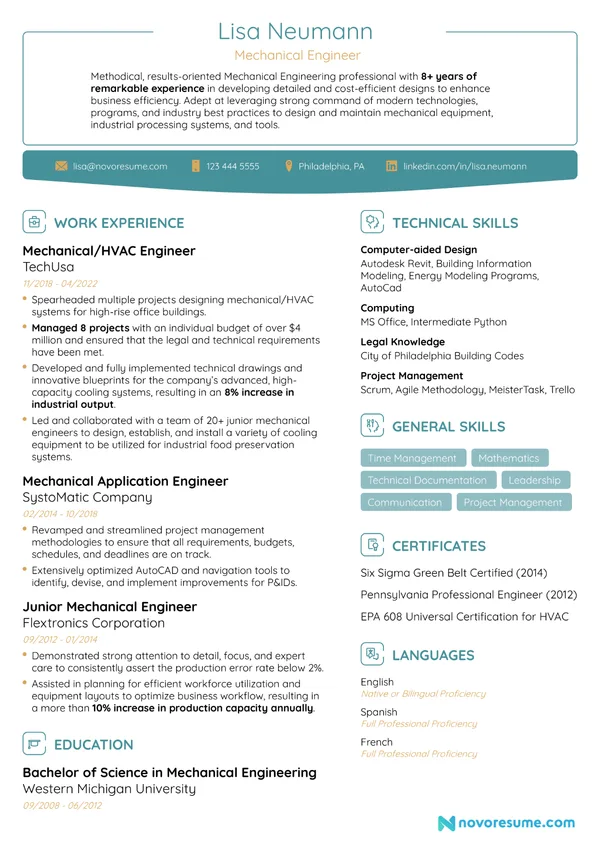
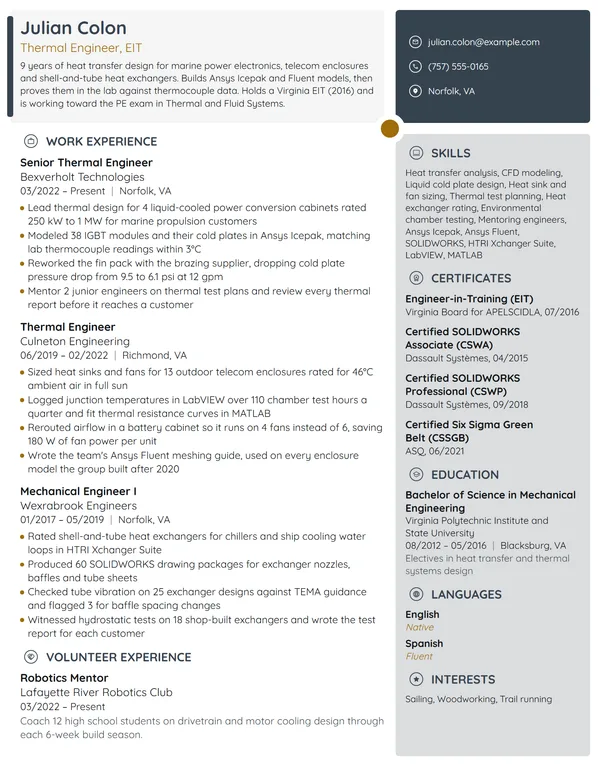
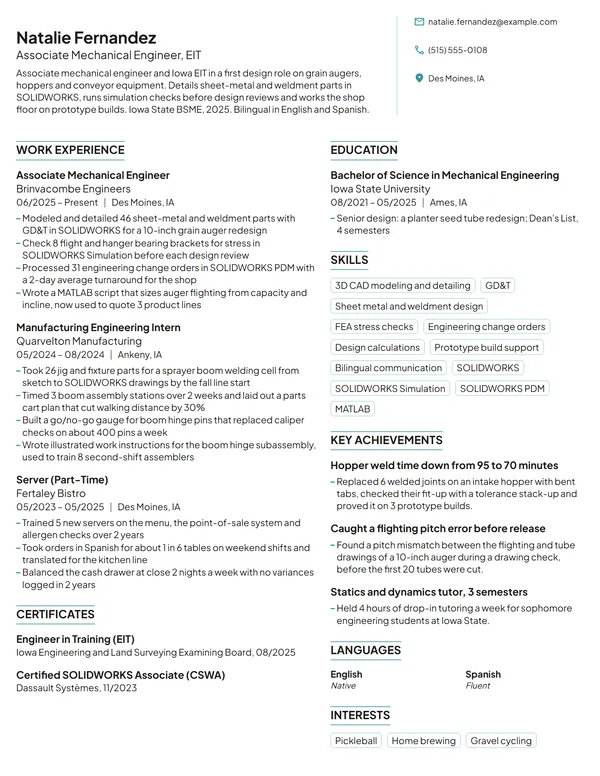
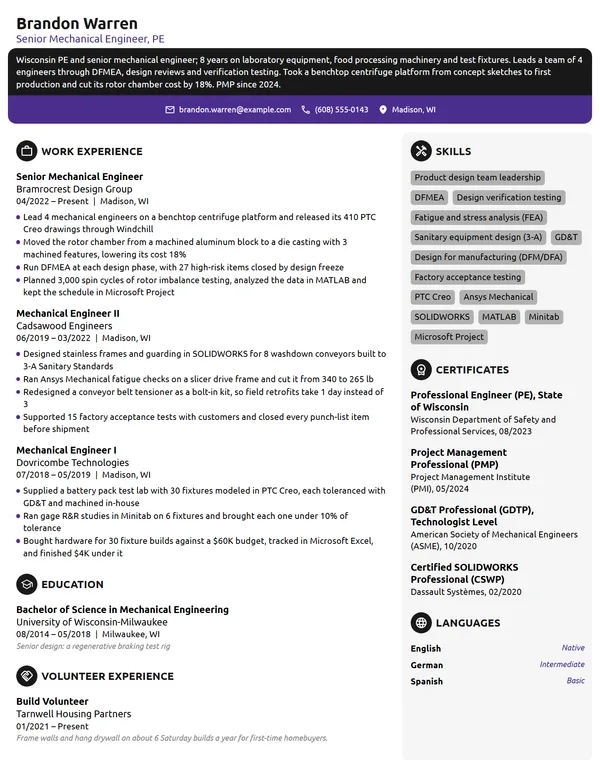
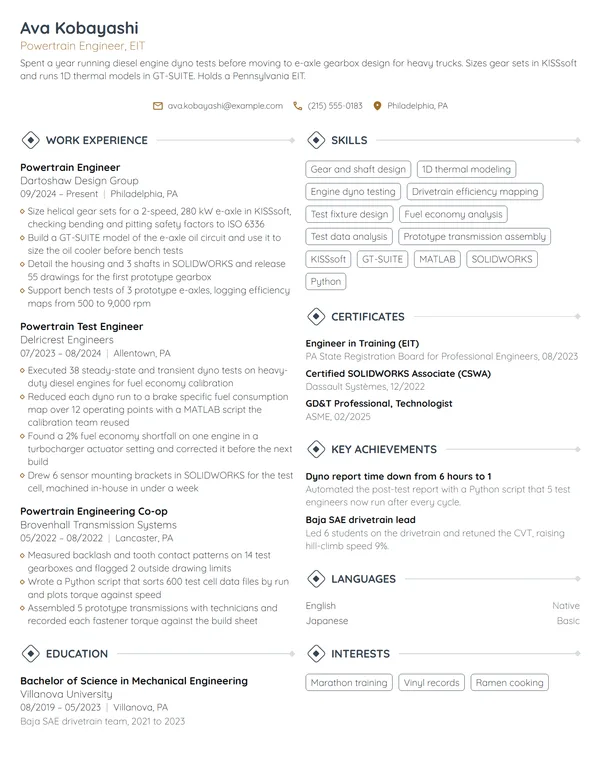
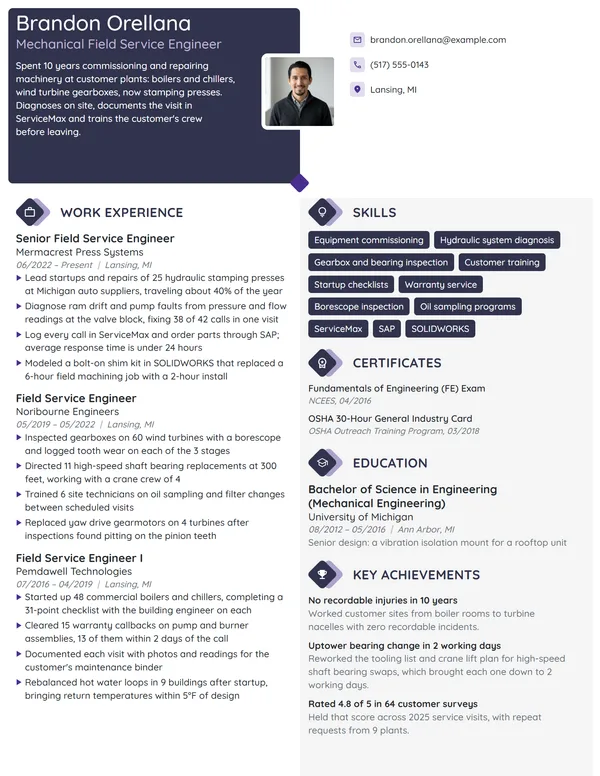
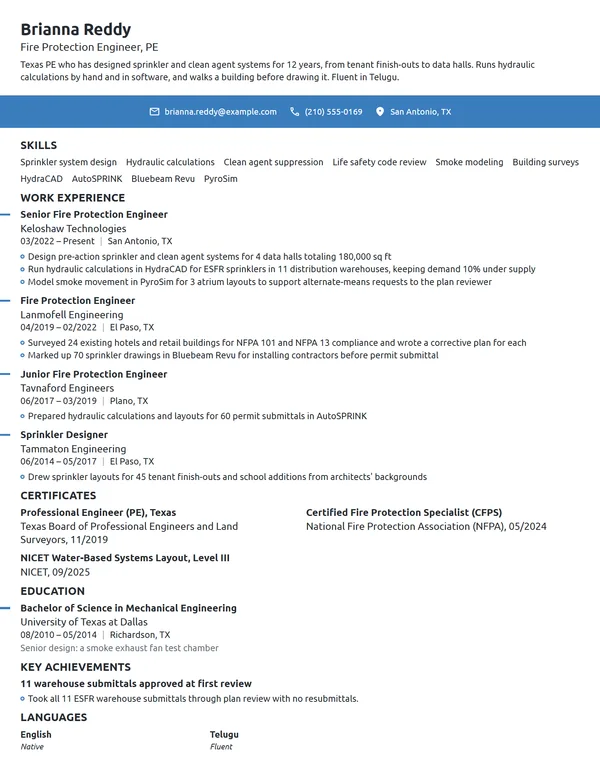
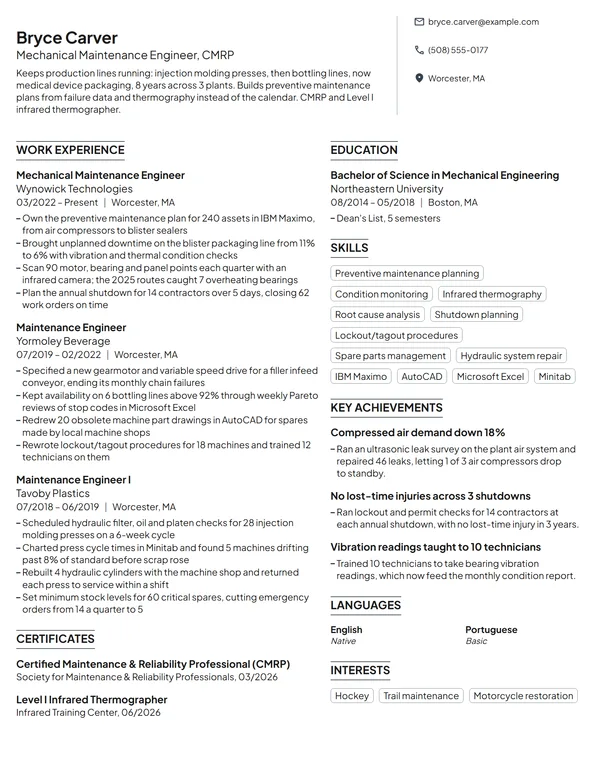
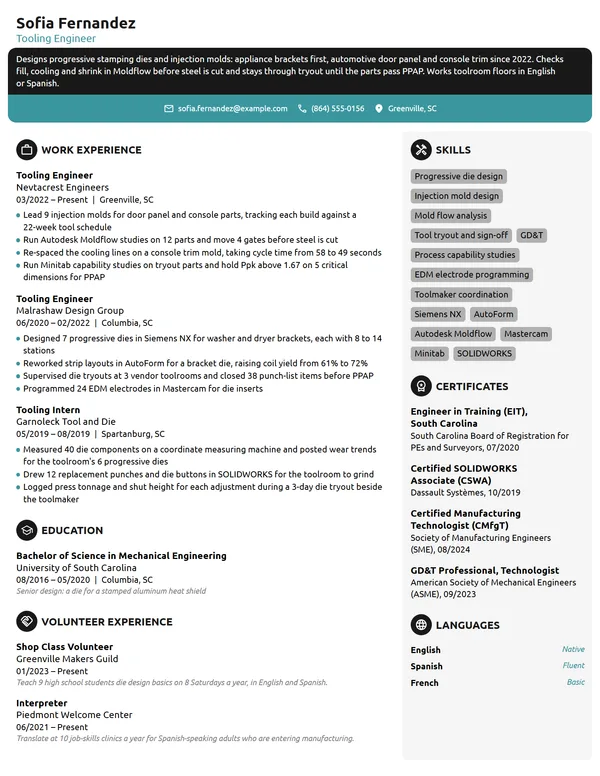
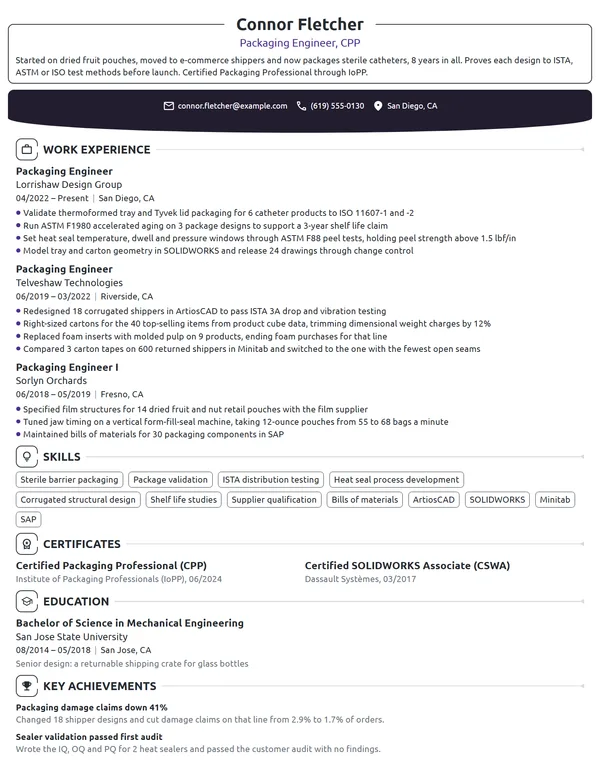
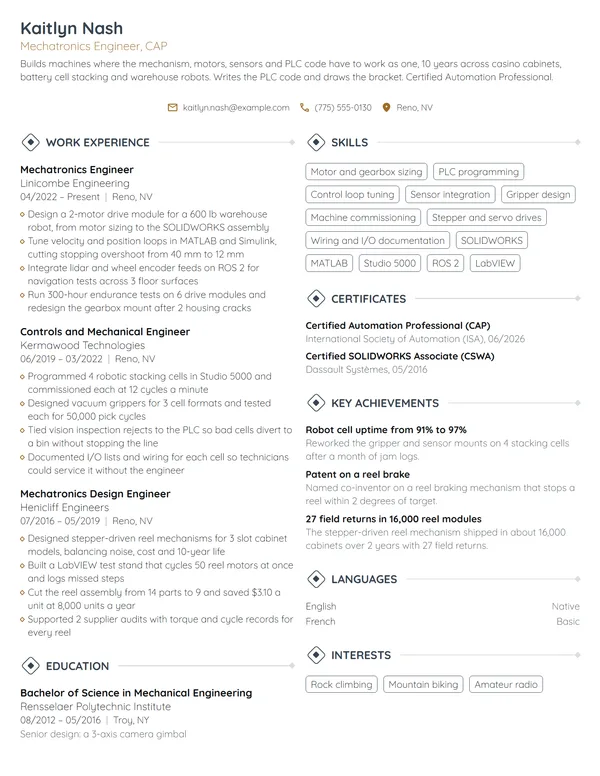
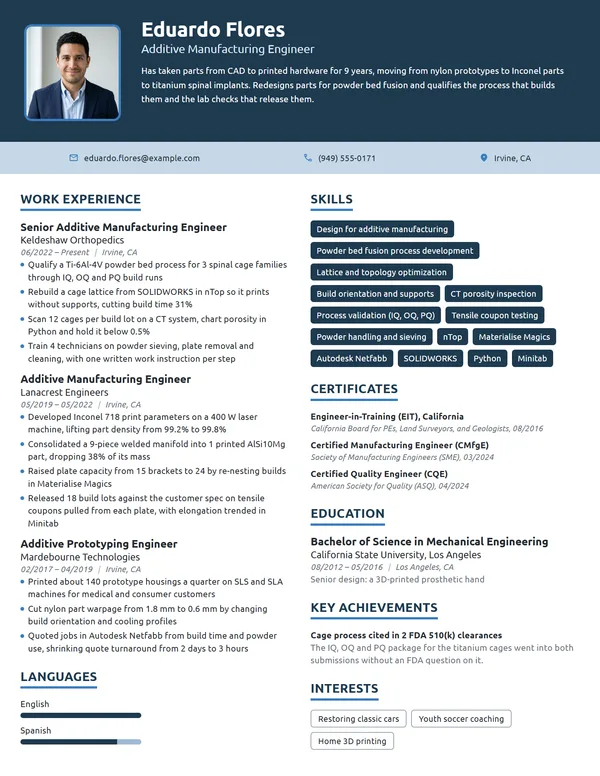
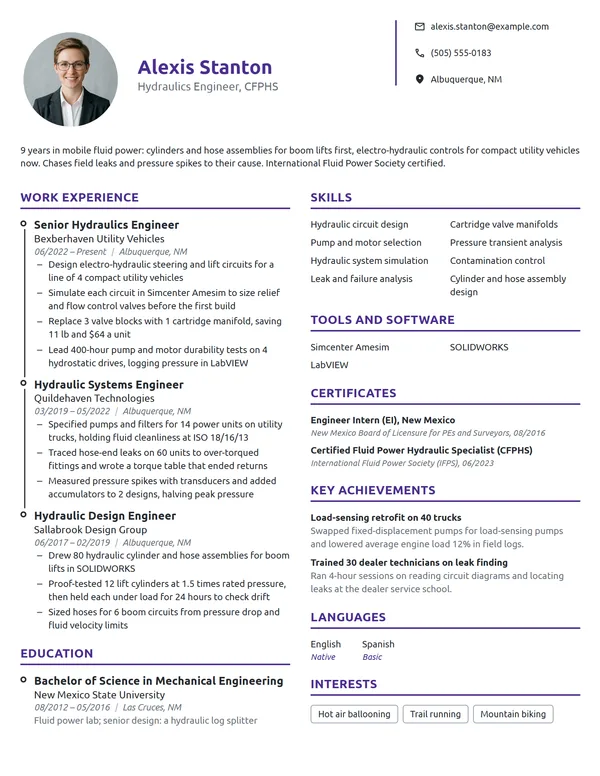
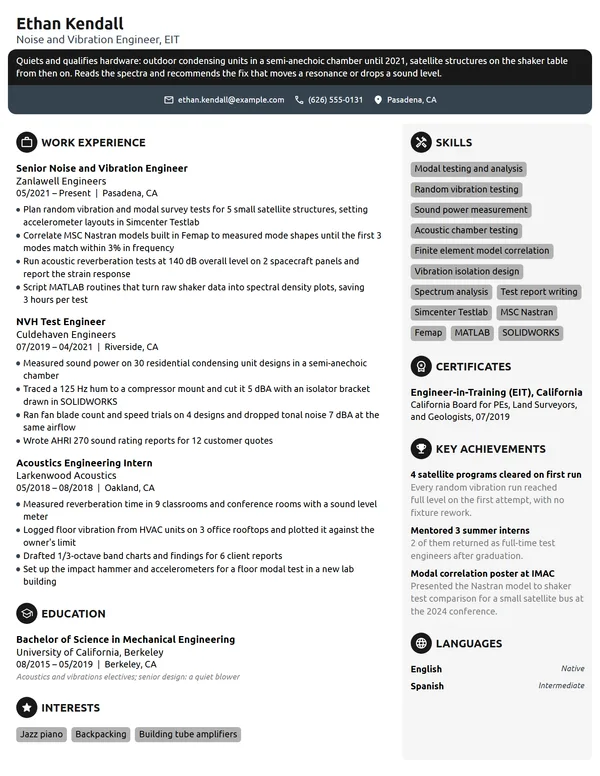
Mechanical engineers solve physical problems, and employers want to see which ones you solved. A good resume names the products you designed, the CAD and analysis software you used, and results you can measure, such as lower cost, less weight or better test performance. The real test is condensing months of project work into a few short bullets that a reviewer can scan in seconds. Each part of the page is covered below.
How to Write a Mechanical Engineer Resume - Key Takeaways
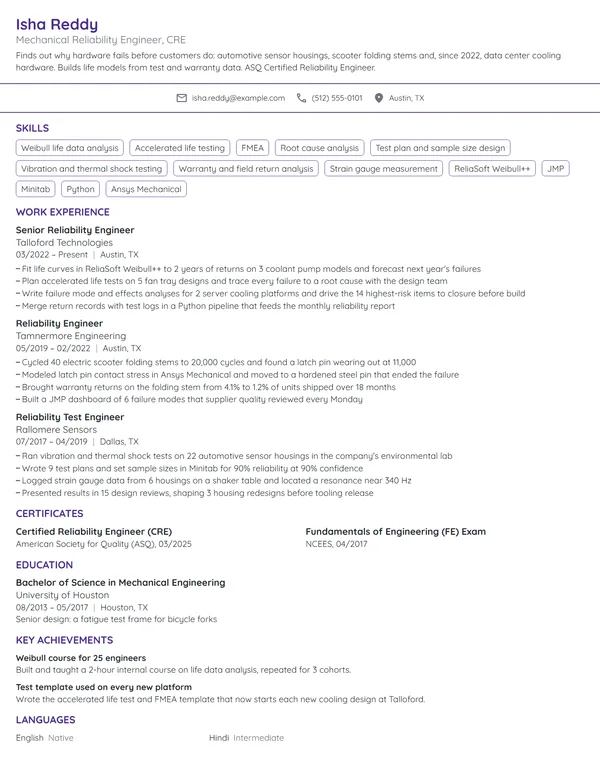
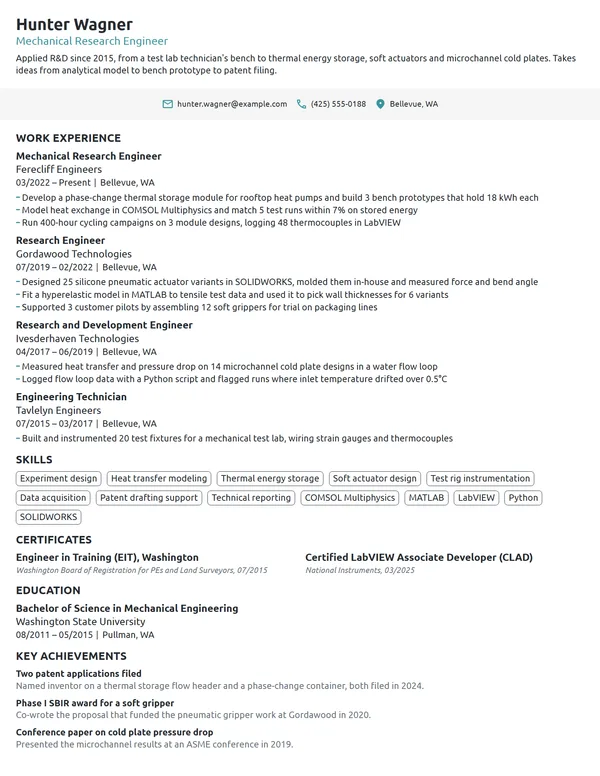
- Choose a reverse-chronological layout and keep it to 1 page, or 2 once you have 10+ years of product launches, plant projects or test programs.
- Open with a 2- to 3-line summary that names your years, your products, your CAD system and 1 measured design, test or cost result.
- Give every bullet an engineering number: drawings released, test hours, unit cost, weight, efficiency, scrap rate or warranty claims.
- Name your CAD and analysis tools as the job ad spells them, such as SolidWorks, Creo, AutoCAD or MATLAB, and prove each one in a bullet.
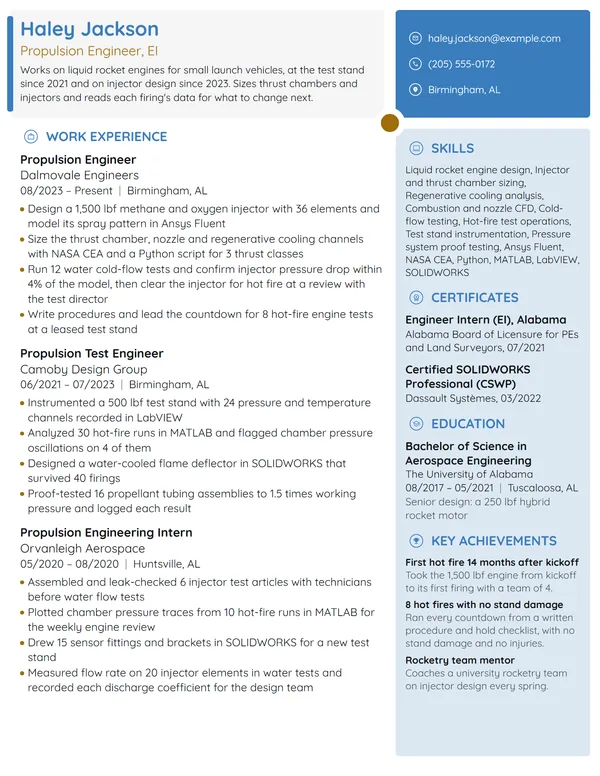
- Add EIT or PE to your headline only after your state board issues it, and list a scheduled PE exam with its month under Certificates.
- Put senior design and Formula SAE work under Education, then test the file in an ATS resume checker before you apply.
What hiring managers look for in a mechanical engineer resume
An engineering manager reads your resume with 3 questions in mind: what did you design or change, how was it proven, and what did it save or fix. The BLS lists designing or redesigning mechanical and thermal devices with analysis and computer-aided design, developing and testing prototypes, and investigating equipment failures as typical duties. O*NET adds reading blueprints and technical drawings and specifying components so a product conforms to its design and performance specifications.
Show each of those tasks with its scale, the tool you used and the result. Build the page from these sections, with headings that resume-screening software reads cleanly:
- Name, headline (for example, Mechanical Engineer, EIT) and contact details
- A 2- to 3-line summary under your name, which needs no heading of its own
- Work Experience, starting with your current role
- Skills, with your CAD and analysis software
- Certificates, with the EIT or PE listed first
- Education, including senior design or competition projects
- Optional extras: Languages, plus Key Achievements or Volunteer Experience
Best format for a mechanical engineer resume
Use the reverse-chronological resume format: your current job first, each with title, employer, location and dates in MM/YYYY. Mechanical careers climb through visible levels, from Engineer I to II, senior, lead and principal, and this layout shows each step with the products behind it. Career changers keep the same order and lead with the new engineering degree.
- Best for most mechanical engineersReverse-chronologicalYour jobs, newest first, with your results under each one.Best for: A steady work history in your field
- FunctionalSkills grouped up top, with a short work history below.Best for: Gaps or very little experience
- CombinationA skills section first, then your full work history.Best for: A career change with strong skills
Stay on 1 page for your first 10 years. A 2-page resume fits a senior engineer or engineering lead with several product launches or plant projects, provided page 1 still holds the current and previous job.
| Setting | What to use |
|---|---|
| Length | 1 page under 10 years; 2 pages for long design or plant careers |
| Headline | Job title plus credential: Mechanical Engineer, EIT or Senior Mechanical Engineer, PE |
| Dates | MM/YYYY on every role, and Present for the job you hold now |
| Units | Imperial or metric, as the employer works, with the unit on every figure (psi, lb, CFM, tons) |
| Photo and private data | Usually no photo in the US and Canada; never a Social Security number, date of birth or marital status |
| File type | PDF, or a Word file when the application portal requests one |
Most US and Canadian resumes carry no photo. Keep part renderings and drawings off the page as well, since a tracking system reads text only, and put a portfolio link in your contact details instead.
Mechanical engineer resume summary vs. objective
Write a resume summary once you have held a full-time engineering job: 2 to 3 lines with your level, your products, your main CAD or analysis tool, 1 measured result and your license status. New graduates and career changers write an objective instead, shown in the last section. Draft the summary after your bullets and borrow its number from them.
Mechanical engineer resume summary formula
Title, credential with X years designing products in CAD or analysis tool. 1 measured design, test or cost result. Next license step or certification.
Example
Mechanical Engineer, EIT, with 7 years designing pumps and air handling equipment in SolidWorks. Raised a pump line's efficiency from 71% to 76% and cut its bearing frame from 38 parts to 24. Sitting for the PE Mechanical exam in 03/2027.
Don't
Results-driven mechanical engineer with strong problem-solving skills and a passion for innovative design.
Do
Mechanical engineer with 4 years in HVAC equipment design, working in Creo and MATLAB. Led thermal testing on 3 rooftop unit platforms and closed 17 test failures before launch. EIT since 2023.
The rewrite names the product type, the tools, a test volume and the license step.
How to write mechanical engineering work experience bullets with numbers
Give your current role 3 to 4 bullets and older roles 1 to 3, each opening with a verb and closing with a result. Engineering results already come with units, so list work experience on your resume as measured outcomes: what you designed, what you tested, what it cost and what changed after release.
| Area | What to count | Example bullet |
|---|---|---|
| Design and CAD | Parts, assemblies, drawings released, ECOs | Released 85 part and assembly drawings for a packaging line retrofit with 0 drawing errors at first article. |
| Cost and weight | Unit cost, part count, material, pounds removed | Removed 1.8 lb from a cast aluminum bracket through topology optimization, saving $4.10 a unit on 12,000 units a year. |
| Testing and validation | Prototypes, test hours, cycles, failures closed | Ran 2,000-hour endurance tests on 6 prototype gearboxes and closed 11 failure reports before production. |
| Manufacturing support | Scrap, cycle time, yield, tolerance stack-ups | Cut machining scrap on a hydraulic manifold from 6.2% to 1.9% by reworking 4 tolerance stack-ups. |
| Reliability and failure analysis | Downtime, root causes, warranty claims | Traced a recurring seal leak to shaft runout and cut warranty claims on the model from 48 to 12 a year. |
| HVAC and building systems | Tons, CFM, square feet, energy use | Sized the chilled-water and air systems for a 140,000 sq ft clinic, 420 tons of cooling in total. |
Here is one engineer's entry with those numbers in place. The current job shows design, analysis and cost; the earlier job gets 2 lines.
Work Experience
- Redesigned the impeller and volute of a 40 hp end-suction pump line in SolidWorks, raising efficiency at the best efficiency point from 71% to 76% on the test loop.
- Cut the bearing frame assembly from 38 parts to 24, lowering unit cost by $212 across 1,100 units a year.
- Ran FEA in SolidWorks Simulation on 9 pressure-casing designs and released drawings with GD&T per ASME Y14.5 to 3 foundries.
- Designed 14 sheet-metal damper housings and released 120 drawings through the ECO process.
- Led root cause analysis on actuator linkage failures, cutting warranty claims from 31 to 9 a year.
Don't
Responsible for designing parts in CAD.
Do
Designed 22 machined and sheet-metal parts in Creo for a conveyor transfer module, released in time for a 60-unit pilot build.
A reviewer now knows the part types, the tool, the volume and the deadline you met.
Don't
Worked on cost reduction projects.
Do
Saved $86K a year on a gearbox housing by replacing a welded steel fabrication with a ductile iron casting, validated by FEA and a 500-hour bench test.
Mechanical engineering skills and CAD software for your resume
Choose 6 to 8 technical skills for your resume that the job ad asks for and your bullets already prove. GD&T, tolerance analysis and design for manufacturing belong on most product design resumes; HVAC load calculations, piping or vibration analysis only where you have done that work.
Hard skills for mechanical engineers
- 3D CAD modeling and drawings
- GD&T and tolerance stack-ups
- Finite element analysis (FEA)
- Design for manufacturing and assembly (DFM/DFA)
- Thermal and fluid analysis
- Prototype testing and validation
- Root cause analysis
- Failure mode and effects analysis (FMEA)
- Bills of materials and ECO control
- HVAC load calculations
Soft skills engineering managers value
- Clear technical writing
- Working with machinists and technicians
- Cross-functional teamwork
- Prioritizing against build dates
- Presenting at design reviews
- Curiosity about why parts fail
List your software with your skills, then use each tool by name in a bullet. O*NET flags SolidWorks, AutoCAD, Revit, PTC Creo Parametric, Python and Microsoft Excel as in-demand technology for mechanical engineers. Revit points to building and HVAC design, while SolidWorks and Creo point to product design, so lead with the one that matches the posting. For analysis, pair the method with the tool, such as FEA in SolidWorks Simulation or test data reduction in MATLAB.
PE license, EIT and certifications on a mechanical engineer resume
List certifications on your resume under Certificates, license first, each with its issuer and date. The BLS says licensure is not required for entry-level mechanical engineers, and a Professional Engineering (PE) license allows for higher levels of leadership and independence. Licensure generally takes a degree from an accredited program, a pass on the Fundamentals of Engineering (FE) exam, typically at least 4 years of relevant experience and a pass on the PE exam. Engineers who pass the FE are commonly called engineers in training (EITs) or engineer interns (EIs), so use the title your state board uses.
| Credential | Issued by | What it takes |
|---|---|---|
| PE (Professional Engineer) | Your state engineering board | An accredited degree, the FE exam, usually 4 years of experience and the PE exam. The NCEES PE Mechanical exam is computer-based, has 80 questions and comes in 3 versions: HVAC and Refrigeration, Machine Design and Materials, or Thermal and Fluid Systems. |
| EIT or EI (Engineer in Training, Engineer Intern) | Your state engineering board, after the NCEES FE exam | The degree plus a pass on the FE, a 110-question computer-based exam NCEES designs for recent graduates and students close to finishing an engineering degree. In Texas, the EIT certificate expires 8 years after issue and can be renewed. |
| CSWA and CSWP (Certified SOLIDWORKS Associate and Professional) | Dassault Systèmes | No prerequisites for either exam. CSWA is aimed at users new to SOLIDWORKS; CSWP at users working in it full time for 6 months or more. |
| CSSGB (Certified Six Sigma Green Belt) | ASQ | 3 years of full-time, paid work in 1 or more areas of the Six Sigma body of knowledge, then a 110-question exam. |
How to show the PE exam before you pass it
Write EIT in your headline once your board issues the certificate, and keep PE off your name line until the license itself is issued. Under Certificates, give the EIT with its board and date, then the PE exam with the month you are scheduled to sit it. The certificate is not a license: the Texas board, for example, states that it does not entitle you to practice as a professional engineer.
Certificates
- Engineer in Training (EIT), Texas Board of Professional Engineers and Land Surveyors, 10/2019
- Certified SOLIDWORKS Professional (CSWP), Dassault Systèmes, 03/2021
- Certified Six Sigma Green Belt (CSSGB), ASQ, 10/2024
- PE exam, Mechanical: Machine Design and Materials, NCEES, scheduled 03/2027
How to list a mechanical engineering degree on your resume
The BLS says mechanical engineers typically need a bachelor's degree in mechanical engineering or mechanical engineering technology, and most employers prefer graduates of an accredited program. State boards care too: Texas asks for a degree from an EAC/ABET-accredited engineering program for its standard PE route and doubles the experience requirement, from 4 years to 8, for a non-accredited degree. Follow the usual rules for listing education on a resume: the full degree name, the school and its city, and the month and year you graduated.
Projects do not need a section of their own. Put your senior design project, Formula SAE car or undergraduate research under the degree as 1 or 2 lines, each with a number. A GPA belongs there only if it is 3.5 or higher and you finished school within the last 2 years.
Education
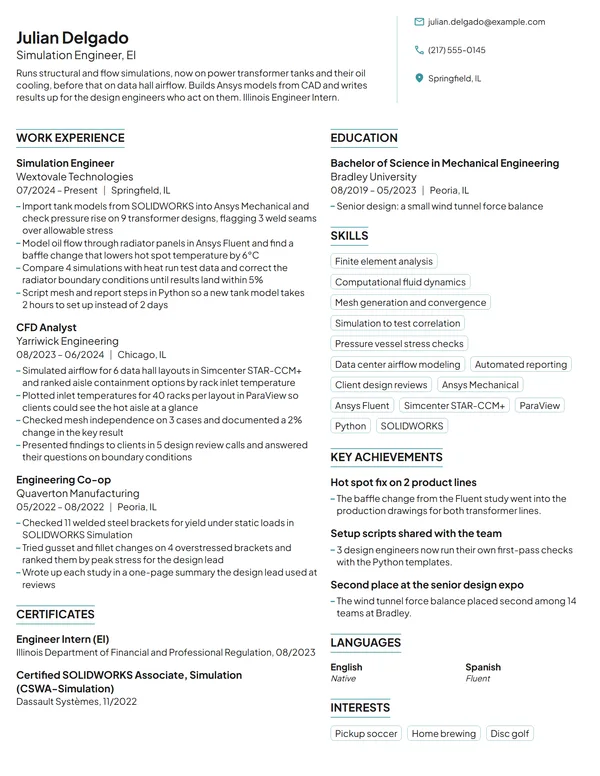
Senior design: a test stand for a 5 hp centrifugal pump, later used in 2 lab courses. Formula SAE suspension team for 2 seasons.
Entry-level and career-change mechanical engineer resumes
Without a full-time engineering job yet, follow the entry-level mechanical engineer layout: a short objective, Education near the top, then the evidence below, each item with a number. Co-op terms and internships get their own Work Experience entries; the BLS notes that some 5-year or even 6-year cooperative plans combine classroom study with practical work.
- Co-ops and internships: parts designed, drawings released and tests run, under Work Experience.
- Senior design and competition teams: Formula SAE, Baja SAE or robotics, with your subsystem and its result, under Education.
- Lab and machine shop work: test rigs you built and equipment you ran.
- FE exam: passed, or scheduled with its month, under Certificates.
Keep a resume objective to 2 lines: the role you want and your 2 strongest pieces of engineering evidence.
Don't
Motivated mechanical engineering graduate seeking an entry-level position where I can apply my skills.
Do
BSME graduate and EIT seeking a design engineer role. Designed the rear uprights for a Formula SAE car and spent 2 co-op terms releasing fixture drawings at a valve plant.
An objective still needs proof: a subsystem, a co-op or the FE.
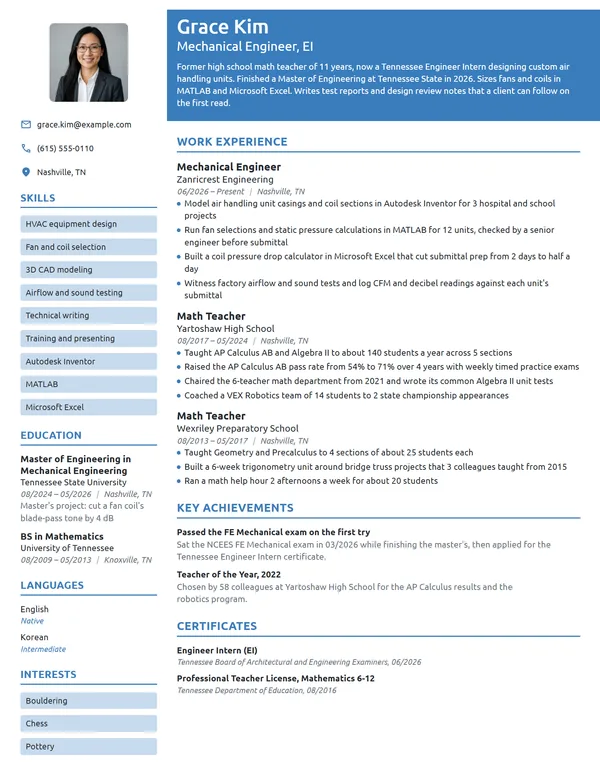
Moving in from teaching math or physics, a technician or drafter job, or the military, stay with reverse-chronological order, and lead with the engineering credential you earned for the switch, such as a master's in mechanical engineering or a passed FE. Put the new degree first under Education, and in past jobs keep the bullets that already use engineering tools: data you analyzed in Excel or MATLAB, equipment you maintained, drawings you produced. A career-change resume or the teacher career change layout shows the order, and the reason for the switch belongs in a mechanical engineer cover letter, not in your summary.
A master's without an engineering bachelor's can still lead to a license on some state routes. Texas, for one, accepts a board-approved combination that starts from a bachelor's in a mathematical, physical or engineering science, so check your own board's rules before you write an expected PE date.
Mechanical Engineer resume FAQ
Can I put PE after my name before I am licensed?
No. Add PE to your name line or headline only after your state engineering board issues the license. Before that, list your EIT or EI certificate under Certificates and add the PE exam with the month you are scheduled to take it.
Should I put EIT on my mechanical engineer resume?
Yes, once your board has issued it. Write it in your headline, as in Mechanical Engineer, EIT, and under Certificates with the board and date. Use the title your state uses: the BLS notes that engineers who pass the FE are commonly called engineers in training or engineer interns.
Do mechanical engineers need a PE license?
Not to start. The BLS says licensure is not required for entry-level mechanical engineer positions and that a PE license allows for higher levels of leadership and independence. If a posting lists a PE as required or preferred, state your license status in your summary as well as under Certificates.
How long should a mechanical engineer resume be?
Keep it to 1 page for your first 10 years. After that, 2 pages work when your product launches, plant projects or test programs need the room, as long as page 1 still carries your current and previous job.
Which CAD software should I put on my resume?
The CAD systems the job ad names that you have built real parts in, such as SolidWorks, Creo, AutoCAD or Revit, and nothing you only opened in class. Then name each one in a bullet with what you made in it, like a released drawing set or an assembly.
Where do senior design and Formula SAE projects go on a resume?
Under Education, as 1 or 2 lines below your degree. Name your subsystem and 1 measured result, such as the weight you removed or the test you passed. Once you have 2 or more years of engineering work, shorten them or drop them.
Should I put my FE exam score on my resume?
No. NCEES reports FE results only as pass or fail, so there is no score to give. Write the EIT or EI certificate your board issued, or FE exam passed with the month if you have not applied for the certificate yet.
Should I list salary expectations on a mechanical engineer resume?
No. Salary talk belongs in the application form or a later interview. As a benchmark, the BLS puts the median annual wage for mechanical engineers at $104,110 in May 2025; offers vary with industry, state and license status.
Next steps
Pick the example nearest your level, keep its structure and swap in your own parts, tests and savings. Build it in our resume builder, or take one of the resume templates as your base, then send it alongside a cover letter whose first line is the design result you are proudest of.