
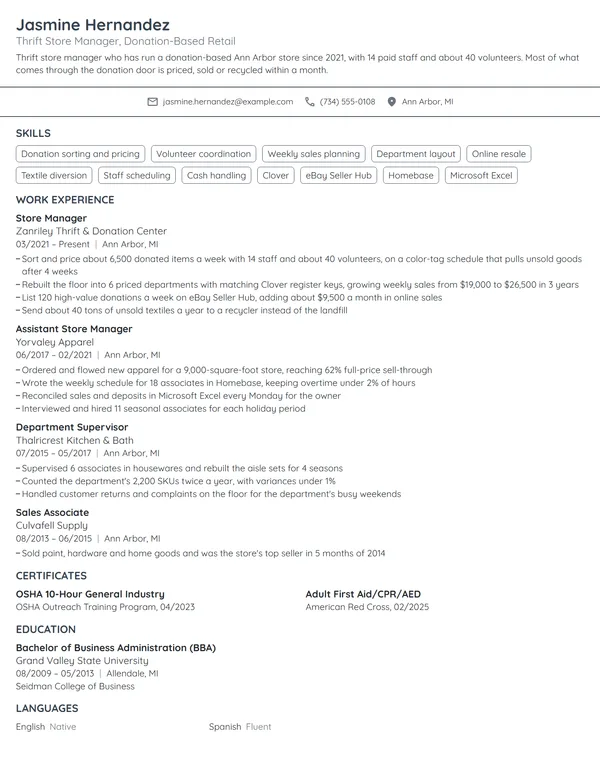
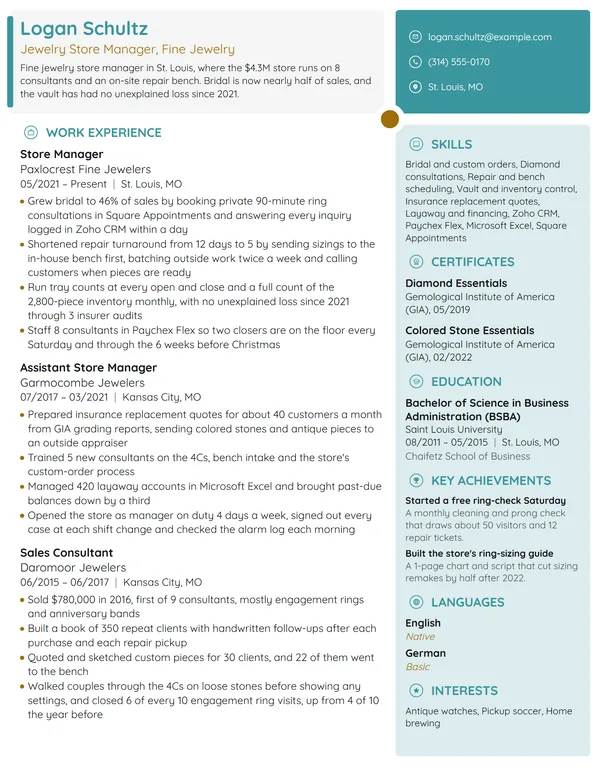
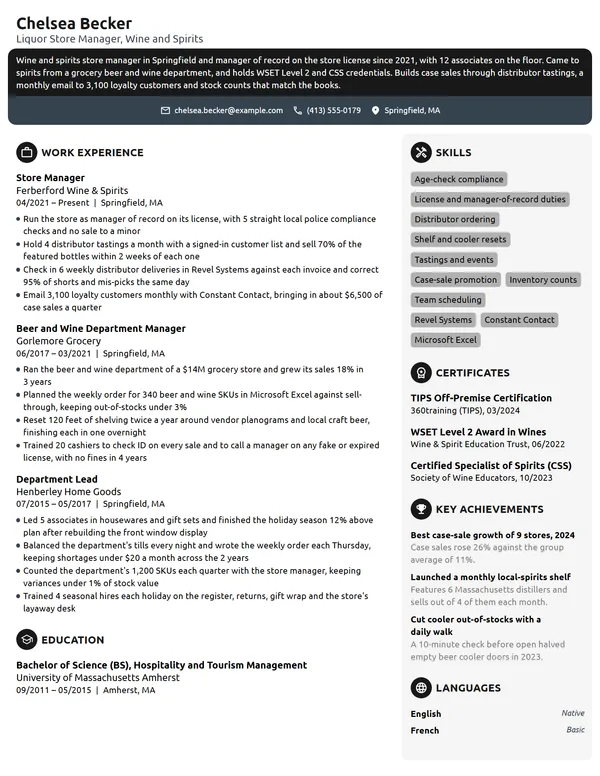
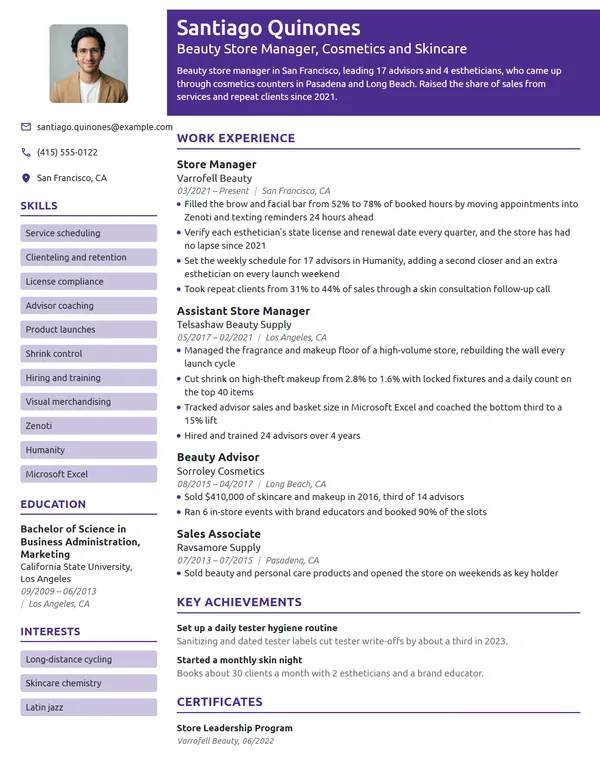
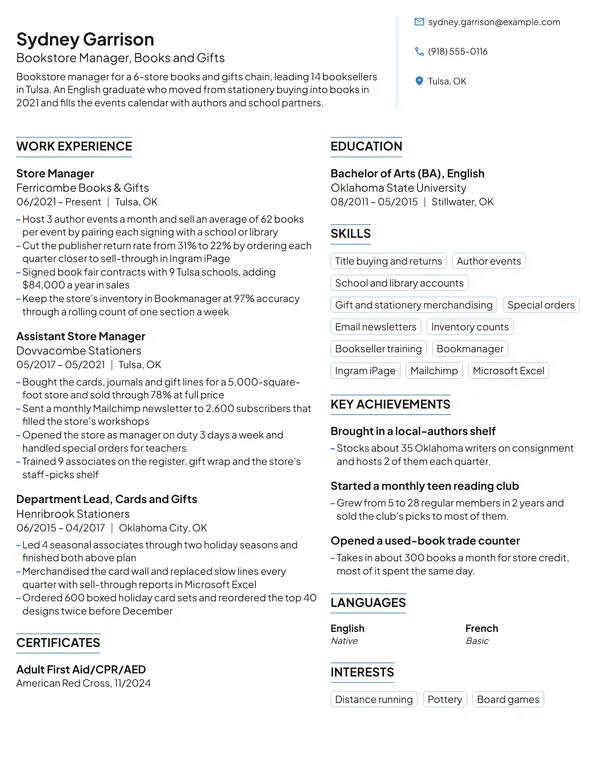
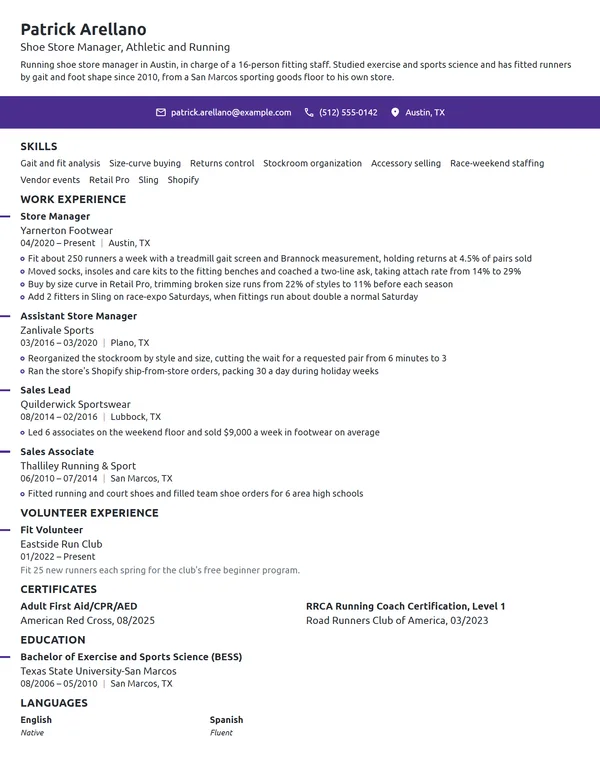
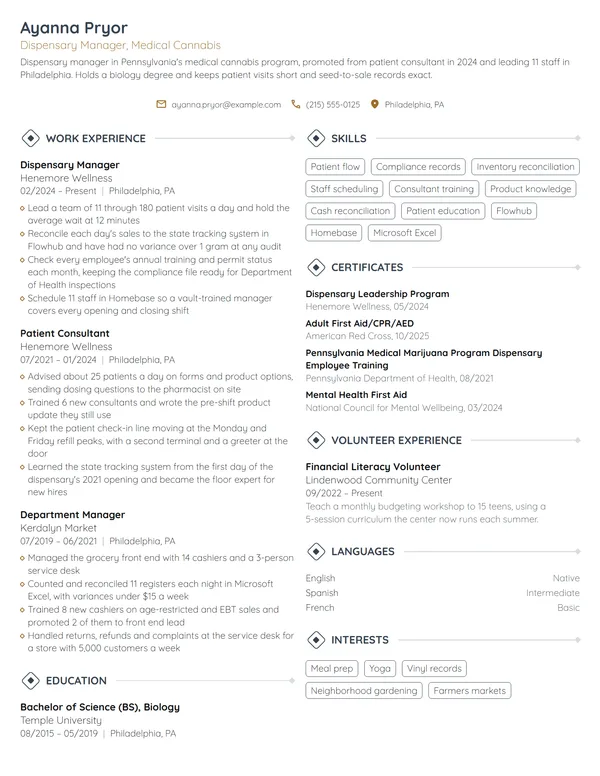
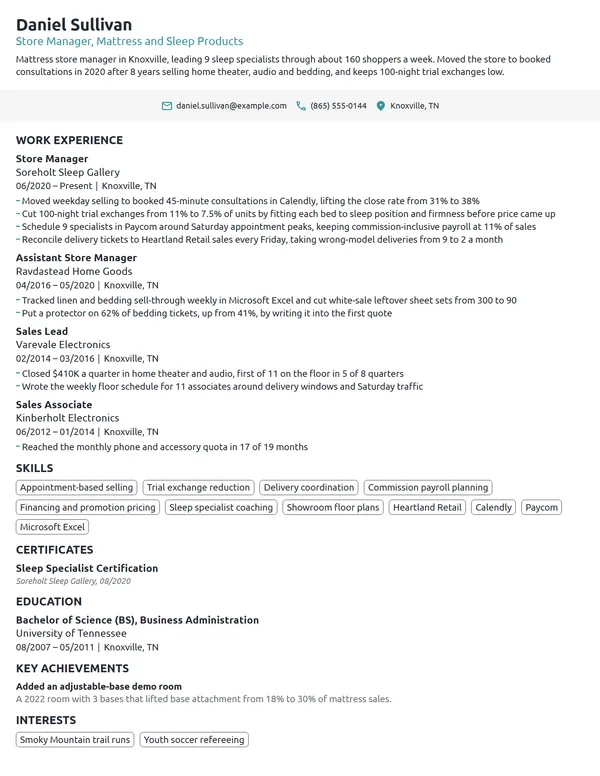
Store managers run the part of a retail business closest to the customer, from the morning delivery to the last register count. Whoever reviews your resume wants to know what kind of store you ran, who worked for you and whether the store got better while you ran it. Head office usually sets the prices, the promotions and often the labor budget, so the results that count most are the ones your own decisions produced.
How to Write a Store Manager Resume - Key Takeaways
- Lead with your current store in a reverse-chronological layout, and stay on 1 page until you have about 10 years or several stores behind you.
- Put the store format in your headline, such as Store Manager, Grocery, so the reader knows which kind of store your numbers come from.
- Write the action you took in each bullet, then the result, so a chain-wide promotion never reads as your own win.
- Choose 6 to 8 skills from the posting, list the POS and scheduling systems you have used, and prove each one in a bullet.
- Give a paid manager-in-training program its own job entry, and put credentials such as ServSafe or RISE Up under Certificates.
- Upload a PDF unless the careers site asks for Word, and test it first with an ATS resume checker.
What a store manager resume needs to show
Your reader is usually the district or regional manager the store would report to, or a recruiter screening for one. They want to see that you can run a store as a business: hit the sales plan, control payroll and shrink, and keep the floor staffed with people you hired and trained. O*NET lists hiring, training and evaluating staff among the tasks of retail supervisors, along with keeping records of purchases, sales and requisitions.
Because the title covers very different stores, a reader also checks whether your format matches theirs. Organize the page under these headings, which applicant tracking systems read without trouble:
- Your name, a headline with your store format (Store Manager, Grocery) and your contact details
- 2 to 3 lines of summary directly under the headline, with no section title
- Work Experience, starting with the store you run now
- Skills, including the POS, scheduling and inventory systems you know
- Certificates, such as food safety or retail credentials
- Education
- If room allows: Key Achievements for district or company awards, or Volunteer Experience, plus Languages
Best format for a store manager resume
Choose the reverse-chronological resume format and start with the store you manage today. Most store managers are promoted inside a chain or hired away from a competitor, and giving each title its employer, its city and MM/YYYY dates lets a reader trace that path at a glance. A career changer keeps the same order, with the first store job on top and the earlier career rewritten below it.
- Best for most store managersReverse-chronologicalYour jobs, newest first, with your results under each one.Best for: A steady work history in your field
- FunctionalSkills grouped up top, with a short work history below.Best for: Gaps or very little experience
- CombinationA skills section first, then your full work history.Best for: A career change with strong skills
One page holds a key holder, an assistant manager or a manager with a single store. Move to 2 pages when you have led several stores or managed for about 10 years, and keep your current store and the one before it on page 1. Experience covering several stores at once may point you toward a district manager role instead.
| Setting | What to use |
|---|---|
| Length | 1 page; 2 after several stores or about 10 years |
| Job title line | Title plus format, such as Store Manager, Pet Supply |
| Promotions | 1 employer name, with each title and its own dates beneath it |
| Dates | MM/YYYY start and end dates, and Present for your current store |
| Photo and personal data | None on most US and Canadian resumes; leave out your age, marital status and ID numbers |
| File type | PDF, or Word when a retailer's careers site requests it |
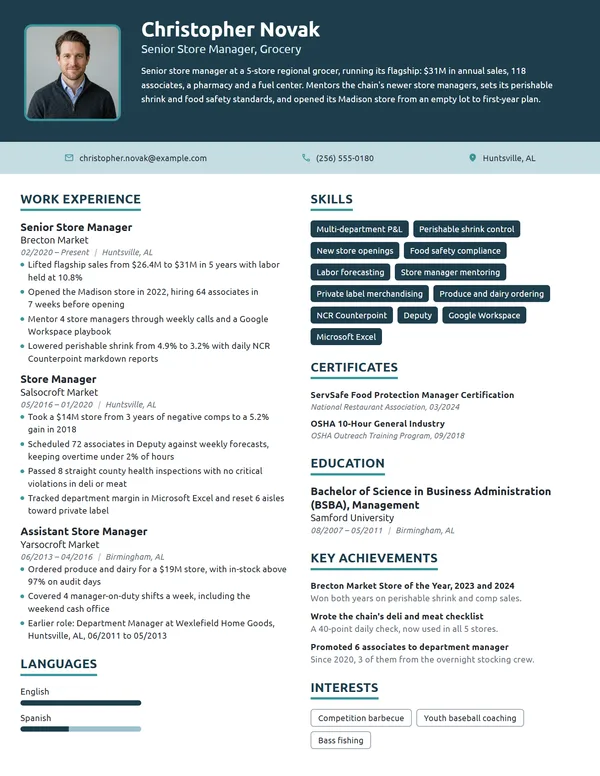
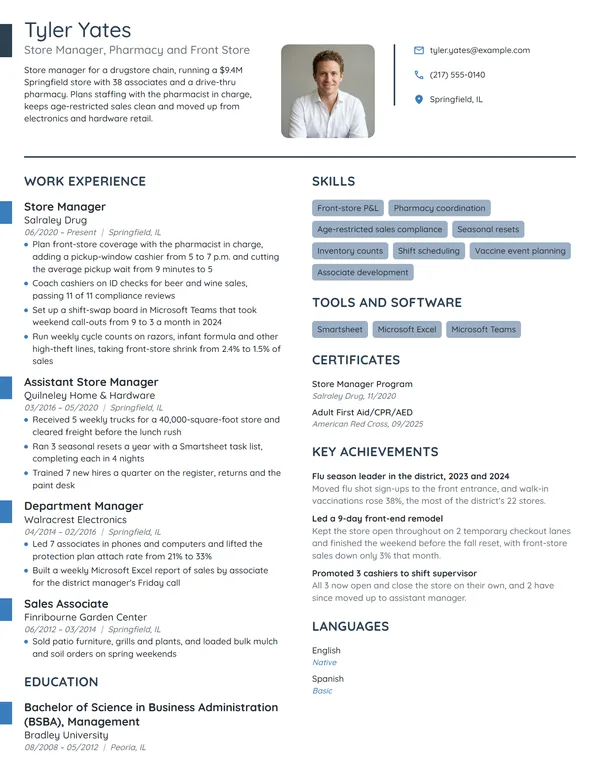
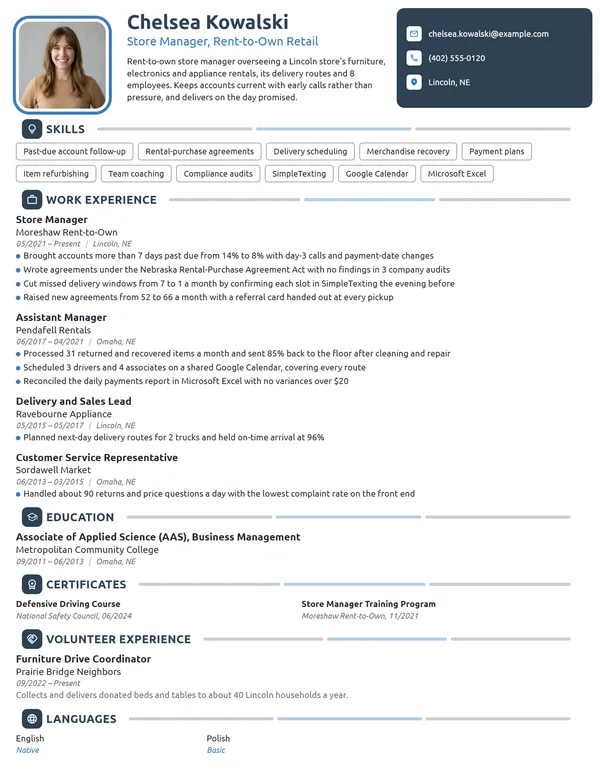
Most US and Canadian resumes carry no photo. Spend that space on the numbers instead: on a store manager resume, a reader looks for the store's size and results before anything else.
Store manager resume summary vs. objective
Ask yourself one question: have you owned a store's or a department's results yourself, with a sales plan and a payroll budget in your name? If yes, write a resume summary with the format, the store's size and your best result. If not yet, as a manager in training or a key holder, use one of these resume objective examples as a model: the job you want and the nearest proof you have.
Store manager resume summary formula
Title with X years in store format, running a annual sales store with team size. A result you drove, with its number. Systems or credentials from the posting.
Example
Store manager with 10 years in specialty and grocery retail, running a $3.6M pet supply store with 22 associates and a grooming salon. Grew grooming bookings from 41 to 63 a week and finished FY2025 at 104% of plan. ServSafe certified; reports in Microsoft Excel and SAP.
Don't
Dynamic store leader with a passion for customer satisfaction and a strong work ethic.
Do
Store manager with 8 years in convenience retail, running a 24-hour, $2.7M store with 19 associates. Cut cash shortages from $85 to $12 a week and promoted 3 associates to shift lead.
The second version names the format, the hours, the size and 2 results the reader can verify.
How to write store manager work experience bullets with numbers
Write 3 to 4 bullets for your current store and fewer for each older job, starting each with a verb. When you list work experience on a resume, put what you decided first and the number second: the schedule you rebuilt, then the payroll it saved. Store managers live on weekly reports, so most of these figures already exist.
| Area | What to count | Example bullet |
|---|---|---|
| Plan and expenses | Percent of plan, comp growth, controllable spend | Cut supply and utility spend by $26K in FY2025 while finishing at 101% of the sales plan. |
| Payroll | Labor percent, hours against budget, sales per labor hour | Raised sales per labor hour from $142 to $158 by moving 2 part-time shifts into the after-work rush. |
| Shrink and damages | Shrink percent, write-offs, cash over and short | Brought damaged-goods write-offs down from $3,900 to $1,700 a quarter by retraining receiving on case handling. |
| Team | Turnover, internal promotions, roles filled | Cut 90-day turnover from 40% to 22% with a written 2-week onboarding plan for every new hire. |
| Store standards | Planogram compliance, audit scores, safety incidents | Reached 98% planogram compliance on 1,100 linear feet after a full reset in 5 nights. |
| Customers | Survey scores, loyalty sign-ups, complaints resolved | Added 2,300 loyalty members in 2025, 140% of the store's goal, by coaching every cashier on the sign-up ask. |
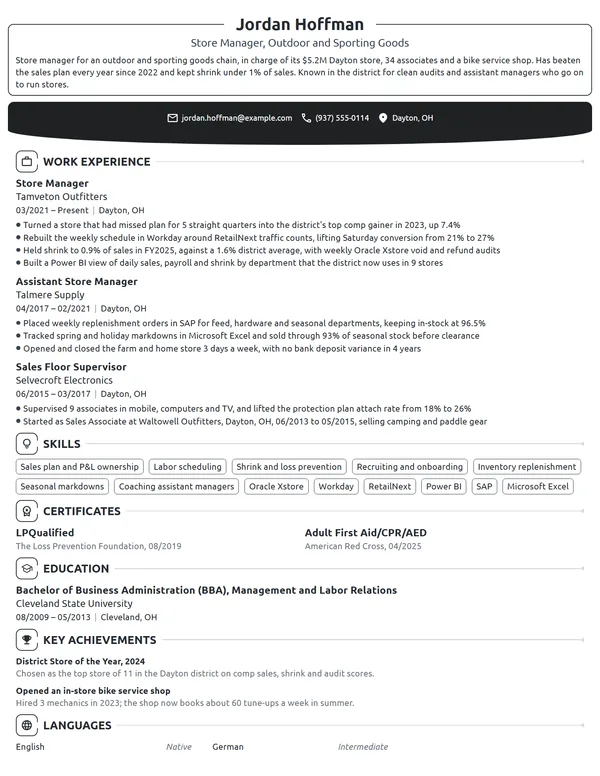
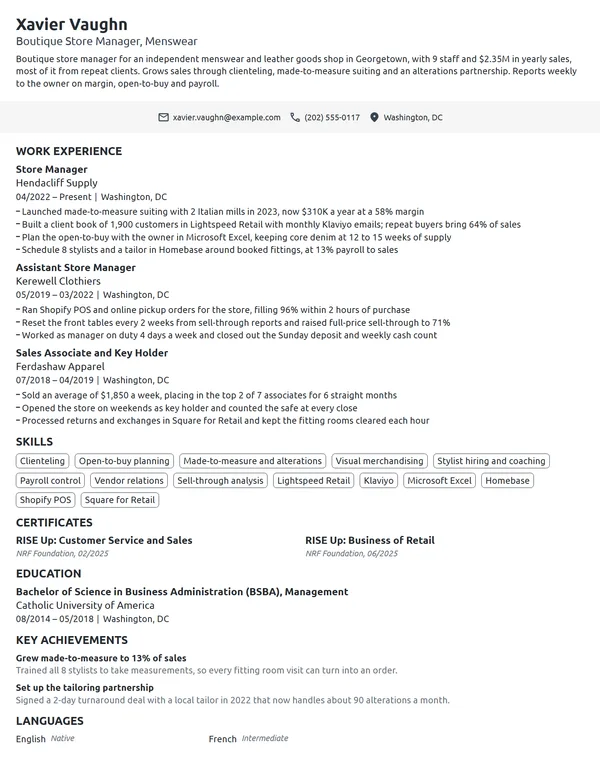
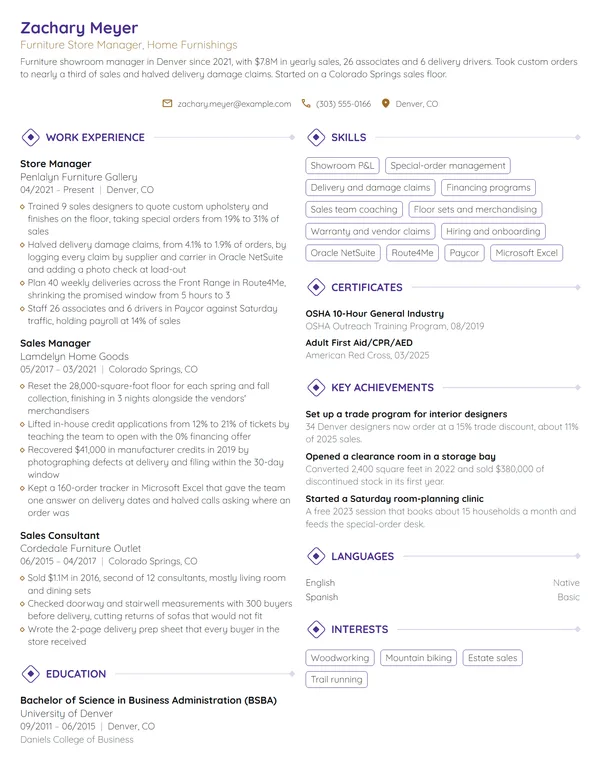
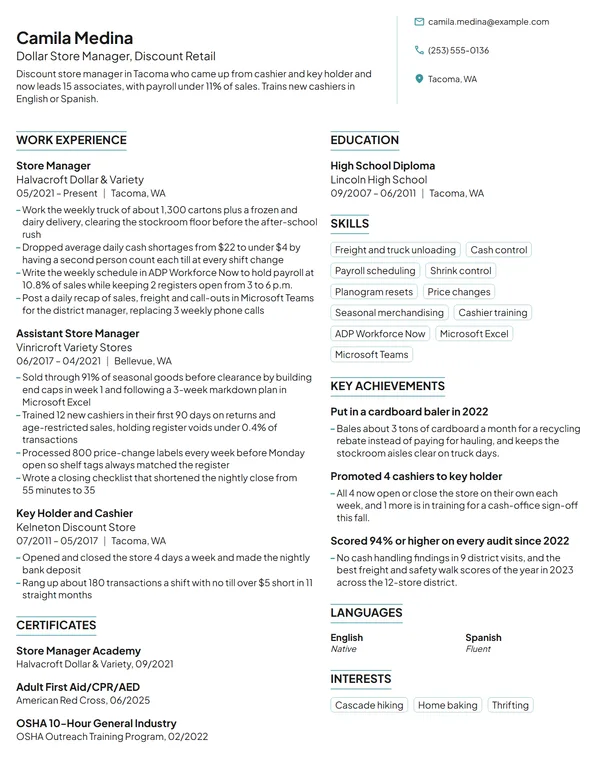
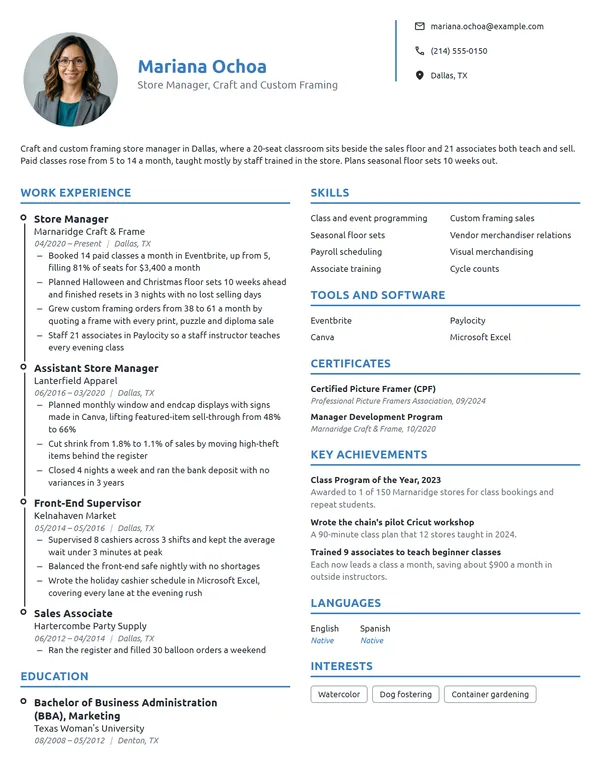
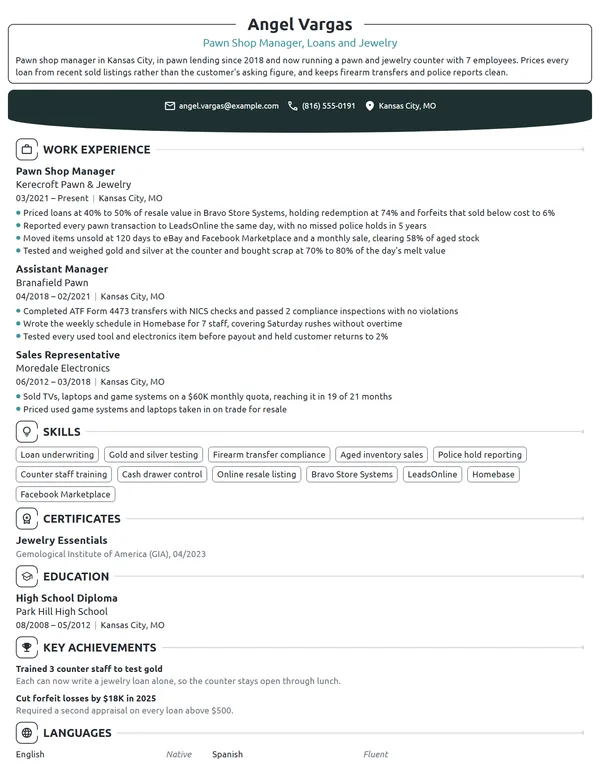
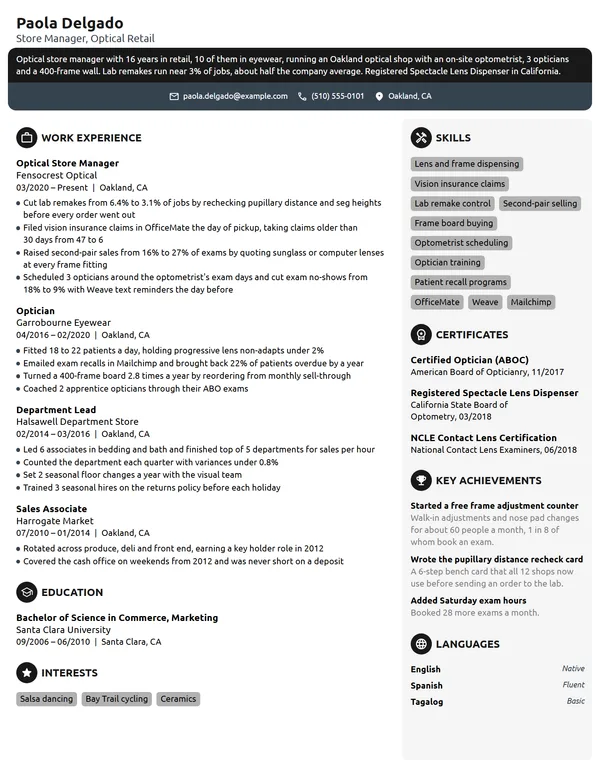
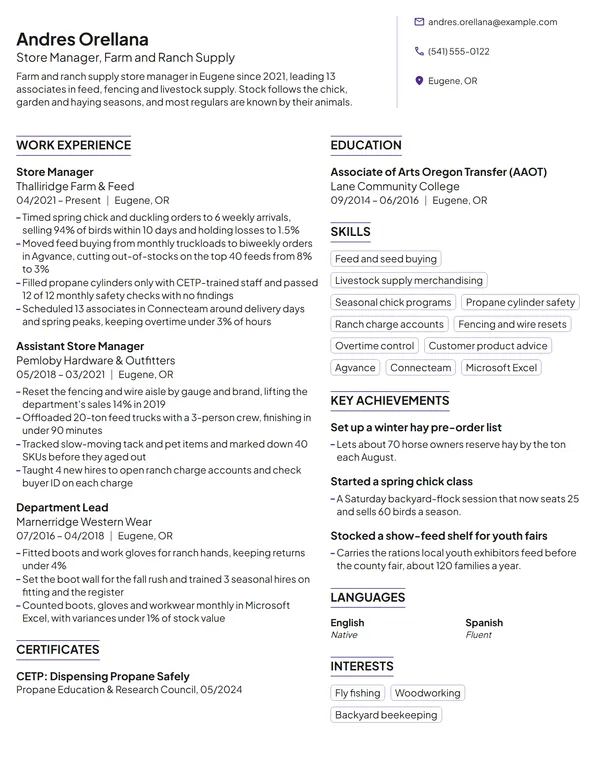
In this sample, the first bullet gives the store's size, the next ones each name a decision and its result, and the assistant role underneath is shorter.
Work Experience
- Run a $3.6M pet supply store with 22 associates and an in-store grooming salon, finishing FY2025 at 104% of sales plan.
- Grew grooming bookings from 41 to 63 a week by adding online booking and a second Saturday groomer.
- Raised the monthly store audit score from 82% to 95% in 3 quarters by giving each checklist area 1 named owner.
- Trained 3 associates who became assistant managers at other stores in the district.
- Ran an 8-person overnight freight crew working 3 trucks a week, with shelves full by the 7 a.m. opening.
- Led the annual physical inventory of 14,000 SKUs, finishing 1 day early at 99.2% count accuracy.
Don't
Responsible for managing store operations and staff.
Do
Managed a 24-person team in a $3.1M apparel store and finished 3 straight quarters above plan.
Headcount, store size and a result against plan replace a line that fits any manager.
Don't
Handled scheduling and payroll.
Do
Cut 60 weekly labor hours without losing floor coverage by moving 2 shifts to match a 4 p.m. traffic peak.
Store manager skills, POS and scheduling systems
Take 6 to 8 hard skills for your resume from the posting, keeping only the ones a bullet proves. The soft skills below show best through results, such as the people you promoted or a store that kept its staff through the holidays.
Hard skills for store managers
- Store budget and P&L ownership
- Associate scheduling
- Recruiting and interviewing
- Inventory replenishment
- Shrink and cash control
- Planogram and merchandise presentation
- Pricing and markdown execution
- Store openings and remodels
- Safety and compliance audits
- KPI reporting to the district
Soft skills district managers value
- Leading from the sales floor
- Coaching new supervisors
- Composure with upset customers
- Judgment on short-staffed days
- Straight talk with head office
- Owning the store's results
Put your systems with your skills, and name each one again in a bullet that shows the work. O*NET flags Microsoft Office as in-demand technology for retail supervisors, and its hot technology list includes SAP software and Kronos Workforce Timekeeper. Your chain may run its own register or ordering tools, so write the product name your store uses now and copy the posting's spelling where the system is the same.
Food safety and retail credentials for store managers
A store manager job is won on your record, and a credential backs it up. Food safety comes first in any store that sells or prepares food, from grocery to a convenience store with a hot case. List certifications on your resume under Certificates with the issuer and the month and year, so a recruiter who searches for ServSafe finds it.
| Credential | Issued by | Where it fits |
|---|---|---|
| ServSafe Food Protection Manager Certification | National Restaurant Association (ServSafe) | Grocery, convenience and any store with food service. The exam is accredited by ANAB under Conference for Food Protection standards; check your state or county rules for renewal. |
| RISE Up credentials, such as Business of Retail or Supply Chain, Inventory, and Logistics | NRF Foundation | Earlier in a retail career, or when moving in from another field. The foundation built the program with more than 20 retailers; list each credential by its own name. |
| Company manager or leadership course | Your employer | A course with its own completion date. Use the name the company gives it. |
Where to put a manager-in-training program
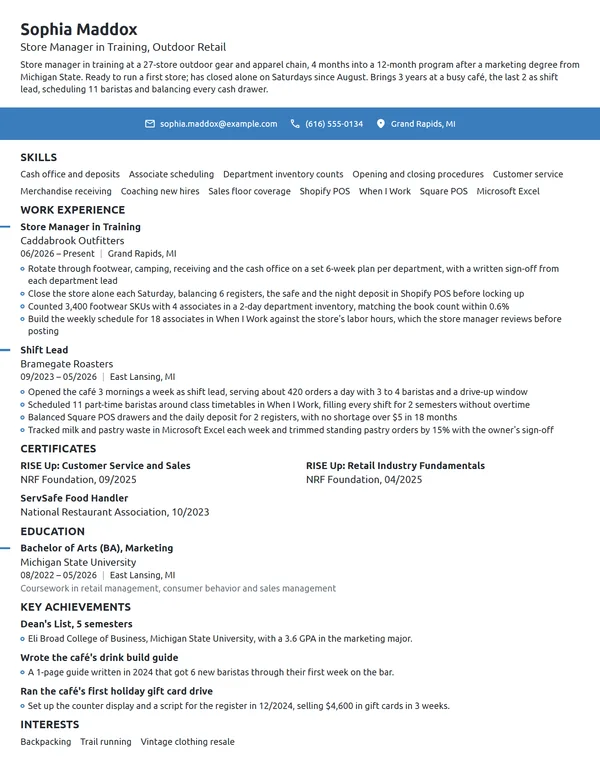
When a chain hires you into a paid manager-in-training program, that program is your job. Give it a Work Experience entry with the company's title for it, such as Store Manager in Training, its dates and bullets on what you ran: the departments you rotated through, the shifts you led alone and the counts or audits you joined. Only a separate course with its own completion date goes under Certificates.
Certificates
- ServSafe Food Protection Manager Certification, National Restaurant Association, 06/2019
- RISE Up: Supply Chain, Inventory, and Logistics, NRF Foundation, 10/2025
- Manager Essentials Course, Halderwyn Pet Supply, 04/2021
Do store managers need a degree? How to list education
O*NET places this work in a job zone that usually requires a high school diploma or GED. BLS career data say retail sales workers may advance to supervisory or managerial positions and that some employers prefer a bachelor's degree for those roles, which matters most for corporate manager-in-training programs at large chains.
Name your degree, then the college, its city and the month you graduated, the standard way of listing education on a resume. Education sits below Work Experience once you manage a store, and a GPA belongs only on a recent graduate's resume, at 3.5 or higher. With a diploma or GED and years of store results, keep it to 1 line.
Education
Moving up to store manager, or into retail from another career
If you are applying for your first store of your own, as an assistant store manager, a key holder or someone finishing a training program, write an objective and prove you have already done parts of the job. O*NET's job titles for this work include Shift Manager and Front End Manager, both common first steps. Count these the way a full store job would be counted:
- Shifts in charge: days a week as manager on duty, opens and closes, deposits balanced.
- Counts and audits: inventories led, SKUs counted, audit scores on your shifts.
- People: new hires you trained, associates you coached into a lead role.
- A department you ran: its sales against plan, its in-stock rate or its shrink.
Don't
Hardworking assistant manager looking for a store manager position where I can grow.
Do
Assistant store manager with 3 years as key holder in a $4M drugstore, seeking a first store manager role. Ran the store alone 2 days a week and led a 9,000-SKU annual count.
Even an objective needs the store's size and proof you have already run it.
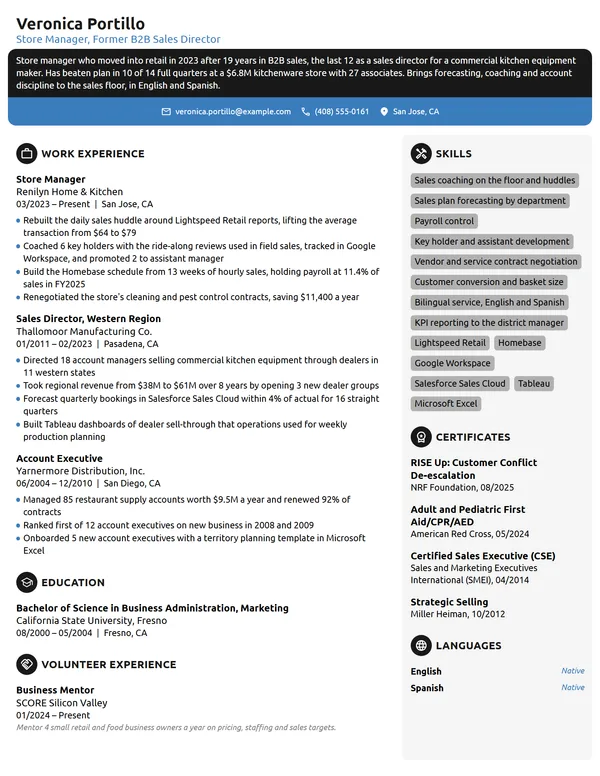
Coming from outside retail, such as sales leadership, hospitality or the military, use a career-change resume structure that keeps reverse-chronological order: your first store job on top, then earlier roles rewritten in store terms. A sales director's quota and team translate into a sales plan and headcount, a hotel manager's occupancy into traffic and conversion. Explain the move in 2 or 3 sentences of your cover letter, as these retail cover letter examples do, and keep the resume on results.
Store Manager resume FAQ
How long should a store manager resume be?
One page for most store managers. Use 2 pages once you have run several stores or managed for about 10 years, and keep your current store and the one before it on page 1, where a district manager reads first.
How do I write a store manager resume for a different type of store?
Put your current format in your headline, then show in your summary that you know the new one, for example by naming its systems or customer from the posting. A bullet on a result any store tracks, such as payroll against budget, reads the same to a grocer as to an apparel chain.
How do I show that I opened a new store or led a remodel?
Give it its own bullet under that job, with the timeline, the team you hired and the result. For example, write how many associates you hired before opening day, how many weeks the reset took and how the store did against its first-year plan.
Should I list every store I have managed?
Only the ones that add something. Give your current store and the 1 or 2 before it full entries, and fold older or short stays into 1 line with the title, employer and years. A store you opened, turned around or grew to a new size is worth keeping even if it was years ago.
Can an assistant store manager apply for store manager jobs?
Yes, if your resume shows you have already run the store without your manager in the building. Put the store's size in your first bullet, then the shifts you ran alone and any department whose results were yours, so the reader can judge the step up.
Where do district or company awards go on a store manager resume?
Under Key Achievements, with the award's name, the year and how many stores competed, such as top store in a district of 14. If the award came from a single result, such as the best shrink in the region, repeat that number in the matching job bullet.
Should I put my salary on a store manager resume?
No. Salary talks belong in the application form or the interview. As a benchmark, BLS data put the median pay of first-line supervisors of retail sales workers at $48,520 a year in May 2025. What you are offered will depend on the chain, the store's size and your track record.
Next steps
Choose the example nearest your store format and level, keep its layout, and replace every figure with your own sales, payroll, audit and team results. Write yours in our resume builder or adapt one of the resume templates, and send it with a cover letter whose first paragraph names the store you run and its best result.