
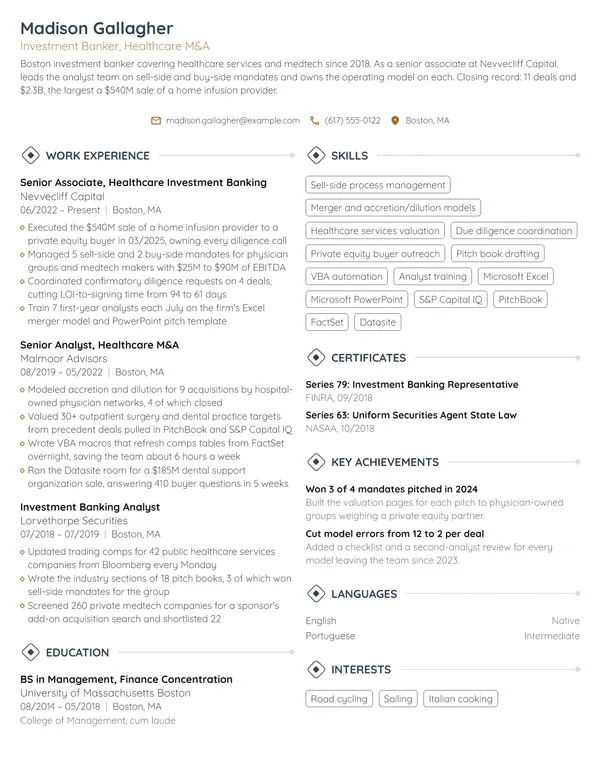
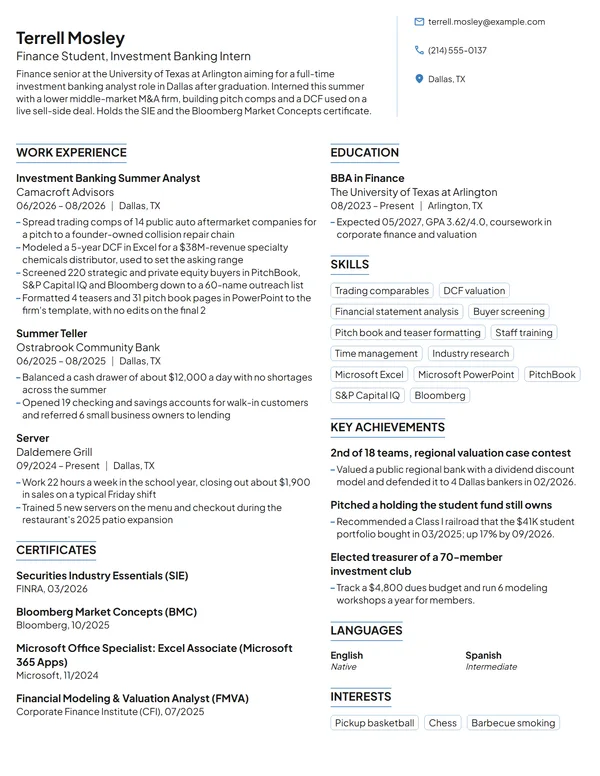
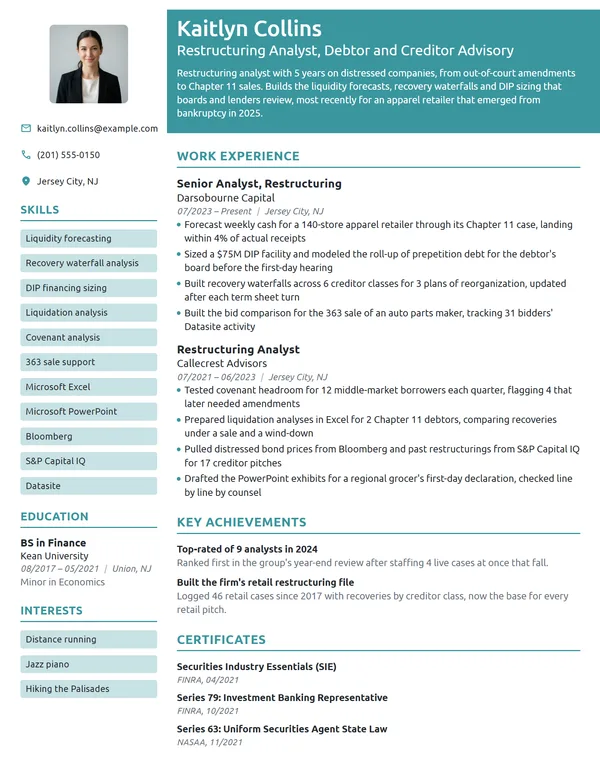
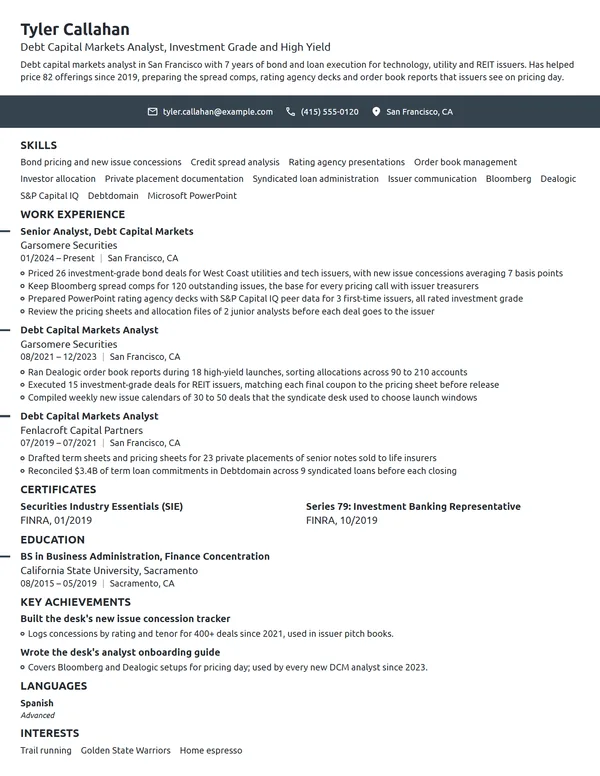
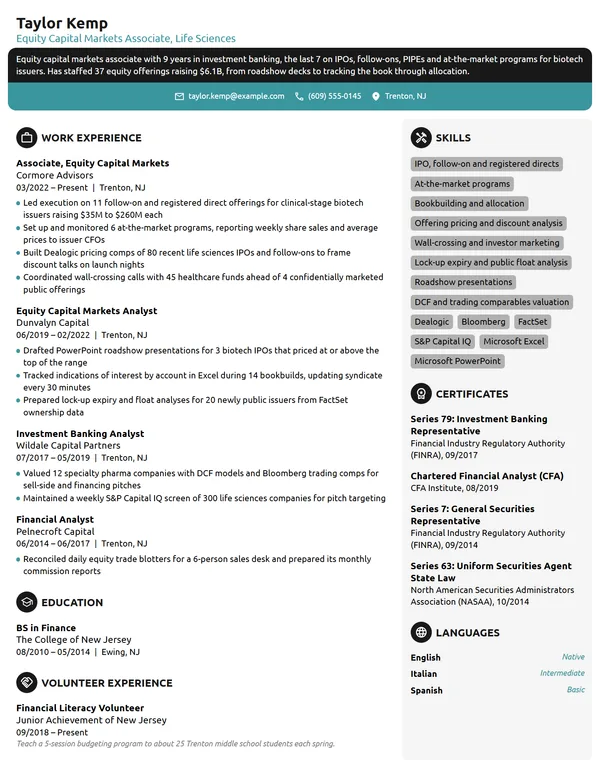
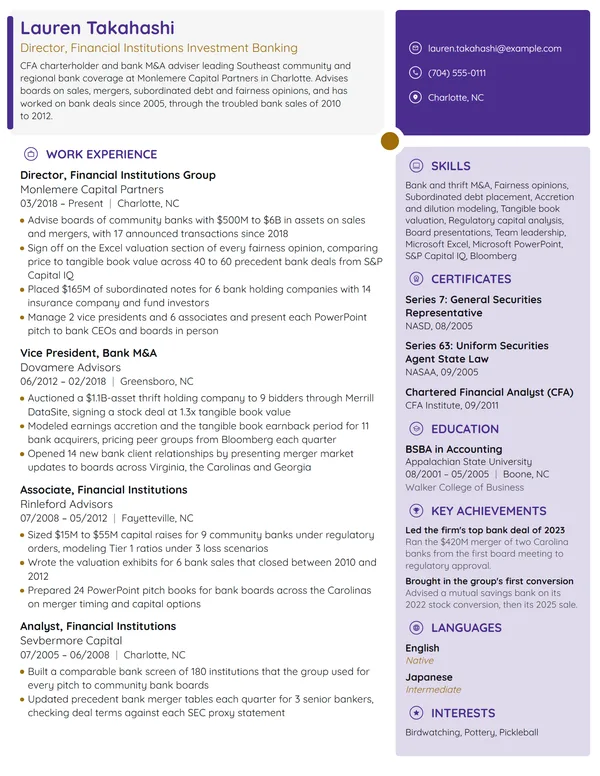
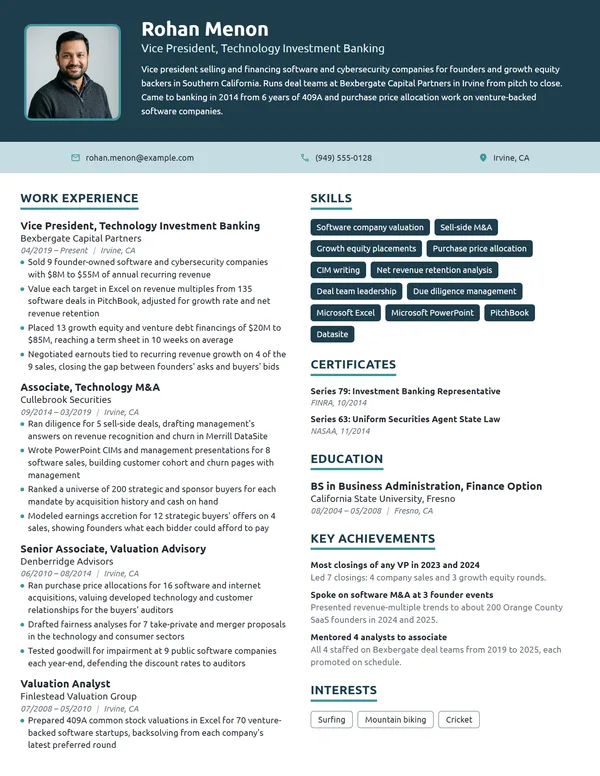
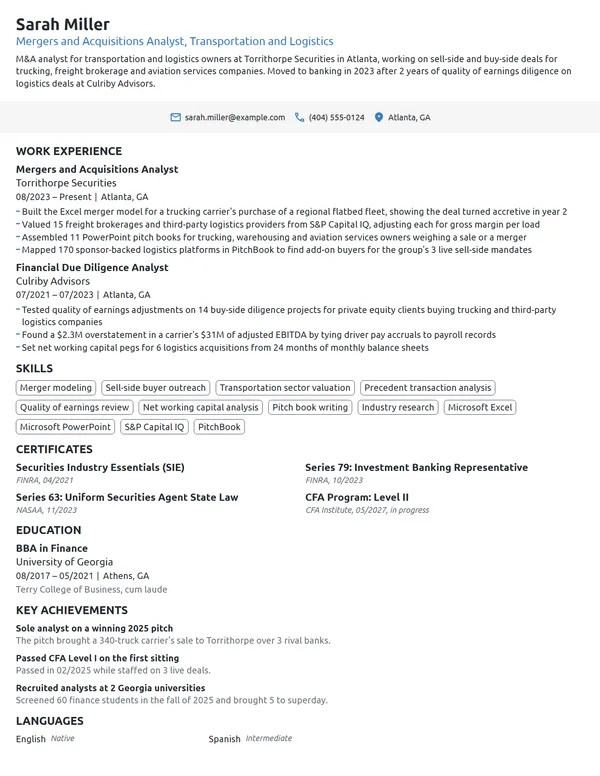
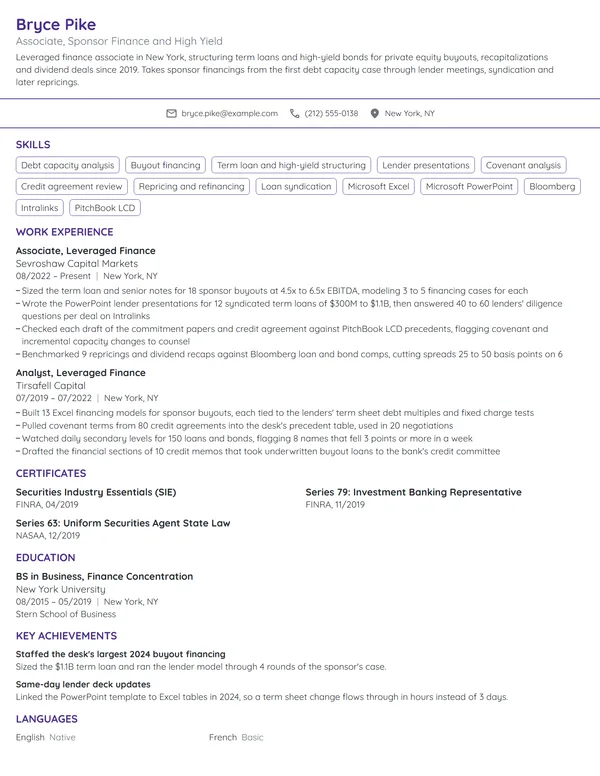
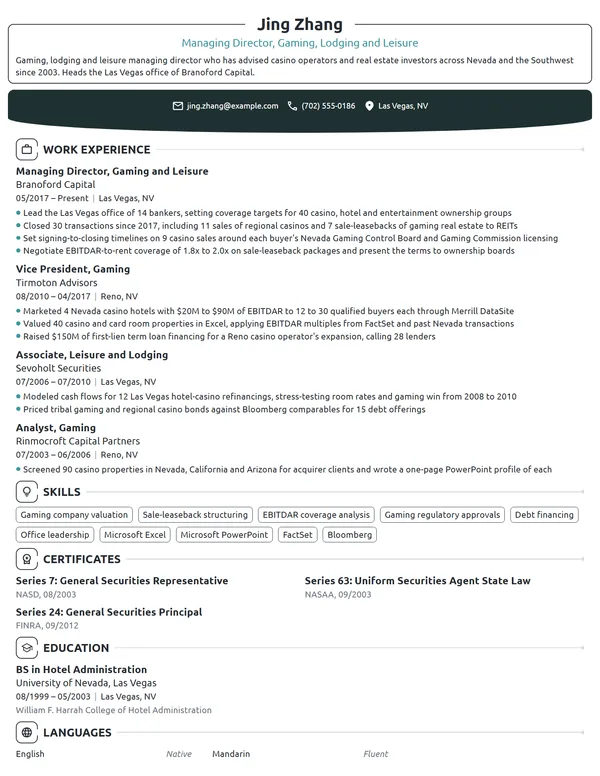
Investment banking is a deals business, and your resume should be built around deals: which transactions you worked on, how large they were, the models and documents you built, and that you stay accurate under deadline pressure. Much of that work is confidential, and all of it has to fit on 1 page. Describing each deal by its size and sector instead of the client's name, and opening every bullet with the deal itself, handles both.
How to Write an Investment Banking Resume - Key Takeaways
- Keep it to 1 page in reverse-chronological order, with deals as the backbone of every job entry.
- Open with a 2- to 3-line summary that names your level, your deal type or sector, and your best closed transaction with its size.
- Start each bullet with the deal, then your part in it: transaction type, value, buyers or investors reached, and the result.
- Describe confidential clients by size and sector, such as a $310M specialty packaging sale, instead of by name.
- List the SIE, Series 79 and Series 63 under Certificates with their dates, and only the ones you have actually passed.
- Name your modeling work (DCF, LBO, merger models, comps) in your skills and bullets, and test the final PDF in an ATS resume checker before you apply.
What hiring managers look for in an investment banking resume
A banker reading your resume wants to know 3 things: what kind of deals you have worked on, what you personally produced on them, and how quickly you could be staffed on the next one. The BLS describes investment bankers as connecting businesses that need money with investors, and names initial public offerings and mergers and acquisitions as core services. O*NET adds advising clients on the amount, source and timing of capital, pricing securities for an offering, and restructuring or refinancing debt.
Those duties map straight onto your bullets. Lay the page out in sections an applicant tracking system can read in order:
- Name, headline (such as Investment Banking Associate, M&A) and contact details
- A 2- to 3-line summary right under your name (it needs no heading)
- Work Experience, current role first, with deals in every entry
- Skills, with your modeling and data tools in the same list
- Certificates, for the SIE, Series 79 and Series 63
- Education, with GPA while you are early in your career
- Optional: Key Achievements, Languages or Interests
Best format for an investment banking resume
Use the reverse-chronological resume format, with your current or most recent role on top and each entry showing your title, the firm, the city and MM/YYYY dates. Banking titles climb in a fixed order, from analyst to associate, vice president and managing director, and readers check that climb first. A skills-first layout hides it, so keep the dates and titles where they expect them, even if you are coming from another field.
- Best for most investment bankersReverse-chronologicalYour jobs, newest first, with your results under each one.Best for: A steady work history in your field
- FunctionalSkills grouped up top, with a short work history below.Best for: Gaps or very little experience
- CombinationA skills section first, then your full work history.Best for: A career change with strong skills
Fit everything on 1 page through the analyst and associate years. If your deal list runs longer than your page, keep the 4 or 5 strongest transactions in your bullets and leave the rest for the interview, where you will be asked to walk through them anyway. An investment banking associate with an MBA still keeps to 1 page; senior bankers with 10+ years may run to 2.
| Setting | What to use |
|---|---|
| Length | 1 page for analysts and associates; 2 only for senior bankers with 10+ years |
| Dates | MM/YYYY for every job, with Present on your current one |
| Deal descriptions | Transaction type, value and sector, such as $240M sale of a regional food distributor |
| Font and layout | A clean serif or sans serif at 10 to 11 pt, no charts |
| Photo and personal details | Usually no photo in the US and Canada; keep birth date, marital status and Social Security number off the page |
| File type | PDF named with your first and last name, unless the portal asks for Word |
Most US and Canadian resumes carry no photo, and banks expect a dense page where the deal numbers line up and nothing distracts from them.
Investment banking resume summary vs. objective
Here is the test: if you have staffed at least 1 live deal in a full-time role, write a resume summary that names your level, your product or sector group, and your largest closed transaction. If your banking experience is internships only, write an objective that names the role and your strongest piece of evidence; these resume objective examples show how short it can be. Either way, keep it to 2 or 3 lines.
Investment banking resume summary formula
Title with X years in product or sector group. Number of deals closed and their combined value, or your biggest deal. FINRA exams held, plus any language or sector edge.
Example
Investment banking associate with 5 years in middle-market M&A, covering industrial and business services companies. Closed 6 sell-side deals worth $1.4B in combined enterprise value. Holds the SIE, Series 79 and Series 63.
Don't
Driven finance professional with strong analytical skills and a passion for investment banking, seeking a fast-paced analyst role.
Do
Investment banking analyst with 2 years in a technology coverage group. Worked on 3 closed buy-side deals totaling $250M, building the merger model on each. Passed the SIE and Series 79.
The second version gives the level, the group, the deal count and size, and the exams in 3 sentences.
How to write investment banking deal experience with numbers
Give your current role 3 to 4 bullets and earlier roles 1 to 3, and start every one with an action verb. Banking work already comes with numbers attached, such as deal value, buyers contacted, bids received and offering size, so use them to show achievements on your resume instead of listing the tasks every analyst shares. Name your role on each deal: built the model, drafted the CIM, ran the data room, or coordinated buyers.
| Area | What to count | Example bullet |
|---|---|---|
| Deal volume | Transactions closed, combined value, deal types | Worked on 5 closed transactions worth $820M, including 2 sell-side sales and 1 recapitalization. |
| Financial modeling | Models built, deal size, scenarios run | Built the LBO model for a $95M acquisition and ran 6 financing scenarios for the sponsor's investment committee. |
| Marketing materials | CIMs, teasers, management presentations, pitch books | Drafted 2 CIMs and 1 management presentation for a family-owned food distributor. |
| Sale process | Buyers contacted, NDAs signed, IOIs and final bids | Contacted 140 buyers, signed 48 NDAs and brought 11 IOIs down to 4 final bids. |
| Capital markets | Offering size, order book, investors met | Supported a $450M senior notes offering that closed 3.1x oversubscribed. |
| Restructuring | Cash forecasts, liquidity gaps, creditor groups | Built a 13-week cash flow model that sized a $60M liquidity gap ahead of lender talks. |
Here is one associate's history laid out that way, with the analyst role cut to its 2 strongest results.
Work Experience
- Ran day-to-day execution on 4 sell-side processes for industrial companies with $40M to $180M in revenue, leading 2 analysts on each.
- Built the DCF and LBO models behind the $310M sale of a specialty packaging maker; the winning bid landed 14% above the first-round range.
- Drafted 3 confidential information memorandums and managed data rooms holding 2,600 documents for 70 prospective buyers.
- Assembled buyer lists of 120 to 150 strategic and financial sponsors for 9 sell-side mandates.
- Produced 35 pitch books and kept trading comps current for 3 coverage groups.
Don't
Assisted senior bankers on M&A transactions.
Do
Coordinated 85 buyers through the $120M sale of a regional HVAC distributor, from teaser to signed purchase agreement.
The rewrite gives the deal type, the size, the sector and the stage you owned.
Don't
Helped with equity offerings and investor marketing.
Do
Prepared the roadshow materials for a $600M follow-on offering and scheduled meetings with 27 institutional investors.
Financial modeling skills and software for an investment banking resume
Your Skills list should hold 6 to 8 hard skills for your resume, each one named in the job ad and proven somewhere in your deal bullets. A coverage or M&A group reads for valuation and modeling; a capital markets desk reads for pricing and market knowledge; a restructuring group reads for cash flow forecasting and credit work. Let the deal results carry your soft skills.
Hard skills for investment bankers
- Three-statement financial modeling
- Discounted cash flow (DCF) valuation
- LBO modeling
- Merger and accretion/dilution models
- Trading and transaction comparables
- Pitch book and CIM drafting
- Due diligence and data room management
- Debt capacity and credit analysis
- 13-week cash flow forecasting
- Offering pricing and book building
Soft skills deal teams value
- Accuracy under deadline pressure
- Clear client communication
- Discretion with confidential information
- Managing several deals at once
- Taking direction and feedback
- Teamwork on long deal cycles
List your software with your skills, and show each tool again in a bullet. O*NET flags Microsoft Excel and Microsoft PowerPoint as in-demand technology for financial and investment analysts. Name what you do in each: macros in VBA, sensitivity tables, or slides built to a bank's template. Copy market data platforms such as Bloomberg, FactSet, S&P Capital IQ or PitchBook exactly as the posting writes them, and only if you have used them.
SIE, Series 79 and Series 63: how to list FINRA exams
Investment banking has no license of its own, but registered bankers pass FINRA qualification exams. The BLS calls FINRA the main licensing organization for the securities industry and notes that because most licenses need employer sponsorship, companies do not expect candidates to hold them before starting the job. Put certifications on your resume in a Certificates section, with each exam's name and the month you passed it.
| Exam | Run by | What it takes |
|---|---|---|
| SIE (Securities Industry Essentials) | FINRA | Open to anyone 18 or older, with no firm sponsorship; 75 questions in 1 hour 45 minutes. A pass stays valid for 4 years but does not qualify you for registration by itself. |
| Series 79 (Investment Banking Representative Exam) | FINRA | Sponsorship by a FINRA member firm and the SIE as a corequisite; 75 items in 2 hours 30 minutes. It covers advising on offerings, M&A, tender offers, restructurings and divestitures. |
| Series 63 (Uniform Securities Agent State Law Exam) | NASAA, administered by FINRA | 60 scored questions in 75 minutes, with no corequisite exam. Take it when your firm registers you for it. |
What to list before a firm sponsors you
Students and career changers can take the SIE without a sponsor, so list it with its pass date, and leave the Series 79 and 63 off until you have passed them. A line such as Series 79 expected tells a recruiter nothing they can check. Once you hold all 3, a single Certificates section with dates is enough; the exams do not go in your headline.
Certificates
- Securities Industry Essentials (SIE), FINRA, 05/2021
- Series 79: Investment Banking Representative, FINRA, 09/2021
- Series 63: Uniform Securities Agent State Law, NASAA, 10/2021
How to list your finance degree, GPA and MBA
The BLS names a bachelor's in finance or a related field such as business as the usual entry point for financial analysts. Give the degree, the school, its city and the month you graduated, the basics of listing education on a resume. Show your GPA while you are in school and for your first 2 to 3 years if it is 3.5 or higher, with any honors on the same line.
The BLS adds that an MBA may help with advancement and that some employers prefer one. List an MBA above your bachelor's degree, with its concentration and graduation date. Students can place Education above Work Experience; after your first full-time banking role, move it to the bottom and keep it to 2 or 3 lines.
Education
GPA 3.7. Dean's List, 6 semesters.
Investment banking resumes for students, interns and career changers
Without a full-time banking job yet, put Education first and treat every finance experience like a deal. A summer analyst role is the strongest item you can have, and if you are still trying to land one, these tips on how to get an internship help you plan the search. A finance intern resume follows the same layout. Give each item the numbers a full-time role would get:
- Summer analyst internships: live deals you supported, their type and size, and the models or materials you built.
- Student investment funds: assets under management, positions you pitched and how they performed.
- Case competitions and modeling courses: the company you valued and the result, listed under Key Achievements.
- Part-time jobs: 1 or 2 bullets each, showing reliability and long hours rather than finance skills.
Don't
Motivated finance student seeking an investment banking internship to learn about M&A.
Do
Finance junior seeking a summer analyst role in M&A. Supported 2 live deals during a 10-week internship at a boutique advisory firm and built 15 comps tables. Passed the SIE in 2026.
Even an objective needs evidence: a deal count, a model or an exam.
Moving from Big 4 transaction services, audit, corporate development or consulting, keep reverse-chronological order and lead each job with its most deal-like bullets, such as quality-of-earnings reports, diligence workstreams or valuation projects. A career-change resume works when the first lines of your current role already look like banking work. Explain the move itself in your cover letter, and these finance cover letter examples show how to keep that to 2 or 3 sentences.
Investment Banking resume FAQ
Do I need the SIE or Series 79 before I apply for investment banking jobs?
No. The BLS notes that most securities licenses need employer sponsorship, so firms do not expect candidates to hold them before starting. FINRA lets anyone 18 or older take the SIE without a sponsor, and a pass stays valid for 4 years, so passing it before you apply is a useful extra. The Series 79 needs a sponsoring member firm.
How long should an investment banking resume be?
1 page for students, analysts and associates. Cut older bullets and minor deals before you shrink the font below 10 pt. Only senior bankers with 10+ years and a long deal record should consider a second page.
How do I describe confidential deals on my resume?
Describe the deal by type, size and sector instead of by name, such as $200M sale of a regional software company. Name a client only if the deal was publicly announced and your firm allows it. Keep the figures you list rounded and consistent with what was made public.
Should I list deals that did not close?
Yes, if you did real work on them. Label them as a sale process or a pitch rather than a completed transaction, and point to your contribution, such as the model you built or the buyers you brought in. Never present a terminated deal as closed.
Should I put my GPA on an investment banking resume?
Yes, while you are a student and for your first 2 to 3 years after graduation, if it is 3.5 or higher. Add Dean's List or honors on the same line. Once you have a few closed deals as an analyst, the deals carry more weight and the GPA can go.
What financial modeling skills should I list on an investment banking resume?
List the models you have built for real deals or graded work: three-statement models, DCF, LBO, merger or accretion/dilution models, and comparables. Add each one to a bullet that names the deal or company it was built for, so the skill is backed by evidence.
Do I need an MBA to work in investment banking?
Not to start. The BLS says a bachelor's degree is the typical entry requirement and that an MBA may help with advancement, with some employers preferring one. If you join as an associate after business school, list the MBA above your bachelor's degree.
How do I move into investment banking from accounting or consulting?
Lead each past role with the work closest to a deal: diligence, valuation, quality-of-earnings or transaction support. Add the modeling skills you have used and pass the SIE, which you can take without a sponsor. Use your cover letter to explain why you are switching.
Should I include my salary expectations on an investment banking resume?
No. Discuss pay later in the hiring process. As a benchmark, the BLS reports that the median annual wage for financial and investment analysts was $102,740 in May 2025; your own offer will depend on the firm, the title and the bonus structure.
Next steps
Pick the example closest to your level and product group, then swap in your own deals, models and exam dates. Put it together in our resume builder, or take one of the resume templates as a base, then write a cover letter whose opening lines name your strongest transaction.