
Private equity firms buy companies, help them grow and sell them a few years later. Deal teams hire people who can carry an investment through each stage: building the model, testing the business in diligence, making the case to the investment committee and working with management once the deal closes. Many candidates arrive from investment banking with similar deal lists, so the resume that gets the interview shows judgment as an investor, not only hours spent on transactions. That proof is in numbers: companies screened, equity invested and how a business performed after you got involved.
How to Write a Private Equity Resume - Key Takeaways
- Keep it to 1 page, newest role first, and add a second page only once you have led deals as a vice president or principal.
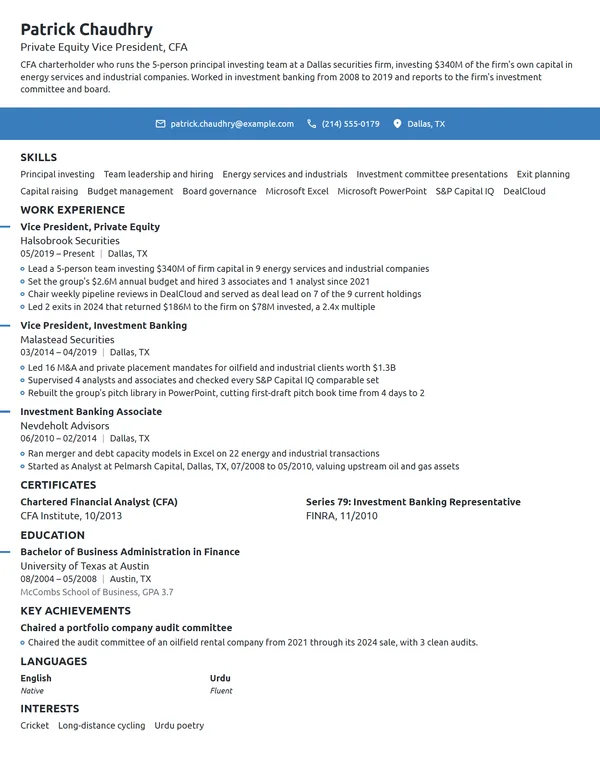
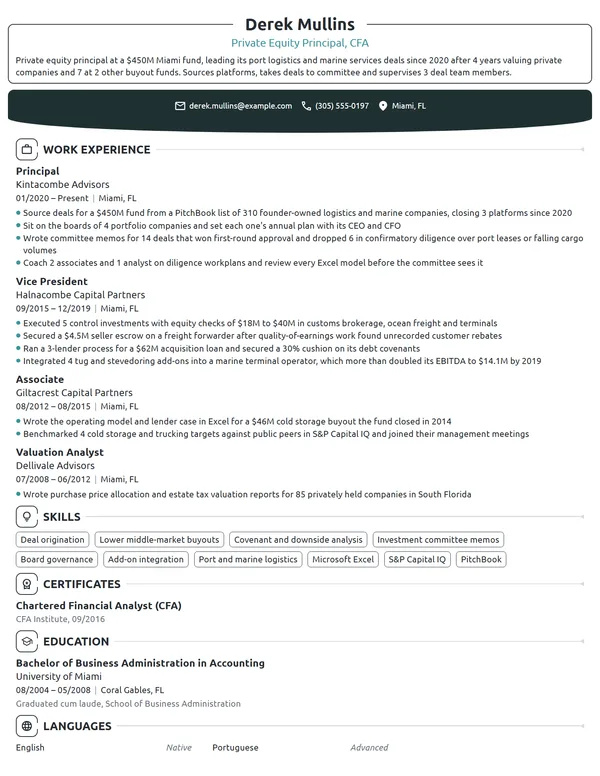
- Open with a 2- to 3-line summary that names your fund's size or strategy, your sector, and the deals you worked on with their combined value.
- Write bullets about investments, not tasks: companies screened, the equity check you underwrote, what diligence found and how the company did after closing.
- Describe portfolio companies by sector and size unless the deal was announced publicly and your firm allows the name.
- Keep passed FINRA exams under Certificates with their dates, and write CFA progress the way CFA Institute allows, such as Passed Level II of the CFA Program.
- Name LBO modeling, diligence and your data platforms in Skills, then run the PDF through an ATS resume checker before a recruiter sees it.
What deal teams look for in a private equity resume
A private equity associate or vice president screening resumes asks whether you could be put on a live deal next week. The BLS describes the core of investment analysis as examining a company's financial statements to determine its value and growth prospects, meeting company officials, and preparing written reports and presentations. O*NET adds assessing companies as investments by examining their facilities and preparing plans of action for an investment. On a fund's side of the table, that becomes sourcing, underwriting, diligence, investment committee memos and portfolio work.
Show that work in sections a recruiter and resume-screening software both expect:
- Your name, contact details and a headline (Private Equity Associate, for example)
- A 2- to 3-line summary under the headline, left untitled
- Work Experience, with the fund or bank, its city and your dates
- Skills, with modeling methods and your software
- Certificates, for FINRA exams and CFA or CAIA progress
- Education, with any MBA listed above your bachelor's degree
- Optional: Key Achievements or Languages, if a language helps with the fund's markets
Best format for a private equity resume
Use the reverse-chronological resume format: your current role on top, then each earlier one with the title, the firm and its location, and the months you started and left. Funds read a candidate's path in order, from analyst or banker to associate, senior associate, vice president and principal, and gaps or short stints stand out quickly. A skills-first layout hides that path, so keep the dates visible even if you come from consulting or an operating role.
- Best for most private equity candidatesReverse-chronologicalYour jobs, newest first, with your results under each one.Best for: A steady work history in your field
- FunctionalSkills grouped up top, with a short work history below.Best for: Gaps or very little experience
- CombinationA skills section first, then your full work history.Best for: A career change with strong skills
Write a one-page resume through the analyst and associate years, and trim older banking bullets before you shrink the type. A vice president or principal who has led several platform deals and their add-ons can use 2 pages, provided page 1 holds the current fund and its strongest investments.
| Setting | What to use |
|---|---|
| Length | 1 page through associate level; 2 for vice presidents and principals with a long deal record |
| Dates | MM/YYYY on every role, with Present for the fund you work at now |
| Fund line | Fund name, city and, if public, its size or strategy, such as a $900M lower middle-market fund |
| Deal names | Sector and size, such as a $175M fire-protection services company, unless the deal was announced |
| Personal details | A photo is uncommon in the US and Canada; leave off your date of birth, family status and SSN |
| File type | A text-based PDF with your name in the file name |
Most US and Canadian resumes carry no photo, so give the space to your deal numbers.
Private equity resume summary vs. objective
Use one test: if you have worked on transactions full time, in banking, transaction advisory, corporate development or a fund, write a resume summary that names your seat, your sector and the deals you worked on. If your deal work so far is internships or coursework, write an objective with the role you want and your best evidence; these resume objective examples show how short one can be. Either version is 2 to 3 lines.
Private equity resume summary formula
Title with X years at fund size or strategy, focused on sector. Deals you worked on, their combined value and your role. Prior seat or credential.
Example
Private equity associate with 3 years at a $900M lower middle-market fund, focused on business services. Worked on 2 platform acquisitions and 5 add-ons worth $410M in total enterprise value, owning the model and diligence plan on each. Former investment banking analyst; passed Level II of the CFA Program.
Don't
Results-driven finance professional with a passion for private equity and strong financial modeling skills.
Do
Investment banking analyst with 2 years in healthcare M&A, targeting a buy-side associate seat. Built the LBO and returns analysis for 3 sponsor-led sales worth $540M combined. Passed Level I of the CFA Program.
The second version gives the seat, the sector, the deal count and value, and a credential a recruiter can verify.
How to write private equity deal and portfolio bullets with numbers
Your current role takes 3 to 4 bullets and each earlier one takes 1 to 3, every one led by a verb. Spread them across the life of an investment, from sourcing to exit, so a reader sees more than modeling. Write each bullet as a resume achievement with a fund number in it, never a duty every associate shares.
| Stage | What to count | Example bullet |
|---|---|---|
| Sourcing | Companies screened, management meetings, bids submitted | Screened 210 companies in a year and met 35 management teams, leading to 3 first-round bids. |
| Underwriting | Equity check, financing, base-case return | Built the LBO for a $60M equity investment in a specialty chemicals distributor with a 25% base-case IRR. |
| Diligence | Advisors managed, issues found, price or terms changed | Coordinated 4 diligence advisors and cut the purchase price by $8M after tracing a customer concentration risk. |
| Investment committee | Memos written, deals approved, deals declined | Wrote 6 investment committee memos, 2 of which became signed deals. |
| Portfolio value creation | Add-ons, revenue, EBITDA, margin | Sourced 3 add-ons for a pool-service platform, growing its EBITDA from $12M to $21M. |
| Exits | Exit value, bidders, multiple of invested capital | Prepared the sale materials for a portfolio exit at 2.8x invested capital, drawing 5 bidders. |
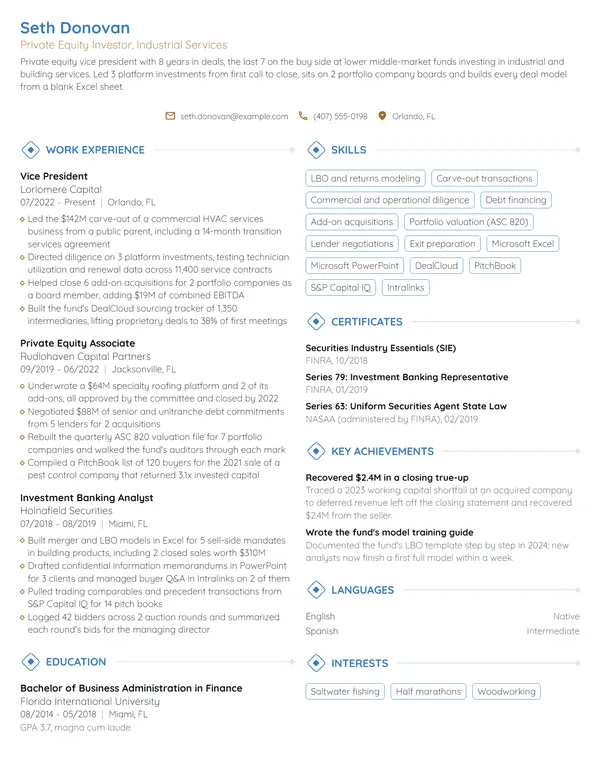
In the sample below, the fund role covers 4 stages of a deal, and the banking role keeps only the 2 lines a fund would ask about.
Work Experience
- Screened 160 business services companies, built first-pass models on 24 and took 4 to the investment committee.
- Built the operating model and wrote the investment memo for the $175M acquisition of a fire-protection services company, underwritten to a 2.6x gross return.
- Ran financial, legal and insurance diligence with 6 outside advisors, closing 10 weeks after the signed LOI.
- Built the monthly KPI pack for 3 portfolio companies and tracked a route-density plan that lifted EBITDA margin from 13% to 16% in 15 months.
- Worked on 4 closed sell-side deals for consumer and healthcare services companies worth $610M combined.
- Managed outreach to 95 financial sponsors on the $90M sale of a dental group.
Don't
Performed due diligence on potential investments.
Do
Ran financial and commercial diligence on a $120M veterinary clinic platform and found $3M of one-time EBITDA adjustments, which reset the fund's bid.
The stronger line names the target, its size and what the work changed.
Don't
Supported portfolio companies with strategic initiatives.
Do
Rebuilt contract pricing for a portfolio fire-alarm monitoring company, raising gross margin from 31% to 35% in 12 months.
Private equity skills and software for your resume
Choose 6 to 8 hard skills for your resume that match the posting and that a bullet above already proves. A buyout fund reads for LBO modeling and debt terms, a growth equity fund for revenue and unit economics, and an operations-heavy fund for portfolio work with management teams.
Hard skills for private equity
- LBO modeling
- Three-statement modeling
- Returns analysis (IRR and MOIC)
- Valuation (DCF and comparables)
- Financial and commercial diligence
- Investment committee memos
- Deal sourcing and screening
- Debt financing and term sheets
- Portfolio monitoring and KPIs
- Add-on acquisition analysis
Soft skills deal teams value
- Investment judgment
- Clear written arguments
- Working with management teams
- Discretion with confidential data
- Running several deals at once
- Composure in negotiations
List your software with your skills, and name each tool again in a bullet that shows what you built in it. O*NET lists Microsoft Excel and Microsoft PowerPoint among the in-demand tools for financial and investment analysts, so be specific: an LBO built from a blank Excel sheet, sensitivity tables, or investment committee decks. Add data and deal platforms such as PitchBook, S&P Capital IQ or DealCloud only when the posting names them and you have used them.
SIE, Series 79, CFA and CAIA on a private equity resume
Many private equity candidates bring FINRA exams from banking, and some add the CFA or CAIA. The BLS names FINRA as the main licensing organization for the securities industry and notes that most of its licenses need an employer's sponsorship. Put each one under Certificates with its issuer and pass date, the standard way to list certifications on your resume.
| Credential | Issued by | What it takes |
|---|---|---|
| SIE (Securities Industry Essentials) | FINRA | Anyone 18 or older can sit it without a sponsor; 75 questions in 1 hour 45 minutes. A pass stays valid for 4 years, and on its own it does not qualify you for registration. |
| Series 79 (Investment Banking Representative) | FINRA | Sponsorship by a FINRA member firm, with the SIE as a corequisite; 75 items in 2 hours 30 minutes, covering offerings, M&A, tender offers, restructurings, asset sales and divestitures. |
| Series 63 (Uniform Securities Agent State Law) | NASAA, administered by FINRA | No corequisite; 60 scored questions, with 75 minutes to answer them. |
| CFA (Chartered Financial Analyst) | CFA Institute | Pass all 3 levels, document 4,000 hours of investment work experience over at least 36 months, and become a regular member of CFA Institute. |
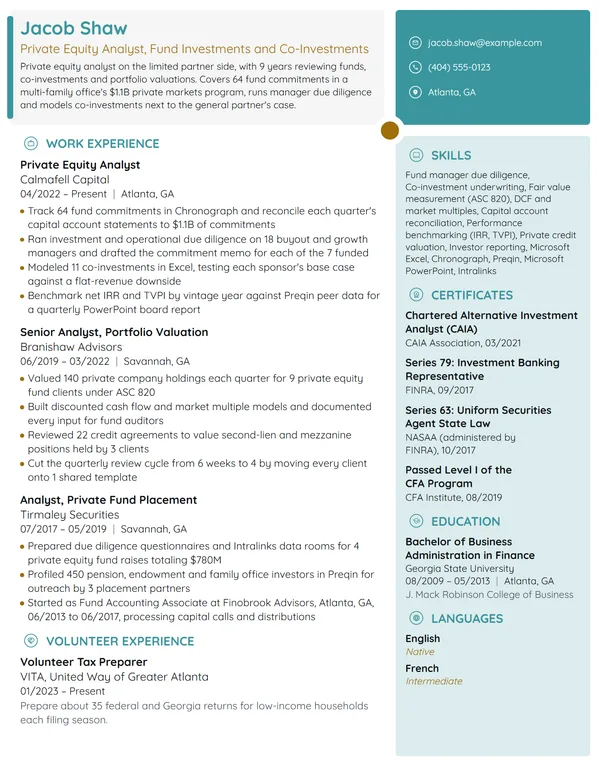
| CAIA (Chartered Alternative Investment Analyst) | CAIA Association | Pass 2 exam levels; Level I covers private equity, real assets, hedge funds and structured products. |
Keep the FINRA exams you passed in banking on your resume after you join a fund, listed with their dates, since they show where your deal training came from. Write them as exams passed, never as a current registration you no longer hold.
How to list CFA progress before the charter
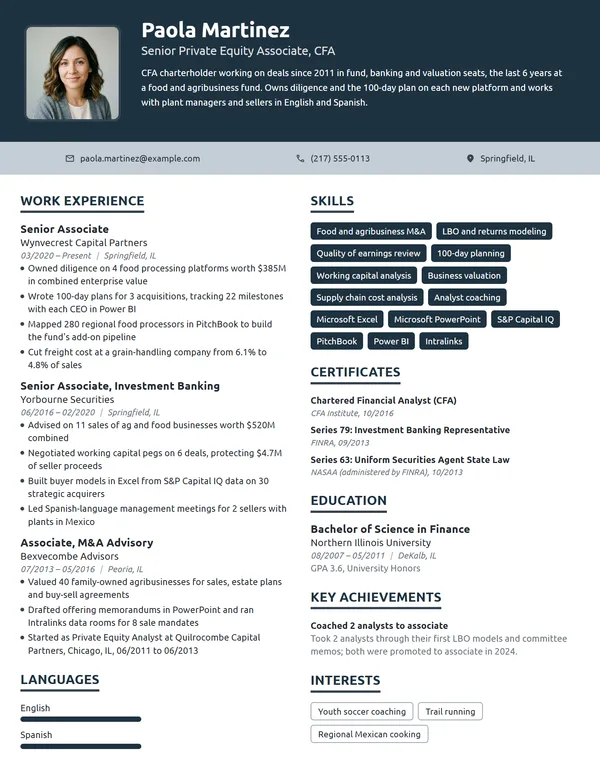
CFA Institute allows a factual line such as Passed Level II of the CFA Program, and the phrase CFA Program candidate only while you are registered for an upcoming exam or waiting for results. Never write CFA Level II after your name or an expected charter date. Once the charter is awarded, add CFA to your headline, as in Senior Private Equity Associate, CFA.
Certificates
- Securities Industry Essentials (SIE), FINRA, 04/2021
- Series 79: Investment Banking Representative, FINRA, 08/2021
- Series 63: Uniform Securities Agent State Law, NASAA, 11/2021
- Passed Level II of the CFA Program, CFA Institute, 2025
How to list your finance degree and MBA on a private equity resume
The BLS says the typical entry degree for financial analysts is a bachelor's in finance or a related field such as business, and that some employers prefer a master's. Give the degree name, the school and its location, and the month you graduated, the basics of listing education on a resume, and add a GPA of 3.5 or higher plus finance clubs or investment competitions in your first 2 to 3 years out.
According to the BLS, a master's in finance or business administration may improve an analyst's chances of advancing, including into portfolio or fund manager roles. If you hold an MBA, list it above your bachelor's degree with its concentration. Once you have fund experience, keep Education to 2 or 3 lines at the bottom of the page.
Education
GPA 3.8. Member, Finance Society.
Moving into private equity from banking, consulting or a first job
If you are a banker now, rework your investment banking analyst resume toward the buyer's view: the model you built, the diligence questions you answered and what the sponsor paid. If you have not worked on deals yet, aim for an analyst seat and give every item below a number:
- Internships at a fund, bank or advisory firm: companies screened, models built and memos drafted.
- Transaction advisory or audit: quality-of-earnings reports, diligence workstreams and deal sizes.
- Consulting: commercial diligence projects for sponsors, with the sector and the question you answered.
- Corporate development: acquisitions evaluated and closed, with their size and integration results.
- Investment clubs and competitions, under Education: the fund size you managed or the pitch that placed.
Don't
Finance graduate eager to break into private equity and learn from experienced investors.
Do
Finance senior seeking a private equity analyst role. Screened 60 software companies and built 2 LBO models during a 12-week internship at a growth equity fund.
Even with no full-time deal job, name a count and the type of fund.
Coming from consulting, corporate development or an operating role, stay with reverse-chronological order and open each job on its most investment-like work, such as diligence for a sponsor or an acquisition you helped close. A career-change resume works here when the first 2 bullets under your current job read like fund work. Use the cover letter to say why you want to invest, and these finance cover letter examples show how to fit that into 1 short paragraph.
Private Equity resume FAQ
Do you need investment banking experience to get into private equity?
Not always. Banking gives you deal experience a fund can check quickly, but transaction advisory, consulting, corporate development and operating roles also lead in, especially at growth and operations-focused funds. Whatever your route, put modeled deals and diligence work in the first bullets of each job.
How long should a private equity resume be?
1 page for analysts, associates and senior associates. Vice presidents and principals who have led several platform deals can use 2 pages if page 1 shows the current fund and its best investments. Move extra deals to a separate deal sheet instead of adding a page.
Can I name portfolio companies on my resume?
Only if the deal was announced publicly and your fund is comfortable with it. Otherwise describe the company by sector and size, such as a $90M dental group, and keep every figure consistent with what the fund has made public.
Should I put IRR or MOIC figures on a private equity resume?
Yes, for underwriting cases you built, labeled as the base case or the underwritten return. Realized returns belong on the resume only if the fund has shared them publicly or allows it. Never present a projected return as a realized one.
How do I list the CFA Program on my resume before I earn the charter?
Write a factual line under Certificates, such as Passed Level II of the CFA Program. CFA Institute allows CFA Program candidate only while you are registered for an upcoming exam or waiting for results, and it does not allow CFA letters after your name or an expected charter date.
Should I keep my Series 79 on my resume after moving to a fund?
Yes. List the SIE, Series 79 and Series 63 under Certificates with the dates you passed them. They show your banking training, but write them as exams passed, not as a registration you currently hold.
Do I need an MBA to work in private equity?
No, not to start. The BLS says some employers prefer a master's degree and that a master's in finance or business administration may help analysts advance. If you have one, list the MBA above your bachelor's degree with its concentration.
Should I include salary expectations on a private equity resume?
No. Compensation comes up later, usually with the recruiter. The nearest BLS benchmark is for the wider group of financial and investment analysts, whose median annual wage was $102,740 in May 2025; a fund offer depends on its size, your seat and its bonus structure.
Next steps
Start from the example that matches your seat, reuse its layout, and swap in your own deals: what you screened, what you underwrote, what diligence changed and what the company did after closing. Build it in our resume builder or pick one of the resume templates, and keep your deal sheet ready for the first call.