
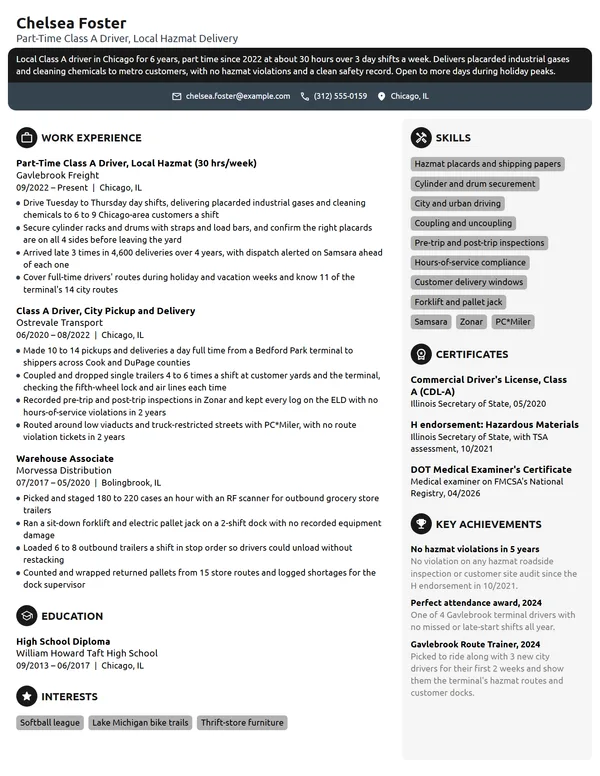
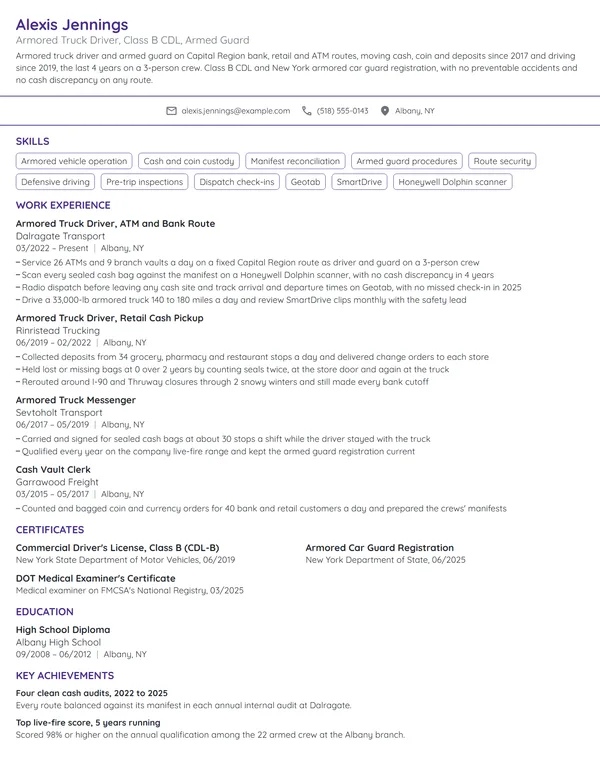
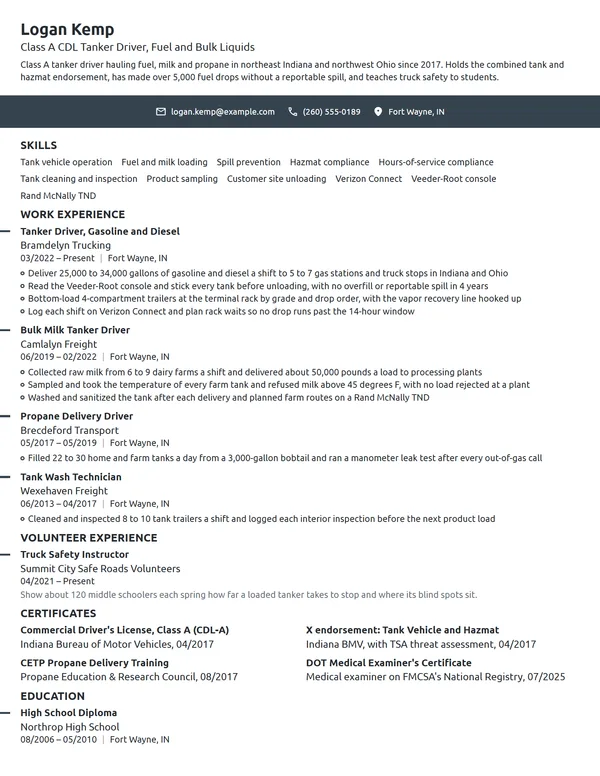
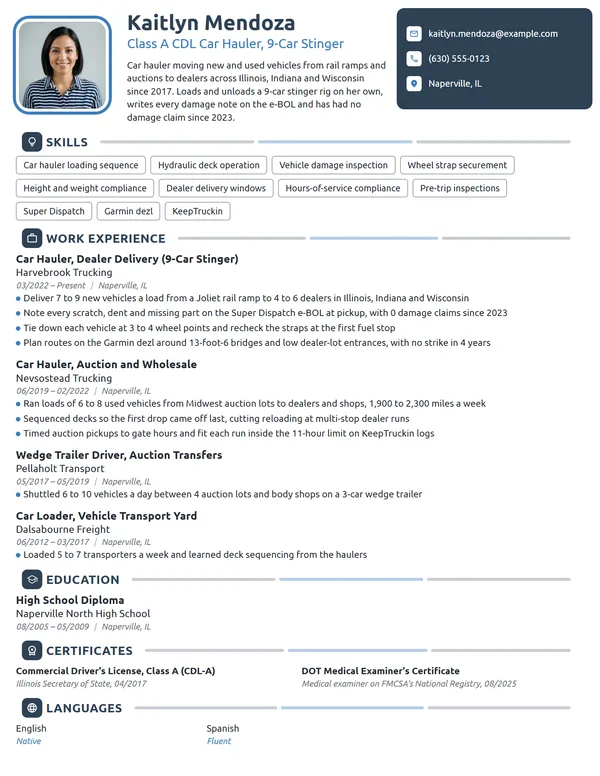
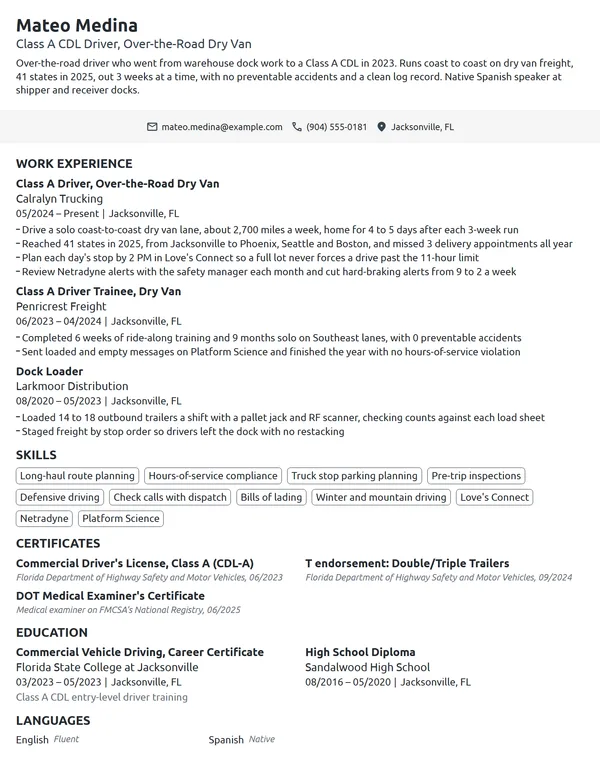
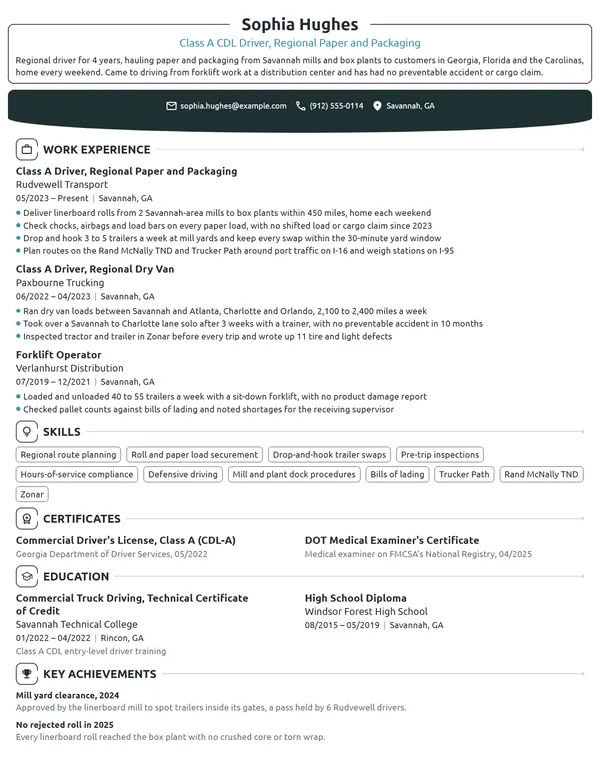
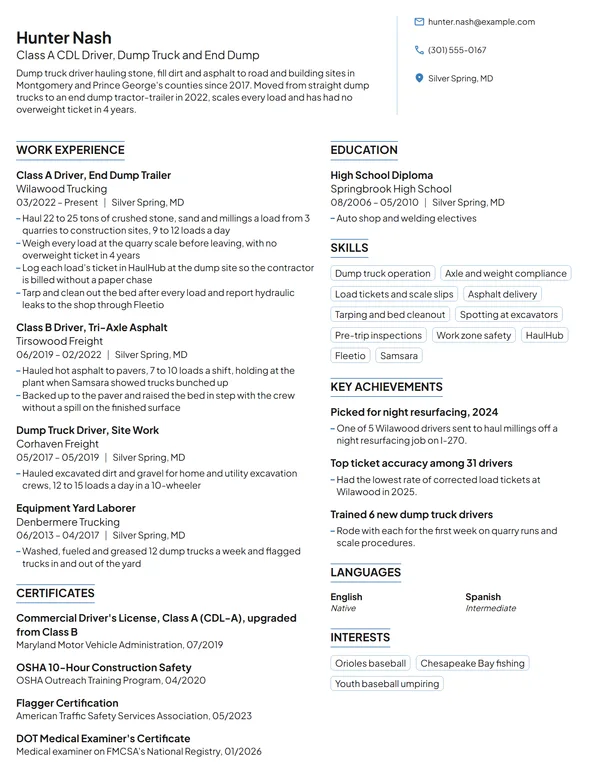
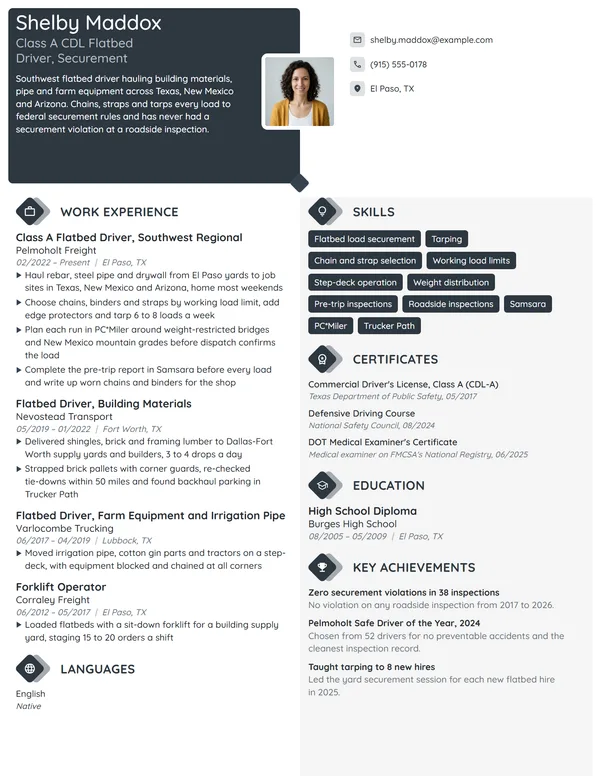
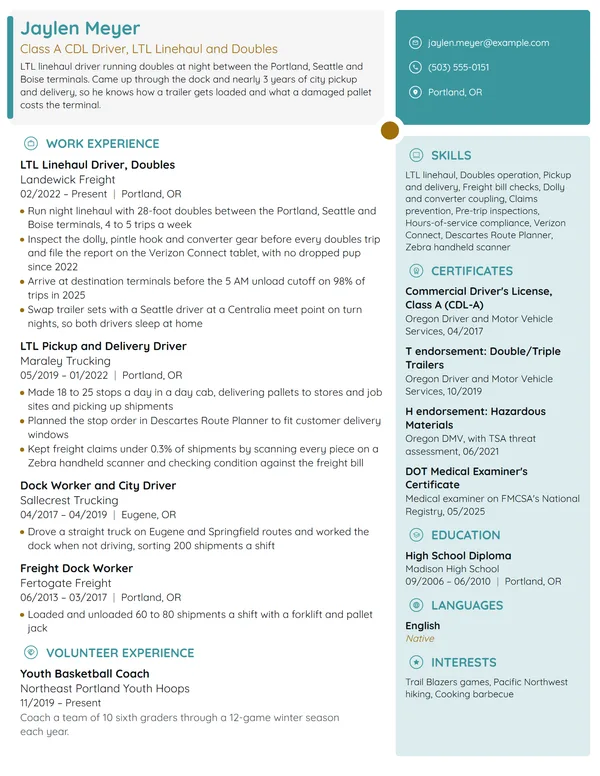
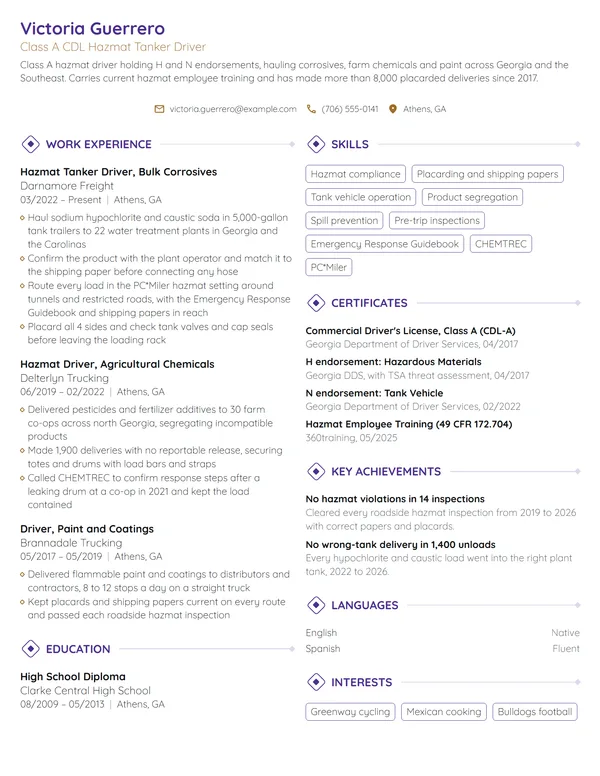
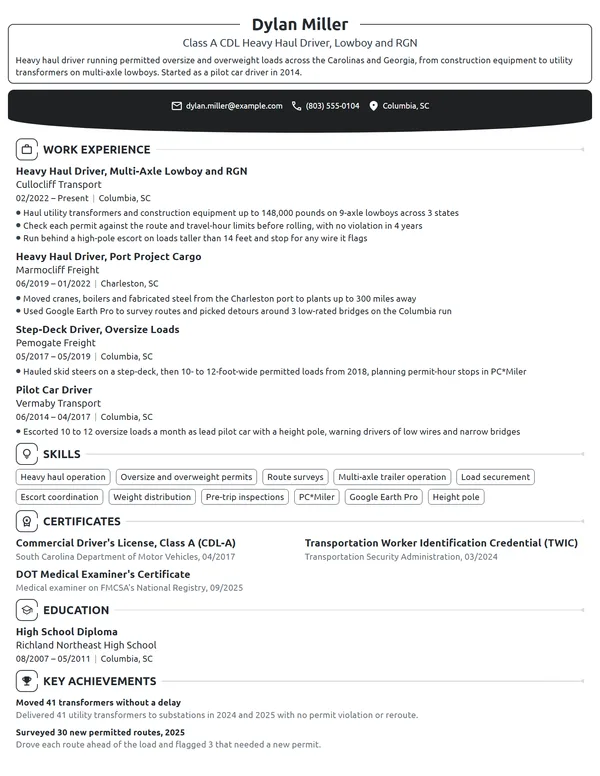
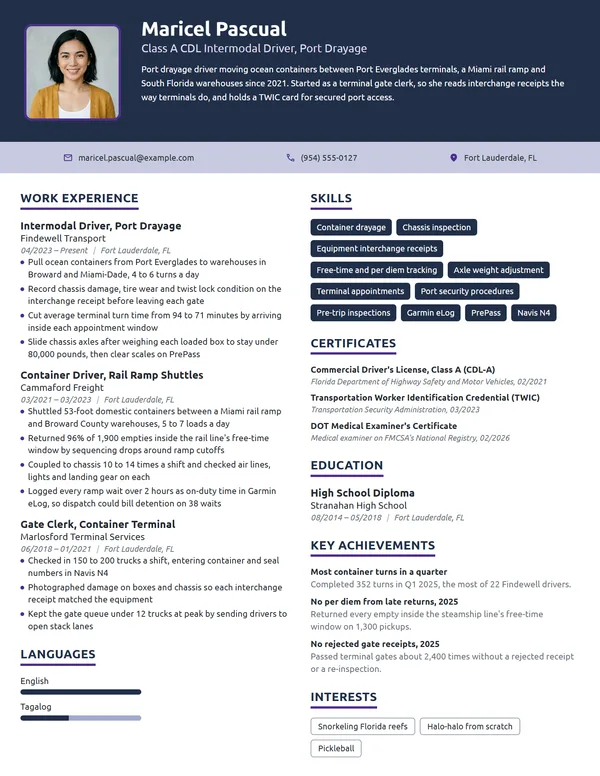
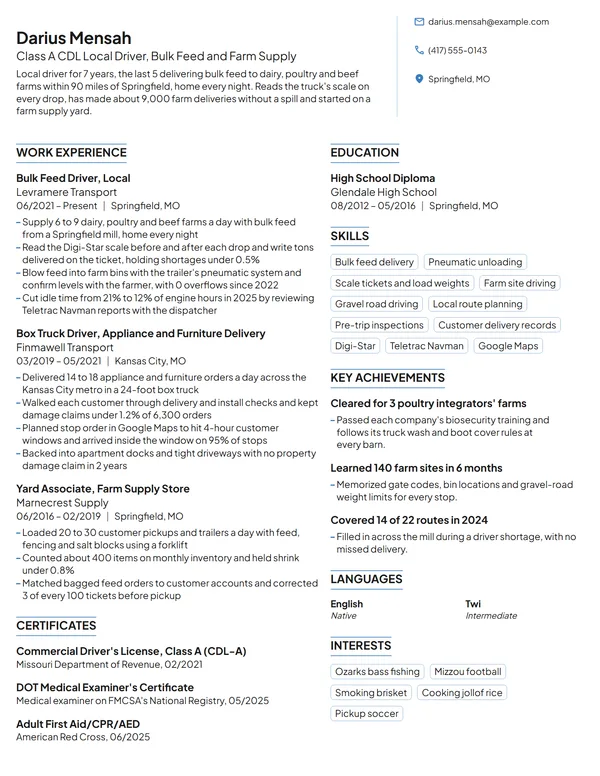
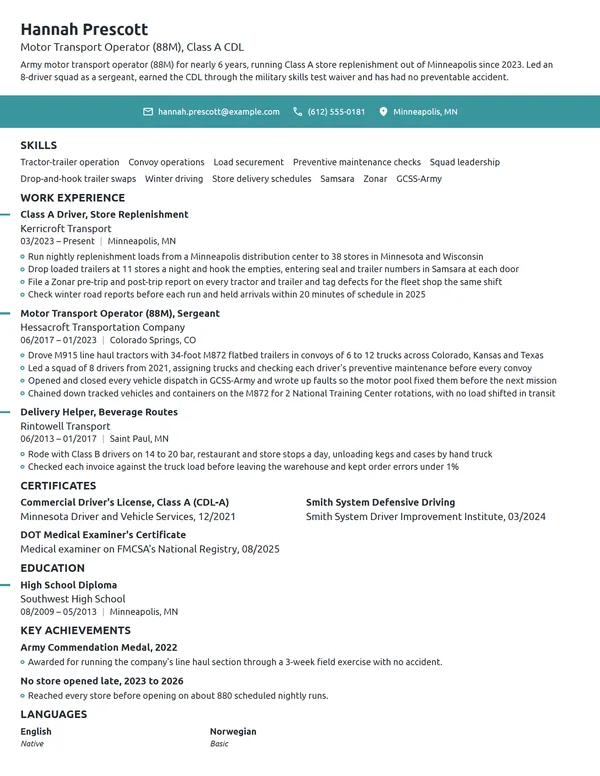
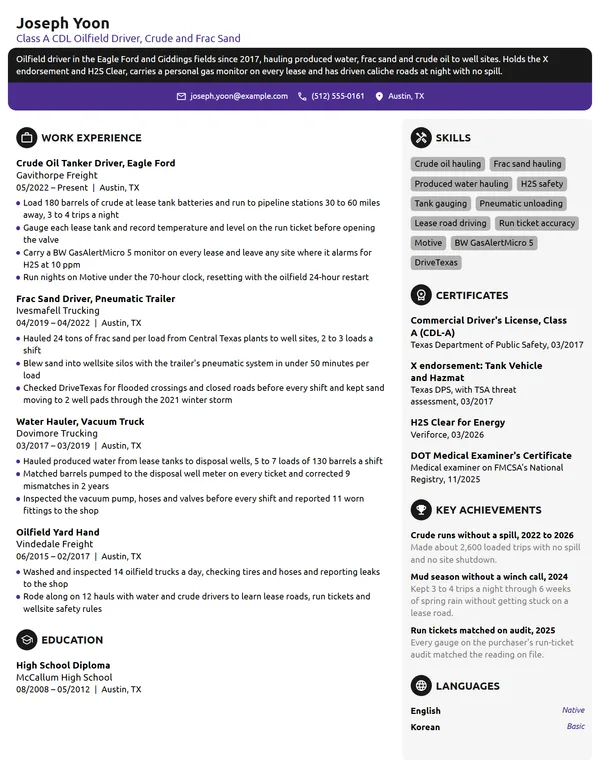
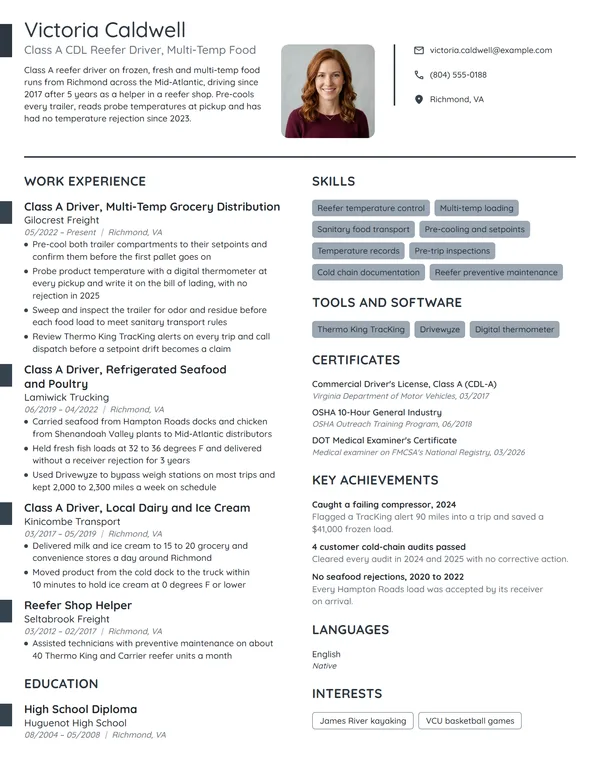
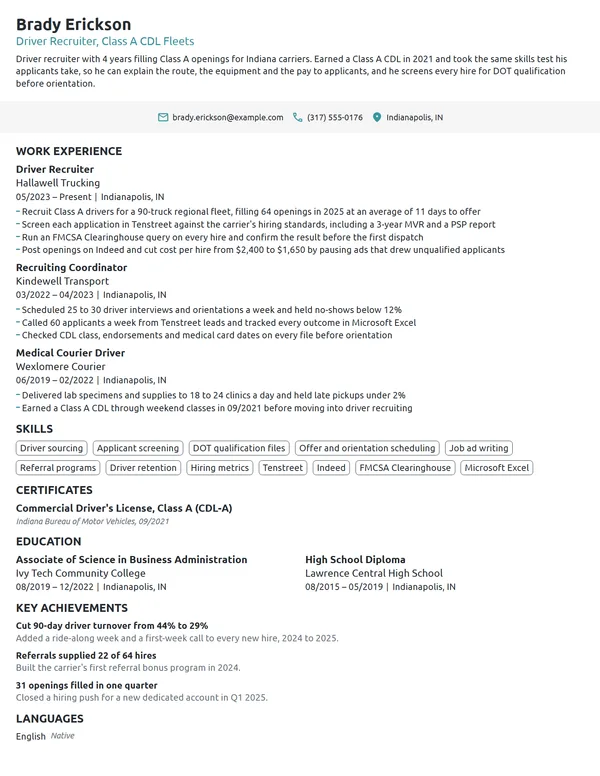
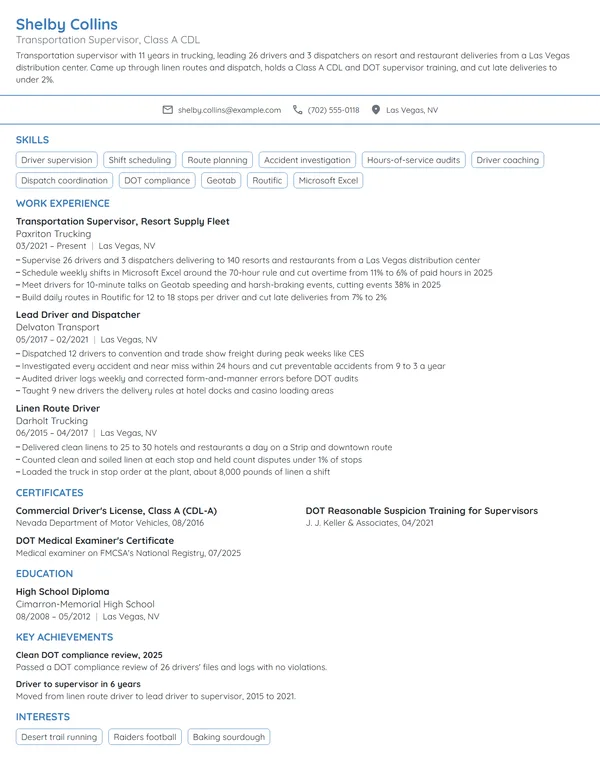
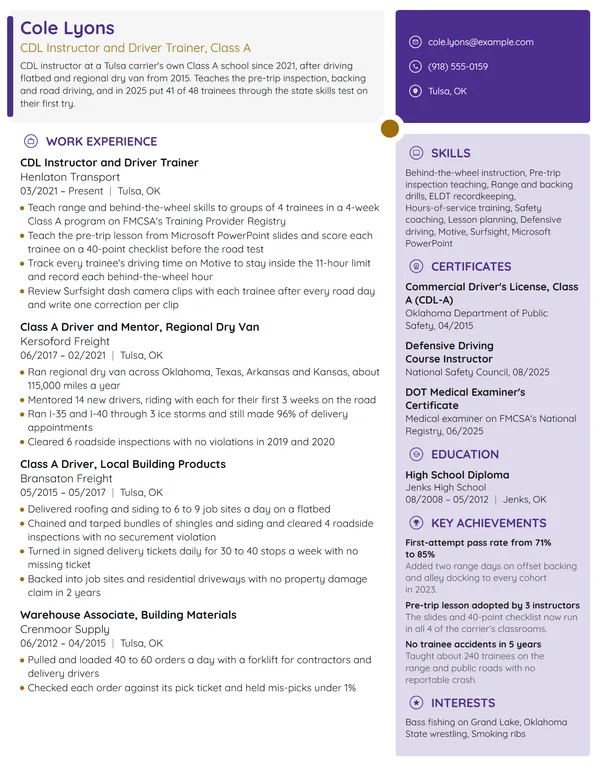
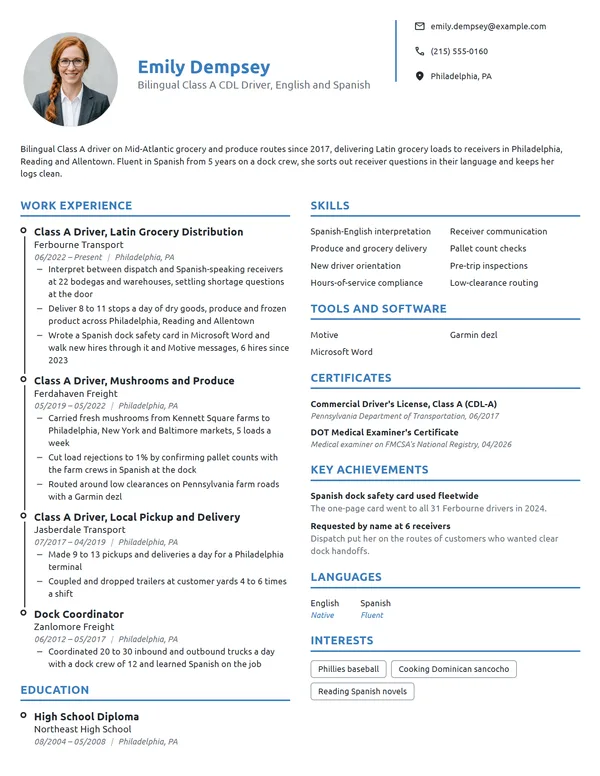
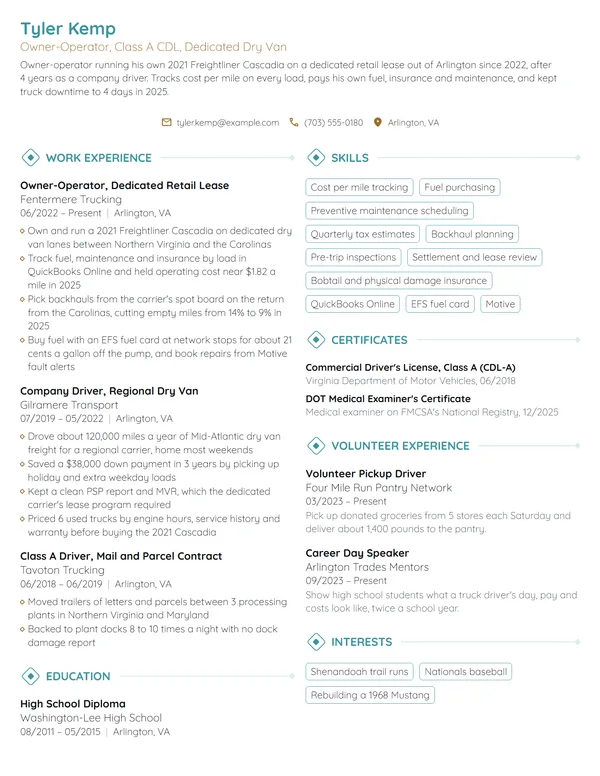
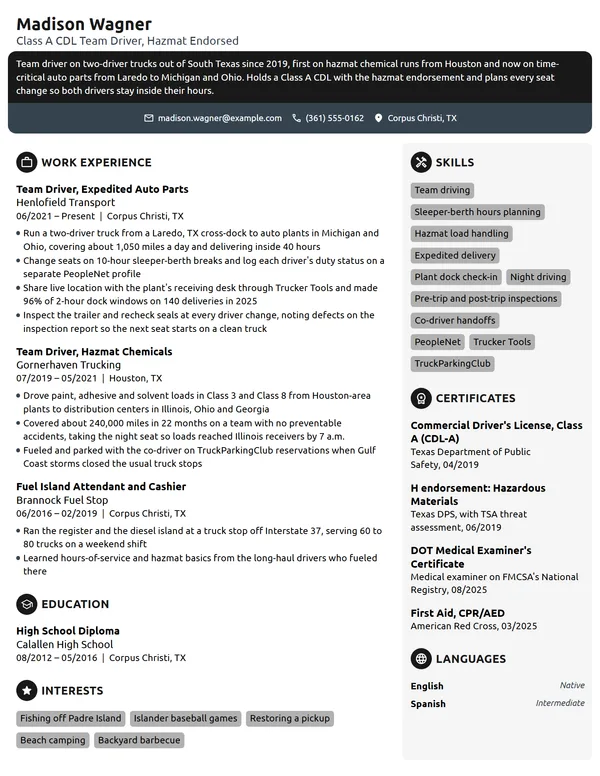
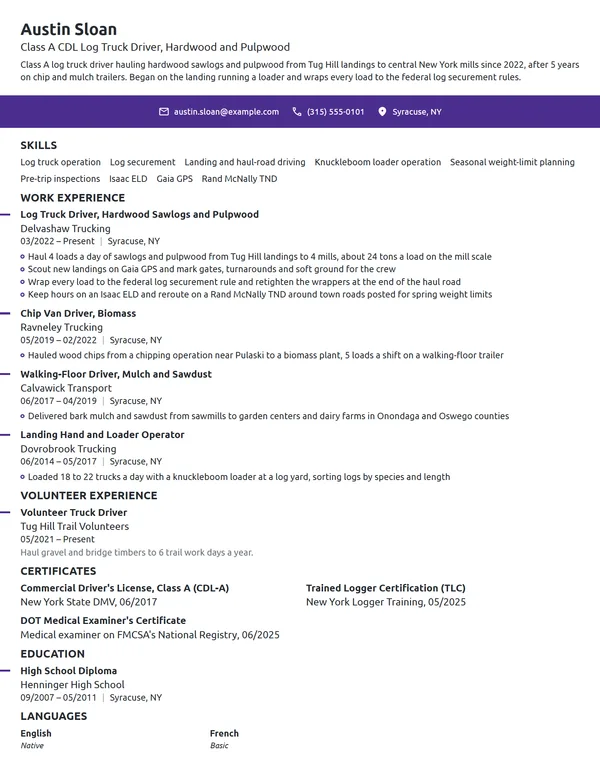
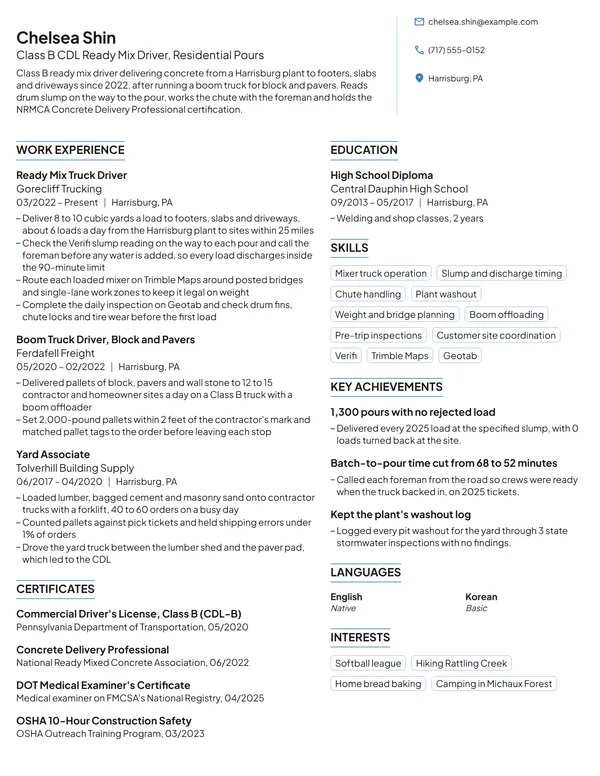
Truck driving comes down to getting every load delivered safely and on schedule. Before offering a job, carriers check the license you hold, the kinds of freight and routes you have driven and your safety record. Safe driving does not make for exciting bullet points, and years without an accident can shrink to a single line. Numbers from your logs, inspections and deliveries give that record the space it deserves.
How to Write a Truck Driver Resume - Key Takeaways
- Keep it to 1 page, newest job first, with MM/YYYY dates and no gaps a recruiter has to guess at.
- Put your CDL class and route type in the headline under your name, such as Class A CDL Driver, Regional Reefer.
- Give every bullet a driving number: miles, preventable accidents, roadside inspections, on-time loads, stops or fuel economy.
- Open your Certificates section with the CDL, its state, its endorsements by letter and name, and your DOT medical card.
- Leave off your license number, birth date and Social Security number; the carrier collects them on its application.
- Run the finished file through an ATS resume checker before you upload it to a carrier's hiring portal.
What carriers look for in a truck driver resume
A driver recruiter and the carrier's safety department read your resume for proof that you can be put in a truck and trusted with a load. The BLS lists securing cargo, inspecting trailers before and after each trip and logging working hours under federal and state rules as core duties. O*NET adds checking load documentation for accuracy, reading bills of lading and reporting vehicle defects or damage.
Each of those duties leaves a record: miles on an electronic log, inspection reports, signed delivery receipts. Pull your numbers from them and lay out your resume in these sections:
- Name, a headline with your CDL class and route type, phone, email and city
- A 2- to 3-line opening summary at the top, printed without a heading
- Work Experience, newest job first, with the equipment and route in each title line
- Skills, with the logging and routing software you have run
- Certificates, with your CDL listed first
- Education, with your truck driving school or CDL program
- Optional: Key Achievements, Volunteer Experience or Languages
Best format for a truck driver resume
Use the reverse-chronological resume format, with your current or latest driving job first and every job carrying its title, employer, city, and start and end month (MM/YYYY). Carriers care about steady work, and this layout shows your history without gaps to guess at. On a CDL job application, federal rules (49 CFR 391.21) ask for every employer of the last 3 years plus each job in the 7 years before that where you drove a commercial vehicle, so your resume should match those dates.
- Best for most truck driversReverse-chronologicalYour jobs, newest first, with your results under each one.Best for: A steady work history in your field
- FunctionalSkills grouped up top, with a short work history below.Best for: Gaps or very little experience
- CombinationA skills section first, then your full work history.Best for: A career change with strong skills
A 1-page resume holds most driving careers, even 10 years of jobs, if older roles get 1 or 2 bullets each. Part-time, weekend and seasonal driving gets the same full entry as a full-time job, with Part-Time in the title line and the days you drove in a bullet. If you have short stints with several carriers, keep each one and have a 1-line reason ready for the interview.
| Setting | What to use |
|---|---|
| Length | 1 page; go to 2 only when 10 years of CDL jobs will not fit |
| Dates | MM/YYYY on every job, with Present on the current one |
| Job title line | Title, route type and equipment: Class A Driver, Regional Dry Van |
| CDL line | Class, issuing state and endorsements, under Certificates, with no license number |
| Personal details | No photo on most US and Canadian applications; leave out your birth date, CDL number and Social Security number |
| File type | PDF, or paste the text into the carrier's online application when it asks |
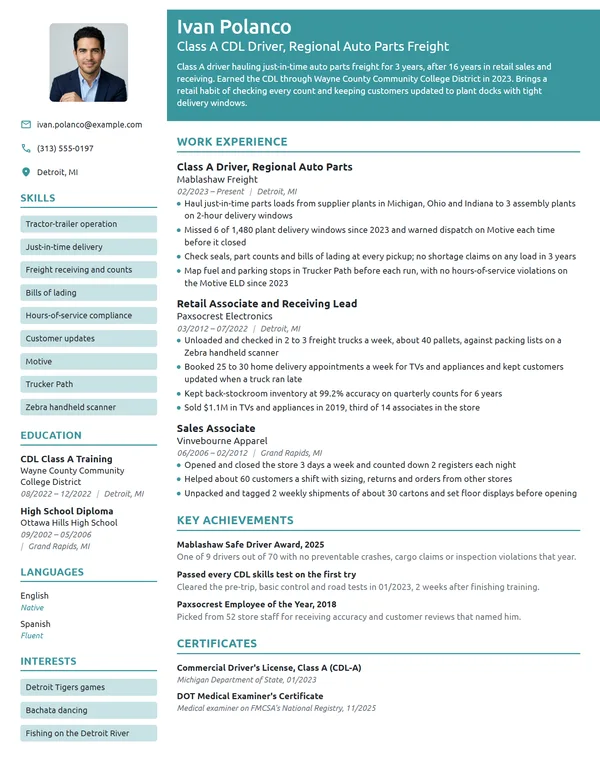
Most US and Canadian resumes carry no photo, so give that space to your CDL and safety lines.
Truck driver resume summary vs. objective
If you hold a CDL and have driven for a carrier, write a resume summary that names your license, your freight, your miles and your safety record. If you are fresh out of CDL school or still waiting on your first driving job, write an objective instead: the route type you want and the training or work that prepared you for it. Either way, take the numbers from your bullets so the two never disagree.
Truck driver resume summary formula
CDL class driver with X years in freight and route type. Miles with your safety record. Endorsements and the schedule you can run.
Example
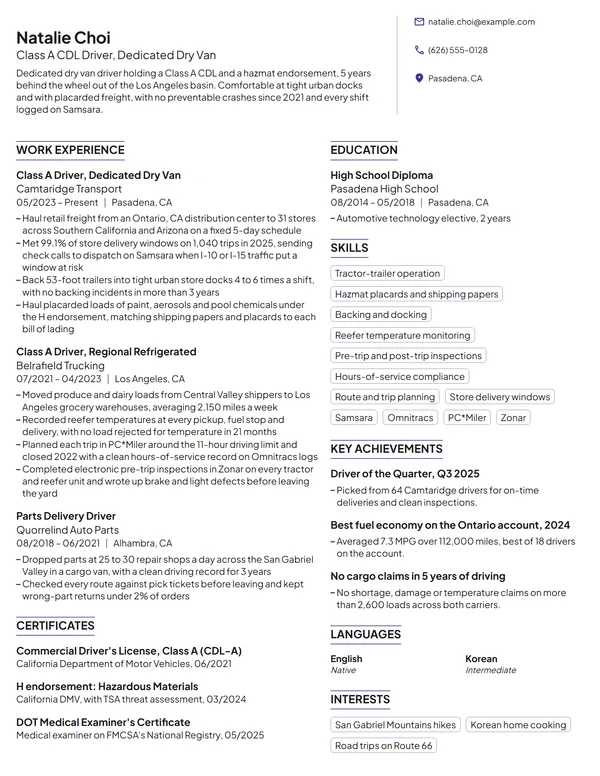
Class A CDL driver with 8 years in regional dry van and refrigerated freight across the Upper Midwest. 410,000 miles with 0 preventable accidents and 11 clean DOT roadside inspections. Tank Vehicle and Double/Triple Trailers endorsements, available for weekend-home regional runs.
Don't
Hardworking truck driver with a clean record looking for a stable company with good home time.
Do
Class A driver with 4 years of over-the-road flatbed freight in 48 states, securing steel coils and lumber with chains and straps. No preventable accidents in 380,000 miles. Hazmat endorsement since 2024.
This version names the license, the freight, the mileage and the endorsement a recruiter screens for.
How to write truck driver work experience bullets with numbers
Give your current job 3 to 4 bullets and older jobs 1 to 3, each opening on an action verb and closing on a number. When you list work experience on your resume, put the route type and equipment in the title line, then use the bullets for mileage, safety and delivery results instead of repeating that you drove a truck.
| Area | What to count | Example bullet |
|---|---|---|
| Safety | Miles driven, preventable accidents, years without a claim | Drove 520,000 miles over 6 years with 0 preventable accidents. |
| On-time delivery | Loads hauled, on-time rate, appointment windows met | Delivered 97% of 1,300 loads inside the receiver's appointment window. |
| Inspections | DOT roadside inspections, violations, defects caught | Passed 9 DOT roadside inspections in 2025 with 0 violations. |
| Hours of service | Days logged, HOS violations, log edits | Logged 240 driving days a year on an ELD with 0 hours-of-service violations. |
| Fuel | Miles per gallon, idle time, fuel cost | Raised average fuel economy from 6.4 to 7.1 MPG by keeping idle time under 10%. |
| Stops and cargo | Stops a day, cases or pallets, damage claims | Ran 12 to 15 stops a day with 0 cargo damage claims for 2 years. |
Hours-of-service numbers carry weight because the limits are tight: under FMCSA's rules for property-carrying drivers (49 CFR 395.3), you may drive 11 hours inside a 14-hour window that starts after 10 hours off duty. A clean log record shows you plan your runs around those limits. Here is a regional driver's entry with the numbers in place.
Work Experience
- Run 2,300 to 2,600 miles a week on lanes across Wisconsin, Minnesota, Iowa and Illinois, home every weekend.
- Logged 410,000 miles with 0 preventable accidents and 0 hours-of-service violations on the fleet's ELD.
- Passed 11 DOT roadside inspections with 0 out-of-service orders, starting every shift with a full pre-trip inspection.
- Kept on-time delivery at 98.6% across 1,150 loads by planning fuel and rest stops around receiver appointments.
- Delivered to 16 restaurant and school kitchens a day on a 3-county route, unloading 900 to 1,200 cases a shift.
- Kept shortages and damaged cases under 0.4% of cases delivered.
Don't
Responsible for driving and delivering freight to customers.
Do
Delivered 22 to 28 grocery stops a week on a 2-day regional loop, with 0 cargo claims in 2025.
The rewrite shows the volume, the route and the result.
Don't
Performed pre-trip and post-trip inspections.
Do
Inspected 3 tractors and 7 trailers before and after each run and wrote up 14 defects that the shop repaired before dispatch.
Truck driving skills and software for your resume
Choose 6 to 8 hard skills for your resume that match the job ad and that a bullet already backs up. Load securement belongs on a flatbed resume, reefer temperature checks on a refrigerated one, and hazmat paperwork only if you hold the endorsement and have hauled placarded loads.
Hard skills for truck drivers
- Tractor-trailer operation
- Pre-trip and post-trip inspections
- Load securement
- Hours-of-service compliance
- Electronic logging (ELD)
- Backing and docking
- Coupling and uncoupling
- Route and trip planning
- Bills of lading and delivery receipts
- Reefer temperature monitoring
Soft skills carriers value
- Defensive driving judgment
- Time management against appointments
- Clear check calls with dispatch
- Courtesy at shipper and receiver docks
- Self-discipline on long runs
- Calm in bad weather and heavy traffic
O*NET lists ALK Technologies PC*Miler for routing, inventory tracking software and driver daily log programs among the tools heavy and tractor-trailer drivers use. Add the electronic logging device and dispatch apps your fleet ran, written exactly as the job ad names them, and mention each one in a bullet, such as logging hours or taking load assignments on it.
CDL class, endorsements and medical card: how to list driving credentials
The BLS states that every long-haul truck driver must hold a commercial driver's license, and that hauling hazardous materials takes an H endorsement with an extra knowledge test and a background check. List certifications on your resume in the Certificates section, with the CDL first, then each endorsement and your medical card. Federal rules (49 CFR 383.91) let a Class A holder drive Class B and C vehicles too, with the right endorsements, so a Class A license covers most openings.
| Credential | Issued by | What it takes |
|---|---|---|
| Class A CDL | Your state's driver licensing agency | Knowledge and skills tests in a combination vehicle of 26,001+ lb GCWR towing more than 10,000 lb. First-time applicants since February 7, 2022 also complete entry-level driver training from a provider on FMCSA's Training Provider Registry. |
| Class B CDL | Your state's driver licensing agency | Knowledge and skills tests in a single vehicle of 26,001+ lb GVWR, such as a straight truck or dump truck, with the same training rule. |
| H (Hazardous Materials) endorsement | Your state, after a TSA security threat assessment | A knowledge test, entry-level hazmat training if it is your first H, fingerprints and the TSA assessment ($85.25 since January 1, 2025), renewed generally every 5 years. |
| N (Tank Vehicle) and T (Double/Triple Trailers) | Your state's driver licensing agency | A knowledge test for each. X is the code a state prints when you hold both tank and hazmat. |
| DOT medical examiner's certificate | A medical examiner on FMCSA's National Registry | A physical exam by a certified examiner within the last 24 months, renewed before the card expires. |
How to write the CDL line
Write the class, the issuing state and the month you earned it, then each endorsement by its letter and name, with the date you added it. Leave the license number off. If your CDL carries an E restriction (no manual transmission), list it on the CDL line so a carrier that runs manual trucks knows before it calls you, and repeat your class in the headline under your name.
Certificates
- Commercial Driver's License, Class A, Wisconsin DMV, 04/2018
- T endorsement: Double/Triple Trailers, Wisconsin DMV, 09/2022
- N endorsement: Tank Vehicle, Wisconsin DMV, 05/2024
- DOT Medical Examiner's Certificate, valid through 03/2028
Truck driving school, ELDT and education on a truck driver resume
According to the BLS, most companies want a high school diploma or the equivalent, and many drivers train at a private truck driving school or a 3- to 6-month community college program that ends with a certificate of completion. Since February 7, 2022, anyone getting a first Class A or Class B CDL, or a first H endorsement, has to finish entry-level driver training (ELDT) with a provider on FMCSA's Training Provider Registry, under 49 CFR 380.609.
Follow the standard rules for listing education on a resume: program, school, city and completion date. Your CDL program belongs here even if it lasted only a few weeks, and your high school diploma or GED stays below it, since most carriers ask for one. A license earned before February 7, 2022 had no ELDT requirement, so leave ELDT off an older entry.
Education
Class A CDL preparation: range, backing and over-the-road driving.
Entry-level and career-change truck driver resumes
With a new CDL and no driving job yet, use an entry-level resume layout: a short objective, then your CDL training and every job that shows you are reliable and safe around equipment. New drivers, the BLS says, normally get several weeks of on-the-job training with an experienced driver, so carriers hiring new drivers expect to teach you the truck.
- CDL school: the program, its length, and the backing, range and road skills you tested on.
- Warehouse and dock work: forklift or pallet jack hours, loads staged a shift, and any safety record.
- Delivery or non-CDL driving: stops a day, miles and a clean driving record in a van or box truck.
- Military motor transport: vehicle types, convoy miles and maintenance duties, written in civilian terms.
Don't
Recent CDL school graduate seeking a truck driving position to gain experience.
Do
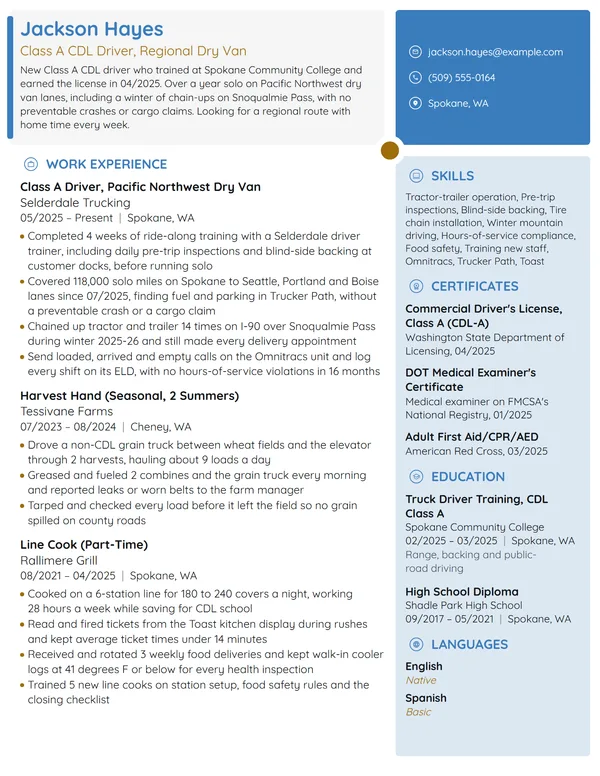
Class A CDL holder since 08/2026 with a clean driving record, seeking a local or regional route. Brings 3 years of forklift and dock work at a distribution center.
Even an objective can name the license, the record and the route you want.
Switching from warehouse, retail, construction or factory work, stay with the newest-first layout and lead your summary with the CDL and the transferable skills a carrier uses, such as equipment checks, shift reliability and customer contact. A career-change resume works best when the first bullets under your last job are the ones closest to driving. Explain the switch in 2 or 3 sentences in your cover letter.
Truck Driver resume FAQ
Should I put my CDL number on my resume?
No. Write the CDL class, the issuing state and your endorsements, and leave the number off. The carrier asks for it on its application and uses it to pull your driving record, so it never needs to sit on a resume that travels through job boards.
How do I list CDL endorsements on a resume?
List each one under Certificates, after your CDL, with its letter, its name and the date you added it, such as T endorsement: Double/Triple Trailers, 09/2022. Name the endorsements the job ad asks for in your summary as well.
How many years of jobs should a truck driver resume show?
About 10 years. Under 49 CFR 391.21, a CDL driver's application lists every employer of the last 3 years plus each commercial driving job in the 7 years before that. Showing the same span on your resume keeps your dates consistent with the application.
Should I mention accidents or tickets on my resume?
No. Your resume shows your safety results, such as miles without a preventable accident. Federal rules require the job application to list your accidents and moving violations from the last 3 years, so answer those questions there, honestly and in full.
How long should a truck driver resume be?
Use 1 page for most drivers. Give your current job 3 to 4 bullets and older ones 1 or 2, and move to a second page only if 10 years of CDL jobs will not fit.
Can I drive a truck across state lines at 18?
Generally no. Federal rules (49 CFR 391.11) set 21 as the minimum age for interstate commercial drivers. Rules for driving inside one state are set by that state, so check yours before you apply for local routes under 21.
Do I need truck driving school to get a CDL?
Not a school as such, but you need registered training for a first Class A or Class B CDL issued since February 7, 2022. FMCSA's entry-level driver training rule requires training from a provider on its Training Provider Registry. Whichever school or carrier trains you, check that it is listed on the registry before you enroll.
Should my DOT medical card go on my resume?
Yes. List it under Certificates with the month of your last exam or its expiration date, such as valid through 03/2028. A medical examiner on FMCSA's National Registry certifies you for up to 24 months, and a current card tells a recruiter you can start without waiting on a physical.
How do I show lead driver or driver trainer experience?
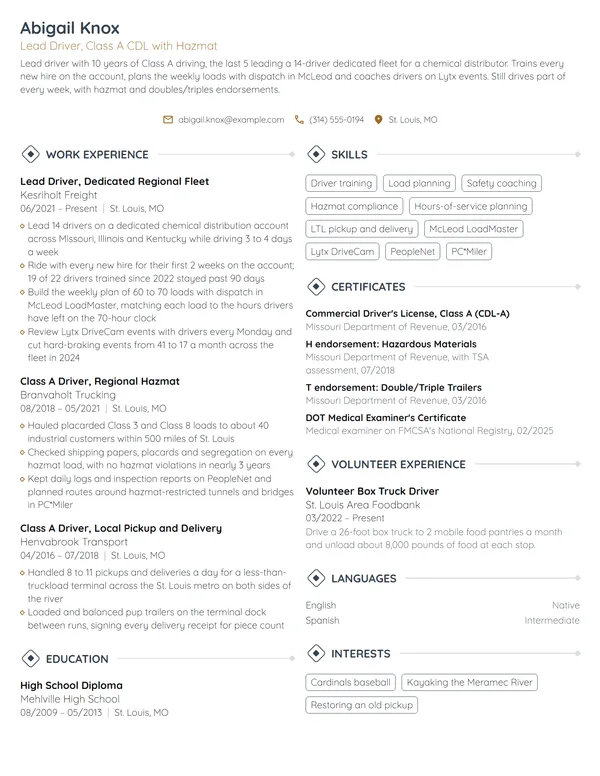
Put the role in the title line, such as Lead Driver or Driver Trainer, and count the people involved: drivers trained, new hires you rode with, and how many passed their first 90 days. Keep your own miles and safety record in the same entry.
Should I include salary expectations on a truck driver resume?
No. Keep pay for the interview or the application form. For a benchmark, heavy and tractor-trailer truck drivers earned a median $58,640 a year in May 2025, according to the BLS; offers depend on your route type, freight and pay model.
Next steps
Choose the example closest to your route and level, follow its layout, and put in your own miles, inspections and on-time numbers. Build it in our resume builder or start from one of the resume templates, check your CDL line against your license, and send a cover letter that opens on the route and freight you want.