
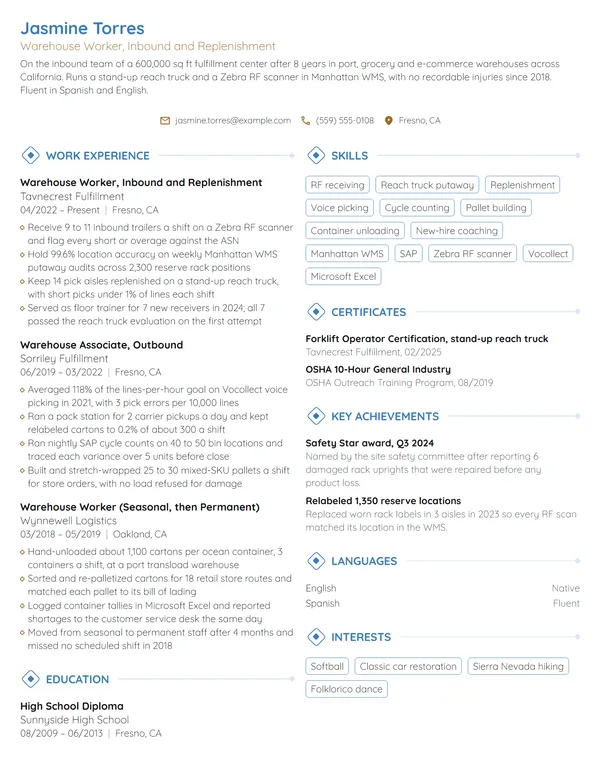
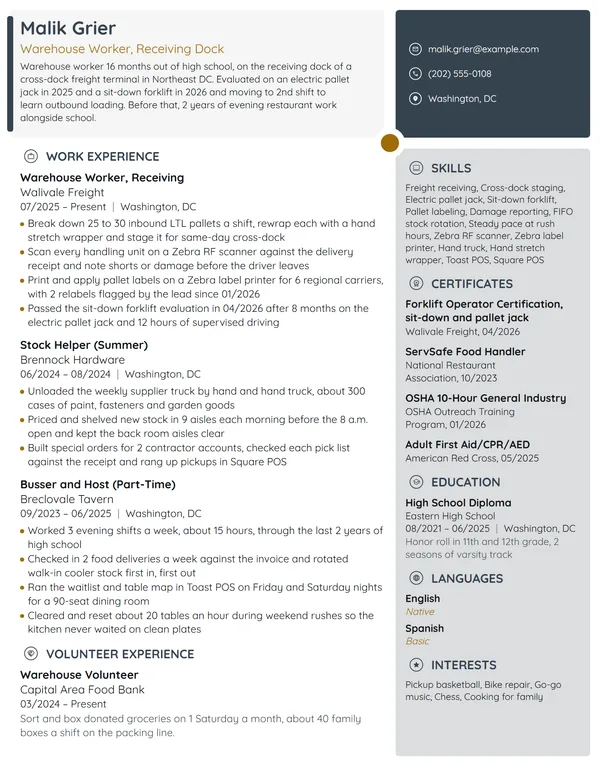
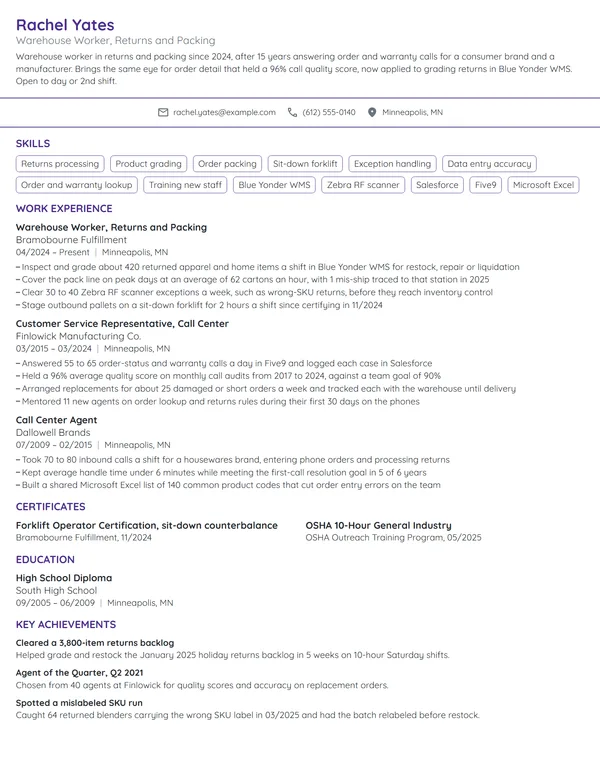
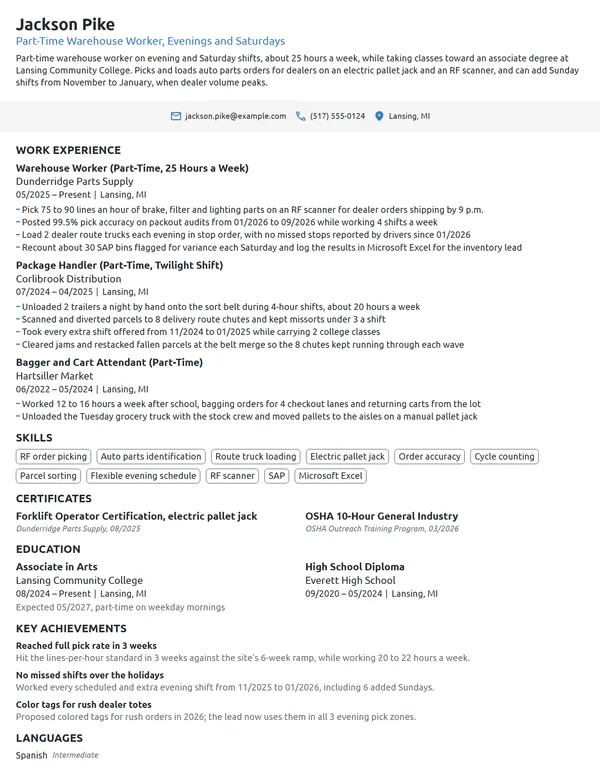
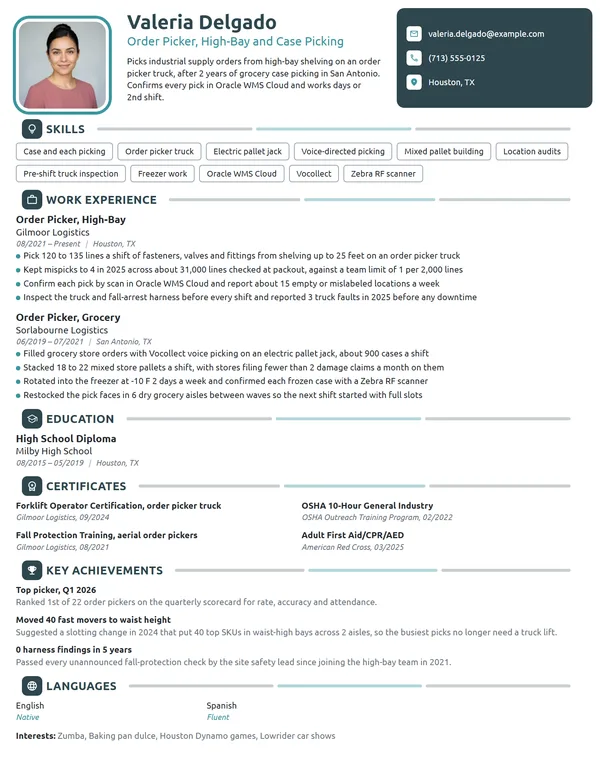
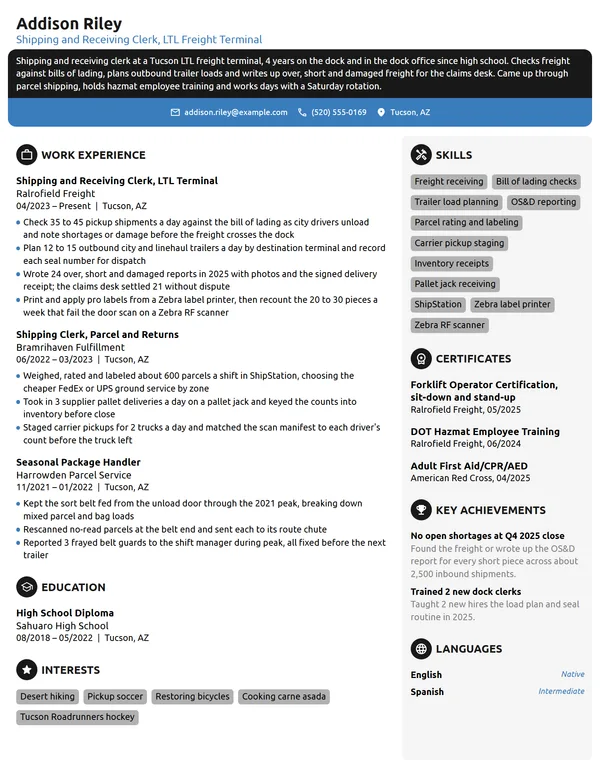
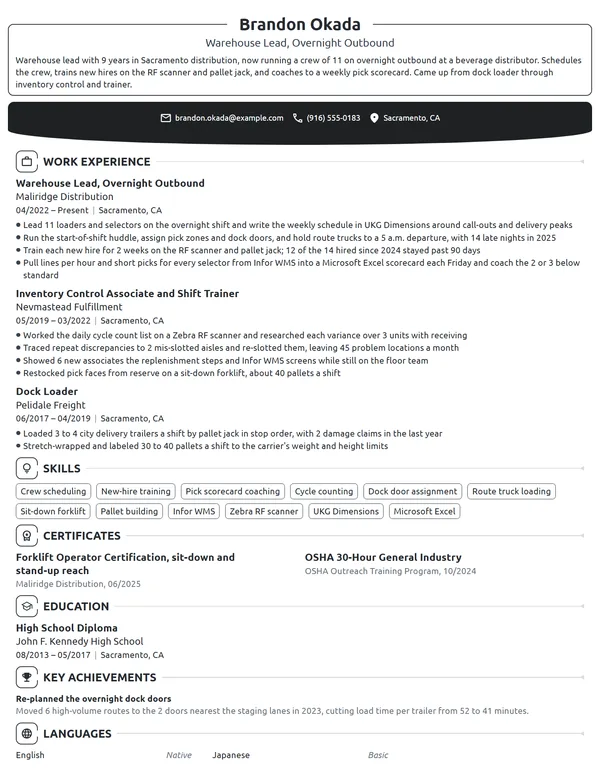
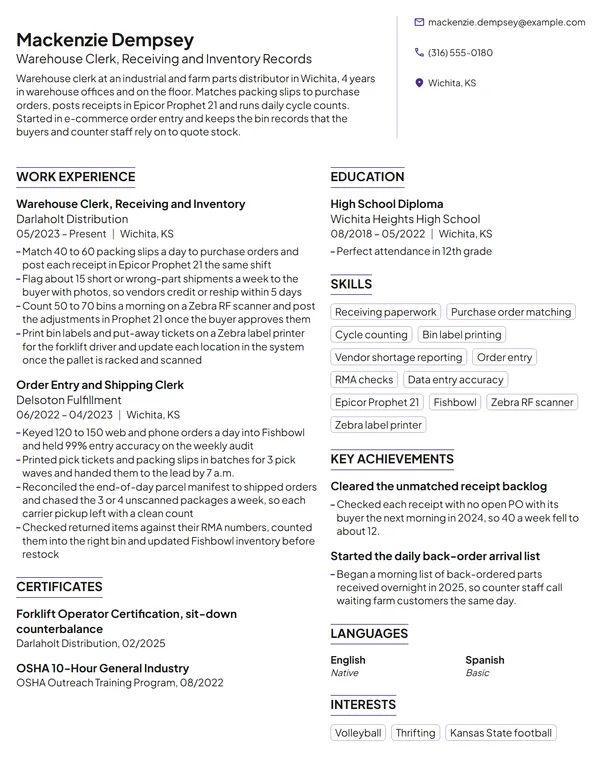
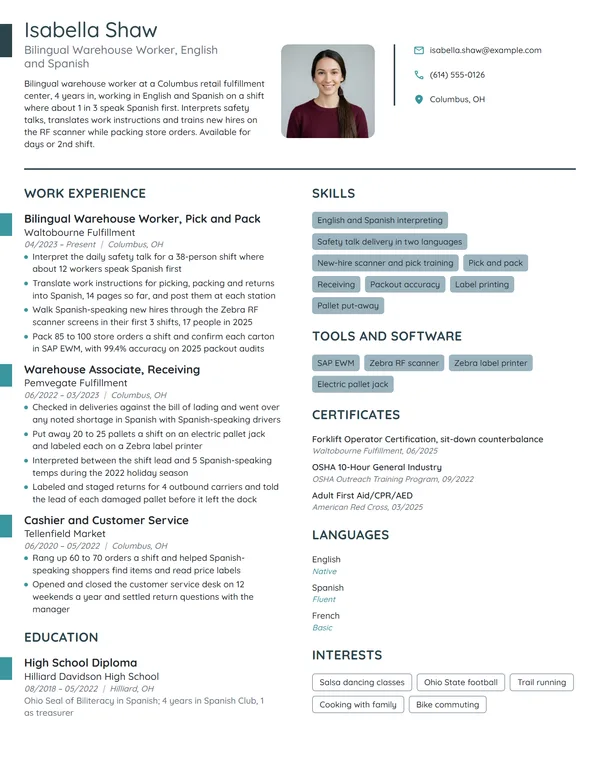
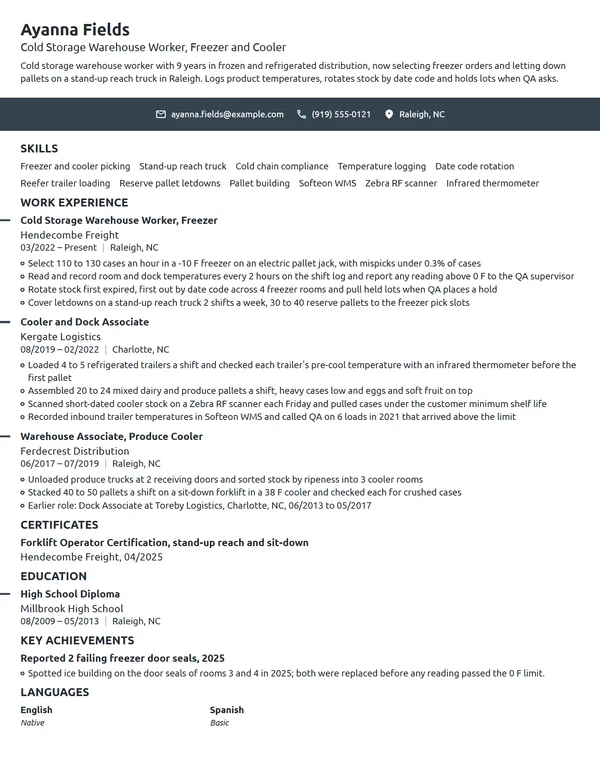
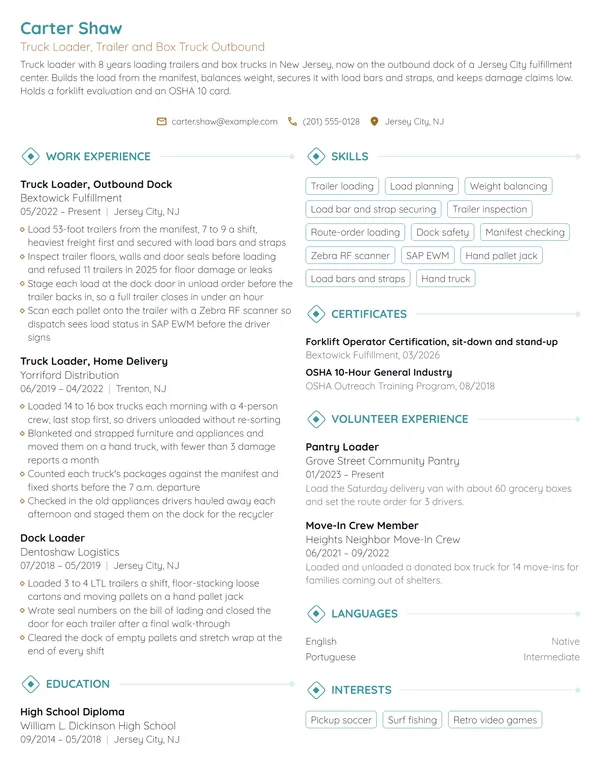
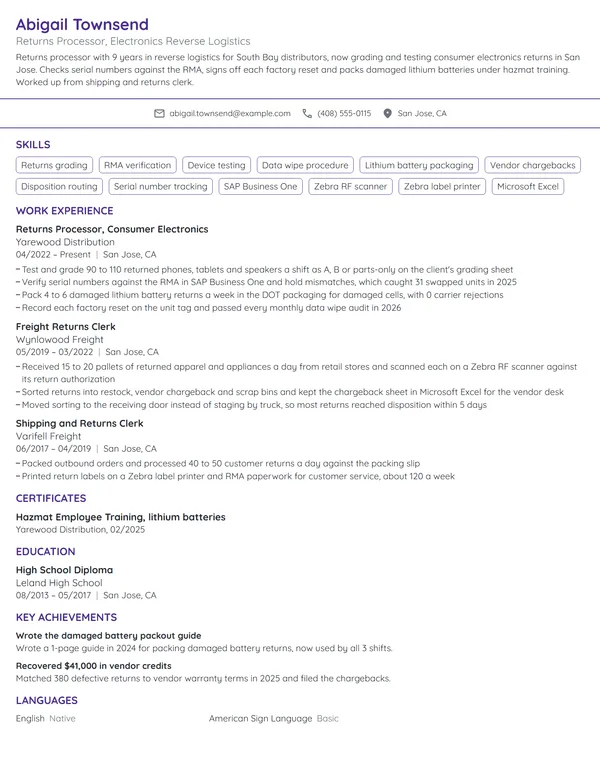
Warehouse work keeps orders moving, and supervisors hire people who can keep pace. Your resume should tell them how much you pick, pack or load in an hour, how accurate your work is, which equipment you run and whether you show up for every shift. A list of the usual tasks will not set you apart. Your own numbers on each job, equipment named by type and forklift training listed clearly will.
How to Write a Warehouse Worker Resume - Key Takeaways
- Use the reverse-chronological format on 1 page; even 10+ years of warehouse work rarely needs a second.
- Open with 2 to 3 lines that name your years, the kind of warehouse, your equipment and your best rate or accuracy number.
- Give every bullet a number a supervisor tracks: units or lines per hour, order accuracy, trailers loaded, locations counted or recordable injuries.
- Write equipment by its type, such as RF scanner, electric pallet jack or stand-up reach truck, and prove each one in a bullet.
- List forklift training as your employer's operator certification with the truck types and the evaluation date, and put an OSHA 10 card under Certificates.
- Say which shifts you can work, then run the file through an ATS resume checker before you apply to a large distribution center.
What hiring managers look for in a warehouse worker resume
The BLS describes the job simply: laborers and freight, stock and material movers move materials to and from storage and production areas. O*NET adds the tasks a shift is built on, such as moving freight to and from docks, delivery vehicles and containers by hand or with equipment, sorting cargo, tagging containers and recording the units handled on daily production sheets. A supervisor reads your resume to see how well you did those tasks, not whether you did them.
That means 4 questions: how fast you work against the site's standard, how accurate your picks, counts and loads are, how safely you run equipment, and how reliable your attendance is. Put the answers in these sections, under headings that hiring software reads cleanly:
- Name, a headline such as Warehouse Worker, Forklift Trained, and your phone, email and city
- A short summary or objective at the top (it prints without a heading)
- Work Experience, with your latest warehouse job first
- Skills, with your equipment and systems inside the list
- Certificates, for forklift training and safety cards
- Education
- Extras if space allows: Languages, Interests, and one of Volunteer Experience or Key Achievements
Best format for a warehouse worker resume
Use the reverse-chronological resume format: your current or latest job first, each with the title, the employer with its city, and each job's dates written MM/YYYY. Warehouse experience builds in plain steps, from package handler or picker to equipment operator, lead and supervisor, and this layout shows each step without making the reader hunt. It also handles seasonal and agency jobs well, since each one gets its own dated entry.
- Best for most warehouse workersReverse-chronologicalYour jobs, newest first, with your results under each one.Best for: A steady work history in your field
- FunctionalSkills grouped up top, with a short work history below.Best for: Gaps or very little experience
- CombinationA skills section first, then your full work history.Best for: A career change with strong skills
Keep the resume to 1 page. 1 page with your 3 or 4 most recent jobs gives a hiring manager the equipment, rates and dates they read for. If you have held more than 4 warehouse jobs, keep the last 10 years and drop the rest, or fold short temp assignments into a single entry.
| Setting | What to use |
|---|---|
| Length | 1 page, covering about the last 10 years |
| Dates | MM/YYYY for every job, with Present on the one you hold now |
| Job title line | Title plus area of the building: Warehouse Worker, Outbound Shipping |
| Availability | Shifts you can work, such as nights or weekends, in the summary |
| Photo | Usually left off; few US or Canadian warehouses expect one |
| Personal details | Leave out your age, Social Security number and family status |
| File type | PDF, or a Word file if the online application asks for one |
Most US and Canadian resumes carry no photo. Large warehouses and staffing agencies take applications through online portals, so a simple layout with standard headings matters more here than any design choice.
Warehouse worker resume summary vs. objective
The test is simple: if you have held a warehouse job, write a resume summary that leads with your years, your warehouse type and your best number. If you have not, write a resume objective: the role you want, plus the closest physical, stockroom or shift work you have done. Either way, keep it to 2 or 3 lines and add the shifts you can cover.
Warehouse worker resume summary formula
Title with X years in type of warehouse, trained on equipment or system. Your best rate, accuracy, safety or training result, with a number. Safety card or certification, plus the shifts you can work.
Example
Warehouse worker with 6 years in e-commerce and parcel distribution, trained on sit-down forklifts, pallet jacks and RF scanners. Trained 9 seasonal hires on RF picking during the 2025 peak with no missed ship cutoffs. OSHA 10-Hour General Industry card; open to nights and weekends.
Don't
Hardworking and reliable warehouse worker who can lift heavy boxes and thrive in a fast-paced environment.
Do
Receiving associate with 3 years at a cold-storage food distributor, checking in about 22 inbound trailers a week on RF receiving and a reach truck. Perfect attendance in 2025.
The second version swaps 3 adjectives for a warehouse type, a weekly volume, the equipment and an attendance record.
How to write warehouse worker bullets with numbers
Give your current job 3 or 4 verb-first bullets and each older job 1 to 3. Warehouses measure almost everything, from units per hour to mis-ships and safety audits, so ask your lead for your numbers or check your daily rate reports before you write. Bullets that show achievements on your resume with those numbers say more than a list of daily duties.
| Area | What to count | Example bullet |
|---|---|---|
| Picking | Units or lines per hour against the standard, pick accuracy | Picked 210 lines an hour in voice-directed picking, 112% of the site standard. |
| Packing | Orders packed per shift, mis-ships, damage | Packed about 340 orders a shift with 2 mis-ships in 6 months. |
| Receiving and unloading | Trailers or containers, cartons, time from dock to shelf | Unloaded and received 4 floor-loaded containers a shift, with all stock put away within 24 hours. |
| Inventory | Locations counted, variance, adjustments | Counted 85 locations a day and held inventory variance under 0.5% for 3 quarters. |
| Loading and shipping | Trailers loaded, on-time departures, damage claims | Loaded 5 LTL trailers a night, with 98% leaving before the 10 p.m. cutoff. |
| Safety and housekeeping | Recordable injuries, audits passed, near misses reported | Worked 3 years with 0 recordable injuries and passed 12 of 12 monthly 5S audits. |
Here is a warehouse worker's entry built on that kind of count. Each bullet names the base behind its number (an hour, a shift, a month), and the older job gets fewer lines.
Work Experience
- Pick an average of 165 units an hour on RF-directed batch picks, against a site target of 140.
- Keep order accuracy at 99.7% across about 2,600 orders a month, measured by pack-station audits.
- Load 6 to 8 outbound trailers a shift on a sit-down counterbalance forklift, with 0 damage claims in 2025.
- Count 120 bin locations a week in cycle counts and keep variance under 0.4%.
- Scanned and sorted about 1,400 parcels an hour onto 12 outbound lanes.
- Unloaded 2 to 3 floor-loaded trailers a shift during peak season, about 1,800 cartons each.
Don't
Responsible for picking and packing orders.
Do
Picked and packed 280 e-commerce orders a shift at 99.8% accuracy on pack-station audits.
A rate and an accuracy figure answer the 2 questions every warehouse supervisor asks first.
Don't
Operated forklift and other warehouse equipment.
Do
Put away about 70 full pallets a shift to 30-foot rack positions on a stand-up reach truck, with 0 product damage reports in 2025.
Warehouse skills, equipment and software for your resume
Pick the 6 to 8 hard skills for your resume that both the posting asks for and your bullets back up. Picking, packing and receiving belong on almost every warehouse resume; reach trucks, cold storage or hazmat handling only where you have done the work. Let your rates and attendance show the soft skills below.
Hard skills for warehouse workers
- Order picking (RF and voice)
- Packing and labeling
- Shipping and receiving
- Trailer loading and unloading
- Cycle counting
- Pallet building and stretch wrapping
- Electric pallet jack
- Sit-down and stand-up forklifts
- Putaway and replenishment
- Damage and discrepancy reporting
Soft skills warehouse supervisors value
- Reliable attendance
- Steady pace over a full shift
- Attention to detail
- Following safety rules
- Teamwork on the dock
- Clear handoffs between shifts
List your systems with your skills, then show each one at work in a bullet. O*NET marks a warehouse management system (WMS) as in-demand technology for this work, and lists SAP software and Microsoft Excel as hot technology. Write the WMS by name, such as Manhattan, Blue Yonder or SAP EWM, only when the job ad names it and you have used it; otherwise, RF scanner, voice picking headset and WMS are the right words.
Forklift certification and safety training on a warehouse resume
The BLS notes that hand laborers and freight, stock, and material movers have some of the highest rates of injuries and illnesses of all occupations, so safety training gets read closely. List certifications on your resume in the Certificates section, with who issued each one and the date. Under OSHA's powered industrial truck standard, 29 CFR 1910.178, your employer trains you, evaluates you in the workplace and certifies that you passed, and the evaluation is repeated at least once every 3 years.
| Credential | Issued by | What it takes |
|---|---|---|
| Forklift operator certification | Your employer, under OSHA 29 CFR 1910.178 | Formal instruction, practical training and an evaluation of your driving in the workplace, repeated at least once every 3 years. The employer's record names you, the training date, the evaluation date and the trainer. |
| OSHA 10-Hour General Industry | An OSHA-authorized Outreach trainer or online provider | A 10-hour class on common job-related safety and health hazards. You get a course completion card, and OSHA says the course is not a certification. |
| OSHA 30-Hour General Industry | An OSHA-authorized Outreach trainer or online provider | A 30-hour class that OSHA describes as more appropriate for supervisors or workers with some safety responsibility, such as a lead. |
How to list forklift training from a past employer
OSHA requires each employer to make sure you are trained and evaluated before you drive one of its trucks, so a new warehouse will evaluate you again. Your past certification still shows you can learn the job quickly. Write it with the truck types, the employer that certified you and the month of your last evaluation, and call an OSHA 10 card a card, not a certification.
Certificates
- Forklift Operator Certification: sit-down counterbalance and stand-up reach truck, Vantreller Supply, evaluated 04/2025
- OSHA 10-Hour General Industry, course completion card, 09/2021
High school diploma, GED and education on a warehouse resume
The BLS says there are usually no formal educational requirements for hand laborers and material movers, and most learn through on-the-job training that lasts 1 month or less. Many job ads still ask for a diploma or GED, so list yours. Follow the basic rules for listing education on a resume: the diploma, the school, the city and the graduation date, below Work Experience.
Keep this section to 1 or 2 lines. Add a logistics, supply chain or industrial maintenance course from a community college only if you finished it or are enrolled now, with the expected date. A GPA or class rank adds nothing to a warehouse resume once you have held a job.
Education
Entry-level, part-time and career-change warehouse worker resumes
With no warehouse job yet, use an entry-level resume layout: a 2-line objective, your most physical or stock-related work first, and Education near the top only if you are still in school. The BLS says new employees may shadow an experienced worker while they learn the basics, so a manager is mostly checking that you can keep a pace, follow instructions and show up.
- Retail stockroom or grocery night crew: cases or totes worked a shift, trucks unloaded, shelves faced before open.
- Restaurant or kitchen work: deliveries checked in, storage rotated, rush periods worked.
- Moving, delivery or landscaping jobs: loads per day, weight handled, equipment used.
- Food bank or donation drives: pounds or boxes sorted, shifts covered, listed under Volunteer Experience.
Don't
Looking for a warehouse job where I can learn new skills and grow with the company.
Do
Grocery stocker with 2 years on the night freight crew, seeking a warehouse worker role on 1st or 2nd shift. Worked about 1,200 cases a night and trained on an electric pallet jack.
Even a 2-line objective can carry a volume, a schedule and a piece of equipment.
For a part-time job, put your exact availability in the summary, such as weekday evenings or Saturday and Sunday shifts. The BLS notes that part-time work is common in this field and that schedules may include nights and weekends, so stating your hours early helps a scheduler place you. Give part-time jobs the same numbers as full-time ones, and mark them part-time on the title line.
Coming from a call center, customer service or another job outside the warehouse, keep the reverse-chronological order and lead with the transferable skills a supervisor recognizes: volume handled per shift, accuracy, attendance and the systems you logged work in. A career-change resume reads best when your summary names the warehouse role you want and any forklift or safety training you have started. Save the reason for the switch for your cover letter.
Warehouse Worker resume FAQ
Do I need a forklift certification to get a warehouse job?
Not for every warehouse job. Picking, packing and loading roles often hire without one, and under OSHA's standard the employer trains and evaluates you before you drive its trucks. If you already have forklift training, list it under Certificates, because it shortens your training time.
How do I list forklift training from a previous employer?
List it under Certificates as Forklift Operator Certification, followed by the truck types, the employer that certified you and the date of your last evaluation. Your new employer will evaluate you again, but the line shows which equipment you have already run.
What do I put on a warehouse resume with no experience?
Put the closest work you have done: retail stocking, grocery night crew, kitchen deliveries, moving or landscaping jobs, or volunteer sorting at a food bank. Give each one a number, such as cases worked or loads per day, and open with a 2-line objective naming the shift you want.
How long should a warehouse worker resume be?
1 page is enough. A supervisor or staffing recruiter wants your recent jobs, your equipment and your numbers, and 1 page holds 3 or 4 jobs with room for skills and certificates. Drop jobs older than about 10 years.
Should I put my pick rate on my resume?
Yes, if it was at or above the site's standard. Write it with its base, such as units or lines per hour, and compare it to the target or the percent of standard you reached. Add your accuracy rate beside it, since speed without accuracy is the first thing a supervisor questions.
What skills should a warehouse worker resume include?
Include 6 to 8 skills from the job ad that you have used: picking, packing, shipping and receiving, cycle counting, pallet jack or forklift types, and the RF scanner or WMS you worked in. Back each one with a bullet, and leave out general claims such as hardworking.
Should I list my shift availability on a warehouse resume?
Yes. Many warehouses run nights, weekends and peak-season overtime, and the first question is often which shift you can take. One line in your summary, such as available for 2nd shift and weekends, answers the question before the interview and helps a part-time application most.
How do I list temp agency or seasonal warehouse jobs?
List the warehouse where you worked as the employer and add the agency in parentheses after it, or group several short assignments under the agency in a single entry with one date range. Mark peak-season jobs as seasonal, and give each one the same numbers as a permanent job.
How much does a warehouse worker make?
BLS wage data for May 2025 puts the median for laborers and freight, stock, and material movers, hand, at $40,240 a year. Pay varies with the shift, the state and the equipment you run. Leave your pay off the resume and discuss it in the interview or the application form.
Next steps
Choose the example nearest to your level and shift, keep its layout, and swap in your own rates, accuracy, equipment and safety record. Then build it in our resume builder, where any of the resume templates works as a starting layout. Send it with a short cover letter that names the shift you want and your best number.