
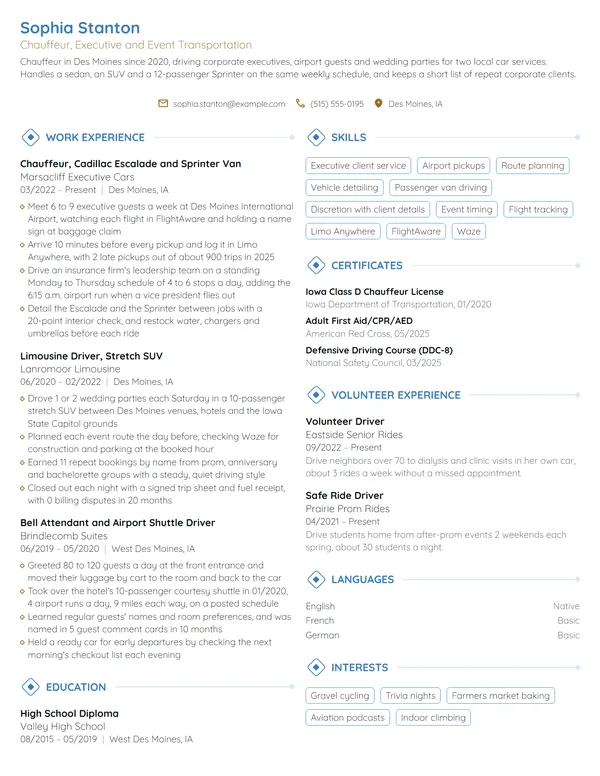
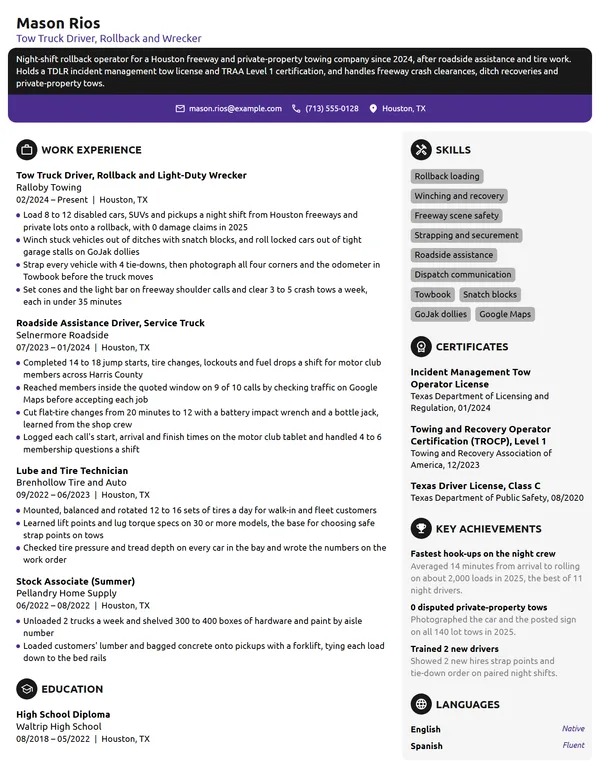
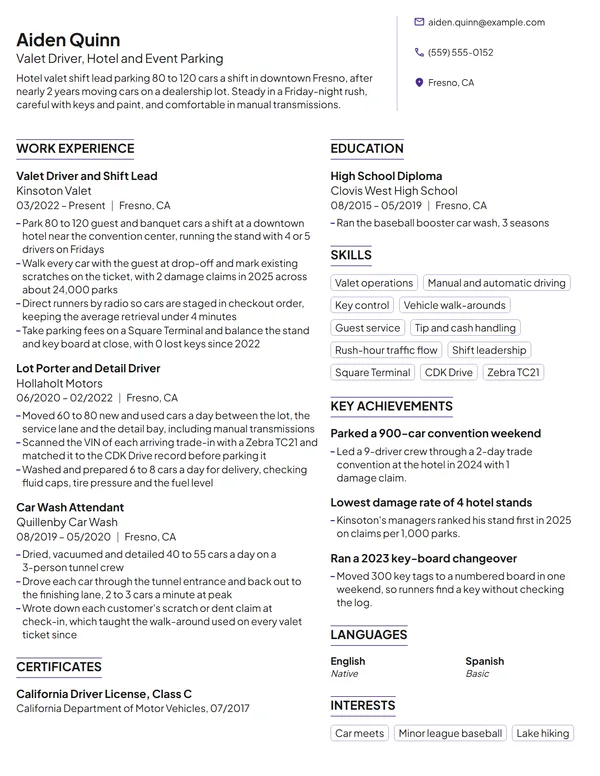
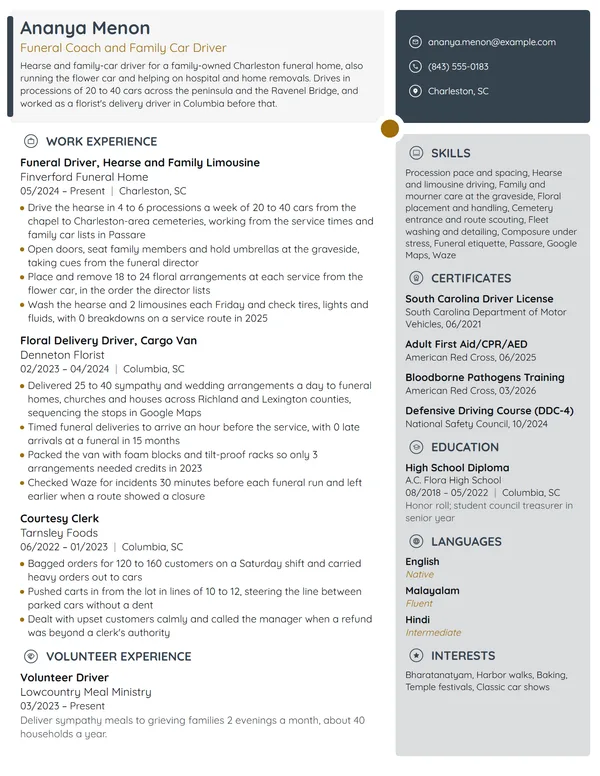
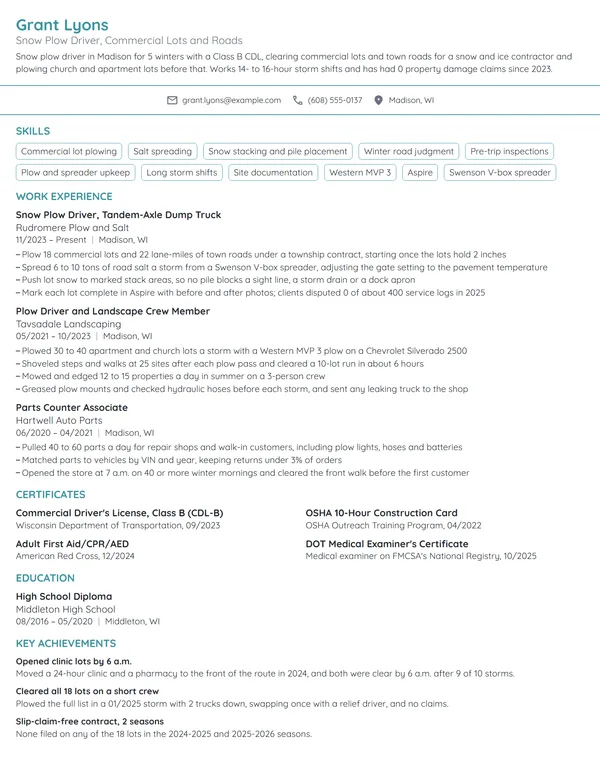
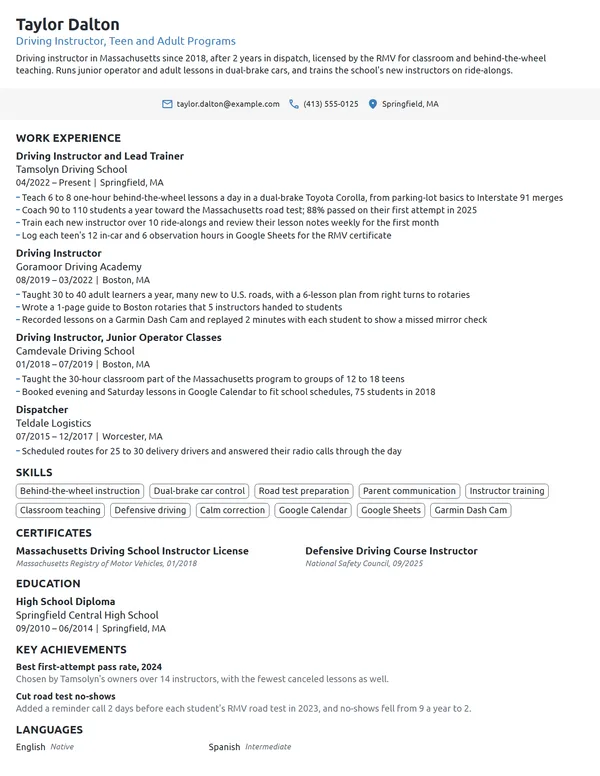
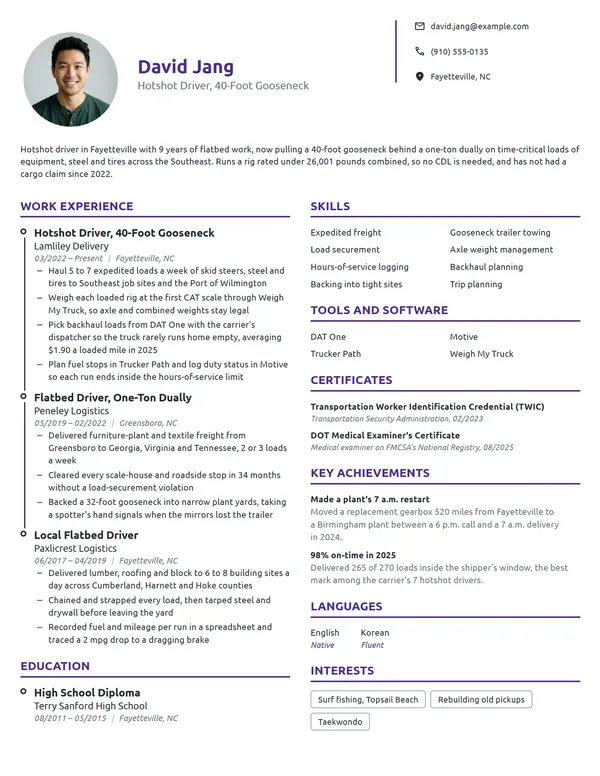
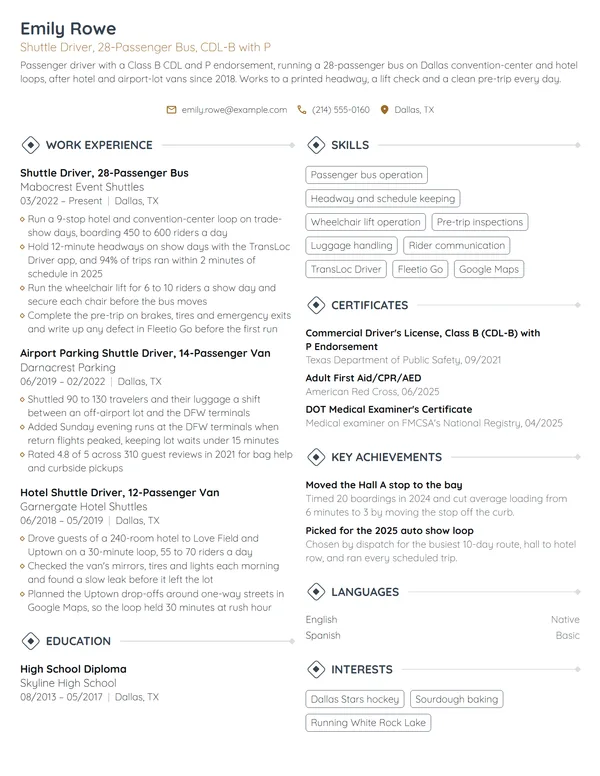
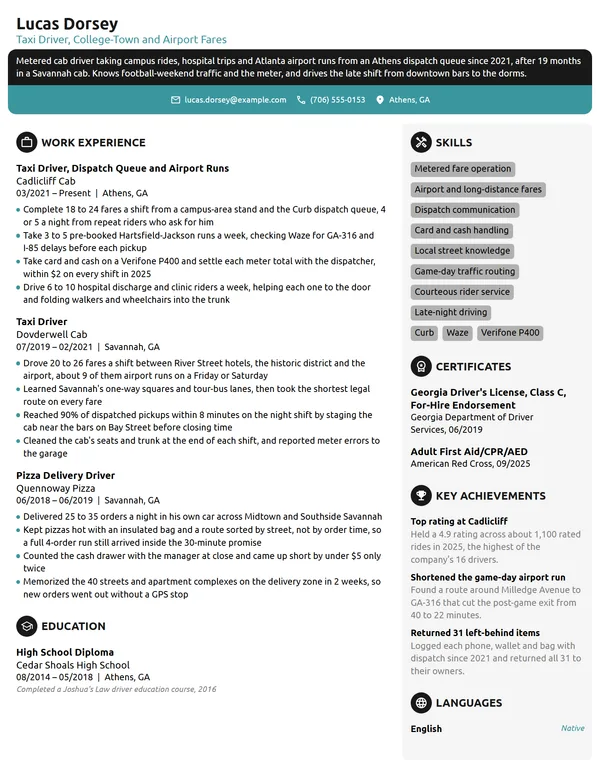
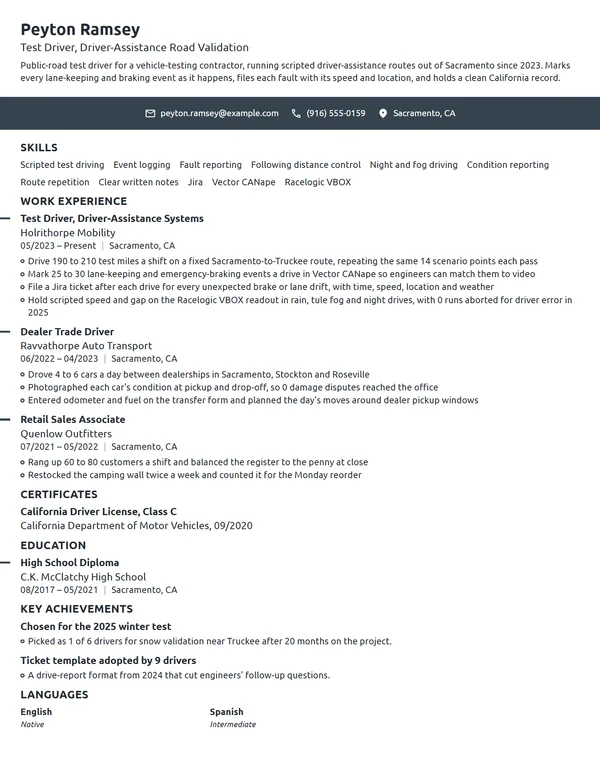
Driving for a living means people count on you to arrive safely and on time. So before anyone hands you the keys, they want to know which license you hold, what you have driven, how clean your record is and whether you turn up for every shift. But "driver" covers everything from a courier van to a 40-foot bus, and a resume that only says you drove leaves the reader guessing which one you are. Name the vehicle, the route and the results, and the guessing stops.
How to Write a Driver Resume - Key Takeaways
- Use the reverse-chronological format on 1 page, with the vehicle and route type in every job title line.
- Open with 2 to 3 lines that name your vehicle, your route or service, your strongest volume number and your safety record.
- Count what a dispatcher counts: stops, riders, on-time rate, safe miles, defects reported and payments collected.
- Check the vehicle, not the job title, to see whether you need a CDL: 26,001+ lb, 16+ people counting the driver, or placarded hazmat.
- List your license first under Certificates, with its class, state and any endorsement, and leave the license number off.
- Run the final file through an ATS resume checker before you upload it to a fleet or delivery contractor's online application.
What employers check on a driver resume
Whoever hires a driver is deciding whether to trust you with a vehicle, its cargo or its riders, and the people waiting on them. The BLS lists talking with customers about pickup and delivery needs, reporting incidents to a dispatcher, accepting payments and handling receipts and delivery confirmations as everyday delivery duties. O*NET adds checking loads against shipping papers, inspecting tires, lights and brakes, and keeping vehicle logs.
Your record matters as much as your experience. A clean driving record is a basic requirement, according to the BLS, and federal rules (49 CFR 391.25) make motor carriers pull and review each driver's motor vehicle record at least once every 12 months. Build your resume from these parts:
- Your name, a headline with your license class or driving specialty, a phone number, an email and your city
- An opening of 2 to 3 lines with no heading above it
- Work Experience, newest first, with the vehicle in each title line
- Skills, including the routing, scanning or dispatch apps you used
- Certificates, with your driver's license or CDL on top and any driver training below it
- Education, with your diploma or the equivalent
- If space allows: Key Achievements, Volunteer Experience or Languages
Best format for a driver resume
Choose the reverse-chronological resume format: your latest driving job on top, then each earlier one with its title, employer, city and MM/YYYY dates. Employers hiring drivers look for steady work and a history they can verify, and a newest-first list shows both at a glance. Keep that order even if your last job was not behind the wheel, and let your opening lines point to the driving.
- Best for most driversReverse-chronologicalYour jobs, newest first, with your results under each one.Best for: A steady work history in your field
- FunctionalSkills grouped up top, with a short work history below.Best for: Gaps or very little experience
- CombinationA skills section first, then your full work history.Best for: A career change with strong skills
A 1-page resume fits nearly every driver, including those with 15 years of jobs, as long as roles older than 10 years shrink to 1 bullet or a single line. Contract and app-based driving gets its own entry with real dates, like any other job, so a run of gig work never looks like a gap.
| Setting | What to use |
|---|---|
| Length | 1 page; older roles cut to 1 bullet before you add a second page |
| Title line | Job title plus vehicle: Route Driver, Class B Box Truck |
| License line | Class, issuing state and endorsements under Certificates; never the license number |
| Dates | MM/YYYY for every job, Present for the one you hold now |
| Typeface | A clean, readable font in 10 to 12 pt, with bold only for job titles |
| Photo and personal data | Usually no photo in the US and Canada; no birth date, Social Security number or license number |
Most US and Canadian resumes carry no photo. Use that space at the top for the details a driving employer checks first: your license class, the vehicles you can drive and the shifts you can work.
Driver resume summary vs. objective
If you have been paid to drive before, write a resume summary: your vehicle, your route or service, your busiest number and your safety record. If this is your first driving job, write a resume objective instead, naming the driving role you want and the record or work history that makes you a safe bet. Finish the rest of the resume first, so every number in the opening already appears in a bullet.
Driver resume summary formula
Job title for type of employer, driving vehicle on route or service. Your strongest volume or on-time number. X years with safety record, holding license and certificates.
Example
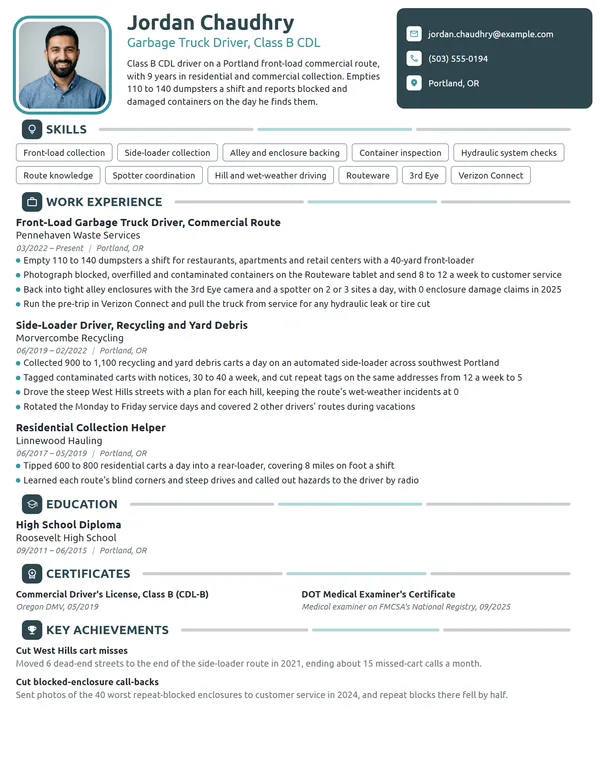
Route driver for a commercial linen service, running a Class B box truck on a fixed 5-day route. Serves 21 hotel, clinic and casino accounts with 99.2% of pickups inside their windows. 7 years with 0 at-fault accidents, holding a Class B CDL and a current DOT medical card.
Don't
Reliable and safe driver with excellent customer service skills looking for a full-time position.
Do
Delivery driver with 4 years on cargo van routes, finishing about 130 stops a day for a parcel contractor. No at-fault accidents and a clean driving record; holds a Class B commercial learner's permit and plans to test in 2027.
The second version names the vehicle, the daily volume, the record and the next license step.
How to write driver work experience bullets with numbers
Give your current job 3 to 4 bullets and earlier jobs 1 to 3, each starting with a verb. When you list work experience on your resume, skip duties every driver shares, such as obeying traffic laws, and count what your route produced. Most of those numbers already sit in your scanner history, dispatch app or trip sheets.
| Area | What to count | Example bullet |
|---|---|---|
| Deliveries | Stops a day, packages, scan accuracy, delivery windows | Completed 120 to 150 package stops a day with 99.5% scan accuracy. |
| Passengers | Riders a shift, trips, departures on time | Carried 60 to 80 riders a shift on a hospital shuttle loop with 97% of departures on time. |
| Safety record | Miles, years without an at-fault accident, moving violations | Drove 85,000 miles over 3 years with 0 at-fault accidents or moving violations. |
| Vehicle care | Pre-trip checks, defects reported, routes missed | Reported 11 brake and tire defects at pre-trip checks in 2025, so the van missed 0 routes. |
| Payments | Cash or card collected, shortages, signed receipts | Collected $3,000 to $5,000 a week in cash-on-delivery payments with 0 shortages. |
| Routing | Stops per route, miles or minutes saved | Re-ordered a 38-stop route to save 14 miles and 40 minutes on each run. |
Here is how a route driver's entry reads once those counts are filled in.
Work Experience
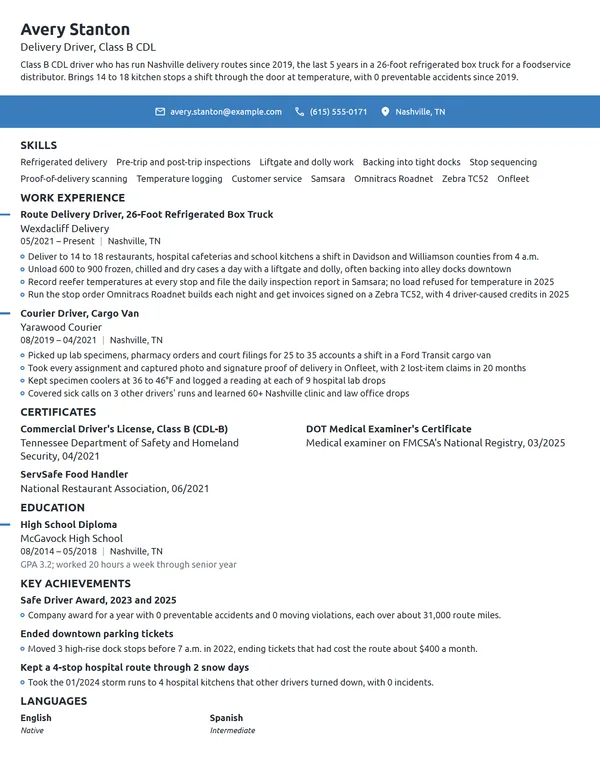
- Deliver clean linens and collect soiled carts at 21 hotel, clinic and casino accounts on a fixed 5-day route across Reno and Sparks.
- Move 260 to 300 carts a week by liftgate and hand truck, with 0 cargo damage claims since 2024.
- Finished 99.2% of scheduled pickups inside each account's delivery window in 2025.
- Trained 3 new route drivers, riding along with each for their first 2 weeks.
- Drove between Reno-Tahoe International Airport and 12 hotels, carrying about 140 riders a shift.
- Logged about 110,000 miles over 4 years with 0 at-fault accidents.
Don't
Drove company vehicle to deliver products to customers.
Do
Delivered 45 to 60 appliance orders a week with a 2-person crew, installing new units and hauling away old ones with 0 damage claims in 2025.
The rewrite gives the volume, the work done at the door and a clean result.
Don't
Transported passengers to their destinations.
Do
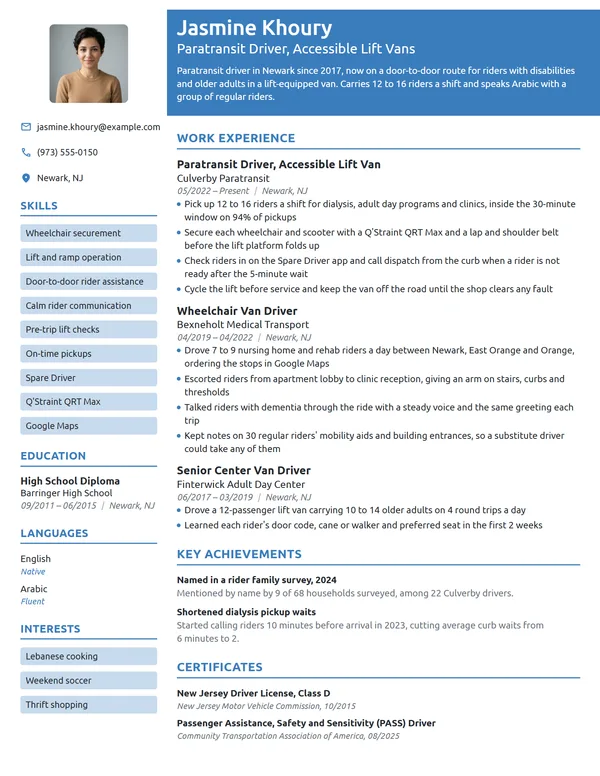
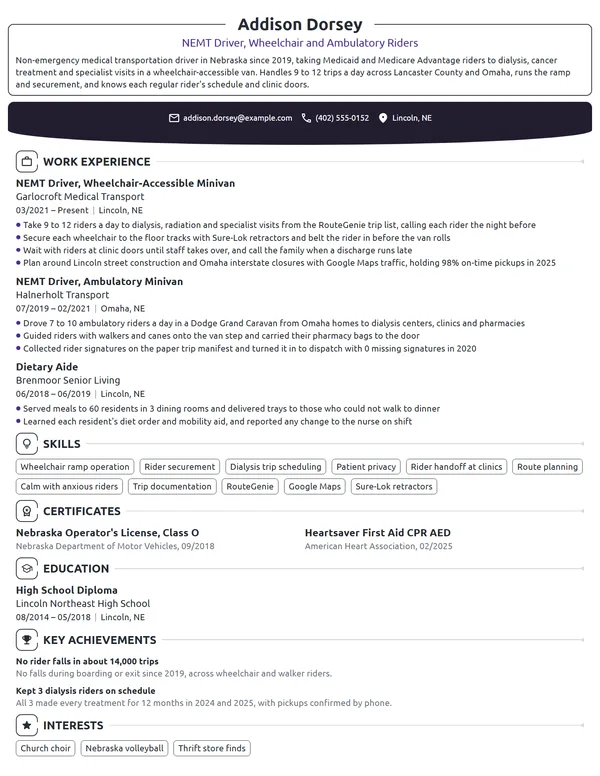
Drove 6 to 9 nonemergency medical trips a day, securing wheelchairs with 4-point tie-downs and logging each pickup and drop-off in the dispatch app.
Driver skills and software for your resume
Choose 6 to 8 hard skills for your resume that the posting names and a bullet already shows. Liftgate and hand truck work suits a delivery route, wheelchair securement a passenger or medical transport job, and backing a large vehicle into docks any box truck or trailer role. On routes with customer contact, add 1 or 2 customer service skills and prove them with a payment, complaint or rating number.
Hard skills for drivers
- Defensive driving
- Pre-trip and post-trip vehicle inspections
- Route planning
- Backing and docking large vehicles
- Load securement
- Liftgate, hand truck and dolly use
- Wheelchair and passenger securement
- Proof-of-delivery scanning
- Cash and card payment handling
- Vehicle cleaning and basic upkeep
Soft skills fleet managers value
- Punctuality
- Calm in traffic and bad weather
- Courtesy with customers and riders
- Sound judgment when working alone
- Clear updates to dispatch
- Physical stamina
For software, write the exact names of the apps you used every shift. O*NET lists package location and tracking software, vehicle location and tracking software and automatic routing software among the tools of light truck drivers, and computer aided dispatch and mapping software for ambulance drivers. Name the handheld scanner, routing app or electronic logging device your employer ran, and show it at work in a bullet, such as taking trip assignments or capturing signatures on it.
Driver's license, CDL and certifications on a driver resume
The BLS says delivery drivers need a driver's license from the state they work in, and many driving jobs need no more than that. List certifications on your resume in the Certificates section with your license at the top, then any CDL endorsement, your DOT medical card and course certificates, each with the issuer and the month you earned it.
| Credential | Issued by | What it takes |
|---|---|---|
| Regular (non-commercial) driver's license | Your state's driver licensing agency | Enough for cars, cargo vans and most light trucks under 26,001 lb; employers also check that your driving record is clean. |
| Class B CDL | Your state's driver licensing agency | Knowledge and skills tests in a single vehicle of 26,001 lb or more, such as a heavy box truck, a dump truck or a city bus. A first Class B since February 7, 2022 also needs entry-level driver training from a provider on FMCSA's Training Provider Registry. |
| Class A CDL | Your state's driver licensing agency | The same steps in a combination of 26,001 lb or more that tows a unit over 10,000 lb, such as a tractor-trailer. |
| P (Passenger) or S (School Bus) endorsement | Your state's driver licensing agency | A knowledge test and a skills test each, plus entry-level training for a first P or S since February 7, 2022. |
| DOT medical examiner's certificate | A certified medical examiner | A physical exam for commercial drivers, repeated at least every 24 months under 49 CFR 391.45. |
Do you need a CDL? Check the vehicle, not the job title
Under 49 CFR 383.5, a vehicle needs a CDL when it weighs 26,001 lb or more, is built to carry 16 or more people counting the driver, or hauls hazardous materials that require placards. A courier in a cargo van and a shuttle driver in a 15-passenger van usually drive on a regular license, while the same job in a heavier truck or a larger bus needs a CDL. If you hold a CDL, put its class in your headline so a reader sees it before the bullets; if you do not, list your regular license by state and let your record do the work.
Certificates
- Commercial Driver's License, Class B, Nevada DMV, 03/2023
- DOT Medical Examiner's Certificate, certified medical examiner, 02/2025
- Entry-Level Driver Training, Class B (theory and behind-the-wheel), completed 02/2023
Education and driver training on a driver resume
According to the BLS, delivery drivers typically start with a high school diploma or the equivalent and learn the route in 1 month or less of on-the-job training. Follow the basic rules for listing education on a resume: the diploma, where you earned it and the year it was awarded. List a CDL training program or a defensive driving course under Certificates with the date you finished, since that is the training a driving employer reads for.
Federal rules (49 CFR 380.609) require registered entry-level training for a first Class A or Class B CDL and for a first P, S or hazmat endorsement. A license or endorsement issued before February 7, 2022 had no such requirement, so drivers licensed earlier can leave the training line out.
Education
Entry-level, career-change and ambulance driver resumes
For your first paid driving job, use an entry-level resume layout: a short objective, your license and record near the top, then any work that shows you are dependable, careful with equipment and good with customers. Put the same kind of number on each item that a full-time route would get.
- Food or grocery delivery in your own car: orders a week, customer rating and months on the platform.
- Warehouse or dock work: forklift or pallet jack time, orders picked a shift and safety record.
- Valet, car rental or dealership lot work: vehicles moved a shift and damage-free months.
- Driving for a club, church or family business: trips, riders or deliveries, listed under Volunteer Experience if unpaid.
Don't
Looking for a driving job where I can grow with the company.
Do
Warehouse associate with 3 years of forklift and dock work and a clean driving record, seeking a local route driver role. Passed a road test in a 16-foot box truck in 08/2026.
An objective still needs evidence: the record, the related work and the vehicle you have already handled.
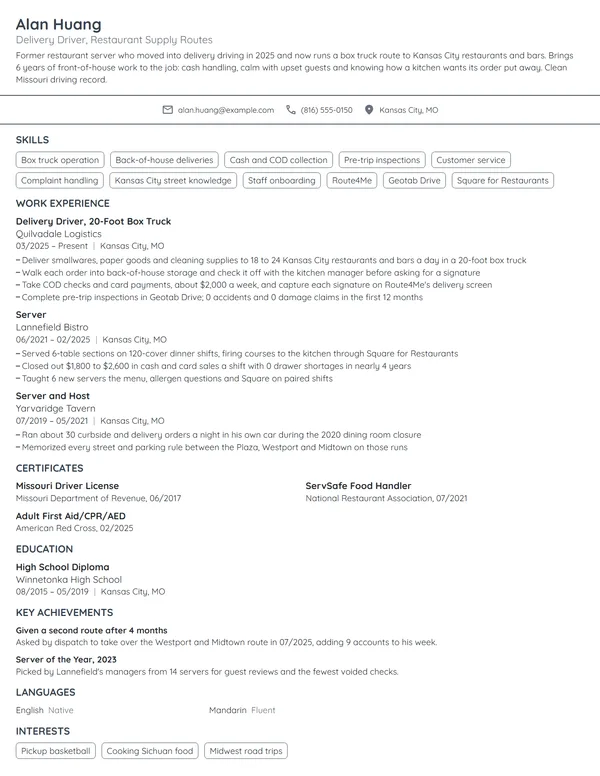
Moving from restaurant, retail or warehouse work, keep the newest-first order and open with the transferable skills a fleet uses: being on time every shift, handling cash, keeping customers calm and knowing the city's streets. A career-change resume works when the first bullets under your current or last job are the ones closest to driving, each with a number.
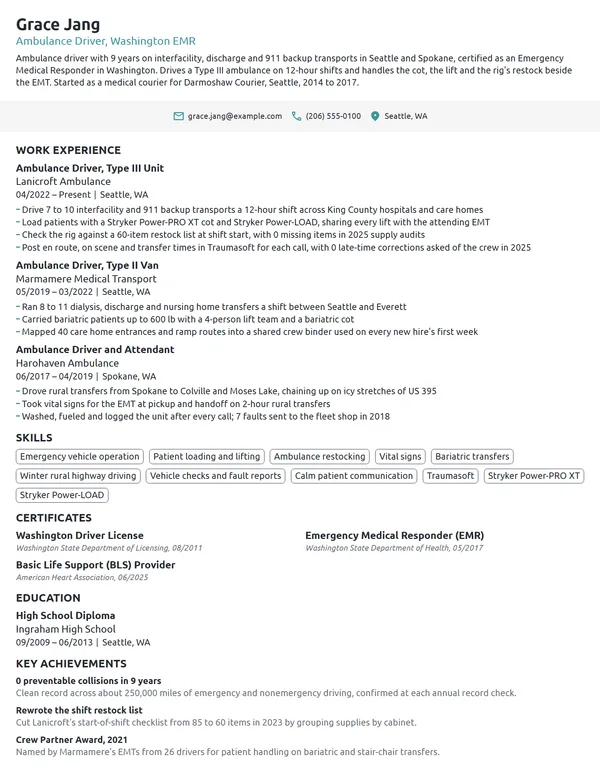
An ambulance driver's resume is read for patient handling as much as for driving. O*NET lists loading patients on stretchers, restocking supplies, accompanying EMTs on calls and keeping the right certifications current as the job's core tasks, so show transports per shift, restocking routines and any state EMR or EMT certification or CPR card you hold under Certificates, plus an emergency vehicle operator course if your service ran one. Leave the photo off, as on any emergency services resume. If you work the patient side as well, compare the EMT resume layout.
Driver resume FAQ
Do I need a CDL to work as a driver?
Only for larger vehicles. Under 49 CFR 383.5, you need a CDL for a vehicle of 26,001 lb or more, one built to carry 16 or more people including the driver, or one hauling placarded hazardous materials. Cars, cargo vans and most light delivery trucks run on a regular license.
Should I mention my driving record on my resume?
Yes, if it is clean. Write it as a result, such as 0 at-fault accidents in 5 years, in your opening lines or a bullet. Employers pull your motor vehicle record anyway, and motor carriers must review it at least every 12 months, so never claim more than the record shows.
How do I list gig or delivery app driving on a resume?
Give it a Work Experience entry like any job: a title such as Independent Delivery Driver, the platform or platforms, your city and MM/YYYY dates. Then count orders or trips a week, your rating and your on-time rate. Several apps at once can share one entry.
What should an ambulance driver put on a resume?
Lead with your license, any state EMR or EMT certification and your CPR card under Certificates. Then show transports a shift, stretcher loading, restocking and work alongside EMTs, the tasks O*NET lists for the job. Leave the photo off, as on any emergency services resume.
Can I get a driving job with no experience?
Yes, for many local routes. The BLS says delivery drivers usually start with a high school diploma and 1 month or less of on-the-job training, and need a state license and a clean driving record. Open with an objective that shows your record and any related work.
How long should a driver resume be?
Keep it to 1 page. Give your current job 3 to 4 bullets with numbers, cut jobs older than 10 years to 1 bullet or a single line, and keep the license and certificates on that same page.
Do I need a passenger endorsement to drive a shuttle van?
Not for most vans. Federal rules make a vehicle built for 16 or more people, counting the driver, a commercial vehicle that needs a CDL with a P endorsement, which takes a knowledge and a skills test. A 15-passenger van stays under that line.
Should I put my availability on a driver resume?
Yes, in 1 short line when the job ad asks about shifts. Name what you can work, such as early mornings, weekends or overnight routes, in your opening lines. Leave out the reasons behind any limits; the interview is the place for those.
Next steps
Start from the example whose vehicle and route look most like yours, then swap in your own stops, riders, safe miles and license line. Build it in our resume builder or begin from one of the resume templates, and send it with a cover letter that names the vehicle and the shifts you can take.