
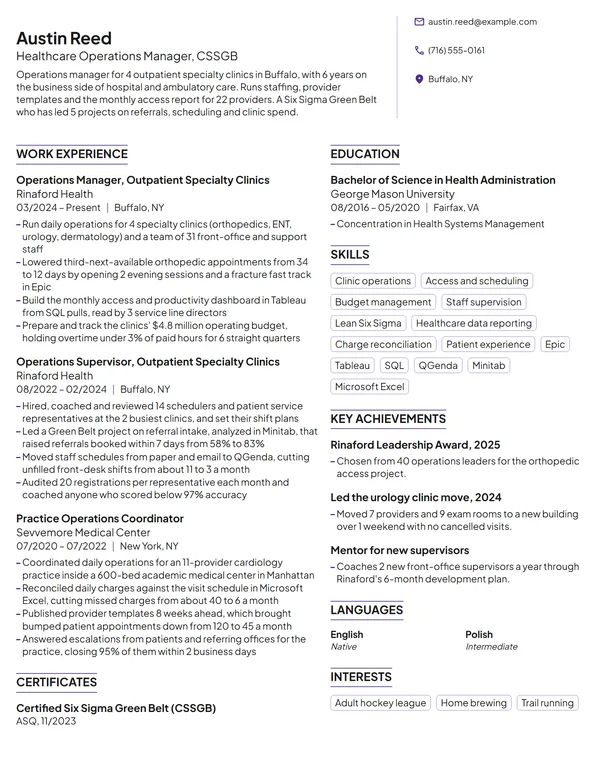
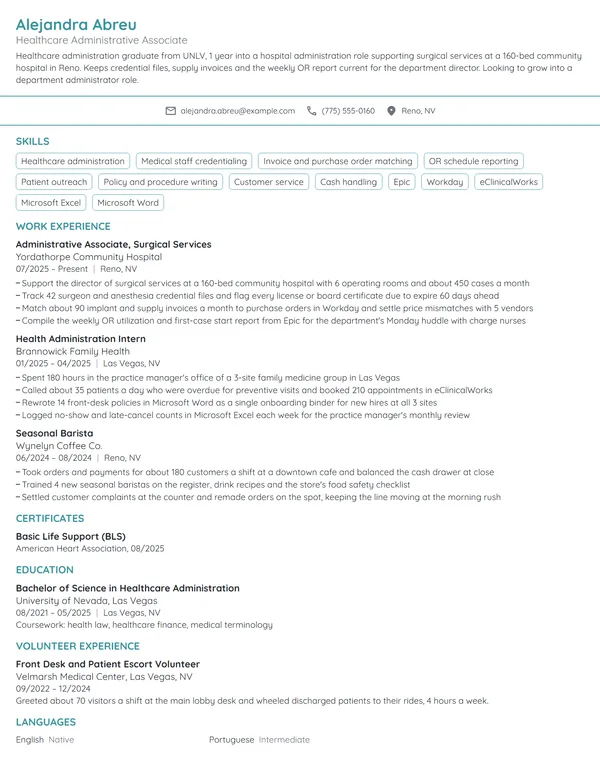
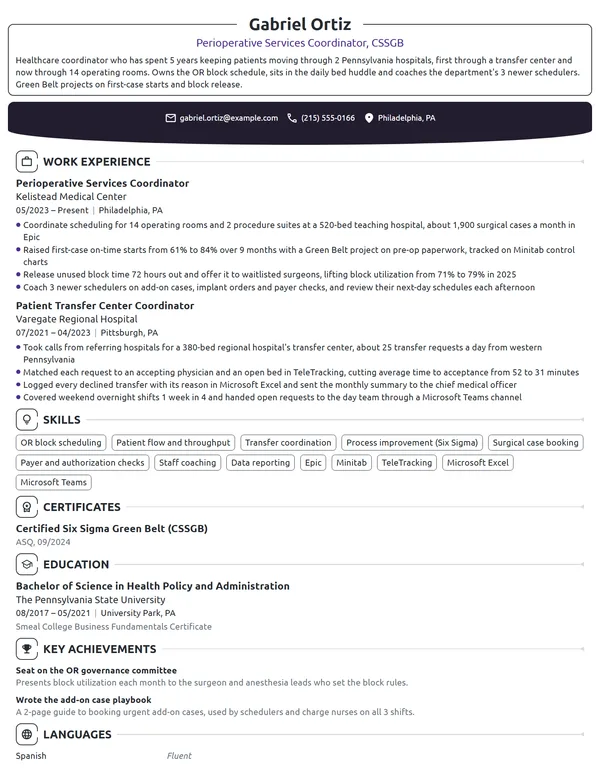
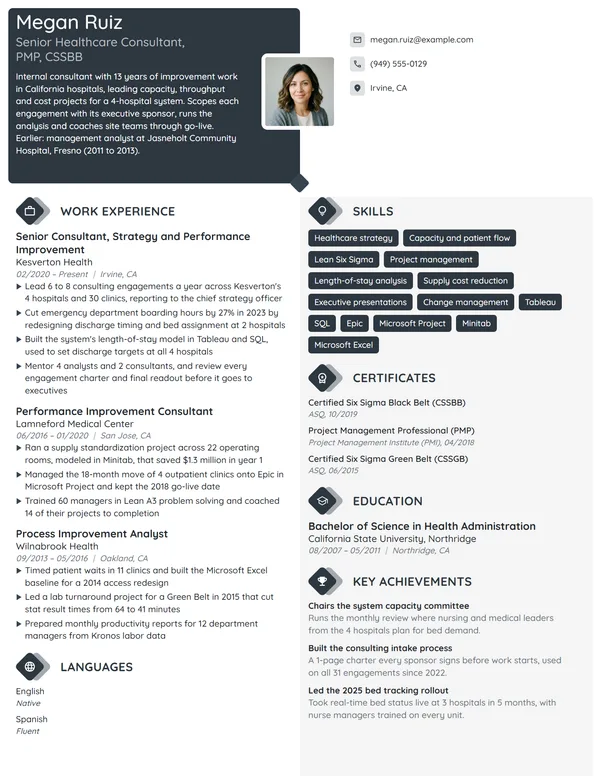
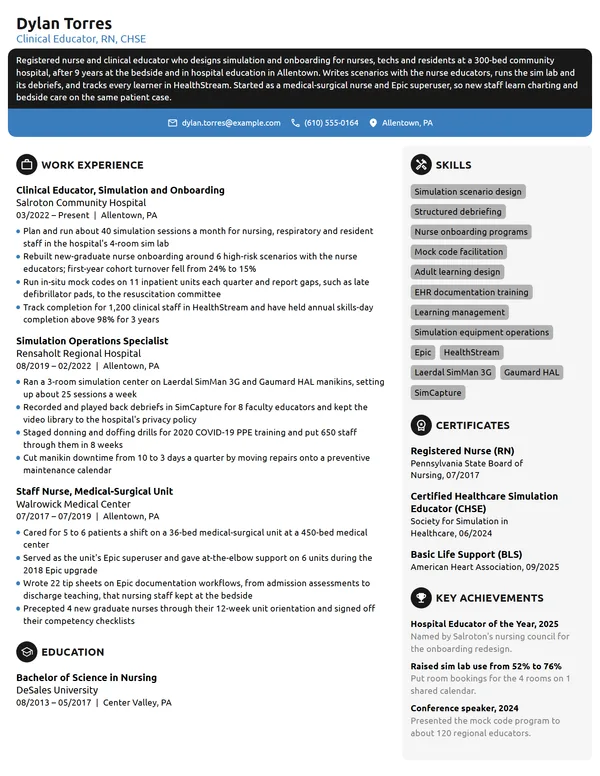
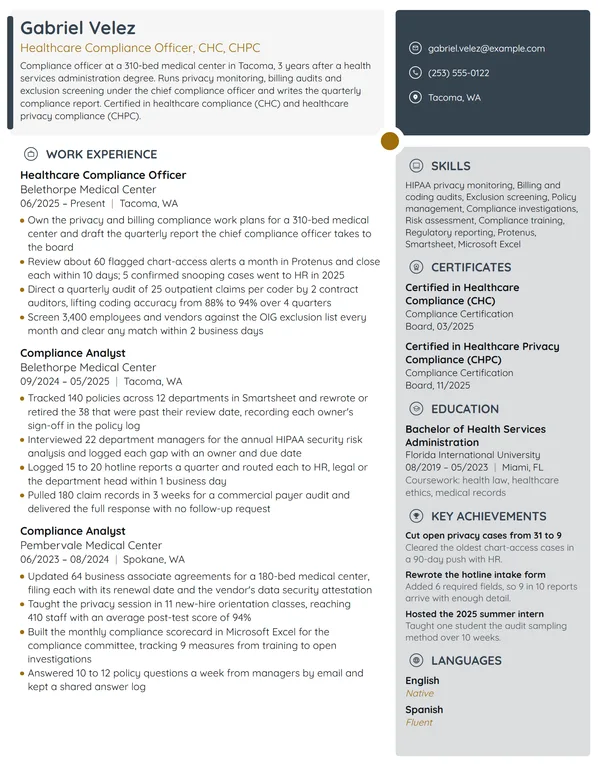
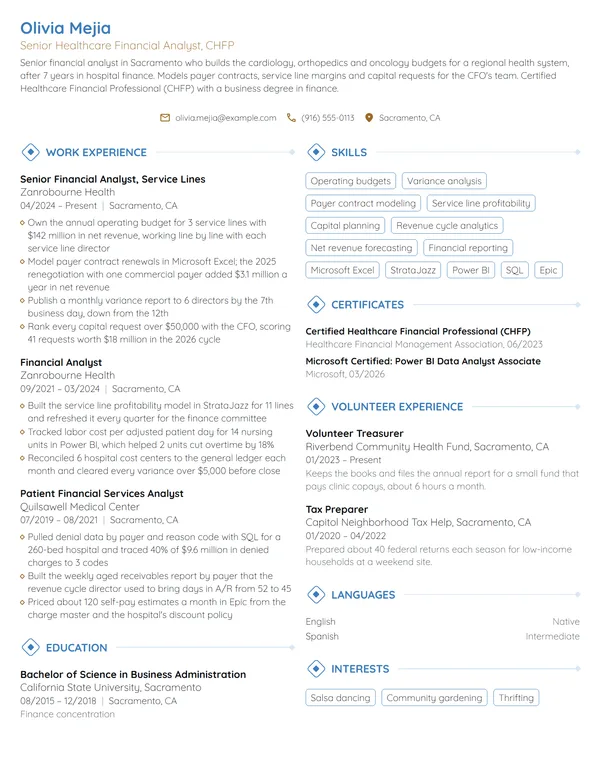
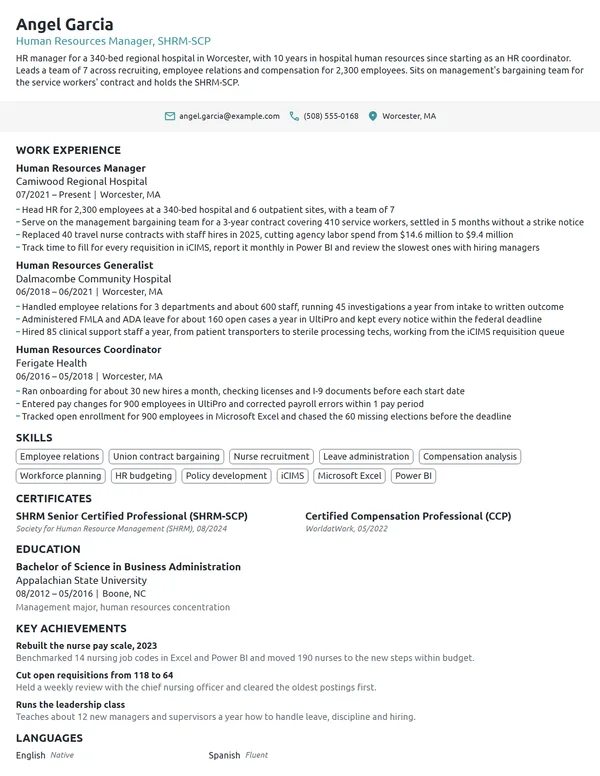
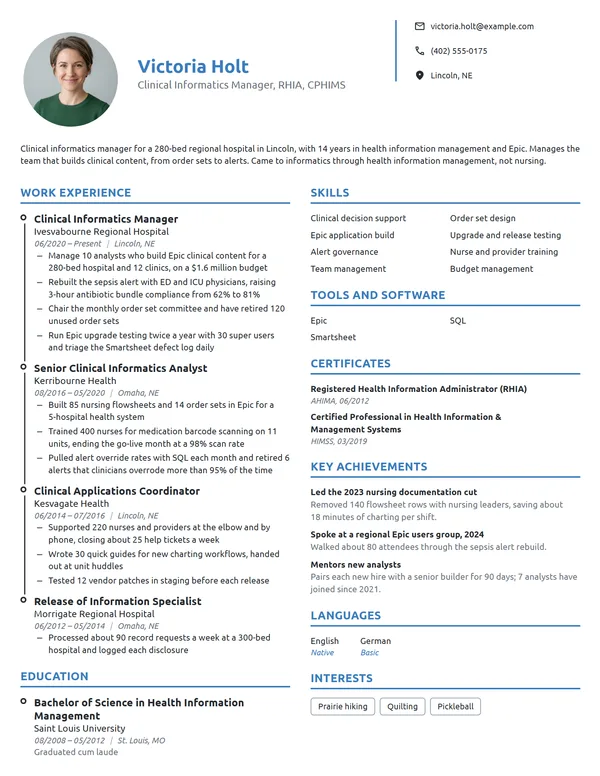
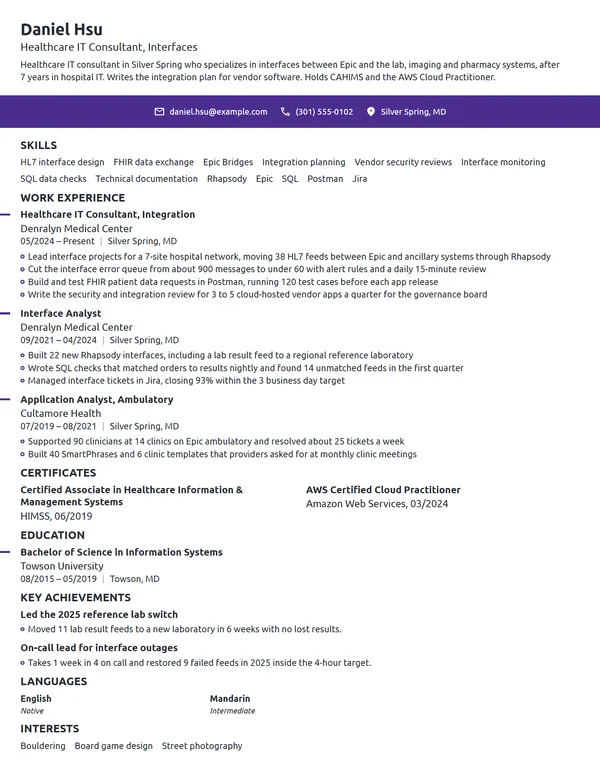
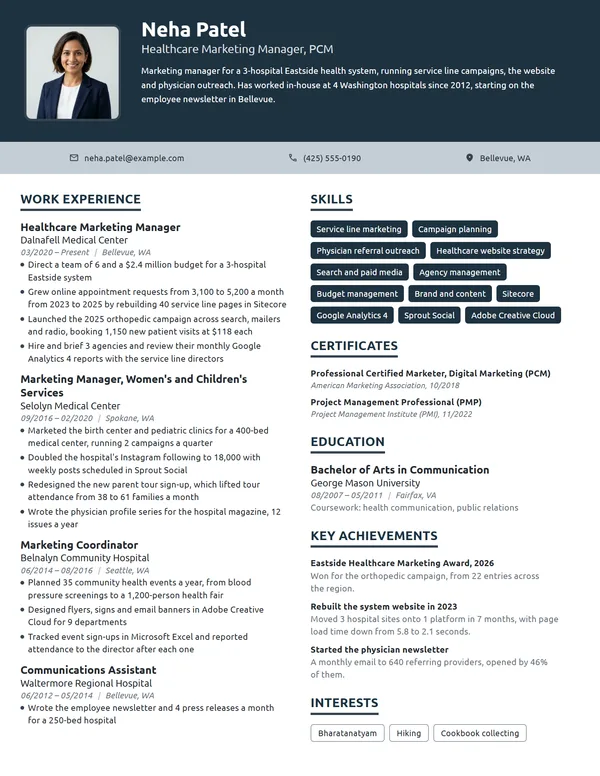
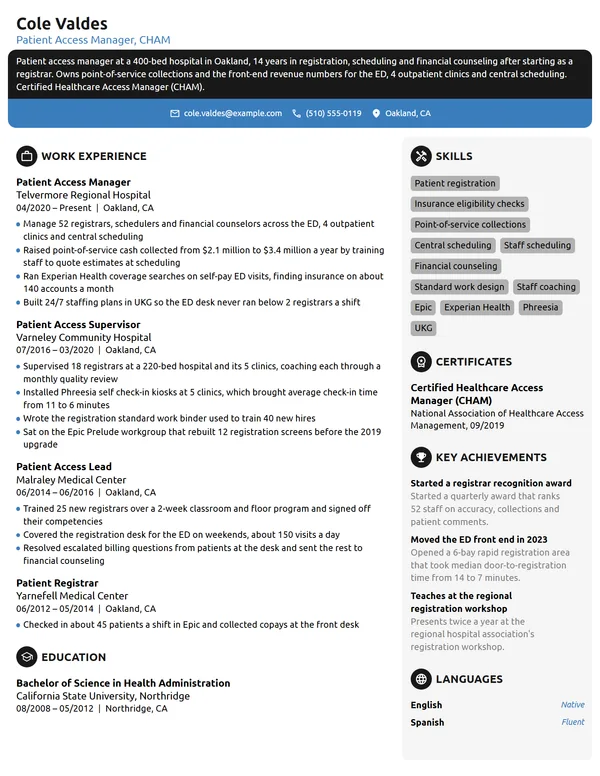
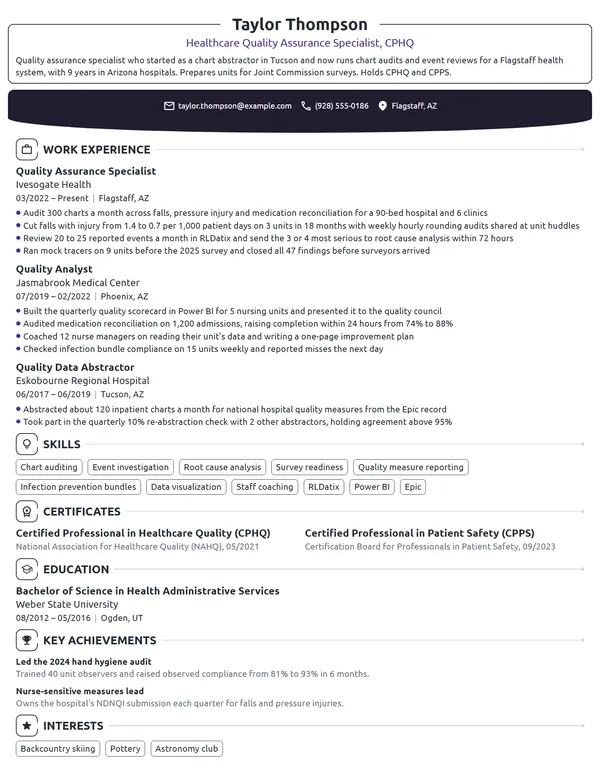
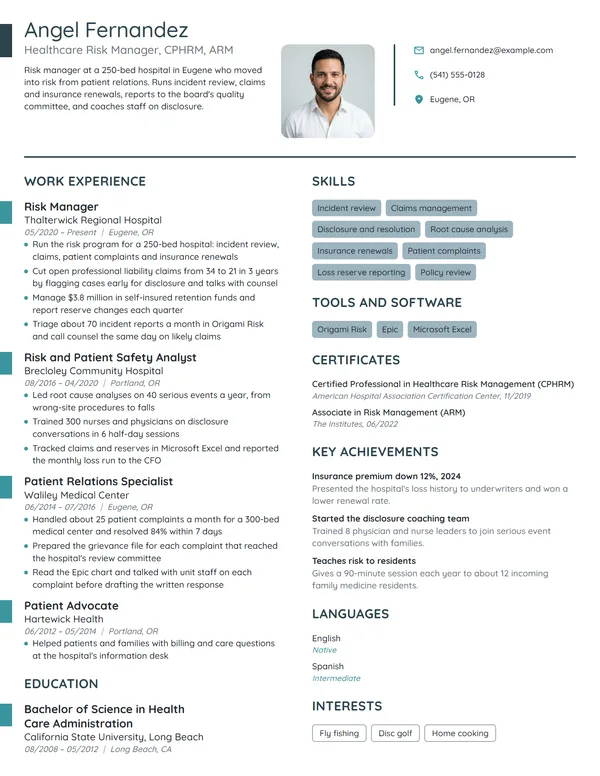
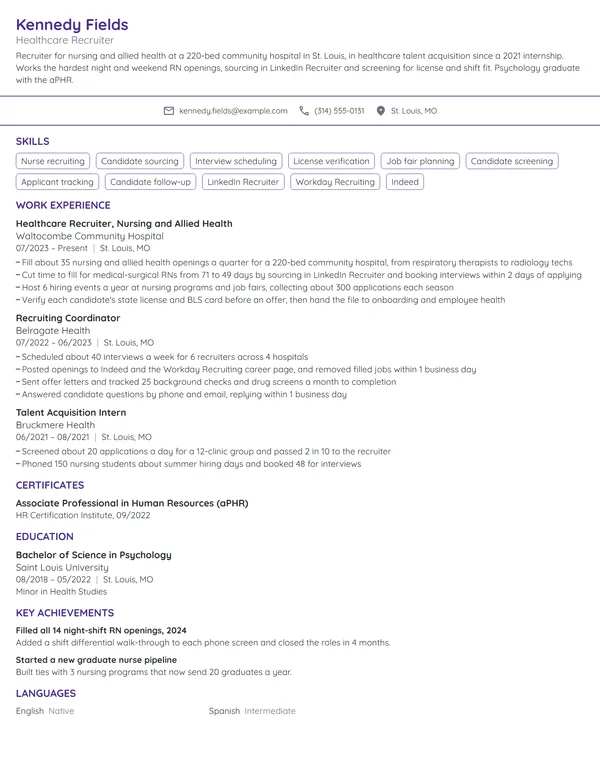
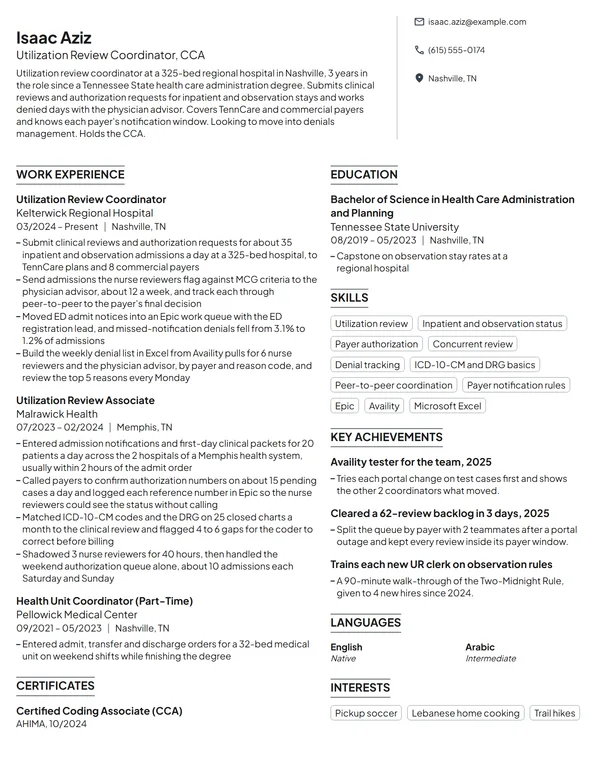
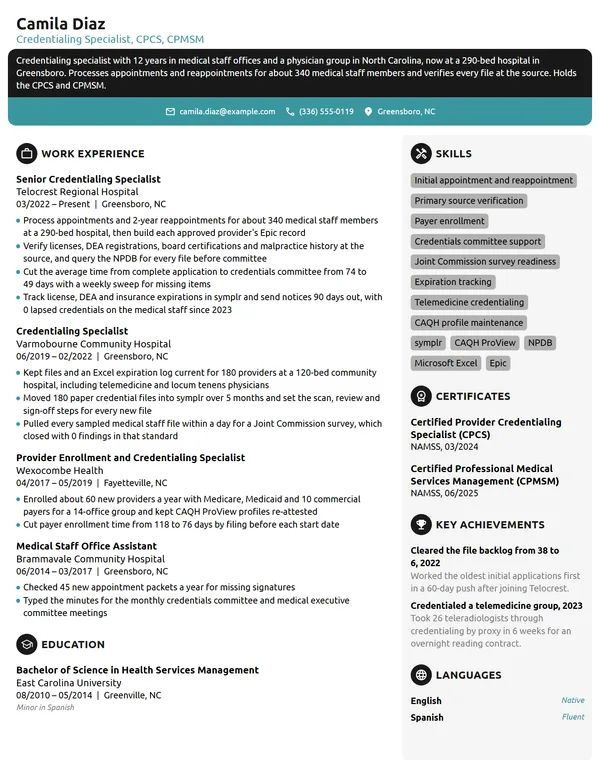
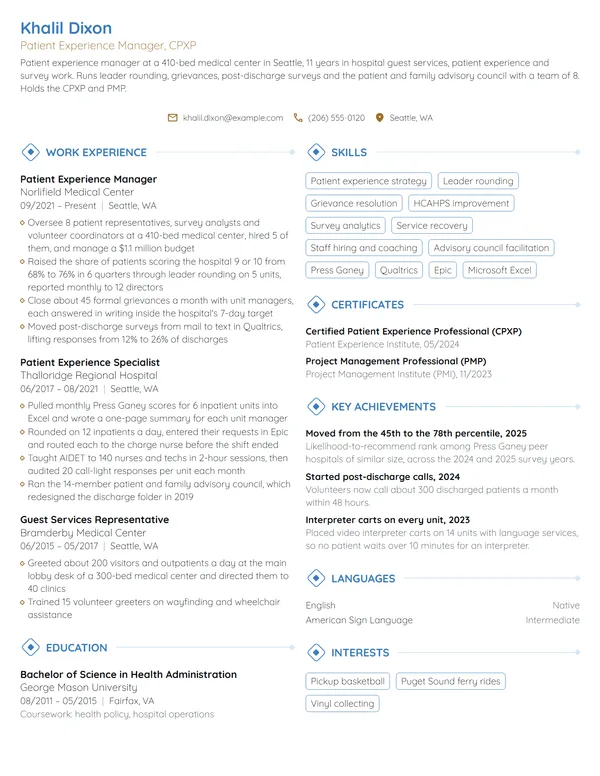
Healthcare depends on people who keep care safe, organized and paid for, at the bedside and in the offices behind it. Whatever your role, the first questions are about the kind of facility you worked in, the systems you use, the credentials you hold and what your work improved. Patient privacy keeps names and details off your resume, so results have to come through as counts and percentages. Your facility type is the natural first detail in each job.
How to Write a Healthcare Resume - Key Takeaways
- List your newest job first and work backward, on 1 page until you have 10+ years or several leadership roles.
- Open each job with its setting: the facility type, its size and the patients, providers or staff you served.
- Back every bullet with a number your department reports, such as no-show rates, denial rates, audit scores or staff trained.
- Describe patients only in counts and groups, never with a name, a date of service or a record number.
- Name your EHR and billing systems exactly, Epic or MEDITECH for example, in Skills and again inside a bullet.
- Put a state license first under Certificates if you hold one, then run the file through an ATS resume checker before you apply.
What hiring managers look for in a healthcare resume
A healthcare hiring manager wants to see a setting close to theirs, systems they already run, and proof that your work made care safer, faster or cheaper to deliver. The BLS lists developing goals for the efficiency and quality of healthcare services, keeping a facility compliant with laws and regulations, managing budgets and billing, and recruiting and training staff as core duties of medical and health services managers. O*NET adds building staff schedules around workload, space and equipment.
Those duties show up in coordinator, analyst and consultant jobs too, so write each one with its scale: how many clinics, providers, claims or staff. A clinical role adds a license and a unit or specialty, and both belong near the top.
- Name, headline (for example, Clinic Operations Coordinator or Healthcare Compliance Analyst, CPC) and contact details
- A 2- to 3-line opening summary; it prints without a heading
- Work Experience, newest first, with the facility type in the first bullet
- Skills, with your EHR, billing and reporting systems among them
- Certificates, led by any state license
- Education
- Optional: Key Achievements, Volunteer Experience or Languages
Best format for a healthcare resume
Use the reverse-chronological resume format: your current job first, then each earlier one with its title, employer, city and MM/YYYY dates. Healthcare careers tend to climb inside one track, from representative to supervisor to manager, or from staff nurse to educator, and this order makes that climb easy to follow. If you moved between departments at one hospital, list each title under the same employer with its own dates.
- Best for most healthcare jobsReverse-chronologicalYour jobs, newest first, with your results under each one.Best for: A steady work history in your field
- FunctionalSkills grouped up top, with a short work history below.Best for: Gaps or very little experience
- CombinationA skills section first, then your full work history.Best for: A career change with strong skills
Keep 1 page while you have fewer than 10 years of experience. Directors, consultants and project leads with a decade or more can use 2 pages, provided page 1 carries the current role, its scale and the credential the posting asks for.
| Setting | What to use |
|---|---|
| Length | 1 page under 10 years; 2 pages for long leadership or consulting careers |
| Setting line | Facility type and size under each employer: 3 outpatient clinics, a 200-bed community hospital |
| Dates | MM/YYYY for every role, and Present on the one you hold now |
| Typeface | One readable sans serif, body text between 10 and 12 pt |
| Patient details | Counts and groups only; no names, dates of service or record numbers |
| Photo and personal data | Usually no photo in the US and Canada; leave off your birth date, marital status and SSN |
Most US and Canadian resumes carry no photo. Health systems hire through large applicant portals that copy your resume into their own fields, so standard section headings and a PDF with real text beat a heavily designed page.
Healthcare resume summary vs. objective
Pick by one test: have you held a paid job in healthcare? If yes, write a resume summary with your title, years, setting, main system and 1 result. If not, because you are a new graduate or coming from retail, hospitality or the military, write a resume objective that names the role you want and the closest evidence you have, such as an internship or a patient-facing job. Write it after your bullets are done, so it can borrow their best number.
Healthcare resume summary formula
Title with X years in setting, working in system. Your best result and the figure behind it. Degree, license or certification, or the next one you are working toward.
Example
Patient access supervisor with 5 years in outpatient registration and scheduling, working in Epic. Led a team of 9 that cut registration errors found on claims from 6.1% to 2.4%. Holds a CPC-A and takes the CPHQ exam in 2027.
Don't
Dedicated healthcare professional with a passion for helping patients and improving outcomes.
Do
Referral coordinator with 4 years in specialty care, supporting 2 cardiology clinics in Epic. Brought the open referral backlog from 300 to 40 by setting a 48-hour first-contact rule.
The rewrite names the job, the setting, the system and a result someone could check.
How to write healthcare work experience bullets with numbers
Give each job 3 to 4 bullets and trim the oldest first when space runs short. Let the first bullet set the scale, such as staff supervised, sites covered or patients a day, because every later number reads against it. Then pick results your department already reports: health systems measure almost everything, so writing your achievements usually means finding the right dashboard, not inventing a metric.
| Area | What to count | Example bullet |
|---|---|---|
| Scheduling and access | Appointments a day, schedule fill, no-shows, wait times | Rebuilt template blocks for 8 primary care providers and raised same-day schedule fill from 78% to 91%. |
| Revenue cycle | Clean claim rate, denials, days in accounts receivable | Traced denials to missing prior authorizations and cut the denial rate from 11% to 7% in 2 quarters. |
| Compliance and privacy | Audits passed, findings closed, staff trained | Delivered annual HIPAA training to 140 staff and closed every quarterly audit with 0 repeat findings for a year. |
| Clinical education | Staff trained, competency pass rates, hours of instruction | Took 38 clinical staff through a new infusion pump competency check, with 35 passing on the first attempt. |
| Operations and budget | Budget managed, cost saved, vendors, volume | Managed a $210,000 annual supply budget and saved $26,000 by consolidating 2 vendors. |
In the sample below, the setting comes first, the results follow, and the earlier job is trimmed to 1 line.
Work Experience
- Supervise 9 registration and scheduling staff across 3 outpatient clinics that see about 420 patients a day.
- Cut registration errors found on claims from 6.1% to 2.4% in 12 months by adding an insurance eligibility check at check-in in Epic.
- Redesigned reminder calls and texts, lowering the no-show rate across the 3 clinics from 14% to 9%.
- Registered and verified insurance for about 60 patients a day at a 2-site family practice.
Don't
Responsible for scheduling patient appointments.
Do
Scheduled about 75 appointments a day for 6 providers and kept same-week access for urgent visits above 90%.
Volume, provider count and an access measure turn a duty into a result.
Patient stories are tempting, because they are often your best work. HIPAA's Safe Harbor standard lists 18 identifiers that must come out of data before it counts as de-identified, starting with names, every part of a date except the year, and medical record numbers. Use that list as a checklist for your bullets: describe patients as counts and groups, never as people a former colleague could recognize.
Don't
Fought for 3 weeks to get a 67-year-old lung cancer patient's chemotherapy approved by his insurer before his March appointment.
Do
Managed about 48 prior authorizations a week for an oncology practice and cut average turnaround from 5 to 2 business days.
The second version keeps the advocacy and drops every detail that points to one patient.
Healthcare skills and software for your resume
Choose 6 to 8 hard skills for your resume from the posting and keep only the ones a bullet proves. A revenue cycle role and a clinical education role share few skills, so build this list fresh for each application instead of keeping one long list for every job.
Hard skills for healthcare jobs
- Patient registration and scheduling
- Insurance verification and prior authorization
- Medical billing and claims follow-up
- ICD-10-CM and CPT coding
- HIPAA privacy and compliance
- Quality improvement (Lean, PDSA)
- Healthcare data reporting
- Budget management
- Staff training and competency checks
- Policy and procedure writing
Soft skills healthcare employers value
- Discretion with private information
- Calm with upset patients and families
- Working across clinical and business teams
- Attention to detail
- Clear written instructions
- Following through on handoffs
O*NET marks Epic Systems, MEDITECH and eClinicalWorks as hot technologies for medical and health services managers, along with Tableau and SQL for reporting and Microsoft Excel, which it also flags as in demand. The BLS notes that these managers must keep up with the coding and EHR systems their facility adopts. Write each system as the posting does, list it with your skills, and name it once more in a bullet that shows what you did in it.
Healthcare certifications and licenses on a resume
Licensed clinicians list the state license first under Certificates, then any specialty credential; for nursing, follow the license rules on the nurse resume page. On the business side, a certification shows a hiring manager you already know the department's work. List certifications on your resume in a Certificates section, each with its full name, issuer and month earned.
| Credential | Issued by | What it takes |
|---|---|---|
| CPC (Certified Professional Coder) | AAPC | Passing the CPC exam; without 2 years of coding experience you hold CPC-A until the apprentice status is removed. Renewal takes 36 CEUs every 2 years. |
| RHIT (Registered Health Information Technician) | AHIMA | An associate-level health information management program accredited by CAHIIM, then the exam. |
| CPHQ (Certified Professional in Healthcare Quality) | National Association for Healthcare Quality (NAHQ) | No formal eligibility rules; NAHQ recommends 2 years in healthcare quality. Recertification every 2 years. |
| CSSGB (Certified Six Sigma Green Belt) | ASQ | 3 years of work in areas of the Green Belt body of knowledge, with no education waiver, and a 110-question exam. |
| FACHE (Fellow of the American College of Healthcare Executives) | American College of Healthcare Executives | 1 year of ACHE membership, a master's degree, a current healthcare management job with 5 years of experience, 36 CE credits and 4 volunteer activities in 3 years, 2 references and the Board of Governors Exam. |
How to list CPC-A or a credential in progress
Write an apprentice credential exactly as issued, CPC-A, since claiming the full CPC early is easy to check and hard to explain. For an exam you have not passed yet, write the credential's full name and add scheduled or in progress with the month, and keep its initials out of your headline until you hold it.
Certificates
- Certified Professional Coder (CPC-A), AAPC, 09/2024
- Certified Professional in Healthcare Quality (CPHQ), National Association for Healthcare Quality, exam scheduled 03/2027
How to list a health administration degree on a resume
The BLS says medical and health services managers typically need a bachelor's degree, though some employers hire with an associate's degree and others prefer a master's, which top executive roles may require. That makes your degree's exact name worth writing out: a Bachelor of Science in Health Services Administration tells a recruiter more than a B.S. in Business. A master's, such as an MHA, goes above the bachelor's, and FACHE requires one.
When you list education on a resume, give the degree, school, city and graduation month. Recent graduates can add an internship or practicum in 1 line under the degree, with its hours and the office it served; after a few years in the field, the degree, school and date are enough.
Education
Internship: 300 hours in a hospital patient financial services office.
Entry-level and career-change healthcare resumes
A first healthcare job is usually won on transferable proof: front-desk speed, accuracy with data, and calm with people who are worried or ill. Use the entry-level resume layout if you are just out of school, and put any work in a clinic, pharmacy or nursing home in a full Work Experience entry, since a recruiter reads it as healthcare experience. A front-office start such as a medical administrative assistant role is a common first step.
- Internships and practicums: the office or department, your hours and 1 task with a count, under Education or as a Work Experience entry.
- Customer-facing jobs: transactions or customers a shift, complaints resolved, cash drawers balanced.
- Hospital or clinic volunteering: under Volunteer Experience, with hours and the people you helped each week.
- Coursework that maps to the job: medical terminology, billing and coding or health law, in 1 line under the degree.
Don't
Motivated recent graduate seeking an entry-level position in the healthcare industry.
Do
Health services administration graduate (05/2026) seeking a patient access or clinic coordinator role. Completed a 240-hour internship in a hospital revenue cycle office after 2 years as a pharmacy cashier.
An objective works when it names the role and the evidence, not the wish.
Moving from a clinical job into administration, or from another industry into healthcare, stay with the newest-first order and rewrite older bullets around what carries over: scheduling, training, audits, budgets or patient volume. A nurse or therapist moving into education or quality should lead with those projects. The career-change resume layout shows the structure. Explain the reason for the move in your cover letter, where healthcare cover letter examples show how to keep it to a short paragraph.
Healthcare resume FAQ
Can I mention patients on a healthcare resume?
Yes, as numbers and groups only. Write about patients a day, referrals handled or a clinic's population, and leave out names, dates of service, record numbers and any detail that points to one person. HIPAA's Safe Harbor list of 18 identifiers makes a good checklist.
How long should a healthcare resume be?
1 page for most coordinators, representatives and early-career staff. Managers, directors and consultants with 10+ years can use 2, as long as page 1 carries the current role, its scale and the credential the posting asks for.
Do I need a degree for a healthcare administration job?
Usually. The BLS says medical and health services managers typically need a bachelor's degree, some employers accept an associate's and others prefer a master's. Front-office and coordinator jobs often hire on experience, so list any healthcare work in full.
Should I list BLS certification on a non-clinical healthcare resume?
Only if the posting asks for it or the job puts you with patients, such as a front desk or a clinical educator role. When you list it, write Basic Life Support (BLS), the American Heart Association and the month, under Certificates.
Which EHR systems should I put on a healthcare resume?
The ones you used, named as the employer names them. O*NET lists Epic Systems, MEDITECH and eClinicalWorks among the hot technologies for health services managers. Put each in Skills and in one bullet that shows the task, such as building schedules or running reports.
How do I move from a clinical job into healthcare administration?
Lead with the administrative work you already did as a clinician: charge shifts, schedules, audits, training or committee projects, each with a number. Keep your license under Certificates, since many administrative roles value it, and add any management coursework or certification in progress.
What does the A in CPC-A mean on a resume?
It stands for apprentice. AAPC adds it when you pass the CPC exam without 2 years of coding experience. Write CPC-A exactly as issued until AAPC removes the designation, then update the line to CPC.
Is healthcare still a growing field?
Yes. The BLS projects employment in healthcare occupations to grow much faster than the average for all occupations from 2025 to 2035, with about 1.9 million openings a year, counting new jobs and the need to replace workers who leave.
What is the median salary in healthcare?
The BLS reports median annual wages in May 2025 of $86,530 for healthcare practitioners and technical occupations, $38,340 for healthcare support occupations and $123,860 for medical and health services managers. Pay varies by job family, so keep it off your resume and bring it up once an offer is on the table.
Next steps
Pick the example closest to your role and setting, keep its structure, and replace its facts with your own facility, systems, credentials and numbers. Put it together in our resume builder or adapt one of our templates, then pair it with a cover letter that names the department you want to join.