
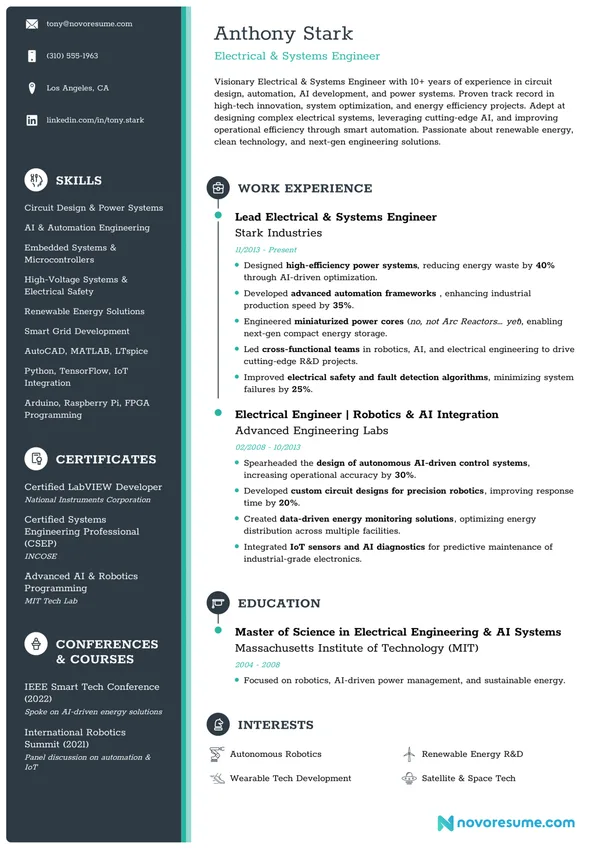
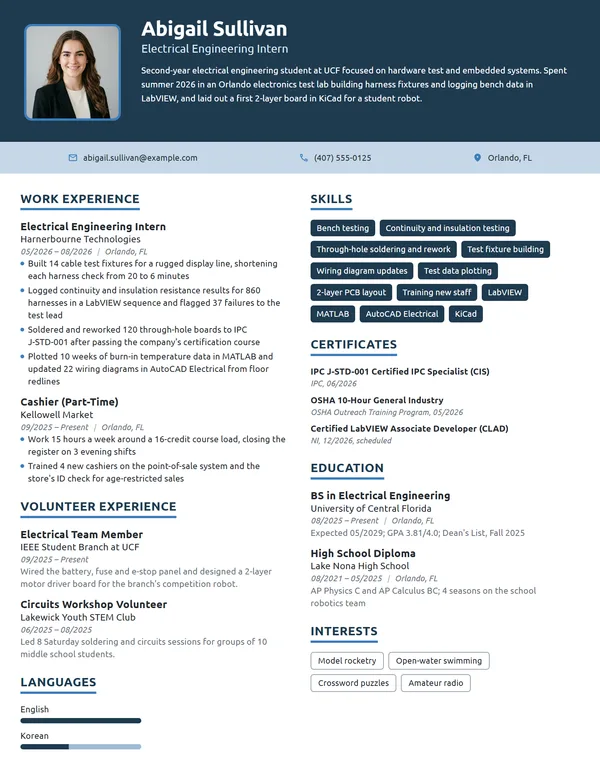
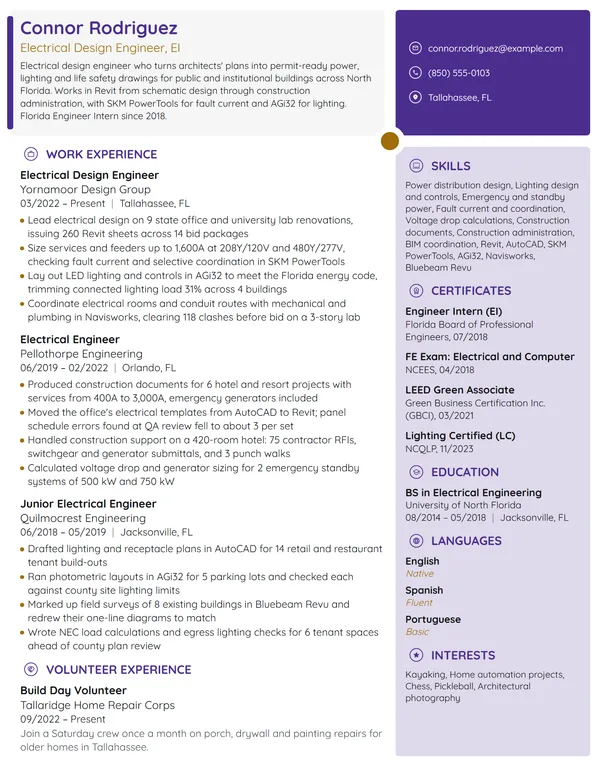
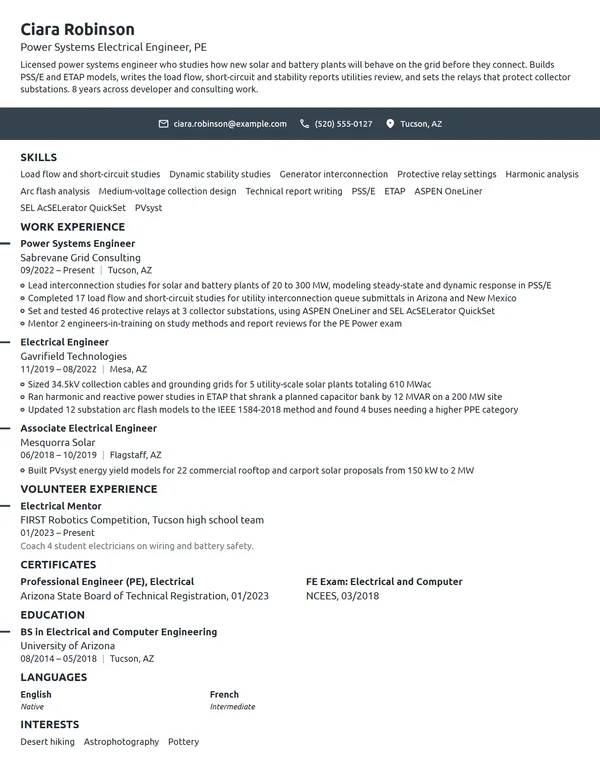
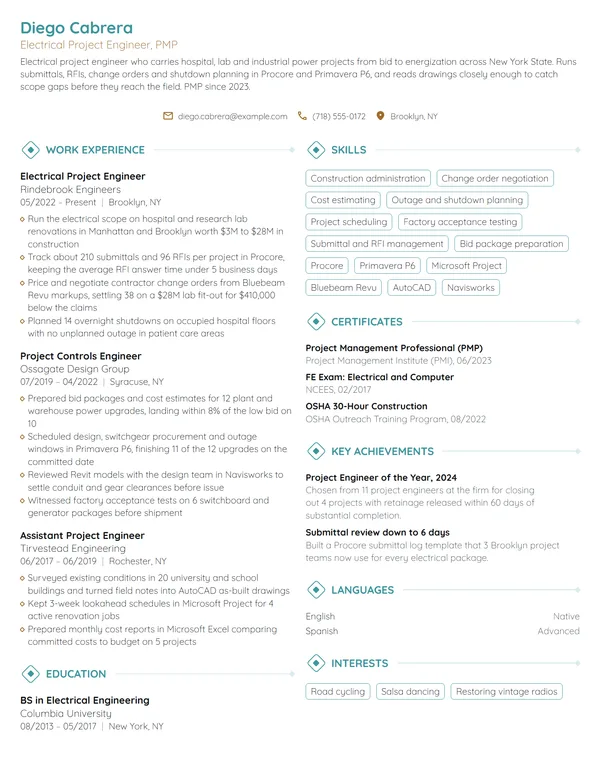
Electrical engineering runs from substations to circuit boards, and a job title alone does not tell a reader which end you work on. An engineering manager scanning your resume checks which systems you designed, the software you used, how large the projects were and how close you are to a PE license. A drawing set or a test report does not fit on one resume line, so each project has to come down to ratings, counts and results.
How to Write an Electrical Engineer Resume - Key Takeaways
- List your jobs newest first (reverse-chronological) on 1 page, moving to 2 only once you have 10+ years of projects worth showing.
- Name your focus (power, controls, electronics or building systems) early, in your title line or the first sentence of your summary.
- Back every bullet with a rating or a count: kVA and voltage, buses modeled, I/O points, board revisions, test yield or project budget.
- List the exact software from the job posting, such as ETAP, AutoCAD Electrical or Altium Designer, in Skills and inside the bullet where you used it.
- Put the FE exam, your EIT and your PE under Certificates, and add PE to your name only once your state board issues the license.
- Keep the file clean and text-based, then test it with an ATS resume checker before you apply.
What hiring managers look for in an electrical engineer resume
An engineering manager wants to know, within a few lines, whether your systems look like theirs. The BLS describes the job as designing and developing electrical and electronic devices and systems, setting their requirements, and inspecting and testing them for reliability and safety. O*NET adds overseeing projects so they finish on time and within budget. Your bullets should show which of those you did, at what voltage or scale, and with what result.
Build the page from these parts, using headings an applicant tracking system recognizes:
- Name, a title line with your focus (Electrical Engineer, Power Distribution) and contact details
- A short summary of 2 to 3 lines at the top, printed without a heading
- Work Experience, starting with your current role
- Skills, with your design and analysis software
- Certificates, for the FE exam, EIT or PE once you hold them
- Education, with your degree and school
- Extras if space allows: Key Achievements, Languages, Interests, or Volunteer Experience for student teams
Best format for an electrical engineer resume
Choose the reverse-chronological resume format: your current job at the top, then each earlier one below it, labeled with your title, the company and its city, with months and years written MM/YYYY. Electrical careers grow in steps a reader can follow, from associate engineer to project lead to senior or principal engineer, and this order makes each step visible. It also suits interns and new graduates, whose co-ops and internships slot in as dated entries.
- Best for most electrical engineersReverse-chronologicalYour jobs, newest first, with your results under each one.Best for: A steady work history in your field
- FunctionalSkills grouped up top, with a short work history below.Best for: Gaps or very little experience
- CombinationA skills section first, then your full work history.Best for: A career change with strong skills
Keep to 1 page until your projects span 10+ years. A senior electrical engineer with a long list of studies, plants or product launches can use 2 pages, provided the first page holds the 2 latest roles and the license.
| Setting | What to use |
|---|---|
| Length | 1 page early on; 2 pages after 10+ years of projects |
| Dates | Month and year as MM/YYYY, ending in Present on your current job |
| Title line | Title plus focus or credential, such as Electrical Engineer, EIT |
| Units | Write ratings as the drawings do: 480V, 2,500 kVA, 13.8kV |
| Photo and privacy | No photo for most US and Canadian employers; skip your age, family status and SSN |
| File type | A PDF built from text, unless the employer's portal asks for Word |
Most US and Canadian resumes carry no photo. Engineering firms and manufacturers often load resumes into a hiring system that reads text, so keep your units, tool names and dates as plain text rather than inside images or text boxes.
Electrical engineer resume summary vs. objective
Use a resume summary once you have held an engineering job, co-ops included: your focus, your years, your main tool, your largest system and your license status. Use an objective only if you have no engineering work yet, and back it with a co-op, a lab or a senior design project. Draft it after your bullets, so it can borrow their strongest number.
Electrical engineer resume summary formula
Focus electrical engineer with X years in industry or project type, working in main software. Largest system you designed or studied, with its rating or count. FE, EIT or PE status.
Example
Power distribution electrical engineer with 5 years in industrial facilities, working in SKM PowerTools and AutoCAD Electrical. Designed services up to 2,500 kVA for 7 plant expansions and ran arc flash studies on 312 buses. FE passed; PE Power exam scheduled for 02/2027.
Don't
Results-driven electrical engineer with a passion for innovation and strong problem-solving skills.
Do
Electronics engineer with 4 years designing battery management boards in Altium Designer. Took a 6-layer board from schematic to production in 9 months with 2 revisions. EIT, preparing for the PE Electronics, Controls, and Communications exam.
The rewrite names the product, the tool, the timeline and the license step.
How to write electrical engineer work experience bullets with numbers
Your current role takes 3 to 4 bullets and each older role 1 to 4, fewer as the role ages, and each bullet starts on an action verb. Electrical work already comes with numbers on the drawings and in the test logs, so pull them into your bullets and show achievements on your resume rather than the duties in your job description. A reader should see the rating, the count and what changed because of your work.
| Area | What to count | Example bullet |
|---|---|---|
| Power distribution | Service size in kVA or MVA, voltage, panels, sheets | Designed a 13.8kV to 480V, 3,000 kVA substation for a new cold-storage warehouse. |
| Power system studies | Buses modeled, relays set, sites, labels issued | Modeled 140 buses in ETAP and reset 58 relays after a coordination study for a hospital campus. |
| Controls and automation | I/O points, PLCs, lines, downtime hours | Programmed 1,200 I/O points across 4 PLCs for a water treatment plant upgrade. |
| Electronics and PCB design | Board layers, revisions, unit cost, power draw | Cut a sensor board's unit cost from $42 to $29 by moving to a 4-layer design. |
| Test and validation | Test cases, defects found, yield, certification passes | Raised first-pass test yield from 91% to 98% on 3,000 boards a month. |
| Projects and construction | Budget, schedule, RFIs, submittals, change orders | Held change orders under 2% of a $4.5M data hall fit-out. |
Below is one engineer's history written that way. The current role carries the ratings and the studies, and the earlier plant job keeps 2 bullets with a downtime and an energy number.
Work Experience
- Designed power distribution for 7 manufacturing plant expansions, from 480V motor control centers to 2,500 kVA unit substations.
- Ran short-circuit, coordination and arc flash studies in SKM PowerTools on 312 buses across 9 client sites and issued new arc flash labels for each.
- Cut drawing revisions after issue for construction from 14 to 4 per project by adding a load calculation check to the AutoCAD Electrical workflow.
- Reviewed 63 contractor submittals and answered 41 RFIs on a $6.2M plant expansion that energized 2 weeks early.
- Rewrote PLC logic in Studio 5000 for 3 packaging lines, lowering unplanned electrical downtime from 11 to 4 hours a month.
- Specified and commissioned 18 variable frequency drives on conveyor motors, saving about 290,000 kWh a year.
Don't
Responsible for designing electrical systems for commercial buildings.
Do
Designed lighting, power and fire alarm systems in Revit for 11 K-12 school renovations totaling 640,000 sq ft, each permitted on first submittal.
Systems, tool, building type, floor area and permit result all fit in 1 line.
Don't
Performed testing on new products.
Do
Wrote and ran 120 validation test cases on a 48V motor controller, catching 9 defects before design review; the unit passed UL testing on the first attempt.
Electrical engineering skills and software for your resume
Pick the 6 to 8 hard skills for your resume this posting asks for and your bullets back up. A power role reads for studies and distribution design, a controls role for PLC and drive work, and an electronics role for schematic capture, layout and test, so pick from the side of the field you are applying to.
Hard skills for electrical engineers
- Power distribution design
- Load calculations
- Short-circuit and coordination studies
- Arc flash analysis
- Protective relay settings
- PLC programming
- Motor control and VFDs
- Schematic capture and PCB layout
- Circuit simulation
- Commissioning and testing
Soft skills engineering managers value
- Clear technical writing
- Coordination with contractors and trades
- Safety judgment
- Systematic troubleshooting
- Explaining design choices to clients
- Managing several projects at once
Put your software with your skills, then repeat each program's name in the bullet where you used it. O*NET's in-demand list for electrical engineers includes ETAP, SKM Systems Analysis Power Tools, Autodesk Revit, AutoCAD, MATLAB, Python and C++. Write the product as the posting does: AutoCAD Electrical, Altium Designer, OrCAD, Simulink or Studio 5000 tell a reader more than CAD or programming.
FE exam, EIT and PE license on an electrical engineer resume
Engineering licenses are issued by state boards, and NCEES counts 68 member licensing boards across the 50 states, DC and the US territories. In the BLS description, experienced engineers may earn a Professional Engineering (PE) license after passing the FE exam, gaining several years of relevant experience and passing the PE exam. List certifications on your resume under Certificates, naming who issued each one and when, so a manager scanning for FE, EIT or PE finds them in one place.
| Credential | Issued by | What it takes |
|---|---|---|
| FE exam (Fundamentals of Engineering) | NCEES | A 110-question, computer-based exam offered year-round, designed for recent graduates and students close to finishing an EAC/ABET-accredited engineering degree. |
| EIT (Engineer-in-Training), Texas | Texas Board of Professional Engineers and Land Surveyors | A degree from a Board-approved engineering or related science program, a passed FE exam, and an EIT application with a $15 fee, sent after the degree is conferred. |
| PE (Professional Engineer) | Your state engineering board; exam by NCEES | Usually an EAC/ABET-accredited degree, the FE exam, 4 years of progressive experience in most states, and the PE Electrical and Computer exam in Power; Electronics, Controls, and Communications; or Computer Engineering. |
How to list the FE exam and a PE in progress
Write the FE exam with its discipline and the month you passed it, and add your intern designation in the exact words your board uses, since Texas certifies an EIT and other boards may word it differently. If your PE exam is booked, add it as scheduled with the module and date. Keep PE off your name and title line until the board issues your license, then list it first with the state.
Certificates
- FE Exam: Electrical and Computer, NCEES, passed 04/2021
- PE Exam: Electrical and Computer, Power, NCEES, scheduled 02/2027
How to list a BSEE degree and ABET accreditation
The BLS says electrical engineers typically need at least a bachelor's degree in a related engineering field, and NCEES notes that licensing boards generally expect a degree from an EAC/ABET-accredited program on the way to a PE. Write the degree as your school awards it, such as Bachelor of Science in Electrical Engineering (BSEE), so a reader checking for an accredited program can match it.
When listing education on a resume, give the degree, the school and its city, plus the month you graduated. Add a GPA of 3.5 or higher while you are a student or within 2 to 3 years of graduating, and 1 line on your senior design project if it used tools the posting names. After a few years in industry, Education moves below Work Experience and shrinks to the degree line.
Education
Senior design: a 3-phase motor drive test bench for a local manufacturer.
Intern, entry-level and career-change electrical engineer resumes
Employers value internships and cooperative engineering programs, the BLS says, so an intern or new graduate resume leads with that work. Place Education above Work Experience, and give each co-op or internship a dated Work Experience entry with the same kind of numbers a full-time role gets. An engineering student resume layout works well until your first full-time role.
- Co-ops and internships: the systems you drew, tested or wired, with counts and voltages, under Work Experience.
- Senior design and lab projects: 1 line under Education, naming the rating and the tools.
- Student teams: a solar car, robotics or Formula SAE electrical lead role, with what you built, under Volunteer Experience.
- Technician or electrician work: panels wired, equipment commissioned or faults traced, under Work Experience with its own dates.
Don't
Motivated electrical engineering student seeking an internship to gain hands-on experience.
Do
Electrical engineering senior seeking an entry-level controls role. Completed 2 co-op rotations at an automotive parts plant, wiring and testing 3 PLC test stands, and passed the FE exam in 03/2026.
Without a co-op, a build or an exam behind it, the objective says nothing.
If you are moving into engineering from electrician or technician work, keep newest-first order, open with your degree and FE status, then lead your current job with the tasks closest to design: load calculations, panel schedules, drawing markups and commissioning. A career-change resume reads best when that field experience comes with numbers. Use the cover letter for the reason behind the switch; our engineer cover letter examples show how to fit it into a short paragraph.
Electrical Engineer resume FAQ
Do I need a PE license to work as an electrical engineer?
Not always. The BLS describes the PE as a license experienced engineers may obtain, not an entry requirement. It matters most in consulting and building design, where drawings go out under a PE seal, so on those tracks show your FE exam, your EIT and any scheduled PE date under Certificates.
Where does the FE exam go on an electrical engineer resume?
Under Certificates, with the discipline, NCEES as the issuer and the month you passed. If your board then certified you as an EIT, add that line too in the board's own wording. Leave your score off: NCEES reports results as pass or fail.
How do I show whether I work in power, controls or electronics?
Put it in your title line, such as Electrical Engineer, Power Distribution, and in the first words of your summary. Then let your first bullet under each job carry the system type and its rating or size, so the focus is clear before anyone reads further.
Should I list the NEC and other codes on my resume?
Yes, if you designed to them. Name the code inside the bullet where you applied it, such as the NEC edition on a building project or NFPA 70E on an arc flash study. A code listed only under Skills, with no project behind it, tells a reader little.
How long should an electrical engineer resume be?
Use 1 page for interns, new graduates and anyone with under 10 years of experience. Past that, 2 pages work if the extra space holds real projects and studies and page 1 carries your 2 most recent jobs and your license.
Where do senior design projects go on an electrical engineering resume?
Under Education, as 1 line below your degree, naming what you built, its rating and the tools. A project you did for a company during a co-op belongs under that co-op's Work Experience entry instead. Drop the senior design line once you have 2 to 3 years of full-time work.
Should I put salary expectations on an electrical engineer resume?
No. Salary talk belongs in the application form or the interview. As a reference point, the BLS puts the median annual pay for electrical engineers at $120,630 in May 2025; offers vary with industry, location and whether you hold a PE.
Next steps
Choose the example nearest your focus and level, and swap in your own ratings, studies and test results. Our resume builder and resume templates handle the layout; check that every tool in the posting appears in a bullet, and open your cover letter on your biggest project.