
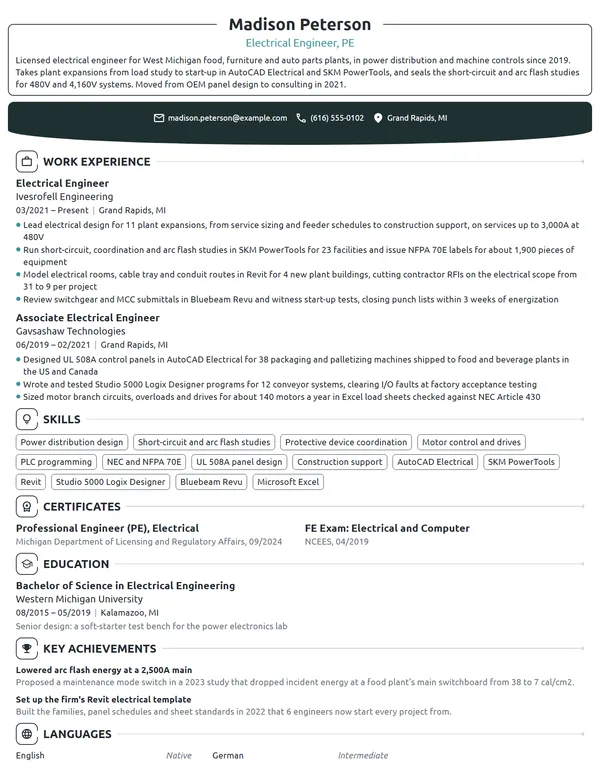
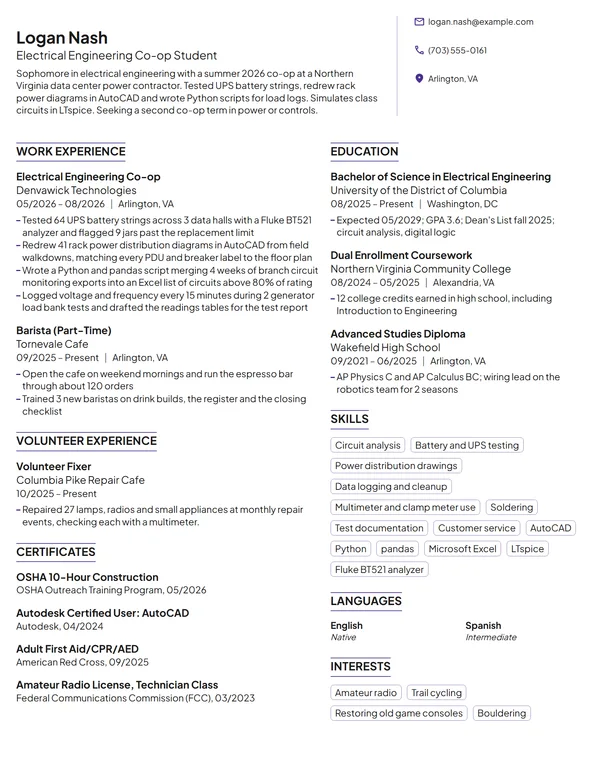
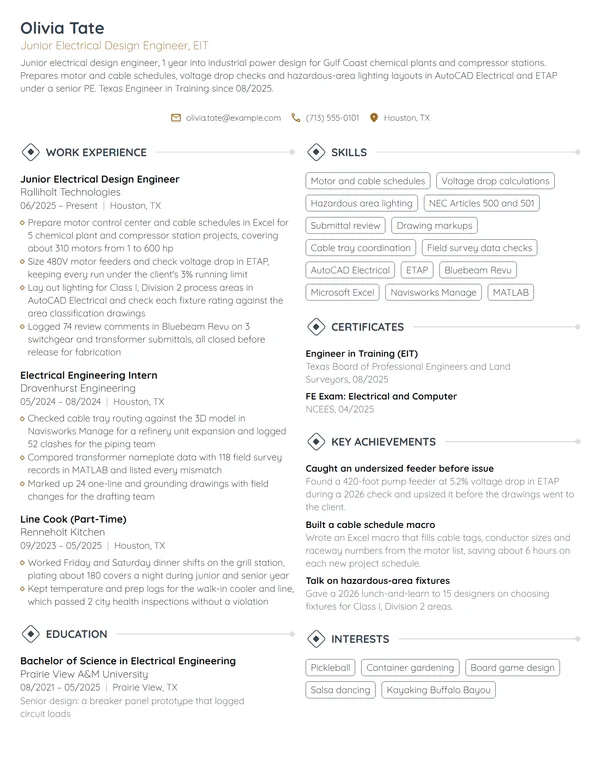
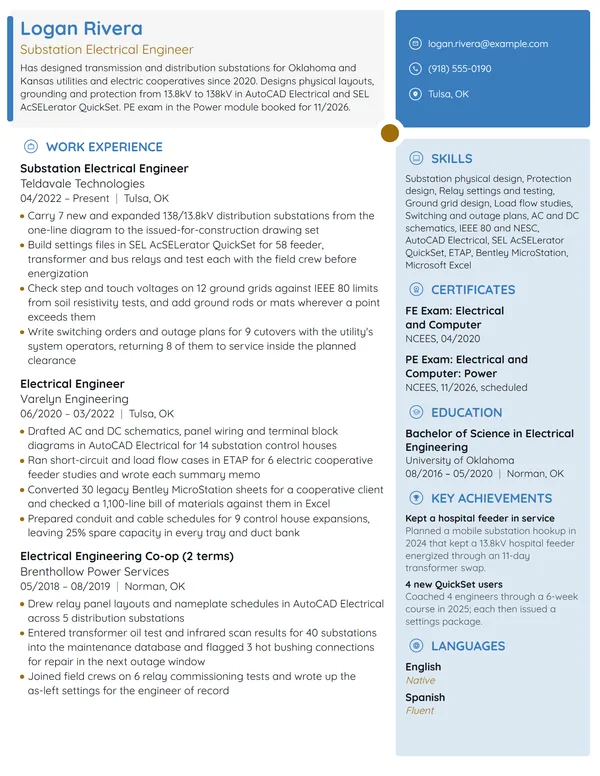
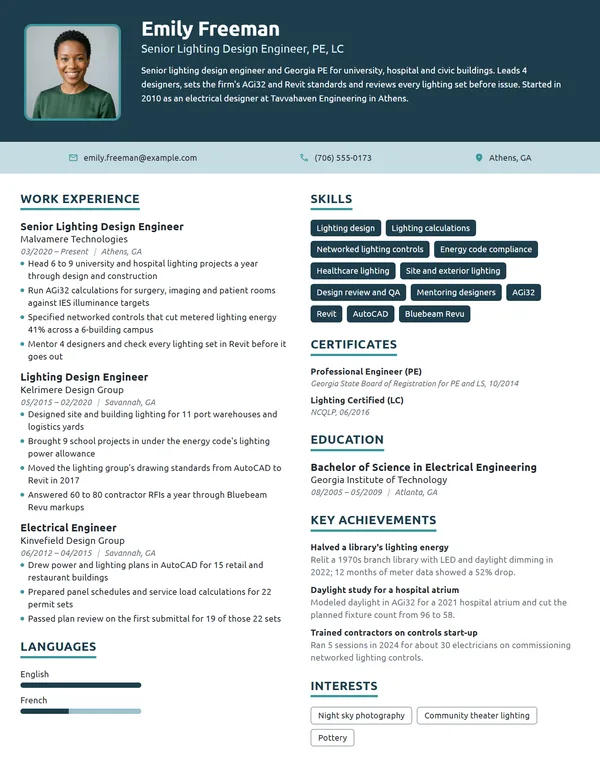
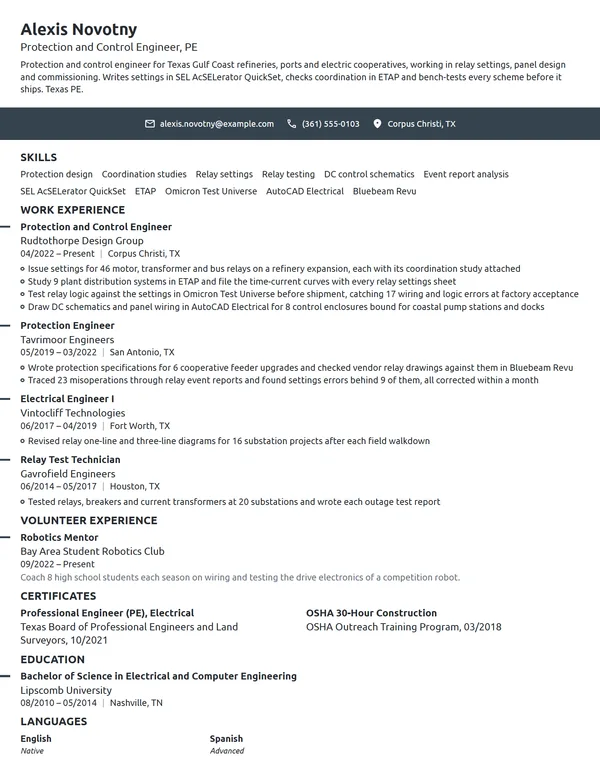
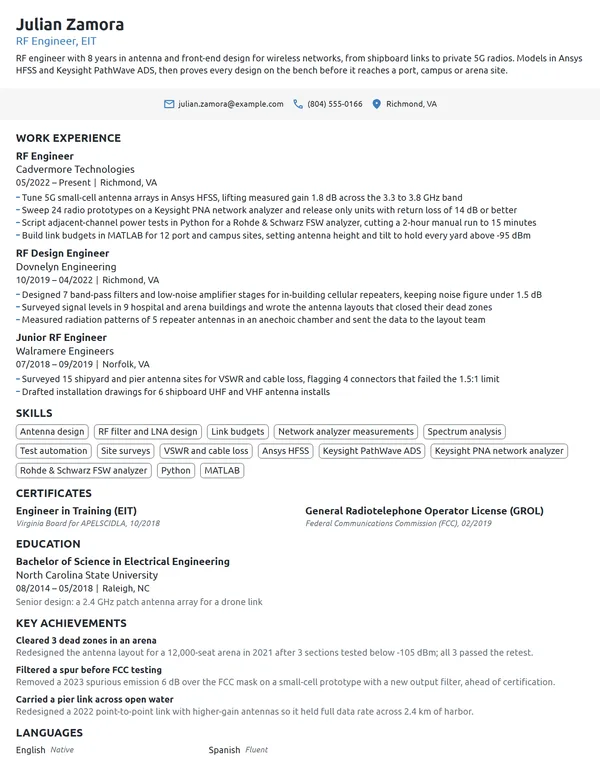
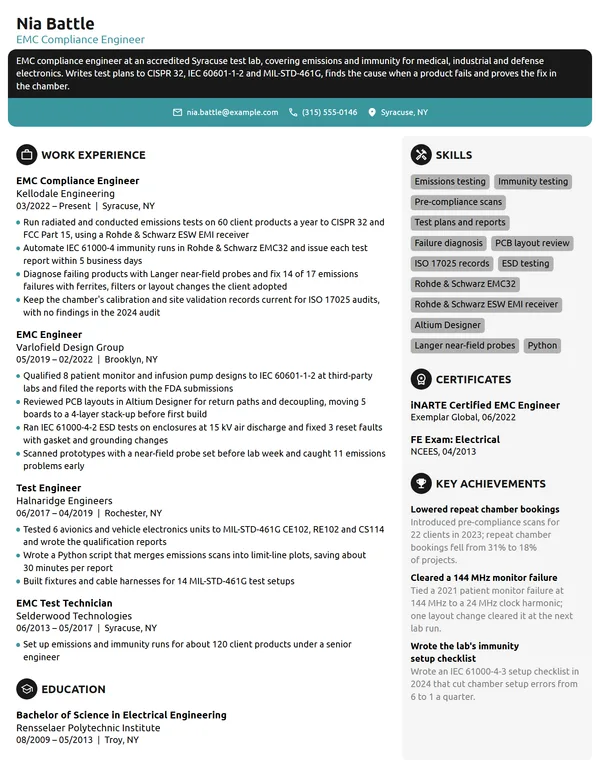
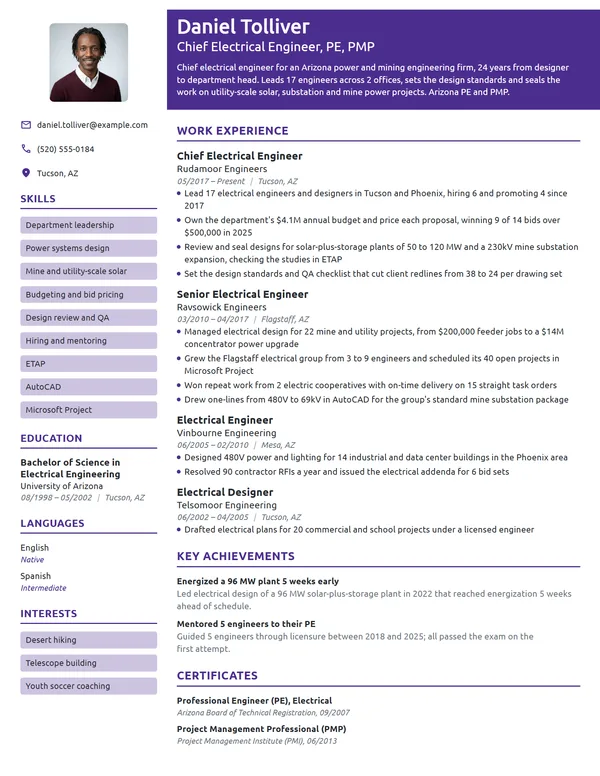
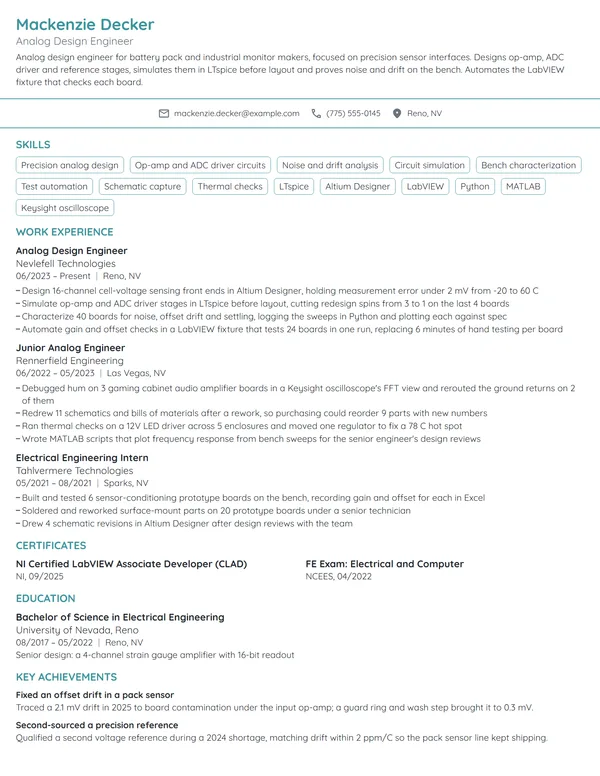
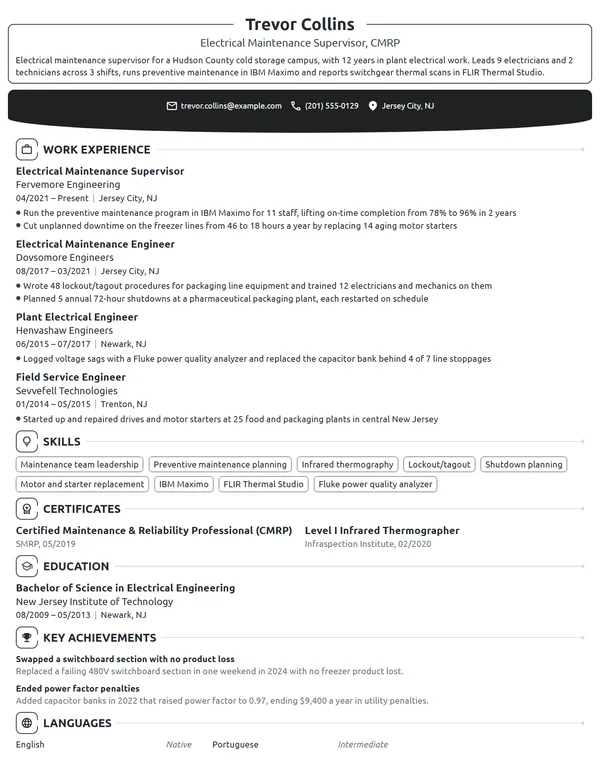
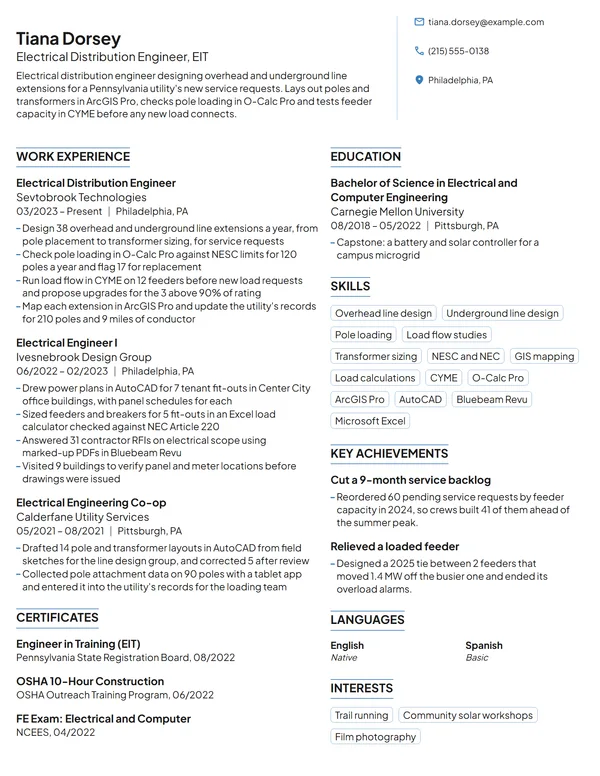
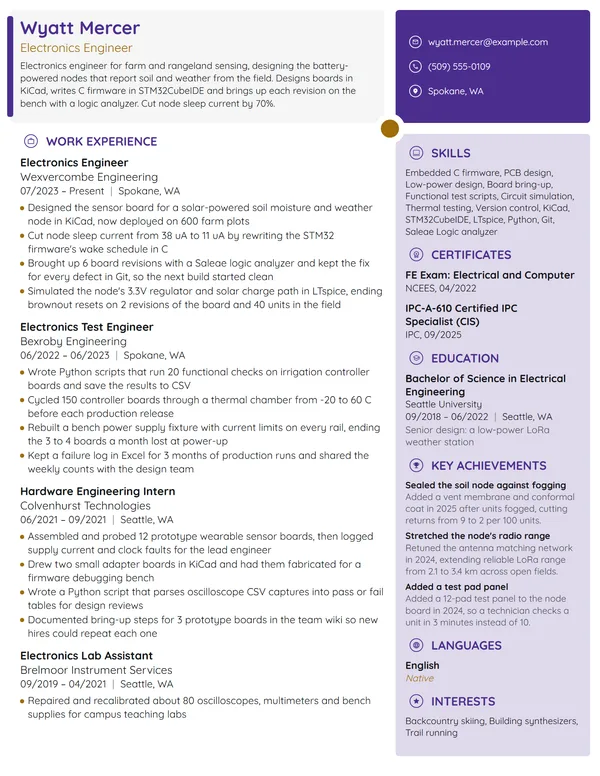
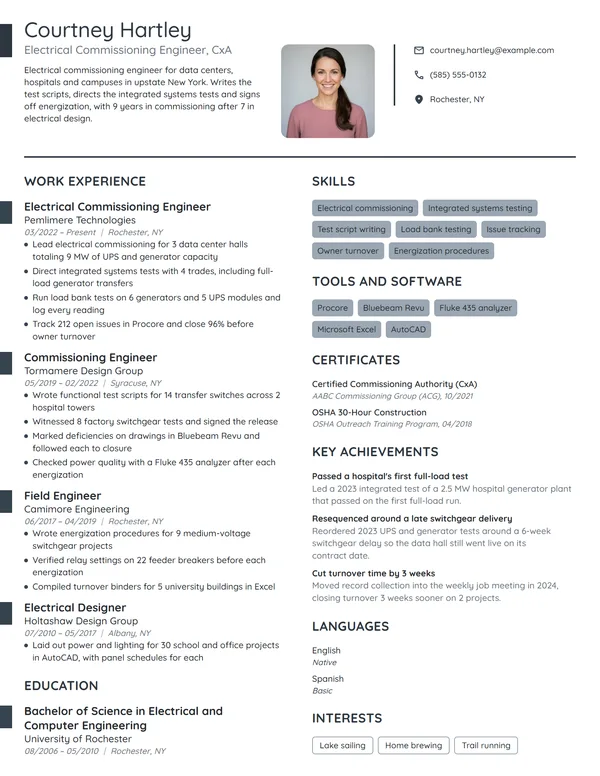
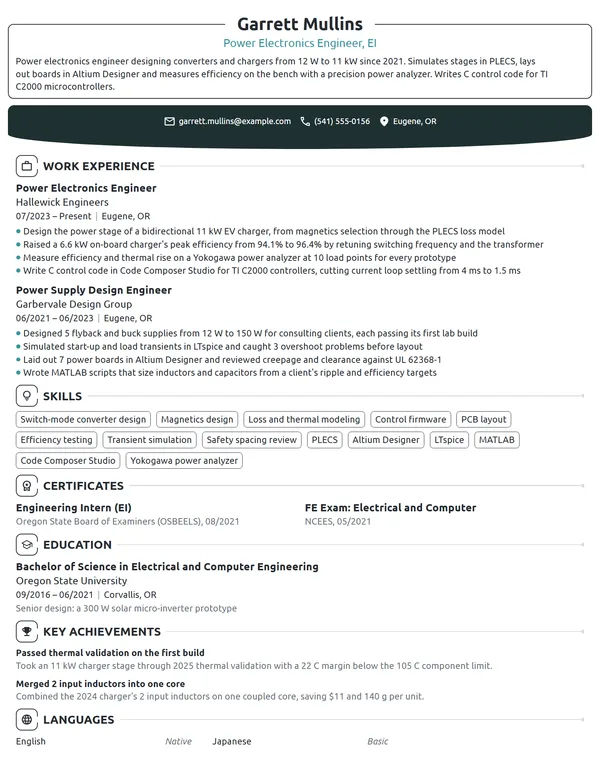
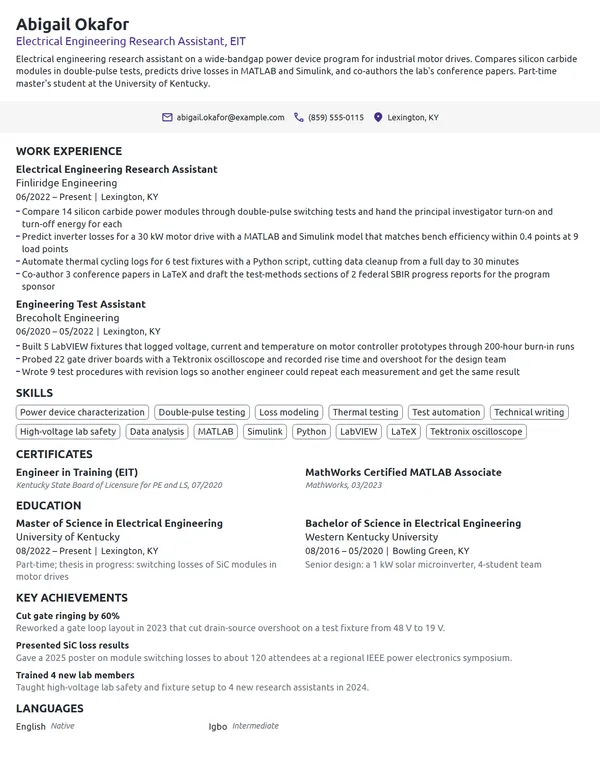
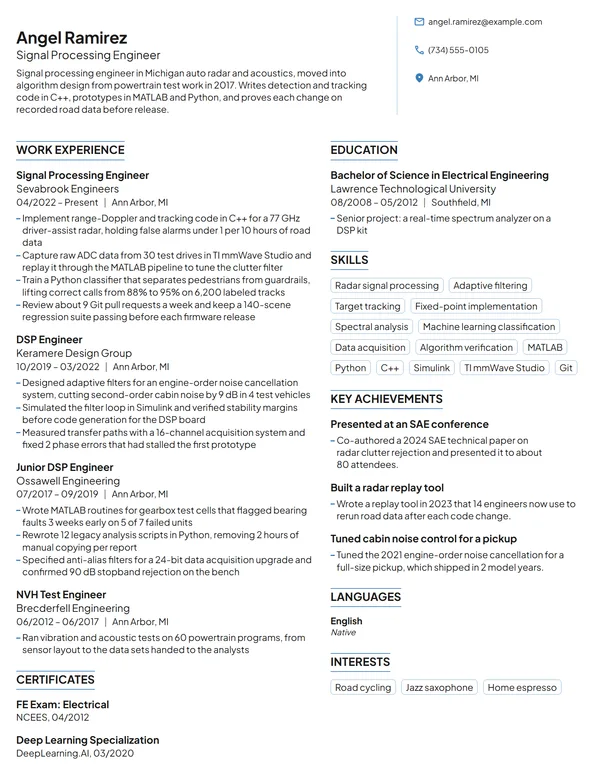
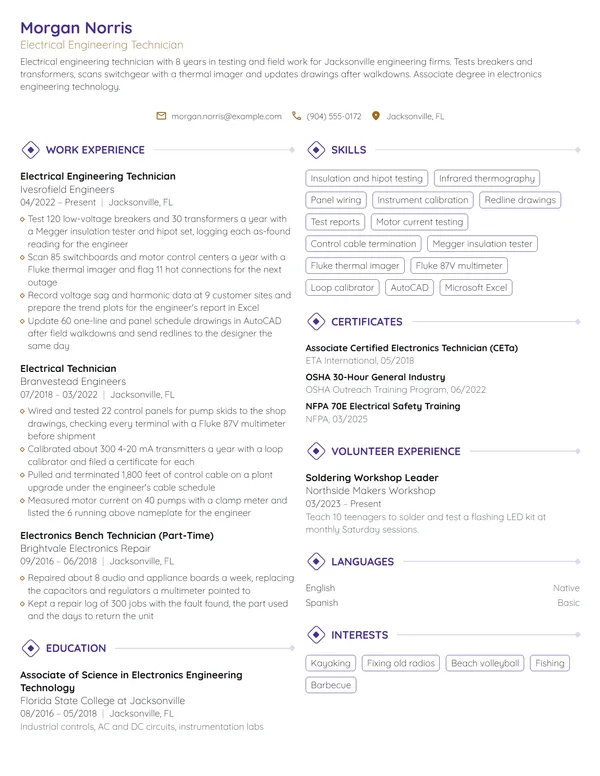
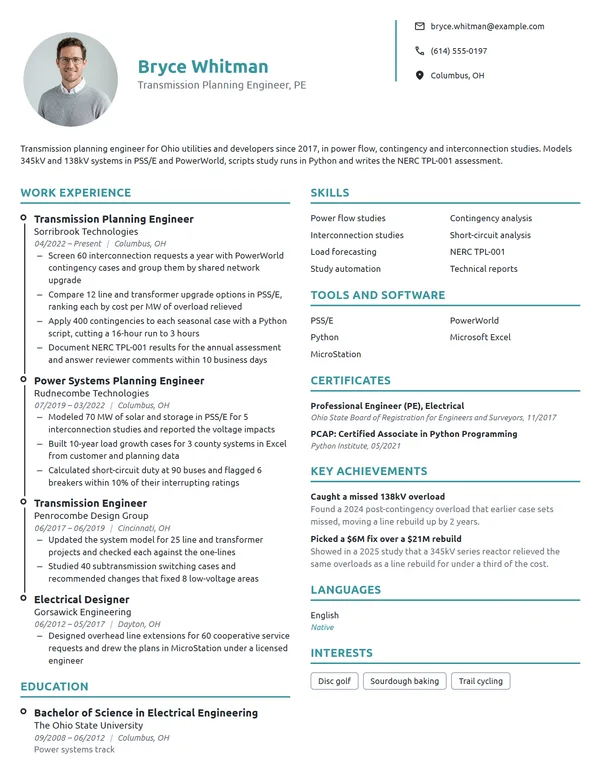
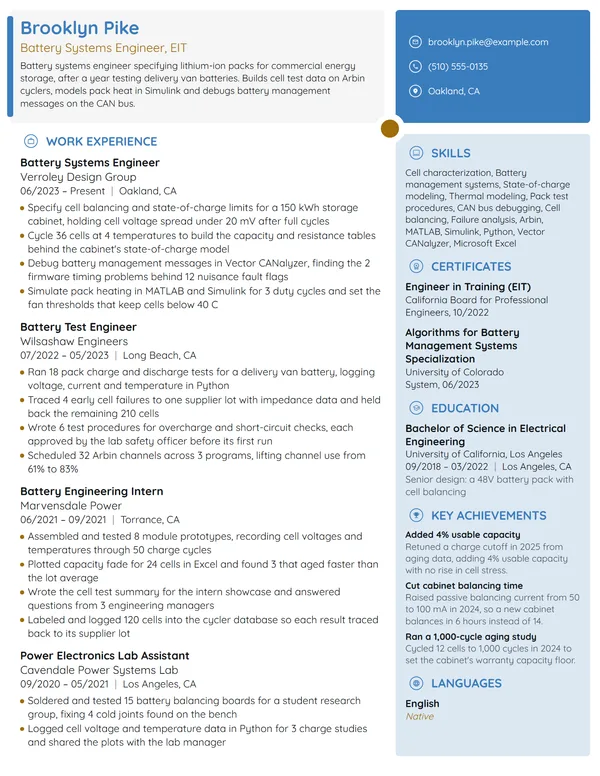
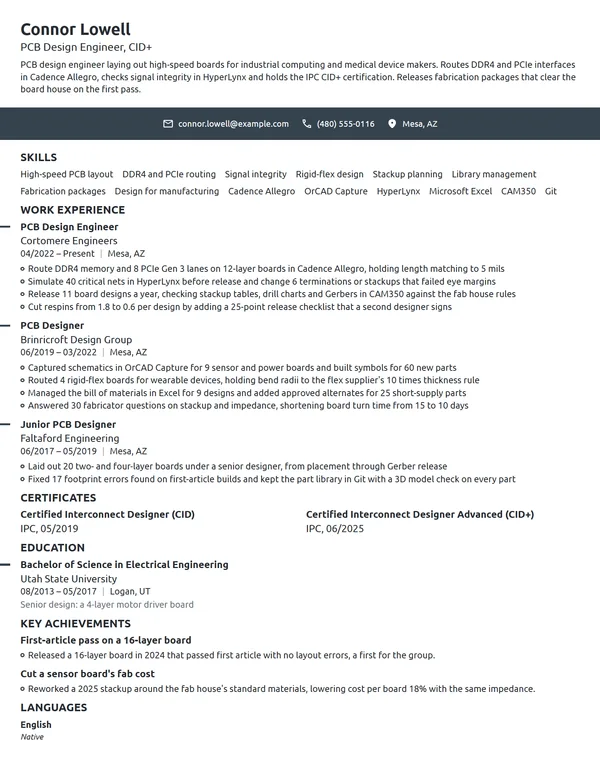
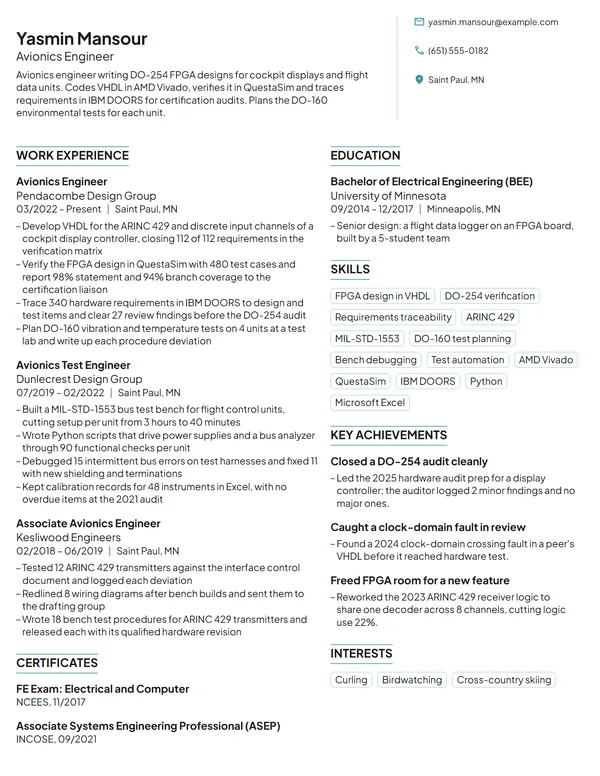
The same degree leads to utility substations, building design firms, packaging plants and electronics labs, and each of those employers hires for its own systems. A substation lead looks for voltage classes and protection work, a lighting firm for building types and code results, a product team for boards and test data. Pick one branch per version of your resume and back it with the numbers that branch already tracks.
How to Write an Electrical Engineering Resume - Key Takeaways
- Order your jobs newest first (reverse-chronological), keep to 1 page, and give each co-op employer its own dated entry.
- Aim each version at one branch, such as power, building systems, controls, electronics or test, and name it in your headline and summary.
- Back each bullet with the number your branch tracks: kV and MVA, watts per square foot, punch-list items, field returns or boards tested per shift.
- List the software the posting names, such as ETAP, Revit or MATLAB, under Skills, then show it at work in a bullet.
- Write your degree exactly as awarded, because a BSEE and a BSEET carry different accreditation and some state boards treat them differently for licensure.
- Put the FE, a booked PE exam and any LC under Certificates, then test the file with an ATS resume checker.
What hiring managers look for in an electrical engineering resume
The BLS sums up the work in one line: electrical engineers design, develop, test and supervise the manufacturing of electrical systems and equipment. O*NET adds directing installation, maintenance, documentation and testing so the result meets specifications, codes or customer requirements. Which of those tasks fills your week depends on the branch you work in, and that is the first thing a hiring manager tries to spot.
- Utilities and power consultants: voltage class, substations and feeders, protection settings, outage windows.
- Building design firms: building types and square footage, lighting and power layouts, code compliance, permit results.
- Plants and system integrators: lines commissioned, controls platforms, downtime and start-up dates.
- Product and electronics companies: boards and prototypes, design verification, compliance testing, field returns.
- Labs and universities: test rigs, data collected, papers and the methods you used.
Whatever the branch, arrange your content under these headings:
- Header: name, contact details and a headline such as Electrical Design Engineer, EIT
- A 2- to 3-line summary under the header
- Work Experience, co-op employers included
- Skills, with your software and programming languages in the same list
- Certificates: FE, PE, LC or vendor training
- Education, with the degree name exactly as awarded
- Optional: Key Achievements or Volunteer Experience, plus Languages
Best format for an electrical engineering resume
Pick the reverse-chronological resume format, with your newest job on top and each entry giving the title, the employer, where it is, and start and end dates as MM/YYYY. A reader comparing you with other candidates wants to see the voltage, project size and responsibility grow from one entry to the next, and newest-first order shows that without extra explanation. It also fits co-op students and technicians moving into design, because their dated work entries carry most of the proof.
- Best for most electrical engineering rolesReverse-chronologicalYour jobs, newest first, with your results under each one.Best for: A steady work history in your field
- FunctionalSkills grouped up top, with a short work history below.Best for: Gaps or very little experience
- CombinationA skills section first, then your full work history.Best for: A career change with strong skills
Hold to 1 page through roughly your first 10 years. After that, 2 pages are fine for a lead or department head whose projects, studies or product launches would otherwise be cut, as long as page 1 carries the current role, the one before it and your license.
| Setting | What to use |
|---|---|
| Length | 1 page for most of your first decade; 2 only when page 2 holds real projects |
| Dates | MM/YYYY on every entry, with Present on the job you hold now |
| Headline | Job title plus branch or credential, such as Electrical Design Engineer, PE |
| Co-op terms | One dated entry per co-op employer, with the term count in the title, such as Electrical Engineering Co-op (3 terms) |
| Degree line | The degree spelled out as your school awards it, such as Bachelor of Science in Electrical Engineering Technology |
| Photo and personal details | Nothing about age, family or ID numbers |
| File type | A text-based PDF, or Word when the application portal requests it |
Most US and Canadian resumes carry no photo. Large employers load applications into a tracking system that reads text, so type ratings, model numbers and software names as plain words rather than pasting a drawing title block or a logo into the page.
Electrical engineering resume summary vs. objective
One question decides it: has anyone paid you for engineering work yet, co-op terms included? If yes, write a resume summary that names your branch, your years, your main tool, 1 result with its scale and your FE or PE status. If not, write an objective for an internship or co-op that names the role and term you want, with a lab build or student-team result as proof.
Electrical engineering resume summary formula
Job title with X years in branch or product type, working in main software. 1 result with its scale or rating. Degree, FE or PE status.
Example
Electrical engineer with 6 years in instrument power design and test, working in Altium Designer and Python. Cut standby draw on a 3-model analyzer line from 6.2 W to 1.9 W. B.S. in Electrical Engineering, FE passed, PE exam booked for 04/2027.
Don't
Electrical engineering professional with a strong background in circuits, power systems and programming, looking to contribute to a dynamic team.
Do
Lighting design engineer with 5 years on healthcare and higher-education projects, modeling in AGi32 and Revit. Designed lighting and controls for 14 buildings totaling 1.1M sq ft. Lighting Certified (LC) since 2024.
The rewrite gives the branch, the building types, the tools, a total and a credential.
How to write electrical engineering work experience bullets with numbers
Give your current job 3 to 4 bullets and each earlier one 2 to 4, every bullet opening on a verb. When you list work experience on a resume, take the numbers from your branch's own records: one-lines, lighting calculations, commissioning logs, test reports. A reader in your branch should recognize the unit before reading the rest of the line.
| Branch | What to count | Example bullet |
|---|---|---|
| Utility and substation | kV class, MVA, relay panels, outage windows | Engineered 4 distribution substation rebuilds at 34.5kV, each cut over inside a 10-hour outage window. |
| Building and lighting design | Square feet, fixtures, lighting power density, control zones | Lowered lighting power density in a 92,000 sq ft office retrofit from 0.98 to 0.61 W/sq ft. |
| Automation and controls | Lines or cells commissioned, punch-list items, start-up dates | Commissioned 6 robotic cells and closed 140 punch-list items before the start-of-production date. |
| Product design and compliance | Prototypes, design reviews, compliance passes, field returns | Passed FCC Part 15 emissions testing on the first attempt for 3 wireless sensor models. |
| Research and lab work | Test rigs built, hours of data, papers | Built a 10 kW inverter test rig and logged 1,800 hours of efficiency data for 2 papers. |
| Technician work | Units calibrated or repaired, turnaround, faults found | Calibrated 260 meters and relays a year with a 2-day average turnaround. |
This entry belongs to a product engineer who started in test. The current role carries design, verification and field data, and the earlier job keeps 2 bullets with throughput and failure rates.
Work Experience
- Redesigned the 24V power supply for a benchtop analyzer line, cutting standby draw from 6.2 W to 1.9 W across 3 models.
- Automated 46 design verification tests in Python, shortening a full regression run from 3 days to 7 hours.
- Led root-cause analysis on 38 field returns, traced 31 of them to 1 connector and released the fix in 2 engineering change orders.
- Prepared the safety files for 2 analyzers that passed UL 61010-1 testing on the first submission.
- Built 3 automated test stations in LabVIEW for motor drive boards, raising throughput from 40 to 110 boards a shift.
- Cut false failures at end-of-line test from 4.1% to 0.6% by reworking fixture tolerances.
Don't
Worked on substation projects.
Do
Prepared relay and one-line drawings for 3 transmission substation upgrades and checked 220 wiring diagrams before field release.
The rewrite names the drawings, the project type and the volume.
Don't
Helped with testing and troubleshooting.
Do
Traced intermittent resets on a battery charger to a grounding fault, ending 17 warranty claims a month.
Electrical engineering skills and software to list by branch
Choose 6 to 8 technical skills for your resume from the posting, and keep only those a bullet backs up. The hard skills below cover the field; a utility posting will draw from the power side, a product posting from the circuit and test side.
Hard skills across electrical engineering
- Circuit analysis
- Power system analysis
- Protection and control
- Lighting calculations
- PLC and HMI programming
- Embedded C
- PCB design
- Signal processing
- Design verification testing
- NEC compliance
Soft skills electrical engineering teams value
- Precise documentation
- Working with field crews and contractors
- Root-cause thinking
- Safety awareness
- Explaining tradeoffs to non-engineers
- Keeping several deadlines in view
Software sorts by branch too. Among the tools O*NET flags as in demand for electrical engineers, ETAP and SKM Systems Analysis Power Tools belong to power studies, Autodesk Revit and AutoCAD to building and drawing work, and MATLAB, Python and C++ to analysis, test and embedded code. O*NET also marks Bentley MicroStation as a hot technology. List each tool with your skills, then name it again in the bullet where you used it.
FE, PE and Lighting Certified: credentials on an electrical engineering resume
In the BLS description, entry-level electrical engineering jobs need no license, and a PE license generally takes a passing FE exam, experience and a passing PE exam. Lighting work has its own credential, Lighting Certified (LC), from the National Council on Qualifications for Lighting Professions (NCQLP). List certifications on your resume under Certificates, each with its issuer and month, with a PE license at the top once you hold it.
| Credential | Issued by | What it takes |
|---|---|---|
| FE exam (Fundamentals of Engineering), Electrical and Computer | NCEES | A 110-question computer-based exam, offered year-round and reported as pass or fail, aimed at students near graduation and recent graduates. |
| PE (Professional Engineer), Electrical and Computer | Your state engineering board; exam by NCEES | The FE exam, experience your board accepts, and a PE exam in 1 of 3 modules: Power (80 questions, year-round), or Electronics, Controls, and Communications or Computer Engineering (85 questions each, once a year). |
| LC (Lighting Certified) | NCQLP | Education, lighting experience and an exam, as set in NCQLP's candidate handbook; renewed with at least 36 professional development credits every 3 years. |
Which FE and PE module to name, and when a PE date belongs on the page
Write the FE exactly as your result names it, with the month you passed. Add a PE exam only once it is booked, with its module and date. The Power module runs year-round, while Electronics, Controls, and Communications sits once a year (NCEES lists April 14, 2027 as the next date), so a scheduled date has to match a real sitting. PE goes in your headline only after your board issues the license.
Certificates
- FE Exam: Electrical and Computer, NCEES, passed 04/2020
- PE Exam: Electrical and Computer, Electronics, Controls, and Communications, NCEES, scheduled 04/2027
BSEE or BSEET: how to list an electrical engineering degree
The BLS says electrical engineers typically need at least a bachelor's degree in a related engineering field, while technicians typically need an associate's degree. Between them sits the engineering technology bachelor's, and the accreditation differs: the University of New Hampshire's B.S. in Electrical Engineering is accredited by ABET's Engineering Accreditation Commission (EAC), and its B.S. in Electrical Engineering Technology by the Engineering Technology Accreditation Commission (ETAC). ABET notes that licensure often requires an ABET-accredited degree as a minimum.
That difference can matter for a PE. The Kentucky Board of Engineers & Land Surveyors, for example, does not accept an ETAC degree alone for licensure, though it accepts one followed by an EAC-accredited master's in engineering. So write the degree exactly as awarded and check your own board's rules before you promise a license date. The rest follows the usual rules for listing education on a resume: school, city, graduation month, and 1 line on a senior project or thesis while you are new to the field.
Education
Senior project: a solar charge controller for a campus weather station, built with a 3-student team.
Co-op, technician and career-change electrical engineering resumes
The BLS points out that students may take part in cooperative education programs or internships, and for a student those terms are the strongest material on the page. Put Education first, then give each co-op employer a dated Work Experience entry with the same kind of numbers a full-time engineer would use. An engineering student resume layout carries you until your first full-time offer.
- Co-op and internship terms: drawings produced, panels tested, test scripts written, with counts and ratings.
- Lab assistant or teaching assistant jobs: benches maintained, labs supported, students per section.
- Student teams and IEEE student branch roles: what you designed or led, under Volunteer Experience.
- Senior project or thesis: 1 line under the degree, with the rating and the tools.
Don't
Electrical engineering student looking for a co-op where I can apply my classroom knowledge.
Do
Electrical engineering junior seeking a spring 2027 co-op in power systems. Built a 3-phase load bank for the machines lab and wired 2 bench test panels as a part-time lab assistant.
A named term, a branch and 2 builds turn the objective into evidence.
Moving from electronic technician or electrician work into engineering, keep newest-first order and open with your degree and FE status. Under your current job, lead with the tasks closest to design, such as drawing markups, load calculations, test procedures or commissioning, and keep repair counts lower down. A career-change resume works when those first bullets read like engineering, and our engineer cover letter examples show how to account for the switch in a few lines.
Electrical Engineering resume FAQ
Can I get an electrical engineering job with an electrical engineering technology degree?
Yes, where the posting accepts engineering technology degrees, so read its education line closely. The road to a PE can be longer: Kentucky, for example, accepts an ETAC degree for licensure only when an EAC-accredited master's in engineering follows it. Write the degree exactly as awarded and check your own board's rules.
Should I list each co-op term as a separate job?
No, not when the terms were with the same employer. Give that employer 1 entry, put the term count in the title, and date it from your first term to your last. Terms with different employers each get their own entry.
Can I use one resume for power and electronics jobs?
Rarely well. A utility reader looks for kV classes, protection and outage work, while a product company looks for boards, verification and compliance tests. Keep 1 master file, then save a version per branch with its own headline, summary, skills and bullet order.
When can I put a PE exam date on my resume?
Only once the exam is booked. List it under Certificates with the module and the month, marked as scheduled, and check the date against the NCEES calendar for that module.
Is the Lighting Certified (LC) credential worth listing?
Yes, on any lighting design or building systems resume. List it under Certificates as Lighting Certified (LC), NCQLP, with the month you earned it, and keep it current: NCQLP renews it on 36 professional development credits every 3 years.
How do I list a master's thesis or research assistantship?
Put the thesis title on 1 line under the master's degree in Education. A paid research assistantship gets its own Work Experience entry, with the lab, your advisor's group or the funded project, and bullets on the rigs you built, the data you collected and any papers.
Should I list IEEE membership on an electrical engineering resume?
Only with a role attached. Chairing a student branch, running a section event or reviewing papers is Volunteer Experience with a line on what you did. A plain membership adds little, so leave it off when space is tight.
How do I move from electrical technician to engineer on my resume?
Lead with the engineering degree you hold or are finishing, plus your FE status. Then rewrite your technician bullets so design-adjacent work comes first: markups you drew, test procedures you wrote, faults you traced to a root cause. Repairs and calibration counts follow.
What salary do electrical engineers earn?
In BLS data, electrical engineers earned a median annual wage of $120,630 in May 2025. Pay varies with branch, region and license, and it belongs in the interview or the application form, not on the resume.
Next steps
Choose the example closest to your branch and level, keep its order, and replace each number with your own ratings, test results and project totals. Lay it out in our resume builder or a resume template, save 1 version per branch you apply to, and lead your cover letter with your strongest project.