
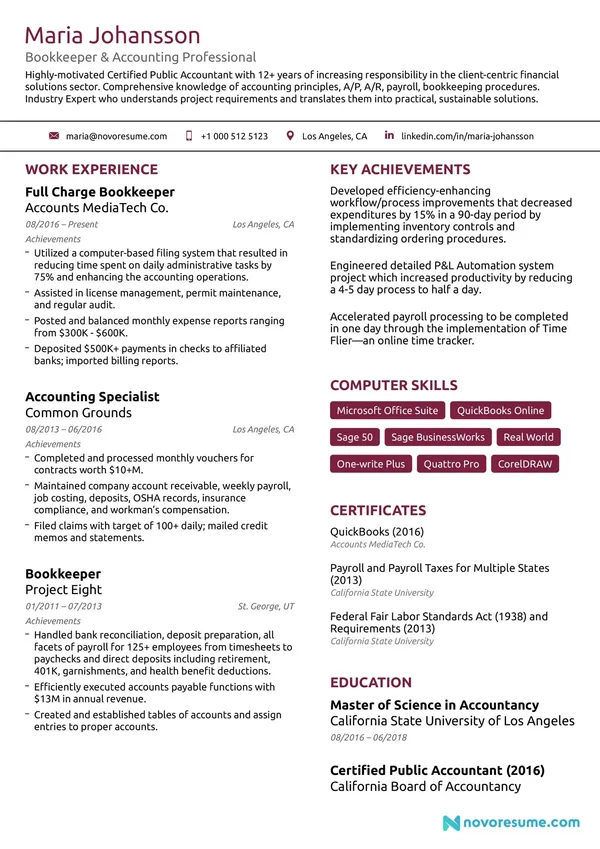
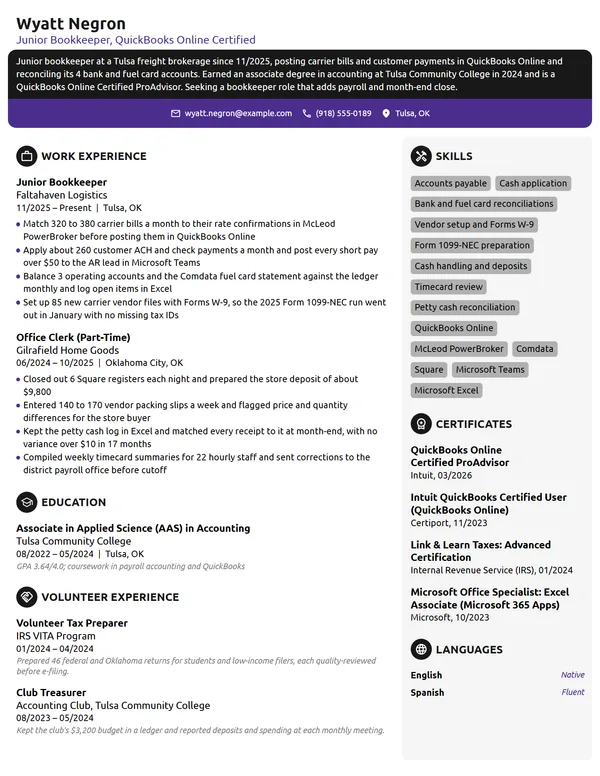
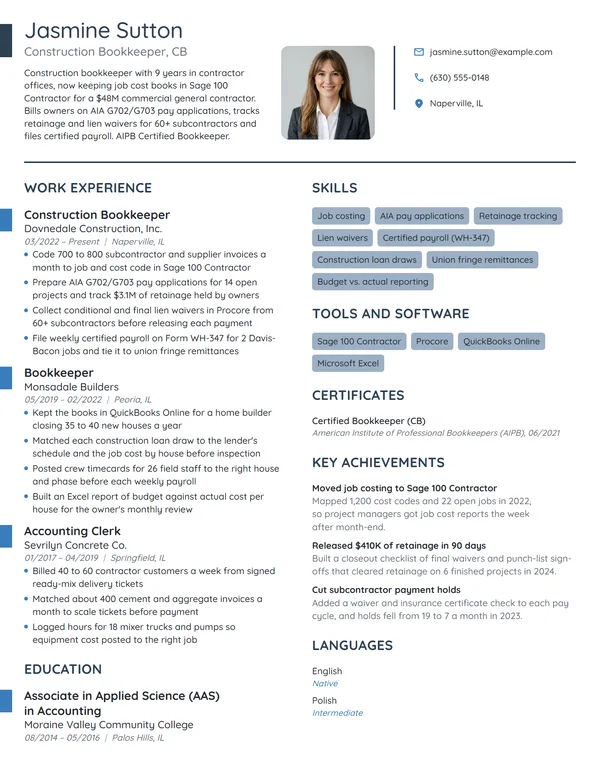
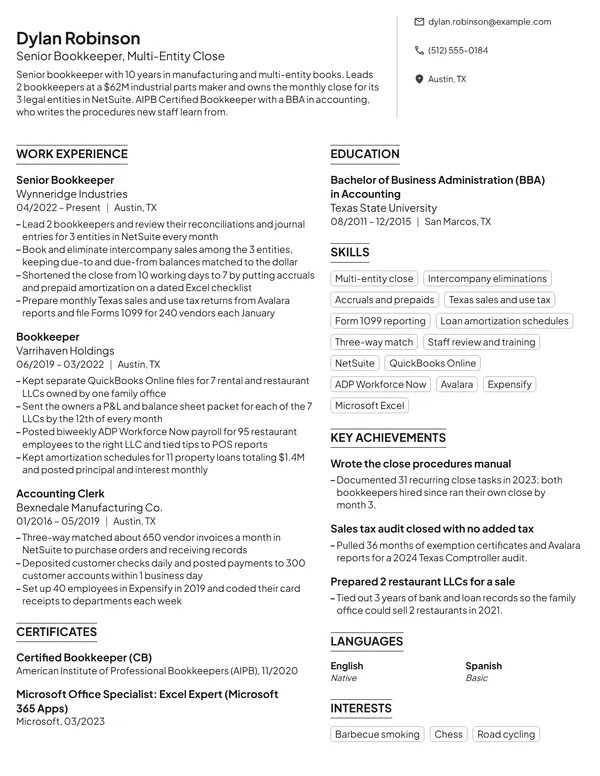
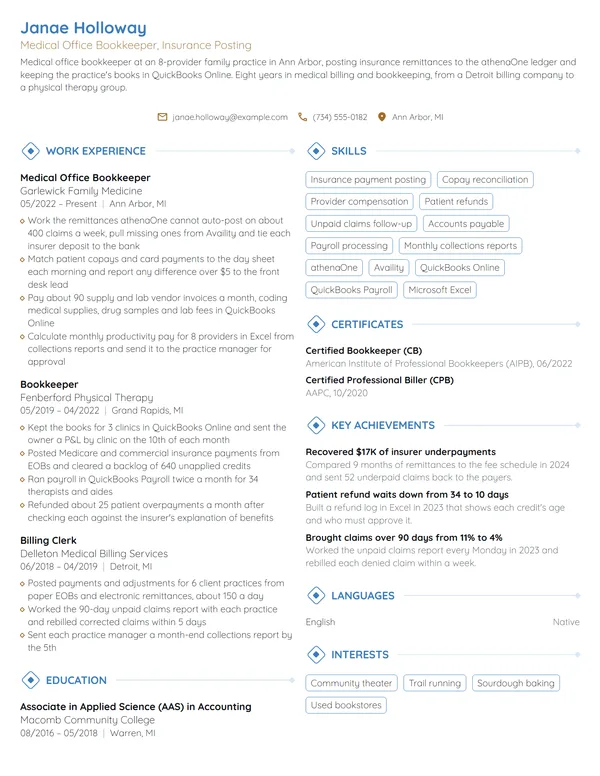
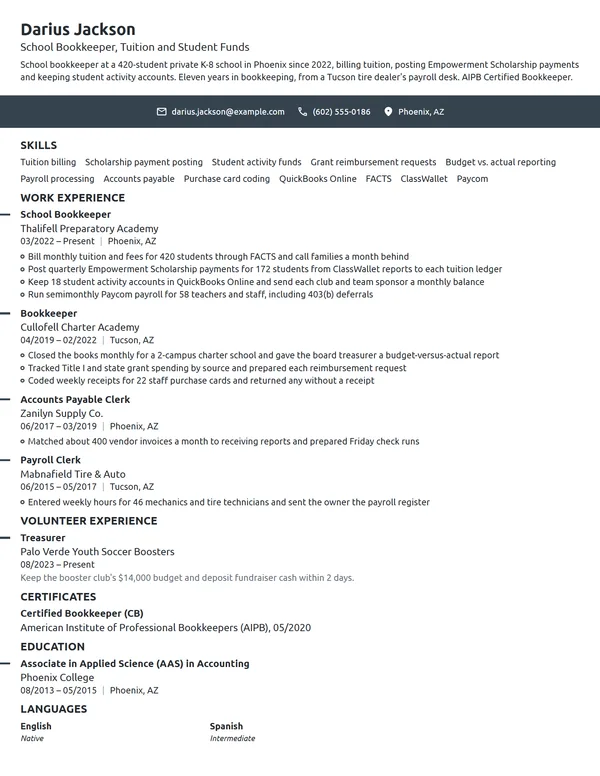
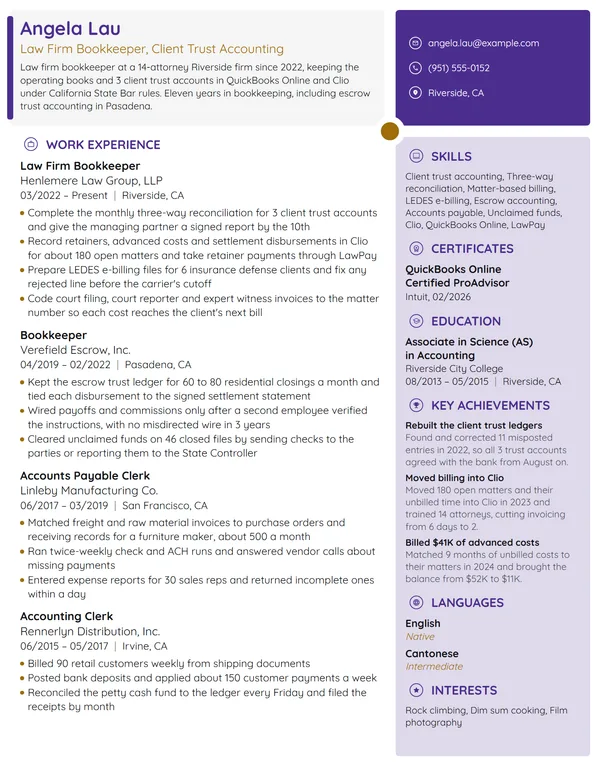
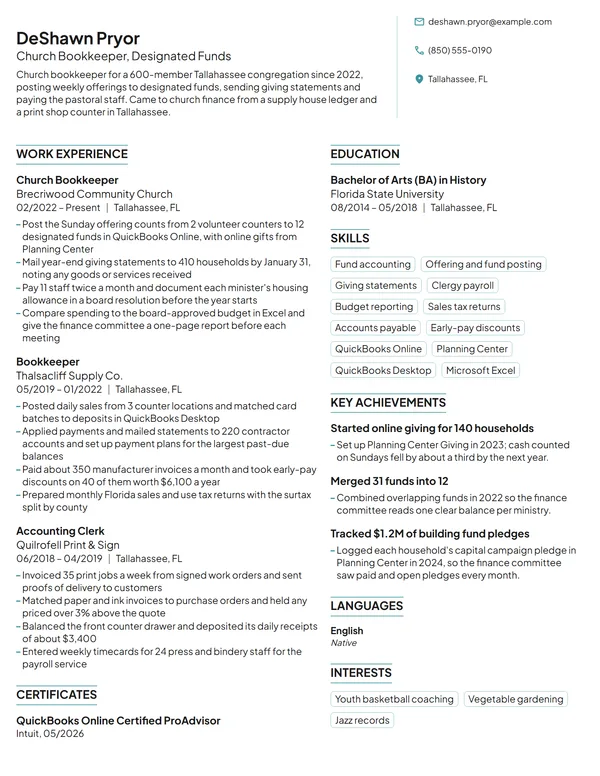
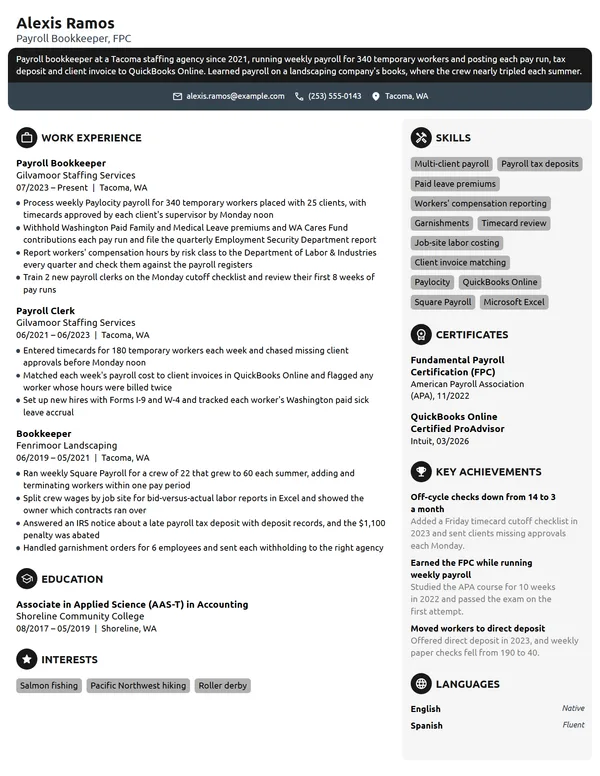
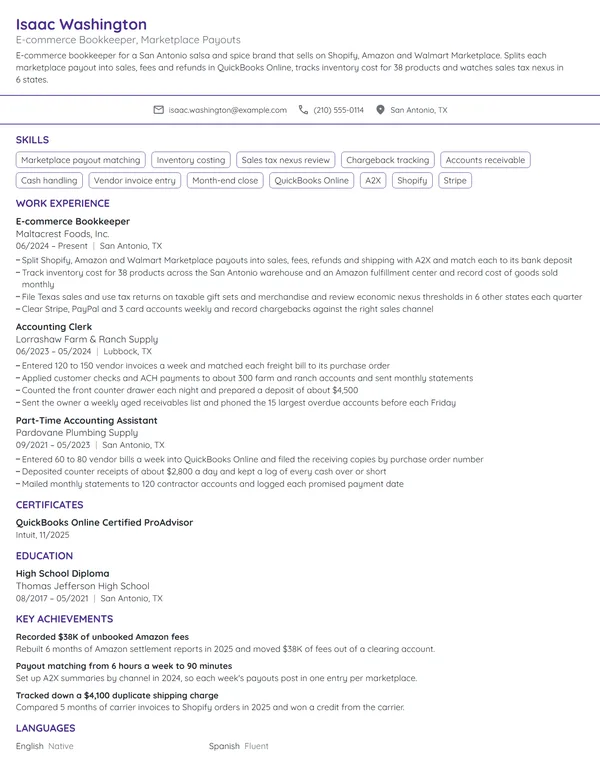
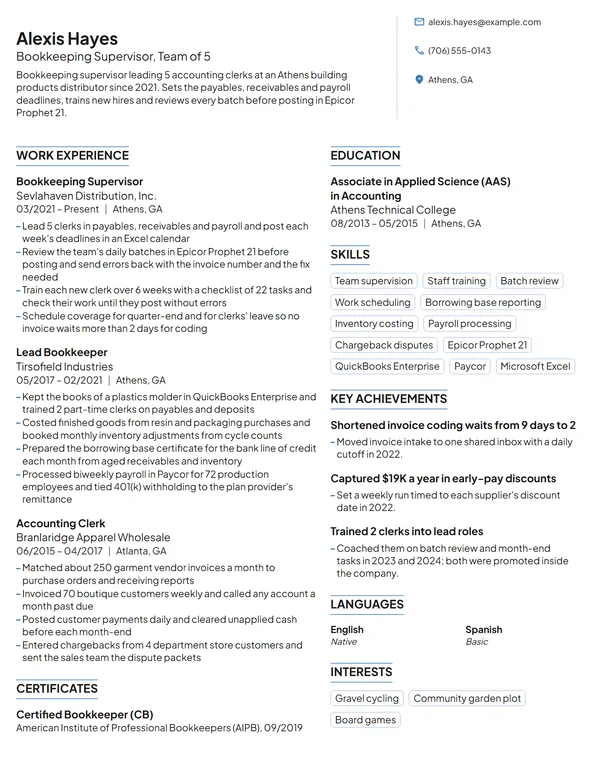
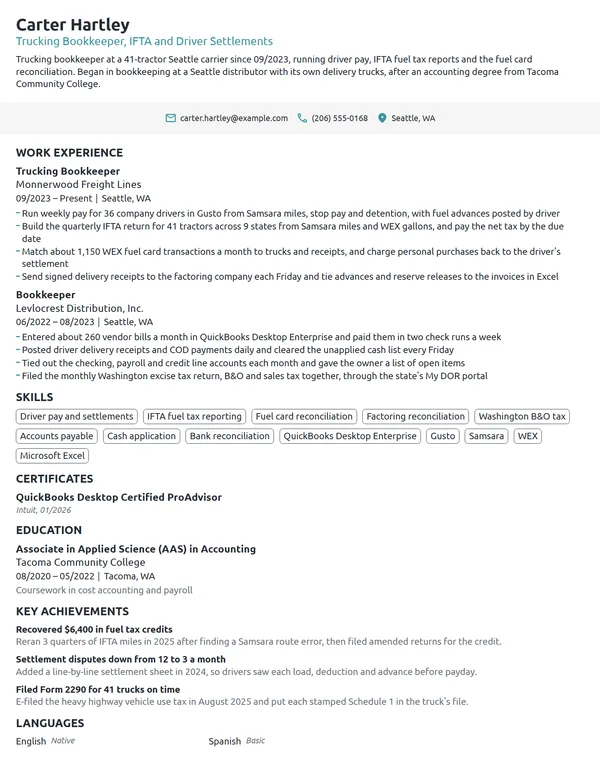
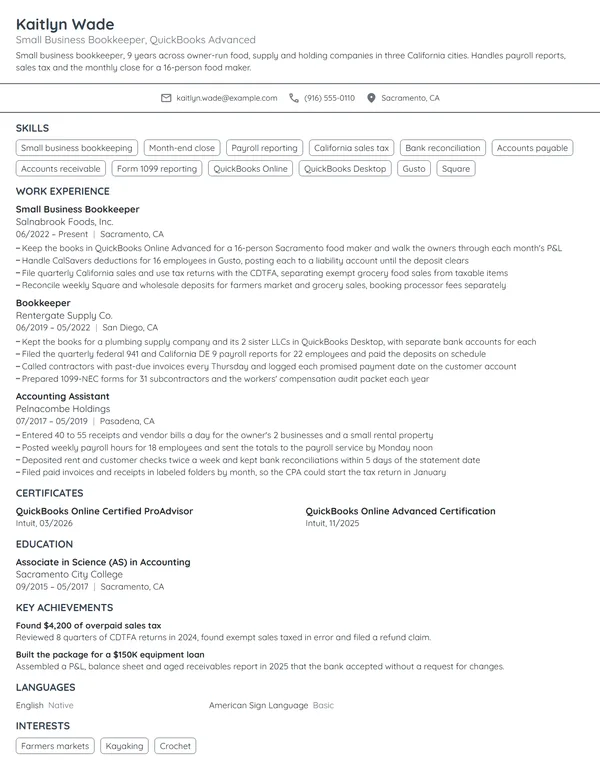
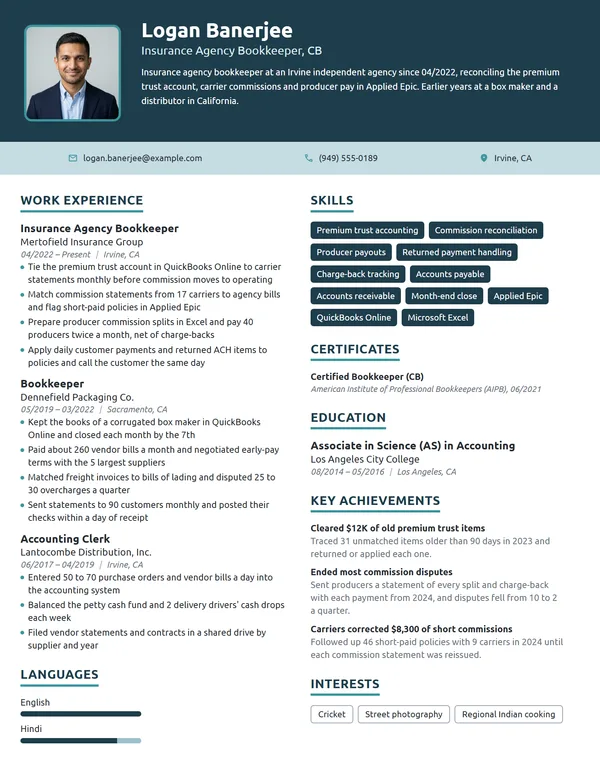
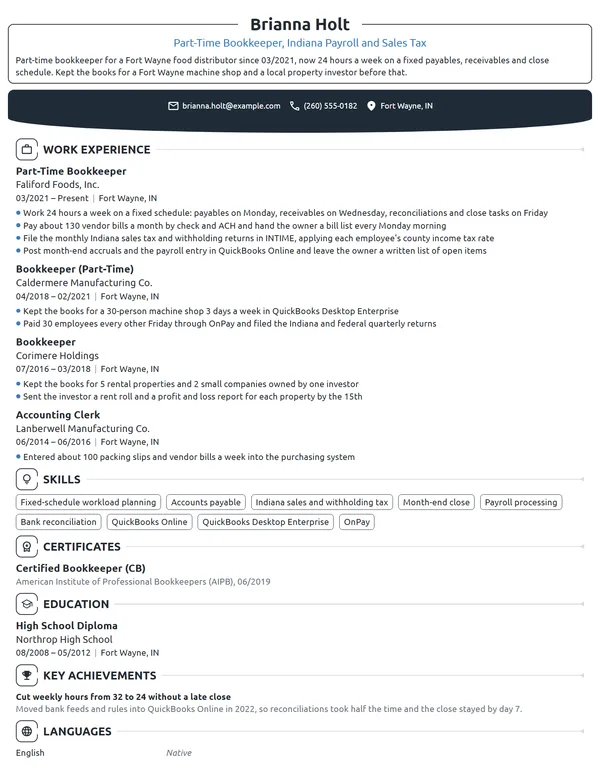
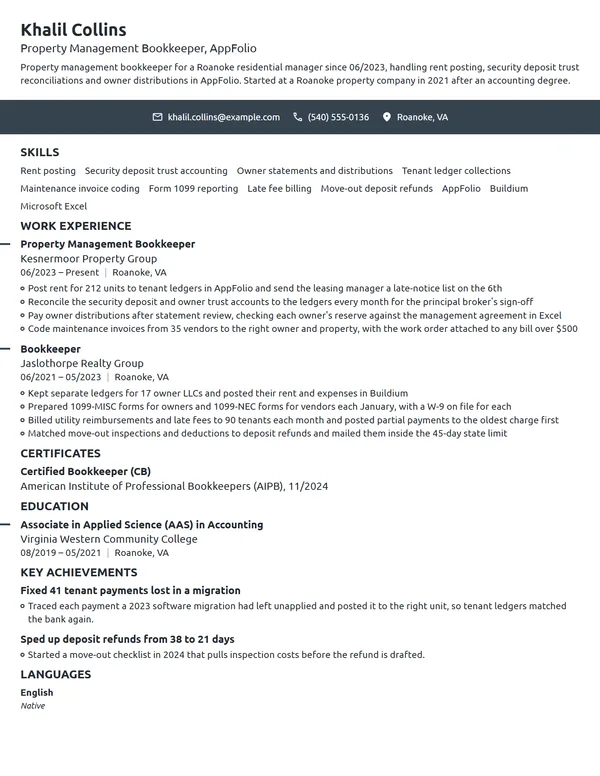
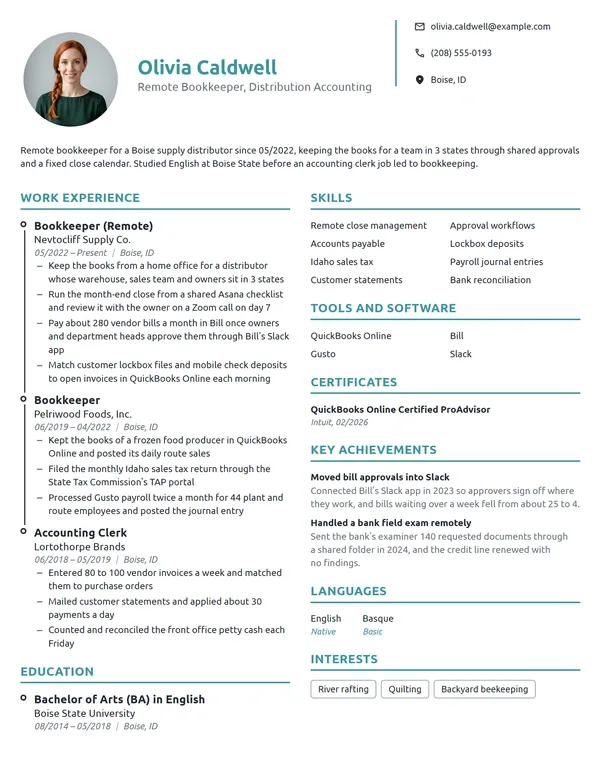
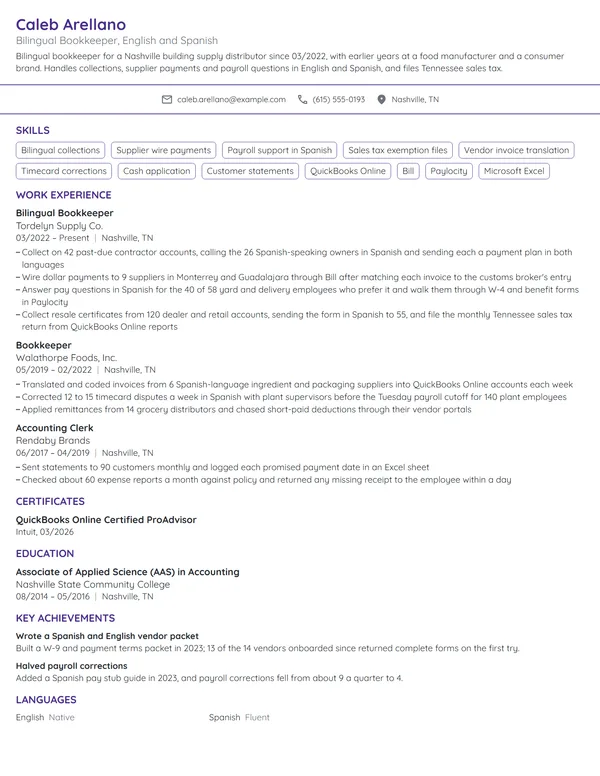
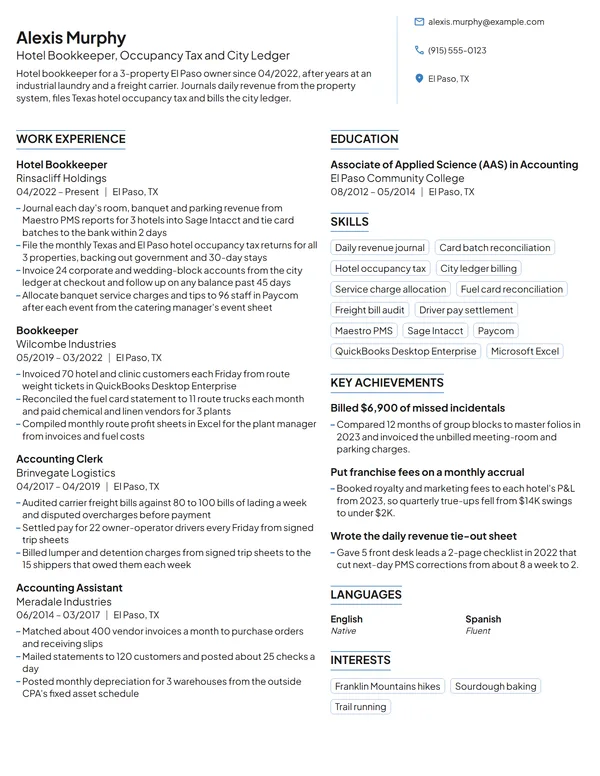
Bookkeeping keeps a business's records true from one month to the next, and your resume is where an owner or controller decides whether to trust you with theirs. They check whose books you kept, how much passed through them, which software you used and whether the month closed on time. Reconciliations, payables and payroll read the same on every bookkeeper's resume when they are listed as duties. A count, a system and a deadline next to each one is what sets yours apart.
How to Write a Bookkeeper Resume - Key Takeaways
- Keep to reverse-chronological order on 1 page, moving to 2 only with 10+ years or many freelance clients.
- Open with 2 to 3 lines that name the kind of business, your software and 1 result, such as your close day or payroll headcount.
- Put a count in every bullet: accounts reconciled, invoices a month, employees on payroll, aged receivables or months of records cleaned up.
- Name the exact product, such as QuickBooks Online, QuickBooks Desktop or Xero, in your skills and again in a bullet.
- List software and bookkeeping certifications under Certificates, naming who issued each and when, and mark one in progress with its next date.
- Leave your birth date and other personal details out, and run the finished file through an ATS resume checker first.
What employers look for in a bookkeeper resume
A small-business owner, an office manager or a controller reads your resume to decide whether to hand you the books. The BLS describes the core of the job as posting transactions, assigning each to the right account, producing balance sheets and income statements, checking postings for accuracy and reconciling differences. O*NET adds processing payroll, preparing bank deposits and reconciling bank transactions. Each of those tasks has a count, and your bullets should carry it.
Scope matters as much as accuracy. The BLS notes that some bookkeepers are full-charge, keeping an organization's entire set of books, while others handle 1 function such as payables or receivables. Make it plain which you were, then use these sections:
- Name, headline (for example, Full-Charge Bookkeeper, QuickBooks Certified) and contact details
- Summary: 2 to 3 lines under your name, which needs no heading of its own
- Work Experience, most recent first
- Skills, with your bookkeeping software among them
- Certificates
- Education
- If space allows: Languages, Interests, and 1 of Volunteer Experience and Key Achievements
Best format for a bookkeeper resume
Choose the reverse-chronological resume format: your latest job at the top, each with its title, employer, city and MM/YYYY dates. Bookkeeping careers grow by scope, from clerk to bookkeeper to full-charge or senior bookkeeper, and putting the newest job first makes each step visible. Move to a combination format only if you are coming from a different field and your bookkeeping work so far is coursework, volunteering or a family business.
- Best for most bookkeepersReverse-chronologicalYour jobs, newest first, with your results under each one.Best for: A steady work history in your field
- FunctionalSkills grouped up top, with a short work history below.Best for: Gaps or very little experience
- CombinationA skills section first, then your full work history.Best for: A career change with strong skills
A 1-page resume fits most bookkeeping careers. Go to 2 only if you have 10+ years or a list of freelance clients that each need their own lines, and keep your current role and your certifications on page 1.
| Setting | What to use |
|---|---|
| Length | 1 page; 2 only for 10+ years or many freelance clients |
| Dates | MM/YYYY when you began and left each role, with Present while you still work there |
| Job title line | Your real scope: Full-Charge Bookkeeper, Bookkeeper (AP and Payroll), Freelance Bookkeeper |
| Software names | The exact product and edition: QuickBooks Online, QuickBooks Desktop Enterprise, Xero |
| Photo and personal details | A photo is usually left off in the US and Canada; also leave off your date of birth, marital status and Social Security number |
| File type | PDF; a Word file only if the employer's portal requests it |
Most US and Canadian resumes carry no photo.
Bookkeeper resume summary vs. objective
If you have kept books for an employer or a client, write a resume summary with your years, the kind of business, your software and 1 number. If you have not, write an objective in the shape of these resume objective examples: the role you want, plus the closest proof you have, such as a certificate, an internship or a club's books. Write it after your bullets, so the number in it is already on the page.
Bookkeeper resume summary formula
Title with X years keeping the books for type of business, in software. Your strongest reconciliation, payroll or close result, with a number. Certification held or in progress.
Example
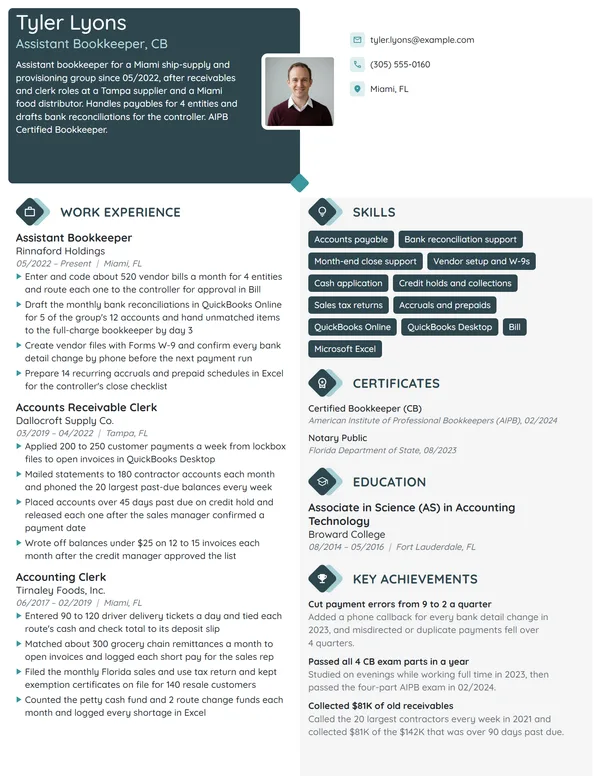
Full-charge bookkeeper with 7 years in dental practice and retail bookkeeping, in QuickBooks Online and Gusto. Runs payroll for 47 employees across 4 offices and closes the books by the 6th business day. QuickBooks Online Certified ProAdvisor, with 2 of 4 parts of the AIPB Certified Bookkeeper exam passed.
Don't
Detail-oriented bookkeeper with excellent organizational skills and a passion for numbers.
Do
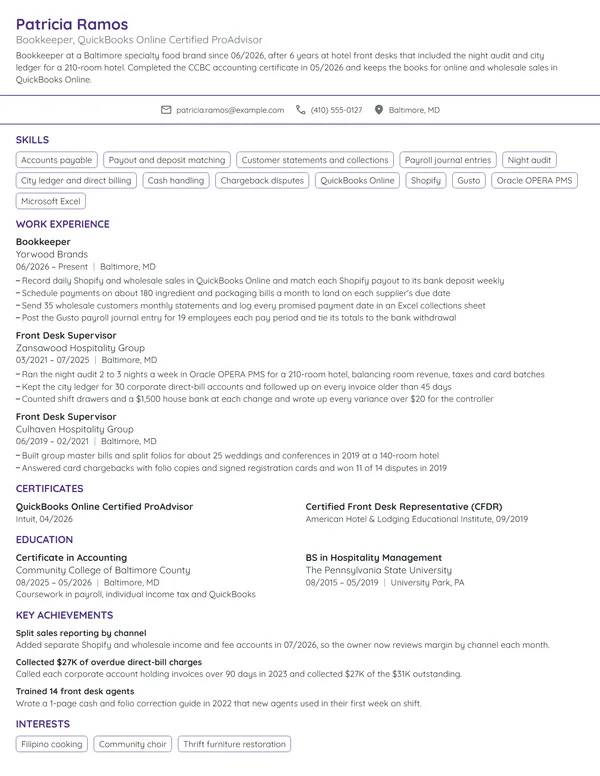
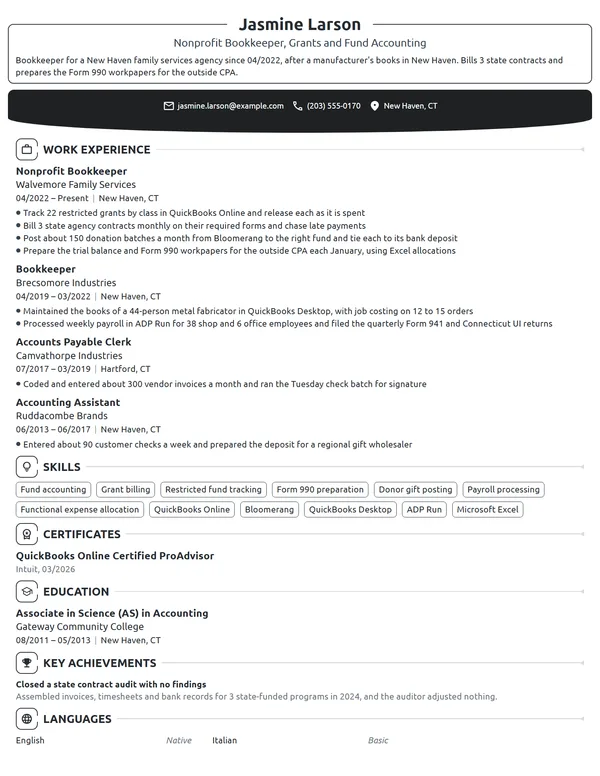
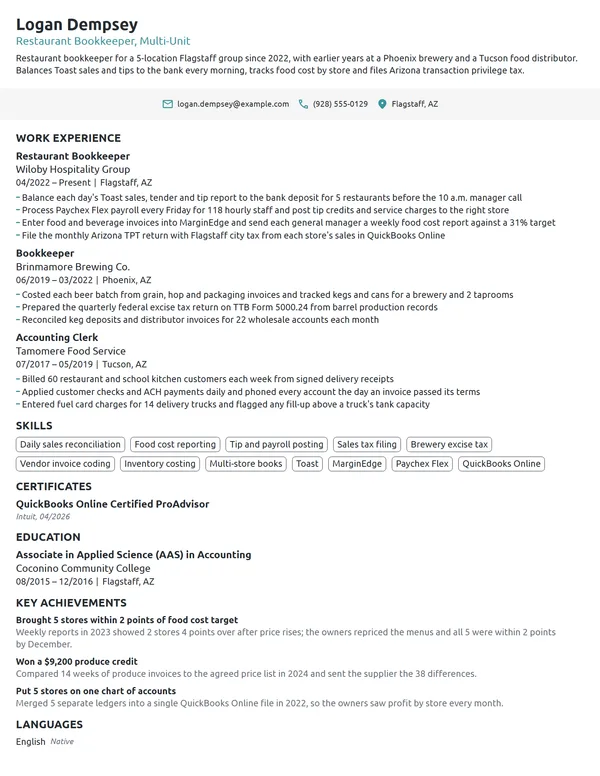
Bookkeeper for a 3-location auto repair group, keeping its books in Xero for 5 years. Reconciles 11 accounts a month and files sales tax returns in 2 states.
Now the reader knows the business, the software, the years and 2 volumes to ask about.
How to write bookkeeper work experience bullets with numbers
Write 3 to 4 verb-first bullets for the job you hold now and 1 to 3 for each earlier one. Bookkeeping already runs on counts and calendars, so follow the rules for listing work experience on a resume and replace each duty with what you did, how often and how much. A bullet that names a volume and a deadline tells the reader what your month looked like.
| Area | What to count | Example bullet |
|---|---|---|
| Bank and card reconciliations | Accounts per month, oldest open item | Reconciled 14 bank and card accounts monthly with no item older than 30 days. |
| Payroll | Employees, pay frequency, filings | Processed semimonthly payroll for 62 hourly workers and filed each quarterly Form 941 on time. |
| Accounts payable | Bills a month, payment method, late fees | Paid 450 bills a month by ACH on net 30 terms with 0 late fees. |
| Accounts receivable | Aged balances, collection steps | Brought invoices past 60 days from $38K to $9K with weekly statements and follow-up calls. |
| Month-end close | Close day, reports delivered | Closed the books by business day 5 and sent the owner a P&L the same week. |
| Cleanups and catch-up work | Months of records, lines categorized | Cleaned up 18 months of uncategorized transactions, about 2,300 lines, before the owner's tax filing. |
Here is a full-charge bookkeeper's entry with those counts in place. The first bullet sets the scope, each bullet after it adds a function, and the older job gets 2 lines.
Work Experience
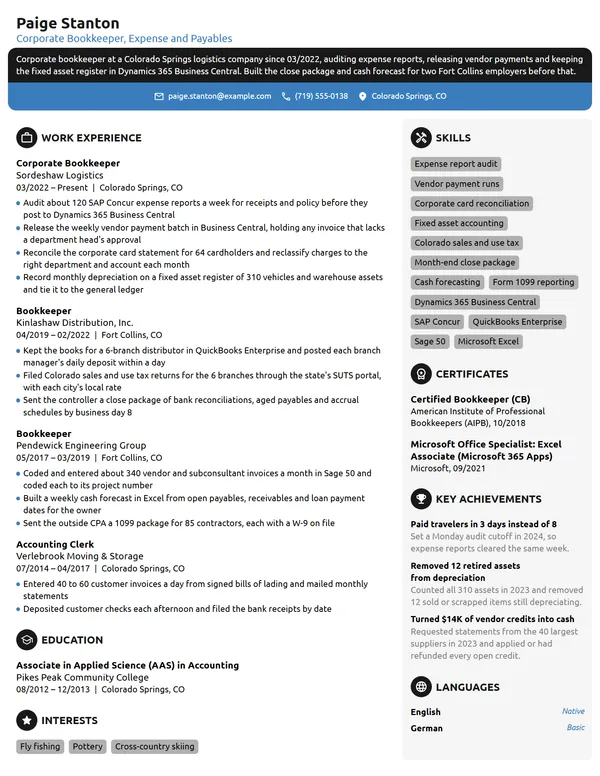
- Keep the books for 4 dental offices in QuickBooks Online, reconciling 9 bank and credit card accounts and closing each month by the 6th business day.
- Run biweekly payroll in Gusto for 47 employees, including hygienist bonuses and 401(k) deductions.
- Cleared $23K in unapplied insurance deposits by matching 610 insurance payments to patient ledgers.
- Prepare the year-end package for the outside CPA, who posted 3 adjusting entries for 2025.
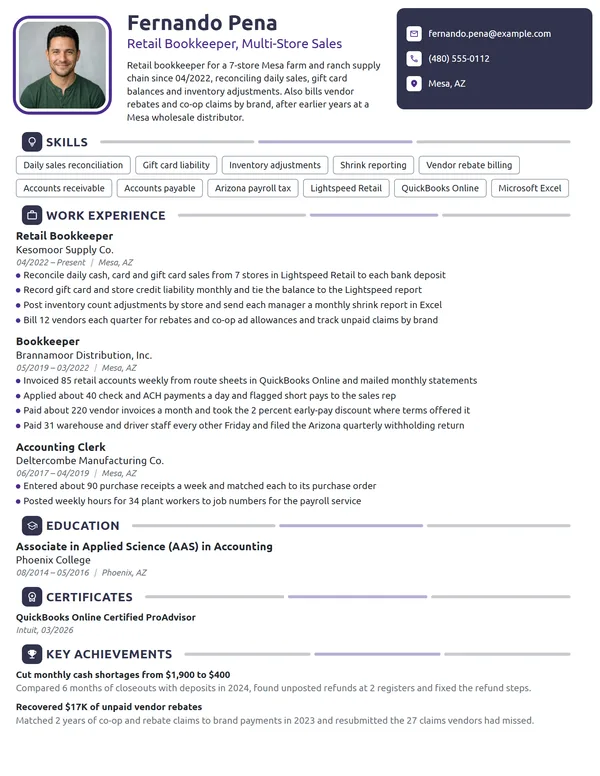
- Entered and coded about 900 vendor invoices a month for 3 stores.
- Caught $11,400 in duplicate invoices in 2021 by checking vendor numbers before each payment run.
Don't
Responsible for bank reconciliations.
Do
Reconciled 6 operating and payroll accounts every month and traced a $2,700 deposit error to a duplicated card batch.
The rewrite shows how many accounts, how often, and what the reconciliation caught.
Don't
Handled payroll and other duties as assigned.
Do
Ran weekly payroll for 28 hourly employees and fixed a misclassified overtime rate before the quarter's Form 941 was filed.
Bookkeeping skills and software for your resume
Choose 6 to 8 hard skills for your resume from the job ad, only ones a bullet already proves, and let your results carry the soft skills. Reconciliations and accounts payable belong on almost every bookkeeper resume; payroll, sales tax or job costing only where you have done them.
Hard skills for bookkeepers
- Bank and credit card reconciliations
- Accounts payable
- Accounts receivable and collections
- Payroll processing
- General ledger maintenance
- Month-end close
- Sales tax filing
- Chart of accounts setup
- 1099 and W-2 preparation
- Bookkeeping cleanup and catch-up
Soft skills employers value in bookkeepers
- Accuracy under deadlines
- Discretion with financial data
- Plain explanations for owners
- Follow-through on open items
- Organization across many accounts
- Asking questions early
List your software with your skills, then repeat each product's name inside a bullet about the work you did in it. O*NET flags Intuit QuickBooks, SAP software and Microsoft Excel as both hot and in-demand technology for bookkeeping, accounting and auditing clerks, and marks SAP Concur and Yardi as hot. Write the edition you used, such as QuickBooks Online or QuickBooks Desktop, and add payroll or bill-pay tools such as Gusto or Bill.com only when the job ad names them and you have used them. For Excel, name the skill: pivot tables, VLOOKUP or bank-feed imports say more than proficient in Excel.
Bookkeeper certifications: QuickBooks, Xero and the AIPB CB
The BLS says certification is not usually required for bookkeepers, so a credential works as proof rather than a gate. Put certifications on your resume under Certificates, each with its issuer and year, starting with the one the job ad asks for. Software certifications show you can run a specific product; the Certified Bookkeeper designation shows tested knowledge of bookkeeping itself.
| Credential | Issued by | What it takes |
|---|---|---|
| Certified Bookkeeper (CB) | American Institute of Professional Bookkeepers (AIPB) | Pass a 4-part national exam, sign the CB Code of Ethics, and show 2 years of full-time bookkeeping or 3,000 hours of part-time or freelance work, within 3 years of passing. |
| QuickBooks Certified ProAdvisor (QuickBooks Online, Desktop and other products) | Intuit | Pass Intuit's certification exam for the product, then a short recertification exam every year to keep the status. |
| Xero certification (Level 1 associate, then professional and specialist) | Xero | Free; a self-paced course, a webinar or the assessment alone, taken in level order. It lasts 12 months and is renewed with an annual assessment. |
Listing a CB exam or certification still in progress
Write the credential's full name, then what you have finished and when the rest is scheduled. Keep the letters CB out of your headline until AIPB awards the designation, and keep a lapsed QuickBooks or Xero certification off the list until you have passed the renewal.
Certificates
- QuickBooks Online Certified ProAdvisor, Intuit, 04/2024; recertified 2026
- Certified Bookkeeper (CB), American Institute of Professional Bookkeepers: 2 of 4 exam parts passed (05/2026, 09/2026); remaining parts scheduled 02/2027
How to list a bookkeeping certificate, associate degree or diploma
According to the BLS, employers generally prefer candidates who finished high school and took college courses in subjects such as accounting, and most bookkeepers learn the rest on the job. A community college certificate or an associate degree in accounting is the usual next step. Follow the rules for listing education on a resume: credential, school, city and completion date, with 1 line of coursework only if it names payroll, tax or the software you will use.
If you earned the credential part-time while working, say so: it explains why the graduation date falls after your first bookkeeping job. Once you have any college credential, drop your high school.
Education
Completed part-time alongside full-time work. Coursework in payroll accounting, business tax and QuickBooks.
Entry-level and career-change bookkeeper resumes
Without a paid bookkeeping job yet, start from an entry-level resume: an objective, Education placed higher, then any work where you handled money or records. Each item below earns a number, just as a full-time job would.
- Internships or co-op placements: transactions posted, accounts reconciled, the software you were trained in.
- A family business or side business: monthly revenue, bills paid, payroll for any staff, and who filed the taxes from your records.
- Treasurer of a club, church or parent group: the budget, deposits made and reports given to the board, listed under Volunteer Experience.
- Tax-season volunteering, such as an IRS VITA site: returns prepared in a season, also under Volunteer Experience.
- Cash handling in retail, hospitality or banking: drawers balanced, deposits prepared and the variances you caught.
Don't
Hardworking individual looking for an entry-level bookkeeping job to grow my skills.
Do
Accounting certificate graduate with a 12-week internship at a property management office, seeking a bookkeeper role. Posted rent receipts for 140 units in Yardi and earned the Xero associate certification in 2026.
An objective still needs evidence: an internship, a volume and a credential.
Changing careers from a front desk, a store, a bank branch or an office, keep reverse-chronological order and put the money tasks first under each old job: deposits, cash counts, invoicing, vendor bills or expense reports. A career-change resume works when a reader sees bookkeeping in your first 2 bullets, with your new certificate or software certification in the summary. Explain the move itself in your cover letter, and the finance cover letter examples show how to keep that to a short paragraph.
Bookkeeper resume FAQ
What is a full-charge bookkeeper, and should I say it on my resume?
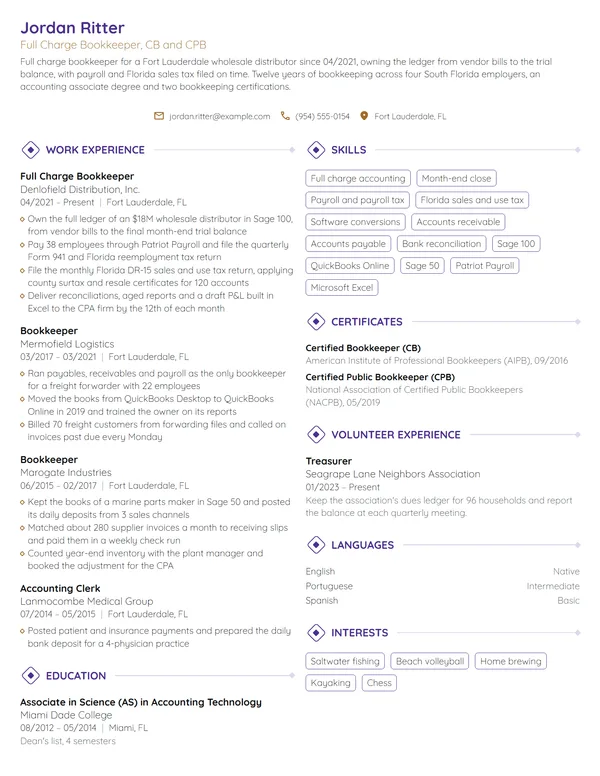
Yes, if it is true. The BLS describes full-charge bookkeepers as those who maintain an organization's entire set of books. If you handled the ledger, reconciliations, payables, receivables and payroll through to the monthly reports, use Full-Charge Bookkeeper as your title and show each function in a bullet.
Do I need a certification to work as a bookkeeper?
No. The BLS says certification is not usually required and that most bookkeepers train on the job. A QuickBooks or Xero certification still helps when a job ad names that product, and the AIPB Certified Bookkeeper designation shows tested knowledge once you have the experience it asks for.
Should I list QuickBooks Online and QuickBooks Desktop separately?
Yes, when you have used both. They are separate products with separate Intuit certifications, and employers usually run one of them. List each by its exact name in Skills, and back the one the job ad names with a bullet.
How long should a bookkeeper resume be?
1 page for most bookkeepers. Use 2 pages only with 10+ years of experience or a freelance practice with several clients worth describing, and keep your current role and your certifications on the first page.
How do I list freelance bookkeeping clients on a resume?
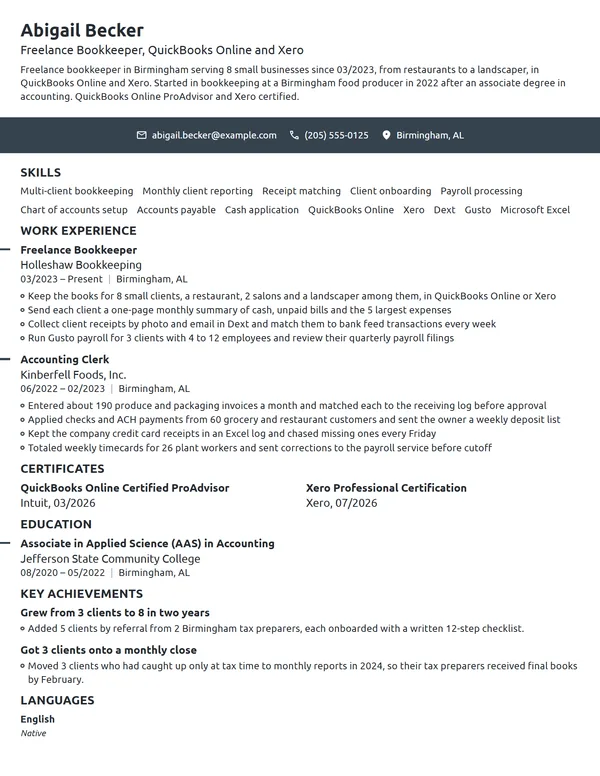
List your practice as 1 Work Experience entry, titled Freelance Bookkeeper or under your business name, with your city and dates. Then use bullets for the client mix: how many clients, their industries, the software and the monthly work, such as reconciliations, payroll or cleanups. Name a client only with permission.
Can I become a bookkeeper without an accounting degree?
Yes. The BLS says employers generally prefer people who finished high school and took some college accounting, and that bookkeepers typically learn the job through on-the-job training. On your resume, lead with a community college certificate, a software certification and any books you have already kept.
Should I put my salary expectations on a bookkeeper resume?
No. Pay belongs on the application form or in a later conversation with the employer. For a benchmark, the BLS reports median annual pay of $50,670 for bookkeeping, accounting, and auditing clerks in May 2025; offers vary with your state, the size of the books and whether the role is full-charge.
Next steps
Pick the example closest to your scope, from a single function to full-charge, and keep its order. Swap in your own accounts, payroll headcount, close day and software. Build it in our resume builder or from one of the resume templates, and open your cover letter with the number you are proudest of.