
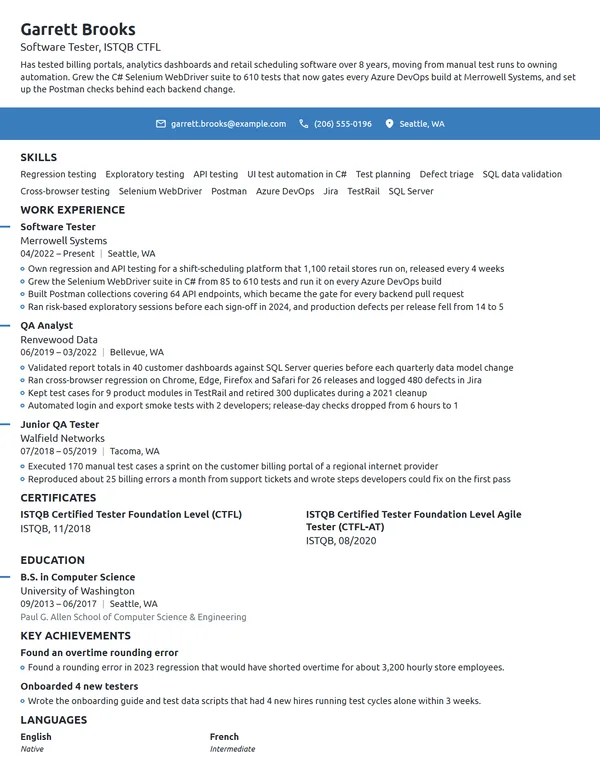
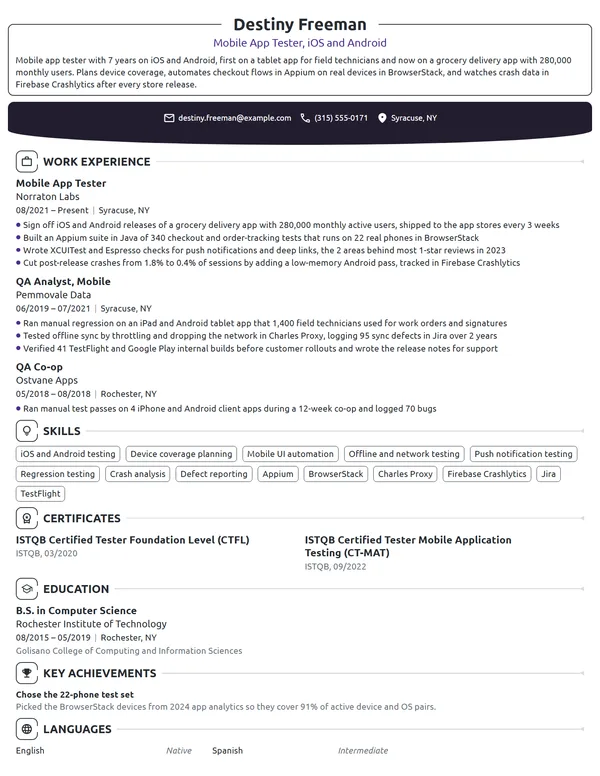
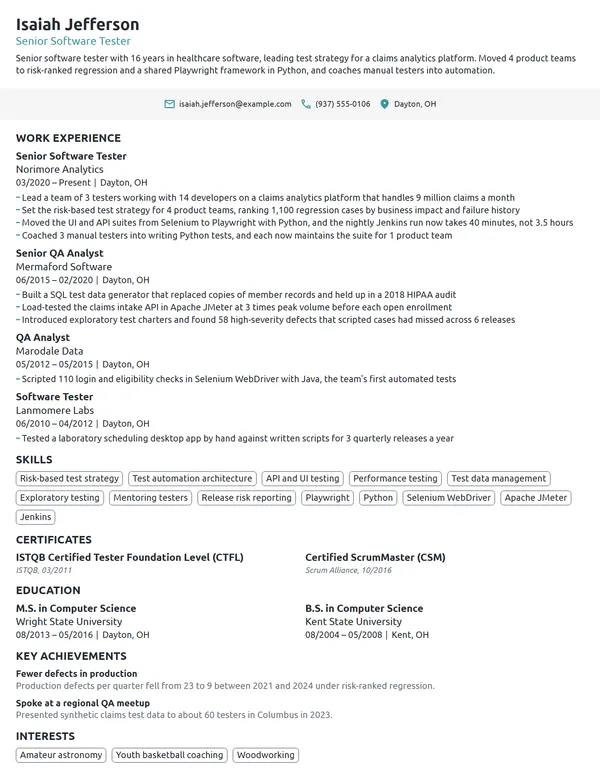
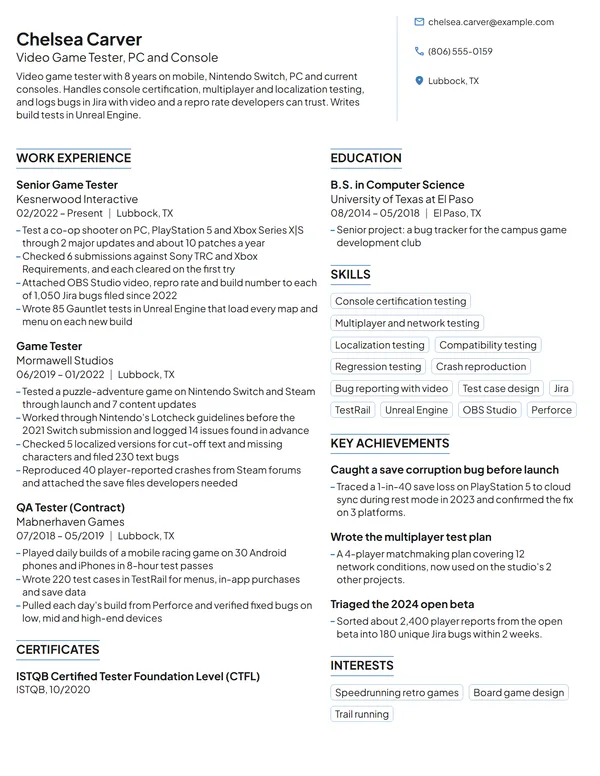
Software testing means finding what breaks before a customer does, then writing it up so a developer can fix it fast. Which kinds of testing you run, the tools you automate with and the products you have covered all matter to a QA lead, and so does whether releases improved once you joined the team. Bug counts help, as long as each one sits next to the size of the release it came from and the number of problems users still reported afterward.
How to Write a Software Tester Resume - Key Takeaways
- Keep the resume to 1 page in reverse-chronological order; a second page fits after about 10 years of testing work.
- Name the kinds of testing you ran under each job, such as regression, exploratory, API, mobile or performance testing.
- Count what QA teams track: test cases automated, suite run time, defects found before release and bugs customers reported after it.
- List your tools in Skills and prove each one in a bullet, whether it is Jira, Postman, Jenkins, Selenium or Playwright.
- Put ISTQB Certified Tester Foundation Level (CTFL) under Certificates with its month and year, and mark an advanced exam as scheduled until you pass it.
- Test the file in an ATS resume checker before you apply, since tool names copied from the posting are the keywords a screen matches.
What QA leads look for in a software tester resume
A QA lead wants to see what software you have tested, how you test it and whether the product shipped in better shape because of you. The Bureau of Labor Statistics lists creating test plans and scenarios, running manual, automated and exploratory tests, and documenting and reporting defects as core duties for quality assurance analysts and testers. O*NET adds logging defects in a bug tracking system and building tests for regression, negative cases and bug retests.
Each of those duties needs a product, a method and a number on your resume. Organize it under these headings, which applicant tracking systems parse cleanly:
- Name, headline (for example, Software Tester, ISTQB CTFL) and contact details, with a GitHub link only if it holds your own test code
- Summary: 2 to 3 lines under your name that state your testing focus and 1 result
- Work Experience, newest first, with the product or platform in each entry
- Skills, with your test frameworks, languages and bug tracker
- Certificates
- Education, including a bootcamp or college certificate
- If space allows: a Key Achievements section, Volunteer Experience in its place, and Languages where they apply
Best format for a software tester resume
Use the reverse-chronological resume format, opening on the job you hold now and working back, with the employer and its location, your title and the month and year you started and left on every entry. Testing careers tend to move from manual testing to automation, then to test lead or QA engineer roles, and this order puts that progression in plain view. If you tested 2 products for the same employer, keep them in 1 entry and give each product its own bullet.
- Best for most software testersReverse-chronologicalYour jobs, newest first, with your results under each one.Best for: A steady work history in your field
- FunctionalSkills grouped up top, with a short work history below.Best for: Gaps or very little experience
- CombinationA skills section first, then your full work history.Best for: A career change with strong skills
One page covers most testers with under 10 years of experience. Move to 2 pages when you have led QA for several products or built frameworks other teams adopted, and keep your current role, your tools and your certificates on page 1.
| Setting | What to use |
|---|---|
| Length | 1 page under 10 years in testing; 2 pages after that |
| Dates | Month and year on each side of a job, such as 03/2022 – Present |
| Job title line | Your title plus the product: QA Analyst, Mobile Banking App |
| Tools | Inside Skills, spelled the way the posting spells them |
| Links | LinkedIn, plus GitHub or a portfolio if it shows test code you wrote |
| Photo, age and family details | Usually left off, along with any ID numbers |
| File type | PDF by default; .docx when the application form requests it |
Most US and Canadian resumes carry no photo. Software companies usually take applications through a careers portal that turns your file into text, so standard headings and plain bullet points keep every tool name readable.
Software tester resume summary vs. objective
Use one test: if you have held a paid testing or QA role, write a resume summary with your years, the products you test and your strongest result. If testing would be your first job in software, write a resume objective that names the role you want and the proof you already have, such as a certificate or a public test project. Either way, it is 2 to 3 lines, and its number should come from a bullet further down.
Software tester resume summary formula
Title with X years testing product type for industry. Your strongest automation, coverage or defect result, with a number. Tools you work in and your certification.
Example
Software tester with 7 years testing web and API products for logistics and healthcare companies. Moved 180 manual test cases into an automated suite that runs on every merge. Works in Playwright, Postman, Jira and Jenkins; ISTQB CTFL certified.
Don't
Detail-oriented QA professional with a passion for quality and a proven track record of finding bugs.
Do
QA analyst with 4 years on an e-commerce checkout, testing web releases every 2 weeks. Wrote 150 automated cart and payment checks in Cypress and has held the ISTQB CTFL since 2024.
The second line gives the product, the release pace, the tool and a count a QA lead can ask about in an interview.
How to write software testing bullets with numbers
Your current role takes 3 to 4 bullets, and so can the job before it; older roles take 1 to 3. Open with the product and the team you test for, because the size of a release changes what every later number means. Then turn tasks into achievements on your resume by counting what changed: tests automated, hours saved on regression, defects caught before release and fewer bugs reaching users.
| Area | What to count | Example bullet |
|---|---|---|
| Coverage | User stories or requirements with tests, platforms, browsers | Mapped tests to 140 user stories a release and closed gaps on 9 checkout paths that had no tests. |
| Automation | Cases automated, suite run time, flaky test rate | Automated 260 of 400 manual checkout cases in Selenium with Java and brought flaky failures down from 11% to 2%. |
| Defects before release | Bugs found, severity, share fixed before go-live | Found 37 severity 1 and 2 bugs in a billing rewrite during system testing, all fixed before go-live. |
| Bugs that reached users | Customer-reported bugs, production incidents after release | Cut customer-reported bugs in the first 30 days after release from 18 to 6 across 4 releases. |
| Release speed | Regression cycle length, release frequency | Shortened the regression cycle from 2 weeks to 3 days, so the team could ship monthly instead of quarterly. |
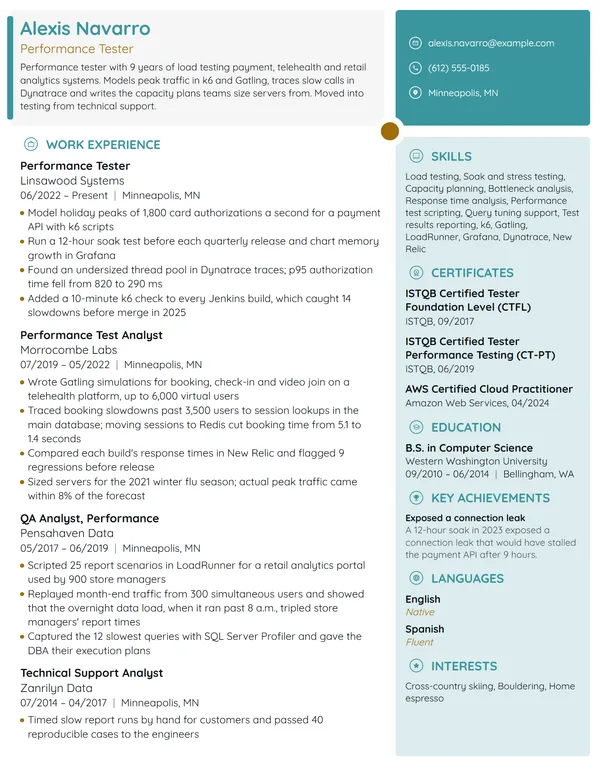
| Performance | Concurrent users, response times, load scenarios | Load-tested a booking API at 2,000 concurrent users in JMeter and traced response times past 4 seconds to 1 slow query. |
This entry opens on the product and team, and the older job keeps 2 bullets.
Work Experience
- Test a freight-booking web app and its carrier API in 2-week sprints with 6 developers and 1 other tester.
- Built a Playwright suite of 420 regression tests in TypeScript that runs in Jenkins, cutting the manual regression pass from 3 days to 5 hours.
- Logged 310 defects in Jira in 2025, each with steps and logs; developers accepted 94% as valid at first triage.
- Wrote 75 Postman tests for the carrier rate API that caught 12 contract breaks before release.
- Ran manual and exploratory tests on a patient portal used by 40,000 members, writing 600 test cases in TestRail.
- Added a pre-release smoke checklist that lowered user-reported defects after quarterly releases from 21 to 8.
Don't
Tested software and reported bugs.
Do
Ran exploratory and regression tests on 3 releases a month and logged about 45 reproducible defects a quarter in Jira, each with steps, logs and screenshots.
The rewrite shows how often you test, how much you find and how well you report it.
Don't
Responsible for test automation.
Do
Converted 90 manual smoke tests into a Selenium suite in Python that runs nightly in Jenkins and posts failures to the team channel by 7 a.m.
Software testing skills and tools for your resume
Pick 6 to 8 technical skills for your resume from the posting, and keep only the ones a bullet already proves. Regression testing and defect reporting fit almost every tester; load testing, mobile device testing or API contract testing belong only where you have done them.
Hard skills for software testers
- Test planning and test case design
- Regression testing
- Exploratory testing
- API testing
- UI test automation
- Performance and load testing
- Defect tracking and reporting
- Cross-browser and mobile device testing
- SQL for test data
- CI pipeline integration
Soft skills QA leads value
- Attention to detail
- Clear, reproducible bug reports
- Curiosity about how things fail
- Working with developers without blame
- Prioritizing tests by risk
- Explaining release risk to product owners
O*NET flags Selenium, Jenkins, Jira, Git and Python as hot technologies for software quality assurance analysts and testers, and marks Playwright, Appium, Postman and Apache JMeter as in demand with employers. List the ones you use in Skills, then show each in a bullet with what you built or found with it. A tester who works mostly by hand can still name the test management tool and the bug tracker, and the SQL used to check results in the database.
ISTQB, CSM and other software testing certifications
No license is required to work as a software tester, so certifications do the job a license does in other fields: they show a shared vocabulary for test design and process. The ISTQB Certified Tester Foundation Level is the common starting point, and ISTQB recognizes it as the prerequisite for every other certification of its own that requires Foundation Level. In the US, ASTQB is the ISTQB member board and keeps an official list of certified testers. List certifications on your resume under Certificates, each with its issuer and the month you passed.
| Credential | Issued by | What it takes |
|---|---|---|
| Certified Tester Foundation Level (CTFL) v4.0 | ISTQB (ASTQB in the US) | No prerequisites; a 40-question, 60-minute exam with a pass mark of 26 out of 40 points. |
| Certified Tester Advanced Level Test Automation Engineering (CTAL-TAE) v2.0 | ISTQB | A Foundation Level certificate and practical experience; a 40-question exam in 90 minutes. |
| Certified ScrumMaster (CSM) | Scrum Alliance | A 16-hour course and a 50-question test with 37 correct answers to pass; renewed every 2 years with Scrum Educational Units. |
How to write ISTQB certifications on a resume
Write the full name, then the abbreviation in parentheses, so a search for either one finds it: ISTQB Certified Tester Foundation Level (CTFL). Add the month and year you passed. An exam you have booked but not passed goes in with the word scheduled and its date, and the abbreviation stays out of your headline until the result is in.
Certificates
- ISTQB Certified Tester Foundation Level (CTFL), ISTQB, 04/2020
- Certified ScrumMaster (CSM), Scrum Alliance, 09/2023
- ISTQB Certified Tester Advanced Level Test Automation Engineering (CTAL-TAE), ISTQB, scheduled 01/2027
How to list a degree, certificate or bootcamp on a tester resume
The Bureau of Labor Statistics says quality assurance analysts and testers typically need a bachelor's in computer and information technology or a related field, and O*NET rates the occupation Job Zone 4, Considerable Preparation Needed. Testers also come in through college certificates and coding bootcamps, and those count as education on your resume.
Follow the standard way of listing education on a resume: the credential, where you earned it, the town or city, and the month you finished. In your first 2 years out of school, add a GPA of 3.5 or more and 1 line on a project where you tested or automated something. After that, cut it back to the credential, the school and the date.
Education
Senior design project: test plan and 120 automated UI tests for a campus parking app.
Entry-level and career-change software tester resumes
With no paid testing job yet, your resume has to show that you already test like a professional. Lead with an objective, your CTFL or a certificate program, and 1 project a reviewer can open. The entry-level resume layout keeps education and projects near the top. These are the places most new testers find their evidence:
- A public automation project: the app you tested, the framework and language, and how many tests run, linked from your header.
- Support or help desk work: customer bug reports you reproduced and escalated in a year, written as a Work Experience entry.
- Open-source bug reports: issues you filed and how many were accepted, under Volunteer Experience.
- Paid crowdtesting projects: devices covered and bugs approved, as a Work Experience entry with its dates.
- Certificates and courses: CTFL with its date under Certificates, and a bootcamp or college certificate under Education.
Don't
Motivated individual seeking an entry-level QA position to gain experience in software testing.
Do
ISTQB CTFL-certified former customer support specialist seeking a junior QA analyst role. Reproduced and escalated 200+ customer bug reports a year and wrote 60 test cases for a personal Playwright project on GitHub.
Even a first-job objective needs proof: a certificate, a count and something a reviewer can open.
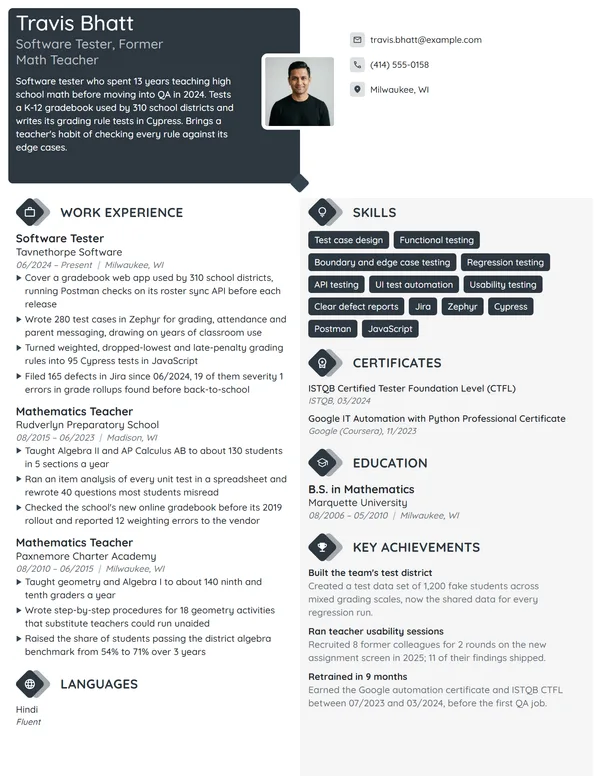
Moving into testing from teaching, support, operations or analysis, list your newest work first as usual, which puts the testing job or certificate at the top. Under your earlier jobs, keep bullets that show testing habits with a number: step-by-step procedures you wrote, work you checked against a standard, problems you reported clearly. Our career-change resume examples show the layout, and our IT cover letter examples show how to make the case for the switch in a few lines.
Software Tester resume FAQ
Do I need a degree to become a software tester?
Not always. The BLS says quality assurance analysts and testers typically need a bachelor's in computer and information technology or a related field. Without one, lead with an ISTQB Foundation Level certificate, a public test project and any bug reporting you did in a support or product role.
Is ISTQB certification worth putting on a software tester resume?
Yes, if you hold it. The Foundation Level (CTFL) has no prerequisites and is the base for the ISTQB certificates that require Foundation Level, so many testers list it first. Write the full name with CTFL in parentheses and the month you passed.
Should I list manual testing if most jobs ask for automation?
Yes. Exploratory and manual testing still find problems automated checks miss, so give them their own bullets with a count. If you have started automating, add the framework, the language and how many tests you wrote, even if the number is small.
How do I write a video game tester resume?
Name the platforms you tested on, such as PC, console or mobile, the genres or titles you worked on, and the bug database you logged in. Count the builds you tested and the bugs you found, and keep bullets about reproducing crashes and checking fixes on every platform.
Should I link my GitHub on a software tester resume?
Only if it holds test code you wrote. A repository with an automation framework, a readable README and tests that pass shows more than a profile full of tutorial forks. Put the link in your header next to LinkedIn.
How long should a software tester resume be?
1 page for most testers with under 10 years of experience. A test lead or QA engineer with several products or a framework other teams adopted can use 2 pages, as long as the current role and tools sit on page 1.
Is a QA analyst resume different from a software tester resume?
Not much. O*NET groups QA analyst, software test engineer, automation tester and QA engineer under one occupation. Use the title the posting uses in your headline if it matches your work, and keep your real job titles under Work Experience.
What is the average software tester salary?
The BLS puts the median annual pay of software quality assurance analysts and testers at $104,300 in May 2025. Pay varies with your state, industry and automation skills; leave it off your resume and raise it when an offer is on the table.
Next steps
Choose the example that matches the product you test and your level, then swap in your own counts: tests automated, defects found, regression hours saved and bugs users reported. Put it together in our resume builder or on one of our templates, and pair it with a short letter that names the product you want to test next.