
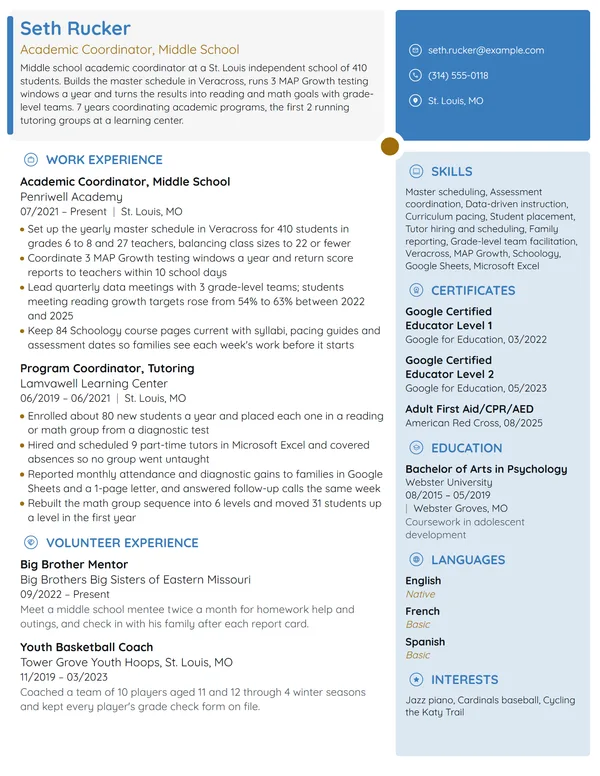
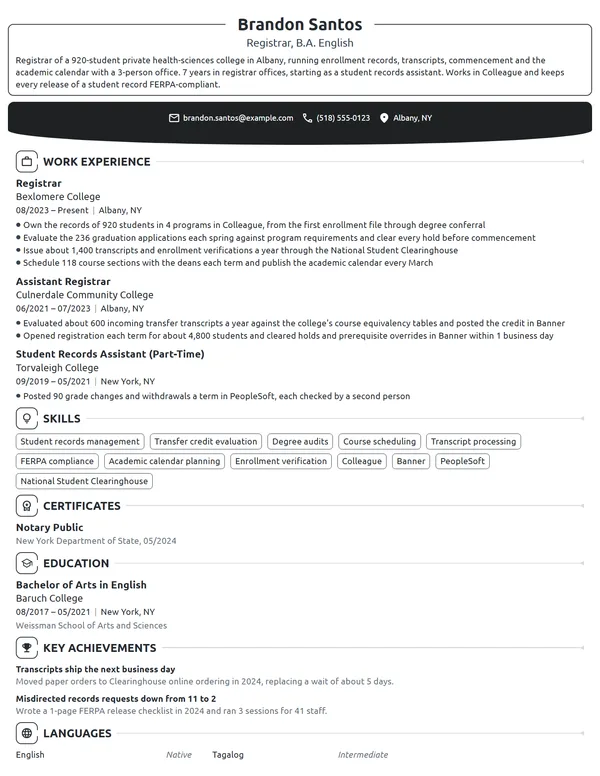
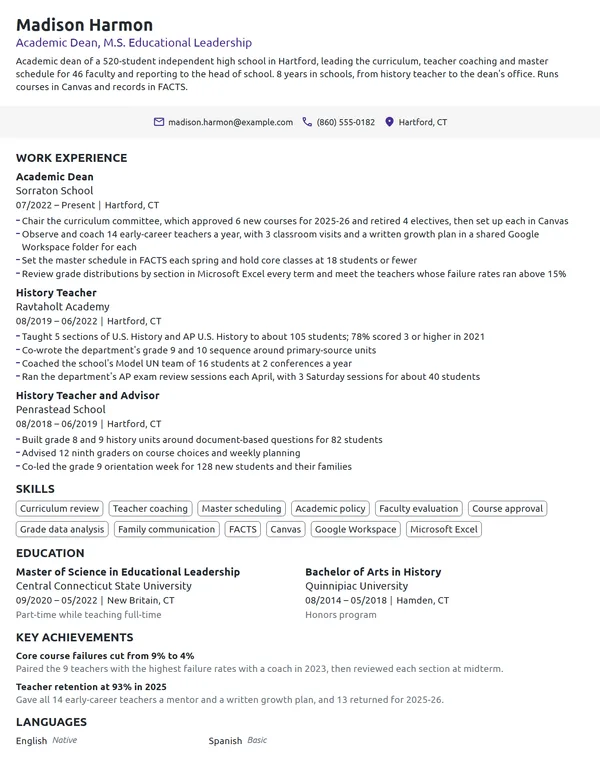
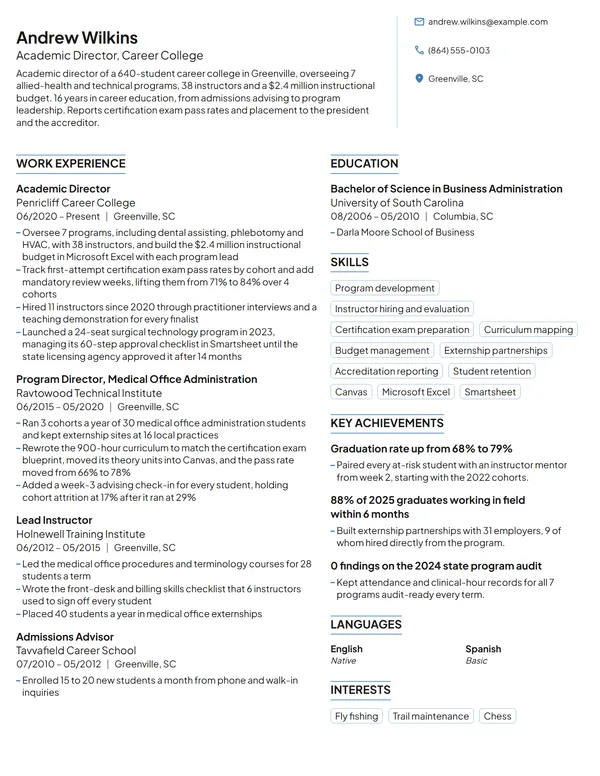
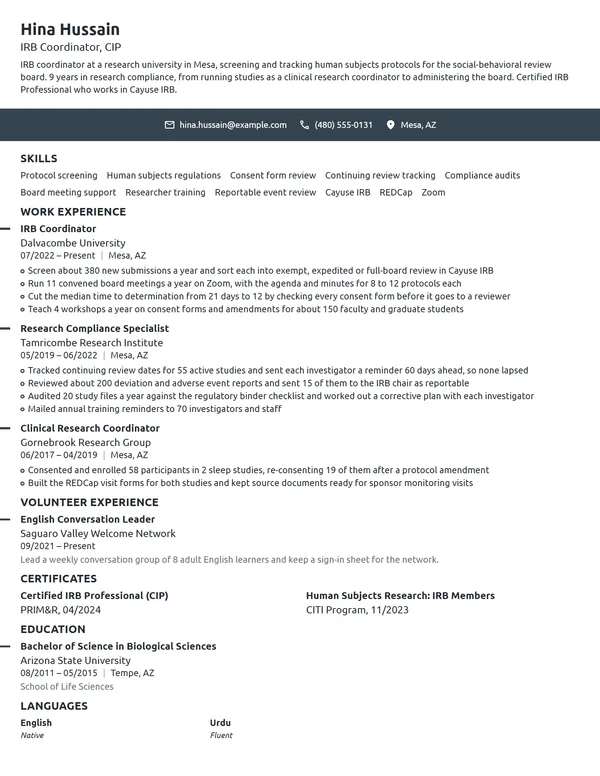
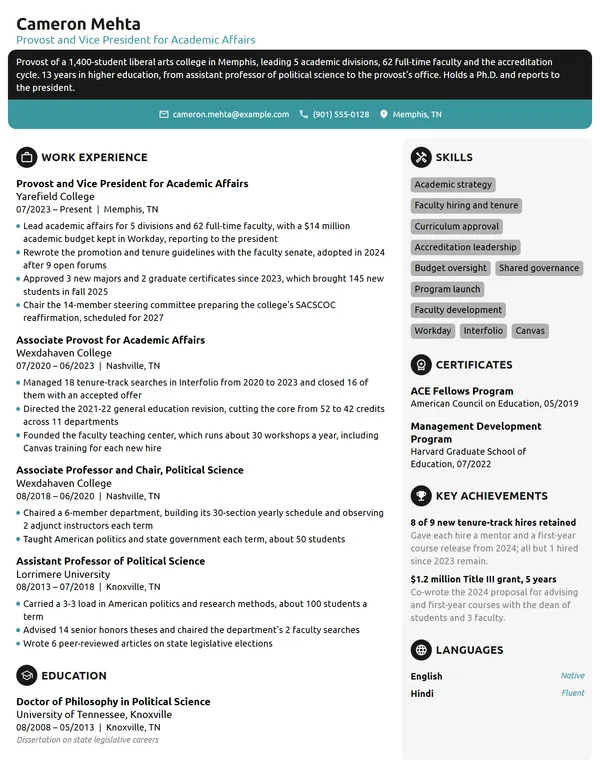
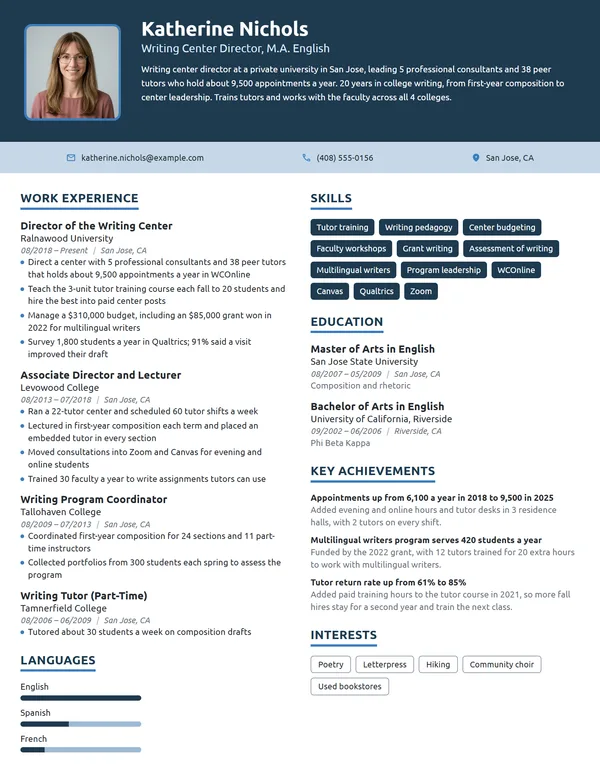
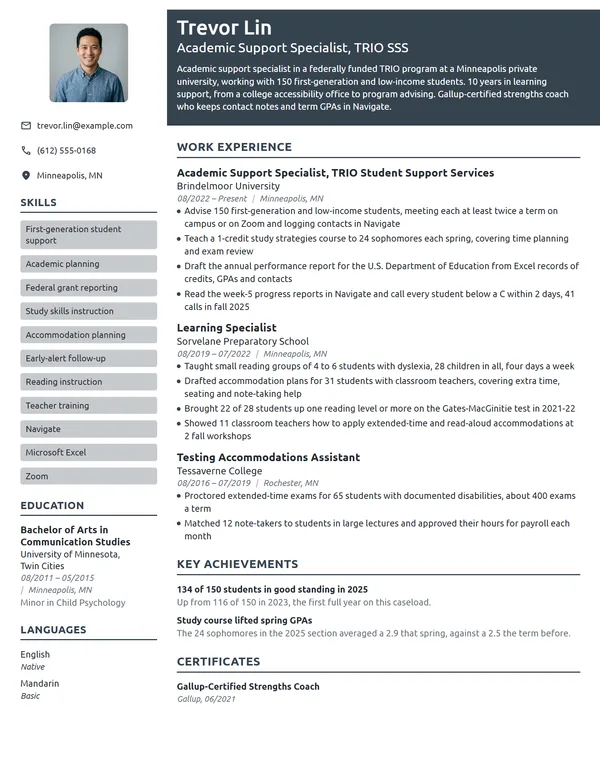
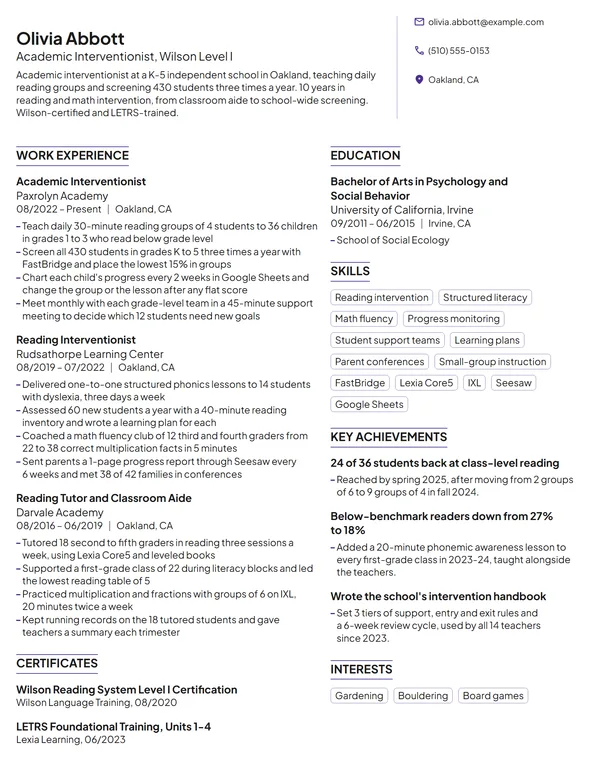
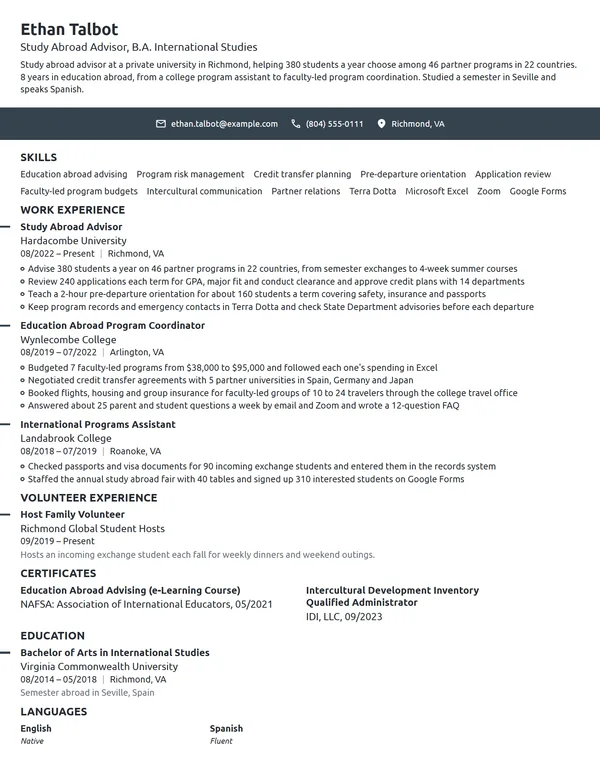
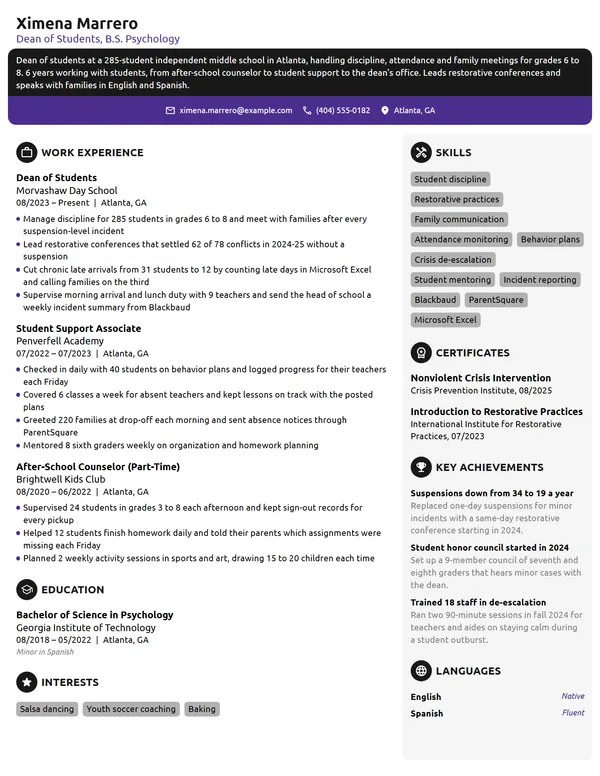
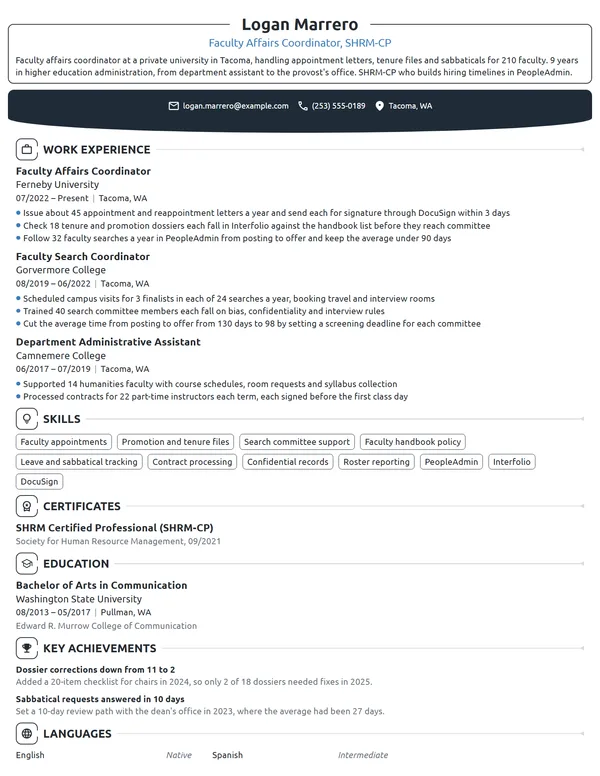
Most staff jobs on a college campus come back to students: getting them enrolled, keeping them on track and seeing them graduate. A hiring committee for an advising, program or teaching role asks who those students were, what changed for them, and which degrees and campus systems you bring. The catch is that advising sessions and office hours rarely produce a tracked number. Plenty of figures still exist, though, and the right ones belong near the top of each job.
How to Write an Academic Resume - Key Takeaways
- Send a 1- to 2-page resume for staff, advising and administrative posts, and an academic CV only when a faculty posting asks for one.
- Use reverse-chronological order, giving every role its title, office, institution, location and MM/YYYY start and end.
- Open with a 2- to 3-line summary that names the students you serve, your setting and 1 counted result.
- Count what deans and directors track: caseloads, persistence and probation returns, sections taught, students served and grant dollars.
- Write each degree by its official name, and a doctorate in progress with the word expected and its month and year.
- Keep student names and case stories off the page, then check the file with an ATS resume checker before you apply.
What hiring committees look for in an academic resume
Academic jobs split into 2 groups: staff roles at colleges, schools and learning centers that keep students on track (advising, student success, registrar and academic affairs work) and faculty roles that teach and research. The BLS lists scheduling course offerings, making sure students meet graduation requirements and advising students on academics among the duties of postsecondary administrators. For faculty it names writing a syllabus, grading students' work and advising them on which courses to take.
O*NET adds preparing reports on academic or institutional data and using assessments to monitor learning outcomes. A committee reads your resume for the students you served, the results you can count and the systems you kept records in. Build it from these sections:
- Name, a headline with your title and highest degree (for example, Academic Advisor, M.S.Ed.) and contact details
- A short profile of 2 to 3 lines under your name; it needs no heading
- Work Experience, with the office or department in each title
- Skills, with your student information system and learning platform
- Education, with the full degree name
- Certificates, for teaching and research training
- Optional: Key Achievements for a grant or publication, Volunteer Experience, or Languages
Best format for an academic resume
Use the reverse-chronological resume format, with your current role first and each entry showing title, office, institution, location and MM/YYYY start and end. Campus careers move in steps that readers know, from coordinator to advisor, senior advisor, assistant director and director, or from lecturer to assistant professor, and this order puts that climb on the first screen. Keep it even if you are moving in from K-12 teaching or another field, since committees expect dates in order.
- Best for most academic jobsReverse-chronologicalYour jobs, newest first, with your results under each one.Best for: A steady work history in your field
- FunctionalSkills grouped up top, with a short work history below.Best for: Gaps or very little experience
- CombinationA skills section first, then your full work history.Best for: A career change with strong skills
Resume or academic CV: what the posting asks for
Staff and administrative postings ask for a resume: 1 page with under 10 years in the field, 2 pages after that, with page 1 holding your 2 latest roles. Tenure-track and research postings usually ask for a CV, which lists every publication, grant, course and presentation and has no page limit. The difference between a CV and a resume is length and scope, and an academic CV example shows the longer layout. When a posting says resume or CV, send the version that matches the job's duties.
| Setting | What to use |
|---|---|
| Length | 1 page under 10 years in the field, 2 pages after that; a faculty CV runs longer |
| Job title line | Title plus office or department: Academic Advisor, School of Engineering |
| Dates | MM/YYYY for each job and for each degree, with Present for your current role |
| Type | One readable font such as Calibri or Garamond, 10.5 to 12 pt in the body |
| Photo, age and family status | Leave the photo off, as most US and Canadian applicants do, along with date of birth, marital status and your Social Security number |
| File type | PDF, unless the college's applicant portal asks for Word |
Most US and Canadian resumes carry no photo. College applicant portals parse your file into fields, so a single column of plain headings and dates reads more reliably than text boxes or graphics.
Academic resume summary vs. objective
Use one test: if you have held a paid job in a college, school or learning center, write a summary; if your campus work so far is student jobs, an assistantship or volunteering, write an objective. A summary names your role, your setting and your strongest result, and the academic advisor summary and objective examples show both versions at different career stages. Write it after your bullets and borrow its number from them.
Academic resume summary formula
Title with X years in advising, student success, teaching or research at type and size of institution. Your strongest student, program or research result, counted. Degree, credential or main system.
Example
Academic advisor with 7 years in student success and engineering advising at a 6,000-student private college. Carry a caseload of 340 majors and returned 29 of 41 students on probation to good standing in 2025. M.S.Ed. in Higher Education and Student Affairs; daily Banner and Canvas user.
Don't
Passionate higher education professional dedicated to student success and committed to fostering an inclusive campus community.
Do
Sociology lecturer with 5 years at a regional public university, teaching 4 sections a term of 35 to 120 students. Rebuilt Introduction to Sociology around weekly Canvas quizzes and cut its D, F and withdrawal rate from 31% to 19%.
The second version names the role, the setting, the teaching load and a result a department chair tracks.
How to write academic work experience bullets with numbers
The current role takes 3 to 4 bullets and earlier ones 2 to 4, each starting with a verb. Campus offices already count students, appointments, sections, terms and dollars, so most bullets can carry a figure your next dean would recognize. Write achievements on your resume instead of the duties from your position description.
| Area | What to count | Example bullet |
|---|---|---|
| Advising | Caseload, appointments, majors declared | Advised 260 undeclared students and helped 188 declare a major by the end of their 2nd year. |
| Retention and persistence | Early alerts, probation returns, term-to-term rates | Raised fall-to-spring persistence among 140 first-generation students in a mentoring program from 81% to 89%. |
| Teaching | Sections, enrollment, course outcomes | Taught 3 sections a term of College Composition, about 25 students each, and moved 2 courses onto Canvas. |
| Research and grants | Proposals funded, dollars, IRB protocols, publications | Co-wrote a $410,000, 3-year federal grant proposal funded in 2024 and managed its 2 IRB protocols. |
| Programs and events | Sessions, attendees, follow-up | Ran 22 workshops on study skills and time management for 530 students in 2025–26. |
| Records and scheduling | Sections scheduled, audits, transcripts, turnaround | Built the term schedule for 480 course sections in Banner with 0 room conflicts. |
Here is how one advisor's entry looks with figures in every bullet. Each bullet names the students, the count and what changed, and the older job gets fewer lines.
Work Experience
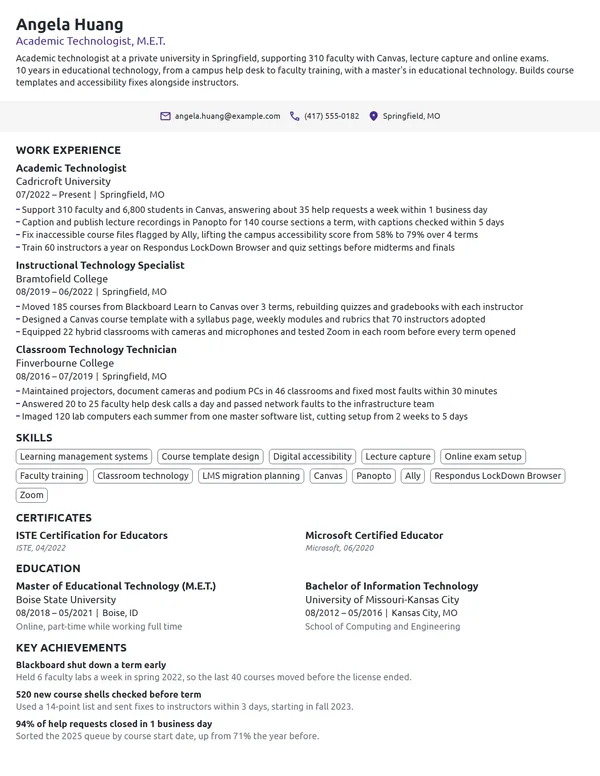
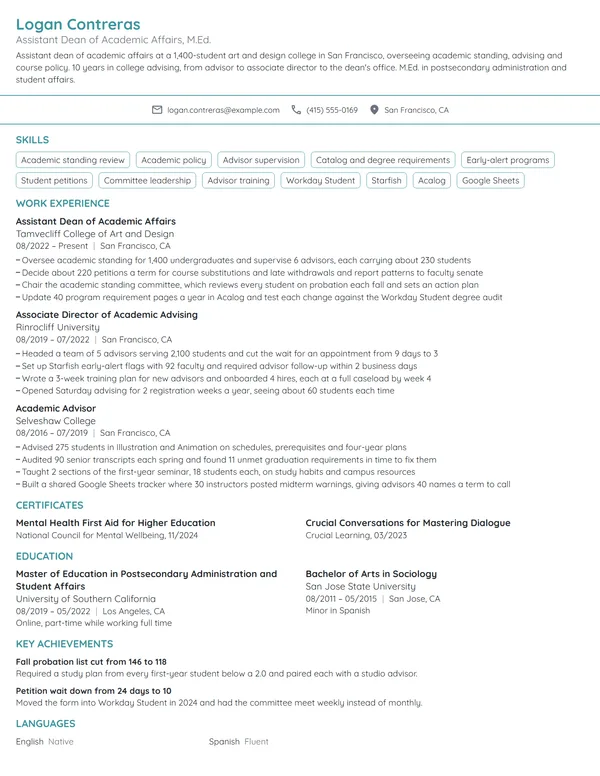
- Advise a caseload of 340 engineering majors from first year to graduation, holding about 1,150 appointments a year.
- Returned 29 of 41 first-year students on academic probation to good standing within 2 terms through biweekly check-ins and written success plans.
- Cleared a backlog of 212 senior graduation audits in Banner in 3 weeks, so every candidate had a checked plan before the March deadline.
- Built a 4-session orientation for 120 incoming transfer students a year; average credits lost in transfer fell from 9 to 4.
- Ran 6 study-skills workshops a term for about 90 students on academic probation.
- Grew tutoring center visits from 2,300 to 3,900 a year by adding evening hours and drop-in math tables.
Student outcomes belong on the page as counts, never as cases. According to the US Department of Education, FERPA is the federal law that governs access to student education records, and its rights pass to the student once they enter a postsecondary institution. Write how many students and what changed, and leave out names, individual grades and stories a reader could trace.
Don't
Helped students with academic issues.
Do
Met 1-on-1 with 85 students flagged by midterm early alerts in fall 2025; 64 finished the term with a C or better in the flagged course.
This version shows the trigger, the number of students and the result an advising director reports.
Don't
Responsible for organizing orientation.
Do
Planned 11 2-day orientation sessions for 1,650 first-year students and families, with 96% rating the sessions useful on the exit survey.
Academic skills and campus systems for your resume
Choose 6 to 8 hard skills for your resume that the posting names and your work history backs up. Advising and degree audits fit almost every staff resume; grant writing, course design and assessment only where you have done them.
Hard skills for academic jobs
- Academic advising
- Degree audits and graduation checks
- Course scheduling
- Early-alert and retention outreach
- Orientation and onboarding programs
- Learning outcomes assessment
- Course design in an LMS
- Grant writing
- Student records and FERPA compliance
- Institutional data reporting
Soft skills deans and directors value
- Active listening
- Plain writing for students and families
- Cultural competence
- Patience with complex cases
- Coordination across departments
- Discretion with student records
List your systems with your skills, and prove each one with a bullet that says what you did in it. O*NET flags Oracle PeopleSoft and IBM SPSS Statistics as hot technologies for postsecondary education administrators and Microsoft Excel as in demand, and it also lists Banner, Instructure Canvas and Blackboard for the same role. Write the student information system and learning platform from the posting, spelled exactly as it spells them, and only the ones you could use on day 1.
Degrees and certifications for academic jobs
The degree a committee expects depends on the role, and the BLS gives a clear line for each. Put your highest degree in your headline when a posting lists it as a requirement, and list the rest under Education, newest first.
| Role | Usual degree, according to the BLS | What to show on the resume |
|---|---|---|
| University faculty | A Ph.D. or other doctoral degree in the field; many then seek tenure | Degree, field, month and year, and the dissertation title |
| Community college instructor | Community colleges may hire those with a master's degree | Master's degree plus the graduate credits in the subject you teach |
| Postsecondary administrator (dean, registrar, director) | Typically a master's degree; a bachelor's may be enough at small colleges | Highest degree in the headline, then years of campus leadership in your summary |
| Academic or college advisor | Employers may prefer a bachelor's degree plus work experience | Degree, then advising, tutoring or student-affairs experience with numbers |
Academic work has no single license, so list certifications on your resume only when they match the posting. 2 come up often. ACUE's Certification in Effective Teaching, endorsed by the American Council on Education, is earned through 4 pathway courses or 1 comprehensive course. The CITI Program's Human Subjects Research training covers anyone working on studies with human participants, and CITI notes that most organizations retrain on a 3-year cycle, so give its completion date.
Certificates
- Certification in Effective Teaching, Association of College and University Educators (ACUE), 05/2024
- Human Subjects Research, Social-Behavioral-Educational (SBE), CITI Program, completed 09/2025
How to list a PhD, master's or degree in progress
Use the familiar conventions for listing education on a resume: the degree name, the school and its city, then the month and year, newest first. Write the degree as the school awards it (M.S.Ed. in Higher Education and Student Affairs, not just a master's in education), because academic readers check the exact field. Add a GPA only if it is 3.5 or higher and you finished within the last 2 years.
How to list a PhD in progress
Write the degree with the word expected and a real month and year, such as Ph.D. in History, expected 05/2027, and add the dissertation title on the next line. Skip the shorthand ABD, which many HR screeners outside faculty hiring do not know; write that coursework and comprehensive exams are complete instead.
Education
2-year graduate assistantship in academic advising.
Entry-level and career-change academic resumes
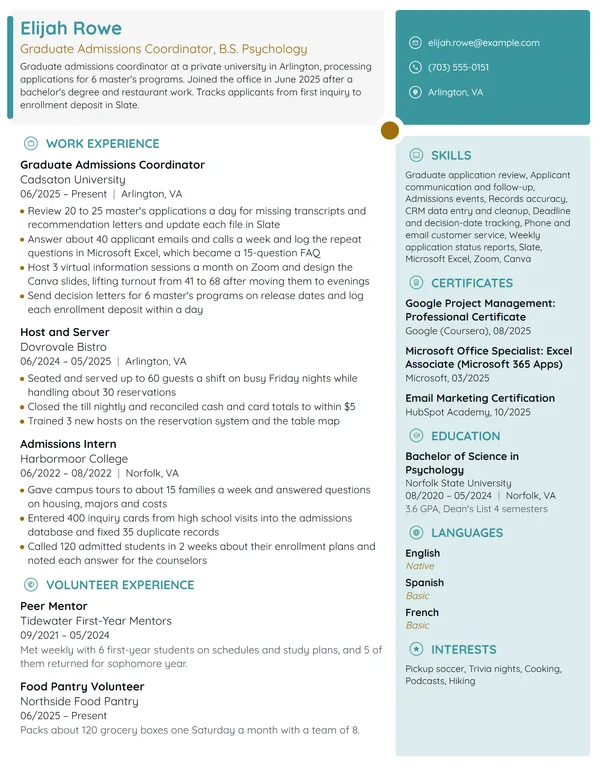
With no full-time campus job yet, start from an entry-level resume: a 2-line objective, then Education high on the page, and after it the student roles that already look like the job. Give each one the numbers a full-time role would carry.
- Graduate assistantships: the office, hours a week and how many students you saw.
- Teaching assistant work: sections led, students per section and the courses, listed under Work Experience with the title Teaching Assistant.
- Peer tutoring, orientation leader or resident assistant roles: sessions run, groups led and students reached.
- Research assistant work: studies supported and participants recruited, with your CITI training under Certificates.
Don't
Recent graduate seeking a position in higher education where I can make a difference.
Do
Sociology graduate with 3 years as a peer tutor and orientation leader, seeking an entry-level academic support role. Tutored 70 students in statistics and led 9 orientation groups of 25.
Even at the start, proof beats intent: the student role, a count and the job you want.
Coming from K-12 teaching, corporate training or counseling, stay with reverse-chronological order, and let the first 3 bullets under your current job be the ones closest to campus work, such as advising families, scheduling or tracking student data. A career-change resume reads best when your summary names the academic role you want. Keep the reason for the move for your letter, where a cover letter gives you 2 or 3 sentences to explain it.
Academic resume FAQ
Is an academic resume the same as an academic CV?
No. A resume runs 1 to 2 pages and picks your strongest results for a staff or administrative role. An academic CV lists every publication, grant, course and presentation, has no page limit, and is what most tenure-track and research postings ask for.
How long should an academic resume be?
Keep it to 1 page with under 10 years in higher education or school settings. Go to 2 pages once you have led an office, taught across several institutions or managed grants, and keep your 2 latest roles on page 1.
Should I list publications on an academic resume?
Only the 1 to 3 that matter for the job. Put them in Key Achievements or in a bullet under the role where you wrote them, with the journal and year. A full publication list belongs on an academic CV.
How do I list a PhD I have not finished yet?
Write the degree, the school and the word expected with a month and year, such as Ph.D. in Sociology, expected 05/2027. Add your dissertation title, and say that coursework and exams are complete if they are.
Do I need a master's degree to work in academic advising?
Not always. The BLS says employers may prefer candidates for career or academic advisor roles who have a bachelor's degree and work experience. Many director roles ask for a master's, so read the posting and lead with advising numbers either way.
How do I show teaching experience from graduate school?
Give it its own Work Experience entry with the title Teaching Assistant or Graduate Instructor, the department, the university and the dates. Then count it: sections led, students per section, labs or discussion groups, and whether you designed the course or taught from an existing syllabus.
Should I include course evaluation scores on my resume?
Yes, if they are strong and you can give the base. Write the average, the scale and the number of sections, such as 4.6 of 5 across 8 sections, and drop scores that only cover 1 small class.
How do I move from K-12 teaching into a college academic job?
Lead with the parts of teaching that campus offices need: advising students and families, scheduling, tracking student data and running programs. Keep your teaching license under Certificates, and aim first for advising, tutoring center or student success roles, where classroom experience transfers most directly.
What do academic administrators and professors earn?
The BLS reports a median annual wage of $104,590 for postsecondary education administrators and $85,330 for postsecondary teachers, both in May 2025. Keep pay off the resume itself and discuss it when the college makes an offer.
Should I add references to an academic resume?
No. Faculty and staff applications usually ask for references or letters in a separate step of the portal. Keep the space on your resume for results, and have 3 contacts who know your work with students ready to send.
Next steps
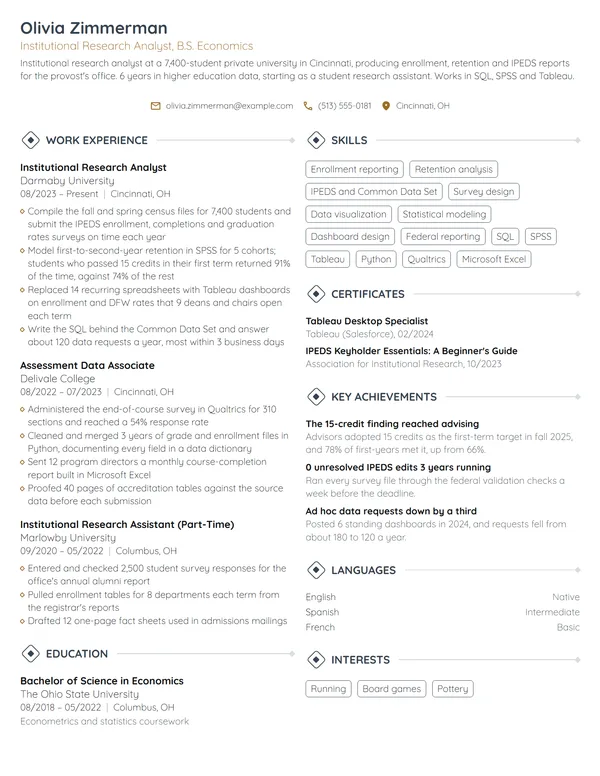
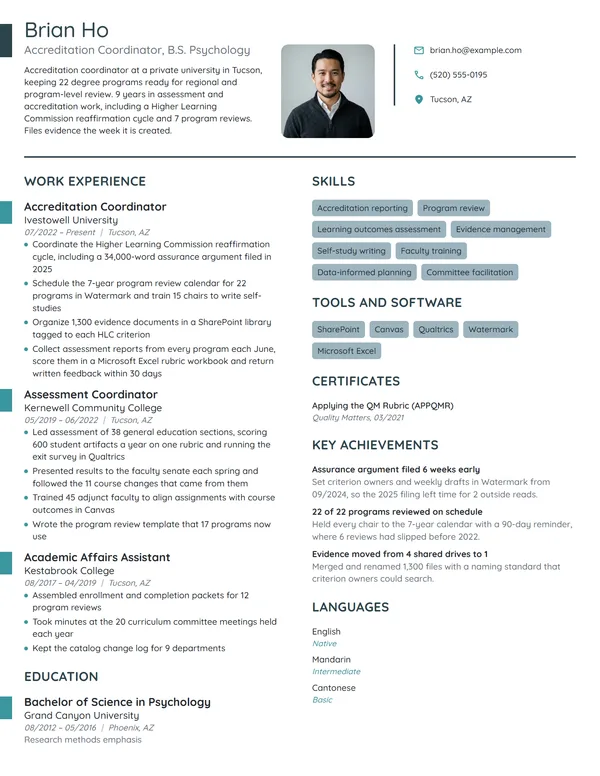
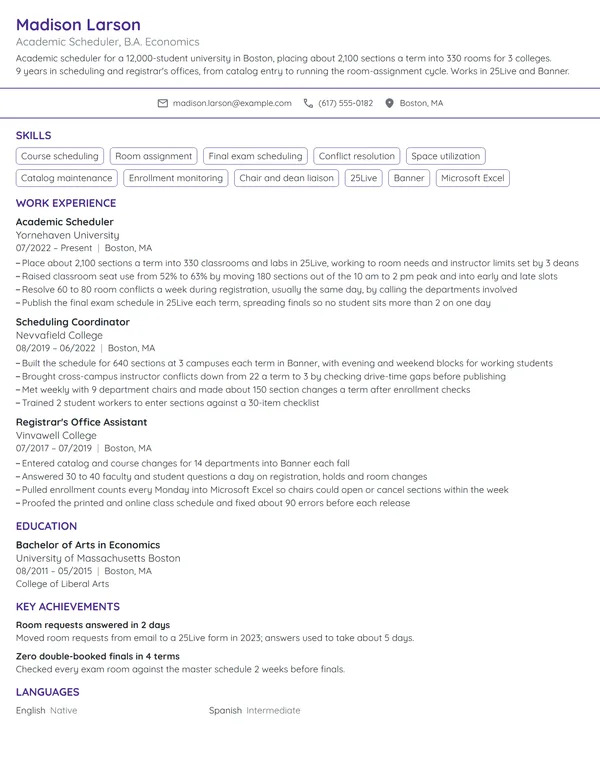
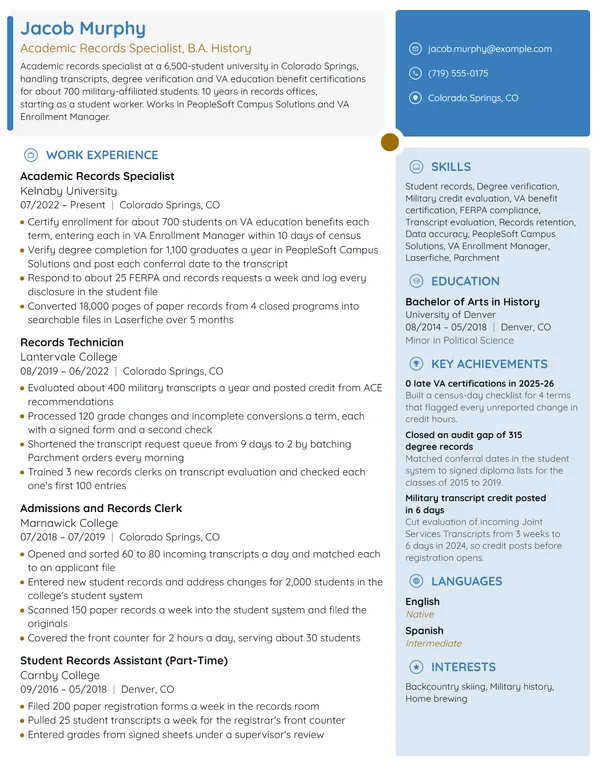
Choose the example closest to your role, keep its layout, and swap in your own students, counts and results. Our resume builder and resume templates give you the layout; pair the finished page with a letter that opens on the student result you are proudest of.