
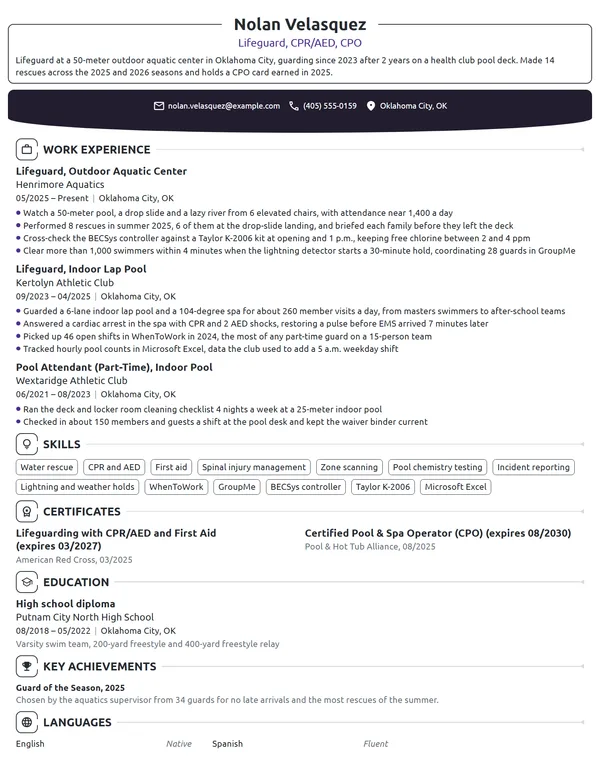
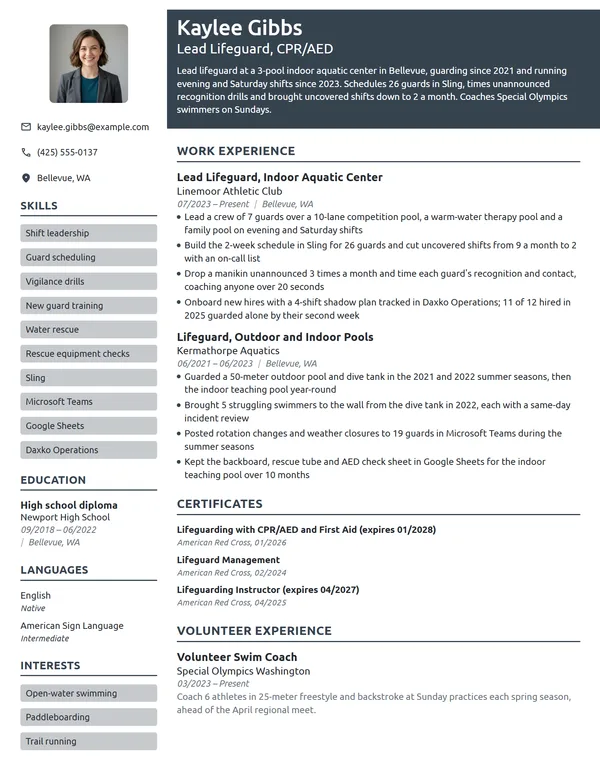
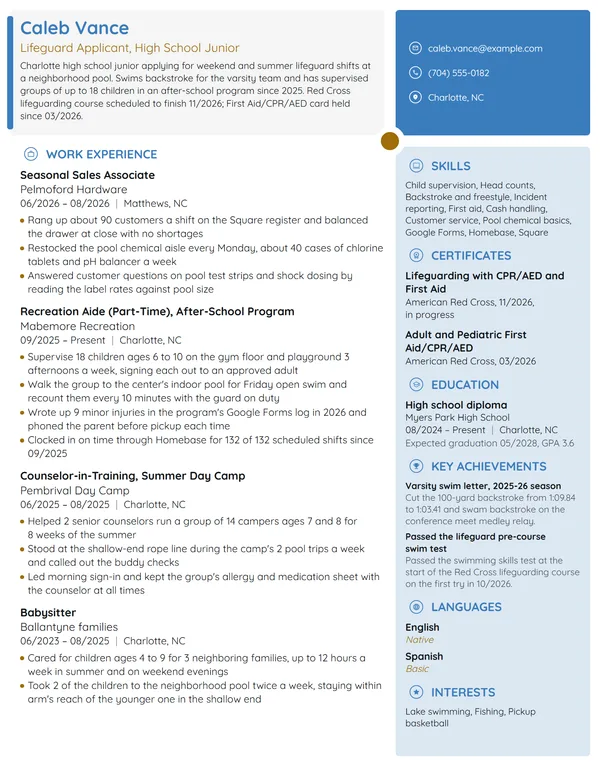
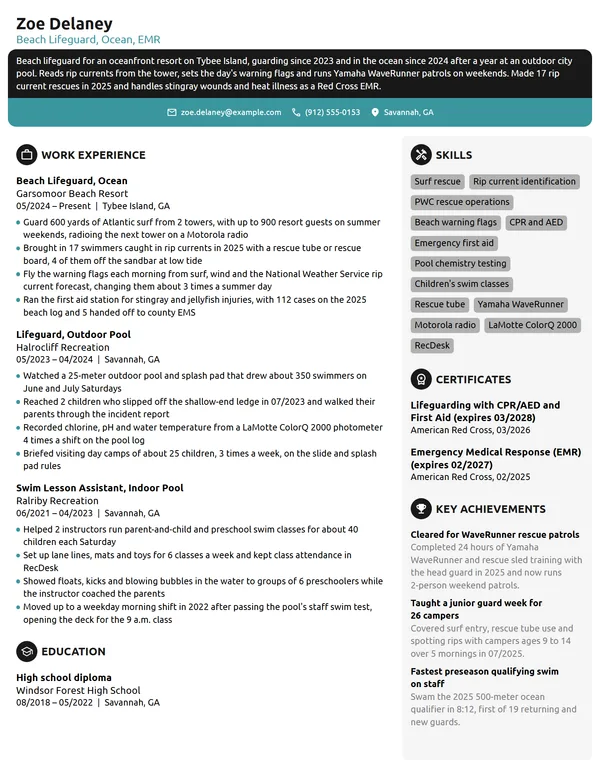
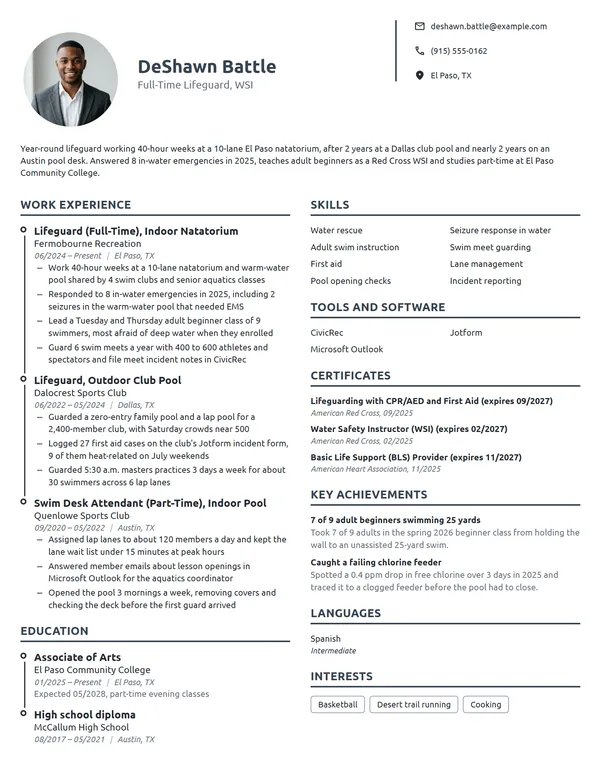
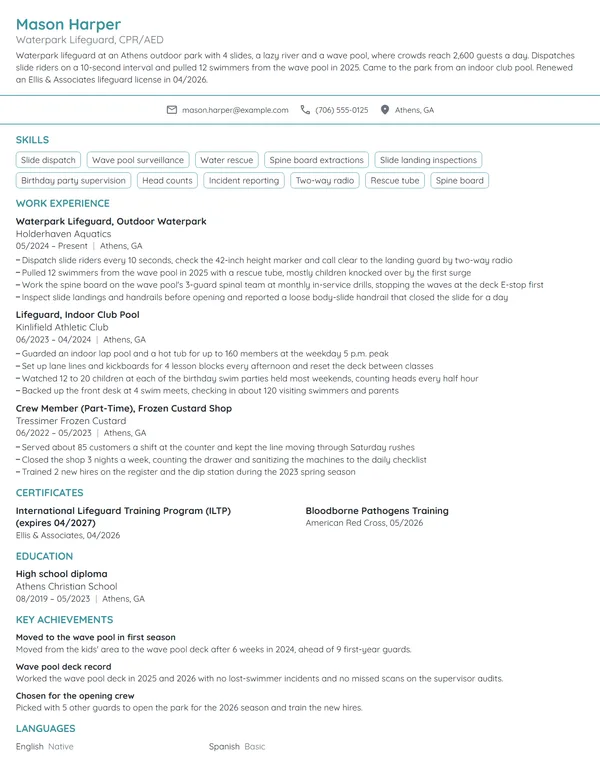
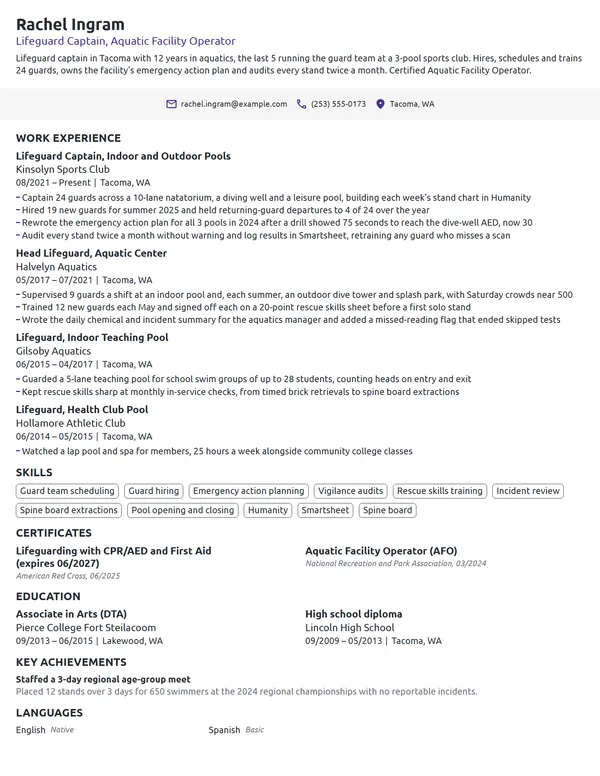
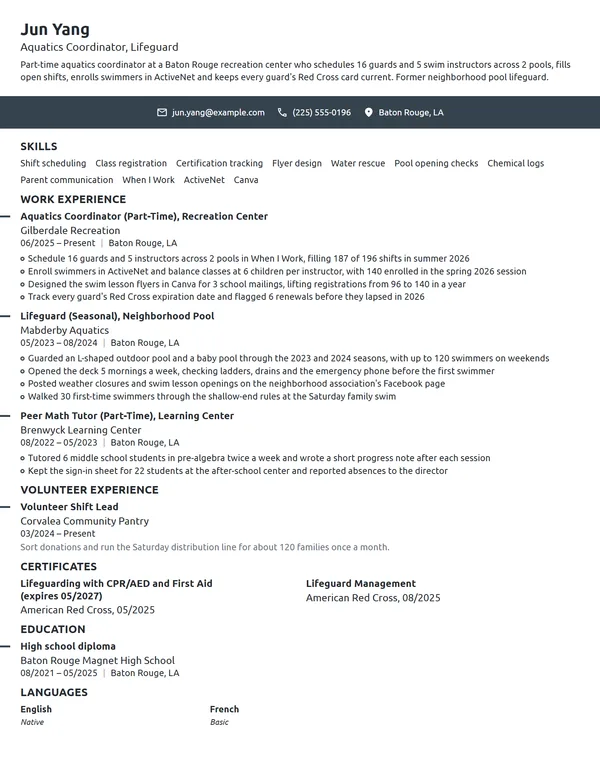
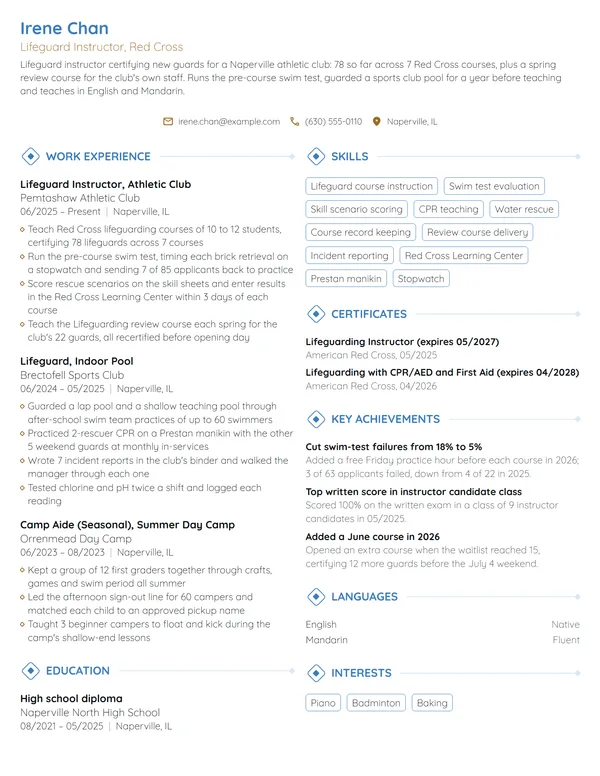
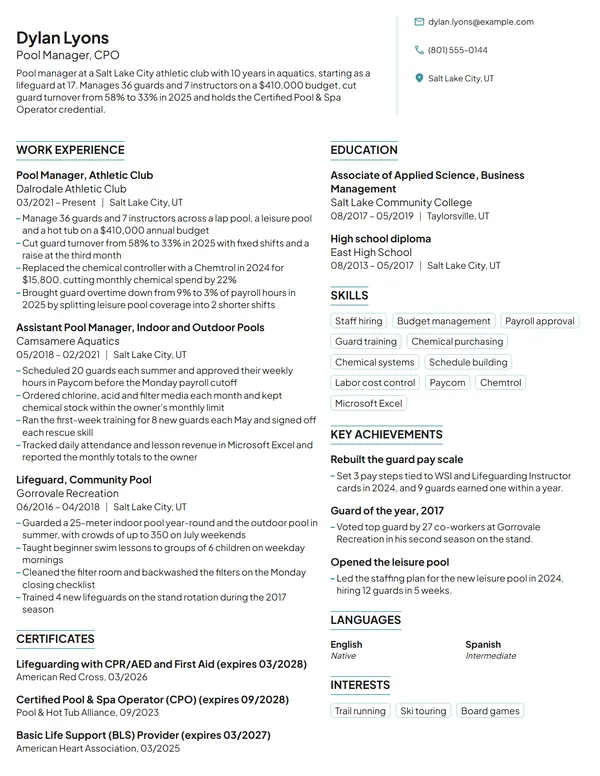
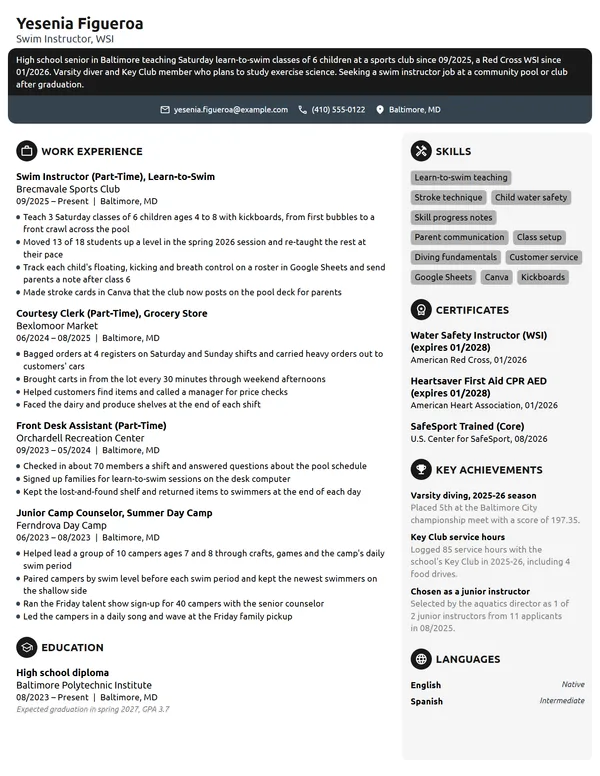
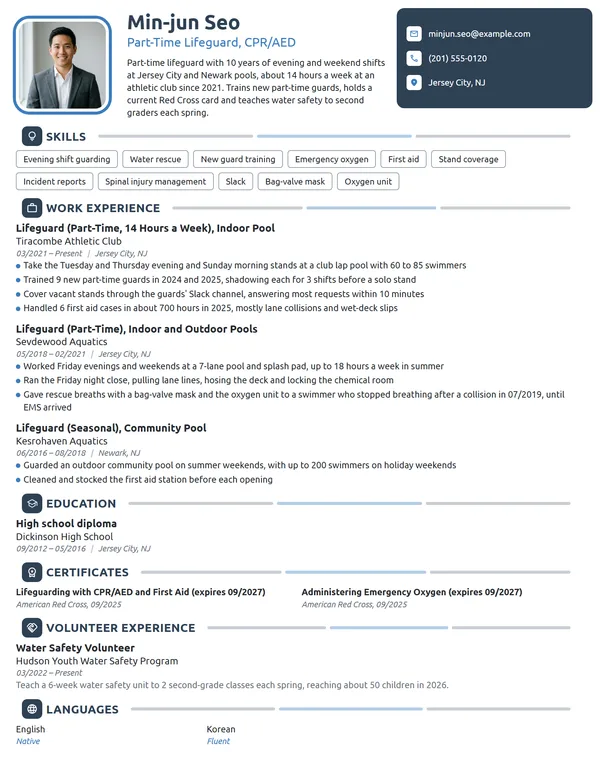
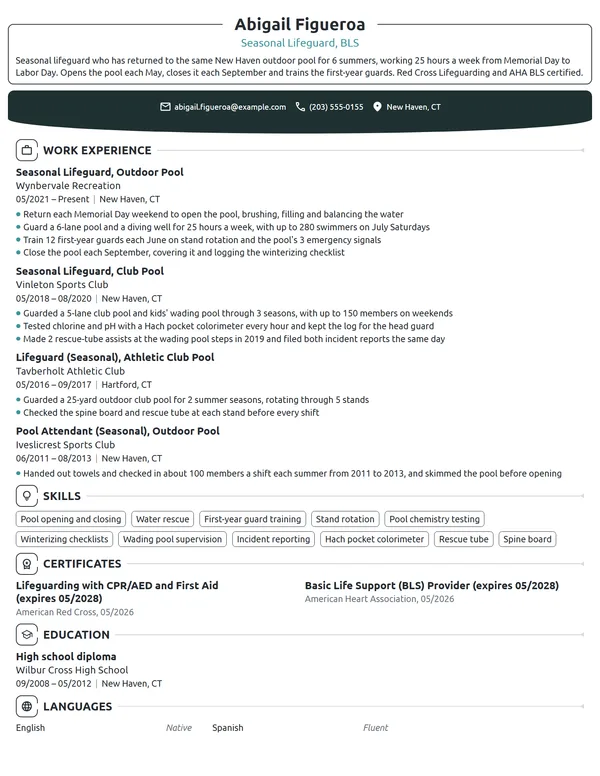
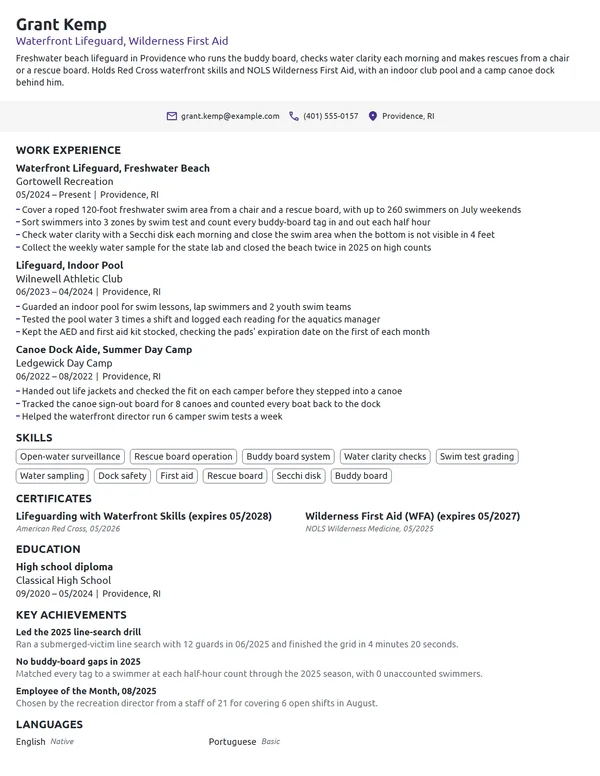
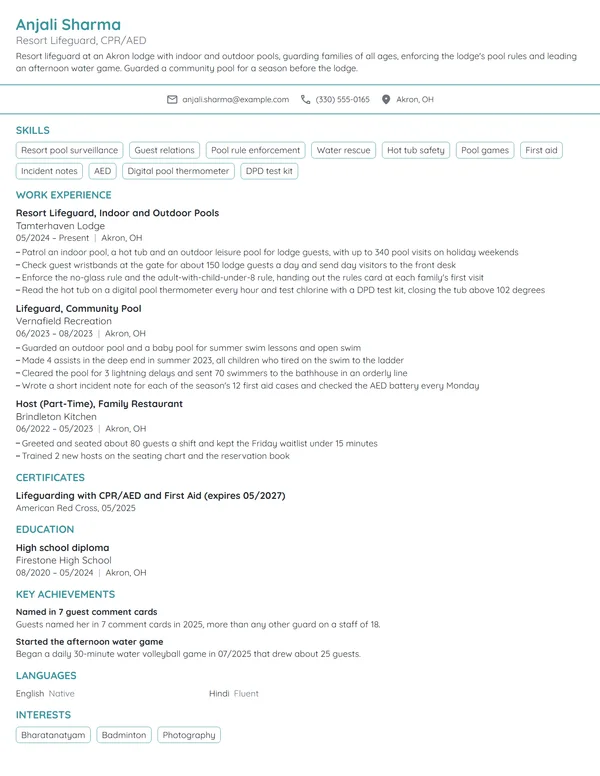
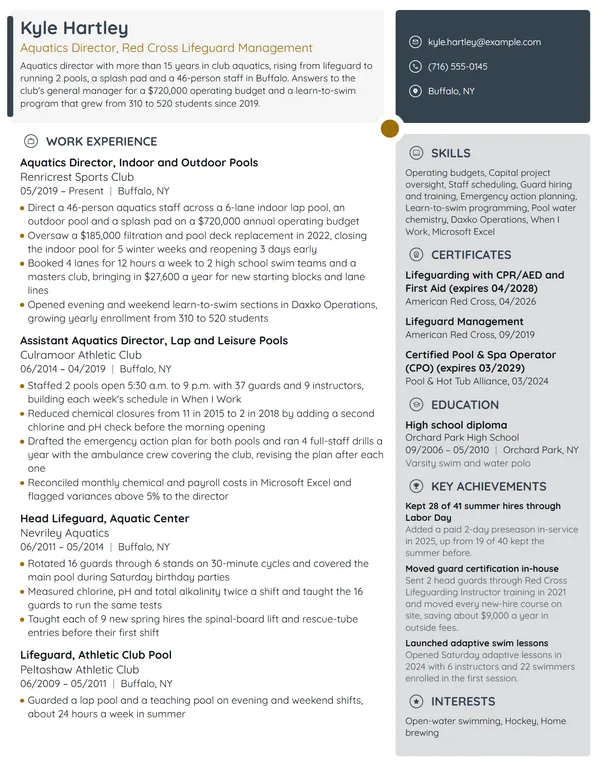
Lifeguarding is often the first job where other people's safety depends on you, and the people hiring treat it that way. They check that your certification is current, how large and busy the pools or beaches you guarded were, and what you did when something went wrong. A strong lifeguard resume answers each of those with a date or a number: the month your card expires, the swimmers in your zone on a July afternoon, and the rescues, first aid calls and swim lessons you handled.
How to Write a Lifeguard Resume - Key Takeaways
- Put your newest job first on a 1-page resume, and group returning summers at the same pool into a single entry.
- List your lifeguard certification first under Certificates, with its issuer, the month you earned it and the month it expires.
- Name the water you guarded in every job: indoor pool, outdoor park pool, waterpark, lake or ocean beach, and how many swimmers you watched.
- Count what you did in each bullet: rescues, first aid cases, chemical tests, audits passed and swim lessons taught.
- With no job history yet, open with an objective that gives your certification date, swim team seasons and volunteer hours.
- Run the file through an ATS resume checker before you apply through a city, county or resort job portal.
What aquatics managers look for in a lifeguard resume
An aquatics manager or head guard reads your resume for 3 things: a current certification, experience on water like theirs, and proof you act fast and calmly. O*NET lists patrolling swimming areas from towers or on foot, rescuing people in distress, giving first aid or CPR and calling emergency medical services as core lifeguard tasks. It also names testing pool water, warning swimmers about weather and unsafe conduct, keeping incident records and teaching swimming.
Most lifeguard resumes fit on 1 page with these sections, written as standard headings so a hiring portal reads them:
- Name, a headline such as Certified Lifeguard, CPR/AED, and your phone and email
- A short summary or objective at the top, with no heading of its own
- Certificates: your lifeguard certification first, then CPR, first aid and any instructor or pool operator credential
- Work Experience, newest job first, with the type of water in each job title
- Skills, with any scheduling or messaging app your pool uses
- Education: your high school, or your college and expected graduation date
- Optional: Key Achievements for swim team results, or Volunteer Experience for meet timing and youth programs, plus Languages
Best format for a lifeguard resume
Use the reverse-chronological resume format: newest job first, each with your title, the facility, the town it is in and the month and year you started and left. Lifeguard careers often run from a summer pool to a year-round aquatic center to a head guard role, and this order shows that step up. If you came back to the same pool for 3 summers, write it as 1 entry with the first and last season's dates and say how many seasons you worked in its opening bullet.
- Best for most lifeguardsReverse-chronologicalYour jobs, newest first, with your results under each one.Best for: A steady work history in your field
- FunctionalSkills grouped up top, with a short work history below.Best for: Gaps or very little experience
- CombinationA skills section first, then your full work history.Best for: A career change with strong skills
| Setting | What to use |
|---|---|
| Length | 1 page, at any level from first summer to head guard |
| Dates | MM/YYYY for every job, with Present for the pool you guard at now |
| Seasonal jobs | 1 entry per employer, dated from your first season to your last, with the season count in the opening bullet |
| Job title line | Title plus water type: Lifeguard, Waterpark or Beach Lifeguard, Ocean |
| Certification line | Course name as printed on your certificate, the issuer, the month earned and the month it expires |
| Photo, age and ID numbers | A photo is uncommon in the US and Canada; skip your date of birth, family status and SSN as well |
| File type | PDF, unless a parks and recreation portal asks for a Word document |
Most US and Canadian resumes carry no photo. Your age can matter to a pool that needs guards of a certain age for certain shifts, but the certification date already shows you met the course's minimum age, so there is no need to write a birth date.
Lifeguard resume summary vs. objective
If you have guarded for at least 1 full season, write a resume summary that gives your certification, your seasons or years, the kind of facility and 1 result. If you are about to finish your first course, write a resume objective that names the role you want, your course date and the swimming background behind it. Both stay at 2 or 3 lines.
Lifeguard resume summary formula
Certification lifeguard with X seasons or years at type of facility. 1 counted result: rescues, audits, swimmers or lessons. Next credential or role you are working toward.
Example
Red Cross-certified lifeguard with 3 years at an indoor aquatic center and 2 summers at an outdoor park pool. Passed all 6 unannounced vigilance audits in 2025. Training for Water Safety Instructor certification in spring 2027.
Don't
Responsible and friendly lifeguard who loves the water and works well with others.
Do
Lifeguard with 3 summers at a waterpark that sees up to 1,200 guests a day, certified in Red Cross Lifeguarding through 06/2027. Made 9 rescues last season and trained 5 first-year guards.
This version names the facility, its crowd, the certification's end date and 2 numbers a manager can check.
How to write lifeguard work experience bullets with numbers
Your current guard job takes 3 to 4 bullets; earlier ones need 1 to 3. Start with the size of the water and the crowd, since every other number reads against it, then add the events you logged: rescues, first aid cases, water tests and audits. Lifeguards keep incident reports and, at most pools, chemical test logs, so those records are where your numbers come from. Turn them into results with the tips on writing achievements on a resume.
| Area | What to count | Example bullet |
|---|---|---|
| Surveillance | Zone, crowd size, rotation length | Covered the deep end and diving well in 15-minute rotations for crowds of up to 220. |
| Rescues and first aid | Water rescues, first aid cases, EMS calls | Handled 4 water rescues and 38 first aid cases in 1 summer, calling EMS twice. |
| Water quality | Chemical tests a shift, inspections | Ran 5 chlorine and pH tests a shift and passed 2 county health inspections with no findings. |
| Swim lessons | Sessions, students, levels passed | Taught 6 learn-to-swim sessions for 48 children, and 41 of them moved up a level. |
| Training and audits | In-service drills, guards trained, audits passed | Ran 2 in-service drills a month for 14 guards and passed 5 of 5 unannounced audits. |
| Patron safety | Deep-water tests, rule enforcement | Gave deep-water swim tests to about 90 children a week before they could use the slides. |
Work Experience
- Guard a 3-zone rotation over an 8-lane, 25-yard competition pool and a leisure pool, with up to 450 swimmers on weekend afternoons.
- Made 11 water rescues and treated 64 first aid cases in 2025, filing every incident report before the end of the shift.
- Test free chlorine and pH every 2 hours and record each reading in the chemical log; flagged 3 out-of-range readings to the aquatics manager in 2025.
- Teach 2 learn-to-swim classes of 8 children each on Saturday mornings.
- Rotated through 4 stands every 20 minutes over 2 summers, with up to 300 swimmers on weekends.
Don't
Watched swimmers and kept the pool safe.
Do
Kept watch over a 4-lane lap zone and a diving well for crowds of up to 180, with 3 rescues and 0 missed rotations in 2 summers.
The rewrite turns a duty into a zone, a crowd and a record.
Don't
Gave first aid when needed.
Do
Treated 35 first aid cases in a season, from scraped knees to heat exhaustion, and called EMS twice, with each incident report complete before closing.
A count and a range of cases show a manager how busy your stand was.
Lifeguard skills and software for your resume
Pick 6 to 8 hard skills for your resume from the job posting, and keep only those a bullet proves. Water rescue, CPR and first aid belong on every lifeguard resume; spinal injury management, water chemistry testing or swim instruction belong there when you have done them on the job.
Hard skills for lifeguards
- Water rescue
- CPR and AED
- First aid
- Spinal injury management
- Zone surveillance and scanning
- Pool chemistry testing
- Incident reporting
- Swim instruction
- Emergency action plans
- Open-water rescue equipment
Soft skills aquatics managers value
- Focus through long shifts
- Quick decisions in an emergency
- Clear, firm rule enforcement
- Calm with injured or scared swimmers
- Teamwork on rotations
- Reliability on every scheduled shift
Lifeguard work uses little software, so name only what you used. O*NET flags Microsoft Excel, Word, Outlook and PowerPoint as hot technologies for this group of jobs and also lists GroupMe, a group messaging app. If your pool ran scheduling or incident reporting in an app, write its exact name in Skills and show it in a bullet, such as building the guard schedule or logging reports.
Lifeguard certifications: how to list them with expiration dates
Your certification is the first thing a hiring manager checks, so put it at the top of the Certificates section with the date it runs out, as you would when you list certifications on your resume. The American Red Cross requires students to be at least 15 by the last day of class and to pass a swimming skills test, and its lifeguarding certification lasts 2 years. If your certificate comes from the YMCA, Ellis & Associates or another program, copy that program's course name and issuer exactly as they appear on your card.
| Credential | Issued by | What it takes |
|---|---|---|
| Lifeguarding with CPR/AED and First Aid | American Red Cross | Age 15 by the last day of class and a swimming skills test; in person or blended online and in-person; valid for 2 years. |
| Lifeguarding review (recertification) | American Red Cross | A shorter course for guards whose certification is current or expired by no more than 30 days. |
| Water Safety Instructor (WSI) | American Red Cross | The Red Cross training for teaching its swim lessons; list it when you teach classes at your pool. |
| Lifeguarding Instructor | American Red Cross | The Red Cross training for teaching lifeguard courses; list it once you teach or co-teach them. |
| Certified Pool & Spa Operator (CPO) | Pool & Hot Tub Alliance | A 16-hour, 2-day course, or an online course plus 1 classroom day; no industry experience required; valid for 5 years. |
How to list a certification that is expiring or still in progress
Write the month you earned it and the month it expires, so a manager hiring for a full season can see you are covered through Labor Day. If your card runs out before the season ends, book the review course and write its date after the certification. A course you are still taking goes in the same list marked in progress, with its end date; never list a lapsed certification as current.
Certificates
- Lifeguarding with CPR/AED and First Aid, American Red Cross, 04/2025 (expires 04/2027)
- Certified Pool & Spa Operator (CPO), Pool & Hot Tub Alliance, 01/2026 (expires 01/2031)
- Water Safety Instructor (WSI), American Red Cross, scheduled 03/2027
How to list high school or college on a lifeguard resume
O*NET places lifeguarding in Job Zone 2, with high school or a GED as the usual schooling, and many guards are still in high school or college when they apply. List education on your resume as the school, its town and the graduation month, with the word expected if you have not finished.
If you are in college, list the college and drop the high school entry. Add 1 line under the degree when it shows you can keep a shift schedule, such as the hours a week you guard during the semester. Swim team times and records go under Key Achievements instead.
Education
Expected graduation. Guarding 20 hours a week during the semester.
Lifeguard resume with no experience or a career change
Lifeguarding is one of the classic jobs for teens, so a manager hiring for summer expects first-time applicants. Your certification date does most of the work, and the rest comes from swimming and from jobs that prove you arrive on time. Use the high school student resume layout if this is your first resume of any kind.
- Lifeguard course: the course name, the issuer and the month you finish, under Certificates.
- Swim team: seasons, your events and a best time or a meet result, under Key Achievements.
- Swim meet timing, junior guard programs or camp help: hours and the age group, under Volunteer Experience. Use this section or Key Achievements, not both, and fold the other into your objective.
- Part-time jobs: babysitting, retail or food service, with 1 bullet that shows reliability or work with children.
Don't
Hardworking teenager looking for my first job as a lifeguard to gain experience.
Do
High school junior and 3-season varsity swimmer finishing Red Cross Lifeguarding in 05/2027, seeking a summer guard role at a community pool. Volunteered 40 hours as a swim meet timer.
Even a first objective can carry a course date, a sport and an hour count.
Adults coming to lifeguarding from another job, such as teachers guarding over the summer or retirees moving to a part-time role, still list jobs newest first, with the new certification at the top of Certificates. Under older jobs, keep the bullets that carry over: first aid, supervising children or groups, or enforcing safety rules. The career-change resume examples show the layout, and a short cover letter can explain the move; the tips on writing a cover letter with no experience fit a first guard job too.
Lifeguard resume FAQ
What certification do you need to be a lifeguard?
Most pools and beaches ask for a current lifeguarding certification with CPR, AED and first aid, such as the American Red Cross course, which lasts 2 years. Some employers train and certify their own guards. Check the posting and write the course name exactly as your card shows it.
How old do you have to be to get lifeguard certified?
15 for the American Red Cross course: students must be at least 15 by the last day of class and pass a swimming skills test. Other programs and employers can set their own minimum age, so check the posting before you sign up.
Should I list an expired lifeguard certification on my resume?
Only if you are renewing it. The Red Cross review course is open to guards whose certification is current or expired by no more than 30 days, so book it and write the review date after the certification. Otherwise, leave an expired card off or mention it in your summary as past experience.
How do I list seasonal lifeguard jobs at the same pool?
Write 1 entry per employer, dated from the month of your first season to the month of your last, and open its bullets with the number of seasons. Separate entries for each summer at one pool repeat the same lines and push your newer jobs down.
What do I put on a lifeguard resume with no experience?
Put your lifeguard course and its completion month under Certificates, then your swimming background and any job or volunteer work. Swim team seasons, meet timing, camp help and babysitting all show the reliability and comfort around kids and water a pool manager wants.
Should I put swim team on a lifeguard resume?
Yes, if you have little guarding experience. Give the seasons, your main events and 1 best time or result under Key Achievements. Once you have 2 or 3 seasons of guarding, cut it to 1 line or drop it to make room for your work bullets.
How long should a lifeguard resume be?
1 page. A first-time guard fills it with certifications, education and swimming, and a head guard with 6 or 7 seasons still fits jobs, credentials and education on 1 page by grouping seasonal entries.
How much do lifeguards make?
BLS data for lifeguards, ski patrol and other recreational protective service workers puts the median wage at $16.14 an hour, or $33,580 a year, in May 2025. Pay varies by state, employer and whether the job is seasonal; leave it off your resume and ask about it at the interview.
Next steps
Choose the example that matches your water and your stage, from first summer to lead guard, and keep its layout. Swap in your own certification dates, the size of your zone and the rescues and tests you logged. Finish it in our resume builder or on one of our templates, and send it before pools start hiring for summer.