
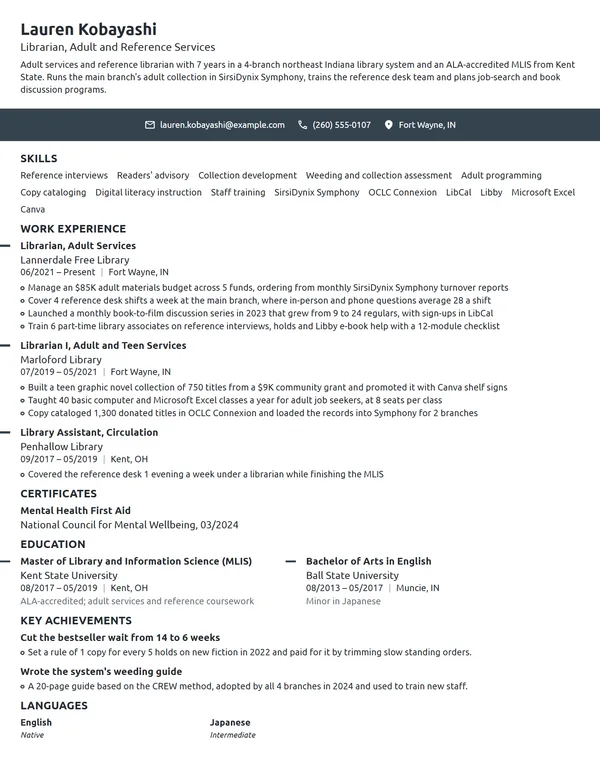
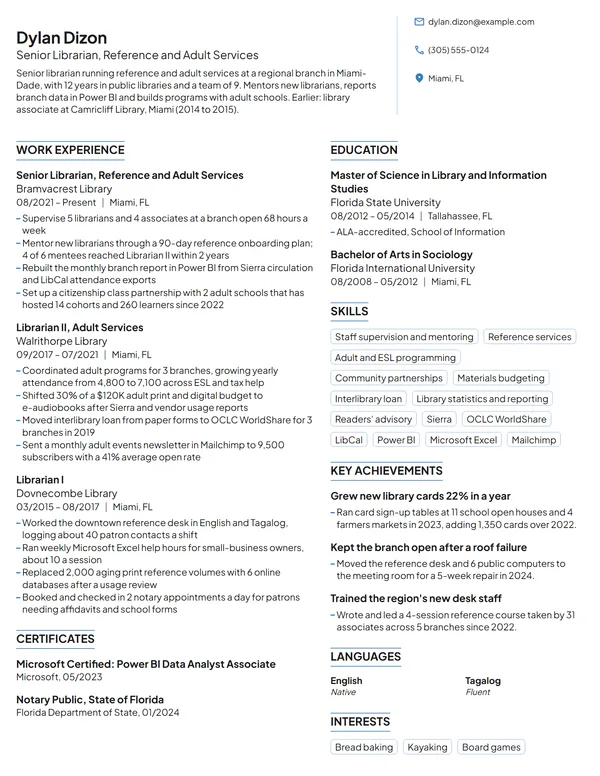
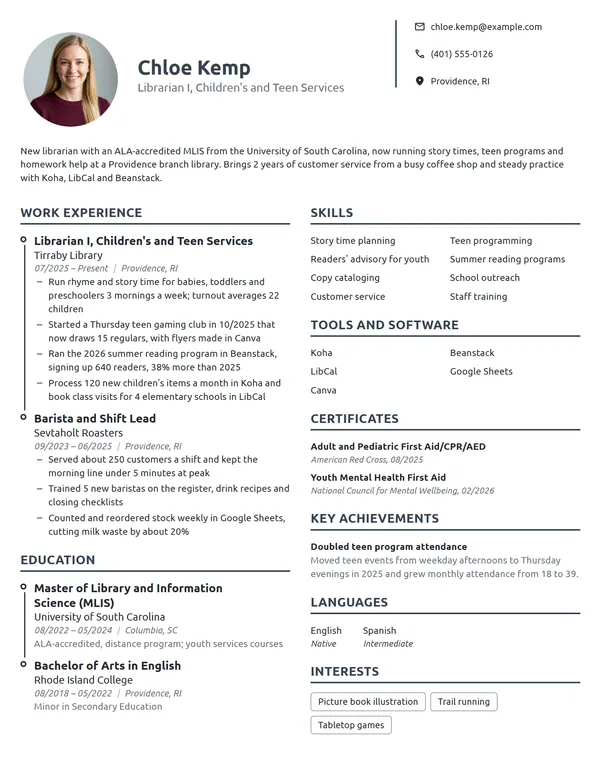
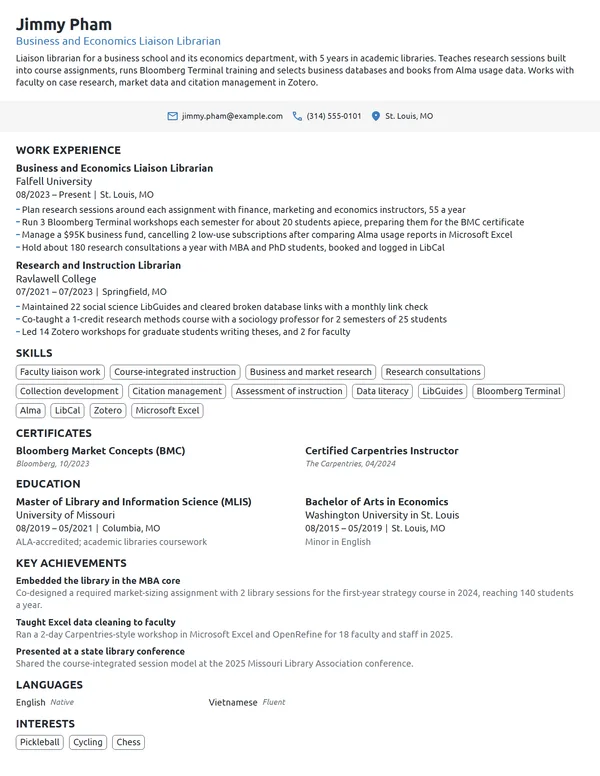
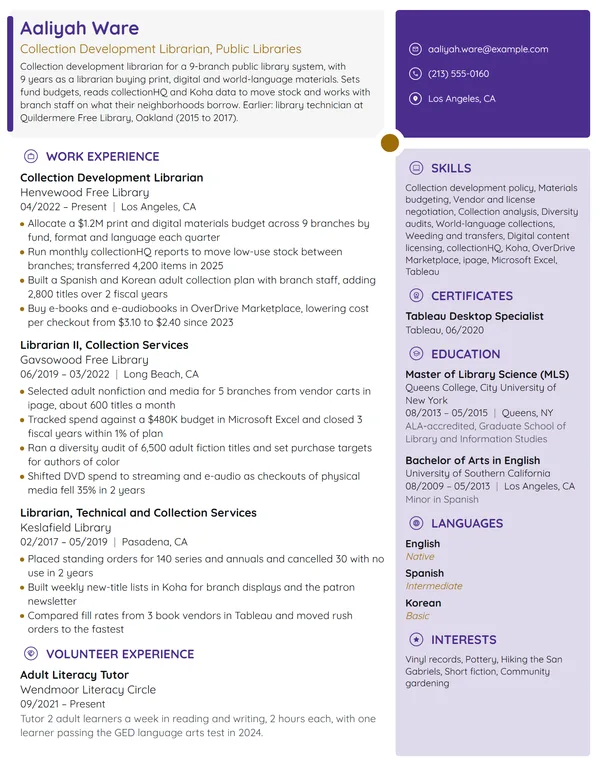
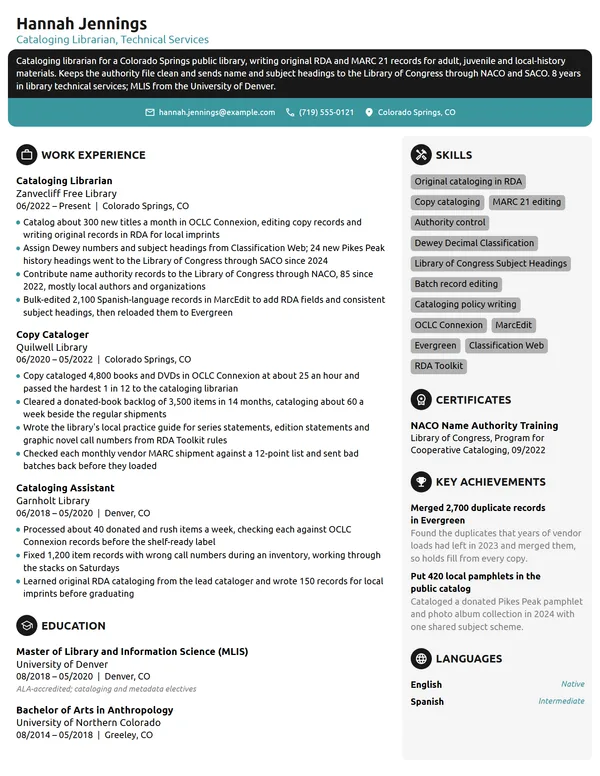
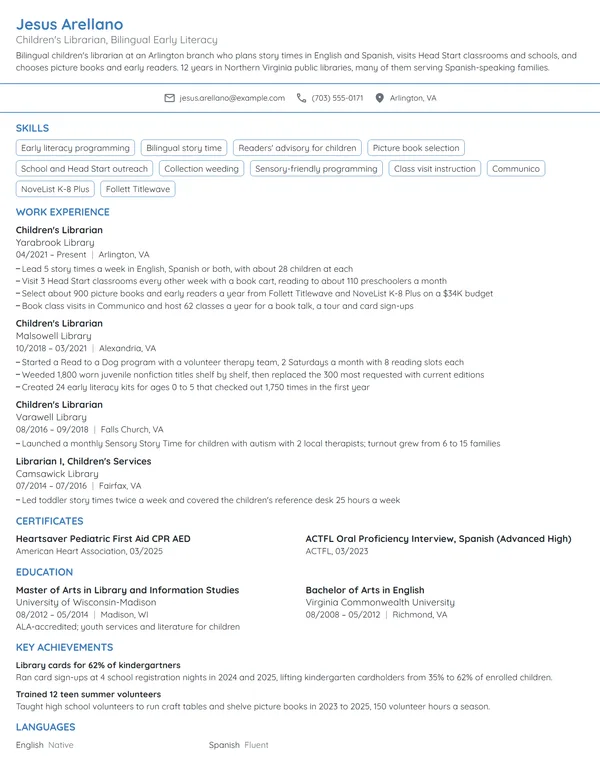
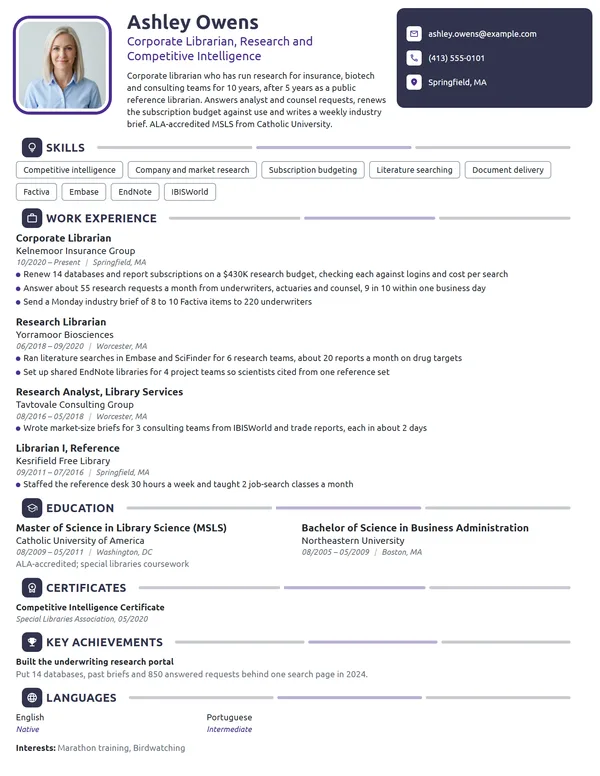
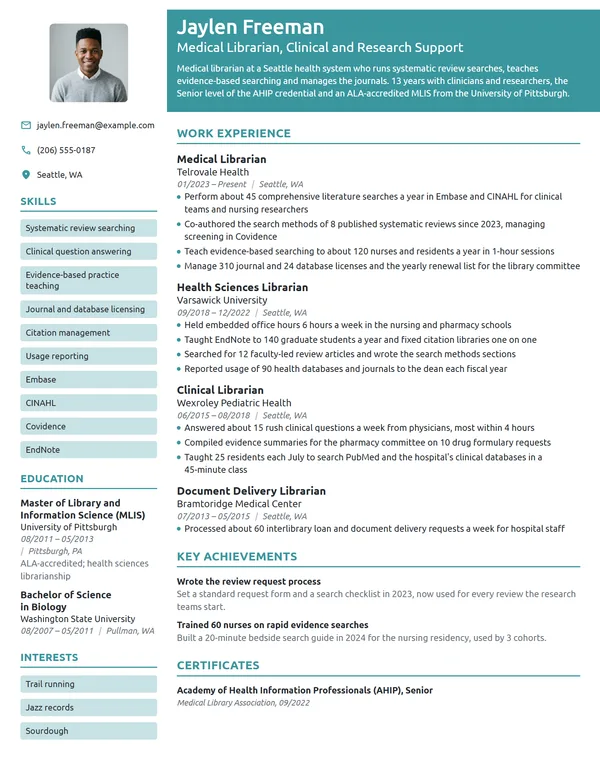
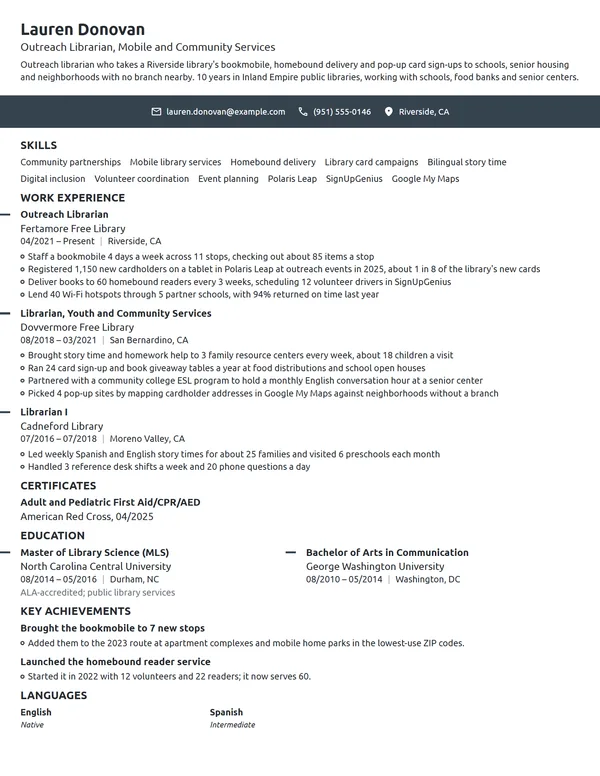
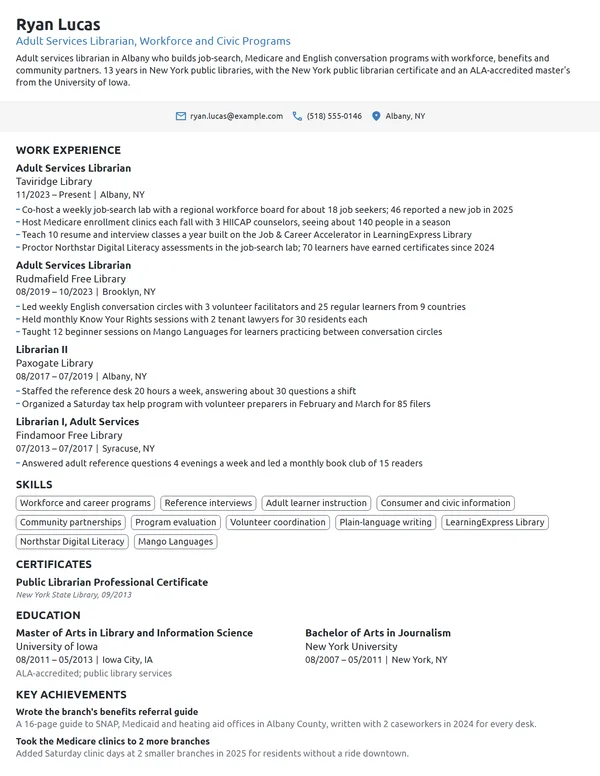
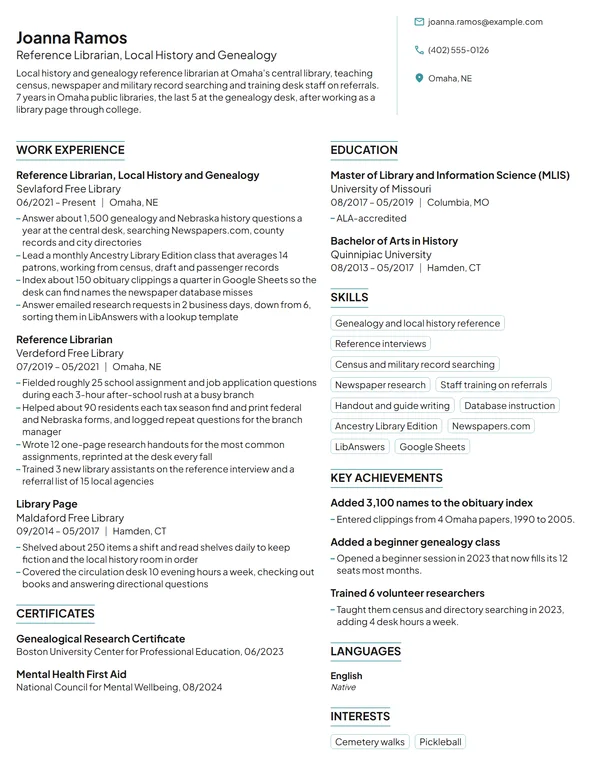
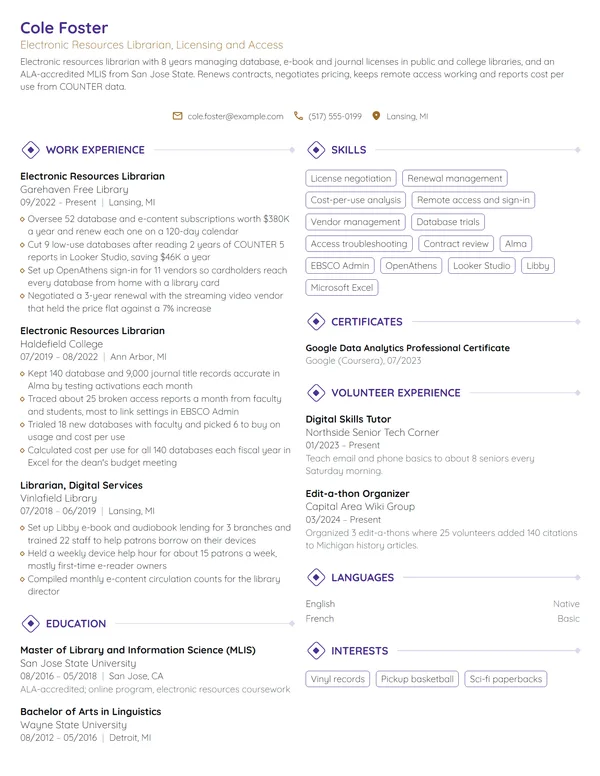
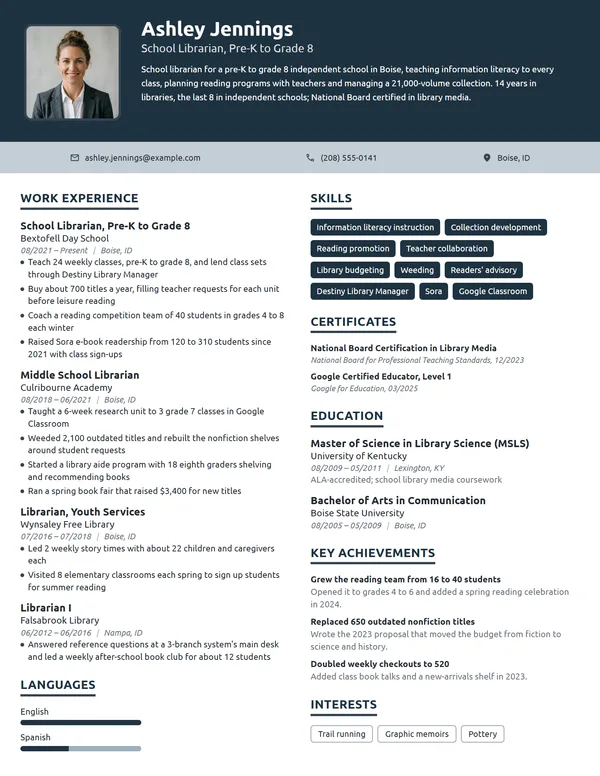
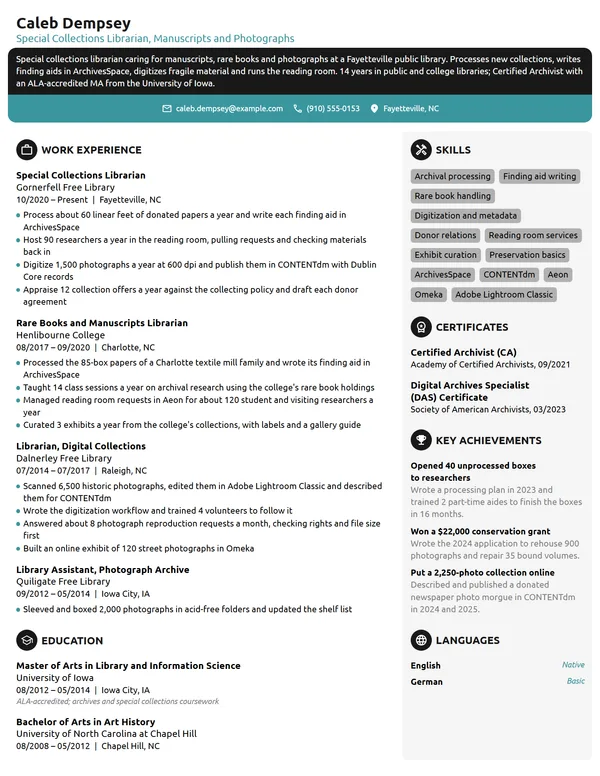
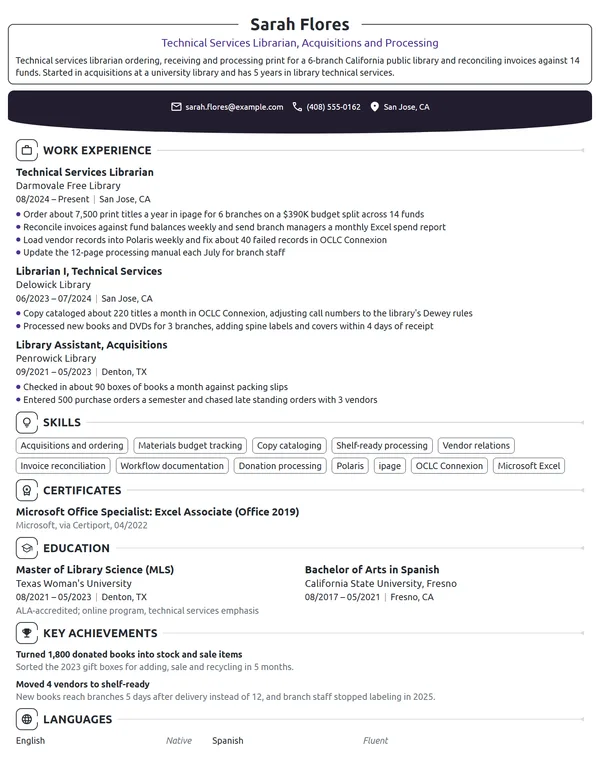
Librarians connect people with the information they need, from a first-grader's next picture book to a nursing student's literature search. Which kind of library you have worked in and who came to your desk matter first, and many professional postings require a master's from an ALA-accredited program. Numbers make the rest of the case: reference questions answered, classes taught, collection dollars spent and the attendance at programs you ran.
How to Write a Librarian Resume - Key Takeaways
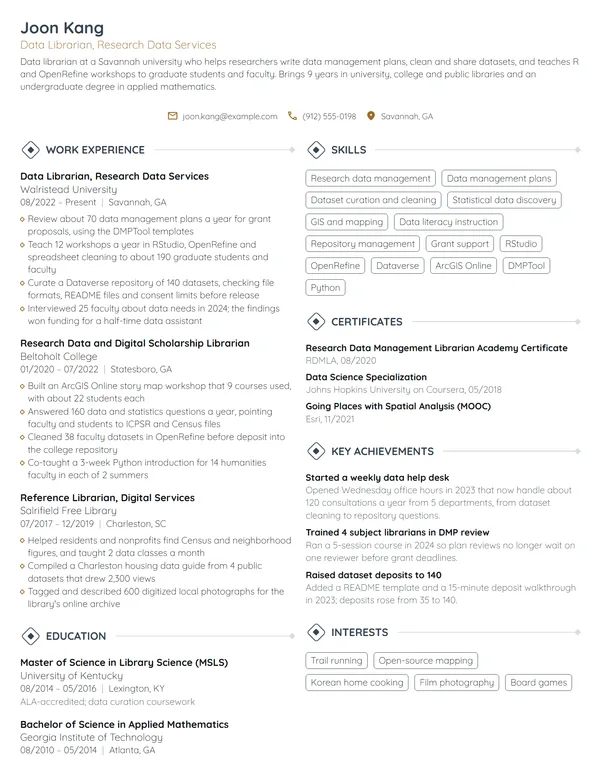
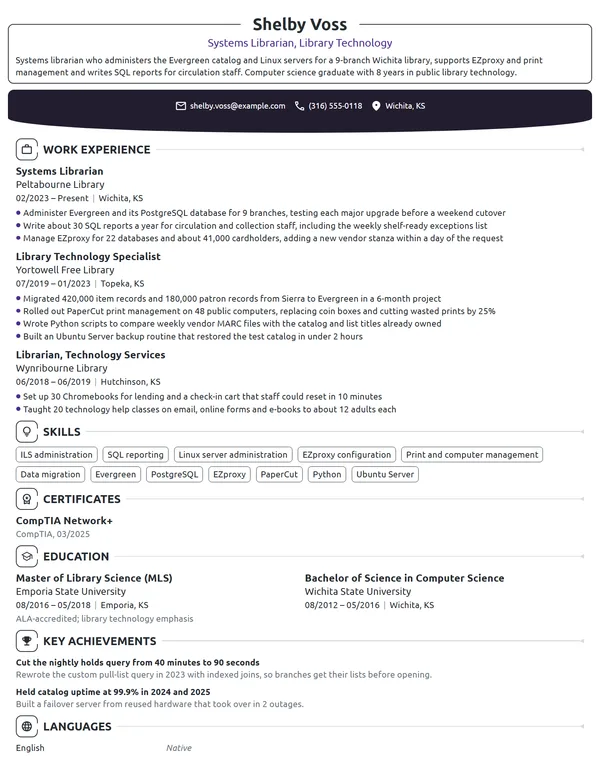
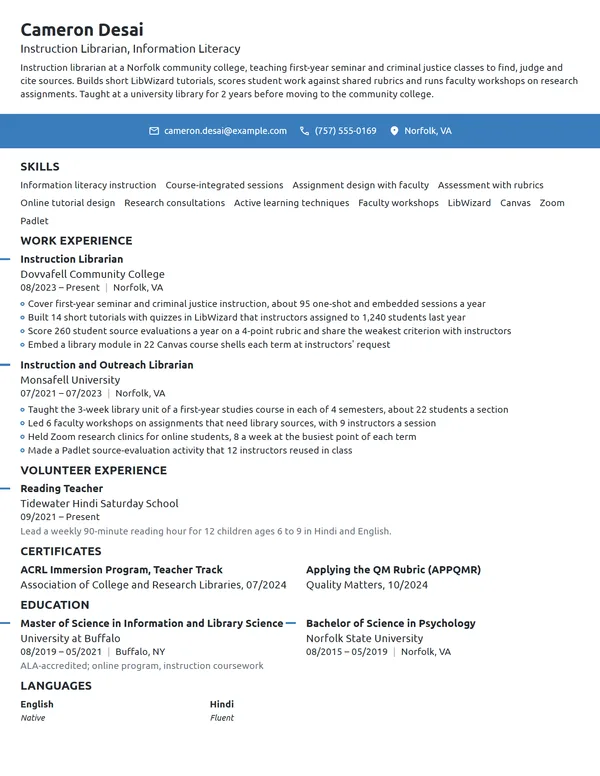
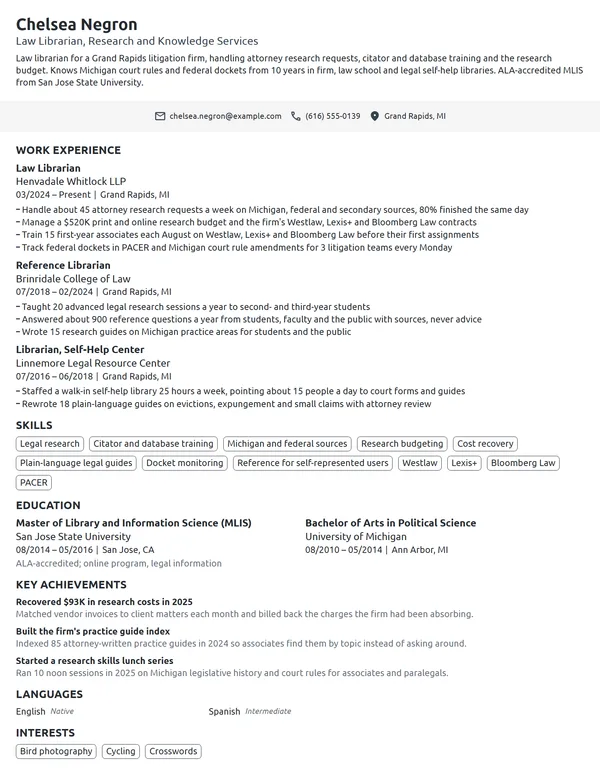
- Use the reverse-chronological format on 1 page, and move to 2 only when 10+ years or a department you ran need the room.
- Name your library type and audience in the title line, such as Librarian, Adult Services or Reference and Instruction Librarian.
- Count your work in the units libraries track: reference questions, sessions and students taught, budget spent, titles added or weeded, program attendance.
- List your integrated library system and platforms such as LibGuides by their exact names, and prove each one in a bullet.
- Put the MLIS under Education with its exact name, and any state school or public librarian certificate under Certificates.
- Keep personal details off and test the file with an ATS resume checker, since many city, county and university jobs go through an applicant portal.
What library hiring committees look for in a librarian resume
The BLS splits the job into 4 settings: academic, public, school and special libraries, such as law firms, hospitals and corporations. Whoever hires you first wants to know which of those you have worked in and who walked up to your desk: children, undergraduates, faculty, attorneys or the general public. O*NET ranks answering patrons' reference questions as the most important core task, ahead of supervising operations, teaching classes and cataloging materials.
Library postings often come with a search committee and a long list of required qualifications, so give each one a clearly labeled place on the page:
- Name, title line (for example, Librarian, Youth Services) and contact details
- A short summary of 2 or 3 lines below your name (it needs no heading)
- Work Experience, starting with your current library
- Skills, with your library system and platforms inside them
- Certificates, for a state school or public librarian certificate
- Education, with the MLIS or MLS on top
- Optional: Key Achievements, Volunteer Experience or Languages, such as Spanish for a bilingual story time
Best format for a librarian resume
Use the reverse-chronological resume format: your current library first, then each earlier role with its title, the institution, the city and MM/YYYY dates. Library careers often move from page or assistant to librarian, then to senior, department head or branch manager, and this order shows each step. Keep it even if you are switching from teaching or another field; a short objective can explain the move.
- Best for most librariansReverse-chronologicalYour jobs, newest first, with your results under each one.Best for: A steady work history in your field
- FunctionalSkills grouped up top, with a short work history below.Best for: Gaps or very little experience
- CombinationA skills section first, then your full work history.Best for: A career change with strong skills
Stay on 1 page if you have under 10 years in libraries. A 2-page resume fits a senior librarian or department head with several roles, grants or a staff to show, as long as page 1 holds your current job. Some academic library postings ask for a longer academic document listing publications and service: send the document the job ad names.
| Setting | What to use |
|---|---|
| Length | 1 page under 10 years in libraries; 2 pages for senior and department head roles |
| Dates | MM/YYYY for every job, and Present for the library you work at now |
| Job title line | Title plus department or audience: Librarian, Adult Services |
| Degree line | The exact name on your diploma: Master of Library and Information Science (MLIS) |
| Photo | Usually no photo in the US and Canada |
| Personal details | City, phone and email only; no date of birth, family details or SSN |
| File type | PDF, unless the city, county or university portal asks for a Word file |
Most US and Canadian resumes carry no photo. Public and school libraries often hire through a government or district portal, so keep the layout simple.
Librarian resume summary vs. objective
If you have held a professional library job, write a resume summary with your library type, your years, your audience and your best result. If you are finishing your MLIS or moving in from another field, write a resume objective that names the role you want and the practicum or library work that prepared you. Either one sits at the top in 2 to 3 lines and takes its number from your bullets.
Librarian resume summary formula
Library type librarian with X years serving audience. Best reference, instruction, collection or program result, with its number. Degree and any state certificate.
Example
Public librarian with 8 years in community college and public libraries, serving adult learners and job seekers. Started a weekly digital-skills drop-in that helped 410 patrons in its first year. MLIS from the University of Washington.
Don't
Passionate librarian who loves books and helping people find information.
Do
Academic reference librarian with 4 years at a community college, teaching about 70 information literacy sessions a year to first-year students. Builds course guides in LibGuides and covers the chat reference queue 2 evenings a week.
The second version gives a library type, an audience, a volume and a platform.
How to write librarian work experience bullets with numbers
Give your current job 3 to 4 bullets and older roles 2 to 4, each starting with a verb. Libraries already count most of what you do for annual reports and state surveys, so pull your numbers from those: gate counts, circulation, program attendance, instruction statistics and reference tallies. The basics of listing work experience on a resume apply, with one library rule on top: say who the numbers served.
| Area | What to count | Example bullet |
|---|---|---|
| Reference | Questions a shift or year, chat and email, referrals | Answered about 35 reference questions a shift at a 2-desk central library and logged 2 referrals a day to legal aid. |
| Instruction | Sessions, students, courses, assessment results | Taught 48 sessions to 1,100 first-year students; 82% passed the source-evaluation quiz on the first try. |
| Collections | Budget, titles added and weeded, circulation change | Spent a $40K materials budget on 1,900 new titles and lifted circulation in that area 11% in a year. |
| Programs | Events, series, average attendance, partners | Planned 26 bilingual story times a year with an average of 31 attendees. |
| Cataloging | Original and copy records, backlog, standards | Created 2,400 original and copy records in RDA and cut the cataloging backlog from 5 months to 6 weeks. |
| Resource sharing | Interlibrary loan requests, fill rate, turnaround | Filled 1,700 interlibrary loan requests a year with an average turnaround of 4 days. |
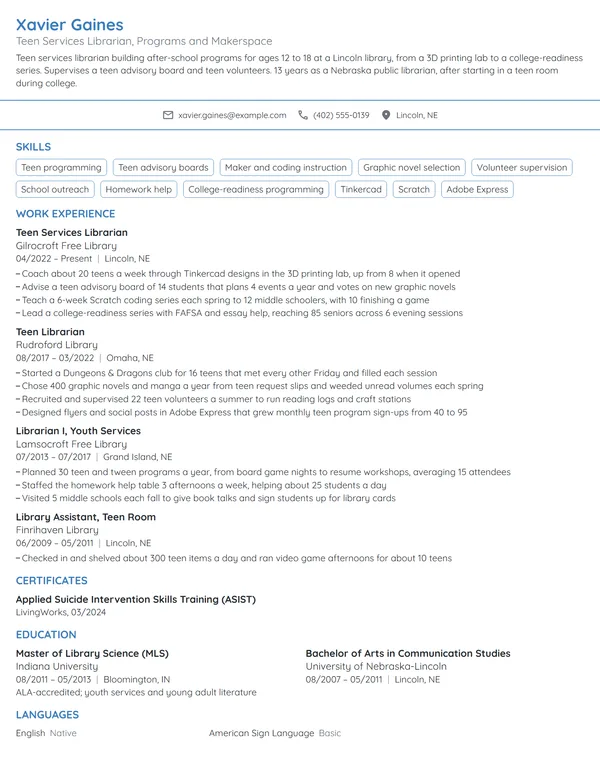
Here is one librarian's entry with those numbers in place. The public library job gets 4 bullets, the earlier college job 2, and every bullet says who it served.
Work Experience
- Select and order $62K a year of adult nonfiction and e-books for a branch with 140,000 annual checkouts.
- Built 11 LibGuides for job seekers and small-business owners, viewed 9,300 times in 2025.
- Started a weekly digital-skills drop-in that helped 410 patrons set up email, job applications or telehealth accounts in 12 months.
- Weeded 3,800 outdated titles from Polaris circulation reports, freeing 2 shelving bays for a new graphic novel collection.
- Taught 64 one-shot information literacy sessions a year for English composition and nursing courses.
- Answered 1,200 chat questions a year in LibAnswers, covering 3 evening shifts a week.
Don't
Responsible for the children's collection.
Do
Spent a $28K children's materials budget and raised juvenile circulation 14% in 2 years, adding 600 Spanish-English picture books for the branch's bilingual families.
The rewrite shows the budget, the result and who the collection was built for.
Don't
Handled interlibrary loans.
Do
Processed 2,600 interlibrary loan requests a year in OCLC WorldShare and cut the average fill time from 9 to 6 days.
Librarian skills and library software for your resume
Your Skills section needs 6 to 8 hard skills for your resume, each one named in the job ad and backed by a bullet. Reference and collection skills fit nearly every librarian; cataloging standards, instruction or youth programming belong only where you have done that work.
Hard skills for librarians
- Reference interviews
- Information literacy instruction
- Collection development
- Weeding and collection assessment
- Cataloging (MARC 21, RDA)
- Library of Congress Subject Headings
- Dewey Decimal Classification
- Interlibrary loan
- Readers' advisory
- Program planning
Soft skills library directors value
- Patience with the public
- Plain-language explanations
- Respect for patron privacy
- Curiosity
- Working with faculty and teachers
- Organization
Put your systems inside Skills and repeat each one in a bullet. O*NET flags Springshare LibGuides, Microsoft Office and Microsoft Excel as in-demand technology for librarians, and lists WorldCat and Classification Web among the software librarians use. If a posting names an integrated library system such as Alma, Polaris, Koha or SirsiDynix Symphony and you have worked in it, write that exact name, plus the module you used: circulation, acquisitions or cataloging.
School and public librarian certificates on a resume
Most academic and special libraries ask for the degree alone, but school and some public libraries also need a state credential. The BLS says public school librarians typically need a teacher's certification, and that some states also certify librarians in public libraries. List certifications on your resume under Certificates, each with the issuing agency and the date, so a district or library board sees them at once.
| Credential | Issued by | What it takes |
|---|---|---|
| Teaching certificate (public school librarians) | Your state's education department | The BLS says public school librarians and library media specialists typically need one; your state sets the school library rules on top of it. |
| School Librarian certificate (Texas) | Texas Education Agency | An approved educator preparation program, a master's degree, the required test and 2 years of classroom teaching in a public or accredited private school. |
| Public librarian certificate (New York) | New York State Library | A graduate library degree from a library school. |
How to list a certificate you are still earning
A certificate that has not been issued goes under Certificates with its status after the name, such as in progress or exam scheduled, and the month you expect it. School districts read that line closely, so match the certificate's name to the state's own wording and keep your classroom teaching certificate on the list too.
Certificates
- School Librarian certificate, Texas Education Agency, 07/2024
- Teaching certificate, English Language Arts, Texas Education Agency, 06/2019
How to list an MLIS or MLS on a librarian resume
Librarians typically need a master's degree in library science, according to the BLS, and MLS programs admit students from any bachelor's major. ALA accredits master's programs in the United States, Canada and Puerto Rico, and says many employers require an ALA-accredited degree for professional positions. Write the degree exactly as your school awards it: MLIS, MLS, MSLS and MSIS all appear on diplomas.
When listing education on a resume, give the degree, school, city and graduation date, with the master's first. Add the bachelor's below it, since academic liaison and subject librarian postings often ask for a background in the subject. A school library or archives concentration can go on the degree line; a GPA belongs only on a new graduate's resume.
Education
Entry-level and career-change librarian resumes
Fresh out of an MLIS program, use an entry-level resume layout: an objective, Education straight after it, then the library work you did along the way. Count it the way a full-time librarian would.
- Practicum or field experience: hours, the desk you staffed, sessions taught, records cataloged.
- Graduate assistantships: chat shifts covered, guides built, a digitization project and its item count.
- Library page, clerk or assistant jobs: items shelved or checked in, holds processed, patrons helped at the circulation desk.
- Literacy, tutoring or ESL volunteering: learners, hours and outcomes, listed under Volunteer Experience.
Don't
Recent MLIS graduate seeking a librarian position where I can grow.
Do
MLIS graduate (05/2026) with a 150-hour practicum at a university library, seeking a reference and instruction role. Taught 6 library sessions and answered 300+ chat questions during the practicum.
An objective still needs proof: hours, sessions or a volume.
Teachers moving into the school library, library assistants with a new MLIS and researchers heading into special libraries all keep reverse-chronological order. A career-change resume works here when the first bullets under your current job are its most library-like tasks: running a classroom library, teaching research skills or managing records. Explain why you are switching in your cover letter; our librarian cover letter examples show how to do it in a few lines.
Librarian resume FAQ
Do you need a master's degree to be a librarian?
For most professional posts, yes. The BLS says librarians typically need a master's degree in library science, and ALA says many employers require an ALA-accredited master's. Library assistant, technician and page jobs do not, which makes them a common way in while you study.
Should I write "ALA-accredited" on my resume?
Yes, when the job ad asks for an ALA-accredited degree, as many professional postings do. Add ALA-accredited after the degree name, with the school and the date, so a screener checking that line finds it in your words.
How do I list a school librarian certification on a resume?
Put it under Certificates with its exact state name, the issuing agency and the date, such as School Librarian certificate, Texas Education Agency, 07/2024. Keep your teaching certificate on the list as well, because districts often check both.
What library software should I put on my resume?
Put the integrated library system you worked in, by its product name, plus the platforms you used daily, such as LibGuides, LibAnswers or OCLC WorldShare. Add the module or task for each one, and leave off systems you only saw in a class demo.
How long should a librarian resume be?
1 page under 10 years in libraries, 2 pages for senior librarians and department heads with staff, grants or several roles to show. If an academic library asks for a list of publications and service, send the longer academic document it names.
Where do conference presentations go on a librarian resume?
In a bullet under the job you held at the time, or under Key Achievements if you have 2 or 3. Give the title of the talk, the conference and the year, such as a state library association meeting. The resume designs have no separate Presentations section.
How do I move from library assistant to librarian on my resume?
Lead with the MLIS under Education, then rewrite your assistant bullets around professional tasks you already do, such as reference questions, programs or cataloging, with their numbers. Use an objective that names the librarian role you want and your degree date.
Should I put salary expectations on a librarian resume?
No. Pay talk belongs on the application form or in the interview. As a benchmark, the BLS reports that the median annual wage for librarians and library media specialists was $68,270 in May 2025; pay varies by state and by library type.
Next steps
Pick the example that matches your library type and level, keep its structure, and swap in your own counts: questions answered, sessions taught, budget spent and programs run. Build it in our resume builder or start from one of the resume templates, then send it with a cover letter that names the library and the audience you want to serve.