
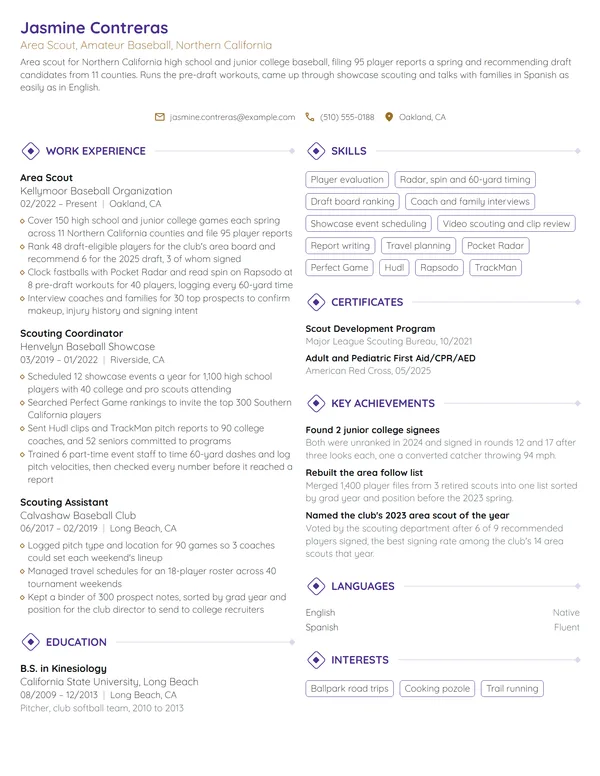
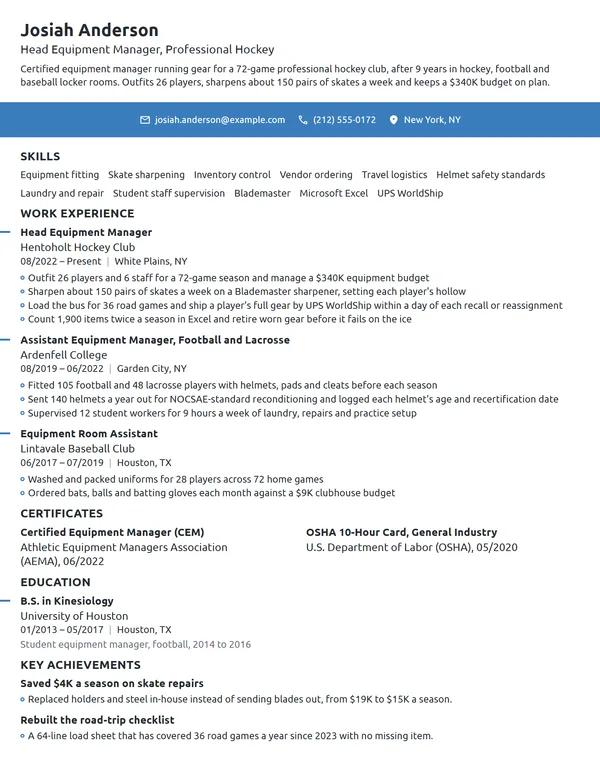
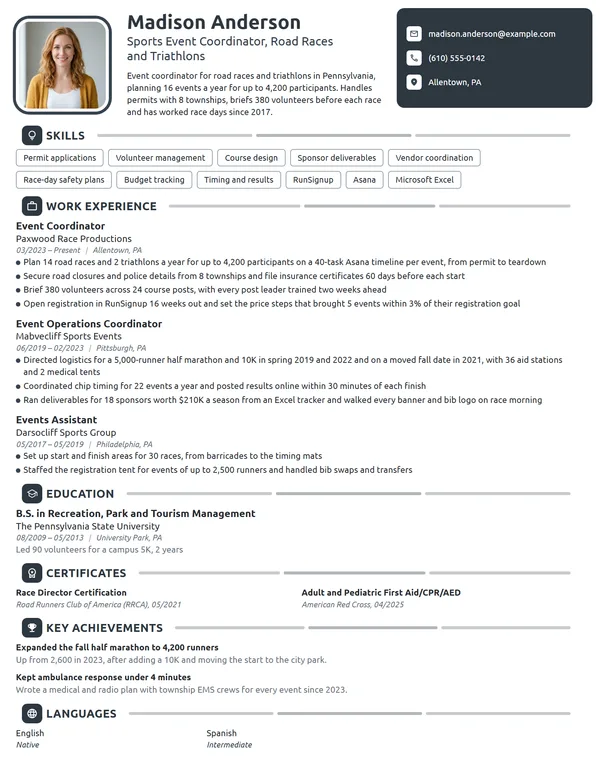
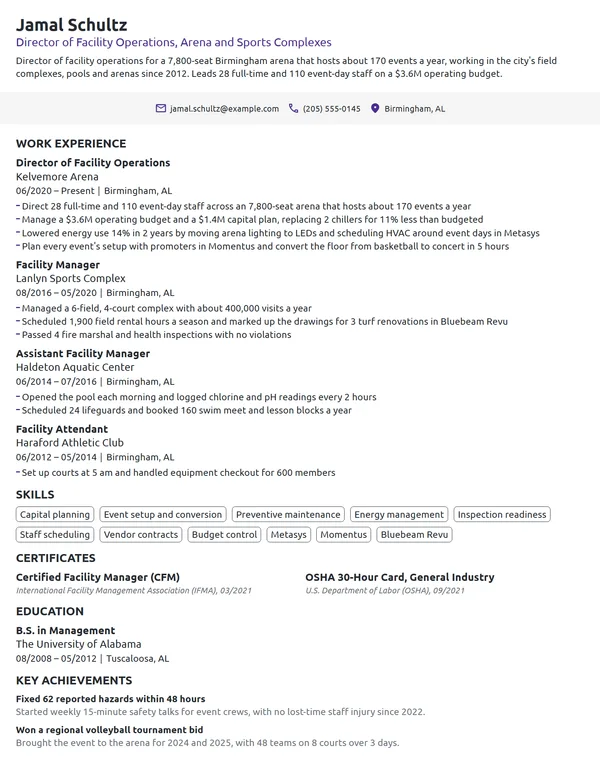
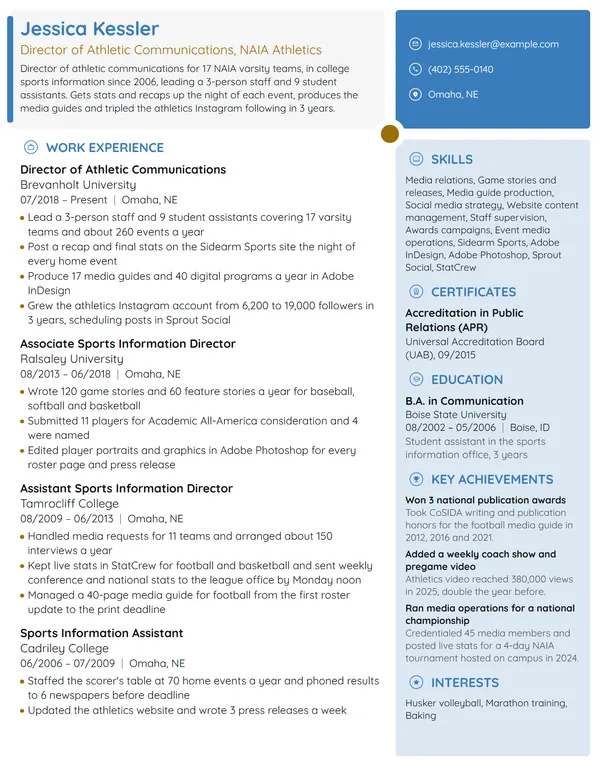
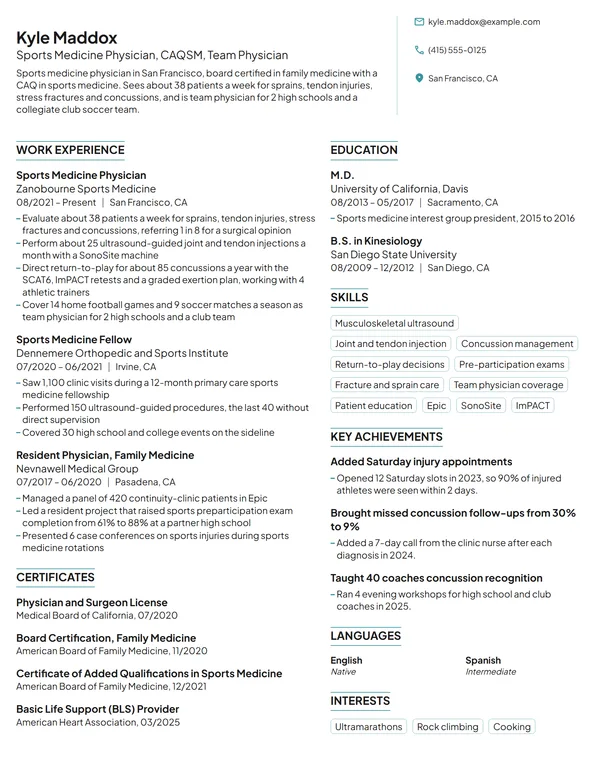
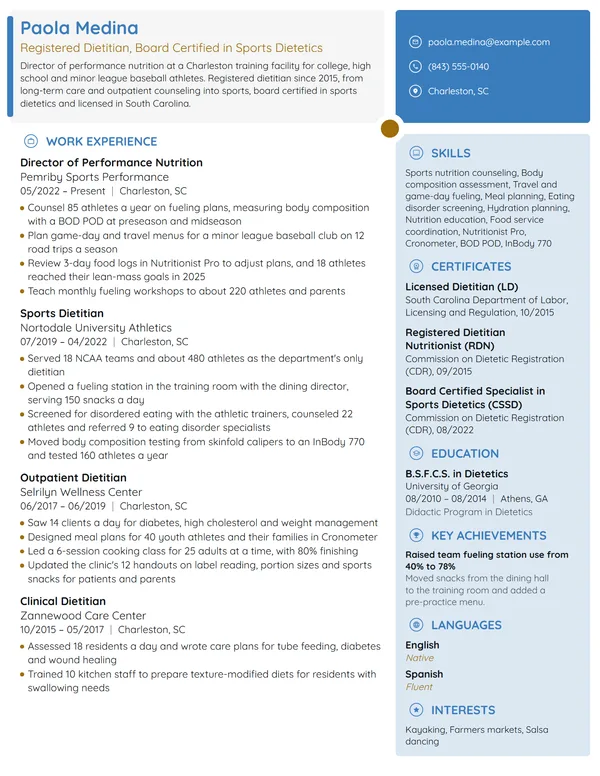
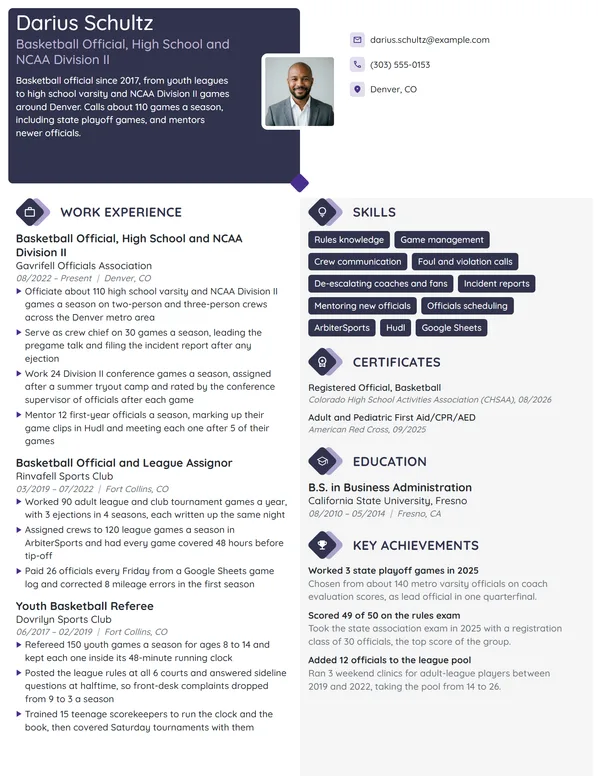
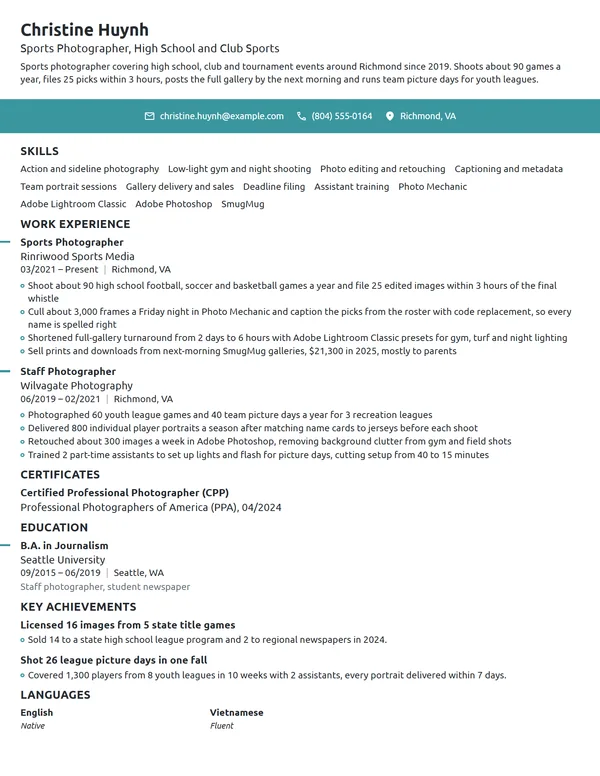
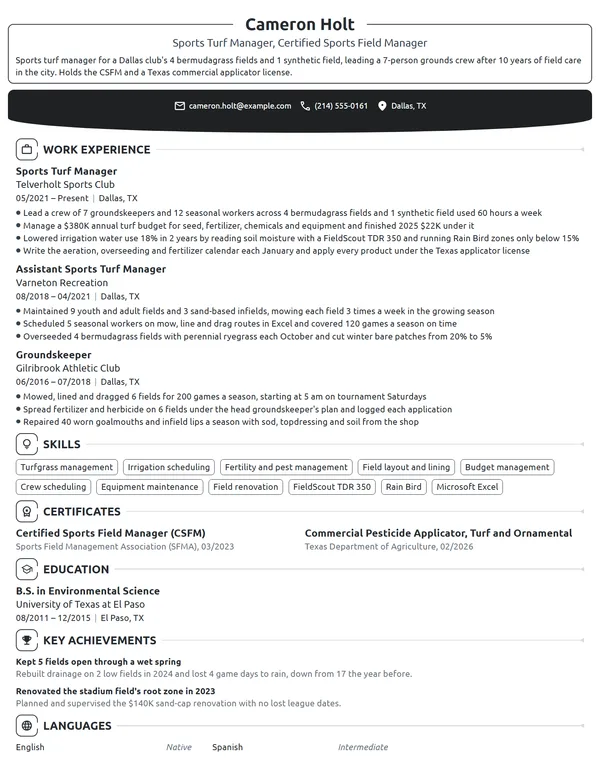
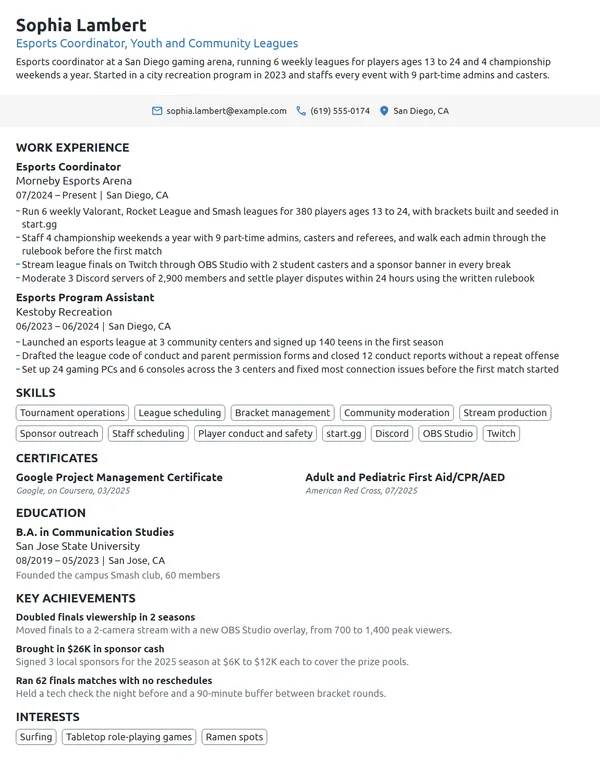
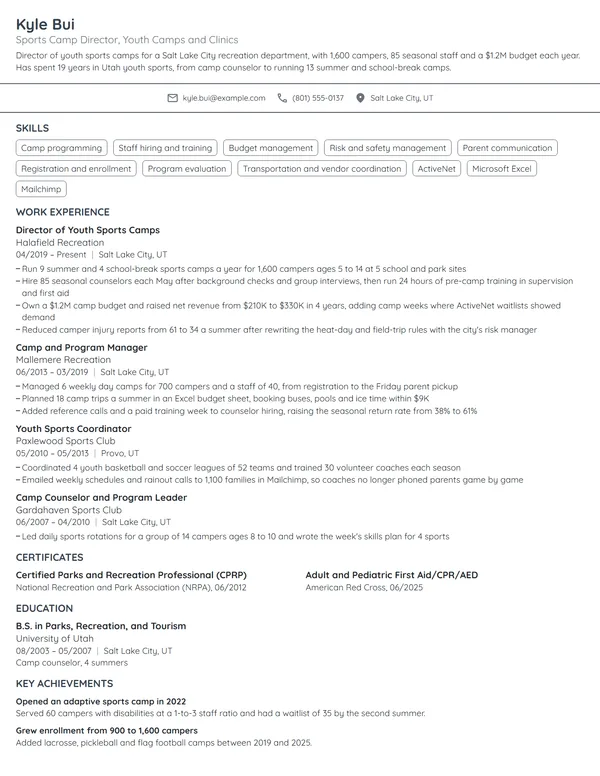
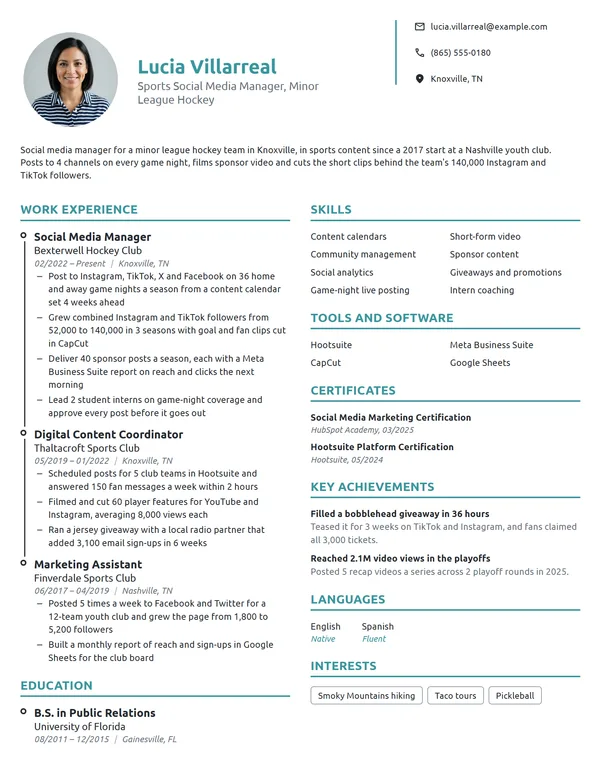
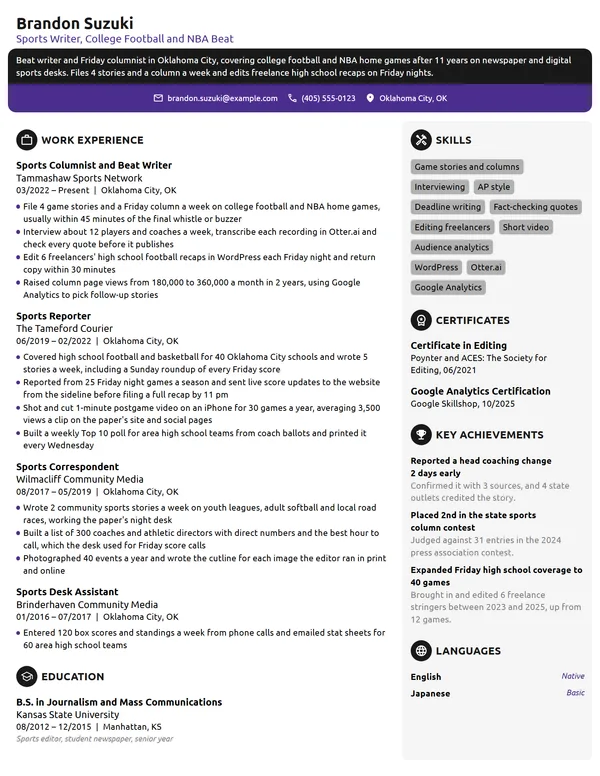
A sports career can mean taping ankles, calling games, crunching stats or running a league. Whichever it is, the employer wants to know the sport and level you have worked in, how much you were responsible for and whether your credentials are current. Nearly every applicant loves the game, so passion sets nobody apart. Counted work does: the seasons, the athletes or fans you served, the events you ran and the certifications you hold, all on 1 clean page.
How to Write a Sports Resume - Key Takeaways
- Order your jobs newest first on 1 page, and show the sport and level in every job entry.
- Open with 2 to 3 lines that name your role, your years, your sport or setting and 1 counted result.
- Count what your corner of sports counts: athletes covered, games called, events run, players advanced, sponsorship dollars.
- List credentials such as ATC, CSCS, NFHS coaching courses and first aid/CPR/AED in the Certificates section, each with its issuing body and date.
- Treat a playing career as evidence of discipline and teamwork, and back it with a job, an internship or a volunteer role in sports.
- Skip your birth date, height and weight, and test the PDF in an ATS resume checker before you send it.
What sports employers look for in a resume
Sports hiring covers very different jobs: athletic trainers, coaches, broadcasters, statisticians, agents, event staff and recreation coordinators. The BLS describes coaches as teaching athletes the skills they need to succeed at their sport, and O*NET lists evaluating athletes' readiness to play and reporting recovery progress to coaches or physicians among athletic trainers' tasks. Whatever your lane, the reader starts with the sport and level.
A sports resume needs these sections, under plain headings an ATS can parse:
- Your name, contact details and a headline like Athletic Trainer, ATC
- A short profile of 2 to 3 lines above Work Experience, with no title of its own
- Work Experience, with your current or latest season first
- Skills, with the software and video or stats tools you use
- Certificates, with any state license in first place
- Education
- Key Achievements, Volunteer Experience, Languages or Interests if you have room
Best format for a sports resume
Use the reverse-chronological resume format: newest role first, each with the title, employer and location, and month and year in MM/YYYY form. Sports careers climb through visible steps, such as graduate assistant to assistant to head, or intern to coordinator to director, and newest-first order shows each one. Seasonal and part-time roles in the same organization can share one entry with a date range.
- Best for most sports jobsReverse-chronologicalYour jobs, newest first, with your results under each one.Best for: A steady work history in your field
- FunctionalSkills grouped up top, with a short work history below.Best for: Gaps or very little experience
- CombinationA skills section first, then your full work history.Best for: A career change with strong skills
Keep it to 1 page until you have about 10 years in the field. A 2-page resume fits a head athletic trainer, coach or operations director with several programs behind them, as long as page 1 holds the current role and its strongest season.
| Setting | What to use |
|---|---|
| Length | 1 page; 2 only after about 10 years or several programs |
| Job title line | Role plus sport and level where it fits: Graduate Assistant Coach, Women's Volleyball, NCAA Division I |
| Dates | MM/YYYY; a seasonal job can show its season range, such as 08/2024 – 11/2024 |
| Media links | 1 line under your contact details for a demo reel, a portfolio or published stats |
| Personal details | Height, weight, birth date and SSN stay off the page |
| File type | PDF, unless the athletics department's portal asks for Word |
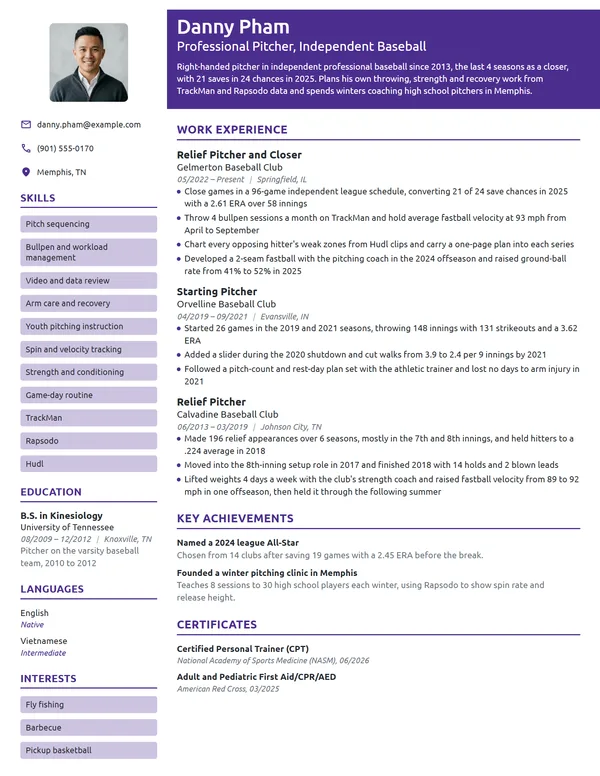
Most US and Canadian resumes carry no photo, and that holds for sports jobs off the field too: a broadcaster shows their look and voice in the reel, not on the page.
Sports resume summary vs. objective
If you have held a paid or volunteer role in sports, write a summary: your role, years, sport or setting, and 1 counted result. If sports work is still ahead of you, write an objective naming the role you want and the best evidence you already have, as our resume objective examples do. Athletic trainers can find credential-led versions in our athletic trainer summary and objective examples.
Sports resume summary formula
Role with X years in sport, level or setting. Biggest counted result from your latest role. Credential or tool named in the job ad.
Example
Sports program coordinator with 7 years in community recreation and youth leagues. Grew adult league registrations by 31% in 2 seasons by adding weeknight divisions. Holds Red Cross First Aid/CPR/AED and runs every league in TeamSnap.
Don't
Passionate sports enthusiast with a strong work ethic, looking to break into the sports industry.
Do
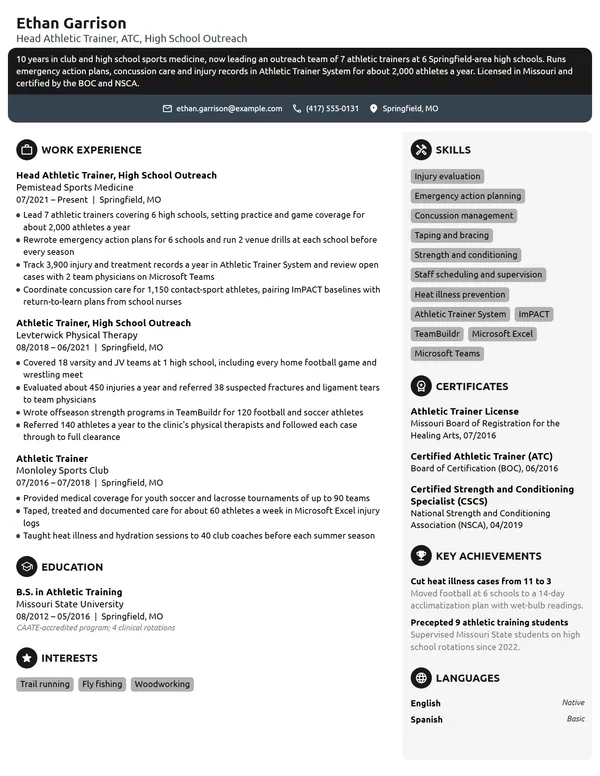
Athletic trainer, ATC, with 7 years in Division II and high school settings, covering 11 teams and about 300 athletes a year. Built a preseason concussion baseline program with ImPACT testing for every contact sport.
This version names the credential, the level, the caseload and a program the reader can picture.
How to write sports work experience bullets with numbers
Give your current role 3 to 4 bullets and older ones 1 to 3, each starting with a verb and ending with a result. Sports already keeps score in seasons, games, rosters and gate counts, so most bullets can carry a figure your next employer tracks too. Write achievements on your resume instead of the duties from your job posting.
| Lane | What to count | Example bullet |
|---|---|---|
| Athletic training | Athletes and teams covered, treatments, return-to-play timelines | Covered 260 athletes on 9 teams and logged 1,100 treatment encounters in the school year. |
| Coaching and performance | Record, roster size, athletes moved up a level | Sent 7 of 22 rostered players on to college programs over 3 seasons. |
| Operations and events | Events per year, attendance, staff scheduled | Ran 32 home events a year with an average attendance of 4,800. |
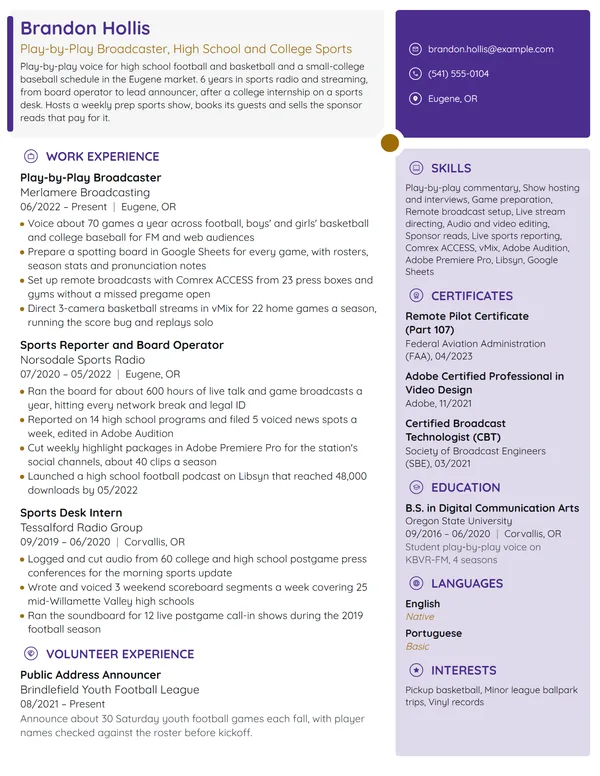
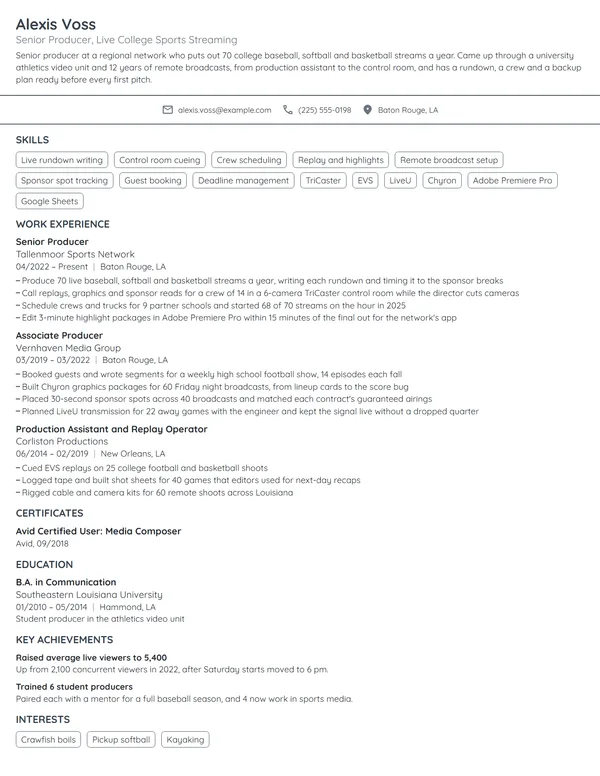
| Broadcasting and media | Games called, audience, clips produced | Called 41 games on radio and stream; average stream views rose from 9K to 15K a game. |
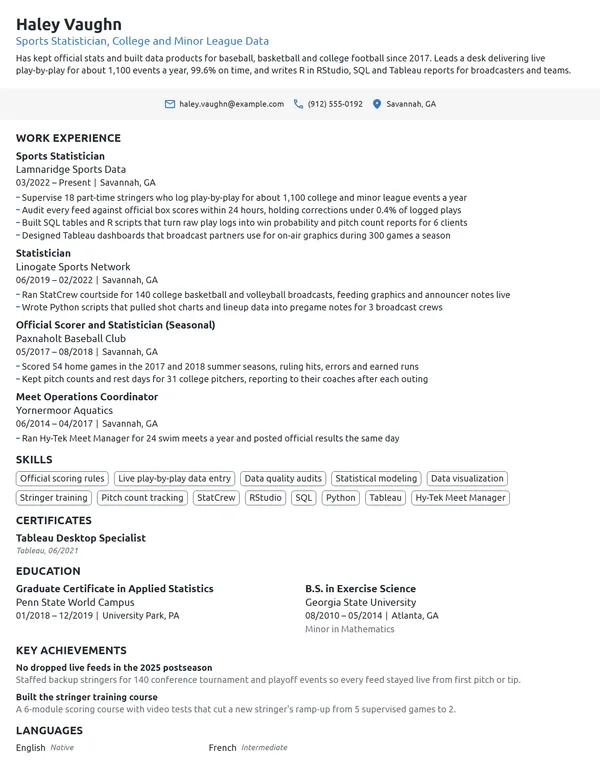
| Statistics and analytics | Games or possessions charted, reports, staff served | Charted 2,400 possessions a season and delivered opponent reports to 4 coaches every week. |
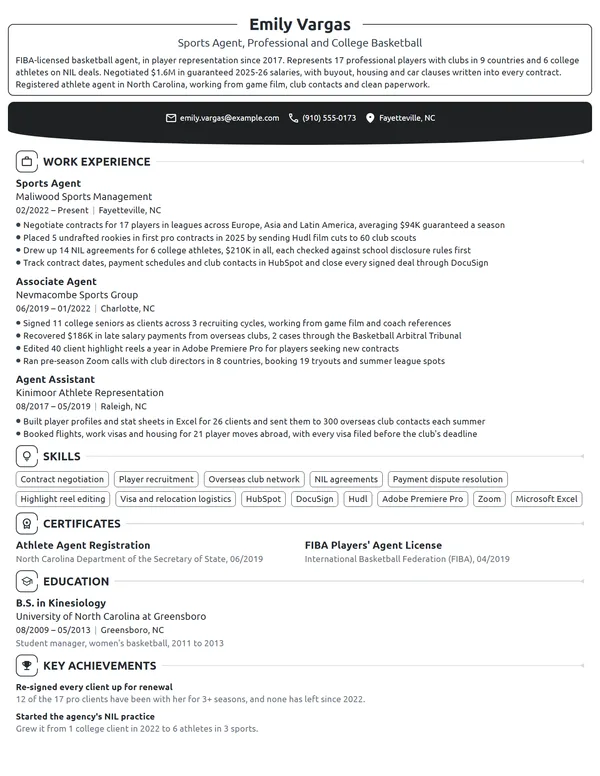
| Agency and business | Clients, deals, contract or sponsorship value | Closed 12 endorsement deals worth $640K for 5 clients in 2025. |
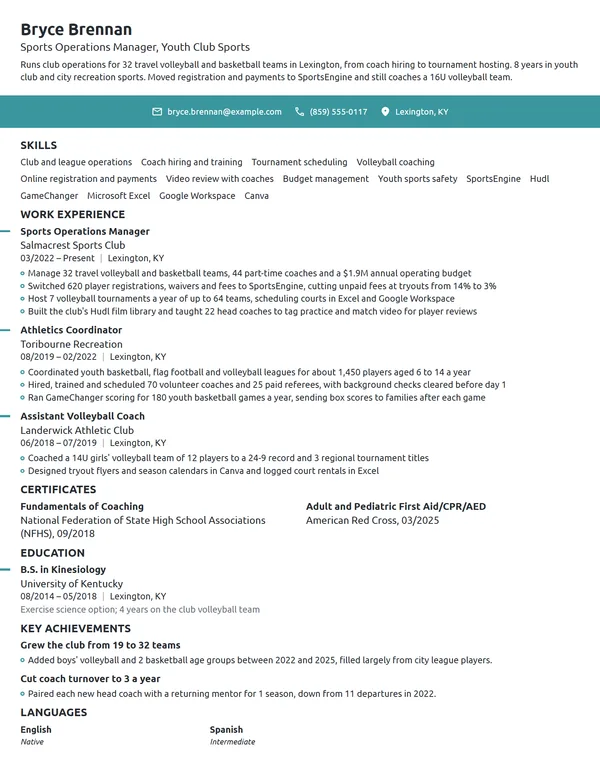
Here is how one recreation coordinator's entry reads with those numbers in place. The current job carries the scale (leagues, players, dollars) and the earlier one stays short.
Work Experience
- Schedule 14 youth and adult leagues a season across 6 fields and 2 indoor courts, about 2,300 registered players.
- Recruited and trained 38 seasonal officials and scorekeepers, cutting forfeits caused by missing officials from 11 to 2 a season.
- Booked 9 weekend tournaments in 2025 that brought in $412K in entry fees and facility rentals.
- Moved registration, payments and schedules into TeamSnap, opening league rosters 10 days sooner.
- Supervised the gym and fitness floor for about 450 member visits a day.
- Taught 6-week youth basketball clinics for 120 kids a year.
Don't
Responsible for game-day operations.
Do
Ran game-day operations for 18 home football and basketball games, scheduling 60 ushers and ticket scanners and opening gates on time at every event.
The rewrite shows the event count, the staff size and the standard you were held to.
Don't
Helped with team statistics.
Do
Kept live stats for 34 volleyball and soccer matches in StatCrew and posted official box scores within 20 minutes of the final whistle.
Sports skills and software for your resume
Choose 6 to 8 hard skills for your resume from the posting, keeping only those a bullet already proves. A trainer's list and an agent's list share almost nothing, so pick from the lane you are applying to and let your results carry the soft skills.
Hard skills for sports jobs
- Injury evaluation and taping
- Strength and conditioning programming
- Practice and season planning
- Video breakdown and scouting reports
- Live stat keeping
- Game-day and event operations
- League and tournament scheduling
- Play-by-play and color commentary
- Sponsorship and ticket sales
- Contract negotiation
Soft skills sports employers value
- Composure on game day
- Clear talk with athletes and parents
- Discretion with medical and contract details
- Leading seasonal staff
- Juggling overlapping seasons
- Teamwork across departments
Name your tools with your skills, then again inside the bullet where you used them. O*NET flags Microsoft Excel, PowerPoint and Outlook as hot technologies for coaches and scouts, and lists ImPACT concussion testing and athletic training record systems for athletic trainers. Where the posting names Hudl for video, StatCrew for stats or TeamSnap for scheduling and you have used it, write that exact name.
Sports certifications and licenses: ATC, CSCS, coaching and agent credentials
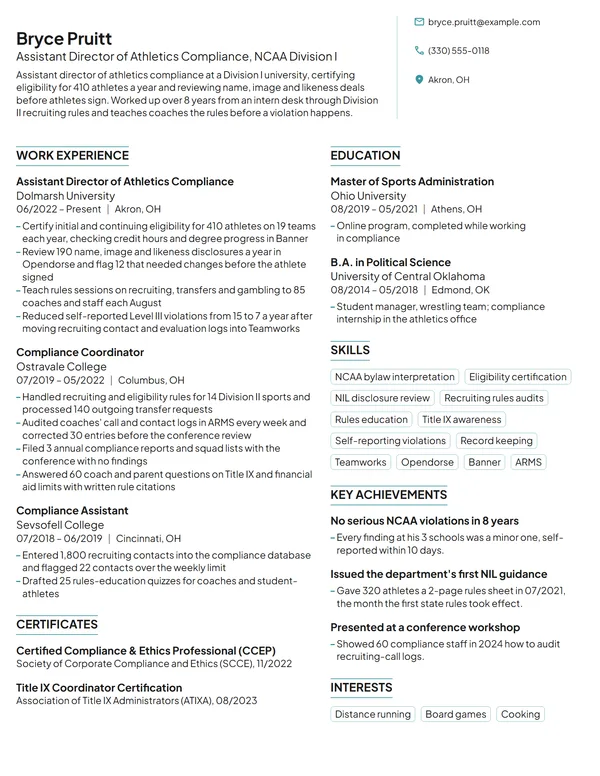
Put certifications on your resume under Certificates, each with its issuer and a date, and list a state license first. The Bureau of Labor Statistics notes that coaches need CPR and first aid training, that public high school coaches may need to be certified or complete mandatory education courses, and that nearly all states require athletic trainers to hold a license or certification. Officials who work high school games typically register with the state or local agency that runs high school athletics and pass a rules exam for their sport.
| Credential | Issued by | What it takes |
|---|---|---|
| ATC (athletic trainer certification) | Board of Certification (BOC) | Complete a CAATE-accredited athletic training program, be confirmed by its program director and pass the BOC exam; practice also needs your state's license or certification. |
| CSCS (Certified Strength and Conditioning Specialist) | NSCA | A bachelor's degree, or senior year of college, current CPR/AED certification and a passing score on the CSCS exam. |
| Fundamentals of Coaching | NFHS | A 12-hour online course with a certificate of completion; check whether your state high school association requires it. |
| NFLPA Certified Contract Advisor | NFL Players Association | An undergraduate degree plus a master's or law degree (or 7 years of negotiating experience), a mandatory seminar, a proctored exam with a scaled score of 70 or higher, and a background check. |
| First aid, CPR and AED | American Red Cross or American Heart Association | A course with a skills check; list the course name as the card prints it and the month you completed it. |
How to list a credential still in progress
The BOC lets you use ATC only once it grants certification, so a candidate with results pending writes the exam and its date, not the letters. The same goes for a CSCS or a coaching course you have booked: list it with the word scheduled and the month, and keep the initials out of your headline until the certificate arrives.
Certificates
- Fundamentals of Coaching, National Federation of State High School Associations (NFHS), 04/2022
- Concussion in Sports, NFHS, 04/2022
- Adult and Pediatric First Aid/CPR/AED, American Red Cross, 08/2025
- Certified Strength and Conditioning Specialist (CSCS), NSCA, exam scheduled 03/2027
How to list a sport management, kinesiology or exercise science degree
The degree you need depends on the lane. According to the BLS, athletic trainers typically need a master's degree from an accredited program, a bachelor's degree is the typical entry requirement for coaches and scouts, and broadcast announcers usually hold a bachelor's in communications, broadcasting or journalism. Agents who negotiate NFL contracts need a master's or law degree for NFLPA certification, unless they have 7 years of negotiating experience.
Follow the usual rules for listing education on a resume: the degree, the school and its city, and the month you graduated, with a GPA of 3.5 or higher only in your first 2 to 3 years out. A varsity sport, a student manager role or campus officiating fits on 1 line under the degree.
Education
Intramural sports official for 3 years.
Former athletes, students and career changers in sports
Without a paid sports job yet, use an entry-level resume layout: an objective, Education high on the page, then every piece of evidence that you can do the work, counted the way a job would be.
- Internships with a team, athletic department or league: events worked, tickets sold, clips produced or athletes treated under supervision.
- Student manager, student trainer or campus media roles: seasons, games covered and the tools you used.
- Youth coaching or officiating: listed under Volunteer Experience when unpaid, with seasons, age group and roster size.
- Your own playing career: level, years and captaincy in 1 line, never a full section of game stats.
Don't
Former college athlete seeking a position in sports.
Do
Former NCAA Division III soccer captain with a B.S. in Sport Management, seeking a ticket sales associate role. Sold $18K in group tickets during a 12-week internship with a minor league baseball club.
Playing experience opens the door, and a counted result from a sports job shows you can work in one.
Moving in from teaching, sales, marketing, media or healthcare, stay with newest-first order and lead each recent job with the bullets closest to sports: coaching a school team, selling sponsorships, producing video or treating active patients. A career-change resume works best when its profile names the sports role you want and the transferable skills that carry over. Explain the move in 2 or 3 sentences of your cover letter, and open it on your strongest sports result.
Sports resume FAQ
Should I put my playing career on a sports resume?
Yes, in 1 or 2 lines. Name the level, school or club, years and any captaincy, under Education for college sport or as a short entry otherwise. Employers value the discipline it shows, though a sports job, internship or volunteer role carries more weight than game statistics.
How do I list athletic training credentials before I pass the BOC exam?
List the BOC exam under Certificates with the word scheduled and the month, and leave ATC out of your name line and headline. The BOC allows the ATC credential only once certification is granted, and you also need your state's license or certification before you practice.
Do you need a degree to work in sports?
For most professional roles, yes. The BLS lists a bachelor's degree as the typical entry level for coaches and scouts, and for athletic trainers a master's degree from an accredited program. Event staff, recreation and officiating roles often start without one, and a degree in sport management, kinesiology or communications helps you move up.
How much do athletic trainers and coaches make?
According to BLS figures for May 2025, athletic trainers earned a median of $62,520 a year and coaches and scouts $47,320. Keep pay off the resume itself and save it for the application form or the interview.
Should a sports broadcaster put a demo reel on the resume?
Yes. Put 1 short link under your contact details, pointing to a reel of 2 to 3 minutes that opens with your best call. On the resume itself, count the games you called, the sports and the outlets, so the page holds up even if nobody clicks.
How do I list seasonal or part-time sports jobs?
Give each employer one entry and show the seasons in the date line or the first bullet, such as 3 fall seasons. Group repeat seasons with the same club or camp instead of listing each year, and count what you did across all of them.
Can volunteer coaching go on a sports resume?
Yes, under Volunteer Experience, with the sport, the age group, the roster size and the seasons. If coaching is the job you are applying for, write those entries with the same counted bullets as paid work, and list any NFHS or first aid courses you completed for them.
How long should a sports resume be?
1 page for most people in sports, including coordinators, assistants and early-career trainers. Move to 2 pages only after about 10 years or several programs, and keep your current role and best season on page 1.
Should a referee or umpire list officiating on a resume?
Yes, as its own entry with the sport, the level and the association you are registered with. Add the number of games or seasons you have worked and any playoff or championship assignments, since those show the trust assigners place in you.
Next steps
Choose the example nearest your lane and level and copy its layout, then replace each figure with your own seasons, athletes, events and credentials. Our resume builder and resume templates give you a clean starting page, and a short letter naming the sport and level you want finishes the application.