
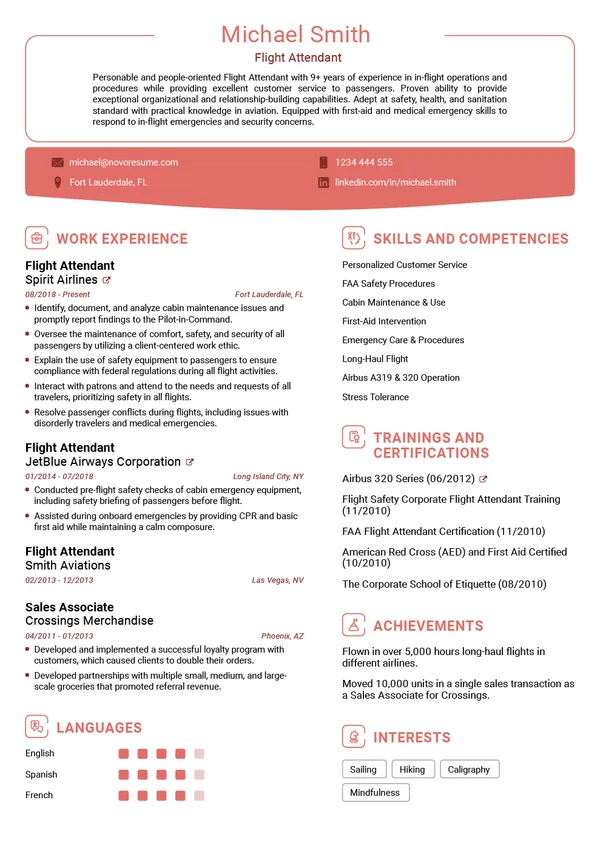
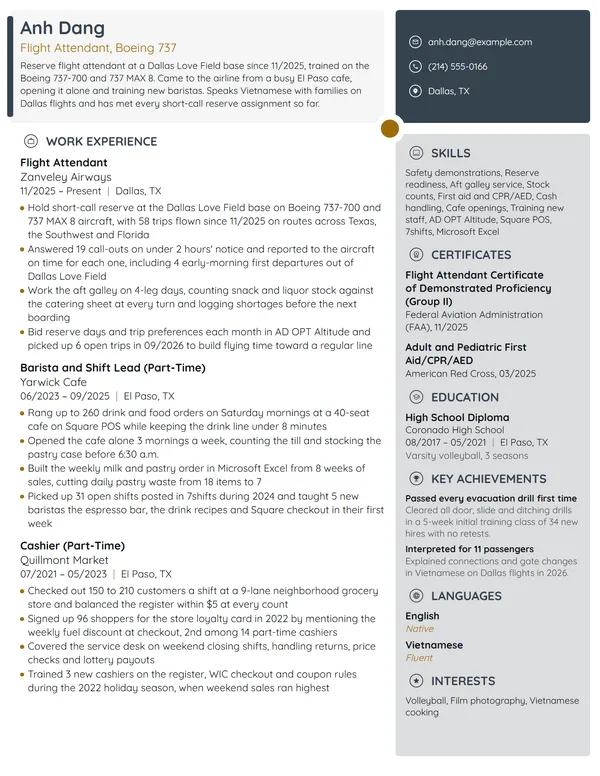
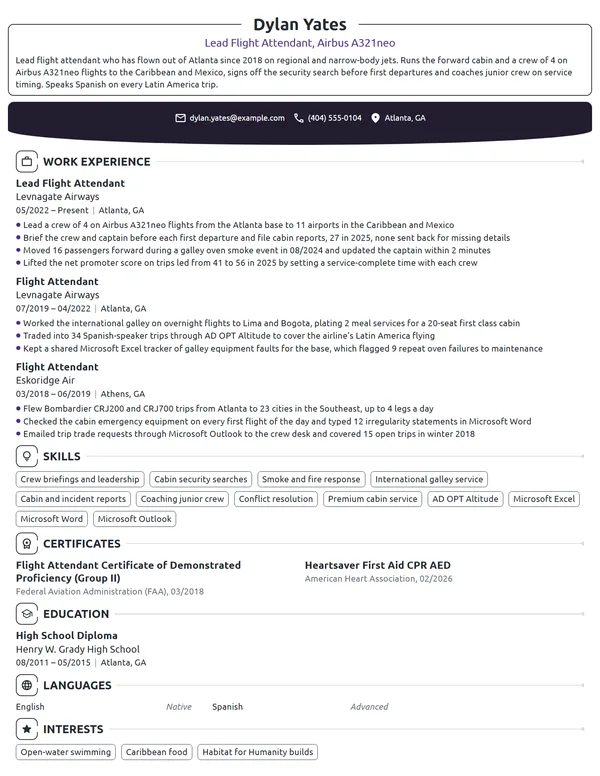
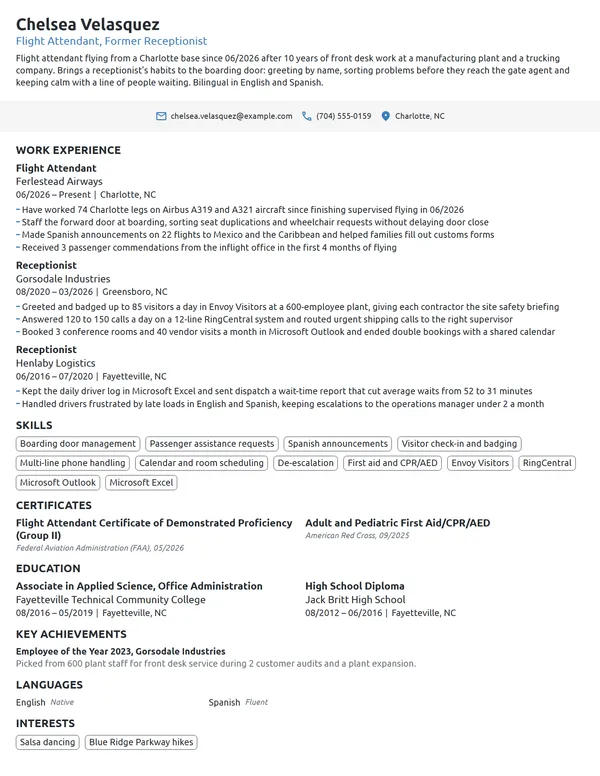
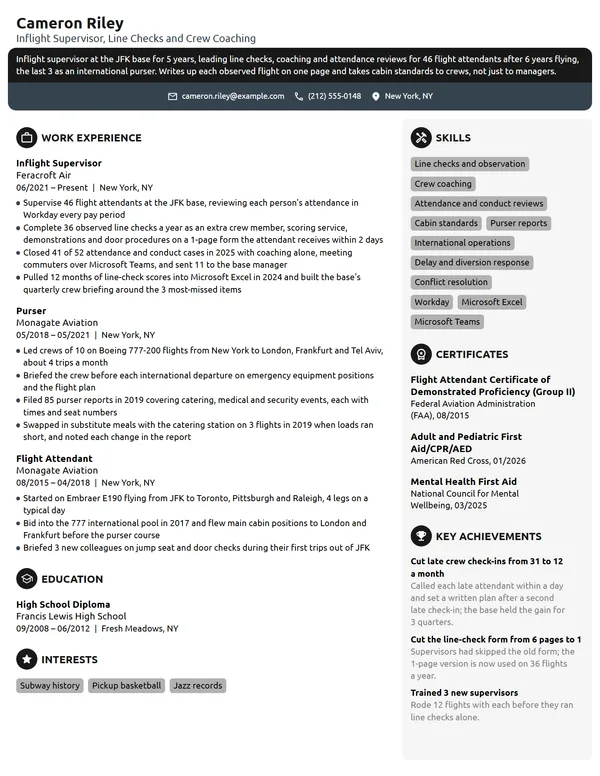
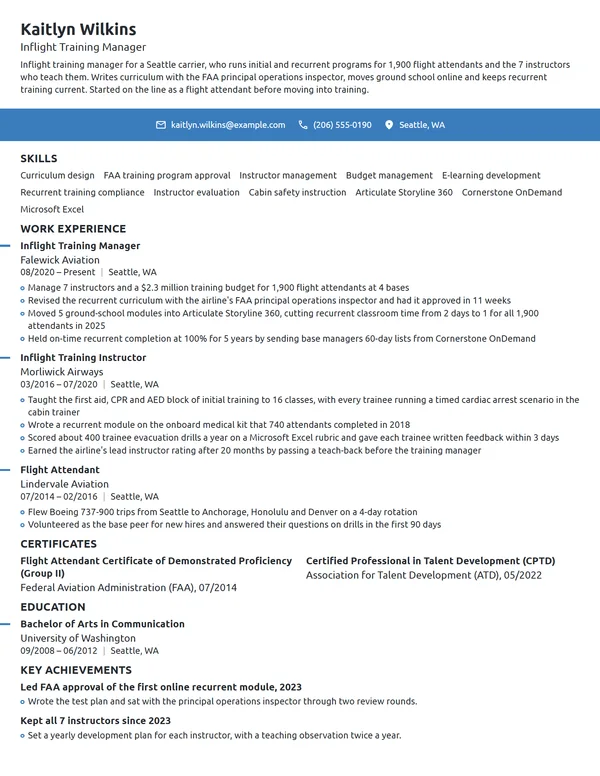
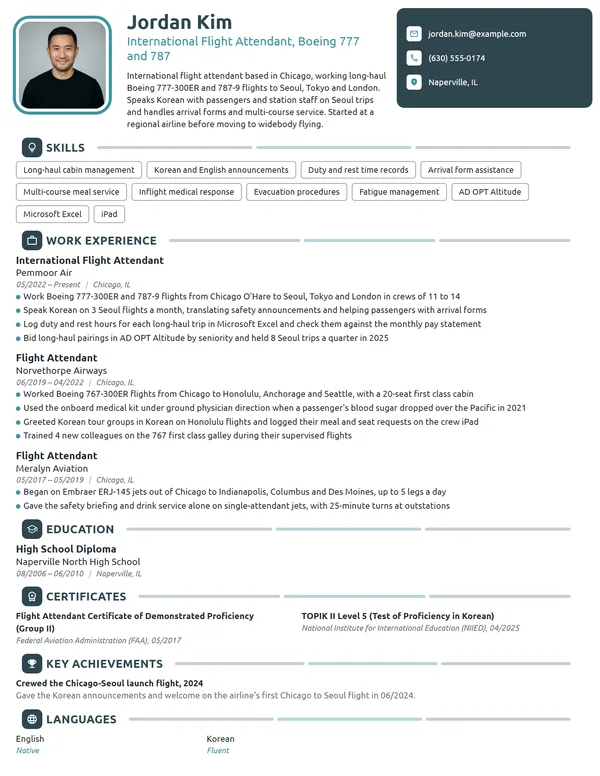
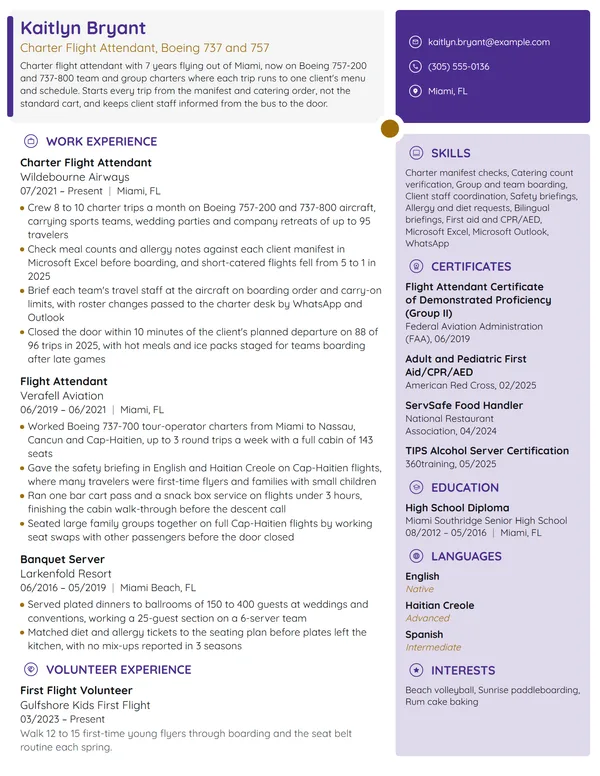
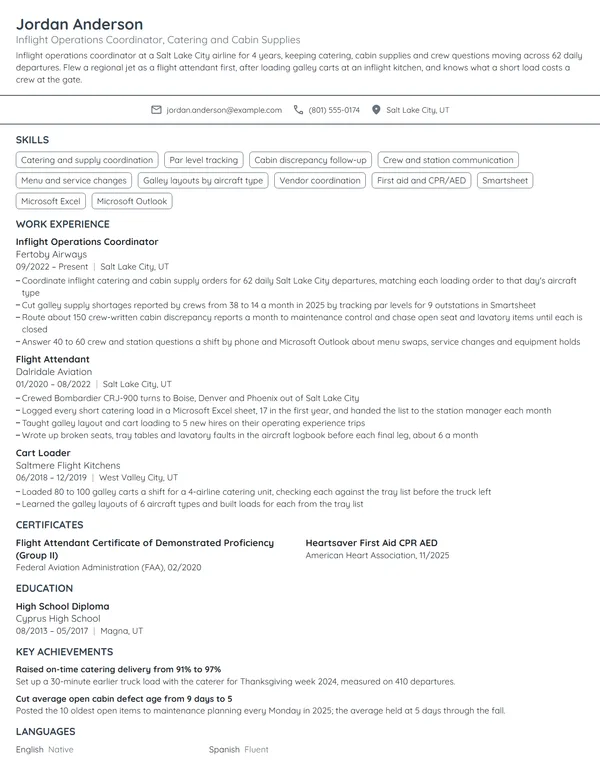
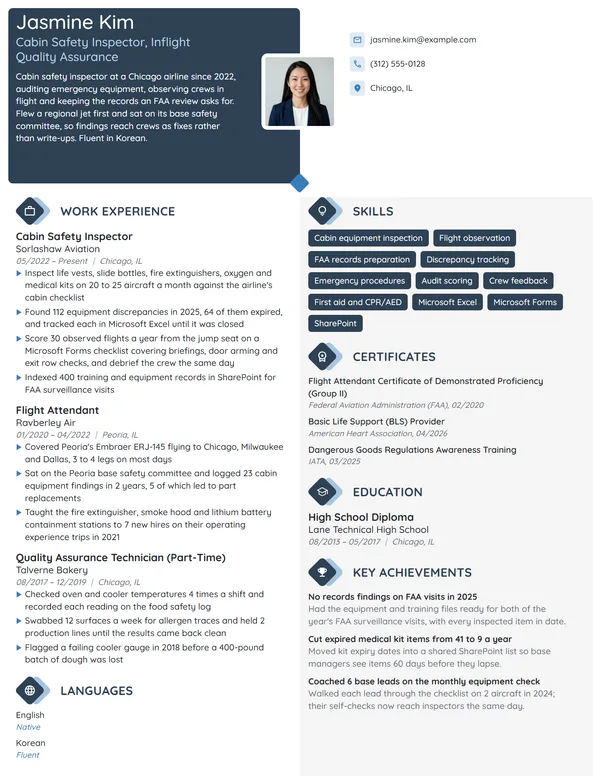
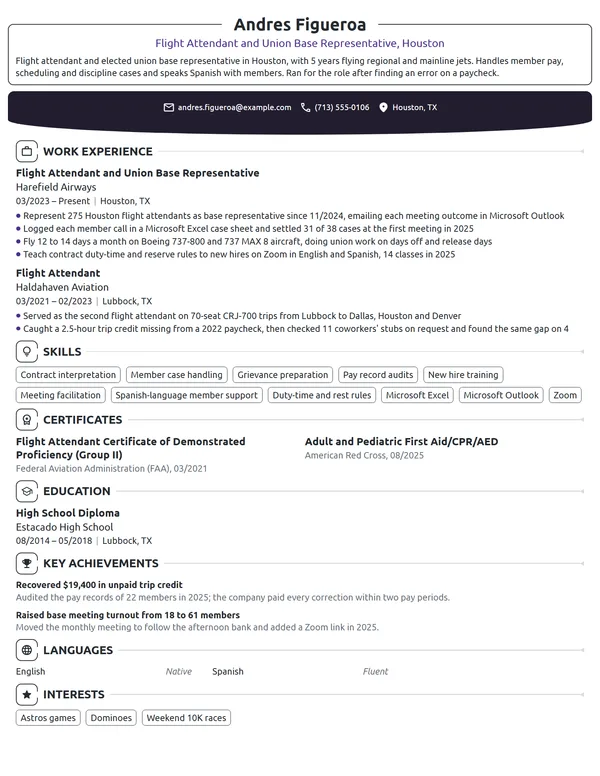
Safety first and comfort second: that is the order of a flight attendant's job, and a strong resume shows both. Airlines look for solid customer service, steady safety habits, good teamwork with a crew and the ability to stay calm when something goes wrong. Calm is the hardest to show, since a steady voice during a medical emergency leaves no trace in a job history. Counting the incidents you handled, next to flights worked and cabins served, gives it one.
How to Write a Flight Attendant Resume - Key Takeaways
- List your jobs newest first (reverse-chronological) on 1 page; save a second page for lead or purser roles with 10+ years.
- Under every airline job, name your base, the aircraft you flew and whether the routes were domestic, international or regional.
- Count what airline work produces: flights or legs, seats in the cabin, onboard sales, medical events handled and new hires mentored.
- List the FAA Certificate of Demonstrated Proficiency first under Certificates, with its date and airplane group, and only once an airline's training has earned it.
- Give each language its own level under Languages, since international routes may call for a second one.
- Keep personal details off the page and check the PDF in an ATS resume checker before an airline portal reads it.
What airline recruiters look for in a flight attendant resume
An airline recruiter reads your resume for 2 things: that you can keep a cabin safe, and that you can serve a full flight of strangers without losing your patience. The BLS lists preflight checks of emergency equipment, safety demonstrations, care for passengers with special needs, emergency medical care and evacuations among their duties. O*NET adds monitoring passenger behavior for threats to the crew and administering first aid.
Service history matters as much as flying. The BLS says flight attendants typically need 1 or 2 years of work in a service occupation, such as a restaurant, hotel, resort or sales job, so a recruiter screening first-time applicants looks there first. Build your page from these sections:
- Name, headline (such as Flight Attendant, Airbus A320 Family) and contact details
- A 2- to 3-line summary or objective under your name, without a heading
- Work Experience, with airline jobs and service jobs in date order
- Skills, covering safety, service and any software you use
- Certificates, with the FAA certificate on the first line once you hold it
- Languages, each with a level
- Education, plus Interests, Key Achievements or Volunteer Experience when space allows
Best format for a flight attendant resume
Use the reverse-chronological resume format: your latest job first, each with the title, the airline or employer, its city, and start and end dates as MM/YYYY. It works for new hires and senior crew alike, because recruiters want to see an unbroken run of service work and, later, steady time on the line. Career changers keep this order too: your earlier customer jobs are the evidence, so they should sit in plain view with their dates.
- Best for most flight attendantsReverse-chronologicalYour jobs, newest first, with your results under each one.Best for: A steady work history in your field
- FunctionalSkills grouped up top, with a short work history below.Best for: Gaps or very little experience
- CombinationA skills section first, then your full work history.Best for: A career change with strong skills
One page covers almost every flight attendant. Go to 2 pages only as a lead, purser or instructor with 10+ years, where training, base and union or committee roles need room, and keep your 2 latest jobs on page 1.
| Setting | What to use |
|---|---|
| Length | 1 page; 2 only for lead or instructor roles with 10+ years |
| Job title line | Title plus scope: Flight Attendant, Domestic and International |
| Base and aircraft | Base city and aircraft types in the opening bullet of every airline job |
| Dates | MM/YYYY start and end, with Present on the job you hold now |
| Languages | Their own section, with a level such as Native, Fluent or Conversational |
| Photo, height and personal data | Leave the photo off for US and Canadian airlines unless asked; skip birth date, height, weight and marital status |
| File | PDF with plain section headings, unless the airline's portal asks for Word |
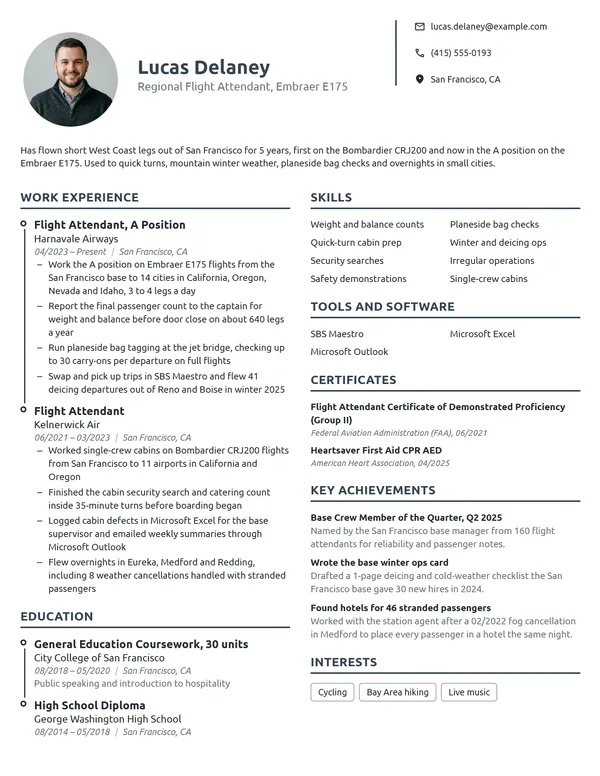
Most US and Canadian resumes carry no photo. Add one only when the airline or the job posting asks for it, and keep height and weight off the page even when a posting lists a reach or size requirement.
Flight attendant resume summary vs. objective
One question decides it: if you have flown as a certified flight attendant, write a resume summary that names your years, your aircraft or route type, one result and your languages. If you have not flown yet, write an objective: the role you want plus your strongest service evidence, the way these resume objective examples pair a goal with proof. Either way, keep it to 2 or 3 lines and borrow its figure from a bullet below.
Flight attendant resume summary formula
Title with X years at type of carrier, qualified on aircraft. One safety, service or sales win with its figure. Languages or a second credential.
Example
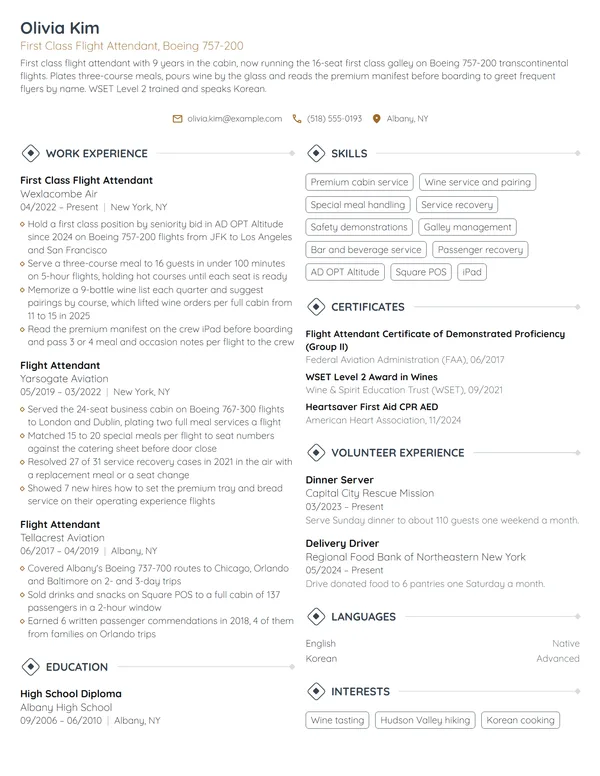
Flight attendant with 4 years at a mainline carrier, qualified on Airbus A320 family and Boeing 737-800 aircraft. Averaged $2,400 a month in onboard sales and led the cabin through 3 inflight medical events in 2025. Fluent in Spanish.
Don't
Friendly, passionate flight attendant who loves travel and making every passenger smile.
Do
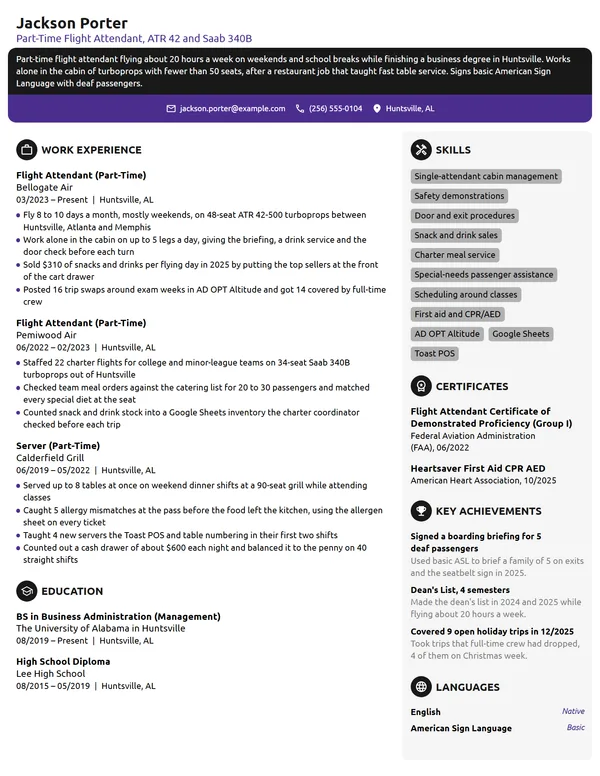
Flight attendant with 2 years at a regional carrier, working as the only crew member in the cabin on 50-seat jets. Flew 5 to 7 legs a day and passed 2 recurrent cycles with no remedial training. Conversational in Portuguese.
The second version tells a recruiter the carrier type, the aircraft size, the pace and a language.
How to write flight attendant work experience bullets with numbers
Your current job gets 3 to 4 bullets, earlier ones 1 to 3, and each opens on an action verb. Every recruiter already knows you served drinks and checked seatbelts, so write achievements on your resume instead: how many flights, how full the cabin was, what you sold, which incidents you handled and who you trained.
| Area | What to count | Example bullet |
|---|---|---|
| Flights and routes | Flights or legs a year, routes, domestic or international | Worked 210 flights in 2025 across 9 routes from a 2-gate regional base. |
| Cabin size and role | Seats, crew size, your position | Served as the only flight attendant on 50-seat regional jets, averaging 6 legs a day. |
| Onboard sales | Sales per passenger or per month, offers introduced | Raised onboard sales per passenger from $1.10 to $1.65 by offering the meal box on the first cart pass. |
| Safety and compliance | Cabin checks, findings, recurrent training | Completed every cabin compliance check with 0 findings in 3 years of company audits. |
| Passenger incidents | Medical events, disruptive passengers, diversions avoided | De-escalated 5 disruptive passenger situations in 2025 with 0 diversions. |
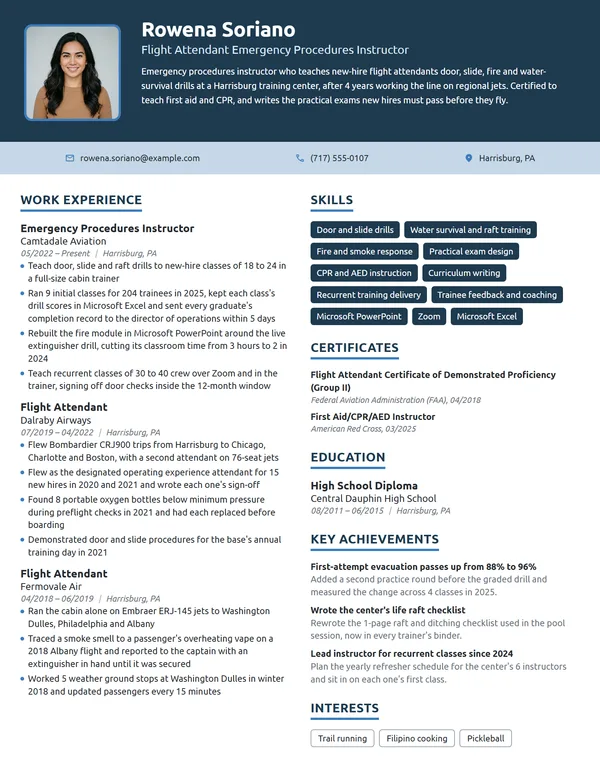
| Training and crew | New hires mentored, briefings led, crew size | Mentored 12 new hires during their operating experience flights. |
Cabin size tells a recruiter a lot. Federal rules (14 CFR 121.391) generally require 1 flight attendant on an airliner with 20 to 50 passenger seats and 2 on one with 51 to 100, so a regional attendant who worked the cabin alone should say so. New hires also work at least 5 hours of flights while a qualified supervisor watches them, which is why mentoring those flights is worth a bullet.
Work Experience
- Fly 14 to 16 trips a month from the Detroit base on domestic and Caribbean routes, on Airbus A320 family and Boeing 737-800 aircraft with up to 190 seats.
- Averaged $2,400 a month in onboard food and drink sales in 2025 by offering the premium snack box during the first service.
- Led the cabin response to 3 inflight medical events in 2025 with the captain and the airline's ground medical service; paramedics met 2 of the flights at the gate.
- Mentored 9 new hires on their supervised first flights and finished 2025 with 0 missed trips.
- Checked in up to 120 guests a shift at a 240-room hotel and handled late-night complaints without a manager on site.
- Held a guest score of 4.6 out of 5 across 2,100 surveys in 2021.
Don't
Served drinks and snacks to passengers.
Do
Ran beverage service with 2 carts for 180 passengers on a 55-minute flight, finishing before the descent call.
Time, load and equipment show you can serve a full cabin on a short leg.
Don't
Responsible for passenger safety.
Do
Briefed exit row passengers and completed compliance walks before 1,100 departures in 2025, with 0 company audit findings.
Flight attendant skills, systems and languages for your resume
Choose 6 to 8 skills from the posting that a bullet already backs up. Safety skills come first, since they are the core of every FAA-approved training program, and customer service skills follow, written as specific tasks rather than personality traits.
Hard skills for flight attendants
- Safety demonstrations and briefings
- Emergency evacuation procedures
- Cabin compliance checks
- First aid and CPR/AED
- Inflight medical response
- De-escalating disruptive passengers
- Beverage and meal service
- Onboard sales and payment devices
- Assisting passengers with disabilities
- Galley inventory control
Soft skills airlines value
- Calm under pressure
- Clear announcements
- Crew teamwork
- Conflict resolution
- Cultural awareness
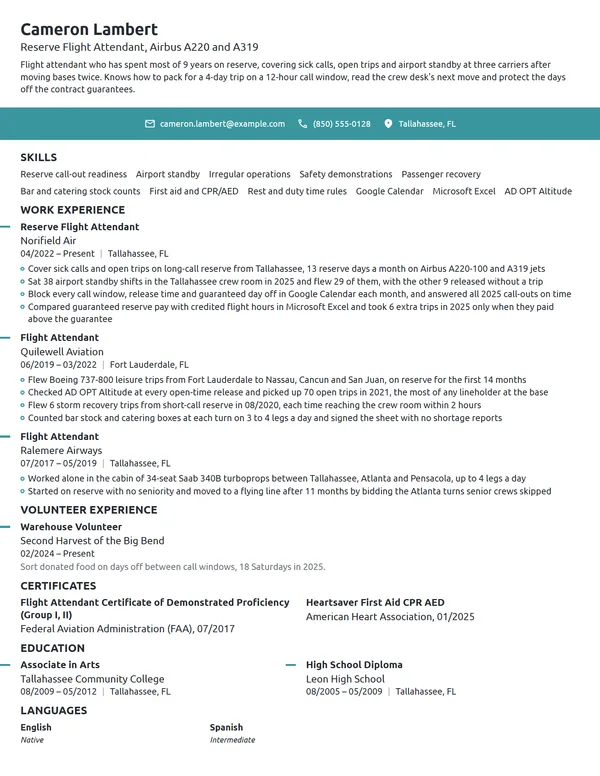
- Flexibility on reserve schedules
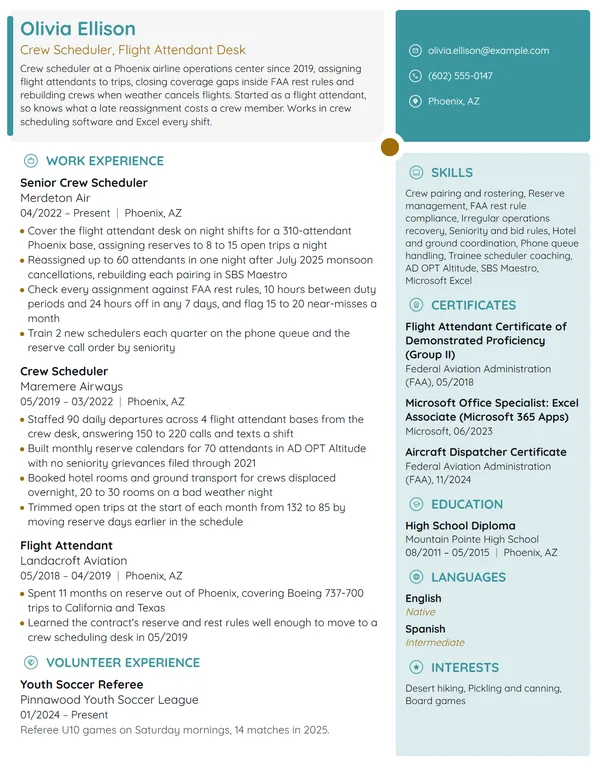
Software matters less here than on most resumes, but it still counts in a keyword search. For this job, O*NET marks Microsoft Office, Word, Excel and PowerPoint as hot technology and lists crew scheduling systems such as AD OPT Altitude and SBS International Maestro Suite. Name the bid or scheduling system and the onboard sales device you used, by the names your airline used, in a bullet as well as under Skills.
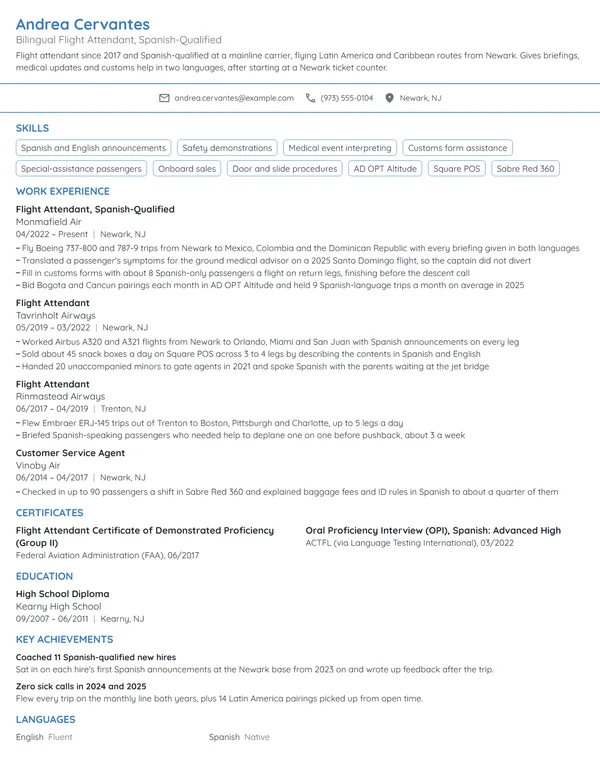
Languages deserve their own section. International flights may call for fluency in another language, per the BLS, and federal law requires every flight attendant to speak, read and write English well enough to answer passengers and write incident reports. List language skills on your resume with an honest level, such as Spanish (Fluent) or Japanese (Conversational), because an airline may test the ones you claim.
FAA certificate, CPR and first aid: how to list flight attendant credentials
Under 49 U.S.C. 44728, nobody may serve as a flight attendant on an air carrier without a Certificate of Demonstrated Proficiency from the FAA. The airline earns it for you: its director of operations tells the FAA you completed the approved training, the FAA issues the certificate, and the certificate states the airplane group it covers. List certifications on your resume under Certificates, with the FAA certificate first and any first aid or CPR cards after it.
| Credential | Issued by | What it takes |
|---|---|---|
| Certificate of Demonstrated Proficiency (flight attendant) | Federal Aviation Administration (FAA) | An airline's FAA-approved initial training, which the BLS says typically lasts several weeks to a few months. The certificate names Group I (propeller) or Group II (turbojet) aircraft. |
| Recurrent training | Your airline, under FAA rules | Completed within the preceding 12 calendar months to keep flying (14 CFR 121.433); list the latest date if a posting asks for current crew. |
| First aid, CPR and AED card | American Red Cross or American Heart Association | A classroom or blended course with a skills check, such as Red Cross Adult First Aid/CPR/AED or AHA Heartsaver CPR AED; copy the name and date from your card. |
Where the FAA certificate goes before you are hired
Leave it off. Only an airline's approved training leads to the certificate, so a first-time applicant cannot hold one, and recruiters know it. List a CPR or first aid card under Certificates instead, put a flight attendant academy course under Education, and add the FAA certificate as your first Certificates line once your airline's training class graduates.
Certificates
- Flight Attendant Certificate of Demonstrated Proficiency, Federal Aviation Administration (FAA), Airplane Group II, 05/2022
- Annual recurrent training, Skelmora Airlines, completed 03/2026
- Adult First Aid/CPR/AED, American Red Cross, 01/2026
Education for a flight attendant resume: diploma, degree or academy
The BLS names the high school diploma as the usual requirement, and some airlines prefer applicants who have taken college courses. Follow the usual rules for listing education on a resume: the credential, the school and its location, and the month you finished. A degree in hospitality, tourism or a language is worth a line of coursework; otherwise keep Education short and below Work Experience.
Some applicants attend a private flight attendant academy before they apply, which the BLS also mentions. List it as a course under Education with its dates, never as an FAA credential, because the airline's own training still comes after the job offer.
Education
4 years of Spanish, including AP Spanish Language and Culture.
Entry-level and career-change flight attendant resumes
Applying for your first airline job, use an entry-level resume layout: an objective at the top, your service jobs in date order, then the credentials and languages that show you can be trained fast. Count each job the way a cabin job would be counted.
- Restaurant, cafe or bar work: covers or tables a shift, rush periods handled, complaints settled.
- Hotel, resort or cruise jobs: guests checked in, room count, late shifts worked alone.
- Retail or call center roles: customers a day, sales targets, satisfaction scores.
- Healthcare or lifeguard experience: first aid or CPR you have actually used, listed with the card under Certificates.
- Volunteer and travel experience: events staffed, groups led or a language learned abroad, listed under Languages or Volunteer Experience.
Don't
Seeking a flight attendant position to pursue my passion for travel.
Do
Restaurant shift lead with 3 years serving up to 140 covers a night, applying for a flight attendant role. Red Cross First Aid/CPR/AED certified and fluent in Spanish.
An objective works when it carries proof: a service number, a credential and a language.
Coming from a front desk, a reception role, retail or healthcare, stay with the newest-first order and give the earlier career its numbers: visitors greeted, calls handled, appointments scheduled, problems solved without a manager. A career-change resume reads well when your first airline job sits on top with its base and aircraft, and the earlier career below it carries the service proof. Your cover letter can say why you switched in 2 or 3 sentences; these customer service cover letter examples show how to lead with a service result.
Flight Attendant resume FAQ
Do I need an FAA certificate before I apply to be a flight attendant?
No. The FAA issues the Certificate of Demonstrated Proficiency only after an airline tells it you have completed its approved training, so you earn it after the job offer. Apply with your service experience, any CPR or first aid card and your languages.
How long should a flight attendant resume be?
One page for nearly everyone, including new hires and line flight attendants with several years. A lead, purser or instructor with 10+ years can use 2 pages if training and committee work need the space.
What do I put on a flight attendant resume with no experience?
Lead with an objective, then list your service jobs with numbers: tables or guests a shift, complaints resolved, sales. Add a first aid or CPR card under Certificates and any second language with its level, since airlines train new hires but look for proven service.
Should I list languages on a flight attendant resume?
Yes, in their own Languages section with a level for each. International routes may call for a foreign language, the BLS says, so a second one can open international bases. Claim only the level you can use in a cabin announcement or a test.
Do flight attendants need a college degree?
No. The BLS gives the high school diploma as the usual requirement, though some airlines prefer applicants with college courses. If you have a degree, list it under Education; hospitality, tourism and language degrees are the most relevant.
Should I list a flight attendant academy on my resume?
Yes, under Education, as a course with the school's name and dates. Keep it apart from Certificates, because it is not the FAA certificate, which comes only from an airline's approved training after you are hired.
How do I show reserve time and seniority on a flight attendant resume?
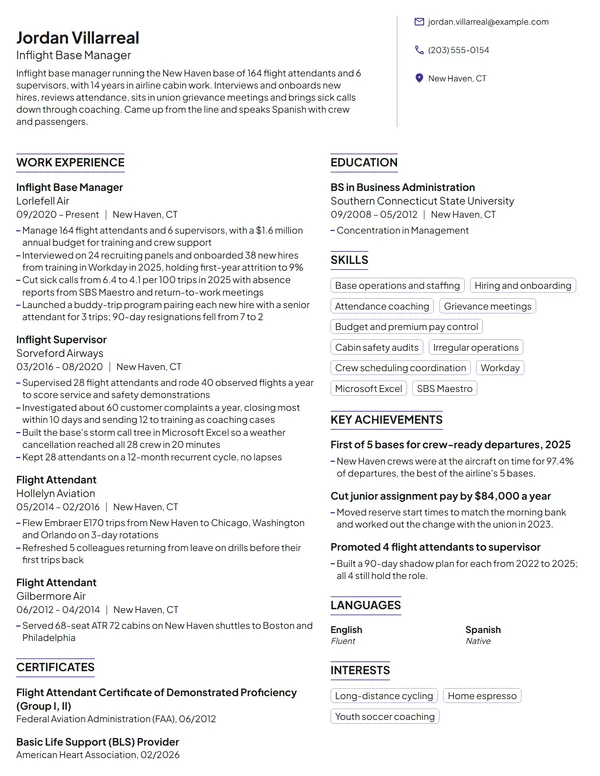
Show reserve time in a bullet, not the job title. The BLS says almost all flight attendants start on reserve and that base and routes follow seniority, so a line such as 14 months on reserve, then a line holder on international routes, tells a recruiter how you progressed.
How do I move from a regional airline to a mainline carrier on my resume?
Keep the regional job as its own Work Experience entry and make its scale clear: seats, legs a day and whether you worked the cabin alone. Then add the aircraft types and any language, purser or training duties a mainline recruiter screens for.
How much do flight attendants make?
The BLS puts the median flight attendant wage at $63,580 a year as of May 2025. Pay depends on the airline, seniority and hours flown, so leave salary off your resume and discuss it at the offer stage.
Next steps
Start from the example nearest your situation, follow its layout, and swap in your own flights, aircraft, service numbers and languages. Build it in our resume builder or pick one of the resume templates, then write the airline a short letter that opens on your best service or safety result.