
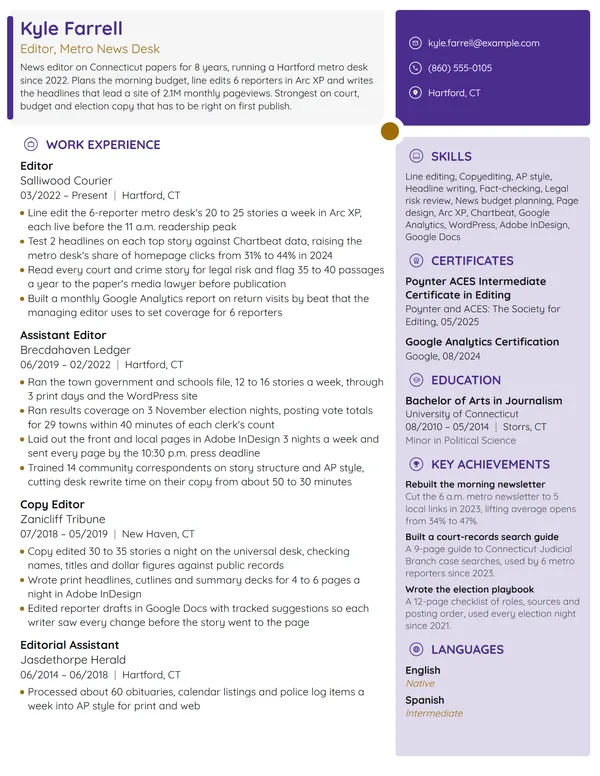
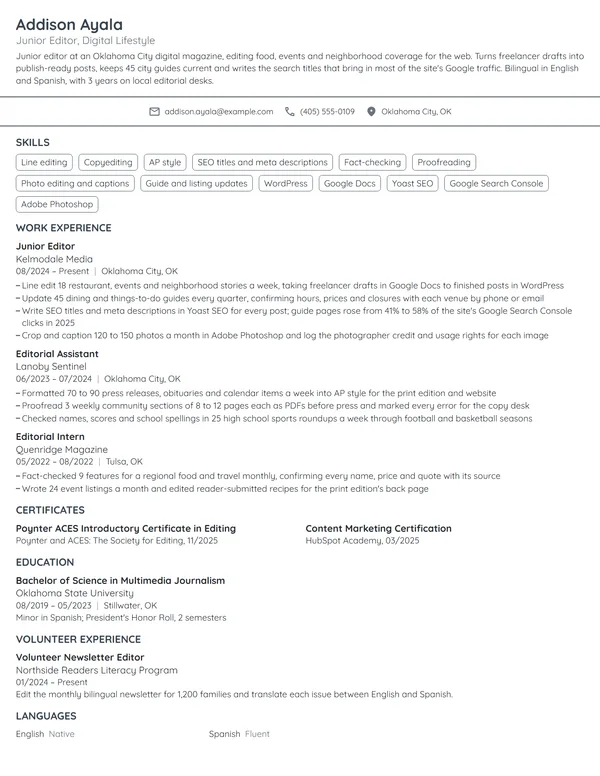
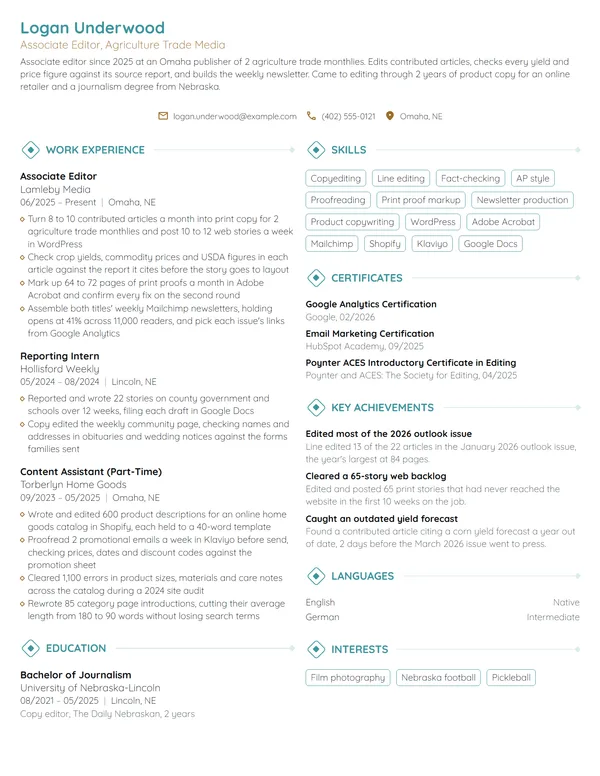
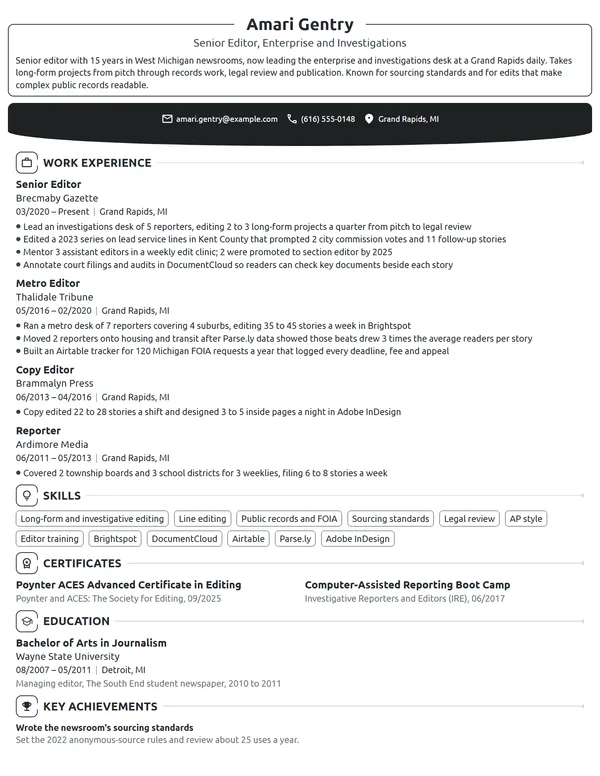
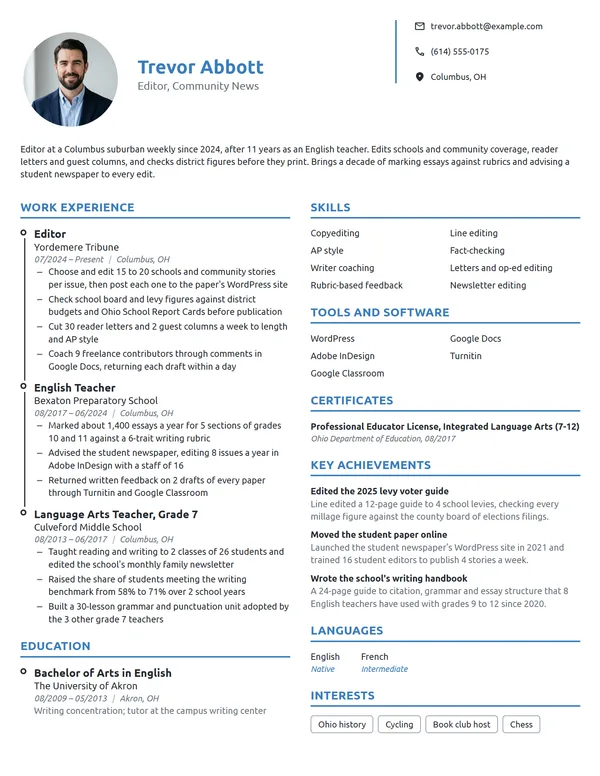
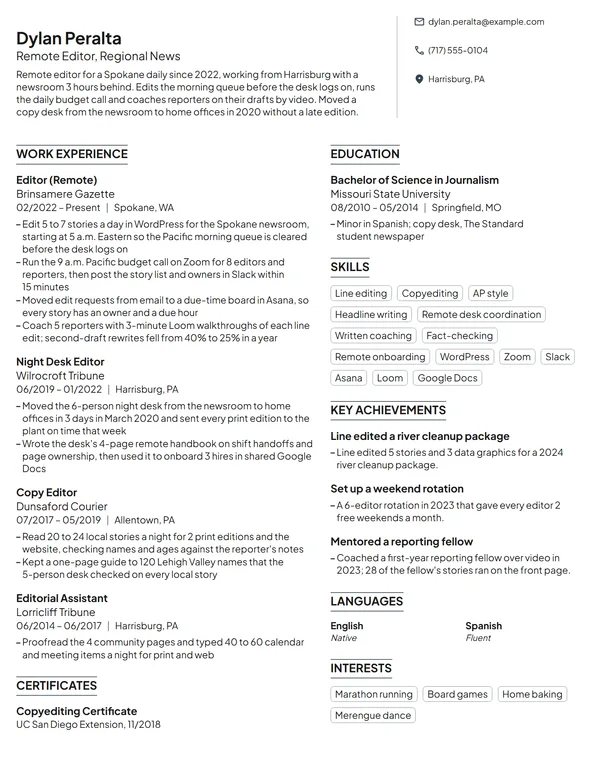
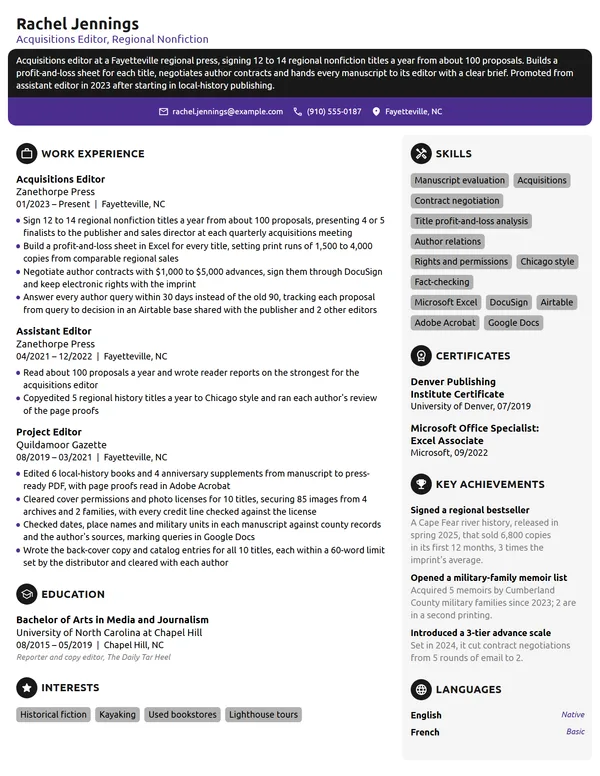
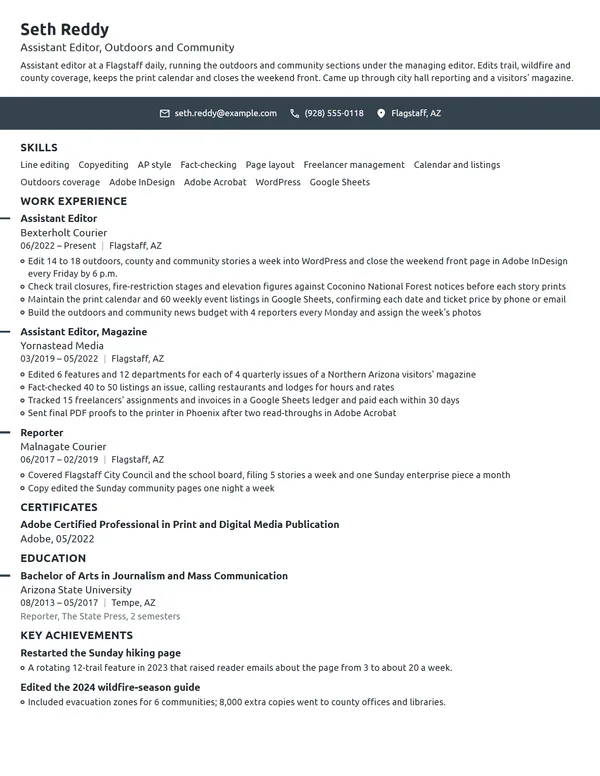
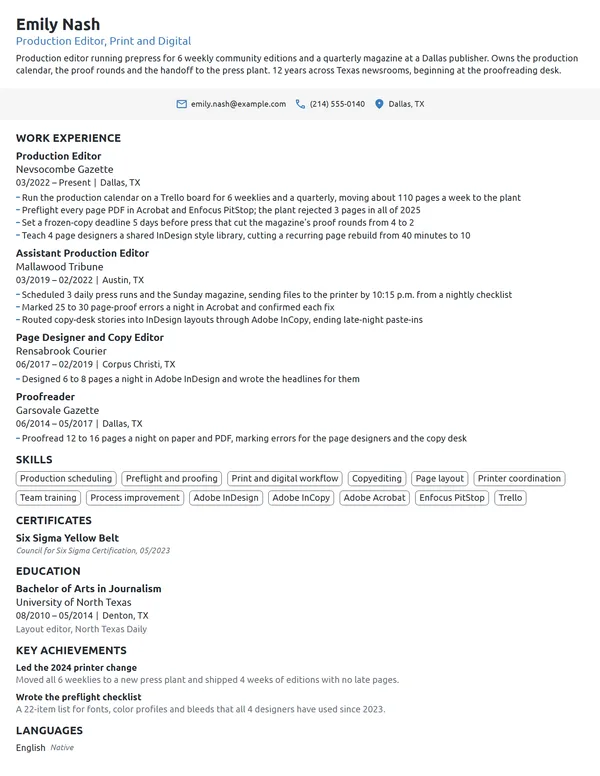
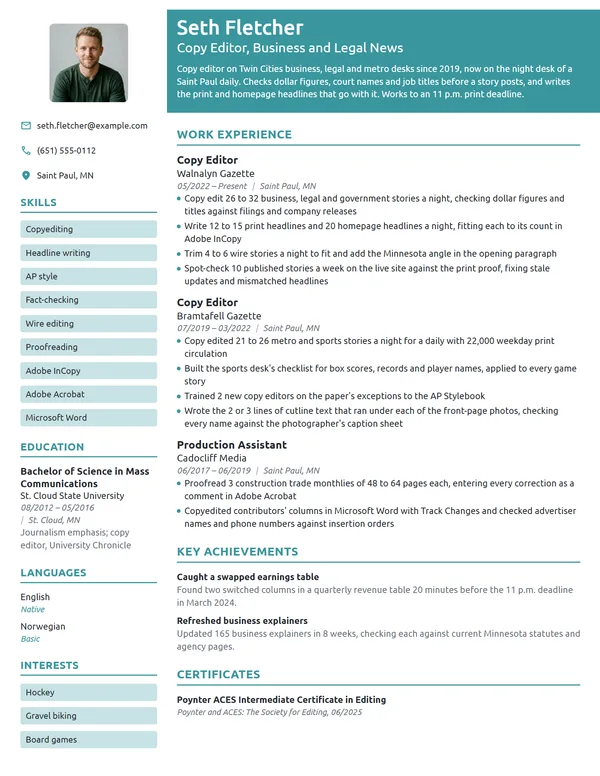
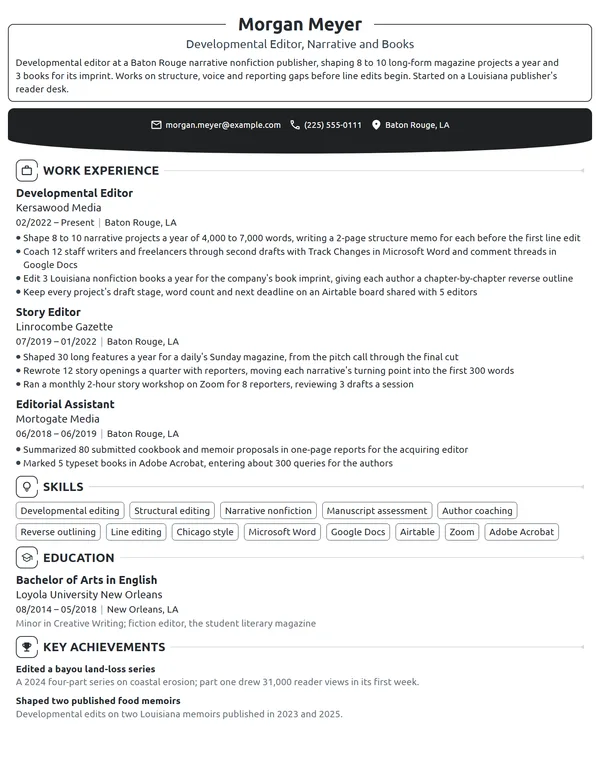
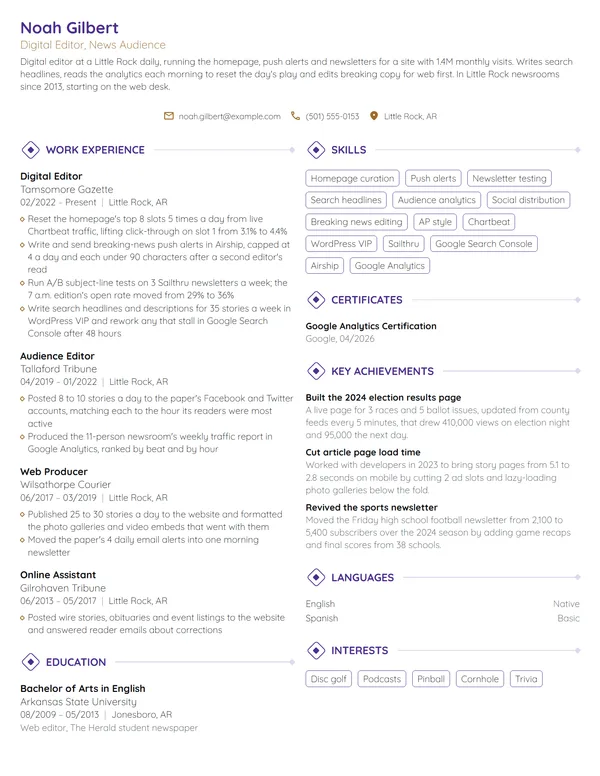
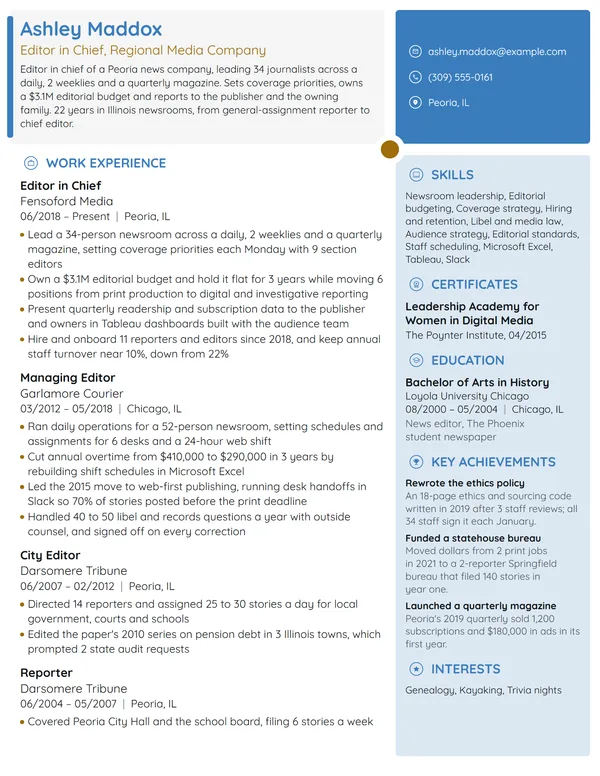
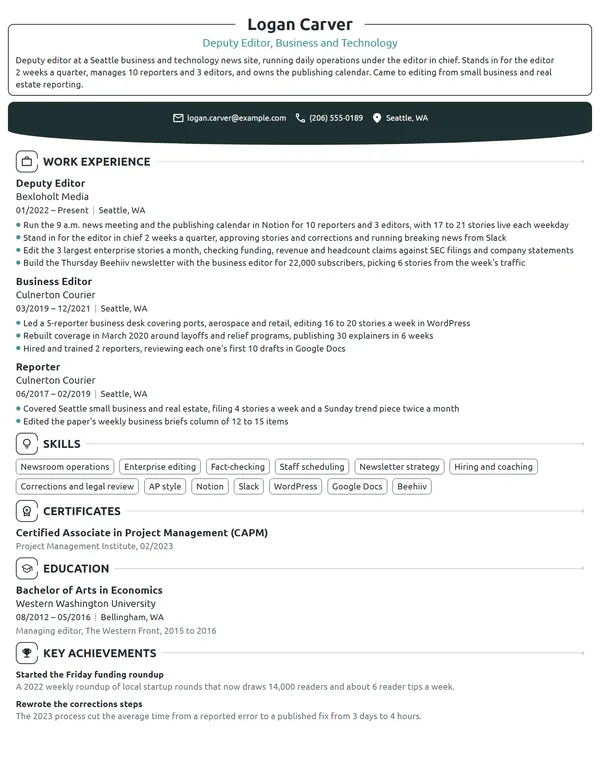
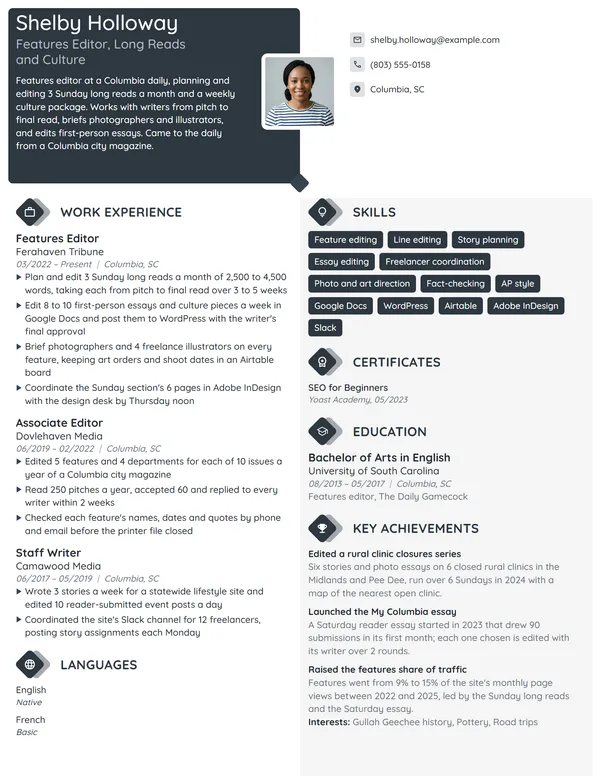
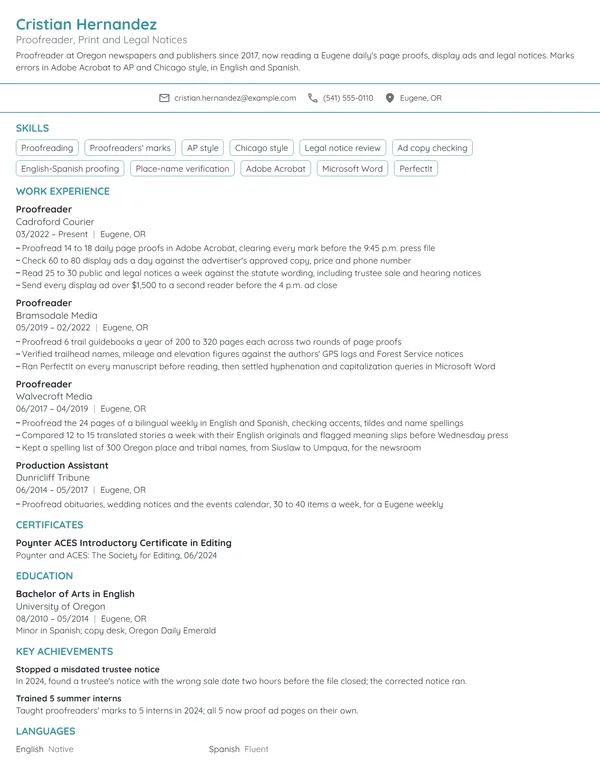
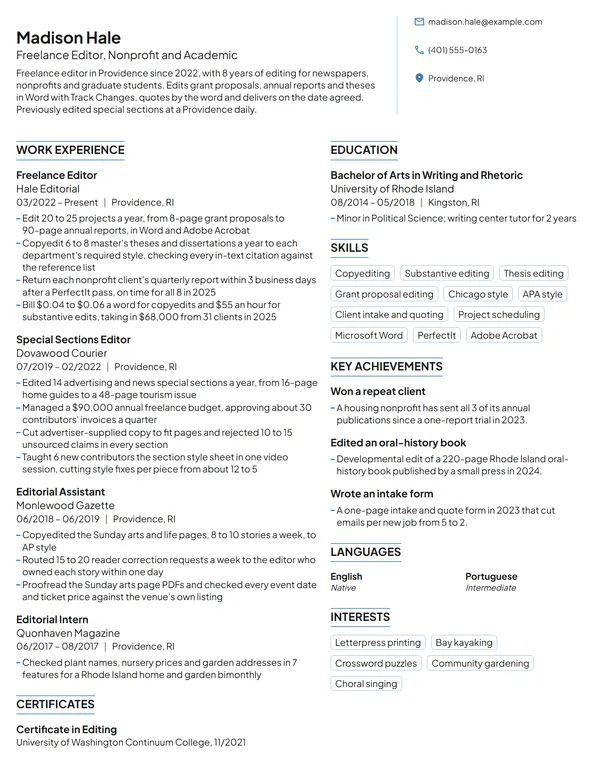
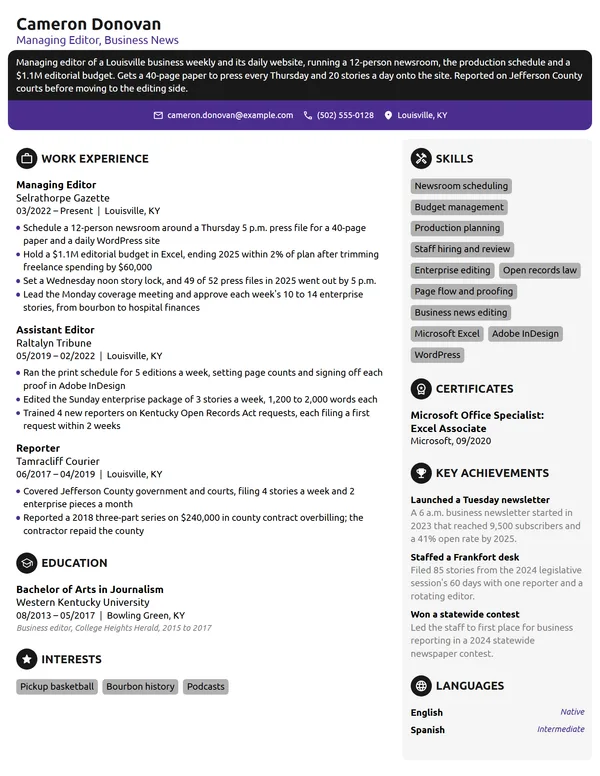
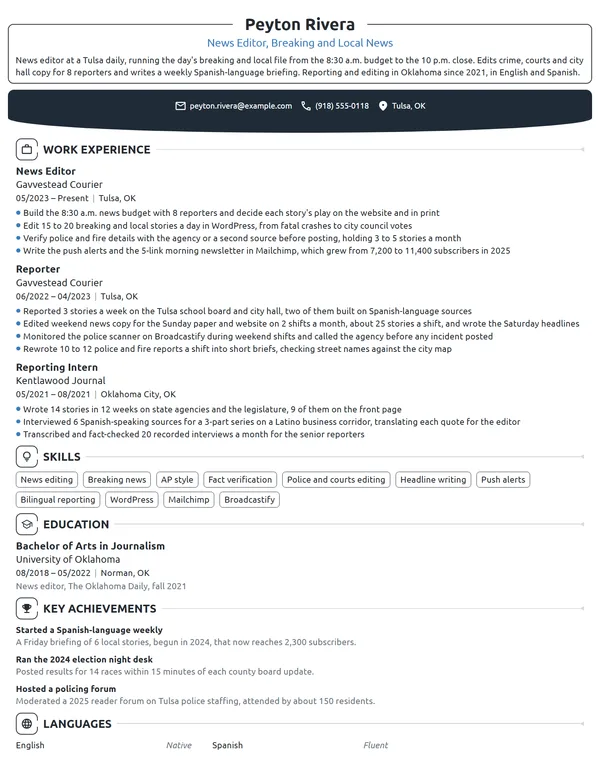
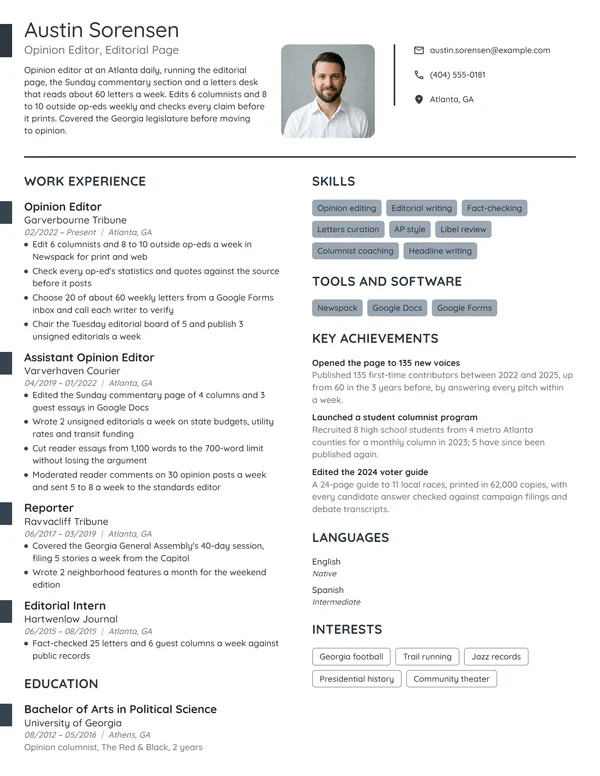
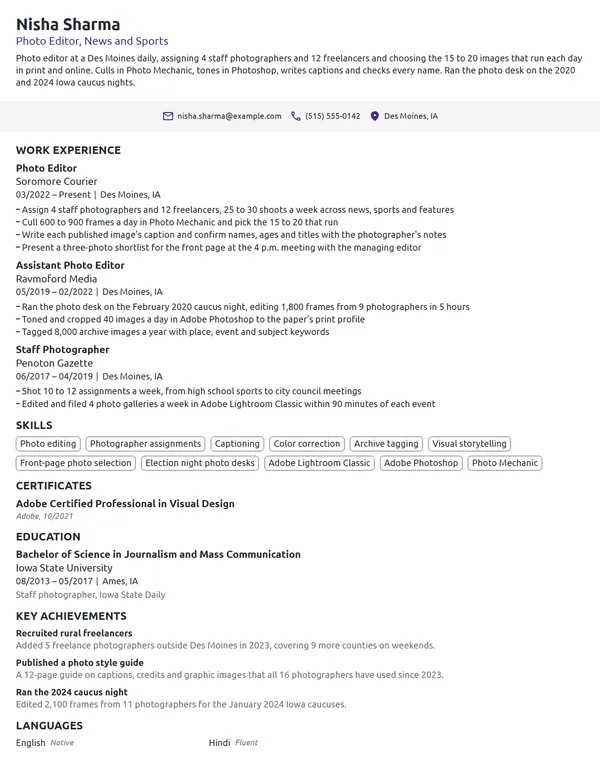
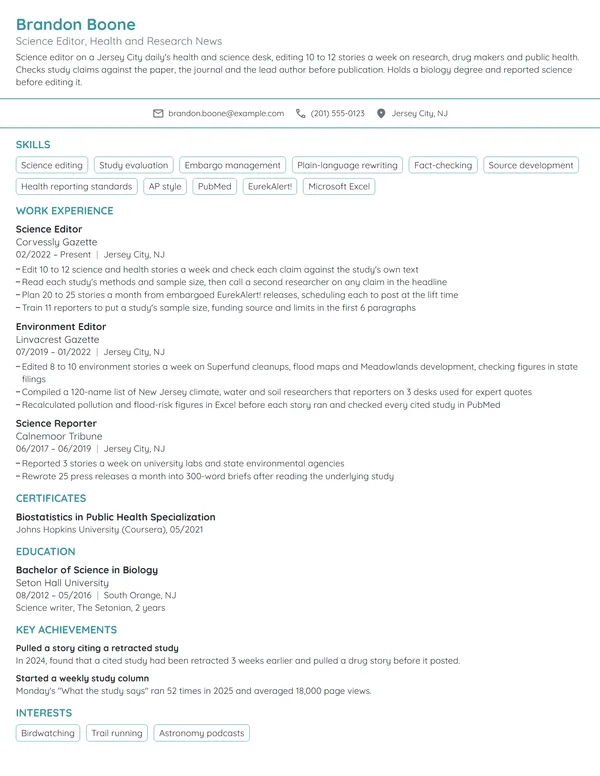
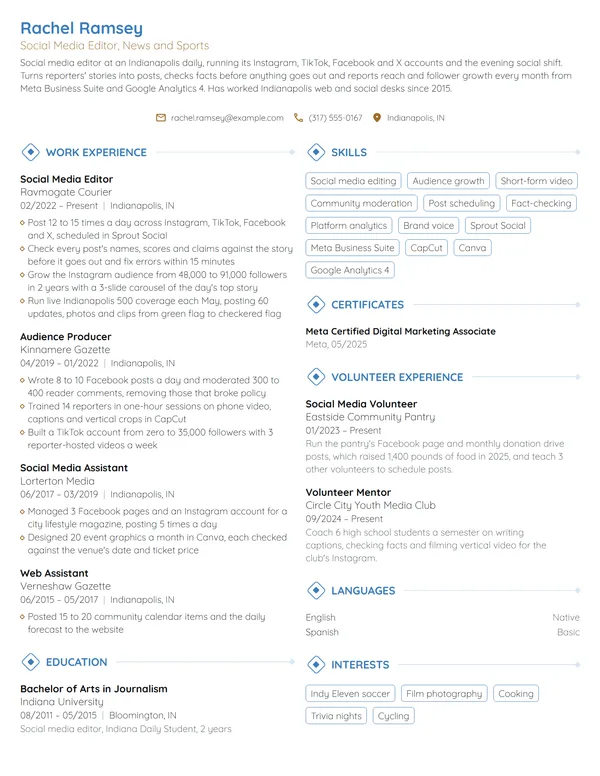
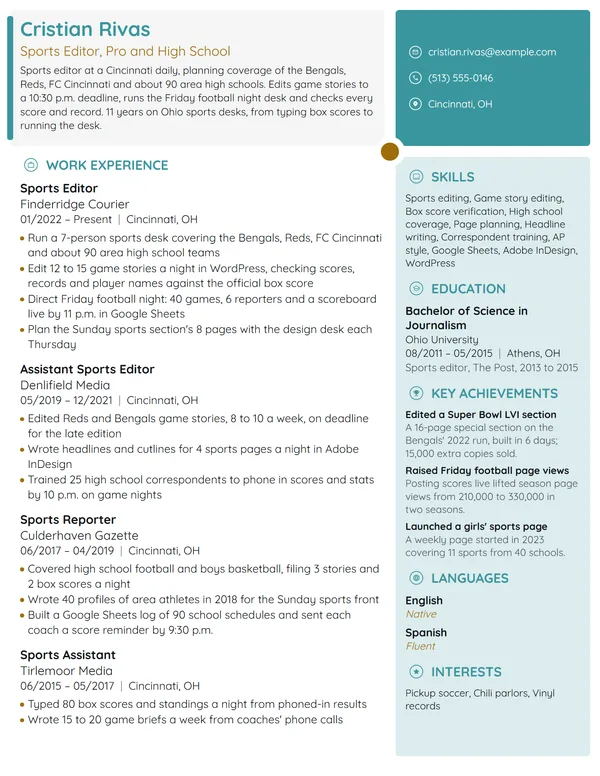
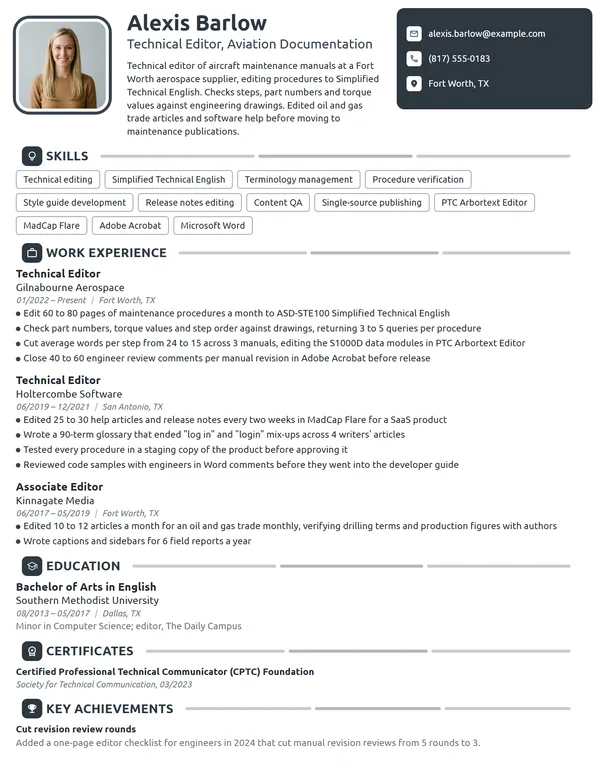
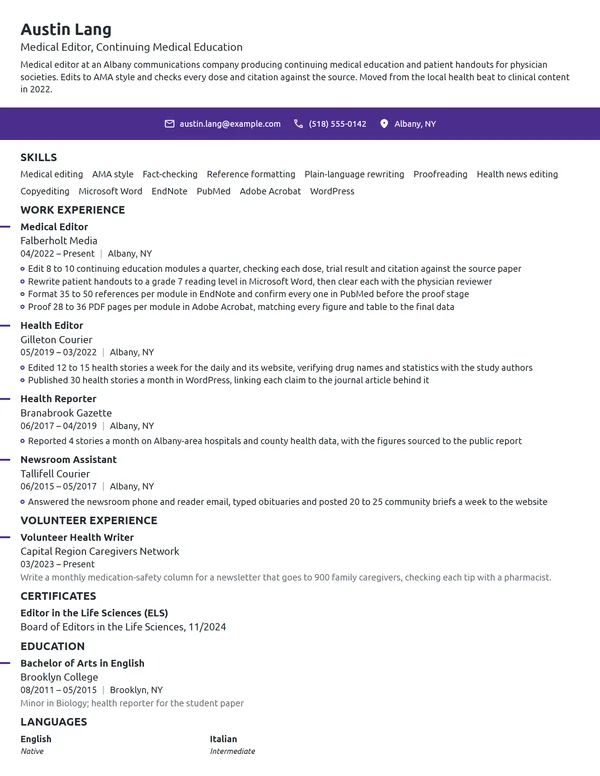
Whoever hires an editor will read the resume as closely as you read a draft. A strong one makes clear what kind of editing you do, how much you handle on deadline and which style guides and tools you work with. Results are harder, because the best edits are the ones readers never notice. Counts fill the gap: pieces edited each month, deadlines met and errors caught before publication.
How to Write an Editor Resume - Key Takeaways
- Use reverse-chronological order on 1 page; move to 2 only with 10+ years in the field or once you run a desk.
- Start with 2 to 3 summary lines: your editing type, your publication or beat, your style guide and 1 counted result.
- Give each bullet a volume and a result: stories or titles a month, words per piece, deadlines met, corrections cut or readers gained.
- List AP or Chicago style, your CMS and your markup tools under Skills, then prove each one inside a bullet.
- No license exists for editors, so an editing certificate, such as one from the Poynter ACES series, is optional proof under Certificates.
- Send clips the way the posting asks, and test the file with an ATS resume checker before you apply.
What hiring managers look for in an editor resume
A hiring editor reads your resume for 3 things: the kind of editing you do, how much copy you handle on deadline, and whether your own page is clean. The BLS lists correcting spelling, punctuation and grammar, rewriting text so readers understand it, verifying facts and approving final versions as core duties for editors. O*NET rates verifying facts, dates and statistics as the most important task of all, so show that work with its volume.
A typo costs an editor more than almost any other applicant, so proof the file twice and read it once aloud. Build it from these sections, with the headings the templates print:
- Name, a headline with your editing type (for example, Senior Editor, Features) and contact details
- 2 to 3 opening lines that sum up your editing, printed without a heading
- Work Experience, current role first
- Skills, with your style guides and software
- Certificates, if you hold an editing certificate
- Education
- Optional: Languages, Interests, Volunteer Experience or Key Achievements
Best format for an editor resume
Use the reverse-chronological resume format: newest role first, each with your title, the publication or publisher, where it was based, and MM/YYYY dates for when you began and left. Editorial careers climb through titles a reader knows, from editorial assistant to assistant, associate, senior and managing editor, and newest-first order makes each step visible. A combination format, with a skills block above your history, suits only a writer, teacher or marketer moving into editing whose best proof sits outside a job titled editor.
- Best for most editorsReverse-chronologicalYour jobs, newest first, with your results under each one.Best for: A steady work history in your field
- FunctionalSkills grouped up top, with a short work history below.Best for: Gaps or very little experience
- CombinationA skills section first, then your full work history.Best for: A career change with strong skills
Keep it to 1 page while you have under 10 years in the field. Past that, or once you run a desk or a staff, 2 pages are fine; put the roles a hiring editor will ask about in the interview on page 1.
| Setting | What to use |
|---|---|
| Length | 1 page under 10 years; 2 pages with 10+ years or once you run a desk or a staff |
| Dates | Start and end as MM/YYYY, ending the current role with Present |
| Headline | Editing type plus beat or format: Copy Editor, News Desk or Developmental Editor, Nonfiction |
| Freelance work | 1 Work Experience entry titled Freelance Editor, with client types and volumes in the bullets |
| Typeface | 1 typeface for the body at 10.5 to 12 pt, styled the same way on every line |
| Photo, birth date and other personal data | No photo for most US and Canadian employers, and no Social Security number, birth date or marital status |
| File type | PDF, or .docx when the publisher's portal asks for Word |
Most US and Canadian resumes carry no photo, so give that space to your name and headline. Make your page look like the copy you hand back: even spacing, consistent capitalization and no stray formatting.
Editor resume summary vs. objective
Write a resume summary if you have been paid to edit, on staff or freelance: 2 to 3 lines with your editing type, your format or beat, your style and a number. Write a resume objective if your editing so far is student, volunteer or side work, and name the role you want next to your best proof. Draft it after your bullets, and take its number from them.
Editor resume summary formula
Title or editing type with X years in publication type or beat, working to style guide in CMS or tool. Your strongest volume, accuracy or audience win, counted. Certificate or specialty.
Example
Editor with 9 years in magazine and book publishing, working to AP and Chicago style in WordPress. Lifted a regional bimonthly's newsletter list from 6,000 to 15,500 subscribers while keeping every print issue on its press date. Holds the Poynter ACES Advanced Certificate in Editing.
Don't
Detail-oriented editor with a passion for storytelling and a sharp eye for grammar, eager to make an impact.
Do
Copy editor with 4 years on a metro news desk, editing 25 to 30 local stories a night in AP style. Writes print and web headlines and runs the overnight homepage on weekends.
This version names the desk, the nightly volume, the style and a second skill a managing editor can schedule.
How to write editor work experience bullets with numbers
Under your current role, write 3 to 4 bullets that open with a verb and close with a result; older roles take 1 to 3. Editing rarely comes with a scoreboard, yet the work is full of numbers: pieces a week, words per manuscript, hours from filing to publish, corrections and readers. When you list work experience on a resume, add the kind of editing to each line, because copy, line and developmental editing are different jobs.
| Area | What to count | Example bullet |
|---|---|---|
| Volume | Stories, chapters or titles per week, month or year; words per piece | Edited 18 to 22 grant reports a quarter, each 6,000 to 10,000 words, for a 4-person program team. |
| Deadlines | Issues shipped on schedule, turnaround hours, filing-to-publish time | Sent 24 of 24 quarterly journal issues to the printer on schedule over 6 years. |
| Accuracy | Corrections run, fact-check items, errors caught at proof | Caught 140 factual errors across 31 manuscripts at the fact-check stage, before typesetting. |
| Audience | Pageviews, search clicks, newsletter opens, subscribers | Rewrote 300 evergreen headlines and meta descriptions, raising organic clicks to those pages 27% in 6 months. |
| Writers and budget | Writers edited, freelancers commissioned, dollars managed | Commissioned and edited 55 freelance essays a year on a $36K budget. |
| Production | Pages per issue, proof rounds, designers and vendors | Ran proofs for a 96-page quarterly with 3 designers and 1 printer. |
In this entry, each bullet says what was edited, how much of it and what changed, and the older role gets fewer lines.
Work Experience
- Edit 12 to 15 features and 30 web stories a month for a print bimonthly and its site, working with 6 staff writers and 22 freelancers.
- Cut published corrections from 14 in 2023 to 4 in 2025 by adding a second fact-check read for every story carrying a name, a figure or a quote.
- Retagged 2,800 archive articles in WordPress and rewrote 180 of their headlines, lifting search visits to the archive 38% in 9 months.
- Copyedited 11 nonfiction titles a year, 60,000 to 95,000 words each, to Chicago style in Word with Track Changes.
- Built a house style sheet of 240 entries that cut author queries per manuscript from about 90 to 55.
Don't
Edited articles for the website.
Do
Edited 40 web stories a week from 9 reporters, with a median of 2 hours from filing to publish.
This one shows the volume, the team and the speed a digital desk measures.
Don't
Responsible for working with freelance writers.
Do
Assigned and edited 70 freelance pieces a year on a $48K budget, cutting late drafts from 1 in 4 to 1 in 10 with a shared pitch calendar.
Editor skills, style guides and software for your resume
Choose 6 to 8 hard skills for your resume from the posting, picking ones your bullets prove, and let your results carry the soft skills. Name your editing type in the list, since a developmental editor and a copy editor answer different job ads.
Hard skills for editors
- Copyediting
- Line editing
- Developmental editing
- Fact-checking
- Proofreading
- AP style
- Chicago style
- Headline and SEO writing
- Editorial calendar planning
- Assigning and commissioning
Soft skills managing editors value
- Judgment on what to cut
- Diplomacy with writers
- Calm on deadline
- Consistency
- Clear written feedback
- Discretion with sources and embargoes
List your software with your skills, then use each name again inside a bullet. O*NET's in-demand list for editors covers content management systems, HTML, Adobe Photoshop and Microsoft Word, Excel, PowerPoint and Outlook, and its hot technology list adds WordPress, Adobe InDesign, Adobe Acrobat, Google Docs and Google Analytics. Copy the exact names from the job ad, and write Track Changes in Word or comments in Google Docs when markup is the job, rather than a vague Microsoft Office.
Editing certificates: what to list and where
No state licenses editors, so a certificate is optional proof rather than a requirement. List certifications on your resume under Certificates with the issuer and the month you finished, and only those that fit the posting's kind of editing. A certificate helps most when your degree is in another field or you are moving into a specialty such as science editing.
| Credential | Issued by | What it takes |
|---|---|---|
| Poynter ACES Introductory Certificate in Editing | Poynter and ACES: The Society for Editing | 6 courses and a final assessment, passed with a score of 80% or higher. |
| Poynter ACES Intermediate Certificate in Editing | Poynter and ACES: The Society for Editing | 7 courses and a final assessment, with the same 80% pass mark. |
| Poynter ACES Advanced Certificate in Editing | Poynter and ACES: The Society for Editing | 6 courses and a final assessment; the level is new as of January 2025. |
| Professional Sequence in Editing | UC Berkeley Extension | 4 required courses for 8 semester units (120 hours of instruction), completed within 3 years. |
| ELS (Editor in the Life Sciences) | Board of Editors in the Life Sciences (BELS) | Usually a 4-year degree or equivalent and at least 2 years as a manuscript editor in the life sciences, then the exam. |
Where AP and Chicago style go on an editor resume
A style guide is a skill, not a certificate: put AP style or Chicago style under Skills and name it again in the bullet where you used it. The Chicago Manual of Style is in its 18th edition, published in 2024, so add an edition only when the posting names one. A house style sheet you built belongs in a bullet, with its size or the titles it covered.
Certificates
- Poynter ACES Advanced Certificate in Editing, Poynter and ACES: The Society for Editing, 03/2026
- Professional Sequence in Editing, UC Berkeley Extension, 12/2019
How to list an English, journalism or communications degree
The BLS describes the usual route into editing as a bachelor's in English or a related field, such as communications or journalism, and adds that people from other backgrounds with strong writing skills may also find editing work. Give the degree, the school, its city and your graduation month when you list education on a resume. Add a GPA of 3.5 or better only in your first 3 years out; after that the degree line says enough.
The BLS points to high school and college newspapers, magazines, broadcast stations and publishing companies as places to gain early experience. A campus publication role belongs under Education as 1 line, or in its own Work Experience entry when it is your main editing proof.
Education
Copy chief of the student newspaper for 4 semesters.
Entry-level and career-change editor resumes
With no paid editing job yet, start from an entry-level resume layout: a short objective, Education high on the page, then every piece of editing you can count. Per the BLS, many editors start as editorial assistants, writers or reporters, so name any of those roles plainly and show the editing inside them.
- Student newspaper or literary magazine: issues edited, stories per issue and your title, under Education or Work Experience.
- Editorial or publishing internships: manuscripts read, proofs checked and pieces published.
- Freelance or volunteer editing: clients or nonprofits served and pages edited, listed under Volunteer Experience when unpaid.
- Bylines with editing duties: pieces you wrote plus the copy you edited for others.
Don't
Recent English graduate seeking an entry-level editorial position to grow my skills.
Do
English graduate who copyedited 42 issues of a campus daily as copy chief, seeking an editorial assistant role. Completed the Poynter ACES Introductory Certificate in Editing in 2026.
Even an objective carries proof: a title, a count and a credential.
Teachers, marketers, paralegals and technical writers already edit as part of the job. A career-change resume keeps your history in order while the summary names that editing: essays marked against a rubric, campaign copy approved, contracts proofed. Lead your current role with its most editing-heavy bullets, and if you are applying to a newsroom, adapt a journalist cover letter and open it with the edit you are proudest of.
Editor resume FAQ
Should an editor resume include a portfolio or clips?
Not as a section of its own. Send clips the way the posting asks, usually as links in the application form or as attached files, and pick 3 to 5 that match the job's kind of editing. On the resume, name the publications and the type of copy in your bullets so the clips confirm what the page says.
How long should an editor resume be?
1 page for most editors with under 10 years in the field. With 10+ years, or once you run a desk or a staff, 2 pages are fine, as long as the latest role and its results sit on page 1.
Do editors need a certification or license?
No. States do not license editors, and the BLS describes a 4-year degree plus writing experience as the usual path. Editing certificates, such as the Poynter ACES series or UC Berkeley Extension's Professional Sequence in Editing, add proof when your degree is in another field. Science editors can pursue the ELS credential from the Board of Editors in the Life Sciences.
Should I put AP style or Chicago style on my resume?
Yes, if you work in it. Name the style guide in Skills and repeat it in a bullet, such as copyediting books to Chicago or a news site to AP. List both only if you have used both, and put a house style you maintained in a bullet of its own.
How do I list freelance editing on a resume?
Give it 1 Work Experience entry titled Freelance Editor or Freelance Copy Editor, with your city and dates. Use the bullets for client types, project or word counts and repeat work, such as 14 manuscripts for 3 university presses. A separate entry for every client buries the volume.
How do I show what kind of editing I do?
Put it in your headline and in the opening bullet of your current role. Copy editing, line editing, developmental editing and fact-checking are different skills, and hiring editors search for the exact term. Write Developmental Editor, Nonfiction rather than plain Editor if that is the work you do.
Should editors list circulation or audience numbers?
Yes, where you are free to share them. Print circulation, monthly readers, newsletter subscribers or titles per year show a hiring editor the scale of your work. Round them, use figures your employer has made public, and never inflate them.
Can I become an editor without an English or journalism degree?
Yes. The BLS lists English, communications and journalism as the usual degree fields for editors, but people from other backgrounds with strong writing skills may also find work, and subject editors often bring knowledge of their field. Put your editing volume and any certificate high on the page.
Should I include salary expectations on an editor resume?
No. Keep pay for the application form or the interview. As a benchmark, the BLS puts the median annual pay of editors at $77,920 in May 2025; offers vary with the publication, its location and your editing specialty.
Next steps
Choose the example closest to your editing type and level, copy its layout, and swap in your own volumes, deadlines and corrections. Build yours in the Novoresume resume builder or pick a resume template as a base, then read every line once more before you send it with your clips.