
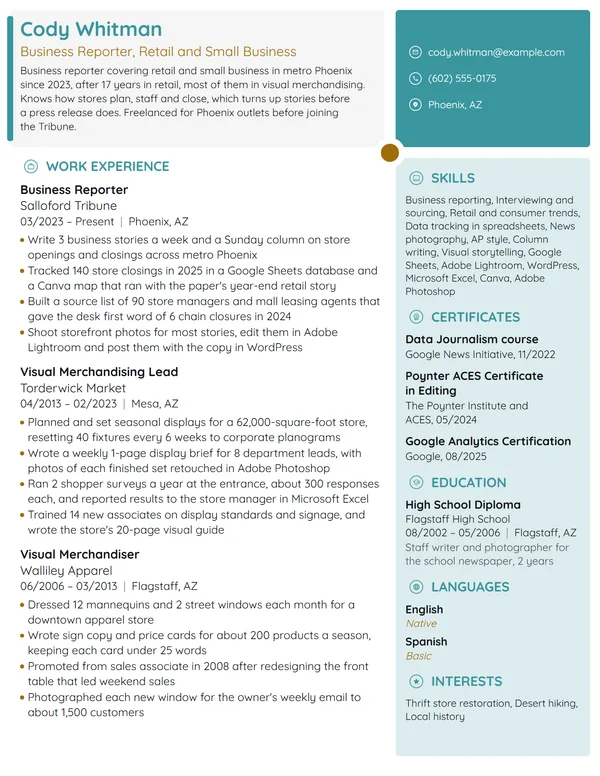
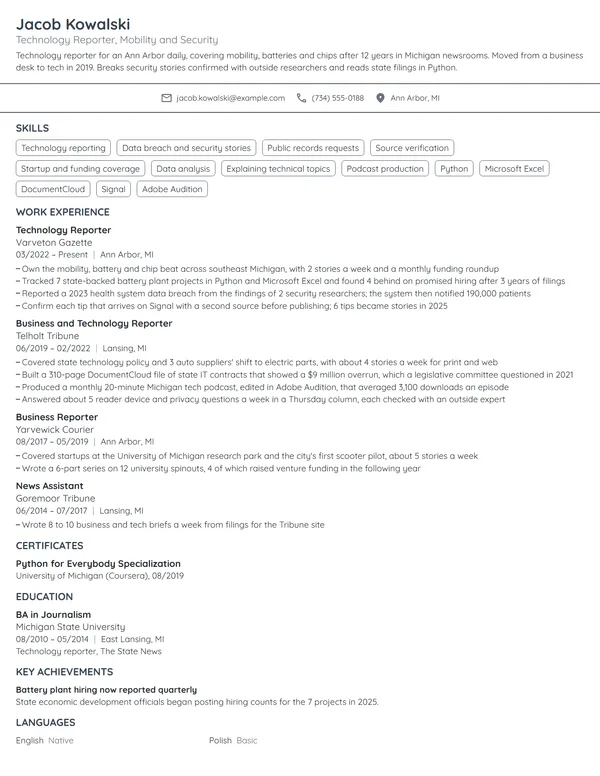
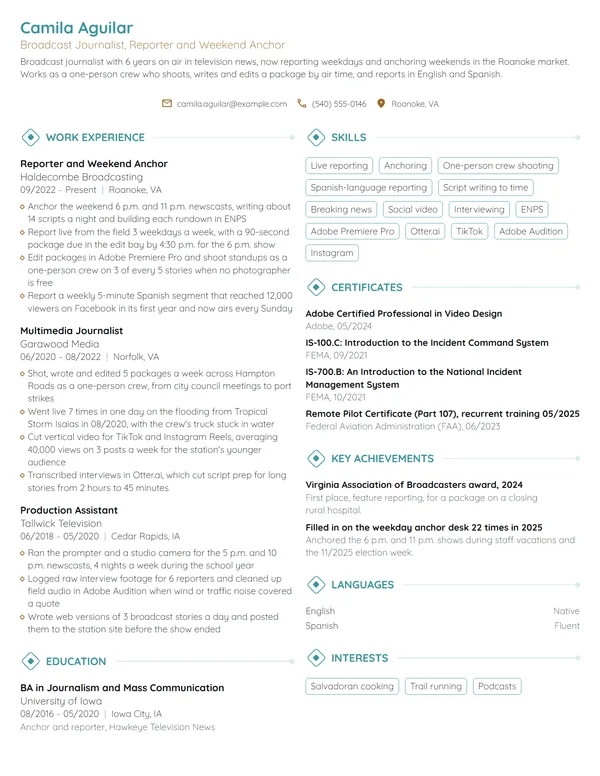
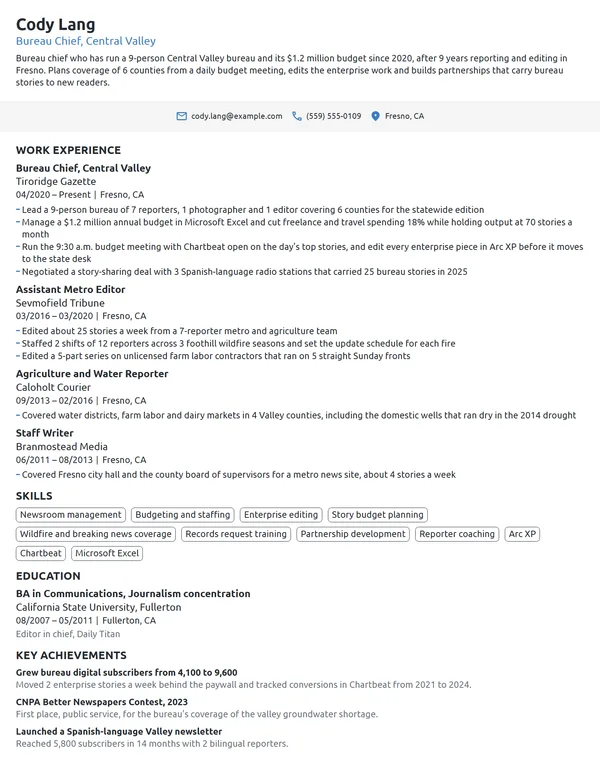
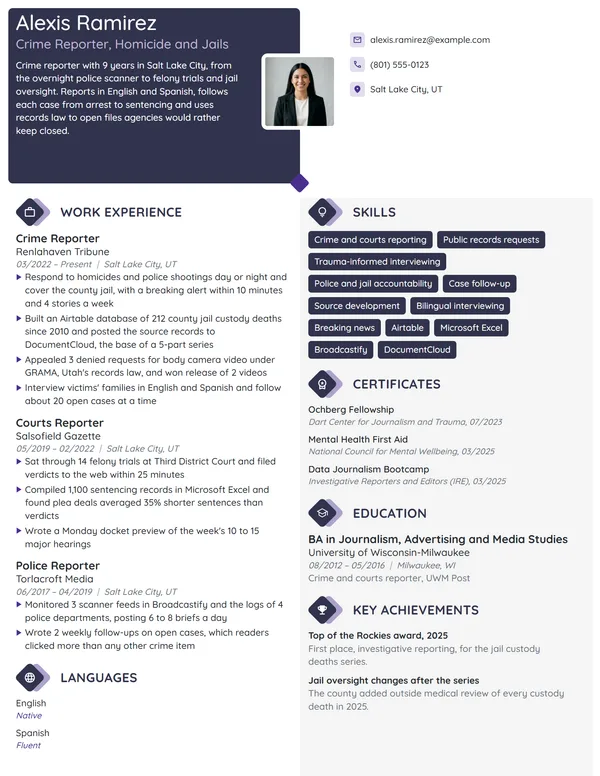
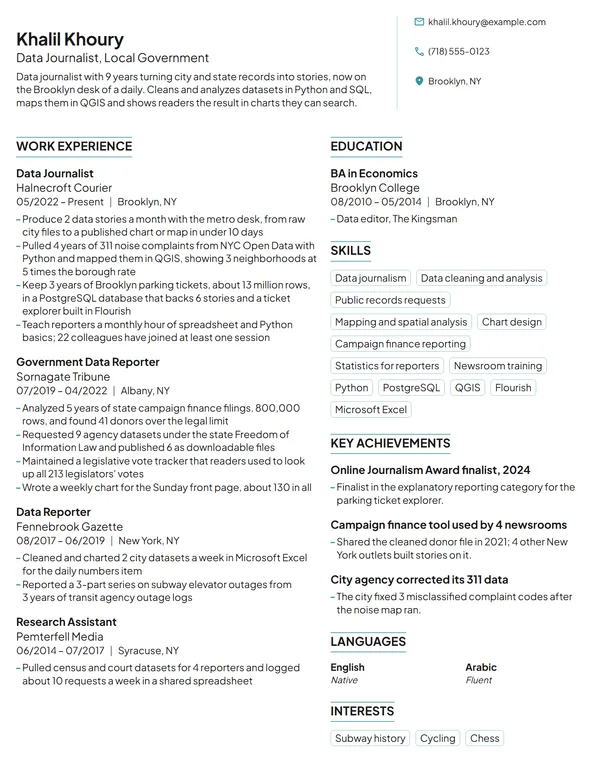
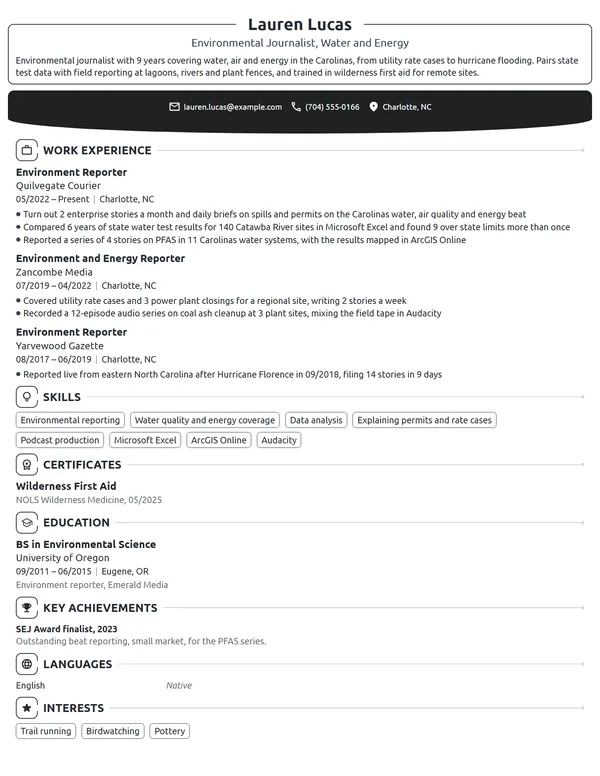
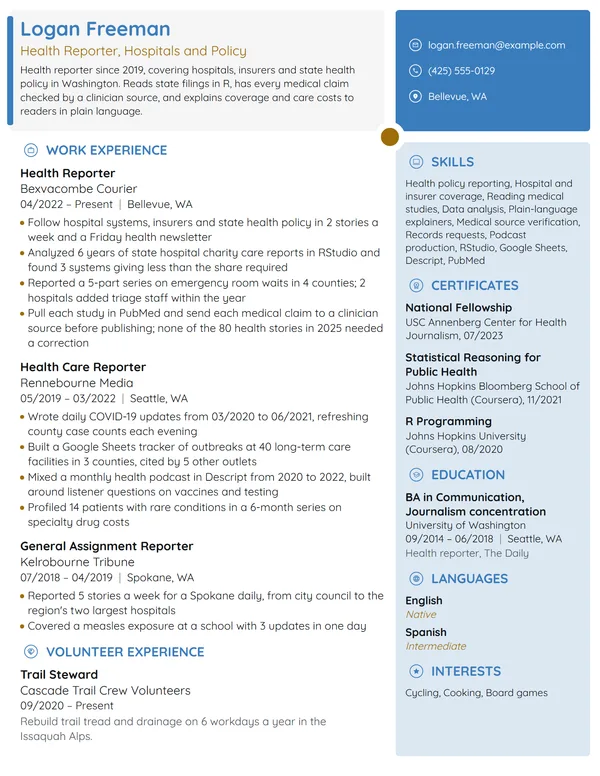
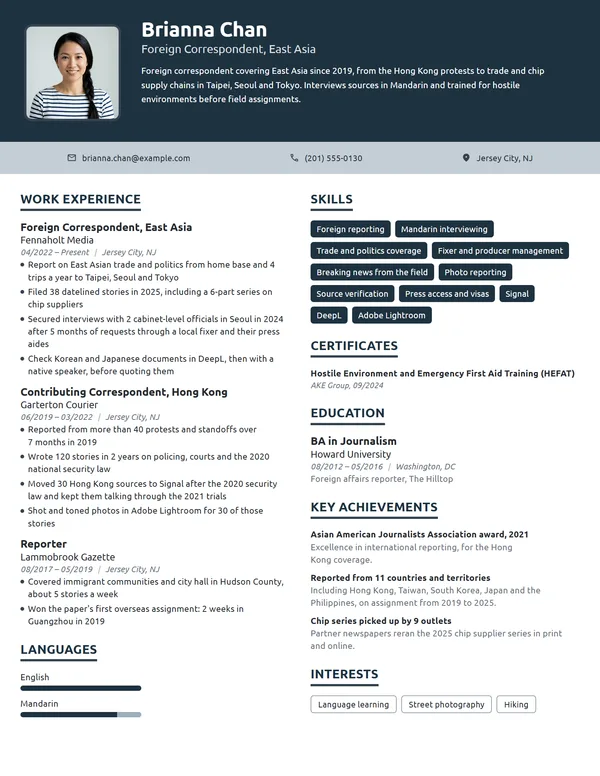
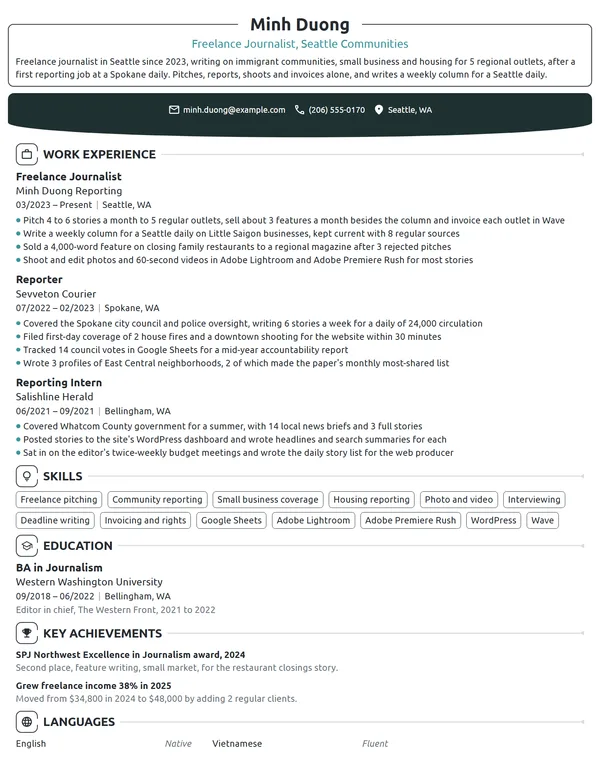
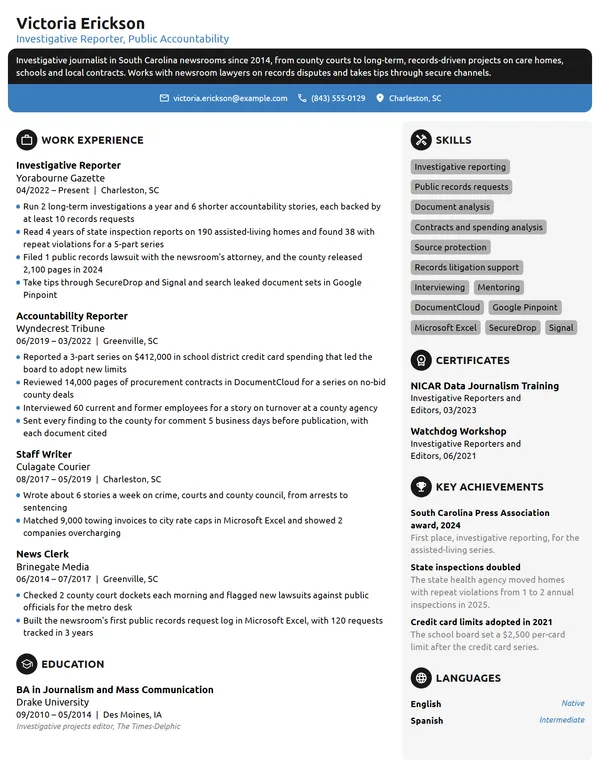
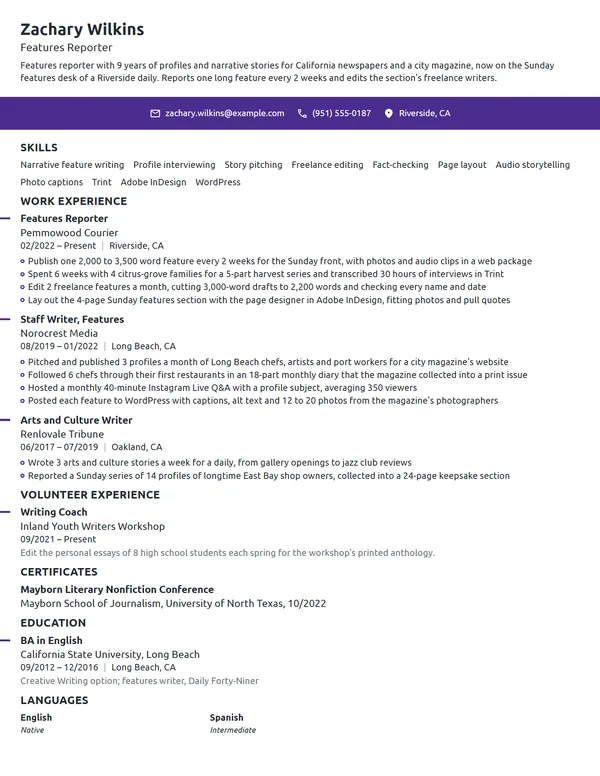
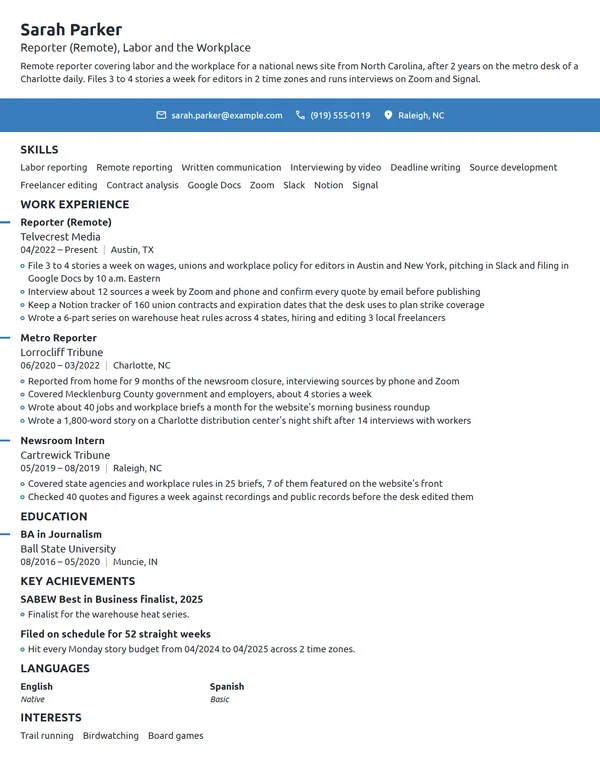
Journalism asks you to get the story first and get it right, and a newsroom editor hires with both in mind. The questions are practical: what you covered, how often you filed, whether you can shoot and edit as well as write, and which of your stories made readers or officials act. Your clips carry the writing itself. Around them, the resume gives the record in dates, outlets and counts.
How to Write a Journalist Resume - Key Takeaways
- Run your jobs from the latest back on 1 page, and move to 2 only after about 10 years or several beats.
- Name the beat in each job's title or first bullet, along with the outlet type and how often you filed.
- Give bullets newsroom numbers: stories a week, records requests, series, audience growth and what changed after a story ran.
- List your CMS, editing and data tools by the names the posting uses, in Skills and in the bullet that shows each one in use.
- Send clips and a reel through the application and the cover letter, and name the same stories in your bullets.
- Test the PDF with an ATS resume checker before you upload it to a newsroom's job portal.
What editors look for in a journalist resume
An editor or news director hiring a reporter wants to know 4 things: what you cover, how much you file, which formats you can produce and whether your reporting holds up. The BLS lists researching assigned topics, developing contacts who provide tips and leads, interviewing sources and reviewing stories for accuracy, style and grammar as core duties. O*NET adds keeping relationships with credible sources and reporting on specialized fields such as politics, medicine or sports. Show that work in each job with a beat, a pace and a result.
A newsroom resume uses the same plain headings as any other, so hiring software can parse every part of it:
- Name, headline (for example, Reporter, Health and Science) and contact details
- An untitled opener of 2 to 3 lines under your name
- Work Experience, with the beat in each title or first bullet
- Skills, including your CMS, editing and data tools
- Certificates, such as a Part 107 drone certificate or newsroom training
- Education, with any campus newsroom work
- Optional: Key Achievements for reporting awards, Languages if you interview in a second language, or Volunteer Experience
Best format for a journalist resume
Use the reverse-chronological resume format: the newest job on top, each with its title and beat, the outlet with its city, plus start and finish months. Reporting careers are read as a path through beats and markets, from a weekly or small daily to a metro desk or a specialty beat, and newest-first order makes that path easy to follow. Group freelance work under 1 entry with its overall dates rather than listing every outlet as a separate job.
- Best for most journalistsReverse-chronologicalYour jobs, newest first, with your results under each one.Best for: A steady work history in your field
- FunctionalSkills grouped up top, with a short work history below.Best for: Gaps or very little experience
- CombinationA skills section first, then your full work history.Best for: A career change with strong skills
Keep it to 1 page until you have about 10 years of reporting. After that, 2 pages fit, provided your current beat and best stories sit on page 1. Your clips make the case for your writing, so the resume never needs to quote it.
| Setting | What to use |
|---|---|
| Length | 1 page, or 2 after about 10 years in newsrooms |
| Dates | Month and year as MM/YYYY; Present for the newsroom you work in now |
| Job title line | Title plus beat: Reporter, Courts and Public Safety |
| Clips and reel | Linked in the application form and cover letter; the same stories named in your bullets |
| Type | 1 readable font throughout, with body text no smaller than 10 pt |
| Headshot and private data | No headshot for most US and Canadian newsroom jobs, and nothing about your age, family status or SSN |
| File type | PDF, unless the newsroom's job portal asks for a Word file |
Most US and Canadian resumes carry no photo. Editors judge reporters on published work rather than looks, and on-air reporters show how they come across on camera through their reel.
Journalist resume summary vs. objective
Write a resume summary if you have reported for pay: your title, your years, your beat and the type of outlet, plus 1 story or figure that proves it. Write a resume objective instead if you are a student, a new graduate or changing careers: the role you want and the bylines, internship or freelance work behind it. Either way, an editor should know your beat by the end of the first line.
Journalist resume summary formula
Title with X years covering beat for outlet type. Your strongest story, with what it changed. The formats or tools you report in.
Example
Health reporter with 8 years in local news, the last 4 covering hospitals and public health for a Midwest daily and its website. Reported a 7-part series on rural ambulance gaps that led 2 counties to fund new contracts. Writes, shoots and edits video for web and social.
Don't
Passionate journalist with strong writing skills and a nose for news, eager to tell stories that matter.
Do
Courts reporter with 5 years at a regional daily, filing about 10 stories a week from 2 county courthouses. Broke the story of a sheriff's office overtime audit that led to 2 resignations.
Beat, pace and a story with a consequence, in 2 sentences.
How to write journalist work experience bullets with numbers
Your current job takes 3 to 4 bullets; each older one, 1 to 3. Start with your beat and your pace, since an editor reads every later number against them, then choose stories with a result: a policy changed, an official answered, a record released, a readership gain. The usual advice on writing achievements on a resume holds in a newsroom too: say what happened because of your reporting.
| Area | What to count | Example bullet |
|---|---|---|
| Output | Stories a week, beats covered, print and web formats | Filed 12 to 15 stories a week for print and web on the county government beat. |
| Breaking news | Time to first post, updates, overnight or weekend shifts | Posted the first web update within 20 minutes of 3 tornado warnings and updated each story 9 times overnight. |
| Enterprise and investigations | Months of reporting, records requests, series parts, follow-up action | Spent 5 months on records requests for a 4-part series on utility shutoffs that a state audit later cited. |
| Audience | Newsletter subscribers, time on page, social referrals | Raised average time on page for the education beat from 1:10 to 2:05 by adding explainer boxes. |
| Multimedia | Videos, photos, podcasts or graphics a week | Shot and edited 2 to 3 short videos a week for the site and its social accounts. |
| Accuracy | Stories fact-checked, corrections, sources verified | Ran a line-by-line fact check on 60+ long-form stories before publication. |
Here is how 2 jobs read once the counts are in. The current job opens with the beat and pace, then adds a growth figure and a records story; the older job keeps 1 line.
Work Experience
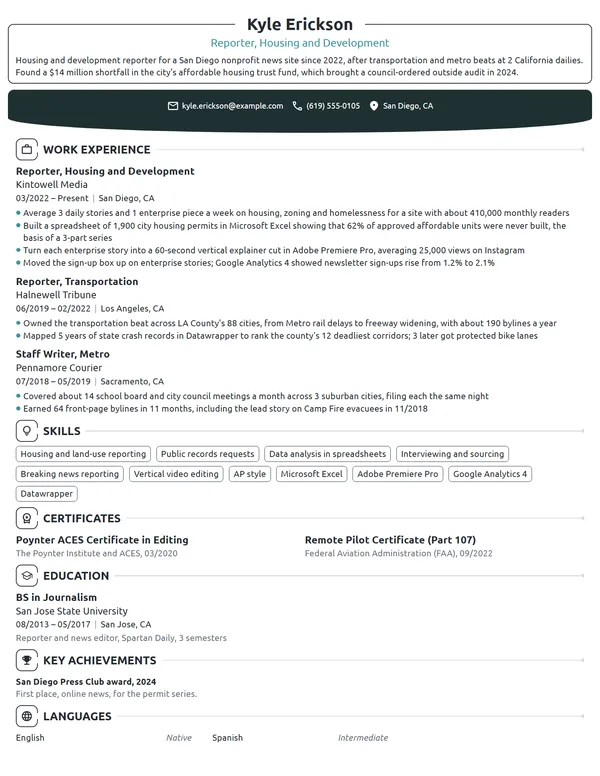
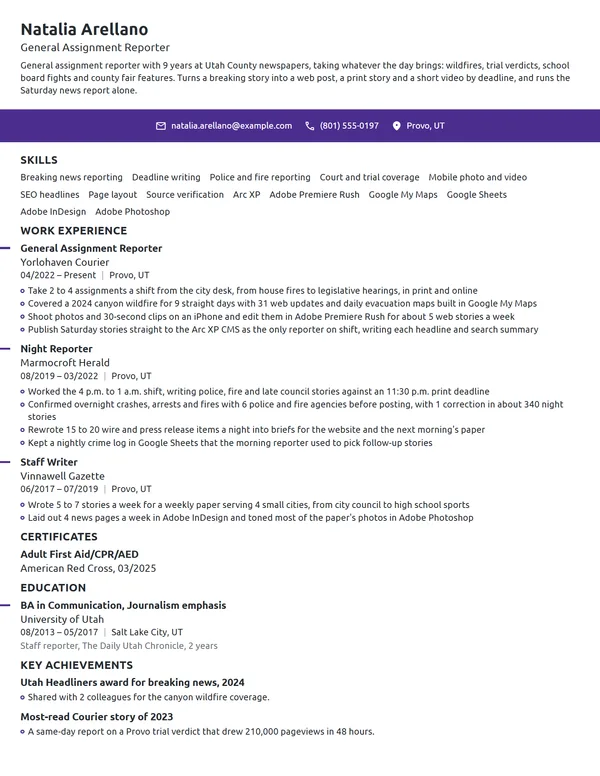
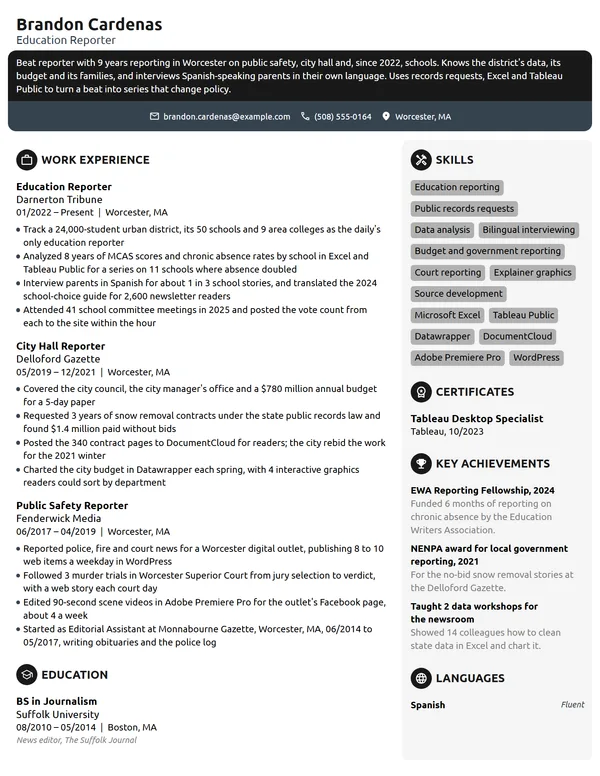
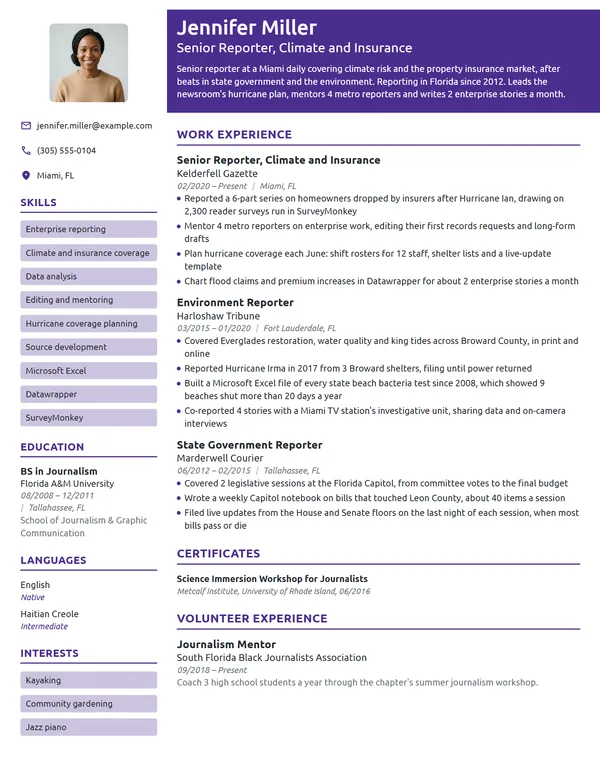
- Cover 4 hospitals and the county health department for a 6-day print daily and its website, filing 4 to 5 stories a week.
- Grew the weekly health newsletter from 2,300 to 9,100 subscribers in 18 months by adding a reader questions column.
- Obtained 14 years of hospital inspection reports through records requests and built a searchable database the newsroom updates each quarter.
- Filed about 220 stories a year on courts, weather, schools and city council for a 3-reporter metro desk.
Don't
Wrote articles on various topics for the newspaper.
Do
Wrote 6 to 8 stories a week on schools and city hall, with 3 front-page pieces in a typical month.
Now the beats, the pace and how often the work led the paper are all on the line.
Don't
Responsible for social media posting.
Do
Posted every breaking story to the paper's Facebook and Instagram accounts within 15 minutes and grew Facebook referrals to the site by 40% in a year.
Journalism skills and newsroom software for your resume
Pick 6 to 8 hard skills for your resume from the posting, then check that a bullet proves each one. Interviewing, sourcing and AP style fit nearly any reporting resume; data analysis, video shooting or Spanish-language reporting only when your work shows them.
Hard skills for journalists
- News writing and AP style
- Interviewing and sourcing
- Public records requests (FOIA and state laws)
- Breaking news reporting
- Fact-checking and verification
- Data analysis in spreadsheets
- Video shooting and editing
- Audio and podcast production
- SEO headline writing
- Social media publishing
Soft skills editors value
- Accuracy on deadline
- Persistence with sources
- News judgment
- Clear writing for a general reader
- Composure at breaking scenes
- Taking an edit well
Name your publishing and editing tools in Skills and again in the bullet where you used them. O*NET's hot technology list for reporters and journalists includes WordPress, Adobe InDesign, Adobe Photoshop, Adobe After Effects, HTML, Excel and, for data work, IBM SPSS Statistics. Outlets increasingly rely on multimedia journalists, the BLS says, who record, report, write and edit their own stories, so video and audio editors such as Adobe Premiere Pro or Adobe Audition belong on a text reporter's resume once you use them. Where a posting names its CMS, use that exact name.
Journalism training, certificates and where your clips go
No state license is needed to report the news, so a journalist's Certificates section stays short and practical. List certifications on your resume when they let you do something an editor needs, such as flying a drone legally for aerial footage or handling the data a series depends on. Training courses count too, written with the course name, the provider and the month you finished.
| Credential | Issued by | What it takes |
|---|---|---|
| Remote Pilot Certificate (Part 107) | Federal Aviation Administration (FAA) | Be at least 16, pass the FAA's UAG knowledge test, and complete online recurrent training every 24 calendar months to keep flying under Part 107. |
| Data journalism bootcamp | Investigative Reporters and Editors (IRE) | An intensive, hands-on course in core data journalism skills and software. |
| Verification or Data Journalism course | Google News Initiative | Self-paced lessons; list the course name and the month you finished, without calling it a certification. |
Where your clips and reel go
Keep the resume itself to names and numbers. Put the link to your clips page or reel in the application form's portfolio field and in the cover letter, and name the stories in your bullets: the subject or series, with what happened after it ran. An editor who then opens your clips already knows which ones to read first.
Certificates
- Remote Pilot Certificate (Part 107), Federal Aviation Administration, 04/2023; recurrent training 03/2025
- Verification course, Google News Initiative, 01/2024
- Data journalism bootcamp, Investigative Reporters and Editors (IRE), 08/2021
How to list a journalism or communications degree
A bachelor's, usually in journalism or communications, is the typical entry requirement the BLS gives for reporters, and it says employers generally prefer candidates who held an internship or worked on a school newspaper. In O*NET's survey of the occupation, 84% of respondents named a bachelor's as the requirement, and 15% named high school or an equivalent. A degree in another field, such as political science, biology or economics, is an asset on the beat it matches, so say so in your summary.
The basics of listing education on a resume apply: name your degree, then your school with its city, then the month you graduated. Students and recent graduates add campus newsroom work in 1 line under the degree, with the paper, station or site and how long they reported for it. After about 5 years in newsrooms, cut the entry back to degree, school and date.
Education
GPA 3.6. Reported 2 semesters for the Columbia Missourian.
Entry-level and career-change journalist resumes
A first reporting job is won on published work. Internships, in the BLS's words, let students develop samples of their writing or on-air appearances, so give a newsroom internship its own Work Experience entry with the desk, the length and your bylines. If you have little else to show, the entry-level resume layout puts that evidence near the top.
- Campus paper, station or news site: your years on staff, your bylines and any editor role you held.
- Internships: the desk, the weeks, the stories filed and how many ran on the front page or homepage.
- Freelance or community paper pieces: the outlets and the story count, grouped under 1 entry.
- A newsletter, podcast or local blog you run: subscribers or listeners and how often you publish.
Don't
Recent graduate seeking an entry-level reporting position where I can grow as a writer.
Do
Journalism graduate seeking a general assignment role at a daily. Filed 85 bylines for the campus paper in 3 years and finished a 10-week summer internship on a metro desk.
A byline count, a desk and a time span turn a wish into a case.
Coming to journalism from another career, your newest reporting still goes on top, even when it is freelance or part-time. Under earlier jobs, keep what transfers to a newsroom: interviewing customers or clients, writing reports, or knowing an industry or community well enough to cover it. Our career-change resume examples lay that out. A short journalist cover letter is the right place to explain the move and name the beat your earlier work prepares you for.
Journalist resume FAQ
Should I put links to my clips on a journalist resume?
Put the link in the application form and your cover letter, and name the same stories in your bullets. Editors open clips to judge your writing; the resume tells them which stories to open first and what each one achieved, so keep the two matched.
How do I list freelance journalism on a resume?
As 1 Work Experience entry titled Freelance Journalist, with your overall dates and the beat you pitch. List your main outlets and story counts in the bullets. The BLS counts 17% of news analysts, reporters and journalists as self-employed.
Do I need a journalism degree to become a journalist?
Not always, but most employers expect a bachelor's degree. The BLS gives a bachelor's in journalism, communications or a similar subject as the usual requirement, and 84% of respondents in O*NET's survey named a bachelor's. Without one, lead with your published stories and freelance work.
Where do journalism awards go on a resume?
Under Key Achievements: the award's name, who gave it and the year. Keep it to awards for reporting, such as a state press association prize, and describe the story behind the award in the matching job bullet as well.
How long should a journalist resume be?
1 page for students, new graduates and most reporters in their first 10 years. A 2-page resume suits senior reporters and editors with several beats, markets or leadership roles, as long as page 1 shows your current beat and your strongest stories.
Should a TV or radio reporter's resume look different?
The layout stays the same, but the content shifts. Broadcast reporters name the station's market, the newscasts they filed for, the live shots or packages they produce a week, and the cameras and editing software they run. A reel replaces most written clips and goes in the application.
What is the average journalist salary?
Half of all news analysts, reporters and journalists made more than $62,200 a year in May 2025, the BLS median for the occupation. Pay varies with the market, the outlet and the beat, so leave it off your resume and bring it up when a newsroom makes an offer.
Next steps
Start from the example nearest your beat and career stage, follow how it is built, and put your own filing pace, beats and results in place of its stories and figures. Build the file in our resume builder or from one of our templates.