
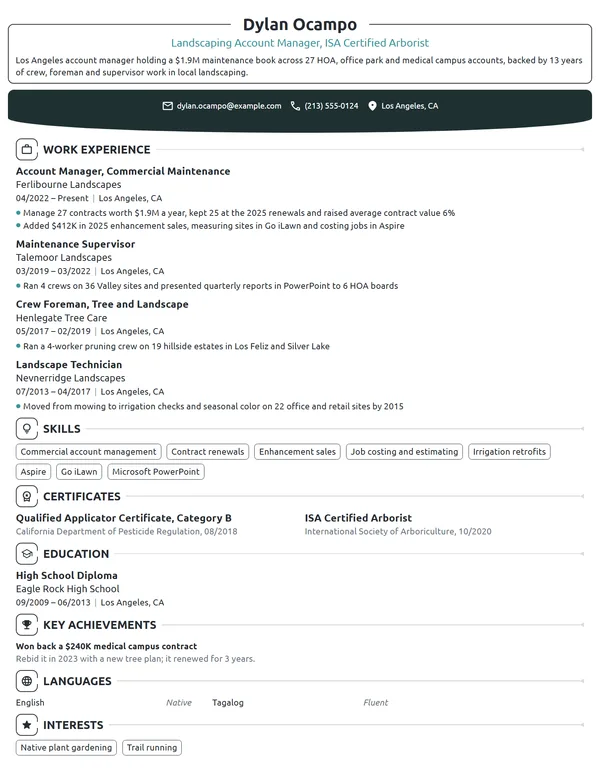
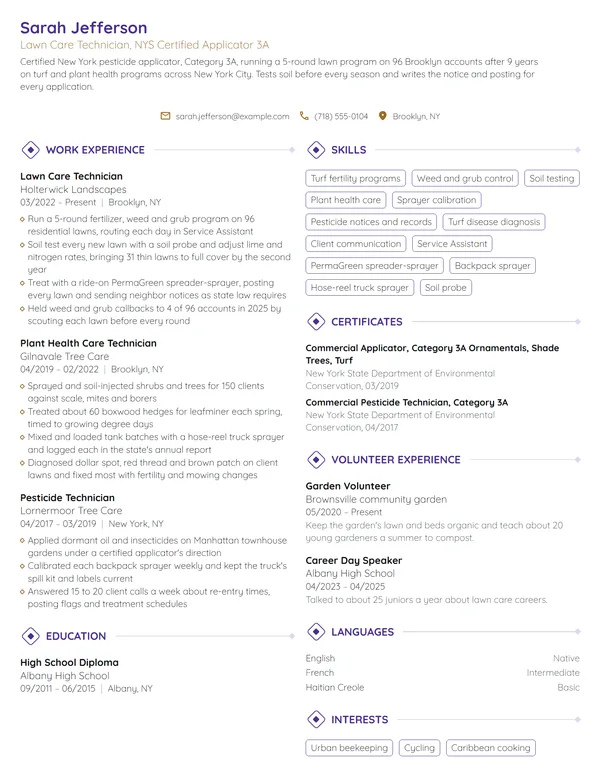
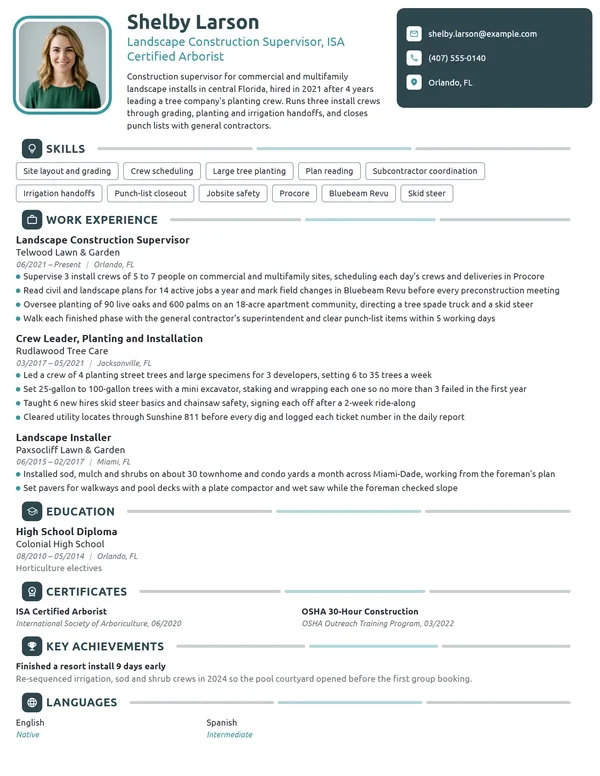
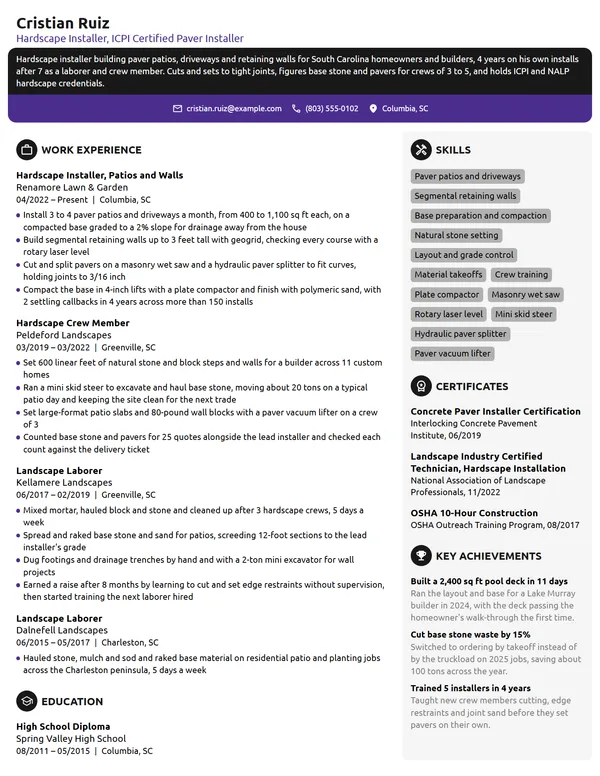
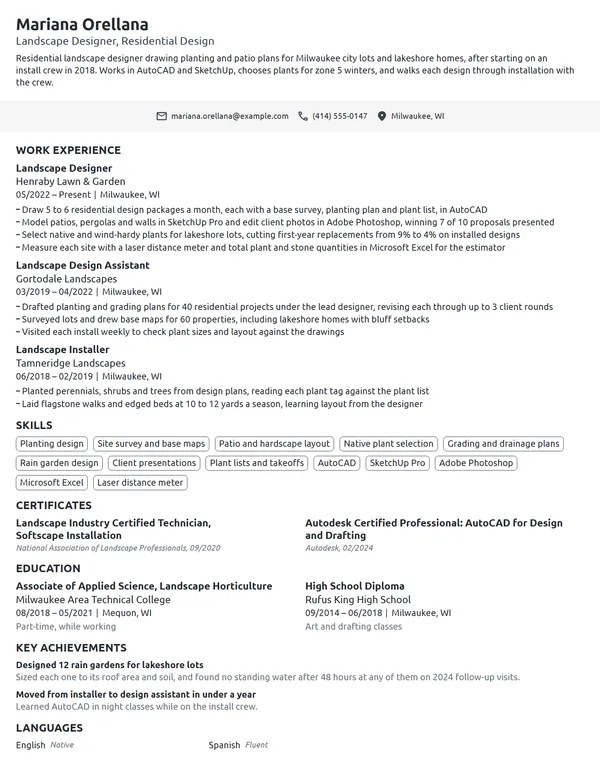
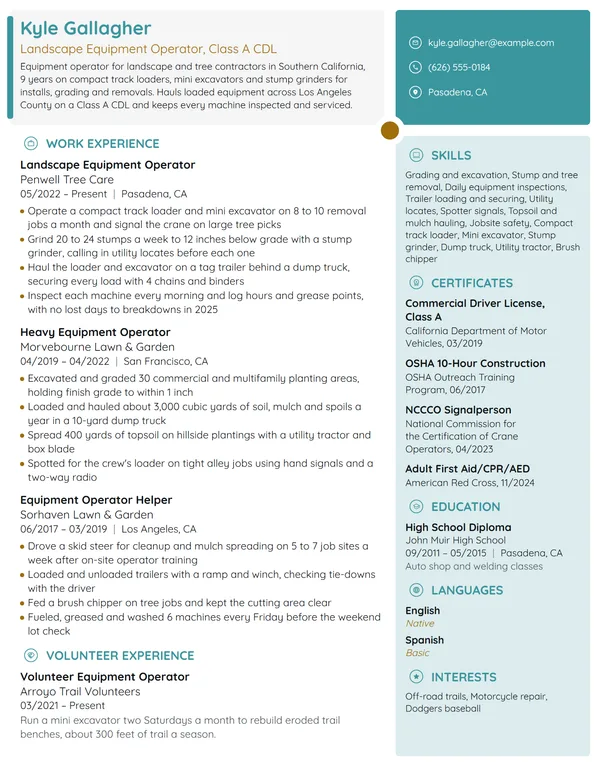
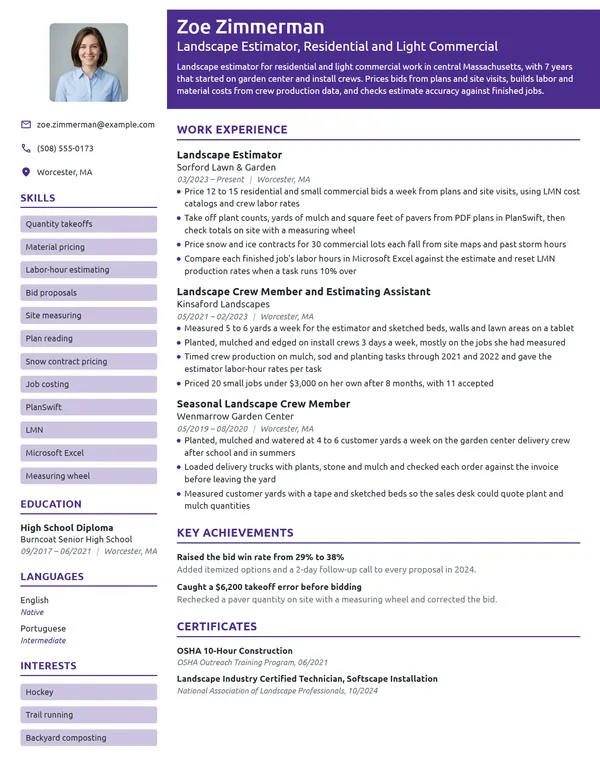
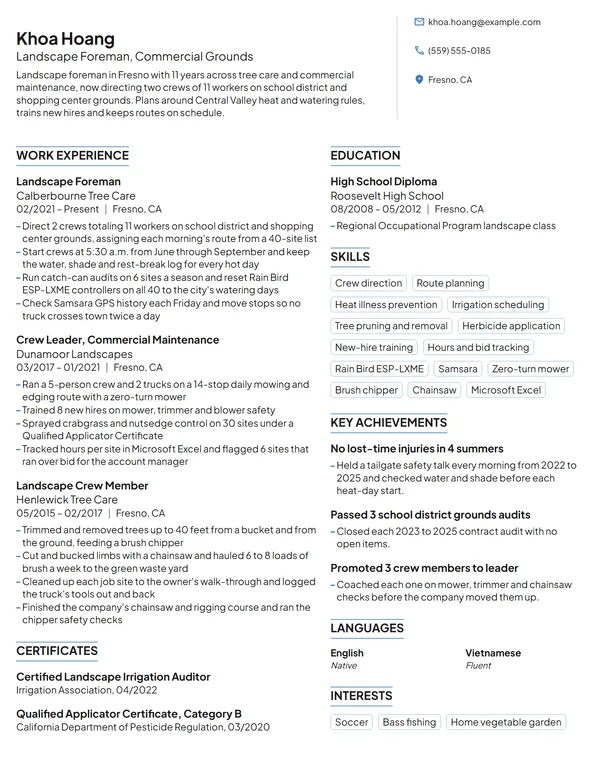
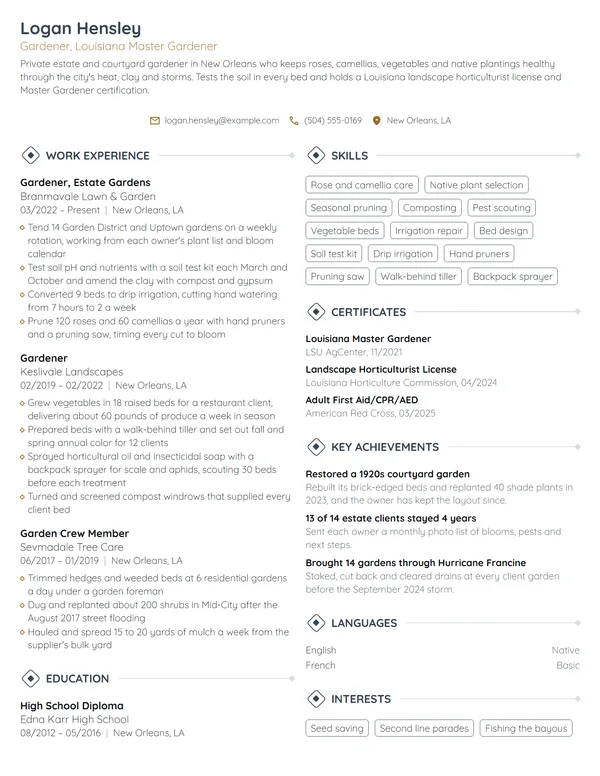
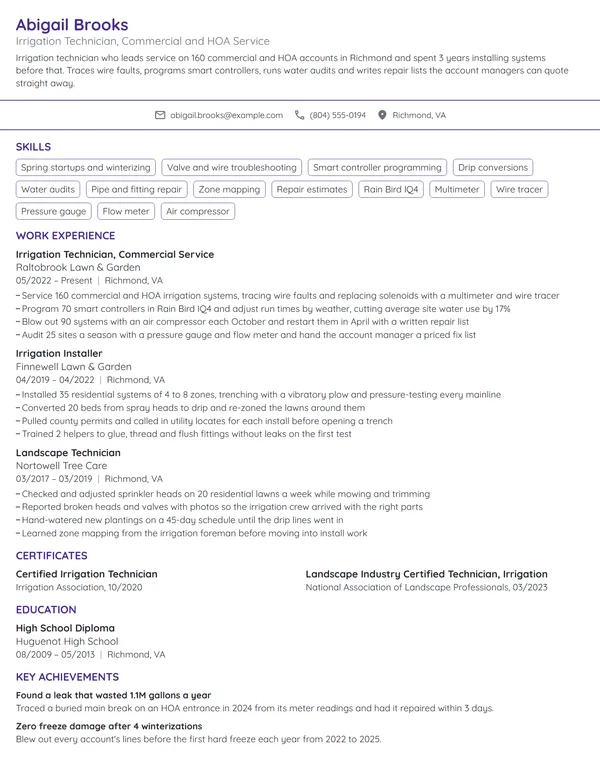
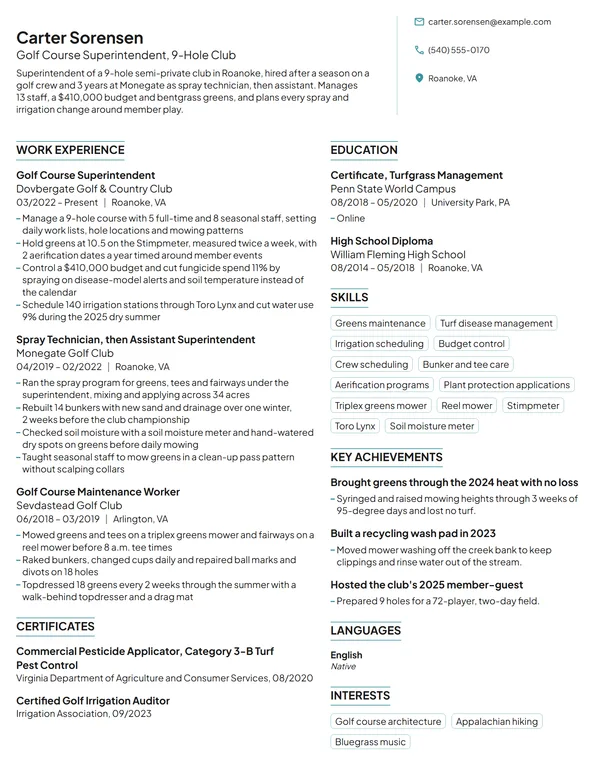
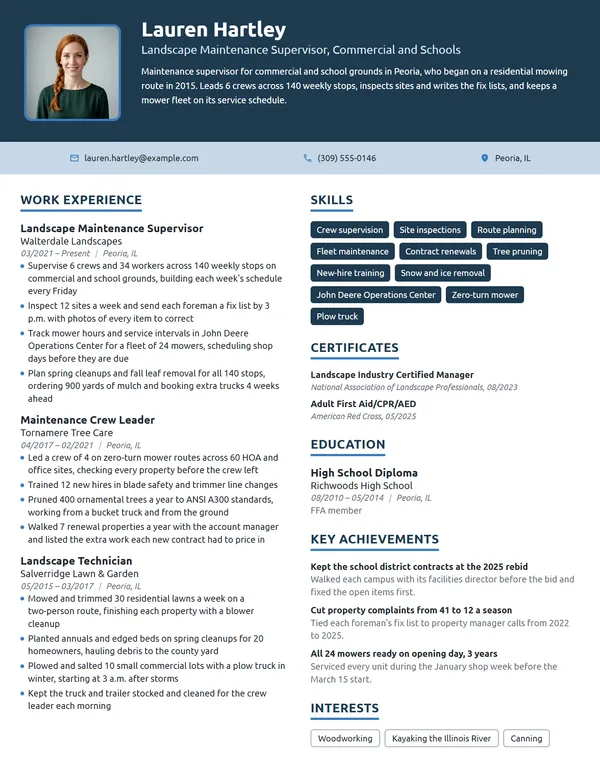
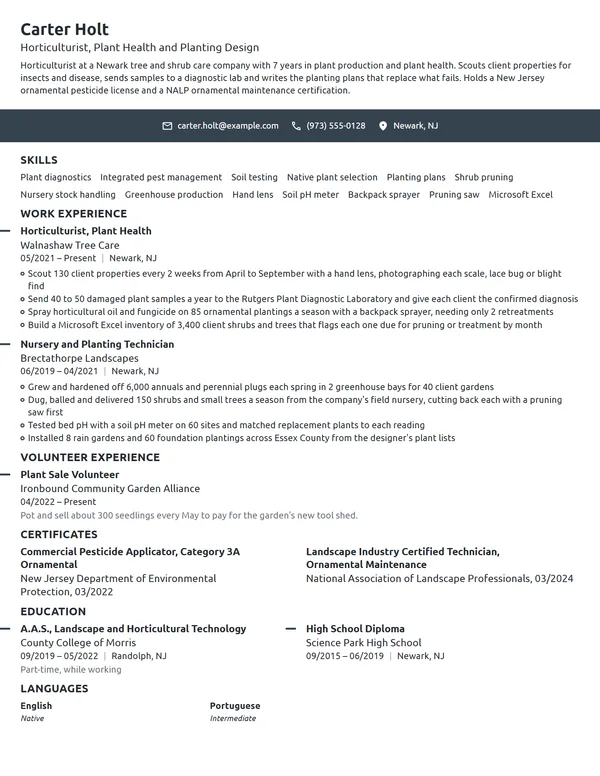
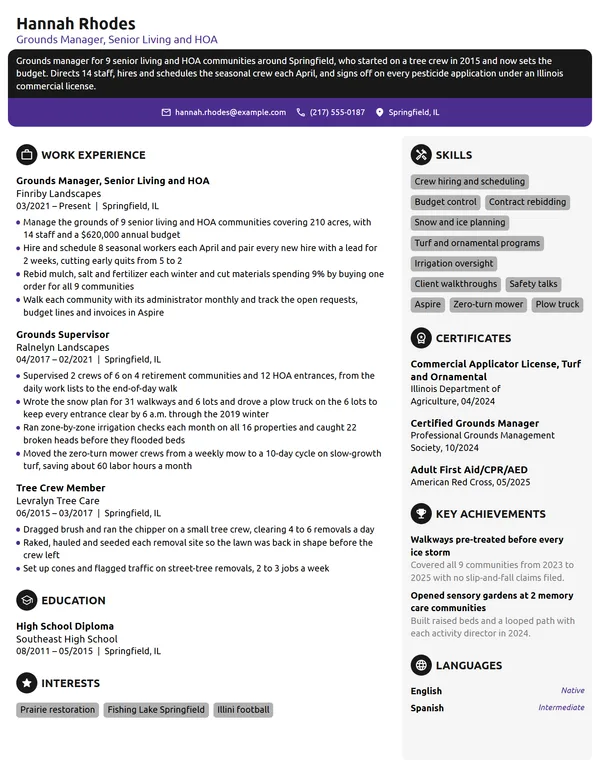
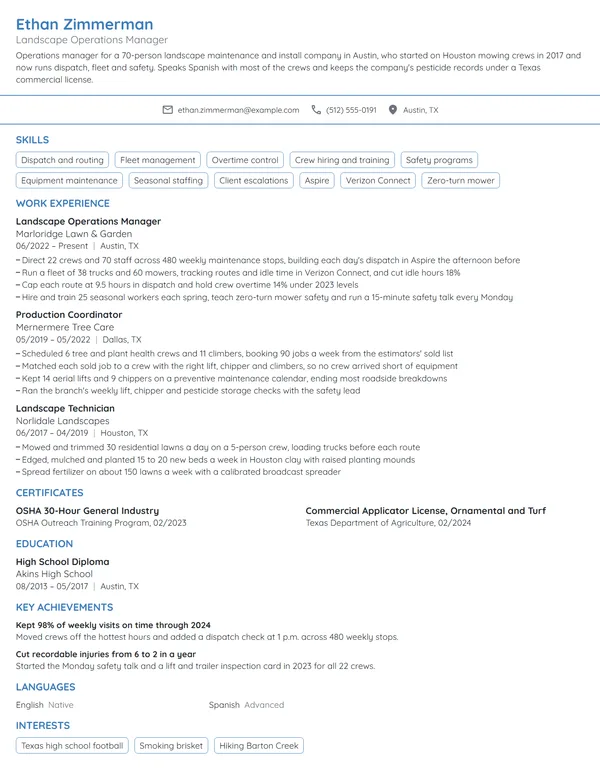
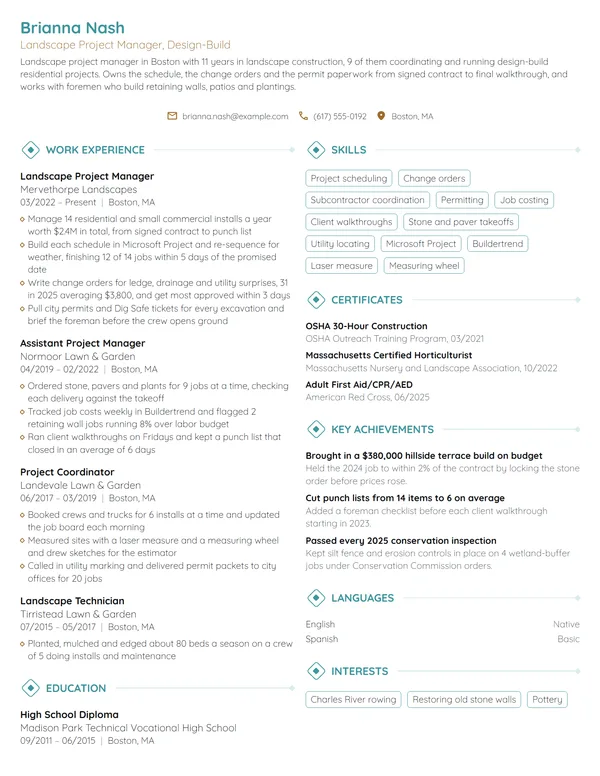
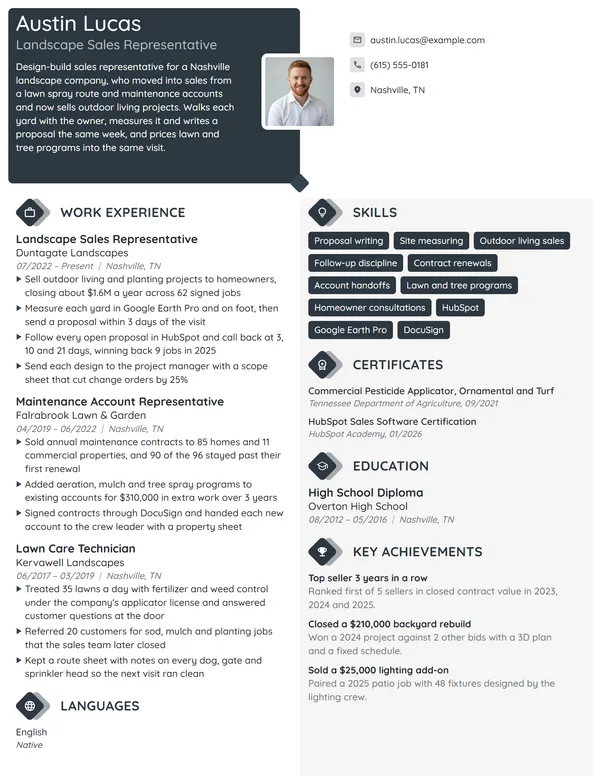
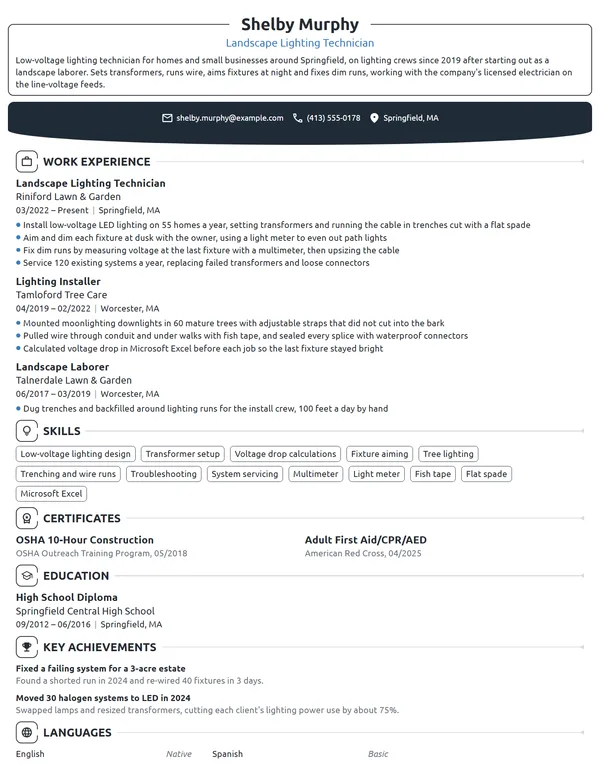
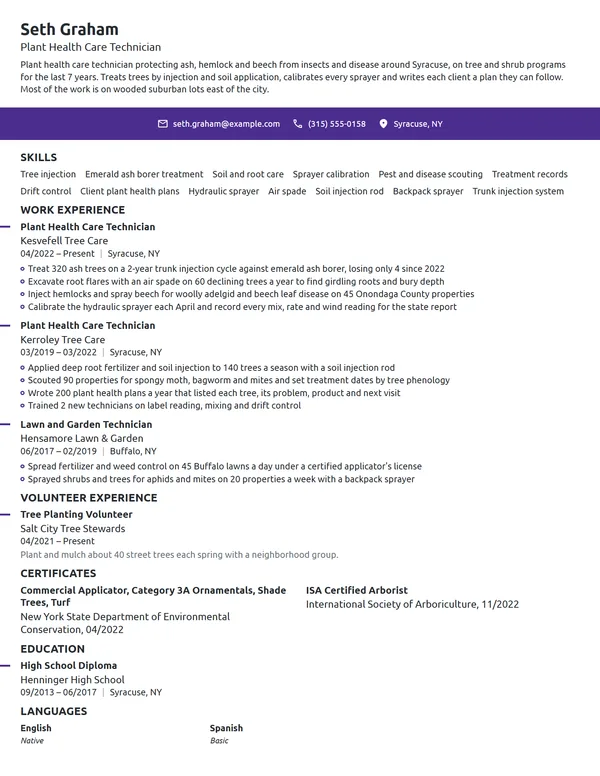
Landscaping work is done in the open, where a client can walk the property and judge it. A resume has to let an owner judge you the same way, on 1 page. Owners and crew leaders hiring for a season want to know what kind of properties you have kept, how many you get through in a week, which mowers and power equipment you can run, and whether you hold a license to apply pesticides. Properties on your route, square feet installed and clients who renewed answer most of it.
How to Write a Landscaping Resume - Key Takeaways
- Put your newest job first in a reverse-chronological layout, keep it to 1 page, and give each company 1 entry even if you worked it for several seasons.
- Open with 2 to 3 lines that name your years, the property types you service, your best route or install number and your license.
- Size every bullet: properties a week, acres, square feet of sod or pavers, crew size, callbacks or contracts renewed.
- Name the equipment you can run, such as zero-turn mowers, skid steers or aerators, in Skills, and prove each one in a bullet.
- List a state pesticide applicator license first under Certificates, with its category and issuing agency; never list one you do not hold.
- Run the finished file through an ATS resume checker before you apply through a large company's job portal.
What landscaping employers look for in a resume
A landscaping owner or crew leader reads your resume for 3 things: whether you show up and keep pace, whether you can run the equipment without breaking it or hurting someone, and what kind of work you have done. The BLS lists mowing, edging and fertilizing lawns, weeding and mulching beds, trimming hedges and shrubs, planting, and applying pesticides or herbicides as typical duties. O*NET adds operating mowers, tractors, chainsaws and sod cutters as a core task.
Maintenance, installation, irrigation and chemical work are different jobs to an employer, so say which ones you do. Put your resume in these sections:
- Name, a headline such as Landscape Crew Leader, and your phone, email and city
- A short opening summary of 2 to 3 lines; it prints without a heading
- Work Experience, latest season on top
- Skills, with the equipment and software you use
- Certificates, with any state pesticide license on the first line
- Education
- Optional extras: Languages, Interests, and either Key Achievements or a Volunteer Experience section
Best format for a landscaping resume
Use the reverse-chronological resume format: your latest job on top, each entry with the title, the company, the town and the MM/YYYY dates. Landscaping careers usually move from laborer or technician to crew leader, foreman and account or operations manager, and this order makes that progress easy to follow. If you worked seasons for the same company, give it 1 entry with the full date range rather than a new entry each spring.
- Best for most landscapersReverse-chronologicalYour jobs, newest first, with your results under each one.Best for: A steady work history in your field
- FunctionalSkills grouped up top, with a short work history below.Best for: Gaps or very little experience
- CombinationA skills section first, then your full work history.Best for: A career change with strong skills
Keep it to 1 page. A second page only makes sense for a manager with 10+ years who has run several crews, branches or large commercial accounts, and even then the first page should carry the 2 latest roles.
| Setting | What to use |
|---|---|
| Length | 1 page for crew and technician roles; 2 only for managers with 10+ years |
| Dates | MM/YYYY, with Present for your current job; 1 range for repeat seasons at one company |
| Job title line | Title plus the work type: Landscape Technician, Commercial Maintenance |
| Equipment | Machine types and sizes inside Skills, each one proven in a bullet |
| Photo, age and ID numbers | Usually no photo in the US and Canada; skip your Social Security number, marital status and date of birth |
| File type | PDF by email or upload; a Word file only if the company's form asks for one |
Most US and Canadian resumes carry no photo. Put your phone number and your city near the top instead, so an owner can see you live within reach of the routes and call you straight from the page.
Landscaping resume summary vs. objective
Pick by 1 test: have you been paid to do landscaping work? If yes, write a resume summary that names your years, the properties you service and your strongest number. If you have not, write a resume objective that names the job you want and the outdoor or equipment work you have already done. Either one fits in 2 or 3 lines.
Landscaping resume summary formula
Title with X years on residential, commercial or HOA properties. Biggest route, install or treatment number. License or certification, with the state.
Example
Landscape crew leader with 7 years on commercial and HOA properties. Runs a 4-person crew across 38 properties a week and sold $48K in enhancement work in 2025. Holds a North Carolina commercial pesticide ground applicator license, Category L.
Don't
Hardworking landscaper who loves working outdoors and takes pride in every lawn.
Do
Residential lawn care technician with 4 years on a 2-person crew, servicing 35 homes a week from April to November. Kept 90% of clients from one season to the next.
This version names the work type, the volume and a result an owner can check with a phone call.
How to write landscaping work experience bullets with numbers
Your current job gets 3 to 4 bullets, each older job 1 to 3, and every bullet opens with a verb. Landscaping already runs on counts (properties on a route, acres, square feet, plants, callbacks), so most bullets can carry one. Write achievements on your resume instead of the list of chores from the job posting, and add the season or the crew size so the number has a base.
| Area | What to count | Example bullet |
|---|---|---|
| Maintenance routes | Properties a week, acres, crew size, missed visits | Maintained 52 residential lawns a week on a 3-person crew with 0 missed visits in the 2025 season. |
| Installs | Square feet of sod or pavers, plants, jobs, weeks | Laid 9,000 sq ft of sod and set 120 shrubs across 4 new-home installs in 6 weeks. |
| Turf and chemical work | Lawns treated, programs, callbacks | Treated 70 lawns for grubs and broadleaf weeds, with 3 callbacks in a season. |
| Irrigation | Systems, heads, valves, zones | Repaired 140 heads and 12 valves on 18 systems during spring startup. |
| Equipment | Machines kept in service, downtime, checks | Kept 9 mowers and blowers running all season with weekly blade and oil checks. |
| Accounts and snow | Contracts renewed, lots cleared, response times | Renewed 31 of 33 HOA contracts and plowed 14 commercial lots each winter storm. |
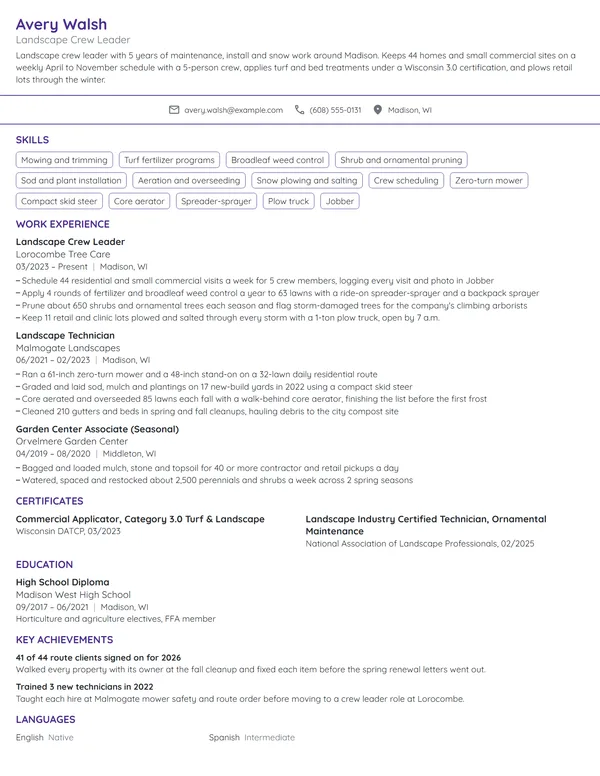
Here is how one crew leader's entry reads with those numbers in place. The current job shows the route, the chemical work and the install work separately, and the older job keeps to 2 lines.
Work Experience
- Lead a 4-person crew across 38 commercial and HOA properties a week, about 160 acres of turf.
- Rebuilt the weekly route around 3 zip codes, cutting about 6 hours of drive time a week.
- Applied pre-emergent and broadleaf herbicide on 22 properties with 0 drift complaints in 2 seasons.
- Sold and built 7 enhancement jobs worth $48K in 2025, including a 1,200 sq ft paver patio.
- Mowed, edged and cleaned up 25 to 30 residential lawns a day on a 2-person crew.
- Planted 300+ shrubs and 40 trees on new-build installs.
Don't
Responsible for mowing, trimming and blowing lawns.
Do
Mowed and trimmed 45 lawns a week on a zero-turn and stand-on mower, and made up rain days within 2 days.
Now the bullet carries the volume, the machines and how you handle the weather.
Don't
Helped with landscape installs.
Do
Built 5 backyard installs from the designer's plan, laying 2,600 sq ft of sod with 1 callback.
Landscaping skills, equipment and software for your resume
Choose 6 to 8 hard skills for your resume from the job ad, and only ones a bullet already backs up. A maintenance role wants mowing, pruning and bed care up front; an install role wants grading, sod, planting and hardscape; a lawn care role wants fertilizer and herbicide programs.
Hard skills for landscapers
- Mowing and edging
- Hedge and shrub pruning
- Bed maintenance and mulching
- Planting and transplanting
- Sod and seed installation
- Fertilizer and herbicide application
- Irrigation repair and startup
- Paver and retaining wall installation
- Small-engine maintenance
- Snow and ice removal
Soft skills crew leaders value
- Reliability on early starts
- Steady pace in heat
- Teamwork on a small crew
- Courtesy with property owners
- Safety around equipment
- Following a plan or plant list
List equipment inside Skills by type, such as zero-turn and stand-on mowers, string trimmers, backpack blowers, aerators, sod cutters, chainsaws and skid steers, then show each one at work in a bullet. O*NET lists Microsoft Excel, Microsoft Word and Facebook as hot technology for landscaping and groundskeeping workers, which matters most if you schedule crews, quote jobs or post a company's work online. If the ad names a scheduling or estimating app you have used, write its exact name.
Pesticide license and landscaping certifications on a resume
A crew member usually needs no license to mow, plant or build, but the BLS says most states license workers who apply pesticides, usually after they pass a test. The EPA adds that state pesticide agencies certify applicators, and that restricted use pesticides may be applied only by a certified applicator or someone under that person's direct supervision. List certifications on your resume under Certificates, with the license first, its category and the agency that issued it.
| Credential | Issued by | What it takes |
|---|---|---|
| Pesticide applicator license (commercial) | Your state's pesticide agency, often the department of agriculture | A state exam on safe use and disposal. In North Carolina, landscapers and lawn care companies applying for pay on someone else's property need the Commercial Ground Applicator license, usually in Category L (Ornamental & Turf). |
| Landscape Industry Certified Technician | National Association of Landscape Professionals (NALP) | An online exam: a Common Core section plus 1 specialty (Softscape Installation, Hardscape Installation, Turf Maintenance, Ornamental Maintenance or Irrigation), finished within 12 months of enrolling. |
| ISA Certified Arborist | International Society of Arboriculture (ISA) | 3 years of full-time experience in arboriculture, or a 2-year degree plus 2 years, or a 4-year degree plus 1 year, each degree with tree-related courses, and a passed exam. |
How to show spraying you did under someone else's license
If you applied products on a licensed applicator's crew, say so in the bullet, such as "applied pre-emergent on 40 lawns under the supervision of a licensed applicator", and leave the license itself off Certificates. If you are studying for the exam, list it with the month you plan to sit it. Keep the word licensed out of your headline until the state issues the card.
Certificates
- Commercial Ground Applicator License, Category L (Ornamental & Turf), North Carolina Department of Agriculture and Consumer Services, 02/2021
- Landscape Industry Certified Technician, Turf Maintenance, National Association of Landscape Professionals, 11/2023
- Adult First Aid/CPR/AED, American Red Cross, 04/2025
How to list a diploma, horticulture degree or turf program
The BLS says grounds maintenance workers typically do not need a formal educational credential and learn on the job, usually within 1 month. A high school diploma or GED line is enough for most crew roles. Listing education on a resume takes 1 short line below your work history: credential, school, town and the month you finished.
A 2-year turf, horticulture or landscape program counts for more on this resume, since it can shorten the road to an ISA credential and backs up plant and soil knowledge. Add 1 line on the practical part, such as an internship or a field course, when you finished in the last few years.
Education
Entry-level and career-change landscaping resumes
With no paid landscaping job yet, an entry-level resume can still show the work. Lead with a short objective, keep Work Experience for any job at all, and size outdoor and equipment experience the way a crew leader would.
- Neighborhood mowing or yard work for pay: how many lawns, how many summers, which mower.
- Family farm, nursery or garden center work: plants handled, equipment run, hours a week.
- School or park grounds jobs: acres covered, events set up, seasons worked.
- Community garden or park cleanups: listed under Volunteer Experience, with hours or trees planted.
Don't
Motivated individual seeking a landscaping position where I can learn and grow.
Do
Reliable worker seeking a landscape technician role. Mowed 20 neighborhood lawns a week for 3 summers on push and zero-turn mowers, with own trimmer and trailer.
Even with no company on the resume, a count and a machine show you can keep up.
Coming from construction, warehouse, farm or delivery work, keep reverse-chronological order and pull your transferable skills to the top: equipment you have run, physical work outdoors, safety records and early starts. A career-change resume reads best when the first 2 bullets under your latest job are its most landscaping-like work, such as grading, loading or operating a skid steer. Save the reason for the switch for a cover letter or the phone call.
Landscaping resume FAQ
Do you need a license to work in landscaping?
Not for most crew work. A crew member usually needs no personal license to mow, plant or build hardscapes, but most states require one to apply pesticides, usually after an exam, the BLS reports. If you hold one, list it first under Certificates with its category and the agency that issued it.
How long should a landscaping resume be?
Use 1 page for crew, technician and crew leader roles. Move to 2 pages only as a manager with 10+ years of crews, branches or commercial accounts, and keep your 2 latest jobs on page 1.
Should I list the equipment I can operate on a landscaping resume?
Yes. Name each machine type in Skills, such as zero-turn mower, aerator or skid steer, with deck sizes or attachments where you know them, and back each one up in a bullet. Leave out anything you have only watched someone else run.
How do I list seasonal landscaping jobs on a resume?
Give each company 1 entry covering every season you worked there, such as 04/2023 – 11/2025, and say seasonal in a bullet or the title line. If you plowed snow or worked another job in winter, list that job too so the gaps make sense.
Should I include my salary on a landscaping resume?
No. Discuss pay on the phone or at the interview. For a benchmark, BLS figures put the median wage for landscaping and groundskeeping workers at $18.82 an hour, or $39,150 a year, in May 2025, and offers vary with your state, your license and the season.
Is an ISA Certified Arborist credential worth listing for landscaping jobs?
Yes, if you hold it, and especially for tree care, pruning and municipal grounds roles. ISA asks for 3 years of full-time arboriculture experience, or a degree with tree courses plus 1 to 2 years. List it under Certificates with the month you earned it.
Should I put my driver's license on a landscaping resume?
Yes, when the job ad asks for one or the role means driving a crew truck or towing a trailer. Add it as 1 line under Certificates with the state, and name any trailer towing or truck experience in a bullet.
How do I show snow and ice removal work on a landscaping resume?
Give it its own bullet under the job where you did it, with the lots, walks or accounts you cleared per storm and the equipment, such as a plow truck, a skid steer with a pusher or a snow blower. If you did winter work for a different company, list that company as its own entry so your dates run through the year.
What should a groundskeeper or arborist resume add to a landscaping one?
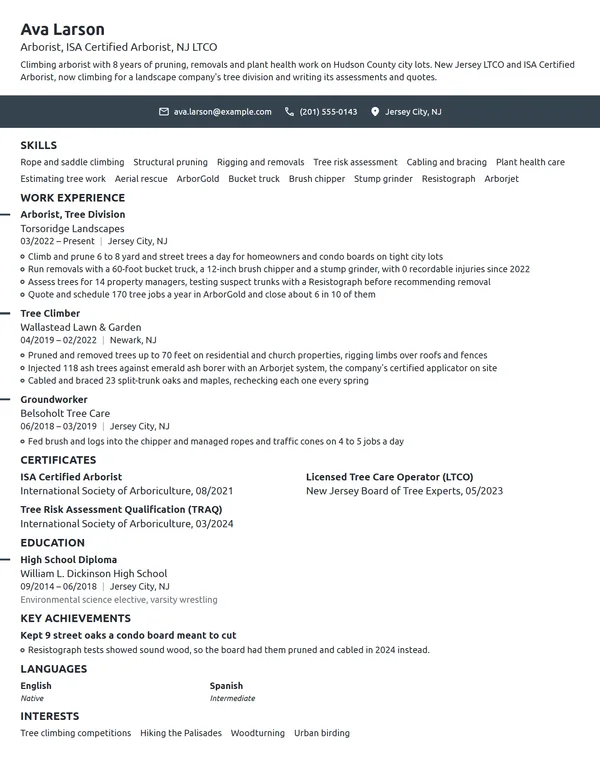
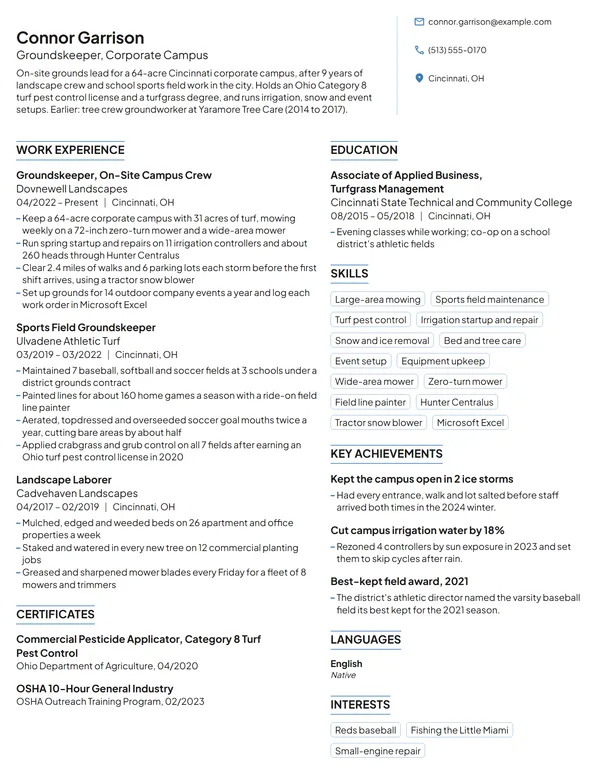
A groundskeeper should name the grounds type and size, such as a campus, school fields or a park, and any field work like line painting or turf repair. An arborist should lead with climbing, rigging and removal work, the largest trees handled and an ISA credential if held. Both still list the mowers, saws or trucks they run in Skills.
Next steps
Start from the example closest to the work you do, use its layout, and put your own route, install and treatment numbers into every bullet. Build it in our resume builder or pick one of the resume templates, then follow up with a phone call 1 or 2 days after you apply.