
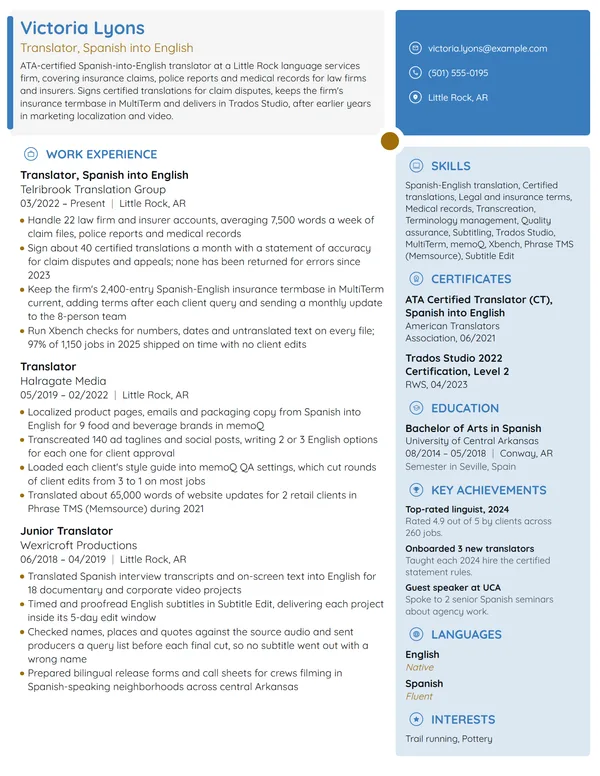
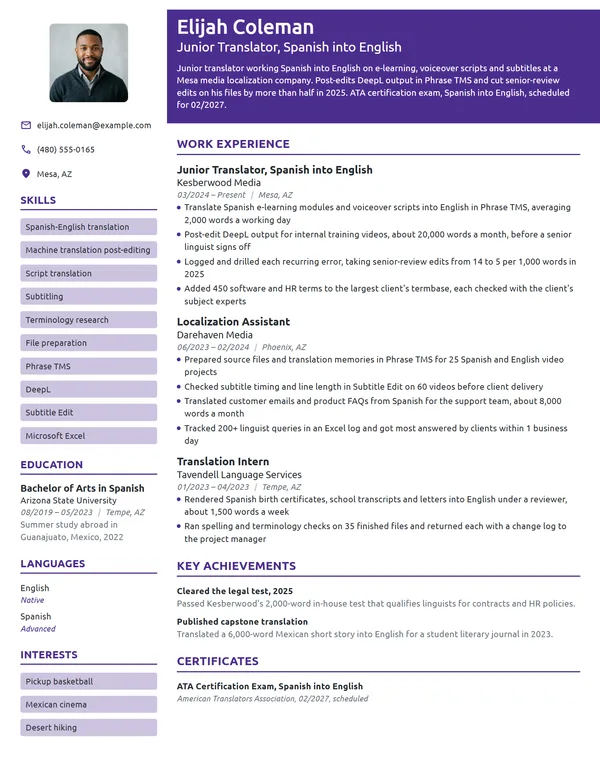
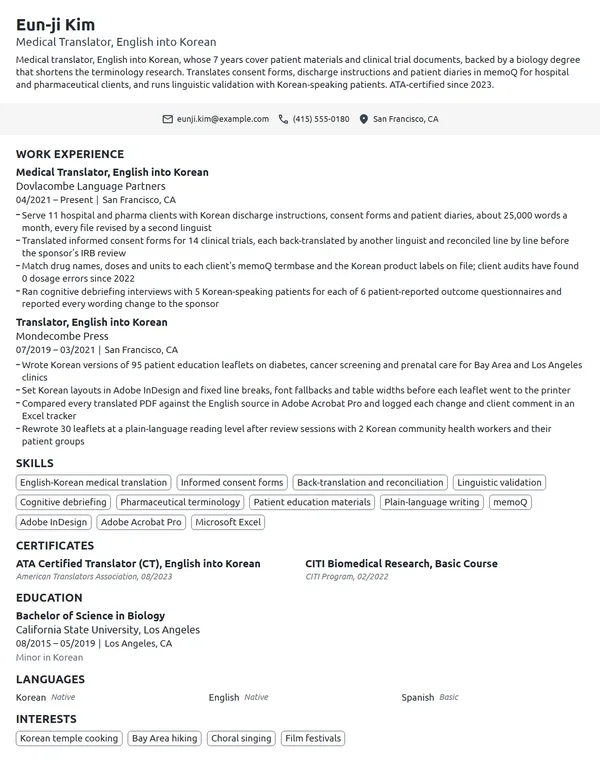
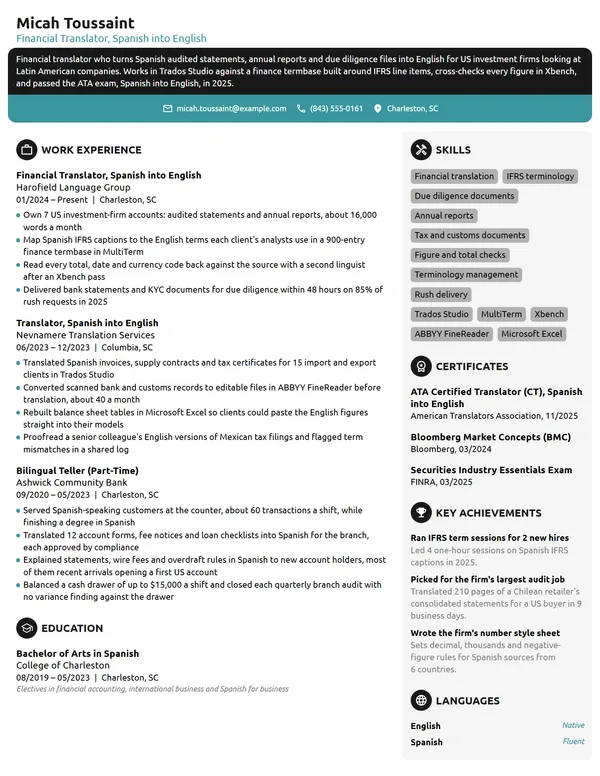
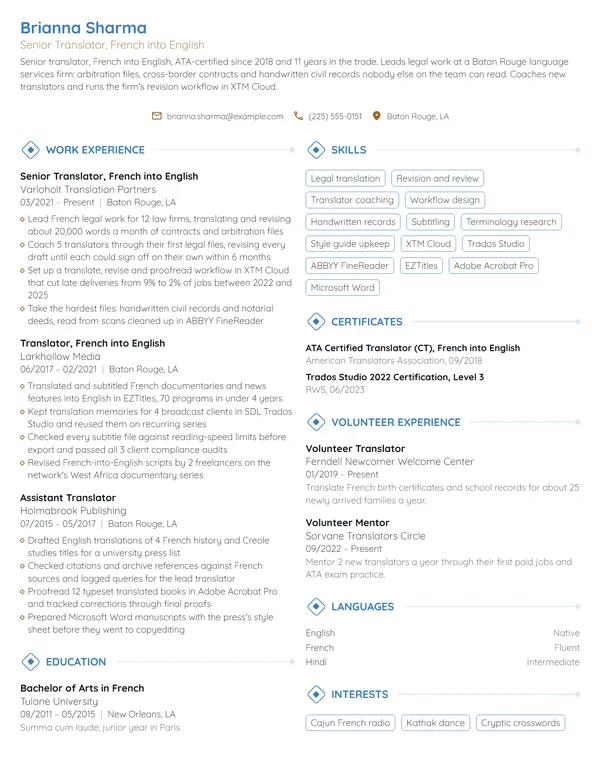
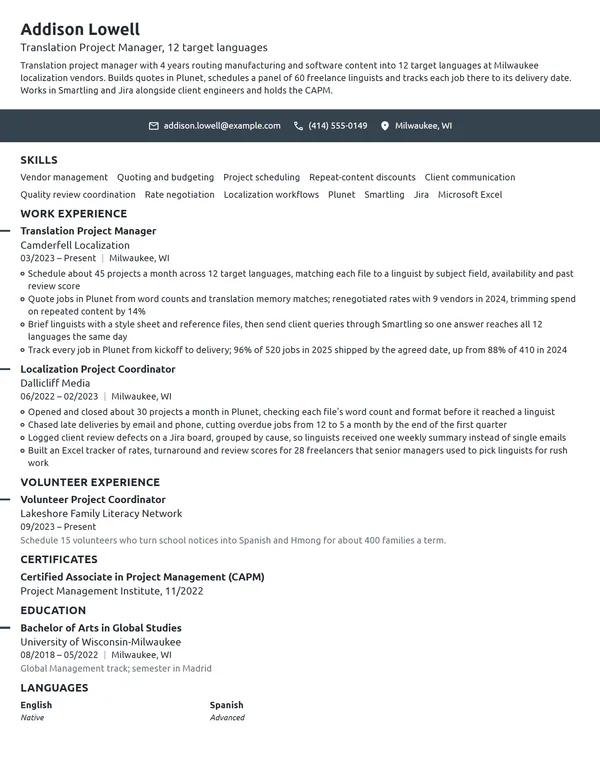
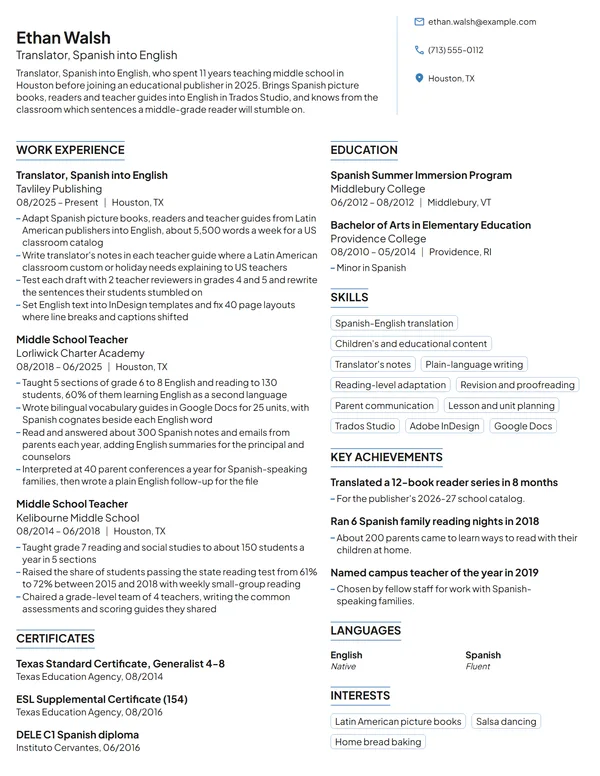
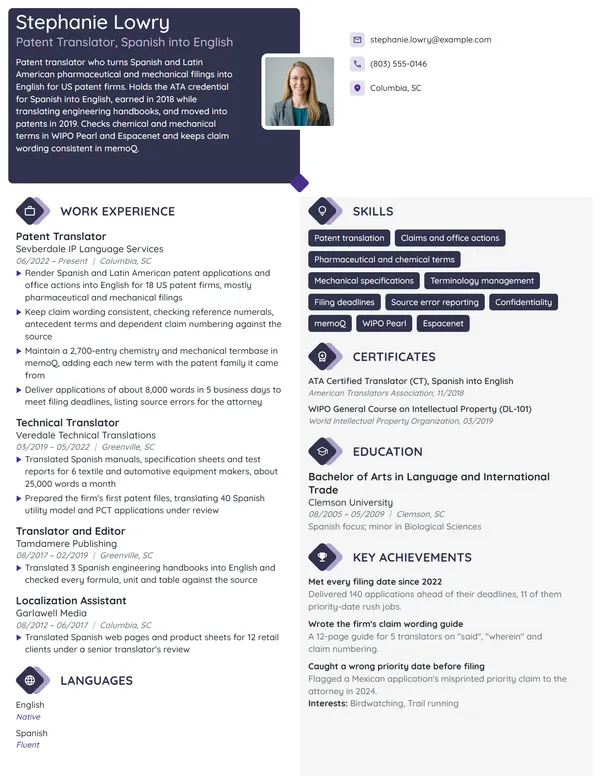
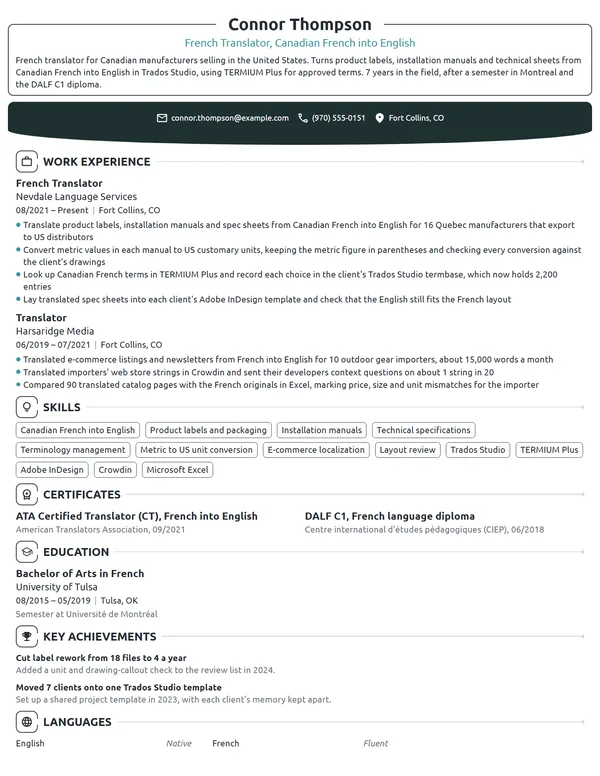
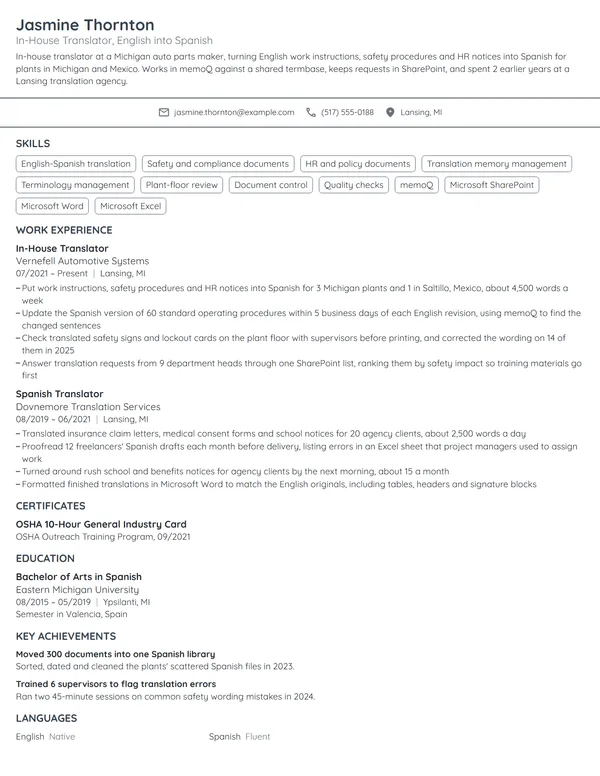
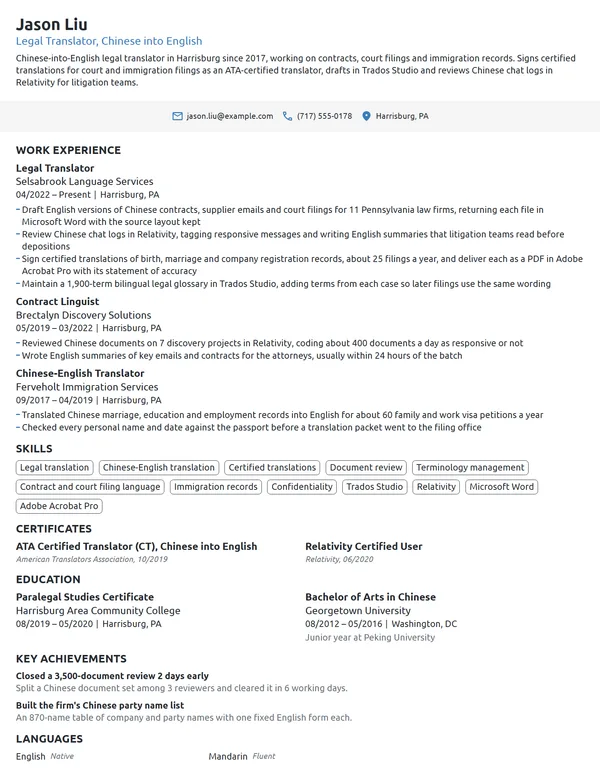
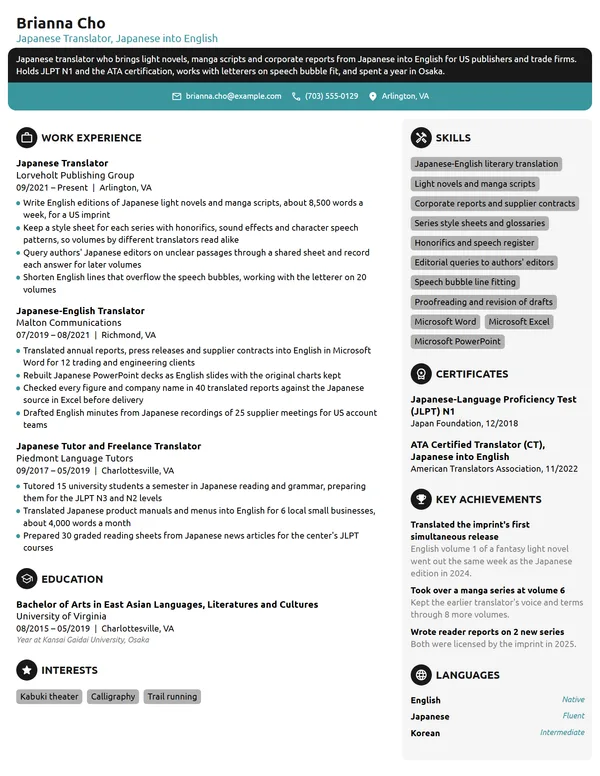
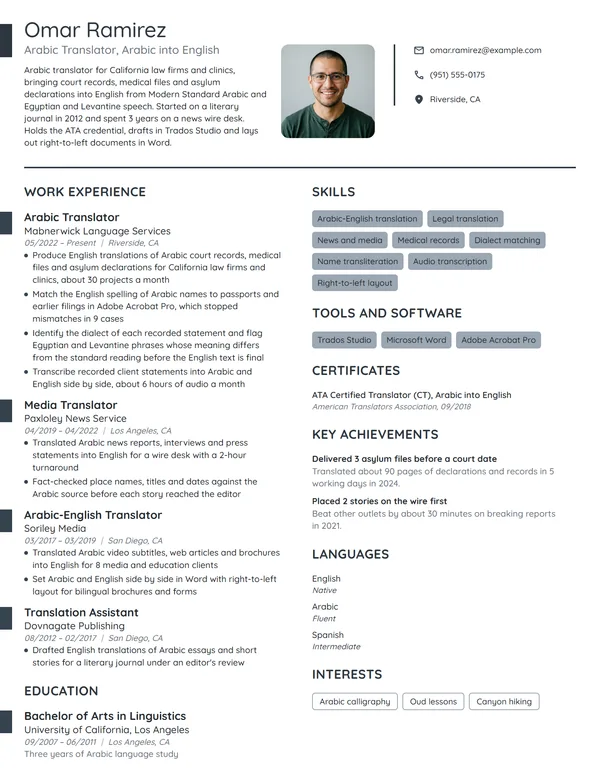
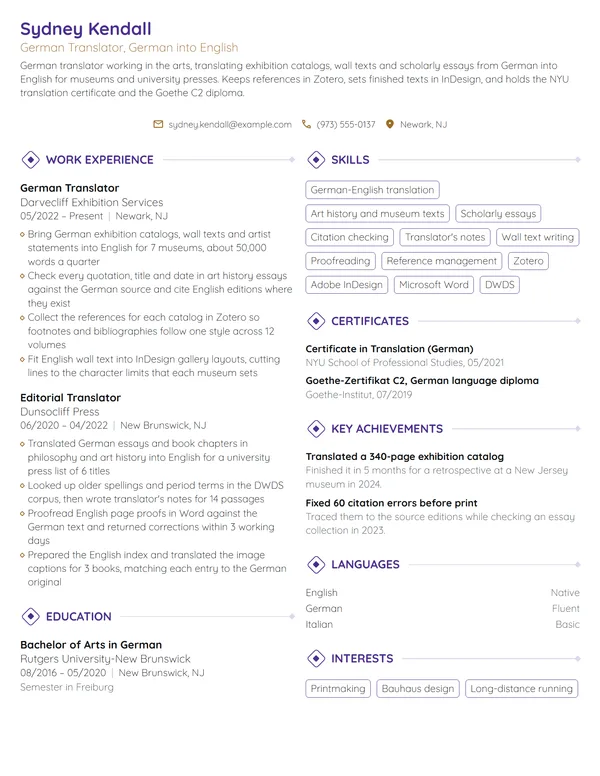
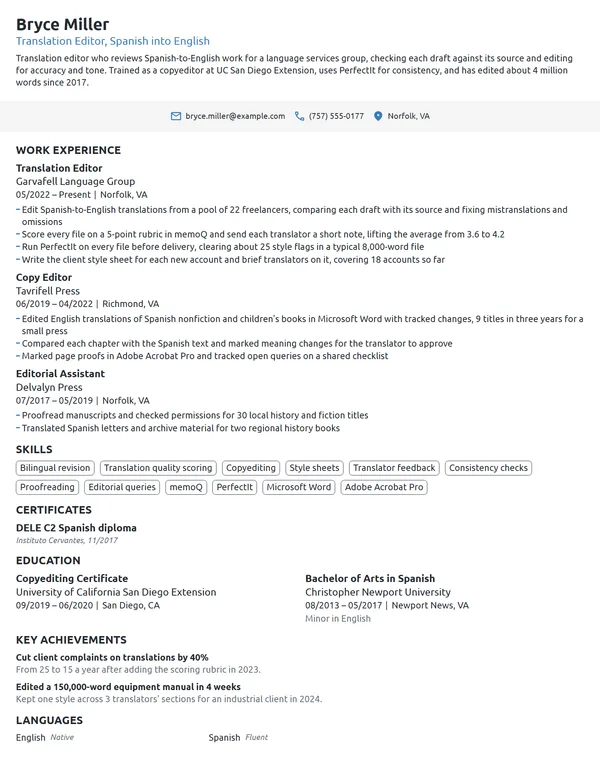
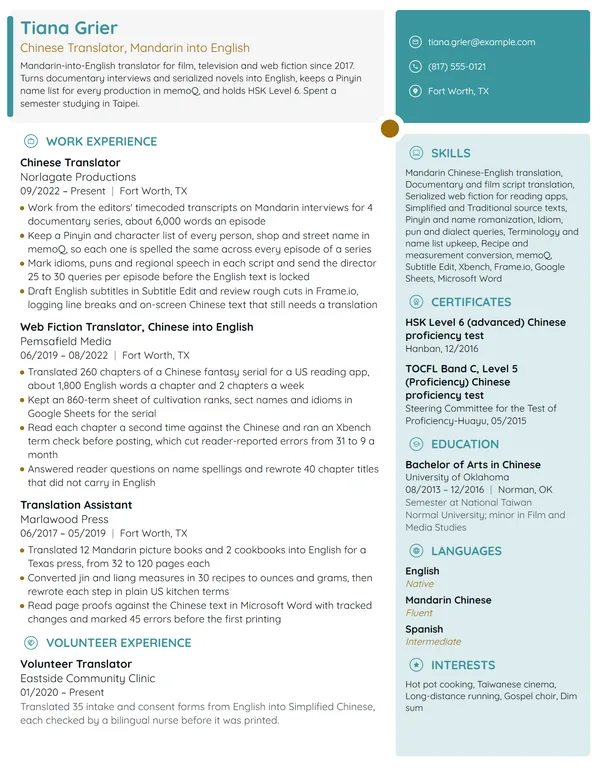
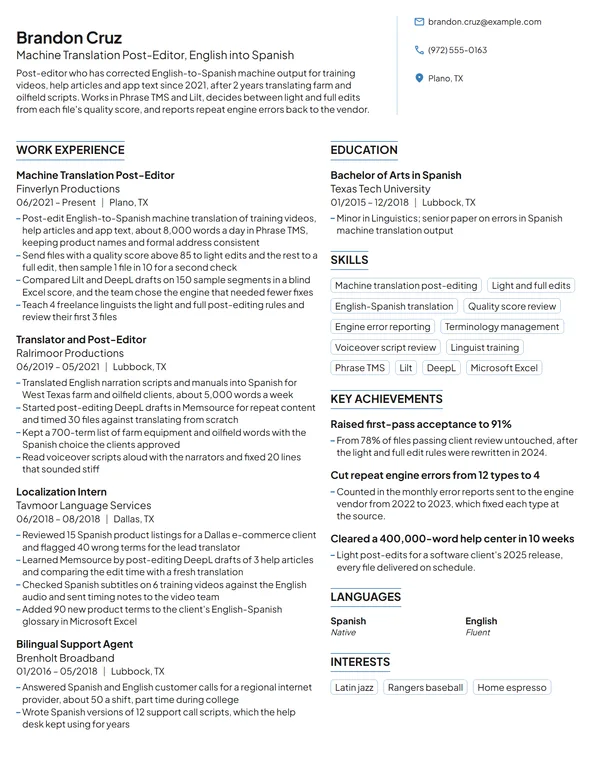
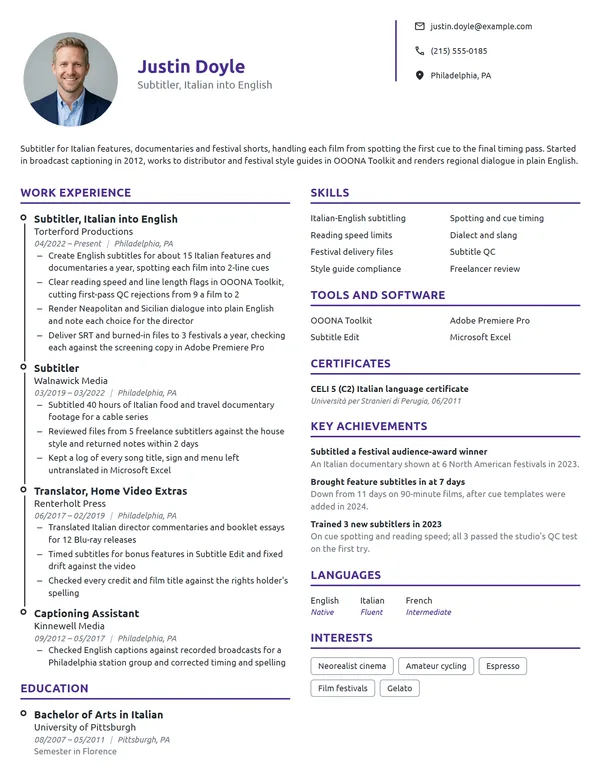
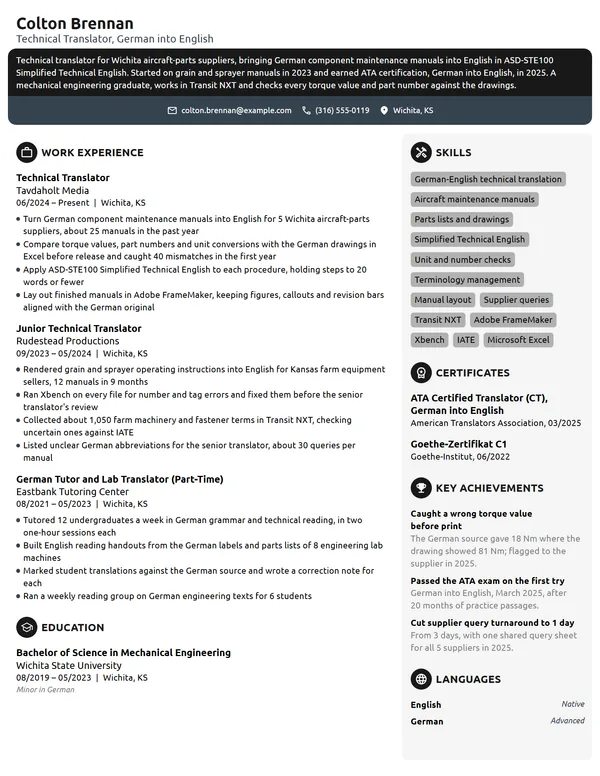
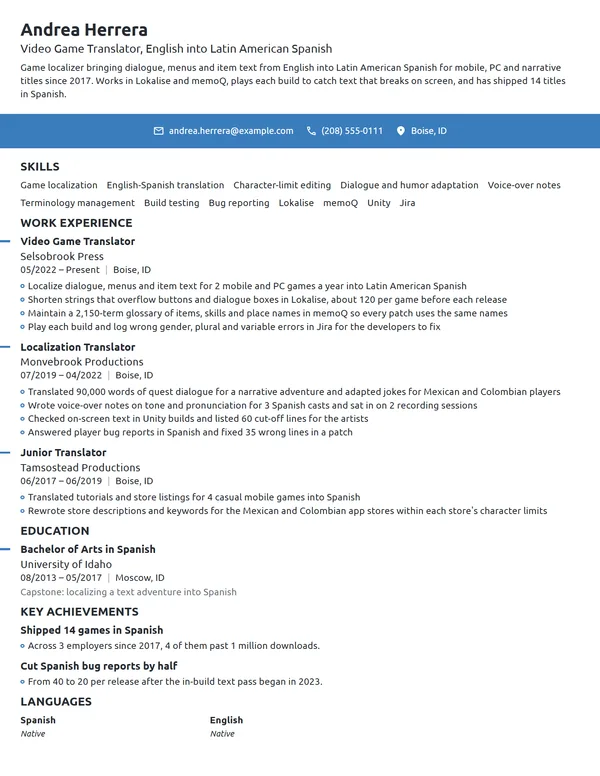
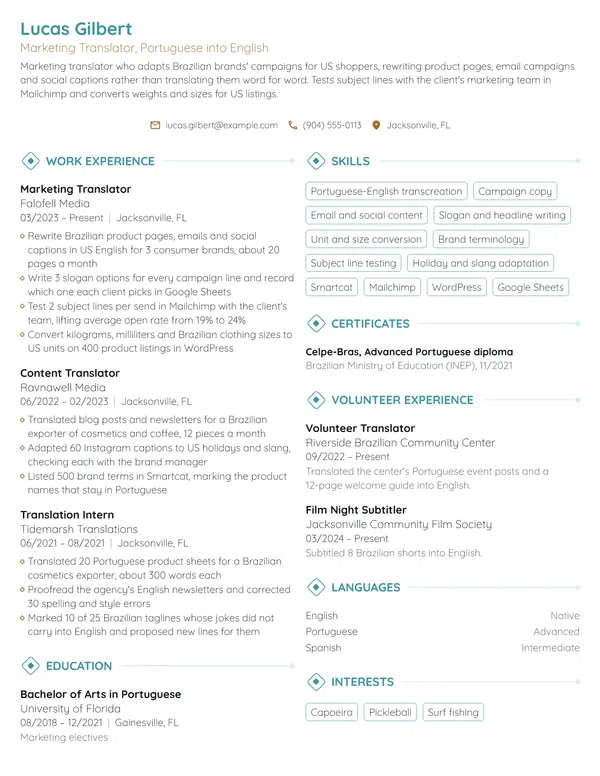
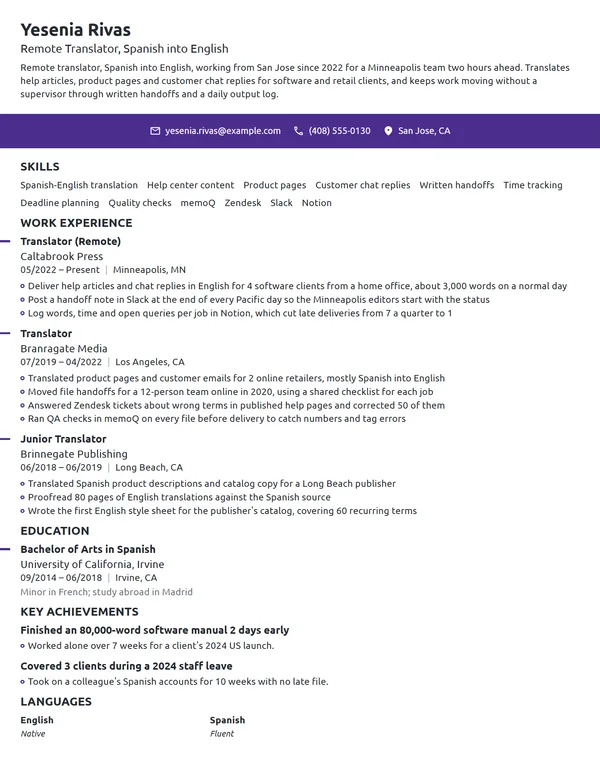
Translation is careful work done against a deadline. An agency project manager or in-house language lead checks your language pair and direction first, then the subjects you know well, the tools you work in and how many words you turn around. Each of those fits on a single line, and each one is more convincing with a number or a credential behind it: words a week, glossary terms built, review scores, an ATA certification in the right direction.
How to Write a Translator Resume - Key Takeaways
- Put your language pair and direction in the headline under your name, such as Translator, German into English.
- Use reverse-chronological order, newest role first, and give a freelance practice its own Work Experience entry with dates.
- Give every bullet a number a project manager tracks: words delivered, turnaround in business days, glossary terms, review scores or client-reported errors.
- Name the CAT tools from the job ad, such as Trados Studio, memoQ or Phrase TMS, under Skills and again inside a bullet.
- List an ATA certification under Certificates with its exact pair and direction, and each language with its level under Languages.
- Send a clean PDF, and run it through an ATS resume checker before you upload it to an agency's vendor portal.
What translation managers look for in a translator resume
Whoever screens your resume, an agency vendor manager or the head of an in-house language team, wants to know which languages you translate and in which direction, which subjects you can handle without a specialist checking every term, and whether you deliver clean text on time. The BLS describes the core of the job as converting the concepts, style and tone of the source language into the target language, and compiling technical terms into glossaries and terminology databases. O*NET rates following ethical codes that protect confidential information as the most important task in the occupation.
Build the page from these sections, each under a heading a parsing system recognizes:
- Name, headline and contact details
- Summary of 2 to 3 lines under the headline (it prints without a heading)
- Work Experience, most recent first, freelance practice included
- Skills, with your CAT tools and subject fields
- Languages, each with its level
- Certificates
- Education
- Optional: a Key Achievements block, or Volunteer Experience for unpaid translation
Best format for a translator resume
Use the reverse-chronological resume format: your latest role first, each with the title, the employer or your practice name, the city, and the MM/YYYY months you began and left. Translators often mix in-house jobs, agency work and freelance clients, and a dated timeline shows how those fit together without gaps. If you work on your own, list the practice as 1 entry and put your clients' sectors and volumes in its bullets, the way a freelance translator resume does.
- Best for most translatorsReverse-chronologicalYour jobs, newest first, with your results under each one.Best for: A steady work history in your field
- FunctionalSkills grouped up top, with a short work history below.Best for: Gaps or very little experience
- CombinationA skills section first, then your full work history.Best for: A career change with strong skills
Fit it on 1 page until you have about 10 years of work behind you. After that, 2 pages work for a senior or lead translator with several subject fields, review or team duties and more than 1 certification, provided page 1 holds your pair, your current role and your credentials.
| Setting | What to use |
|---|---|
| Length | 1 page; 2 once you pass 10 years or several specialist fields |
| Headline | Title plus pair and direction: Translator, Portuguese into English |
| Dates | Month and year as MM/YYYY; Present marks the post you are in |
| Languages | Each language with a level, such as native, full professional or conversational |
| Photo, age and family details | Leave the photo off on most; omit age, family status and nationality |
| File type | PDF, or a Word file when an agency's vendor portal asks for one |
Most US and Canadian resumes carry no photo. Agencies often load your file into a vendor database by language pair, so plain headings and the pair written out in text matter more than design touches such as flags or skill bars.
Translator resume summary vs. objective
Once you have paid translation work, write a resume summary with your pair, your years, your subject fields, your main tool and 1 volume or quality result. With no paid work yet, write a resume objective instead: the role and pair you want, plus your strongest proof so far, such as an internship or a degree in translation. Either way, the pair belongs in the first line.
Translator resume summary formula
Pair and direction translator with X years in subject fields, working in CAT tools. Largest volume or quality result, in figures. Certification or exam status.
Example
German-to-English translator with 8 years in technical translation for manufacturers, working in Trados Studio and Phrase TMS. Delivered 2.1 million words of manuals and contracts with fewer than 1 client-reported error per 10,000 words. ATA-certified, German into English.
Don't
Detail-oriented bilingual translator passionate about languages and cultures, seeking a challenging opportunity to grow.
Do
Portuguese-into-English translator with 5 years on an agency's legal team, working in memoQ. Handles contracts and court filings for 30+ law firm clients and plans to sit the ATA exam in 2027.
The second version gives the pair, the field, the tool, the client base and the next credential.
How to write translator work experience bullets with numbers
Your current post takes 3 to 4 bullets and each earlier post 2 to 4, every one led by a verb. Translation is already counted in words, jobs, days and errors, so a bullet without a number usually means one is missing. Start each work experience entry with your volume and subject field, then add results such as faster turnaround, glossaries other translators now use, or fewer corrections from reviewers.
| Area | What to count | Example bullet |
|---|---|---|
| Volume | Words per week, month or year; jobs delivered on time | Translated 1.4 million words in 2025 across 310 jobs, each delivered by the agreed date. |
| Quality | LQA or review scores, client-reported errors | Kept LQA scores above 98 out of 100 on 120 reviewed jobs for a medical device client. |
| Terminology | Termbase entries, glossaries, queries cut | Built an 1,800-entry termbase for an insurance client and cut terminology queries from 30 to 5 a month. |
| Turnaround | Business days per job, rush jobs handled | Shortened turnaround on 5,000-word jobs from 6 to 4 business days with translation memory. |
| Review | Words revised, translators supported | Revised 55,000 words a month as second linguist for 4 translators. |
| Machine translation | Words post-edited, quality checks passed | Post-edited 600,000 words of machine translation output in 2025 to publication quality. |
This is how a translator's entry reads once the counts are filled in.
Work Experience
- Translate about 9,000 words a week of machinery manuals, supplier contracts and safety data sheets for 14 manufacturing clients.
- Built a 3,200-term German-English glossary in Trados Studio that all 6 translators on the engineering team now use.
- Review 40,000 words a month as second linguist; client-reported errors fell from 11 in 2023 to 2 in 2025.
- Translated 180 service bulletins and 26 operator manuals from German into English for US dealers.
- Cut parts catalog turnaround from 10 to 6 business days by setting up translation memory for repeated content.
Don't
Translated documents from English to Spanish.
Do
Translated 85 patient-facing documents from English into Spanish for a 3-hospital system, each checked against the client's 600-term glossary.
The rewrite adds the volume, the subject field and the quality check.
Don't
Responsible for proofreading translations.
Do
Reviewed 30,000 words a month from 3 junior translators and logged each correction in a style sheet the team adopted in 2025.
Translation skills and CAT tools for your resume
Pick 6 to 8 hard skills for your resume from the posting, keeping only those a translation bullet of yours proves. Terminology management and revision belong on nearly every translator resume; a subject field such as legal, medical or financial translation only where you have real volume in it.
Hard skills for translators
- Translation memory and termbases
- Terminology research
- Revision and proofreading
- Machine translation post-editing
- Style guide compliance
- Legal translation
- Medical translation
- Technical translation
- Financial translation
- Localization QA
Soft skills translation managers value
- Attention to detail
- Confidentiality
- Meeting tight deadlines
- Cultural sensitivity
- Clear queries to clients
- Research skills
The Bureau of Labor Statistics says nearly all translators use software, including computer-assisted translation (CAT) tools that store past work in a translation memory. List the CAT tools the job ad names with your skills, such as Trados Studio, memoQ, Phrase TMS or Wordfast, and show each one in a bullet. If you worked in Memsource before it unified its brand with Phrase in 2022, write Phrase TMS (Memsource). O*NET also flags Microsoft Office, Excel and PowerPoint for interpreters and translators as in demand across job postings.
Your languages need their own section. Follow the usual advice on language skills on a resume: name each language and give it a level, and keep the target language you write natively at the top. In the BLS profile of the job, the language translators work into is usually their native one.
Languages
- English, native
- German, full professional proficiency
- Dutch, conversational
ATA certification and other translator credentials on a resume
The BLS says general certification is typically not required for translators, but optional certification tests show proficiency and some employers require or prefer them. List certifications on your resume in the Certificates section, naming who issued each one and when. For written translation, the American Translators Association offers ATA certification in set language pairs. If you also interpret, the BLS adds that most states require certification for court interpreters.
| Credential | Issued by | What it takes |
|---|---|---|
| ATA Certified Translator (CT) | American Translators Association | A 3-hour, open-book, proctored exam: translate 2 of 3 passages of 225 to 275 words in 1 language pair and direction, then continuing education to keep it. |
| CoreCHI or CHI (healthcare interpreting) | Certification Commission for Healthcare Interpreters (CCHI) | Age 18+, a high school diploma or GED, 40+ hours of healthcare interpreter training and proficiency in English and your language; the CHI exam is offered for Arabic, Mandarin and Spanish. |
| Court interpreter certification | Federal courts or your state's court system | Most states require it for court interpreters; the federal courts certify Spanish/English interpreters only. |
How to write an ATA certification and its direction
ATA certifies translators in 1 specific language pair and direction, from or into English, so write that direction on the line: ATA Certified Translator, German into English. Holding 2 directions means 2 lines. ATA allows certified translators to use the CT designation on a resume, so you can add it after your name too, but never write the certification for a direction you have not passed.
Certificates
- ATA Certified Translator (CT), German into English, American Translators Association, 10/2021
How to list a translation or language degree
The BLS says translators typically need at least a bachelor's degree and must read, write and speak at least 2 languages fluently. Any of 3 routes counts: a degree in a language, in translation, or in the subject field you translate, such as law, nursing or engineering. Follow the standard rules for listing education on a resume: the degree title, the school and its city, then the month you graduated, with the language named in the degree line when the title does not show it.
A study-abroad term or a degree completed in your source language is worth 1 short line under the degree, because it explains your fluency. With 5+ years of paid translation, move Education below Work Experience.
Education
Language concentration: German.
Entry-level and career-change translator resumes
The BLS says experience is not typically required to start, and that freelance or volunteer assignments, internships and formal mentoring through a professional association help new translators learn the work. With no paid translation yet, use an entry-level resume layout: an objective with your pair, Education high on the page, then every piece of translation you have done, counted the same way a job would be.
- Internships at agencies or in-house teams: words translated, subject fields and the CAT tool you used.
- Volunteer translation for nonprofits: documents or words delivered, listed under Volunteer Experience.
- First freelance jobs: 1 entry for your practice, with clients, words and repeat orders.
- Bilingual duties in another job: customer letters, forms or signage you translated, with a count.
- Translation coursework, under Education: only practicum or capstone work with real text and real tools.
Don't
Recent graduate fluent in French looking for an entry-level translator job.
Do
Translation graduate, French into English, seeking a junior translator role after a 12-week internship at a localization agency. Translated 48,000 words of software strings and help pages in Phrase TMS.
Even an objective needs the pair, the tool and a volume.
If you come to translation from a bilingual job such as paralegal, nurse, customer support or teaching, the reverse-chronological layout still fits. On a career-change resume, open your current job with its translation-heavy tasks, and your subject field from that job becomes your specialty. Explain the switch briefly in a cover letter, following the cover letter guide.
Translator resume FAQ
Should I put my language pair on my translator resume?
Yes. Write it in your headline, source into target, such as Spanish into English, and repeat it in your summary. Agencies search their vendor databases by pair and direction, so a resume that only says bilingual can be skipped before anyone reads your experience.
Do I need a certification to work as a translator?
No. The BLS says general certification is typically not required, though some employers require or prefer it and optional tests such as the ATA exam show proficiency. Court interpreting is the exception: most states require certification for court interpreters.
How do I list freelance translation work on a resume?
As 1 Work Experience entry with your practice name or Freelance Translator, the city and the dates. Use the bullets for your client sectors, your yearly word volume, repeat clients and agencies you work with regularly, rather than a separate entry for each client.
What CAT tools should I list on a translator resume?
List the tools the job ad names that you could use on day 1, by their current names, such as Trados Studio, memoQ or Phrase TMS. Add each to Skills and show it in a bullet with what you did in it, like building a termbase or reusing translation memory.
How do I get translation experience for my resume?
Start with an internship, volunteer translation for a nonprofit or small freelance jobs, which the BLS names as ways to learn the work. Count each one in words, documents or clients and list it with dates, so it reads like experience rather than a hobby.
Should I send a translation sample with my resume?
Only when the posting or agency asks for one. An agency may set its own test translation instead. If you do send a sample, use text you have the right to share, never a client's confidential document, and label the pair and the subject field.
How much do translators make?
Interpreters and translators earned a median of $60,170 a year in May 2025, the BLS reports. Pay varies with language pair, subject field and whether you work in-house or freelance. Keep rates and salary expectations off the resume and discuss them when an employer asks.
Next steps
Choose the example nearest to your pair and level, copy its layout, and swap in your own word counts, turnaround times and review results. Our resume builder and resume templates give you the same layouts to fill in; then put your language pair and your strongest number in the first line of your cover letter.