
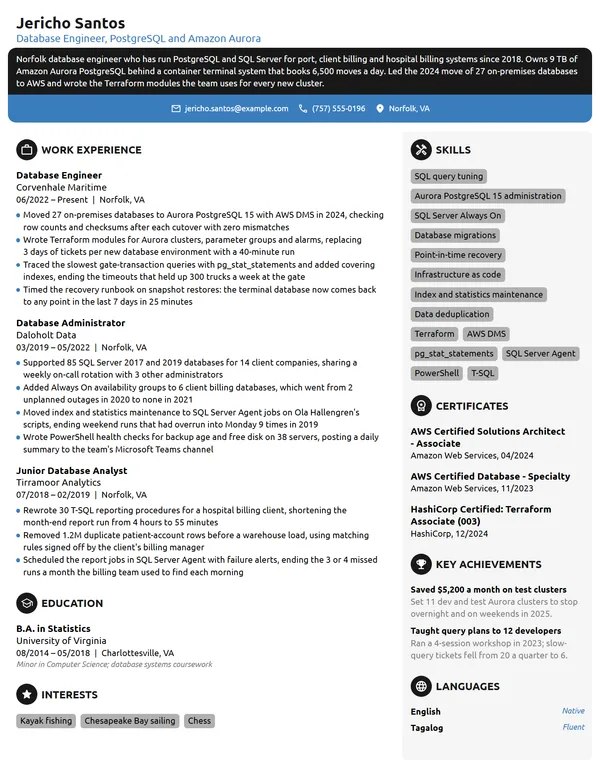
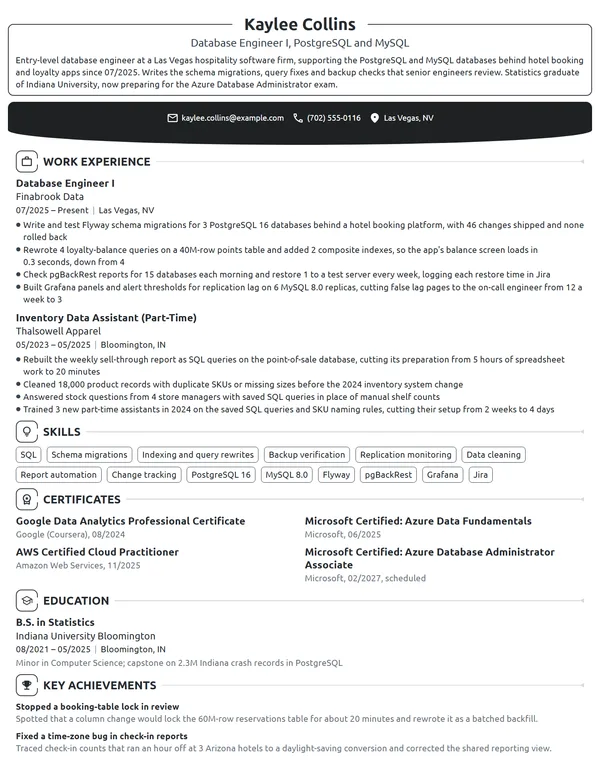
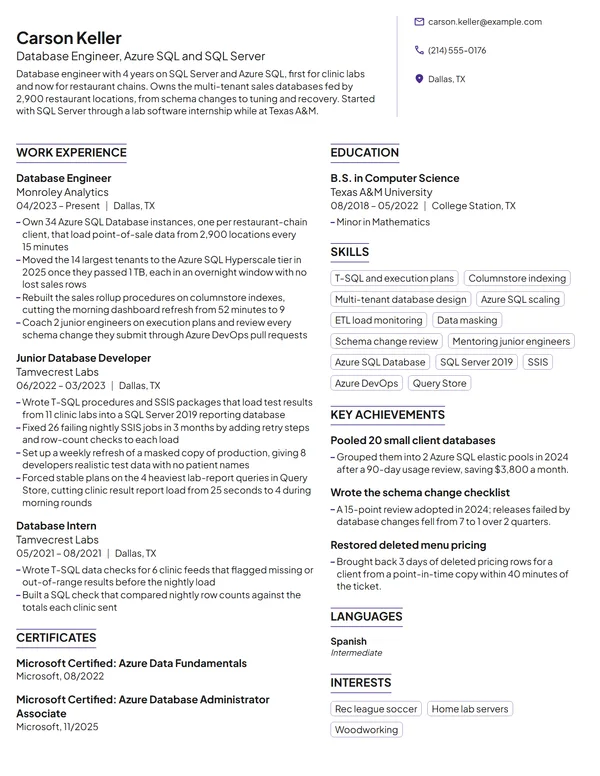
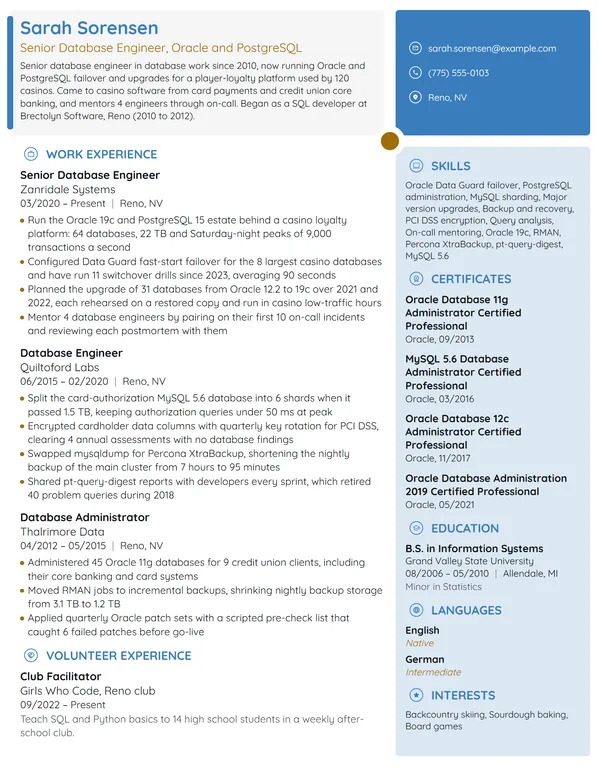
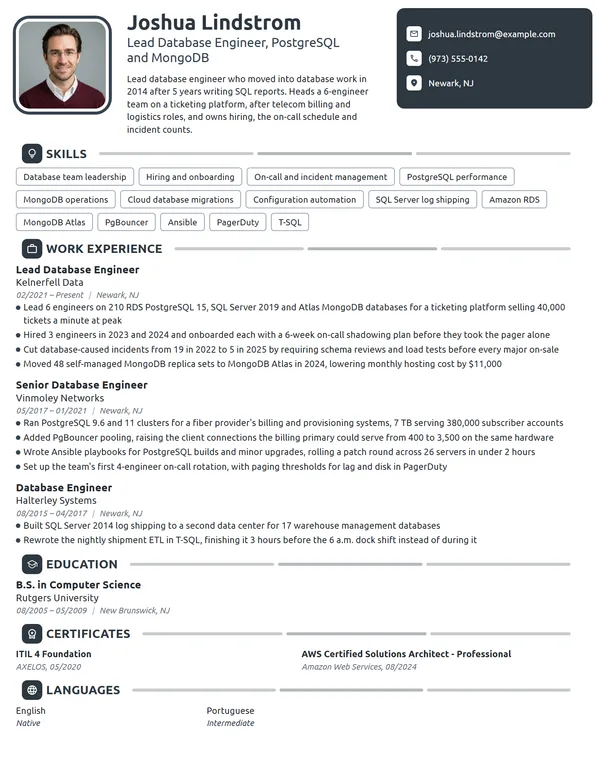
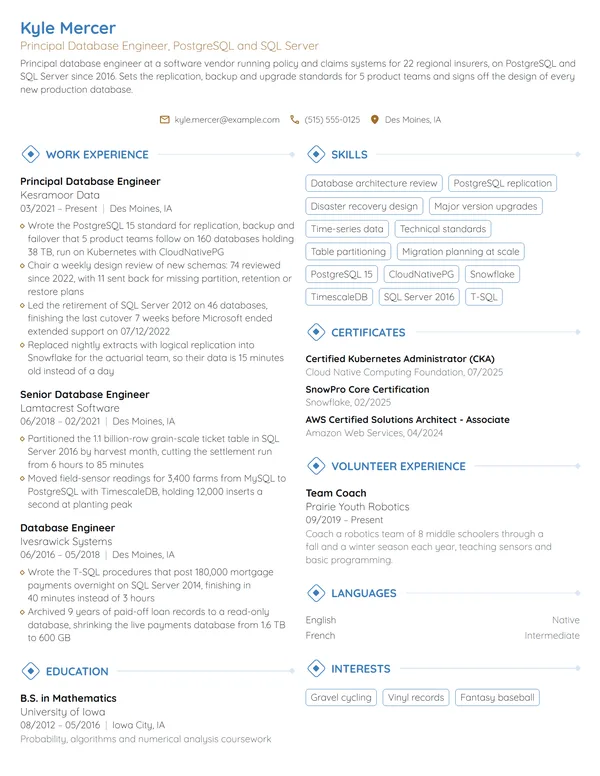
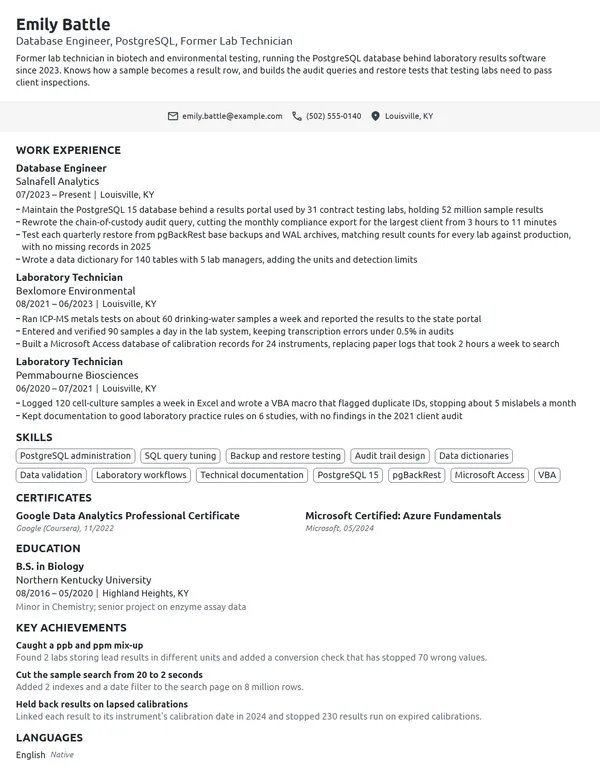
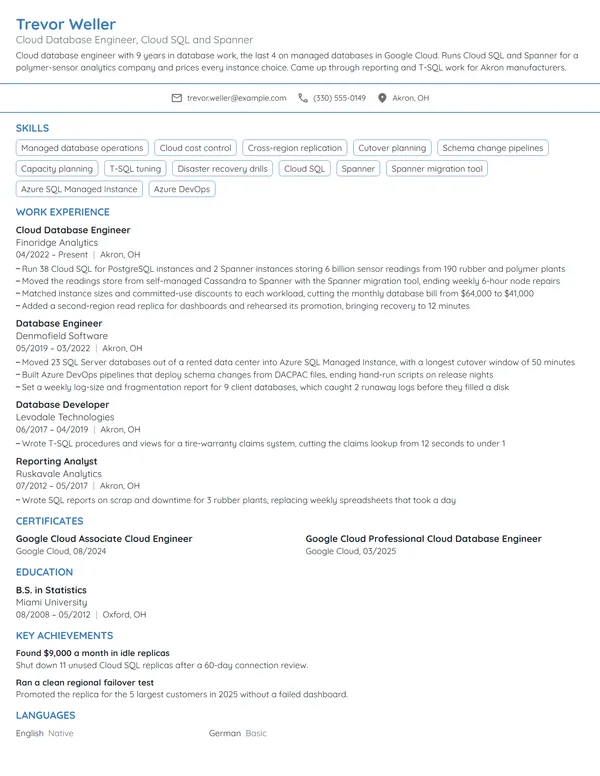
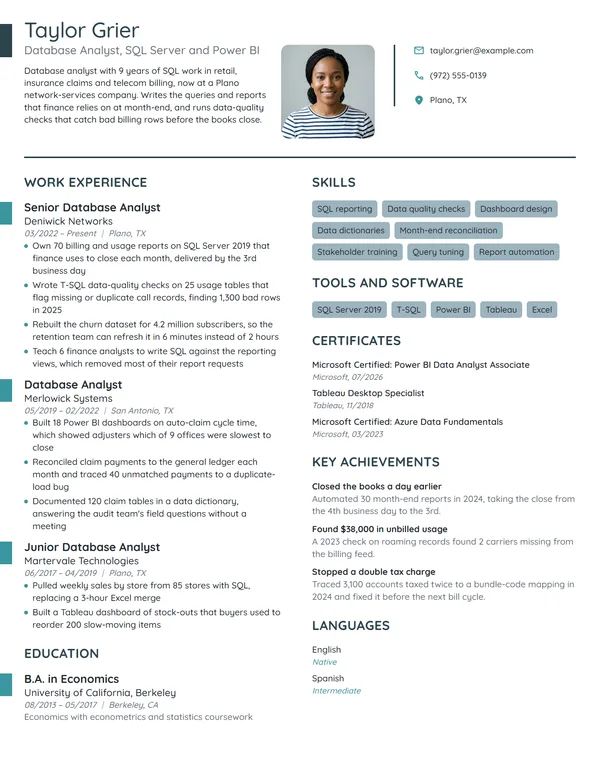
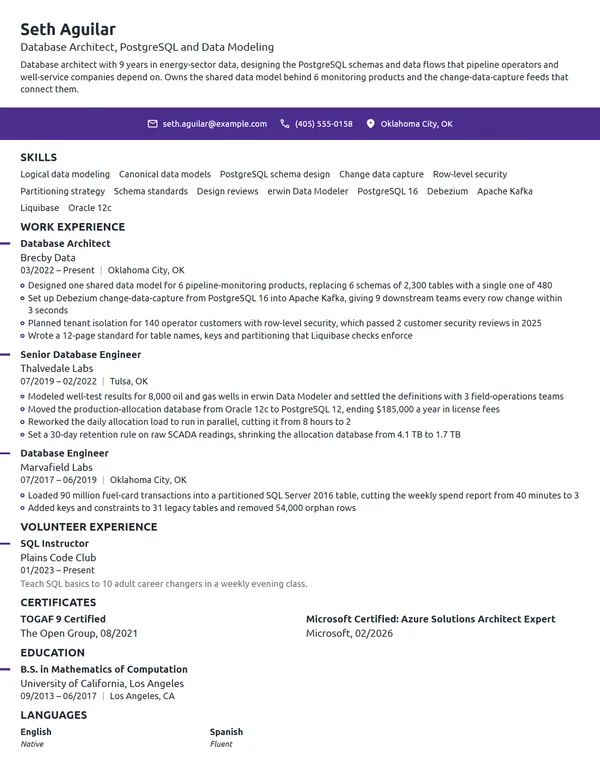
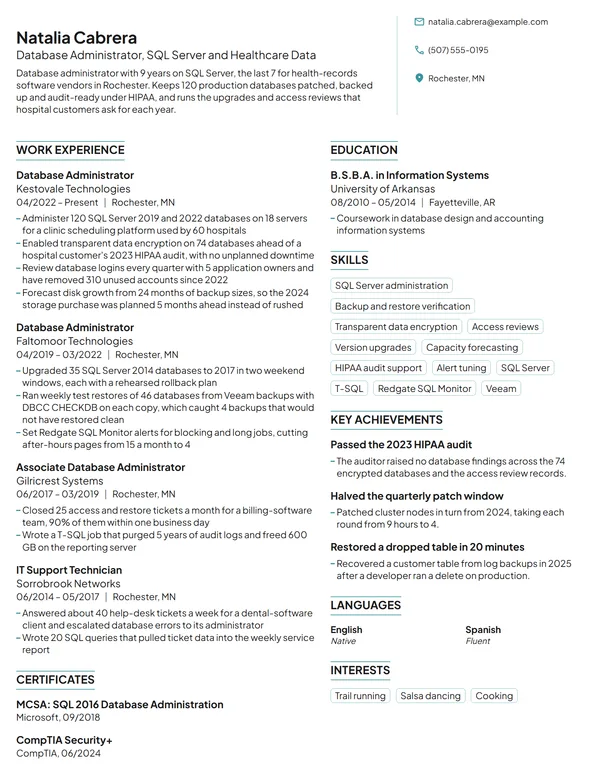
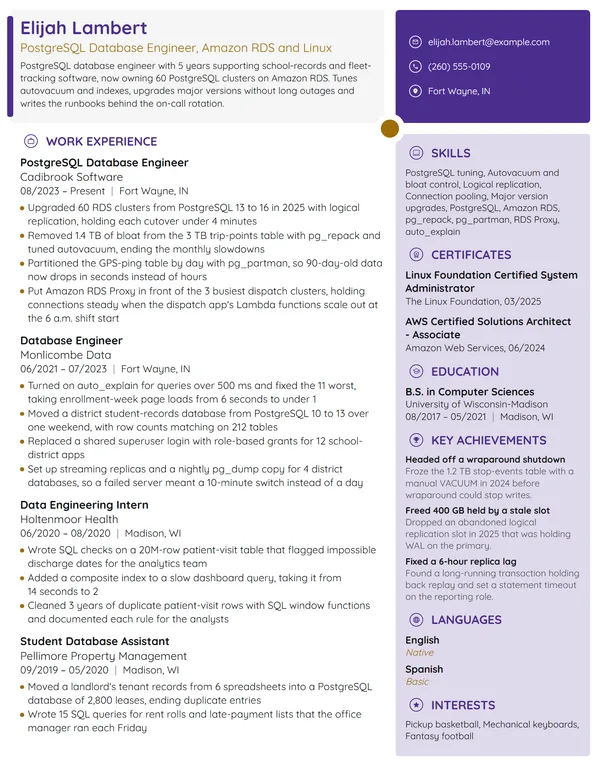
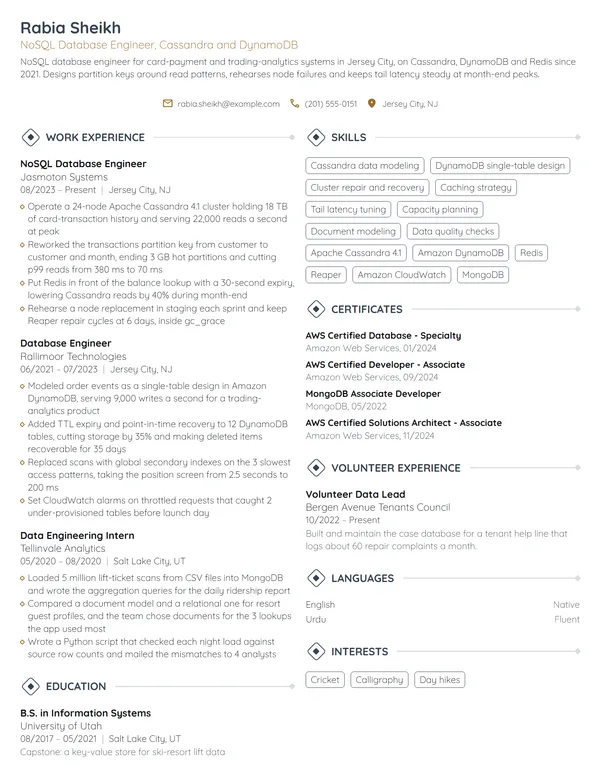
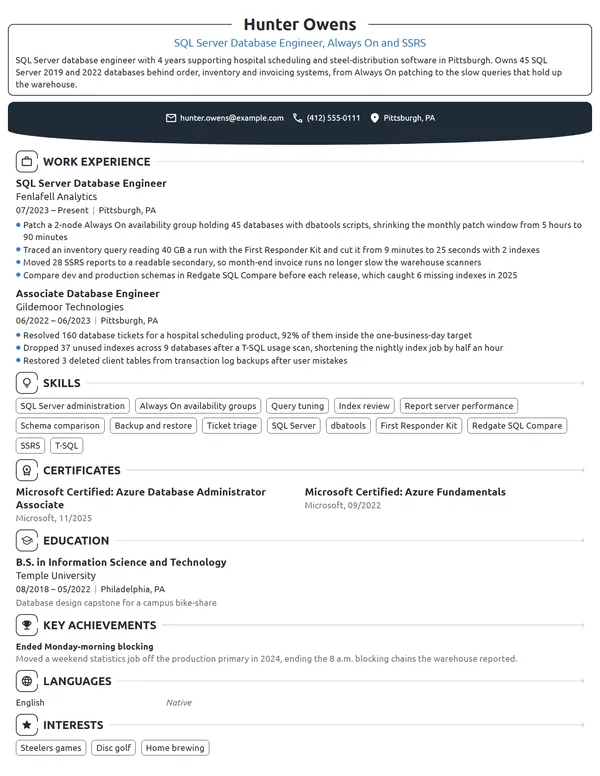
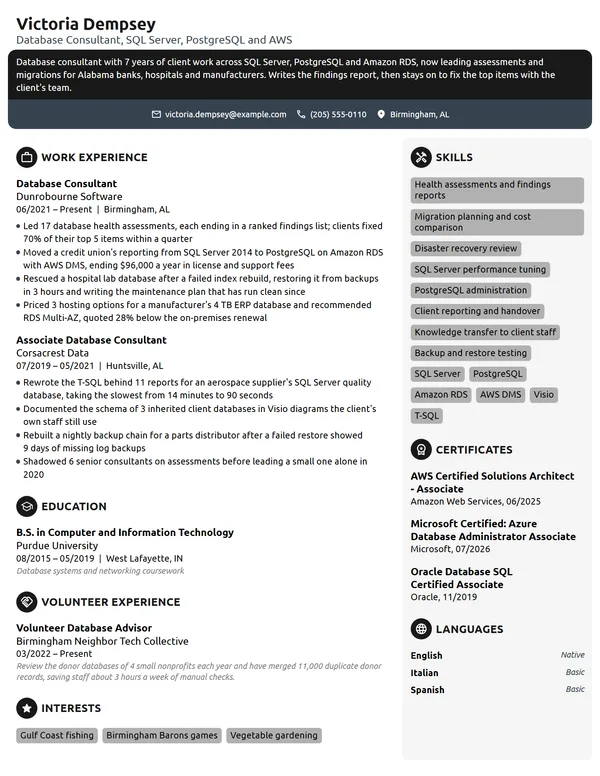
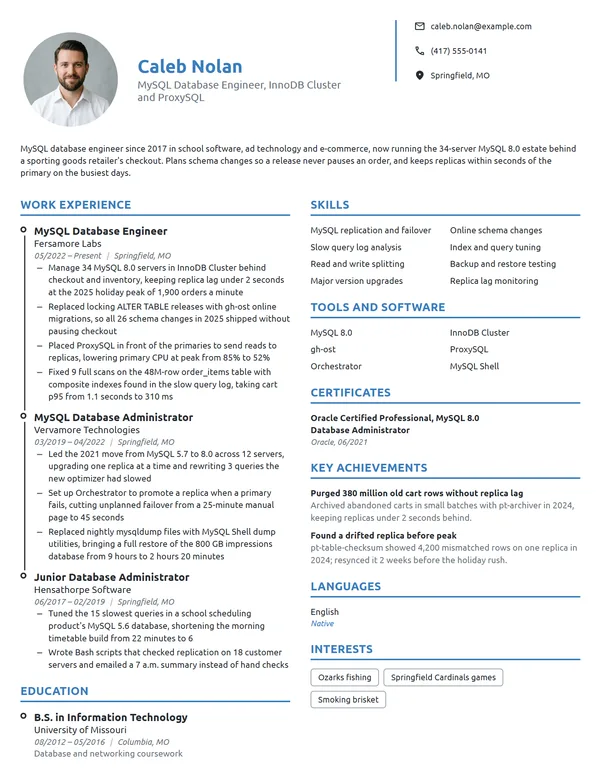
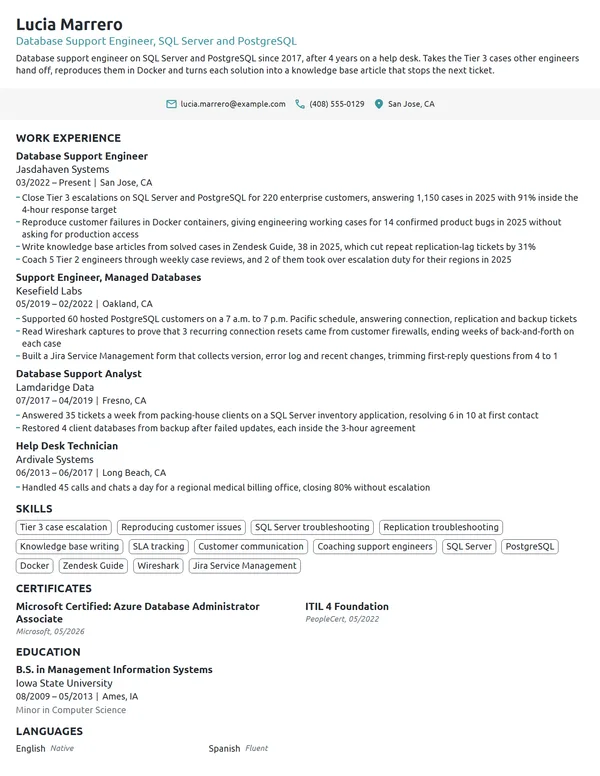
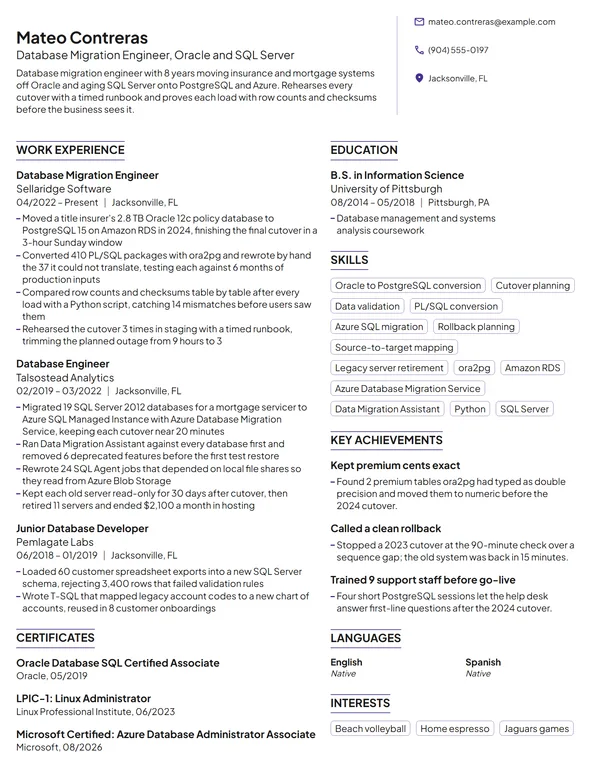
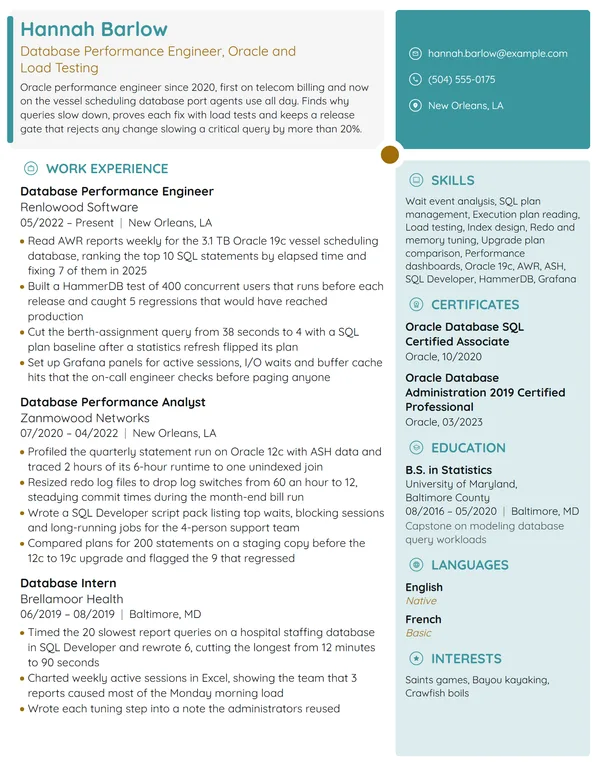
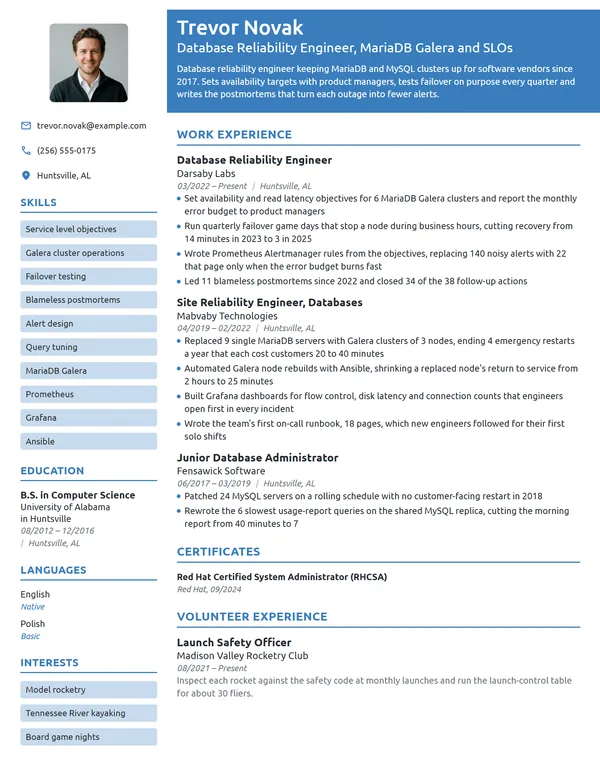
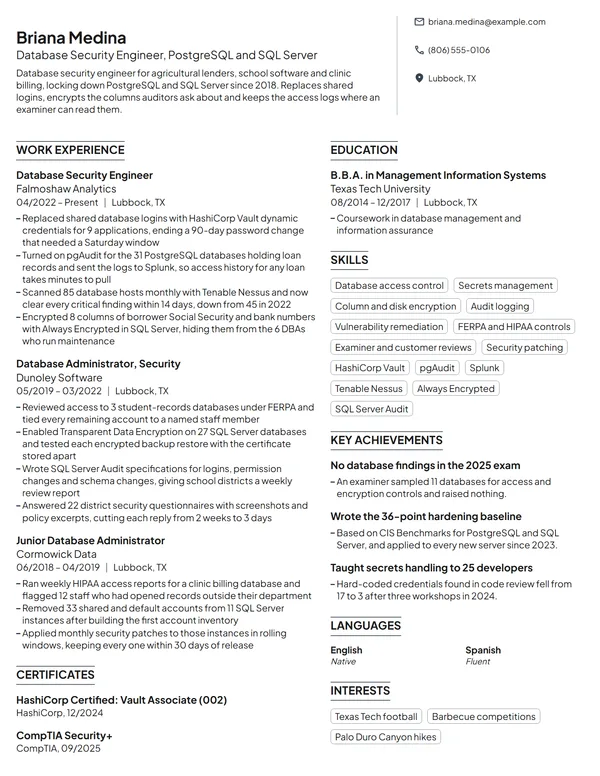
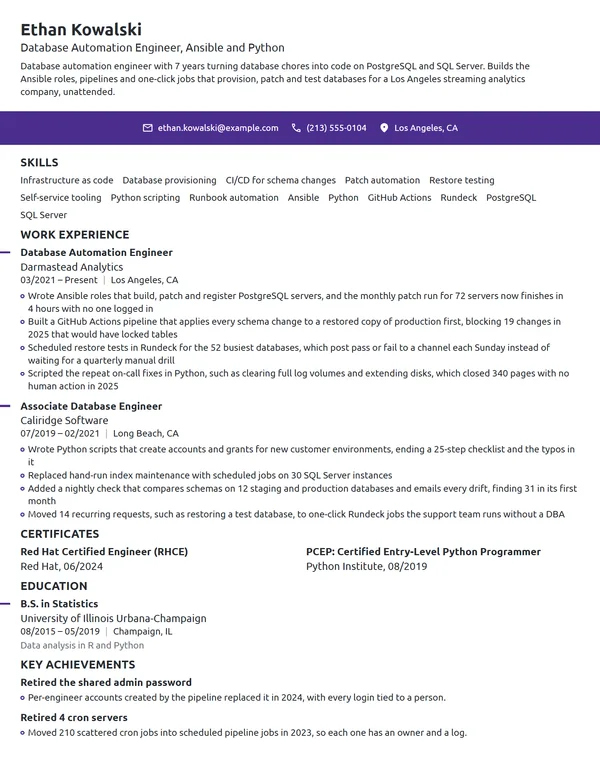
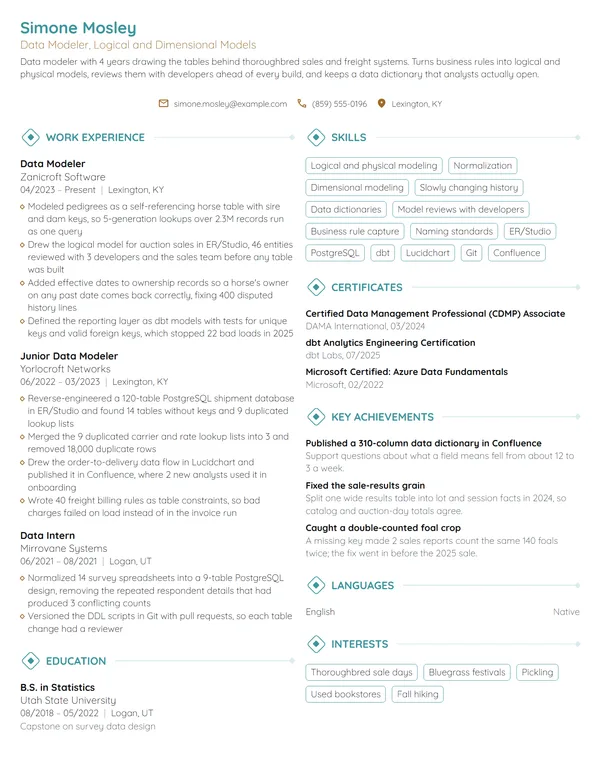
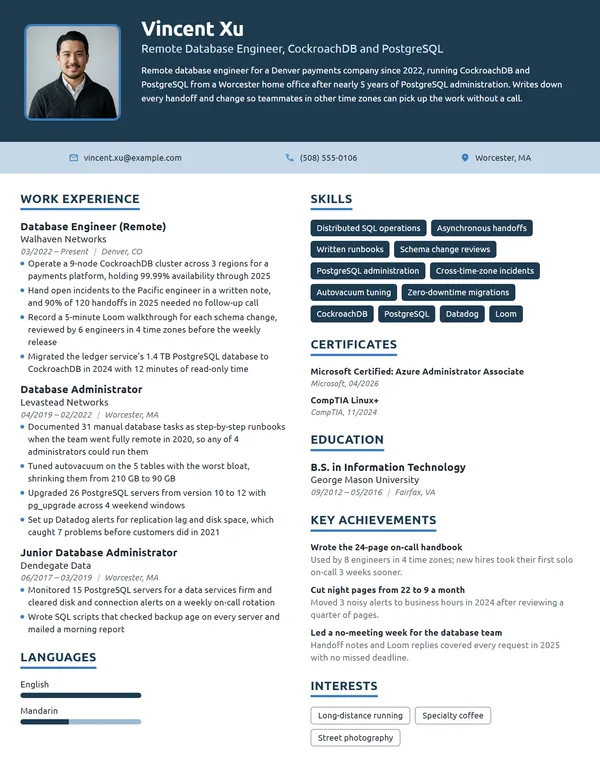
Database engineers design the schemas, tune the queries and keep production data fast and recoverable. Engineering teams hiring one check which engines you know in depth, such as PostgreSQL, SQL Server, Oracle or MySQL, how large and busy your databases were, and whether your backups have ever been proven by a real restore. The strongest resumes give every database a size, in terabytes or transactions a second, and every change a before-and-after number.
How to Write a Database Engineer Resume - Key Takeaways
- Pick newest-first (reverse-chronological) order and fit it on 1 page, adding a second only with 10+ years or several large migrations behind you.
- Open with a 2- to 3-line summary naming your engines, the size of the data you run and your best tuning, uptime or migration result.
- Give each bullet a database number: TB or rows, query time before and after, uptime, failover time, recovery targets or downtime.
- Write engines with their version and hosting, such as PostgreSQL 15 on Amazon RDS, in Skills and again inside a bullet.
- List certifications under Certificates with the month you passed, and keep a retired AWS Database Specialty only while it is still active.
- Leave out your age and other personal details, and run the finished file through an ATS resume checker before sending it.
What hiring managers look for in a database engineer resume
The BLS lists designing and building new databases, keeping organizational data secure, and backing up and restoring data to prevent loss among the core duties of database administrators and architects. O*NET files Database Engineer as a reported title under database administrators, with tasks such as installing upgrades to improve performance and setting user access levels for each part of a database.
A hiring manager also wants to see your own part in each change, apart from the team's. Use sections that screening software parses cleanly:
- Name, headline (Database Engineer, PostgreSQL and SQL Server) and contact details, plus GitHub if it holds your own scripts
- A short summary at the top of the page; it prints without a heading
- Work Experience, current role first
- Skills, with your engines, languages and cloud services
- Certificates
- Education
- Optional: Key Achievements or Languages
Best format for a database engineer resume
Go with the reverse-chronological resume format, with your newest role on top and each one carrying your title, the employer, its city, and the months you began and left. Database engineers often start as developers, analysts or administrators and take on bigger systems with each move, and newest-first order shows that growth in scale. A combination format, with skills above a short history, only helps when every earlier job sits outside tech.
- Best for most database engineersReverse-chronologicalYour jobs, newest first, with your results under each one.Best for: A steady work history in your field
- FunctionalSkills grouped up top, with a short work history below.Best for: Gaps or very little experience
- CombinationA skills section first, then your full work history.Best for: A career change with strong skills
Under 10 years in database work fits on 1 page. A senior or lead engineer with several platform migrations, on-call ownership or a team to run can use 2 pages, keeping the latest 2 roles on page 1.
| Setting | What to use |
|---|---|
| Length | 1 page; 2 pages with 10+ years or several large migrations |
| Dates | Month and year (MM/YYYY), and Present for your current role |
| Headline | Your title plus your main engines, such as Database Engineer, PostgreSQL and SQL Server |
| Links | GitHub or a personal site in the contact line, only if it shows SQL, scripts or tooling you wrote |
| Photo, age, SSN | Skip the photo, which US and Canadian employers rarely expect, along with your age, family status and Social Security number |
| File type | PDF, or .docx when the hiring portal accepts nothing else |
Most US and Canadian resumes carry no photo. Tech employers screen with ATS software, so engine names typed as text, never inside a logo or chart, matter more than any design choice.
Database engineer resume summary vs. objective
Already working on production databases? Write a resume summary with your years, your engines, the size of what you run and 1 result. Aiming for your first database engineering title? Write a resume objective naming the role and the closest database work you have done, from an internship, a capstone or your current job. Leave it until your bullets are finished, then lift its figure from the strongest one.
Database engineer resume summary formula
Title with X years on engines in industry, running data size or load. Your best tuning, uptime or migration figure. Certification or exam status.
Example
Database engineer with 8 years on PostgreSQL and SQL Server in healthcare, running 14 TB across 3 clusters. Cut the nightly claims batch from 5 hours to 70 minutes. Microsoft Certified: Azure Database Administrator Associate, with the Google Cloud database exam booked for 01/2027.
Don't
Results-driven database professional with strong SQL skills and a passion for performance and data integrity.
Do
Database engineer with 5 years on MySQL and Aurora at a payments company, supporting 4,000 writes a second. Built the replica setup that brought failover under 30 seconds.
The rewrite names the engines, the industry, the load and 1 measured result.
How to write database engineer work experience bullets with numbers
Give your current role 3 to 4 bullets and older roles the same or fewer, down to 1 or 2 for a short early job, every one opening with a verb. Databases record their own evidence in slow query logs, monitoring dashboards, change tickets and cloud bills, so most bullets can carry a before-and-after figure. Follow the usual rules for listing work experience on a resume, then add the scale a database team checks first.
| Area | What to count | Example bullet |
|---|---|---|
| Query performance | p95 latency, slow queries fixed, CPU on the primary | Rewrote 18 of the 25 slowest queries and cut average CPU on the primary from 78% to 45%. |
| Availability | Uptime, failover time, incidents | Cut failover time from 4 minutes to 20 seconds by moving to a 3-node Always On availability group. |
| Backup and recovery | Recovery point, recovery time, restore tests | Brought the recovery point from 24 hours to 5 minutes with continuous WAL archiving to Amazon S3. |
| Migrations and upgrades | Databases moved, TB, downtime, failed cutovers | Upgraded 22 MySQL 5.7 databases to 8.0 with no failed cutovers. |
| Scale | TB, rows, transactions a second | Partitioned a 2.4 TB orders table by month and held 3,000 transactions a second through peak sales. |
| Security and cost | Encrypted databases, audit findings, monthly spend | Right-sized 16 RDS instances and moved 9 to reserved pricing, saving $7,400 a month. |
Work Experience
- Migrated 41 SQL Server databases (6.2 TB) to PostgreSQL 15 on Amazon RDS over 9 months, with 35 minutes of planned downtime in total.
- Redesigned indexing on the 900M-row claims table, cutting p95 read latency from 1.8 s to 240 ms.
- Set up Patroni streaming replication across 2 availability zones; the cluster has held 99.97% uptime over the last 12 months.
- Run quarterly restore drills on 12 production databases, each restored within the 2-hour target.
- Administered 60 SQL Server 2016 instances for 1,100 users and scripted patching in PowerShell, shrinking a 3-night patch window to 1.
- Replaced individual logins with 14 role-based groups after an access review found 230 stale accounts.
Don't
Responsible for database performance tuning.
Do
Found 12 missing indexes through Query Store and cut the nightly billing batch from 3 hours to 50 minutes.
Don't
Performed regular database backups.
Do
Scheduled and tested backups for 40 databases, with a monthly restore drill that met the 1-hour recovery target every time.
Database engineer skills, engines and tools for your resume
Choose 6 to 8 technical skills for your resume that the posting names and your bullets back up. SQL, data modeling and performance tuning fit almost every database engineer; NoSQL, infrastructure as code or a second cloud belong only where you have run them in production.
Hard skills for database engineers
- SQL and query optimization
- Relational schema design
- Indexing and partitioning
- Replication and high availability
- Backup, restore and disaster recovery
- Database migrations and version upgrades
- Access control and encryption
- Monitoring and capacity planning
- Stored procedures (T-SQL, PL/SQL, PL/pgSQL)
- Infrastructure as code
Soft skills engineering managers value
- Calm incident response
- Clear change documentation
- Working with application developers
- Risk judgment before a cutover
- Teaching others to write better queries
- Ownership of on-call rotations
Put your engines and tools in Skills, then prove each one inside a Work Experience line describing what you did with it. O*NET flags PostgreSQL, MySQL, MongoDB, Transact-SQL, Oracle PL/SQL, Terraform and Kubernetes among the in-demand tools of database administrators, the occupation it files database engineers under. Write the managed service where you used one, such as Amazon RDS, Aurora, Azure SQL Database or Cloud SQL, and the monitoring tool your team relied on.
Azure, Google Cloud and AWS certifications for database engineers
Database engineering has no license, so certifications are optional proof, strongest when they match the employer's cloud or engine. The BLS says certification usually comes from software vendors or vendor-neutral providers, and some employers require it for the products they use. List certifications on your resume under Certificates, with the issuer and the month you passed.
| Credential | Issued by | What it takes |
|---|---|---|
| Microsoft Certified: Azure Database Administrator Associate | Microsoft | Exam DP-300, covering Azure SQL Database, Azure SQL Managed Instance and SQL Server, including high availability and disaster recovery. Renewed every 12 months through a free online assessment on Microsoft Learn. |
| Professional Cloud Database Engineer | Google Cloud | A 2-hour exam of 50 to 60 questions. Google recommends 5+ years of database and IT experience, including 2 years hands-on with Google Cloud database products. |
| AWS Certified Database (Specialty) | Amazon Web Services | Retired: the exam closed in 04/2024. A certificate earned by then stays active for 3 years from the date you passed it. |
How to list the retired AWS Database Specialty
Keep it under its original name with the month you passed, for as long as its 3 years run; once it lapses, it cannot be renewed, so take it off. Never date it after 04/2024. AWS announced the AWS Certified Data Engineer (Associate) in the same January 2024 notice, available from 03/2024, but it is a data engineering credential, so add it only if you have built pipelines as well.
Certificates
- Microsoft Certified: Azure Database Administrator Associate, Microsoft, 06/2023, renewed 06/2026
- AWS Certified Database (Specialty), Amazon Web Services, 02/2024
- Professional Cloud Database Engineer, Google Cloud, scheduled 01/2027
How to list a computer science or IT degree on a database engineer resume
The BLS gives a bachelor's in computer and information technology, or a nearby field such as engineering, as the typical education for database administrators and architects; some study business. The same page adds that they need an understanding of database languages such as SQL. When listing education on a resume, give the degree, the school, its city and your graduation month.
In your first 2 to 3 years, 1 line under the degree can name database systems coursework or a capstone that ran on a real engine. After that, Education moves below Work Experience and stays to 2 lines. A bootcamp or a community college certificate is its own Education entry, with the program name and end date.
Education
Entry-level and career-change database engineer resumes
With no database engineering title yet, an entry-level resume layout works: a brief objective, Education high on the page, then every piece of work where you designed, queried or ran a database. Give each one an engine and a size.
- Internships: the engine, the tables or queries you owned, and what got faster or cleaner.
- Capstone or course project, under Education: a schema you designed, its table count and the query times you reached.
- Analyst or support jobs: reports you rebuilt in SQL, data you cleaned, the run time you cut.
- Certifications: a passed or scheduled exam, such as DP-300, listed under Certificates with its date.
Don't
Computer science graduate looking for an entry-level database role where I can grow my skills.
Do
Computer science graduate seeking a junior database engineer role. Designed a 22-table PostgreSQL schema for a campus housing app in a 2-semester capstone and tuned its 5 slowest queries to under 100 ms.
Even a first-job objective can name an engine, a size and a result.
Career changers often arrive from database administration, software development, data analysis or systems administration. Keep newest-first order, open with a summary naming the database work you already do, and put the most engineering-heavy bullets first: schema changes, tuned queries, automated maintenance. A career-change resume leaves the reason for the move to your cover letter, and the IT cover letter examples show how to give it 2 or 3 sentences.
Database Engineer resume FAQ
Is a database engineer the same as a database administrator?
Not quite, though the work overlaps. O*NET files Database Engineer under database administrators, and many teams use both titles. Engineer postings usually lean toward design, automation and migrations, administrator postings toward daily operations. Match your headline to the posting's title and lead with the matching bullets.
Do I need a certification to work as a database engineer?
No. No license exists for the job, and many engineers are hired on experience alone. Per the BLS, some employers require certification in the products they use, so a credential such as the Azure Database Administrator Associate helps most when the posting names that platform.
How long should a database engineer resume be?
Use 1 page for under 10 years of experience. With 10+ years, several large migrations or a team you led, 2 pages work, provided your 2 most recent roles sit on page 1 with their sizes and results.
Which database engines should I list on my resume?
Only the engines you have run in production or could support from your first week, with their versions where it matters, such as SQL Server 2019 or PostgreSQL 16. Put the ones the posting names first, and back each with at least 1 bullet.
Can I still list the AWS Certified Database Specialty?
Yes, while it is active. AWS stopped offering the exam in 04/2024, and a certificate earned by then stays active for 3 years from its pass date. List it with that date, and remove it once it lapses, since it can no longer be renewed.
How do I show database results when the details are confidential?
Use rounded sizes and relative changes instead of names. Write about 10 TB, a customer orders database or cut p95 latency by 80% rather than naming the system or client, and keep any figure your employer treats as secret off the page.
How much do database engineers make?
The BLS reports a median annual wage of $104,620 for database administrators and $139,500 for database architects in May 2025, and has no separate line for database engineers. Salary belongs in the offer conversation, never on the resume itself.
Next steps
Start from the example nearest your level, copy its section order, then swap in your own engines, database sizes and before-and-after numbers. Build the page in our resume builder or begin from one of the resume templates, and open your cover letter with the migration or tuning result you are proudest of.