
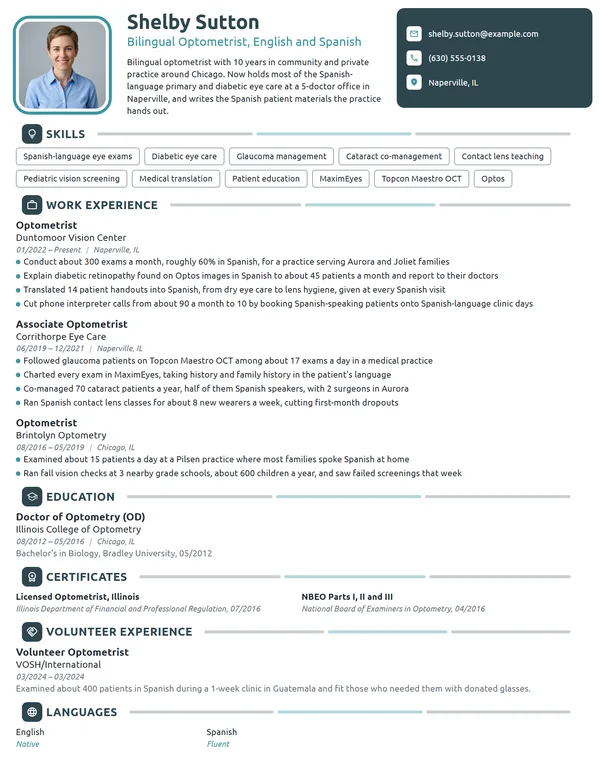
When a practice owner or clinic director opens your resume, your state license is usually the first thing they look for. Next come your clinical experience, the EHR and imaging systems you use, and numbers like patients seen per day. Fitting all of that on one page without burying the key details takes some planning, and each section below walks through it.
How to Write an Optometrist Resume - Key Takeaways
- Keep a reverse-chronological layout to 1 page, moving to 2 only after 10+ years or with residency, teaching or research work to show.
- Open each job with the practice setting, the number of doctors and your usual exams a day.
- Count what a practice tracks: medical visits, glaucoma and diabetic patients, contact lens fits, optical capture and recall.
- Put your state license first under Certificates, with its DPA/TPA or other prescribing endorsements written the way your state names them.
- List NBEO Parts I, II and III, TMOD and any laser or injection exam as passed, with no scores.
- Run the final file through an ATS resume checker, since group practices and retail-affiliated employers filter for license and EHR terms.
What practice owners look for in an optometrist resume
The BLS sums up the job as performing vision tests, diagnosing vision problems and eye diseases, prescribing corrective lenses and referring patients when needed. O*NET adds 2 tasks that sort candidates fast: prescribing medications to treat eye disease where state law permits, and giving pre- and post-operative care to cataract and laser vision correction patients. An employer reading your resume wants to know how much of that you already do without help.
That reader is usually a private practice owner, a medical group's clinic director or a recruiter for a retail-affiliated office. Each one scans for a license in their state, a setting like theirs and a patient load they can schedule. Arrange the page in these sections:
- Name, headline (for example, Optometrist, OD) and contact details
- A 2 to 3 line profile under your name, printed without a heading
- Work Experience, with the practice setting and doctor count in each entry
- Certificates: your state license first, then NBEO exams and laser or injection credentials
- Skills, with your EHR and imaging systems
- Education: the OD, any residency and your undergraduate degree
- Optional: Languages, Key Achievements or Volunteer Experience
Best format for an optometrist resume
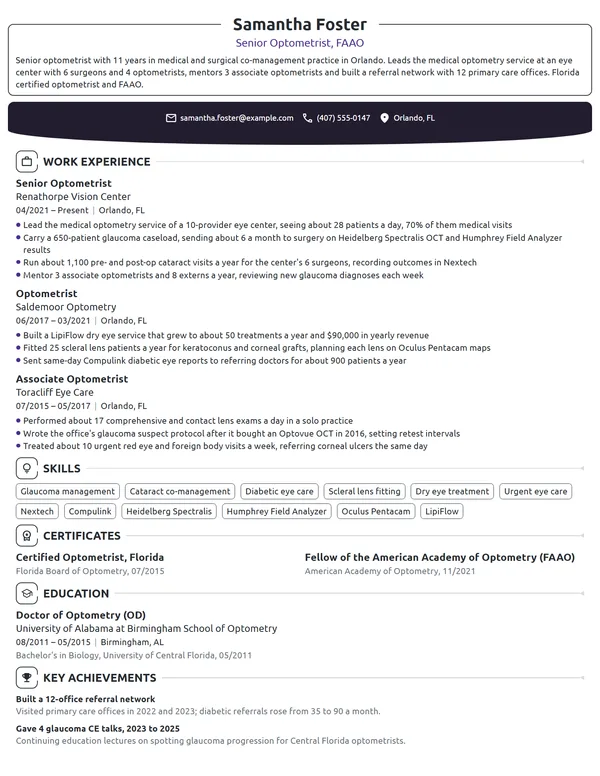
Use the reverse-chronological resume format: current job first, then older ones, each with your title, the practice, the city, and start and end months as MM/YYYY. Optometry careers tend to move from a first associate job to a larger caseload, a specialty clinic or ownership, and this order lets an employer follow that path. Keep it even if you changed settings, since the setting change is part of the story.
- Best for most optometristsReverse-chronologicalYour jobs, newest first, with your results under each one.Best for: A steady work history in your field
- FunctionalSkills grouped up top, with a short work history below.Best for: Gaps or very little experience
- CombinationA skills section first, then your full work history.Best for: A career change with strong skills
Most optometrists fit on 1 page. Go to 2 pages once you have 10+ years, a residency plus several practice jobs, or teaching, research and precepting to show, and keep your license and current job on page 1.
| Setting | What to use |
|---|---|
| Length | 1 page; 2 after 10+ years or with residency and academic work |
| Headline | Optometrist, OD, plus a residency area if you completed one |
| Dates | MM/YYYY for every job and exam, Present for the current role |
| Typeface | 1 clean font family, body text no smaller than 10 pt |
| Photo | None for most US and Canadian applications; skip your date of birth, marital status and SSN too |
| File type | PDF by default; a .docx only when the application form requests it |
Most US and Canadian resumes carry no photo. When you apply through a group practice or a retail-affiliated employer's online portal, keep standard section headings and real text, not text inside images, so the system can read every line.
Optometrist resume summary vs. objective
Licensed and practicing? Write a resume summary that gives your years, your setting, your clinical focus and 1 number. Still in your 4th year or finishing a residency? Write a resume objective that names the setting you want, your NBEO and license status and your strongest externship. One test decides it: an active license means a summary.
Optometrist resume summary formula
Optometrist, OD with X years in practice setting, focused on clinical area. A measured result. License and the prescribing endorsements it carries.
Example
Optometrist with 7 years in private practice, focused on dry eye and ocular surface disease. Built an in-office dry eye clinic that now sees 60 patients a month. Licensed in Washington with DPA/TPA endorsements.
Don't
Dedicated optometrist with excellent patient care skills seeking a position at a growing practice.
Do
Optometrist with 5 years in a medical optometry practice, averaging 2,400 exams a year. Fits and follows 95 keratoconus and post-surgical scleral lens patients.
The rewrite gives the setting, the volume and the specialty an employer would book.
How to write optometry work experience bullets with numbers
Give your current job 3 to 4 bullets, and 2 to 4 to each job before it. Start with the setting and your daily patient load, then move to the results a practice can see on its own reports: medical visits, specialty fits, optical sales and recall. Phrase each one as one of your achievements on your resume, with the before and after figures.
| Area | What to count | Example bullet |
|---|---|---|
| Patient volume | Exams a day, schedule fill, doctors in the practice | Saw 24 patients a day in a 2-doctor office with the schedule 88% booked 3 weeks out. |
| Medical eye care | Glaucoma, diabetic and dry eye patients, urgent visits, referrals | Followed 140 diabetic patients with annual dilated exams and sent 12 urgent retinal referrals in 2025. |
| Contact lenses | New fits a month, specialty lenses, annual supply purchases | Fit 35 new contact lens patients a month and raised annual supply purchases from 30% to 47%. |
| Practice growth | Optical capture rate, recall rate, new patients | Rebuilt reminder texts with the front desk and lifted recall from 48% to 61% in a year. |
| Myopia management | Children enrolled, follow-up visits kept | Launched a myopia control program with 85 children enrolled in its first 18 months. |
| Surgical co-management | Pre- and post-operative visits, surgeons worked with | Handled 260 cataract co-management visits a year with 3 ophthalmology partners. |
Setting and load come first, medical work next, practice results last; the earlier job keeps 2 bullets.
Work Experience
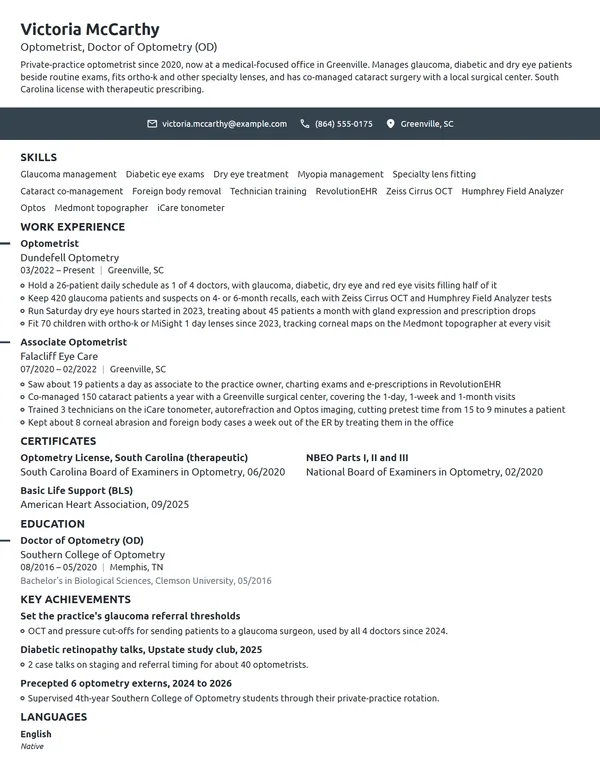
- See about 22 patients a day in a 3-doctor private practice, with about 40% of visits for dry eye, glaucoma or diabetic eye care.
- Follow 310 glaucoma patients with OCT and visual field testing and refer surgical candidates to 2 local glaucoma specialists.
- Grew scleral and other specialty lens fittings from 4 to 15 a month after adding corneal topography to the workup.
- Raised the share of diabetic exam letters reaching primary care within 7 days from 60% to 95% by templating the report in the EHR.
- Performed 18 comprehensive exams a day in a 2-lane clinic attached to an optical shop.
- Raised the optical capture rate from 52% to 64% by handing each patient off to an optician in the exam room.
Don't
Performed comprehensive eye exams.
Do
Performed about 20 comprehensive and medical exams a day across 2 offices, including dilated diabetic exams and same-day red eye visits.
Volume, visit mix and setting are what a scheduler books against.
Don't
Responsible for contact lens fittings.
Do
Fit 28 new soft and toric contact lens patients a month with a 91% first-lens success rate.
Optometry clinical skills and EHR software for your resume
Pick 6 to 8 hard skills for your resume from the posting and keep only the ones a bullet already proves. Refraction and binocular vision testing belong on nearly every optometrist resume; scleral lens fitting, vision therapy or laser procedures only when you do them.
Hard skills for optometrists
- Refraction and binocular vision testing
- Dilated fundus examination
- Glaucoma management
- Diabetic eye exams
- Dry eye treatment
- Contact lens and scleral lens fitting
- OCT and visual field interpretation
- Myopia management
- Pre- and post-operative care
- Foreign body removal
Soft skills eye care employers value
- Explaining a diagnosis in plain words
- Chair-side manner with children
- Decision-making on referrals
- Attention to detail
- Working with opticians and technicians
- Steady pace on a full schedule
Write your EHR and imaging systems by name in Skills and again in a bullet. Copy the exact system the posting names, whether that is MaximEyes, Compulink, RevolutionEHR or a hospital EHR. Do the same for instruments: an OCT, an Optos widefield camera or a Humphrey field analyzer is worth naming when the practice owns one.
Optometry license, NBEO exams and certifications on a resume
The BLS states that all states require optometrists to be licensed, and that some add an exam on clinical skills or on the state's optometry law. The national exams come from the National Board of Examiners in Optometry (NBEO), and each state decides which of them it accepts. List certifications on your resume under the license line, each with its issuer and the month you passed.
| Credential | Issued by | What it takes |
|---|---|---|
| State optometry license | Your state board of optometry | An OD from an accredited program and the exams the state names; Washington, for example, asks for NBEO Parts I, II and III plus TMOD. |
| NBEO Parts I ABS, II PAM and III PEPS | National Board of Examiners in Optometry | The 3-part licensure series: Applied Basic Science, Patient Assessment and Management, and Patient Encounters and Performance Skills. |
| TMOD (Treatment and Management of Ocular Disease) | National Board of Examiners in Optometry | A 120-item exam, taken alone or as an embedded part of Part II PAM. |
| LSPE (Laser and Surgical Procedures Examination) | National Board of Examiners in Optometry | A laser section (SLT, peripheral iridotomy, YAG capsulotomy) and a surgical section (suturing, chalazion excision), open to 4th-year students, residents and practitioners. |
| ISE (Injection Skills Examination) | National Board of Examiners in Optometry | A hands-on clinical skills exam on administering injections safely. |
| Residency certificate | Your residency program (ACOE accredits optometric residencies) | 1 year of advanced clinical training after the OD, in a named focus area; optional, as the BLS notes. |
How to write the license line
Write the license, the state, the issuing board and the month it was issued, then the prescribing endorsements in your state's own words, such as DPA/TPA in Washington. If you hold licenses in 2 states, list each on its own line. Leave out the license number and the NBEO scores: an employer checks the license with the board, and a pass is all the exam line needs to show.
Certificates
- Optometrist License, Washington (DPA/TPA), Washington State Board of Optometry, 06/2019
- NBEO Parts I, II and III, with TMOD, National Board of Examiners in Optometry, completed 04/2019
- Laser and Surgical Procedures Examination (LSPE), Laser Section, National Board of Examiners in Optometry, passed 10/2024
How to list your OD degree, externships and residency
The BLS describes the path: at least 3 years of undergraduate study and an entrance exam, then a Doctor of Optometry (OD) program that takes 4 years. The Accreditation Council on Optometric Education (ACOE) accredits OD programs and optometric residencies, and the BLS adds that some graduates choose 1 more year of advanced clinical training. List the residency above the OD, with its focus area and dates.
For each entry, follow the usual way to list education on a resume: degree, school, city and the graduation month. In your first 2 years of practice, add 1 line with your externship areas; after that, keep it to degree, school and year, and the undergraduate degree can shrink to 1 line.
Education
Externships: ocular disease, pediatrics and specialty contact lenses.
New grad and practice-change optometrist resumes
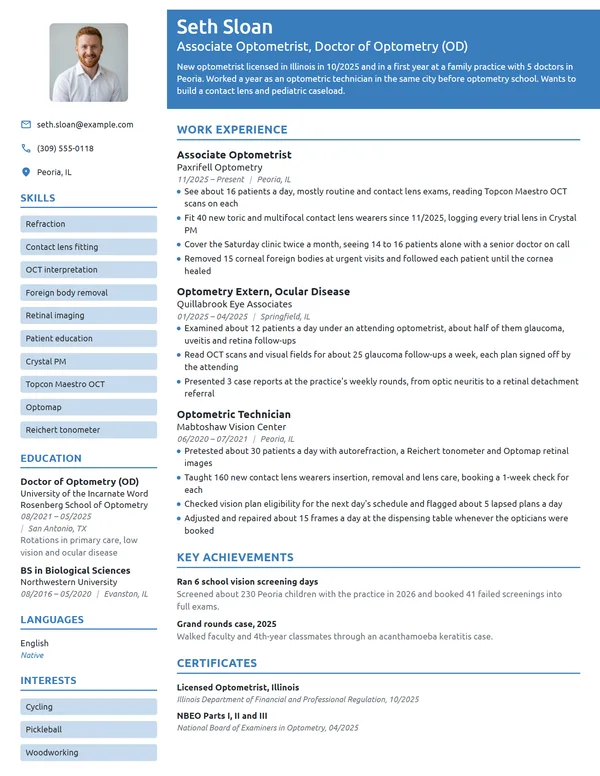
As a 4th-year student or new graduate, open with an objective that names the setting you want and your status: NBEO parts passed, license applied for or issued, with the month. Your externships are your work history, so give the strongest one a full entry with its setting, its patient mix and how many encounters you logged. The entry-level resume layout works if you have little else to show.
- Externship rotations: the setting (VA, community health center, private practice), its focus and your patient encounters.
- Residency: its focus area, your clinic days a week and any lectures or case reports you gave.
- Optometric technician or optician work: a full Work Experience entry with patients pretested a day and the instruments you ran.
- Vision screenings and outreach clinics: under Volunteer Experience, with the number of children or adults screened.
Don't
Motivated optometry student looking for an opportunity to learn and grow in a busy practice.
Do
OD candidate graduating 05/2027 with NBEO Part III passed 08/2026, seeking an associate role in a medical optometry practice. Completed 4 externships and about 1,600 patient encounters, half of them medical visits.
Exam status, a target setting and an encounter count stand in for the years of practice you do not have yet.
Moving from a retail-affiliated office to a medical practice, or into optometry after work as a technician or optician, stay with newest-first order and lead your bullets with the work that matches the new setting: medical visits, co-management or specialty fits. The career-change resume examples show how to frame an older job. Explain the move itself in your cover letter, and the healthcare cover letter examples show how to keep that to a few lines.
Optometrist resume FAQ
Should I put my optometry license number on my resume?
No. Give the license, the state, the issuing board, the endorsements and the issue month. Employers and credentialing staff verify the license with the state board, and the number adds nothing a reader can use on the page.
How do I list NBEO scores on an optometrist resume?
Leave the scores off and list the exams as passed, with the month or year: Parts I, II and III, TMOD, and any LSPE or ISE section. A pass is what an employer screens for, so the line ends with the date.
Do I need a residency to get hired as an optometrist?
No. The BLS describes the extra year of advanced clinical training as a choice after the OD. A residency helps most for hospital, VA, medical group and teaching jobs, so name its focus in your headline and list it above the degree.
How long should an optometrist resume be?
1 page for new graduates and most associates. 2 pages fit after 10+ years, or once a residency, teaching, research or practice ownership needs room, provided page 1 carries your license and current role.
Which EHR systems should I name on an optometrist resume?
Name the exact system you charted in, such as Compulink, MaximEyes or RevolutionEHR, and copy the spelling the posting uses. Put it once in Skills and once in a bullet that shows the work, such as building exam templates or onboarding a new doctor.
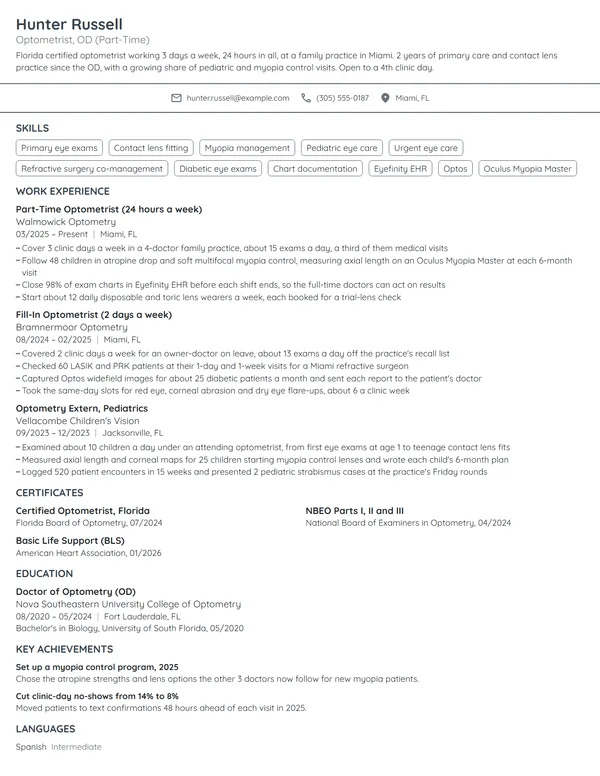
How do I show part-time or fill-in optometry work on a resume?
Give each regular part-time job its own entry with your days a week. Group short fill-in shifts at several offices under 1 entry, such as Fill-In Optometrist, with the overall dates and a bullet on the offices covered and exams done. The BLS notes part-time work is common in the field.
Should I list a second language on an optometrist resume?
Yes, if you can run an exam in it. Add it under Languages with your level, and show it in a bullet with the share of patients you see in that language, since practices in bilingual communities schedule around it.
Can I write OD after my name before I graduate?
No. Write OD only once the degree is conferred. Before that, write OD candidate with your expected graduation month in the objective, and list each NBEO part as passed or scheduled with a date.
What is the average optometrist salary?
Optometrists earned a median of $136,570 a year in May 2025, per the BLS. Pay varies with the setting, the state and production bonuses; keep it off the resume and talk about it when an offer is on the table.
Next steps
Pick the example nearest to your setting and career stage, keep its layout, and put in your own license, endorsements, daily exams and results. Build it in our resume builder or begin with one of our templates. Send it out with a short letter naming the practice and the patients you hope to see.