
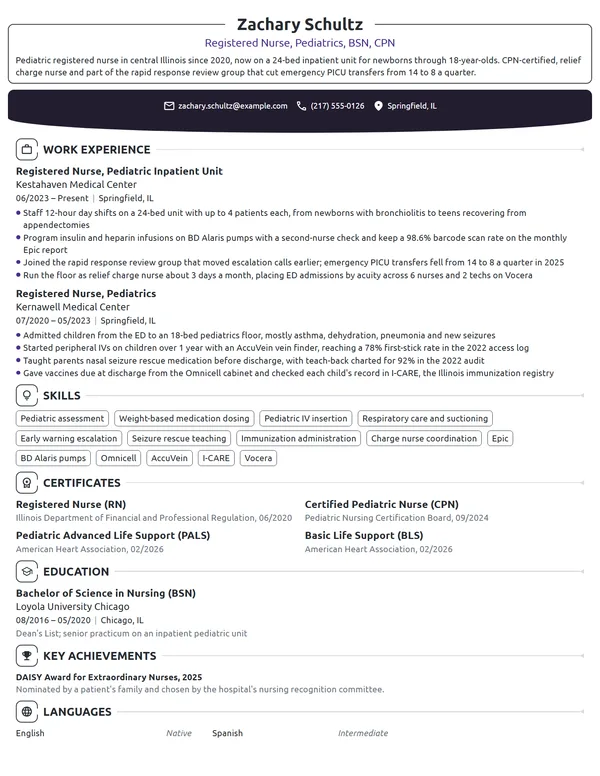
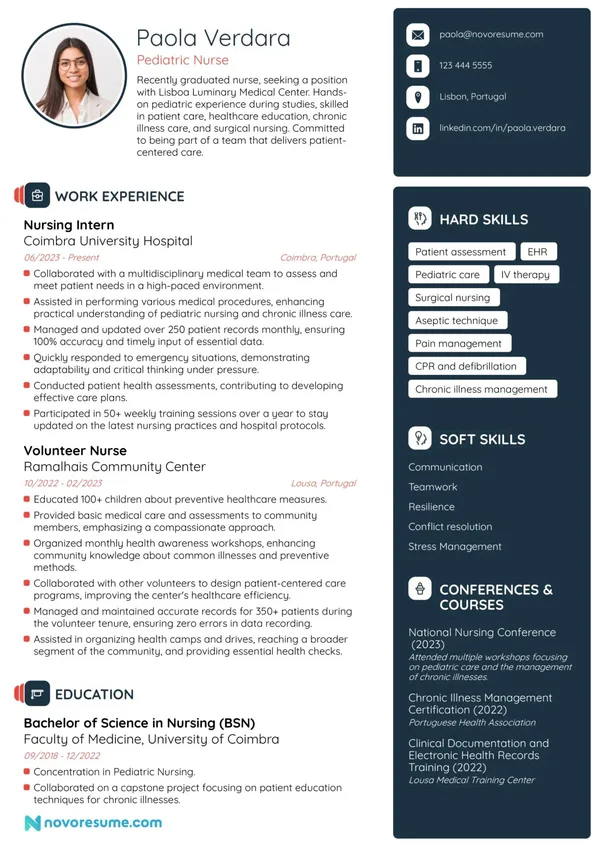
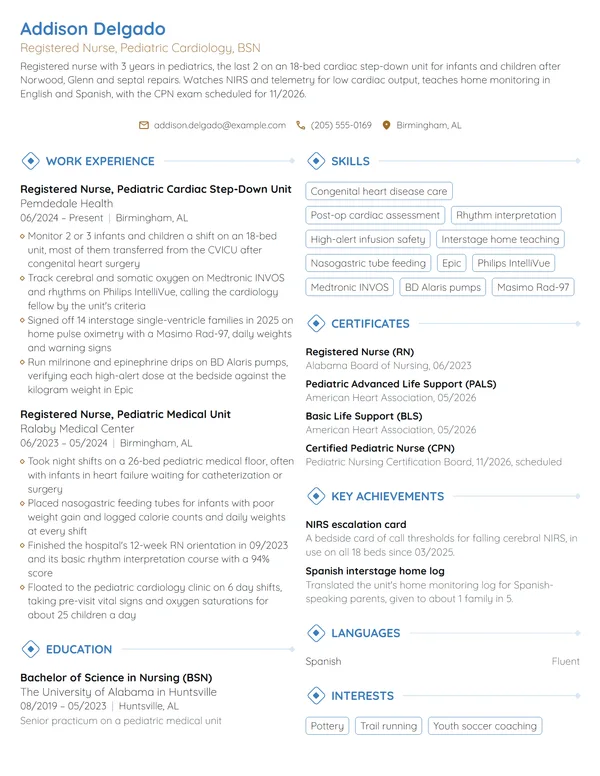
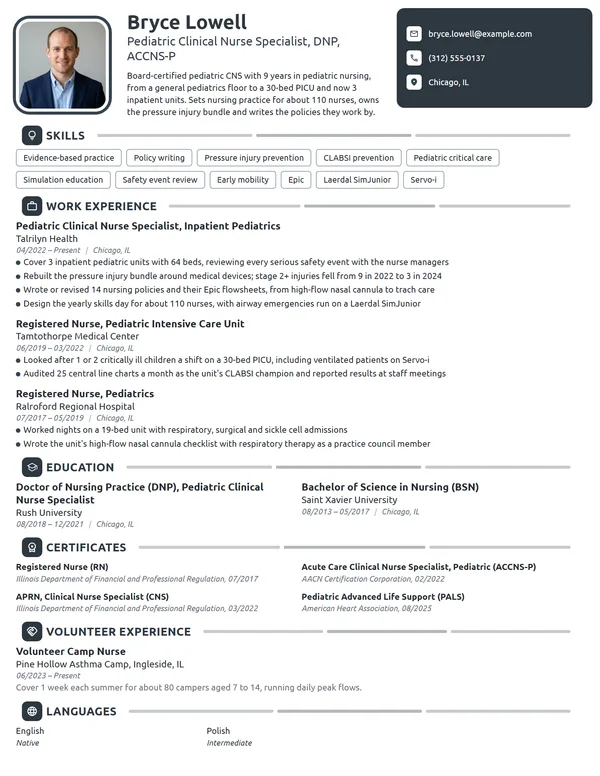
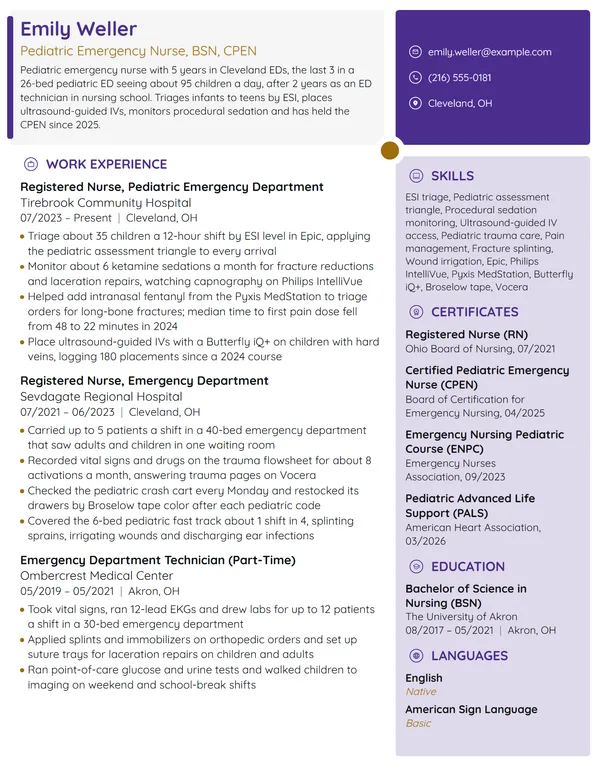
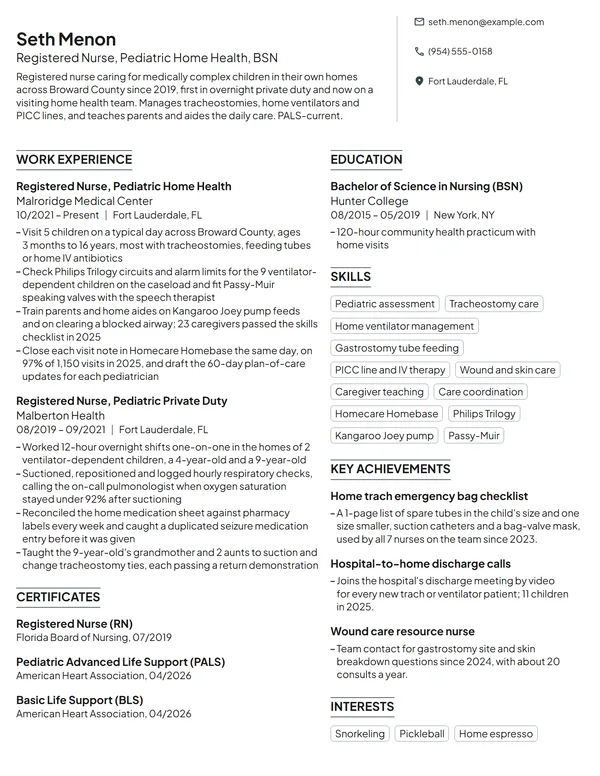
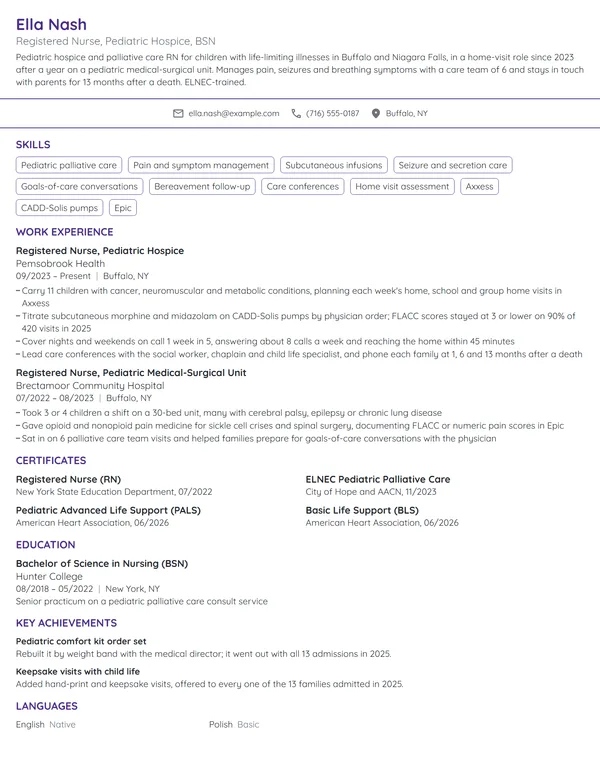
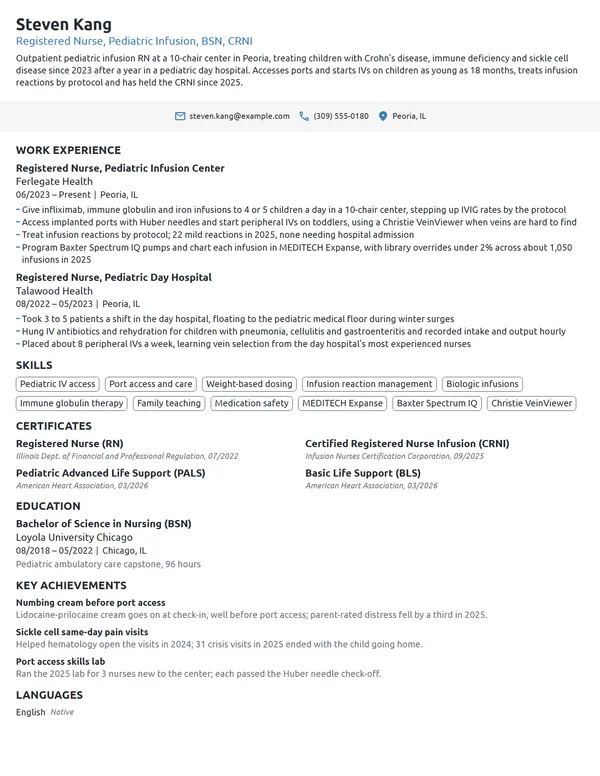
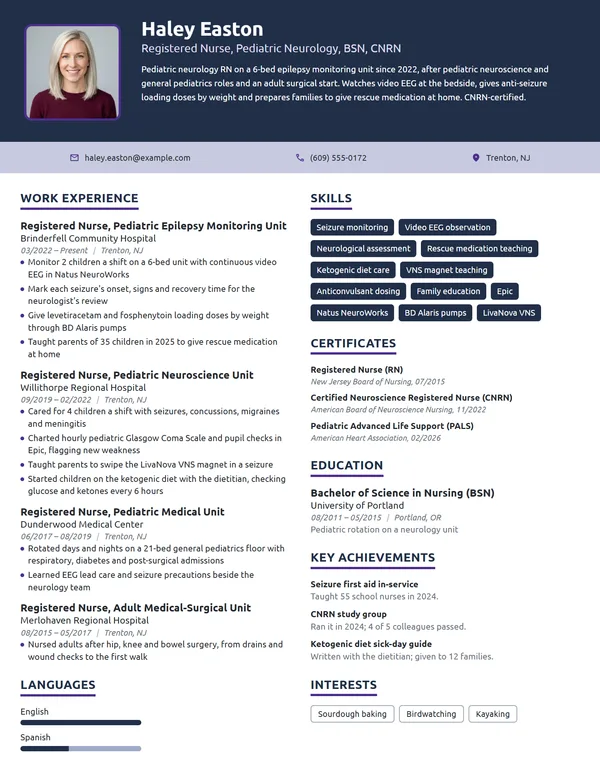
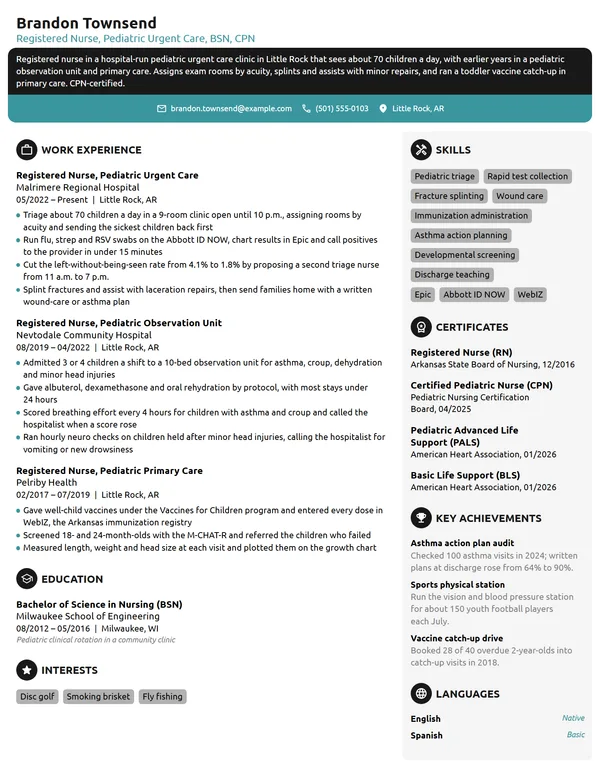
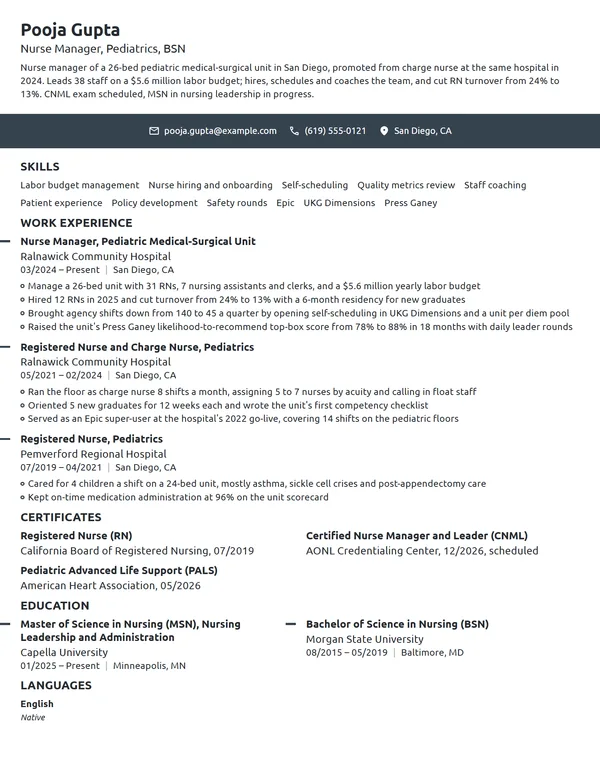
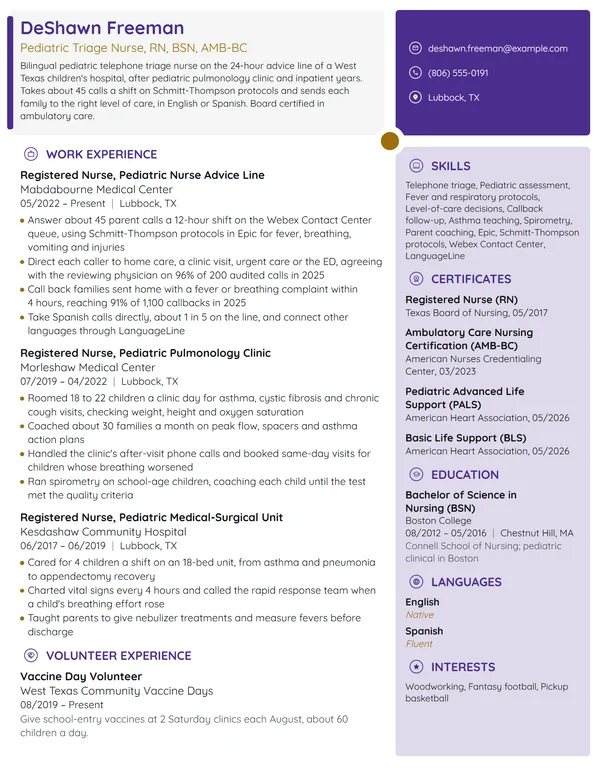
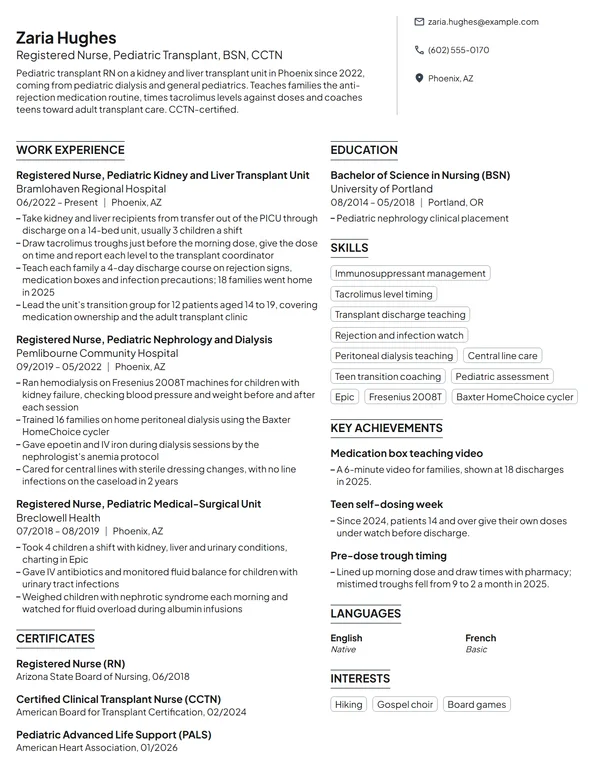
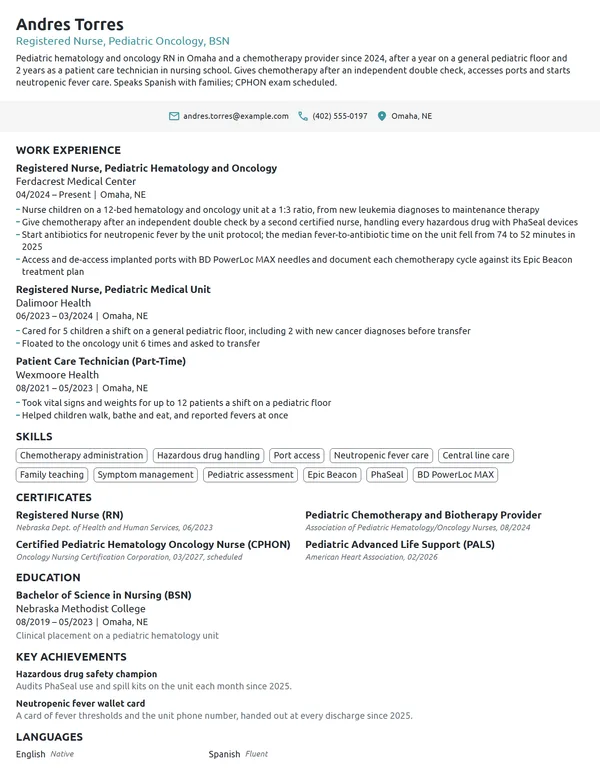
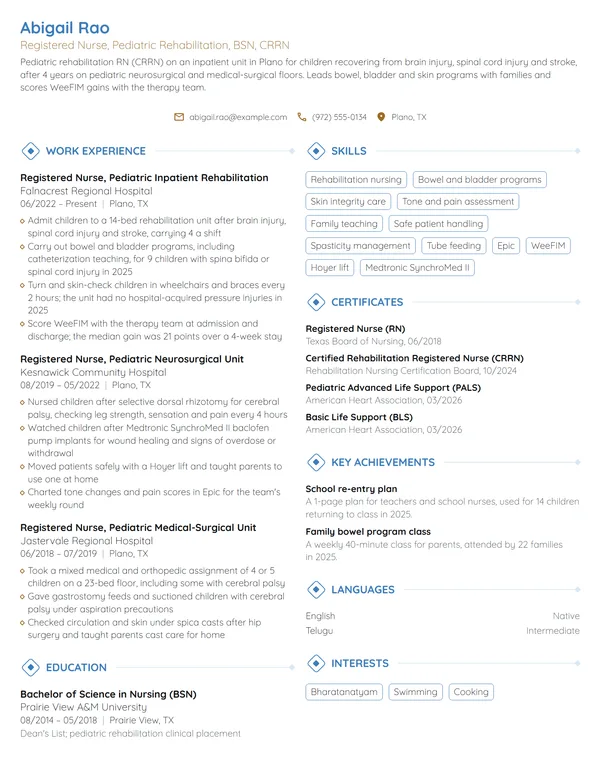
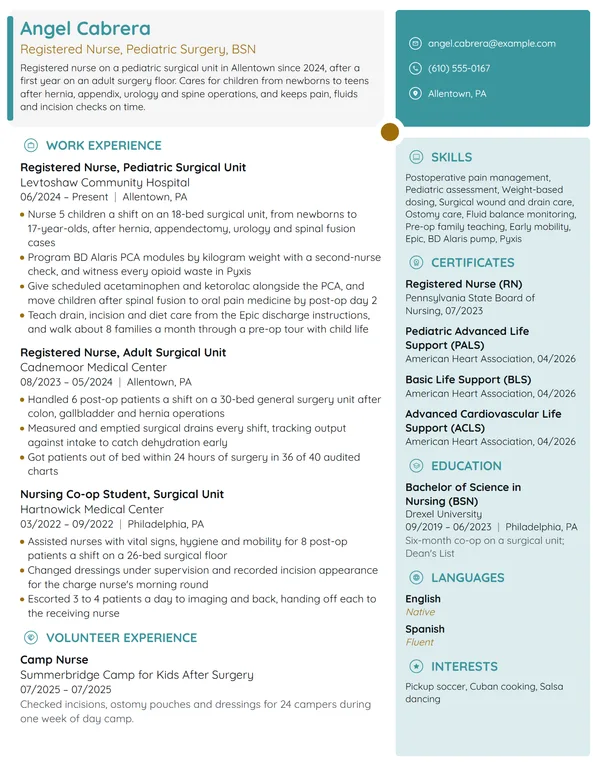
Pediatric nurses care for patients from newborns to teenagers, along with the parents who stay at the bedside. On a children's unit, the ages you have nursed count as much as your years: a toddler with a chest infection and a teenager after surgery need different care. If most of your experience is with adults, much of it still transfers, as long as each bullet shows what changes when the patient is 4 years old. Unit size, patient loads and the families you taught are the numbers that make that case.
How to Write a Pediatric Nurse Resume - Key Takeaways
- List jobs newest first (reverse-chronological) and keep to 1 page, moving to 2 only after 10+ years, several pediatric specialties or CNS-level work.
- Open every nursing job with the unit, its bed count, your usual load and the ages of your patients.
- Pick bullet numbers a pediatric unit tracks: dosing checks, pain reassessments, families taught, line infections or nurses precepted.
- Put your RN license first under Certificates, then CPN or CCRN (Pediatric), PALS and BLS, each with its issuer and date.
- If you are coming from adult care, lead with the skills that carry over and any pediatric hours, training or volunteering you already have.
- Run the finished file through an ATS resume checker and check that PALS, CPN and your unit name read cleanly.
What pediatric nurse managers look for in a resume
A pediatric nurse manager reads your resume with 3 questions in mind: which age groups you have nursed, what kind of pediatric unit or clinic you worked on, and whether your license and certifications match the posting. O*NET lists recording vital signs and giving medications while watching for reactions or side effects among the core RN tasks, and both look different when a patient weighs 9 kilograms. The Bureau of Labor Statistics adds teaching patients and their families to manage an illness, which in pediatrics usually means teaching the parents.
Build the resume from these sections, named the way a hospital ATS expects:
- Name, headline (for example, Registered Nurse, BSN, CPN) and contact details
- A short summary under the headline, 2 to 3 lines and no section title
- Work Experience, newest first, with the pediatric unit in each job title
- Certificates: RN license on top, then CPN or CCRN (Pediatric), PALS and BLS
- Skills, with your charting system
- Education
- If space allows: Volunteer Experience (camps, clinics), Languages, Key Achievements
Best format for a pediatric nurse resume
Choose the reverse-chronological resume format: current job first, each with the title and unit, the hospital or clinic, where it is, and MM/YYYY dates from first month to last. Pediatric careers often run from general pediatrics into a specialty such as cardiology, oncology or the PICU, and newest-first order makes that path easy to follow. If you moved over from an adult unit, keep the same order and let the pediatric job sit on top.
- Best for most pediatric nursesReverse-chronologicalYour jobs, newest first, with your results under each one.Best for: A steady work history in your field
- FunctionalSkills grouped up top, with a short work history below.Best for: Gaps or very little experience
- CombinationA skills section first, then your full work history.Best for: A career change with strong skills
A staff pediatric nurse with under 10 years fits on 1 page. Go to 2 pages after 10 years, or once education, research or clinical nurse specialist work needs the room, and keep your license and current unit on page 1.
| Setting | What to use |
|---|---|
| Length | 1 page for staff roles; 2 pages with 10+ years, several specialties, or education, research or CNS work |
| Dates | Month and year (MM/YYYY) on jobs and credentials; Present where you still work |
| Job title line | Title and unit together: Registered Nurse, Pediatric Intensive Care |
| Ages and unit | Age range, bed count and usual ratio in the first bullet of each pediatric job |
| Font and spacing | One readable font such as Calibri or Lato, 10.5 to 12 pt, with space between jobs |
| Personal details | Skip the photo for US and Canadian hospitals in most cases, plus marital status, birth date and SSN |
| File type | PDF, or .docx when a hospital careers portal requests it |
Most US and Canadian resumes carry no photo. Children's hospitals usually take applications through an online portal that copies your resume into its own form, so plain headings and a single column of dates make that copy come out right.
Pediatric nurse resume summary vs. objective
If you have held an RN job, write a resume summary with your years, the ages and unit you know, 1 result and your strongest credential. If you are a new graduate, or an adult-care nurse applying to pediatrics for the first time, a resume objective works better: the unit or residency you want, your license status and the pediatric hours you already have.
Pediatric nurse resume summary formula
Credentials pediatric nurse with X years of nursing, Y of them on a unit type and size caring for age range. 1 measured result. Pediatric certification held or in progress.
Example
Pediatric nurse (RN, BSN) with 7 years of nursing, 5 of them on a 28-bed pediatric medical-surgical unit caring for infants to teens. Trained 40 nurses on the unit's new pediatric early warning score. CPN-certified and current in PALS.
Don't
Caring pediatric nurse who loves working with children and their families in a fast-paced hospital.
Do
Pediatric RN with 5 years on a 22-bed general pediatrics unit, caring for infants through teens with asthma, bronchiolitis and post-surgical needs. CPN-certified, PALS-current and precepting new hires.
Now a manager can see the unit, its size, the patients and the credentials before reading further.
How to write pediatric nursing work experience bullets with numbers
Your current job takes 3 to 4 bullets; each earlier job, 1 to 3. Let the first bullet carry the unit, its size, your ratio and the ages, since every later number reads against that. Then turn your best results into achievements on your resume with a before and after: safety checks, pain care, family teaching and the new nurses you trained.
| Area | What to count | Example bullet |
|---|---|---|
| Patient load and ages | Beds, ratio, age range, seasonal surges | Cared for 3 to 4 infants and toddlers a shift on a 20-bed pediatric respiratory unit through RSV season. |
| Medication safety | Weight-based dose checks, smart pump use, overrides | Added a pump library check to shift handoff, cutting infusion overrides on the unit from 40 to 12 a month. |
| Family teaching | Families taught, teach-back, discharge readiness | Taught 15 families a month to give gastrostomy tube feeds at home before discharge. |
| Pain and comfort | Reassessments on time, pain scale use | Reassessed pain within 60 minutes of each dose using the FLACC scale in all 50 post-op toddler charts audited. |
| Infection prevention | CLABSI, CAUTI, line bundle audits | Led central line bundle rounds on a 16-bed oncology unit as CLABSIs fell from 4 to 1 in a year. |
| Leadership | Charge shifts, nurses precepted, unit councils | Precepted 6 new graduate nurses through pediatric orientation, each signed off on schedule. |
Here is one nurse's entry after a move from an adult floor into pediatrics. The pediatric job opens with ages and load, and the adult job keeps a single line that shows the bedside years.
Work Experience
- Care for 4 to 5 patients a shift, ages 2 months to 17 years, on a 28-bed unit with post-op, respiratory and diabetes admissions.
- Led an audit that raised kilogram-only weights documented at admission from 81% to 98%, the base for every weight-based dose.
- Teach asthma action plans to about 6 families a week with teach-back; the unit's 30-day asthma readmissions fell from 11% to 7%.
- Take charge 2 shifts a month for a team of 9 nurses and aides.
- Cared for 5 to 6 adult patients a shift on a 32-bed unit, many of them after orthopedic surgery.
Don't
Provided care to children of all ages.
Do
Took 2 to 3 post-op patients a shift aged 6 months to 12 years after tonsil, hernia and fracture surgery, rechecking pain within 1 hour of every dose.
Ages, load and a care standard turn a vague line into evidence.
Don't
Educated parents on their child's care.
Do
Showed 10 to 12 families a week how to manage newly diagnosed type 1 diabetes at home, from carb counting to insulin pens, before discharge.
Pediatric nursing skills and EHR software for your resume
List 6 to 8 skills taken from the posting, and keep only those a bullet already backs up. Pediatric assessment and weight-based dosing fit almost every pediatric resume; ventilator care, chemotherapy or cardiac monitoring only when your unit did that work. Calm with a scared child and clear teaching for parents are soft skills worth naming, as long as a bullet shows them.
Hard skills for pediatric nurses
- Pediatric assessment
- Weight-based medication dosing
- Pediatric IV insertion
- Pediatric early warning scores
- Pain assessment (FLACC, FACES)
- Respiratory care and suctioning
- Gastrostomy tube care and feeds
- Growth and development milestones
- Immunization administration
- Family-centered discharge teaching
Soft skills pediatric units value
- Calm with frightened children
- Plain-language teaching for parents
- Clinical judgment
- Patience
- Advocacy for patients too young to speak
- Teamwork with child life and therapy staff
Name your charting system in Skills and show it in use in at least 1 bullet. O*NET marks Epic Systems, MEDITECH software and eClinicalWorks EHR software as hot technologies for registered nurses. Name the one your unit or practice actually charted in, spelled the way the posting spells it. Smart pumps, Vocera phones or a medication cabinet earn a place when a bullet shows you using them.
Pediatric nursing certifications and your RN license
There is no separate pediatric license. The Bureau of Labor Statistics states that registered nurses need a license from the state where they work, earned by finishing an approved program and passing a qualifying exam. It also lists pediatrics among the areas where nurses certify through professional associations and notes that certification is usually voluntary, so check each posting for the ones it names. Add certifications to your resume under the license, each with its issuer and month.
| Credential | Issued by | What it takes |
|---|---|---|
| PALS (Pediatric Advanced Life Support) | American Heart Association | A provider course in recognizing and treating seriously ill or injured children; list it next to BLS whenever you hold both. |
| CPN (Certified Pediatric Nurse) | Pediatric Nursing Certification Board (PNCB) | A current RN license and a minimum of pediatric RN practice hours set by PNCB, then the exam. |
| CCRN (Pediatric) | AACN Certification Corporation | A current RN or APRN license and 1,750 hours caring for acutely or critically ill children in 2 years (875 in the latest year), or 2,000 hours in 5 years (144 in the latest). |
| CPEN (Certified Pediatric Emergency Nurse) | Board of Certification for Emergency Nursing (BCEN) | A current RN license and the exam; BCEN recommends 2 years in the specialty but does not require it. |
| ENPC (Emergency Nursing Pediatric Course) | Emergency Nurses Association (ENA) | A course for emergency nurses, now in its 7th edition; passing earns a 4-year verification. |
Listing a certification you are still working toward
A credential you have not earned yet still belongs under Certificates when you are close, written so nobody reads it as held: CCRN (Pediatric), in progress, about 1,200 of 1,750 hours logged, exam planned for 2027. Put only earned credentials after your name in the headline, and write RN there once your state board has issued the license.
Certificates
- Registered Nurse (RN), Pennsylvania, Pennsylvania State Board of Nursing, 08/2019
- Certified Pediatric Nurse (CPN), Pediatric Nursing Certification Board, 10/2023
- Pediatric Advanced Life Support (PALS), American Heart Association, 03/2026
- Basic Life Support (BLS), American Heart Association, 03/2026
How to list a BSN, ADN or MSN on a pediatric nurse resume
The BLS describes 3 usual education paths into registered nursing, a BSN, an associate's degree (ADN) or a diploma from an approved program, and adds that employers, particularly hospitals, may require the bachelor's. So an ADN nurse working toward a BSN should list the BSN first with its expected date. Pediatric clinical nurse specialists go further: the BLS states that a CNS must earn a master's degree in nursing, and some schools run BSN-to-DNP tracks for the role that lead to a doctorate instead.
The usual rules for listing education on a resume hold here: the degree, then the school and its city, then the month you finished. A new graduate can add a GPA of 3.5 or higher and the pediatric capstone or preceptorship hours on 1 line below the degree. After a few years on the job, the degree, school and date are enough.
Education
GPA 3.6. Capstone: 160 hours on a pediatric medical-surgical unit.
New grad pediatric nurse resumes and moving from adult care
Pediatric units hire new graduates mostly through nurse residency programs, so name the residency you want in your objective, along with your NCLEX status or the month your license was issued. Your pediatric clinical hours are your strongest evidence, and the nursing student resume layout works if you are still in school. Bring in any work with children, even outside a hospital:
- Pediatric capstone or preceptorship: the unit, the ages, your hours and the patient load you carried by the end.
- Other pediatric rotations: 1 line under Education naming the units, such as a pediatric clinic or a newborn nursery.
- CNA, patient care technician or child care jobs: a Work Experience entry with how many children or patients you looked after.
- Camp nursing, school health or vaccine clinics: under Volunteer Experience, with the number of children you screened, treated or vaccinated.
Don't
Recent graduate seeking a pediatric nursing position where I can make a difference in children's lives.
Do
BSN graduate with an RN license issued 07/2026, applying to a pediatric nurse residency. Completed a 144-hour preceptorship on a pediatric hematology-oncology unit and 2 summers as a counselor at a diabetes camp.
Even a first objective can carry a date, a unit and an hour count.
Moving from an adult unit into pediatrics, keep the reverse-chronological order and put pediatric evidence near the top: PALS, any float shifts to pediatrics, and volunteer or camp work with children. Under your adult jobs, keep bullets that a pediatric manager can use, such as IV skills, family teaching and safety audits, and cut the rest. See the nurse resume examples for adult-unit layouts, and use your cover letter to say why you want children's care; our healthcare cover letter examples show how to put that in a short paragraph.
Pediatric Nurse resume FAQ
Do I need a CPN certification to get a pediatric nursing job?
No. The RN license is the legal requirement, and the BLS describes nursing certification as usually voluntary. Add a CPN once you have the pediatric hours, and list it, along with PALS, whenever a posting names them.
How do I switch from adult nursing to pediatrics on my resume?
Lead with what carries over. Earn PALS before you apply, write an objective naming the pediatric unit you want, and keep adult-job bullets about IV skills, family teaching and safety work. Any pediatric float shifts, camp nursing or vaccine clinics go near the top.
Where does PALS go on a pediatric nurse resume?
Under Certificates, right after your RN license and any CPN or CCRN (Pediatric). Write Pediatric Advanced Life Support (PALS), American Heart Association, and the month you completed the course, so a recruiter can see it is current.
Should I write the ages of the patients I cared for?
Yes. Pediatric units range from infants to teenagers, and a manager wants to know which ages you know. Put the range in the first bullet of each pediatric job, next to the unit size and your usual ratio.
Can a new grad count pediatric clinical rotations as experience?
Only your capstone or preceptorship gets a full entry, with the unit, ages and hours. Other pediatric rotations go in 1 line under Education, and paid work with children, such as a CNA or camp job, gets its own entry.
What is the difference between the CPN and the CCRN (Pediatric)?
They come from different boards. The CCRN (Pediatric), from the AACN Certification Corporation, asks for hours caring for acutely or critically ill children, such as in a PICU: 1,750 in 2 years. The CPN, from the Pediatric Nursing Certification Board, is a general pediatric credential; check its current hour rule on PNCB's site before applying.
How long should a pediatric nurse resume be?
1 page for new graduates and most staff pediatric nurses. Use 2 pages once you have 10+ years, several pediatric specialties, or education, research or CNS work, with your license and current unit on page 1.
How much do pediatric nurses make?
The BLS does not publish a separate figure for pediatric nurses; its May 2025 figure for all registered nurses is a median of $97,550 a year. Pay varies by state, unit and shift, so leave it off your resume and raise it once an offer is on the table.
Next steps
Start from the example nearest your unit and the ages you care for, keep its layout, and swap in your own unit size, ratio, certifications and results. Fill it in with our resume builder or one of our templates, and send it with a short letter naming the pediatric unit you want.