
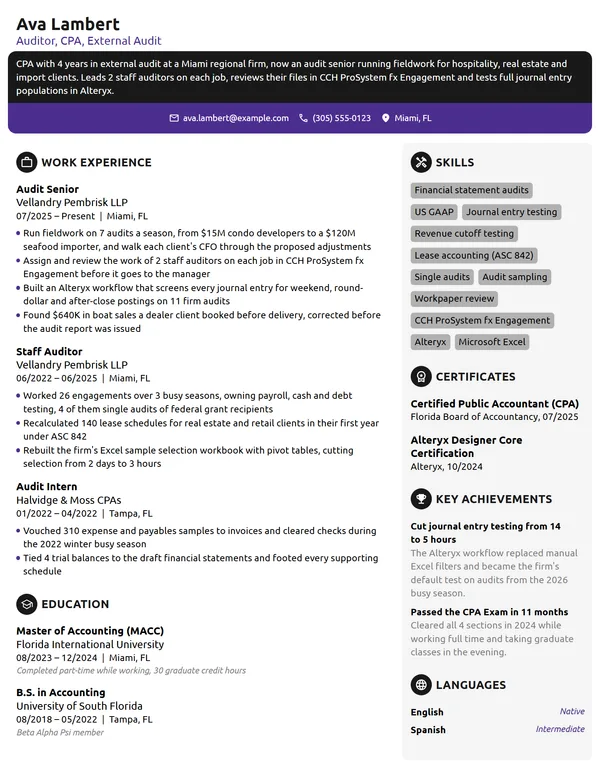
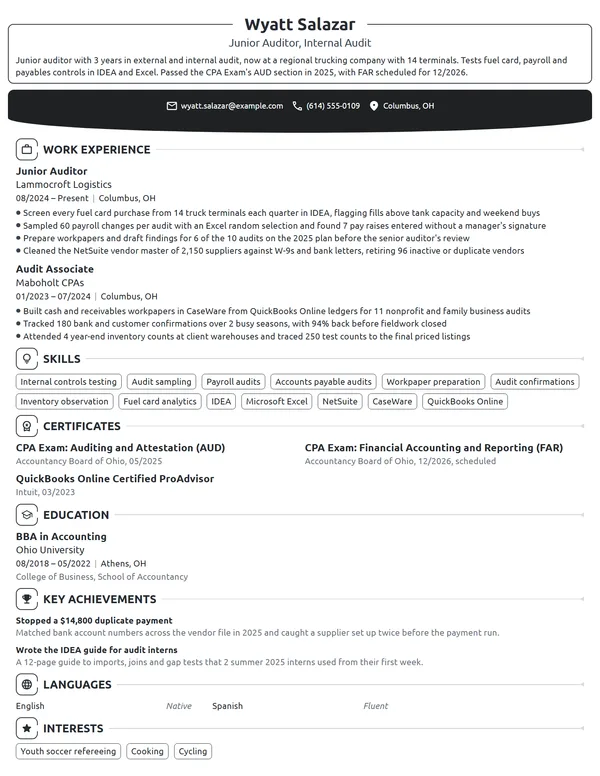
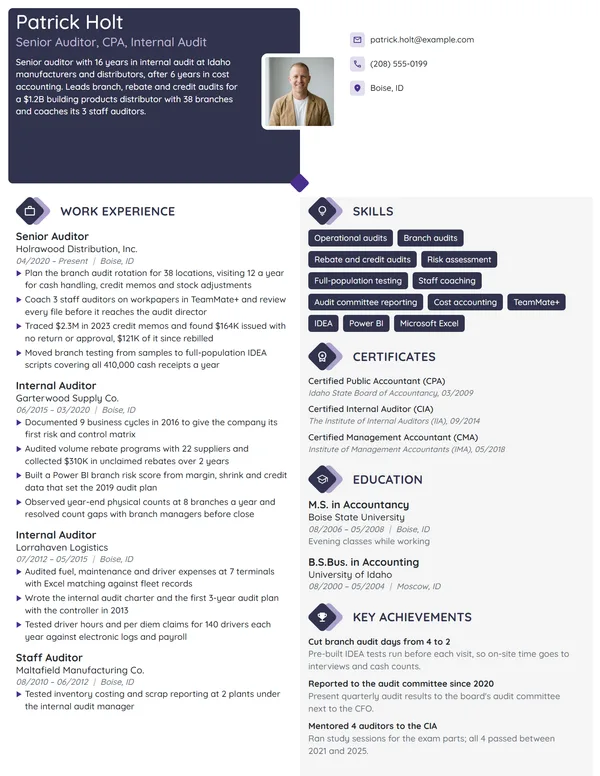
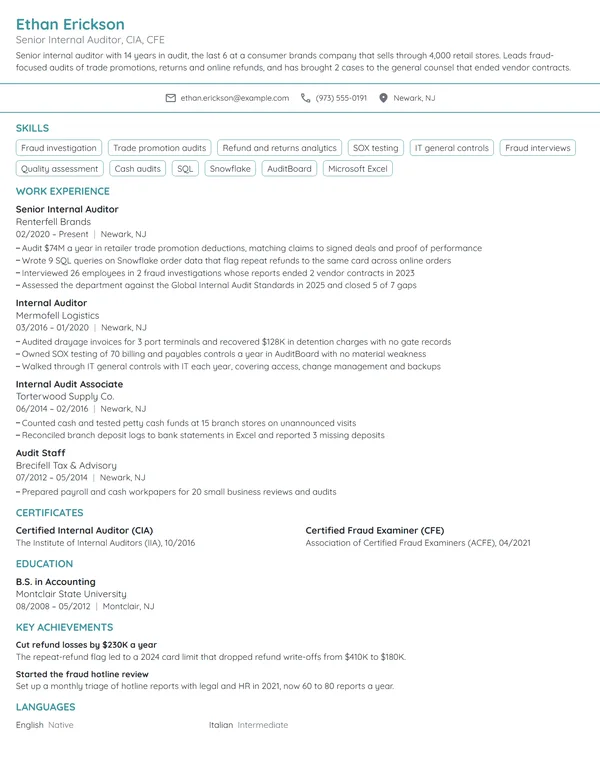
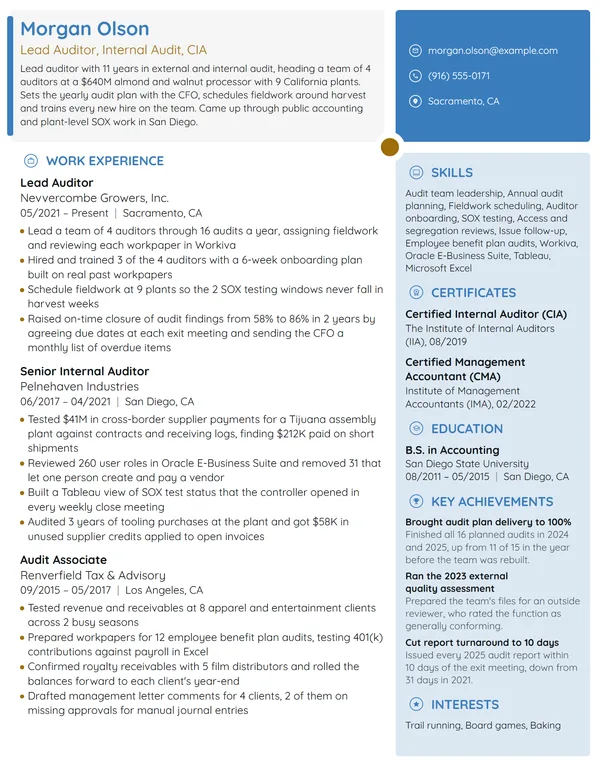
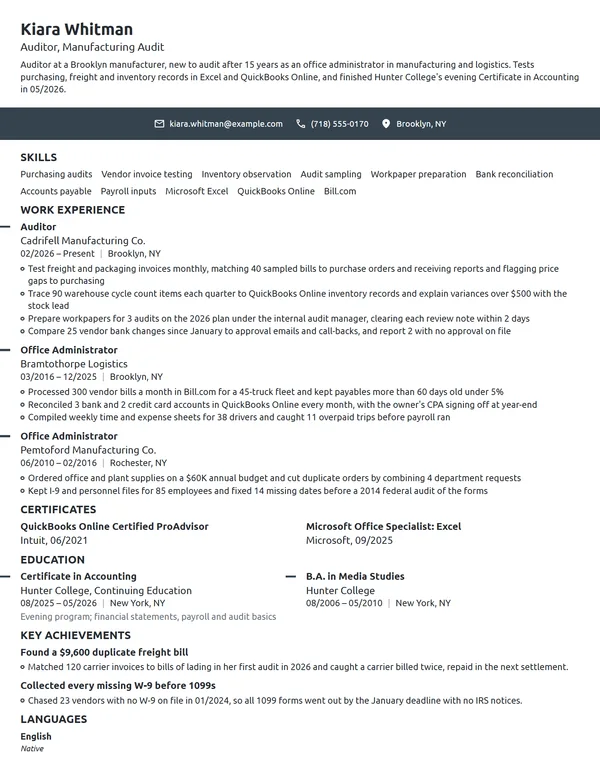
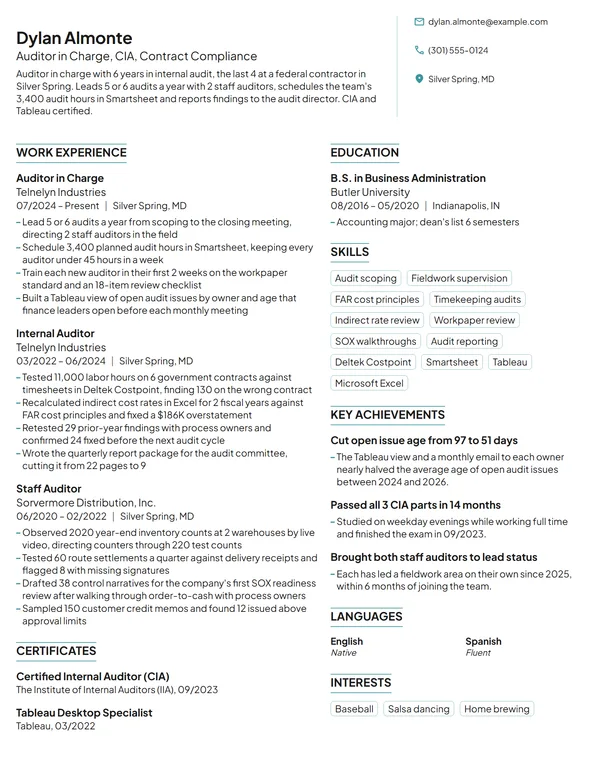
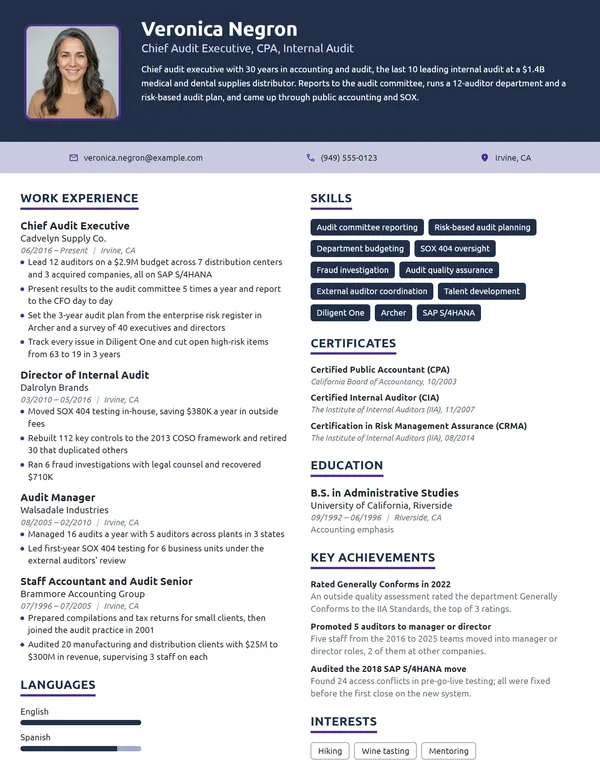
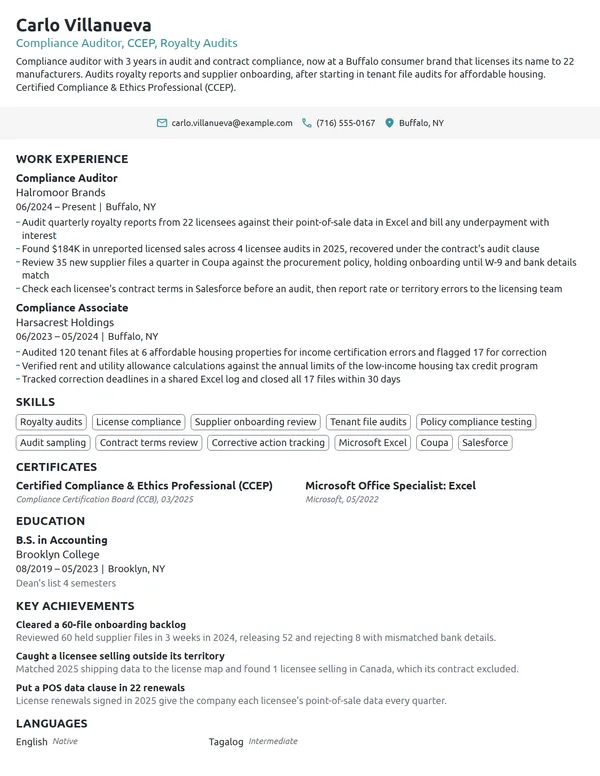
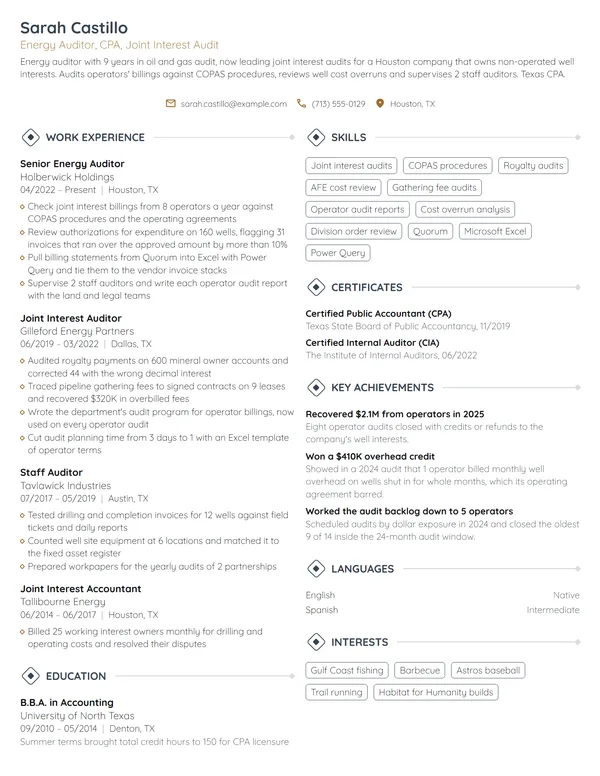
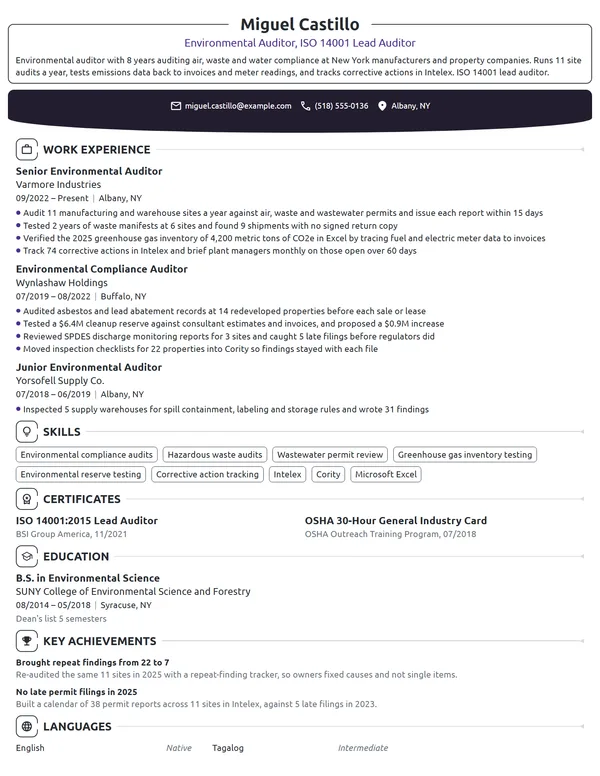
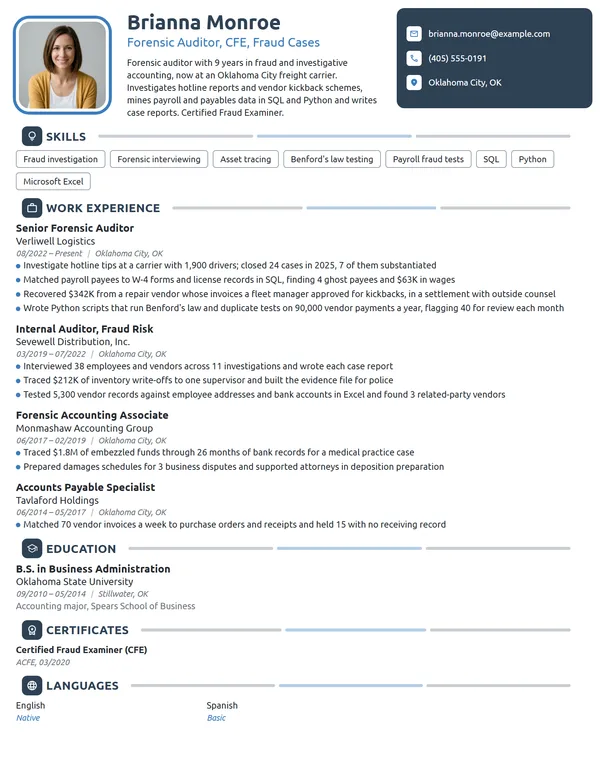
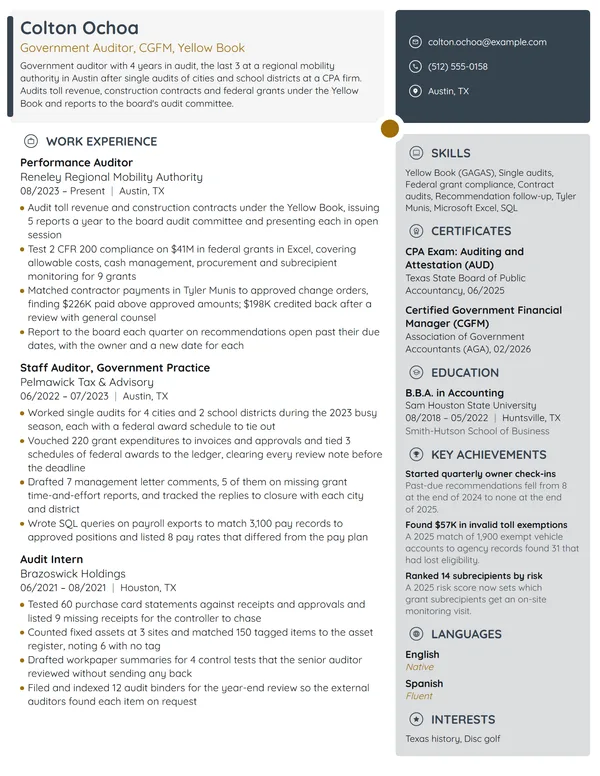
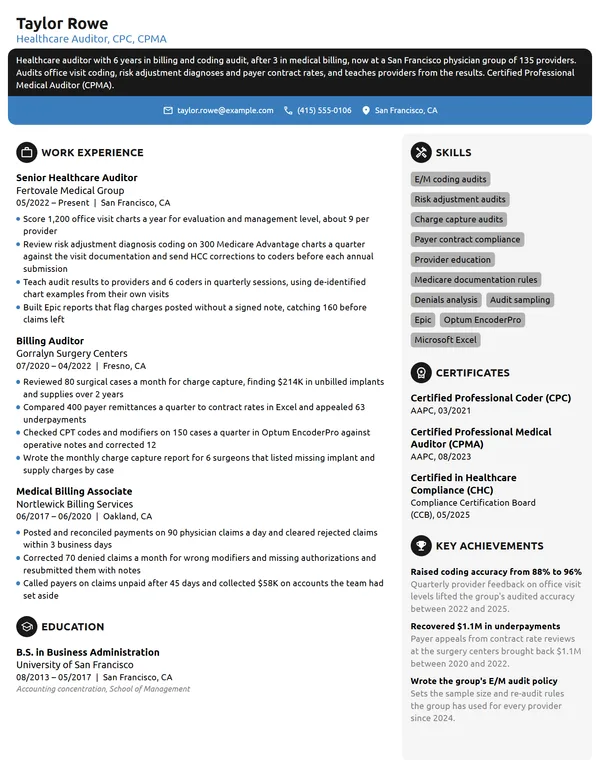
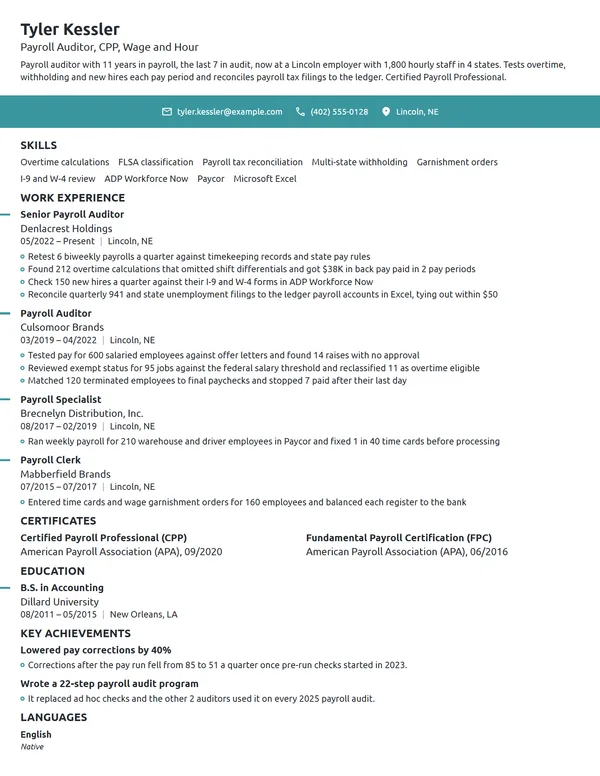
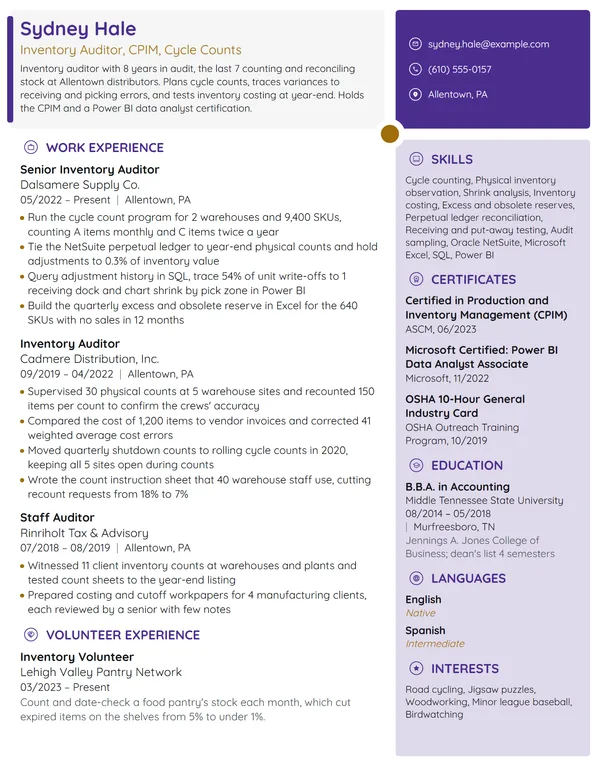
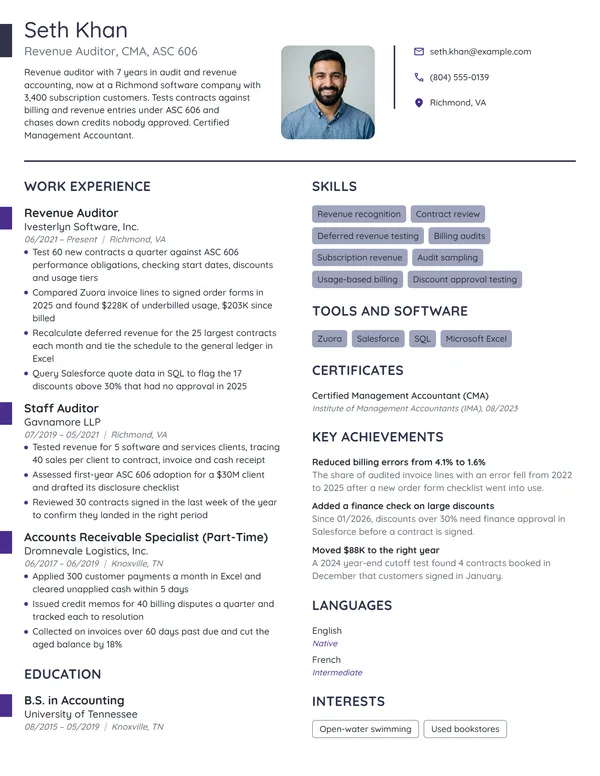
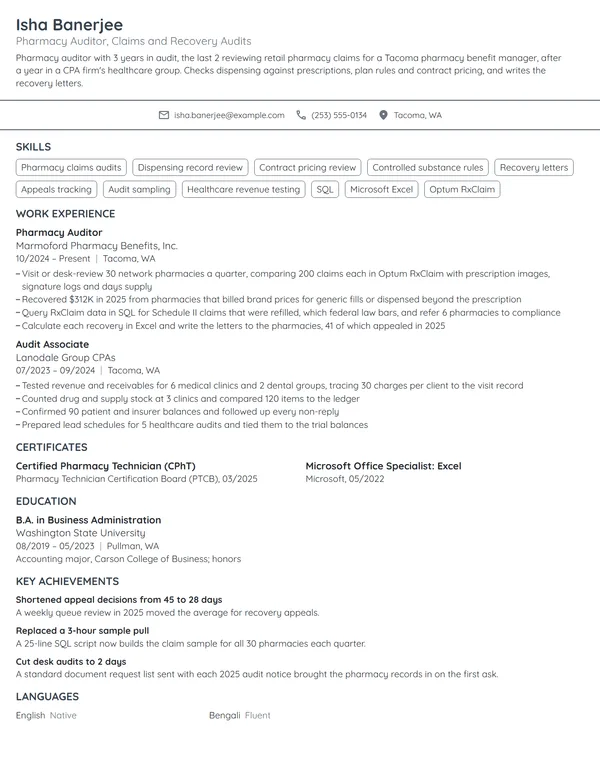
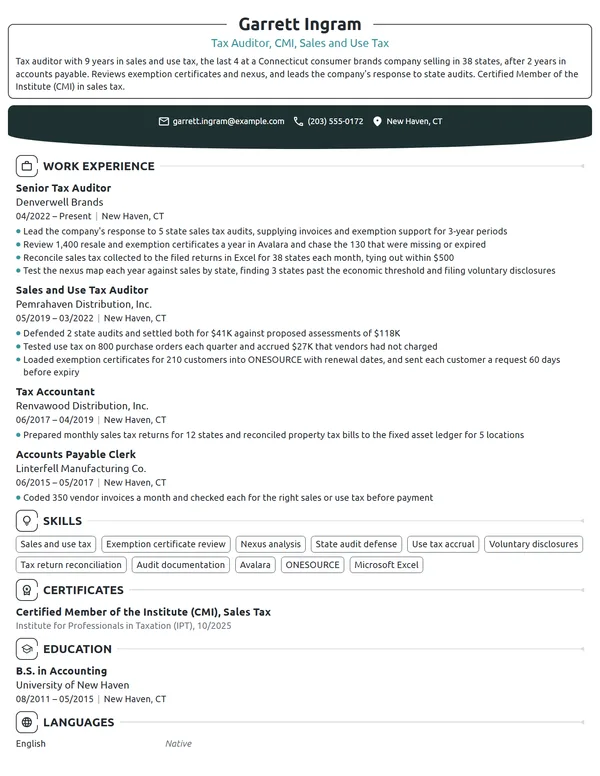
Auditors check other people's numbers for a living, so expect the person hiring you to check yours. They want to know whether you audit from outside, for a firm, or from inside the company, which areas you test, and how large the clients or business units were. Then they look for proof in counts: controls tested, findings raised, and how many of those findings management fixed before the next audit came around.
How to Write an Auditor Resume - Key Takeaways
- Say in your job title line and summary whether you work in external, internal, IT or government audit.
- Pick reverse-chronological order on 1 page, and move to 2 only after about 10 years or once you lead audit teams.
- Give every bullet an audit number: audits completed, controls tested, deficiencies found, issues closed or dollars recovered.
- Describe public firm clients by industry and revenue range instead of by name.
- Put a CPA license first under Certificates, then a CIA, CISA or CFE, or the exam parts you have passed so far, each with its date.
- Check the finished file with an ATS resume checker, since large audit departments and firms screen through applicant tracking systems.
What audit managers look for in an auditor resume
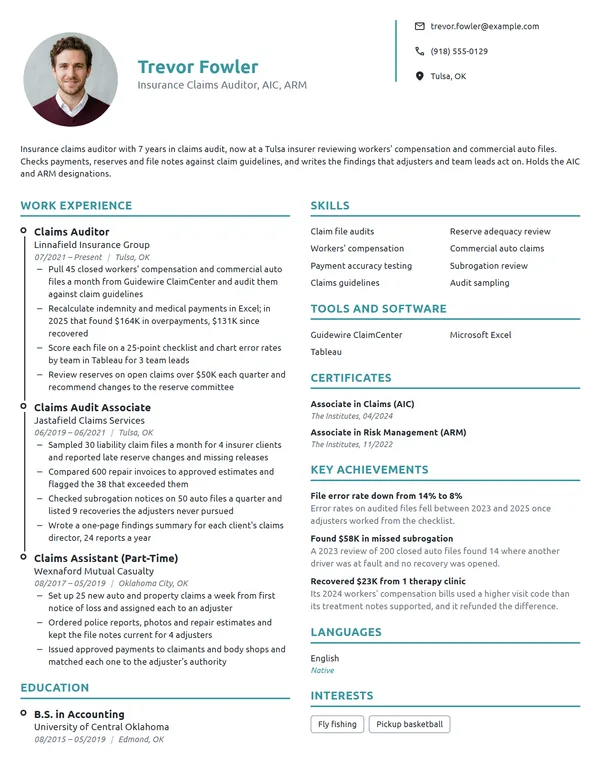
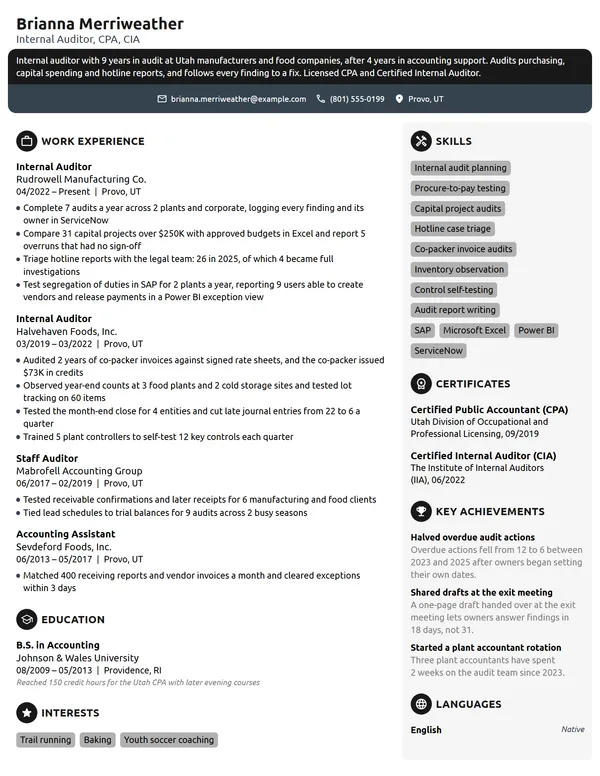
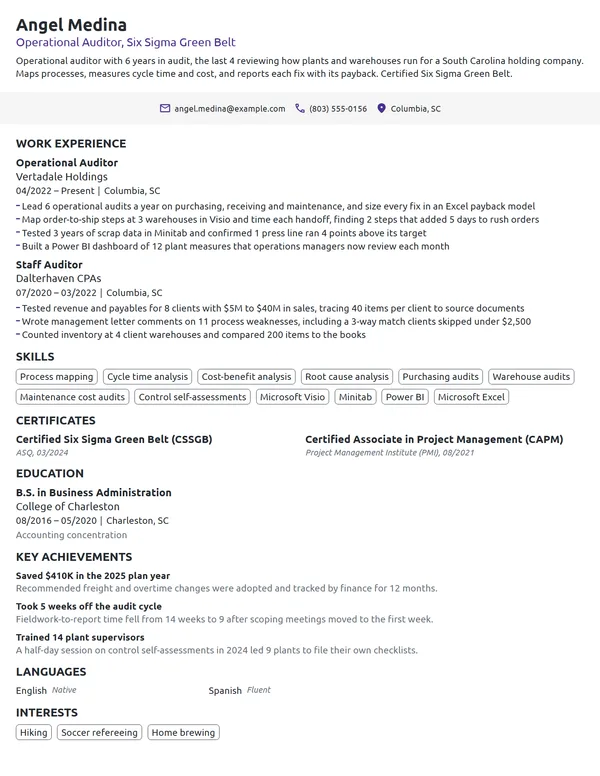
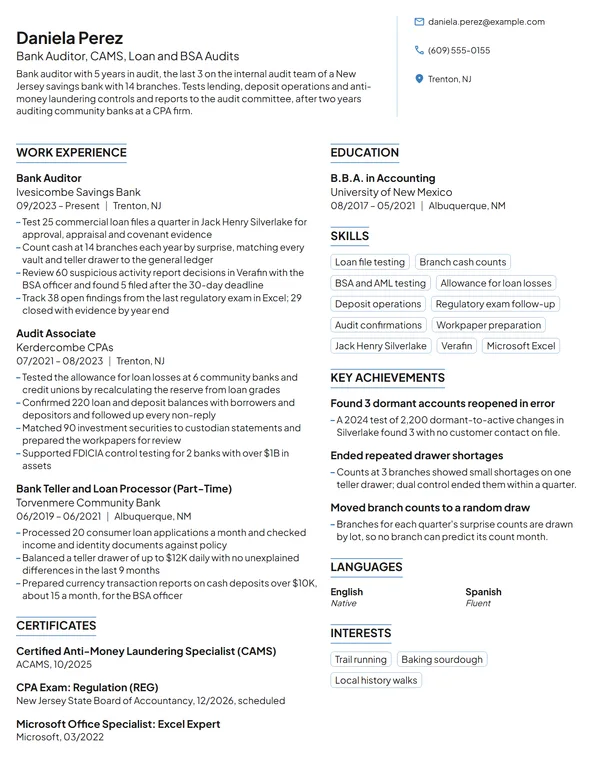
The first thing an audit manager sorts for is your side of the work. The BLS describes external auditors as employed by an outside organization, internal auditors as employed by the organization they audit, IT auditors as reviewing controls over IT systems, and government auditors as examining agency records and the businesses those agencies regulate. A resume that leaves this unclear risks being read as the wrong kind of auditor.
After that, the reader wants the tasks O*NET lists for the occupation, written as results: analyzing data to detect deficient controls, fraud or non-compliance, and preparing detailed reports on audit findings. Organize the page into sections that screening software reads cleanly:
- Your name, then a headline like Internal Auditor, CPA, then contact details
- A 2- to 3-line summary under the headline; it prints without a section title
- Work Experience, current audit role first
- Skills, with your audit frameworks and software
- Certificates, with a CPA license listed first
- Education
- Key Achievements, Volunteer Experience or Languages, when they add evidence
Best format for an auditor resume
Choose the reverse-chronological resume format, with your current audit role at the top and each entry carrying the title, the employer, its city and the start and end month (MM/YYYY). Audit careers climb in named rungs, from associate or staff auditor to senior, in-charge, manager and director, and this layout lets a reader count the steps. A combination format, with skills above your history, is worth it only when your past jobs hold almost no audit work; most people coming from bookkeeping, compliance or IT support do better staying reverse-chronological.
- Best for most auditorsReverse-chronologicalYour jobs, newest first, with your results under each one.Best for: A steady work history in your field
- FunctionalSkills grouped up top, with a short work history below.Best for: Gaps or very little experience
- CombinationA skills section first, then your full work history.Best for: A career change with strong skills
Fit an associate or staff auditor resume on 1 page. Senior auditors and audit leads with 10+ years, several industries or a team to describe can use 2 pages, provided page 1 holds the current role and its biggest audits.
| Setting | What to use |
|---|---|
| Length | 1 page for associate and staff roles; 2 pages at 10+ years or with team leadership |
| Job title line | Title plus audit type, such as Senior Auditor, External Audit or Internal Auditor, IT and SOX |
| Client names | Industry and revenue range for public firm clients, such as 13 manufacturing and nonprofit clients with $8M to $90M in revenue |
| Dates | MM/YYYY start and end months; Present for the role you hold now |
| Photo and private data | Usually leave the photo off in the US and Canada; skip your Social Security number, marital status or date of birth |
| File type | PDF by default; a Word file only if the application portal asks for one |
Most US and Canadian resumes carry no photo. Many audit departments screen applications with software, so standard section headings and real text, never text inside images, are the safe choice.
Auditor resume summary vs. objective
If you have held an audit title, internal or external, write a resume summary that names your audit type, your years, your industries and one result. If you have not, write an objective naming the audit role you want and your closest evidence, such as an internship or a reconciliation job. The accountant summary and objective examples show both versions for finance roles, and the same logic carries over to audit.
Auditor resume summary formula
Title, credential, with X years in external or internal audit across industries. Audit coverage, with a count. Your strongest finding and what it changed, with a number.
Example
Internal Auditor, CPA, with 7 years across public accounting and insurance audit. Led 9 operational and SOX audits in 2025 covering claims, premium billing and vendor payments. Recovered $412K in duplicate vendor payments and got an ERP control added to block repeats.
Don't
Results-oriented audit professional with a strong understanding of internal controls and a passion for compliance.
Do
Senior auditor with 5 years at a regional CPA firm, running fieldwork on healthcare and nonprofit audits and supervising 3 associates per engagement. Finished the CPA Exam in 2026.
This version tells the reader the level, the audit type, the industries, a team size and a credential.
How to write auditor work experience bullets with numbers
Your current role gets 3 to 4 bullets and older roles 1 to 3, and each bullet opens with a verb. Audit work leaves a paper trail of counts, such as audits on the annual plan, controls in the testing matrix and issues in the tracker, so every bullet can carry one. Write achievements on your resume instead of the audit program steps you followed.
| Area | What to count | Example bullet |
|---|---|---|
| Audit plan | Audits completed, entity or unit size, hours against budget | Completed 14 audits from the annual plan, 12 of them within budgeted hours. |
| Controls testing | Key controls, samples, deficiencies | Tested 88 key controls over revenue and payroll and reported 2 deficiencies to the audit committee. |
| Findings and follow-up | Issues raised, issues closed, days to remediate | Closed 31 of 34 open audit issues by their agreed dates after quarterly follow-up testing. |
| Recoveries | Dollars found, recovered or prevented | Recovered $96K in vendor overbillings during a freight contract compliance audit. |
| Data analytics | Populations tested, scripts or monitoring tests built | Wrote 6 SQL monitoring tests that check every travel expense claim each month. |
| Engagement leadership | Team size, engagement hours, staff trained | Ran fieldwork with a team of 4 on a 900-hour financial statement audit. |
The sample below moves from public accounting into internal audit, so its older role keeps the client count and revenue range, while the current role leads with audits, controls and money recovered.
Work Experience
- Led 9 operational and SOX audits in 2025 across claims, premium billing and vendor payments.
- Tested 146 key controls in the annual SOX 404 cycle and reported 3 deficiencies, none rated significant.
- Ran a duplicate payment test on 61,000 vendor invoices in Alteryx, recovering $412K.
- Followed 27 audit issues to closure and cut average remediation time from 140 to 75 days.
- Audited cash, payables and fixed assets for 13 private manufacturing and nonprofit clients with $8M to $90M in revenue.
- Supervised 2 first-year associates on 4 engagements in the 2022 busy season.
Don't
Performed audits in accordance with company policies and procedures.
Do
Audited purchasing at 5 distribution centers, sampling 240 purchase orders, and found 18 orders split to stay under approval limits; IT added a system block the next quarter.
The good version names the scope, the sample, the finding and the fix.
Don't
Responsible for SOX testing.
Do
Tested 52 financial close controls each quarter for SOX 404 and documented walkthroughs the external auditors relied on in their own testing.
Auditor skills, frameworks and software for your resume
Choose 6 to 8 hard skills for your resume that the job ad requests and your bullets already show. Internal audit postings lean on risk assessment, SOX and operational audits; public firm postings lean on financial statement audits, GAAP and sampling; IT audit postings add access, change management and system controls.
Hard skills for auditors
- Risk assessment
- Internal controls testing
- SOX 404 compliance
- COSO 2013 framework
- Audit sampling
- Financial statement auditing
- US GAAP
- Workpaper documentation
- Audit report writing
- Data analytics for audit
Soft skills audit managers value
- Professional skepticism
- Objectivity
- Interviewing process owners
- Clear written findings
- Confidentiality
- Managing several engagements at once
List your software with your skills and show each tool again in a bullet. O*NET flags Microsoft Excel, SAP software and Intuit QuickBooks as in-demand for accountants and auditors, and marks Alteryx, Tableau and SQL as hot technology. Write your audit management platform and ERP by the exact names in the posting, and for Excel, name what you did with it, such as pivot tables for sample selection or Power Query for full-population tests.
CPA, CIA, CISA and CFE: how to list auditor certifications
List certifications on your resume under Certificates, each with its issuer and year, and repeat your top credential in the headline. In BLS terms, certification gives an advantage in the job market, and any accountant who files a report with the Securities and Exchange Commission must be a licensed CPA, which makes the license the standard credential in external audit. Internal auditors add the CIA, IT auditors the CISA, and fraud and forensic auditors the CFE.
| Credential | Issued by | What it takes |
|---|---|---|
| CPA (Certified Public Accountant) | Your state Board of Accountancy | Pass the national CPA Exam and meet your state's education, experience and other requirements. |
| CIA (Certified Internal Auditor) | The Institute of Internal Auditors (IIA) | Pass a 3-part exam and show 2 years of internal audit experience with a bachelor's degree, or 1 year with a master's, and meet every requirement within 3 years of acceptance into the program. |
| CISA (Certified Information Systems Auditor) | ISACA | Pass the exam and show at least 5 years of information systems audit, control or security work from the 10 years before you apply. |
| CFE (Certified Fraud Examiner) | Association of Certified Fraud Examiners (ACFE) | Join as an Associate Member, reach 40 eligibility points to sit the exam and 50 to be certified, pass the exam, and hold 2 years of fraud-related experience. |
How to list a CIA in progress
Because the IIA counts experience toward eligibility, many internal auditors pass exam parts before they can use the title. List each part you have passed with its date under Certificates, mark the next one as scheduled, and keep CIA off your headline until the IIA certifies you. A licensed CPA still goes first.
Certificates
- Certified Public Accountant (CPA), licensed in Illinois, 11/2021
- CIA Exam Part 1, The Institute of Internal Auditors, passed 02/2026
- CIA Exam Part 2, The Institute of Internal Auditors, passed 06/2026
- CIA Exam Part 3, The Institute of Internal Auditors, scheduled 12/2026
How to list an accounting degree on an auditor resume
The BLS lists a bachelor's degree in accounting or a closely linked subject as the typical entry education for accountants and auditors; IT auditors often hold one in information systems instead. When listing education on a resume, give the degree, school, city and graduation month, and add a GPA of 3.5 or higher only in your first 2 to 3 years out of school.
If you are on the CPA route, the BLS describes the traditional requirement as 150 semester hours of college coursework, though NASBA reports new pathways that change it are being adopted across the country. Note completed hours or a master's on the degree line, and check your state board before you print an expected license year.
Education
150 semester hours, with coursework in auditing and accounting information systems.
Entry-level and career-change auditor resumes
Without a full-time audit job yet, build an entry-level resume: an objective, Education high on the page, then any work that involved checking records against a standard. Count it the way an audit would.
- Audit internships: clients, accounts or cycles you tested, and the busy season you worked.
- Inventory observations and cash counts: sites visited and items counted.
- Reconciliation or accounts payable work: accounts reconciled each month and errors you caught.
- Campus treasurer or volunteer finance roles: budgets reviewed and receipts checked, listed under Volunteer Experience.
Don't
Accounting graduate looking for an auditor position where I can grow my skills.
Do
Accounting graduate seeking a staff auditor role after a winter busy-season internship, where I tested cash and payables for 3 clients and joined 2 physical inventory observations.
Even a short objective needs a count and a named audit task.
Moving over from staff accounting, bookkeeping, compliance or IT support, stay with reverse-chronological order, and lead your current role with its most audit-like tasks: reconciliations you reviewed, controls you operated, access reviews you ran. A career-change resume works when the summary names the audit role you want and the first bullets back it up. Your cover letter is the place for why you are switching, and the accountant cover letter examples show how to frame a move inside finance in a few sentences.
Auditor resume FAQ
What is the difference between an internal auditor and an external auditor resume?
The employer and the reader. An external auditor resume, for a public accounting firm, shows client counts, industries, revenue ranges and the audit areas you owned. An internal auditor resume shows audits on the company's annual plan, controls tested, SOX work and the issues management fixed after your reports.
Do I need a CPA license to work as an auditor?
Not for every audit job. The BLS says any accountant who files a report with the SEC must be a licensed CPA, so external audit careers usually lead there. Internal, IT and government auditors are often hired without one and add the CIA, CISA or CFE instead.
Can I put CIA on my resume before I pass all 3 parts?
No, not as a title. List each CIA Exam part you have passed with its date under Certificates, mark the next part as scheduled, and add CIA to your headline only after The Institute of Internal Auditors certifies you, which also requires internal audit experience.
Should I name audit clients on my resume?
Usually not. Client work is confidential, so describe clients by industry, count and size, such as 9 healthcare clients with $20M to $150M in revenue. Name a client only when the relationship is public, such as a listed company whose auditor appears in its annual report, and your firm allows it.
How long should an auditor resume be?
1 page for associate, staff and junior auditors. Senior auditors, audit leads and managers with about 10 years or more, several industries or a team to describe can use 2 pages, as long as the current role and its audit plan fill the first page.
What software should an auditor list on a resume?
Excel first, then the ERP you audited in, such as SAP, Oracle or NetSuite, then your analytics tools, such as Alteryx, SQL or Tableau, and the audit management platform your team used. Name each exactly as the posting does, and back every one with a bullet.
How do I list Big 4 experience on an auditor resume?
Write the firm, your title and the dates like any other employer, then show what you did there: the number of engagements, client industries and sizes, the audit areas you owned and any team you supervised. The firm's name gets a second look, but recruiters still compare your bullets with candidates from regional firms.
How do I move from external audit to internal audit on my resume?
Rewrite your public firm bullets around controls and risk instead of client service. Lead with controls you tested, deficiencies you documented and process walkthroughs you ran, name the industries you know, and say in your summary that you are targeting internal audit or SOX work.
How do I list CPA Exam sections I have passed?
List each section you have passed, such as Auditing and Attestation (AUD), with its month under Certificates, and mark the next one as scheduled. Keep CPA off your headline until your state board licenses you, since passing all 4 sections is not the license itself.
Next steps
Start from the example nearest your audit type and level, then swap in your own audit plan, controls, findings and recoveries. Build it in our resume builder or begin with one of the resume templates, and pair it with a letter that opens on the finding you are proudest of and what changed because of it.