
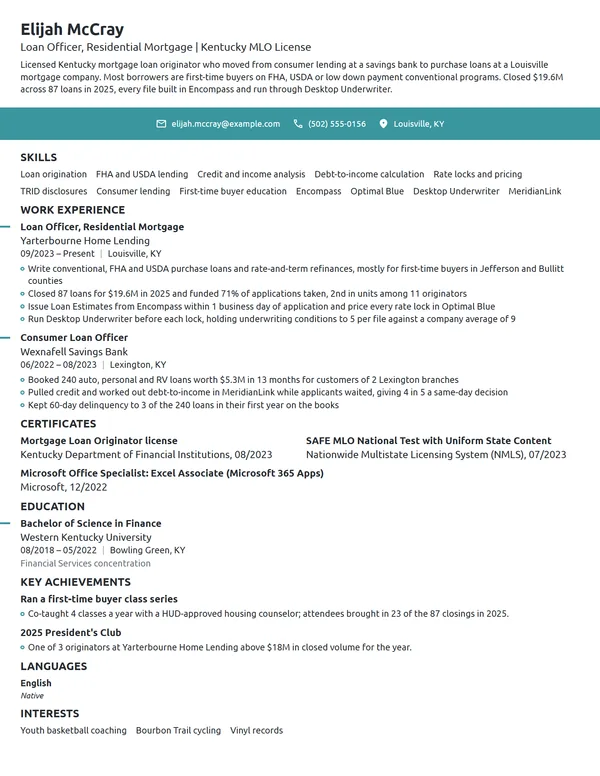
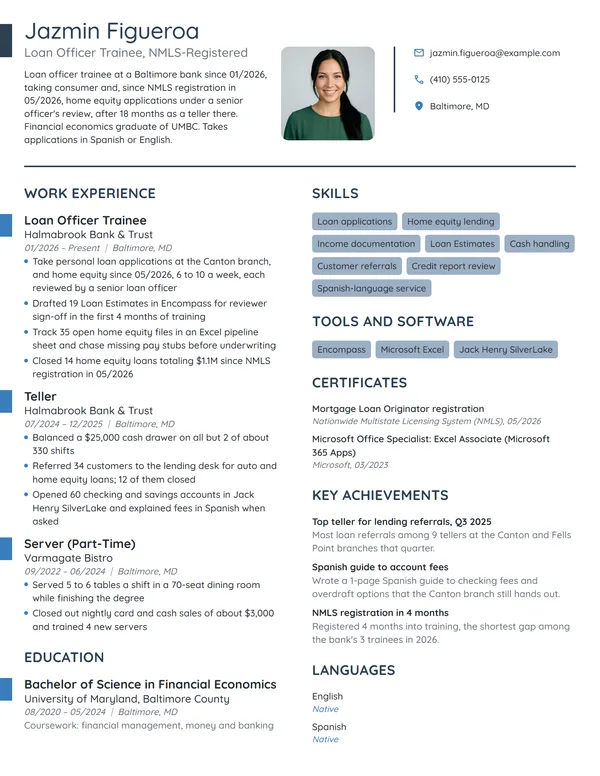
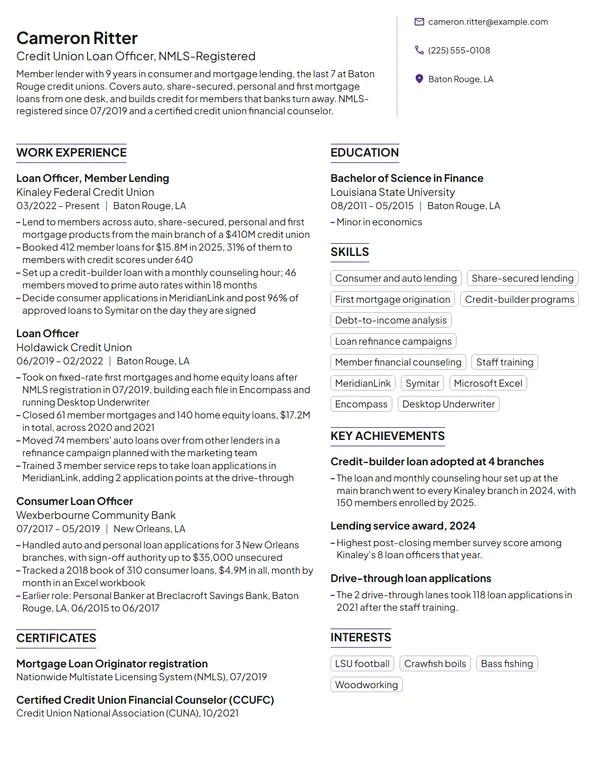
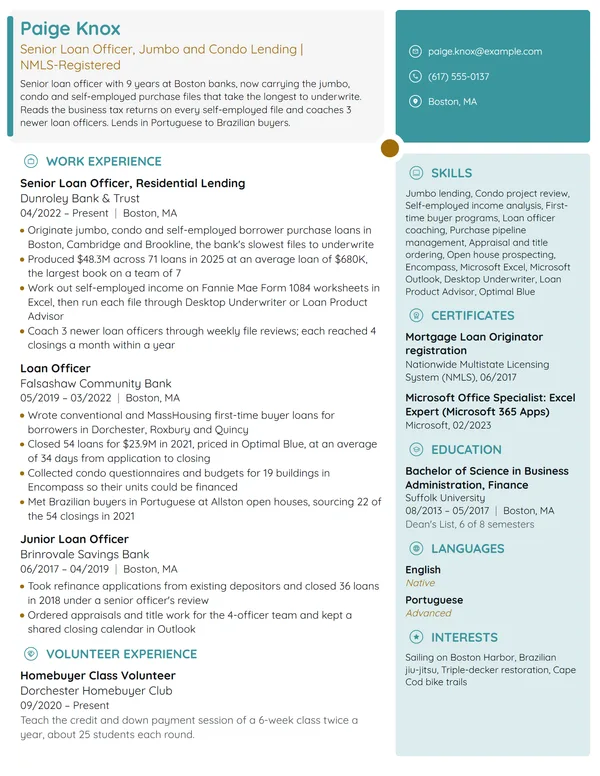
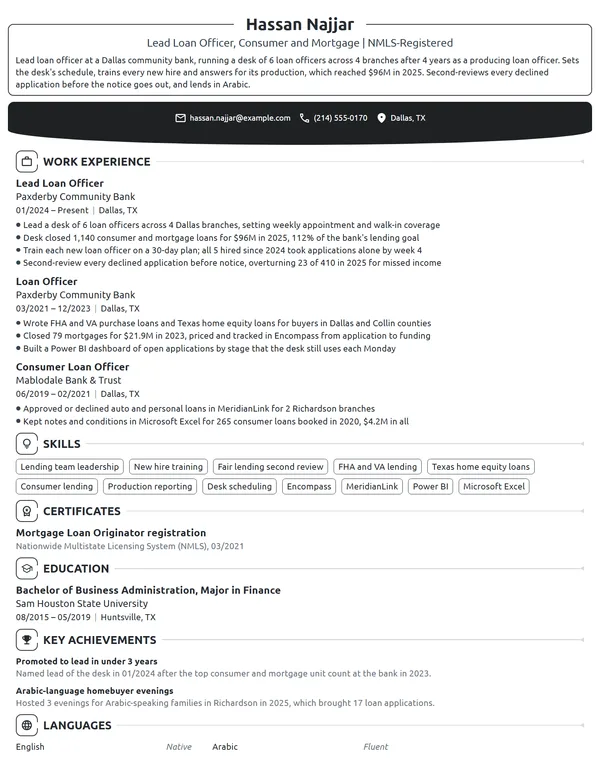
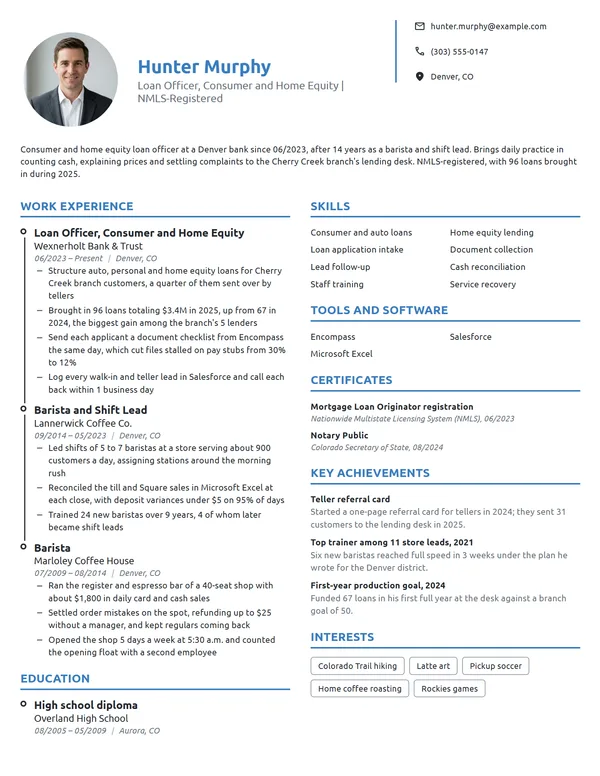
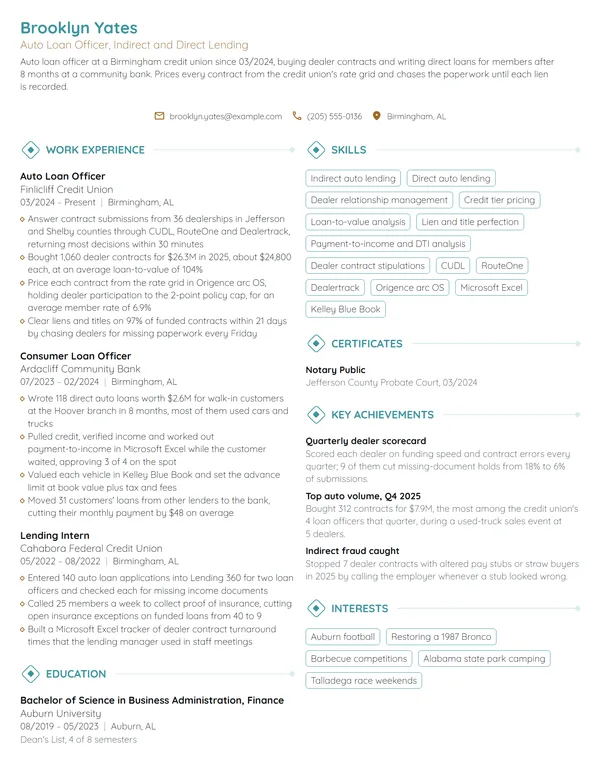
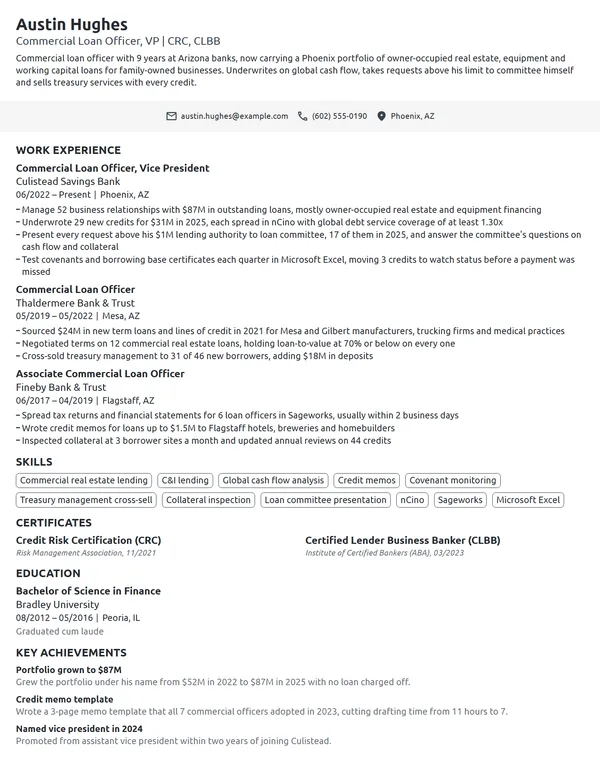
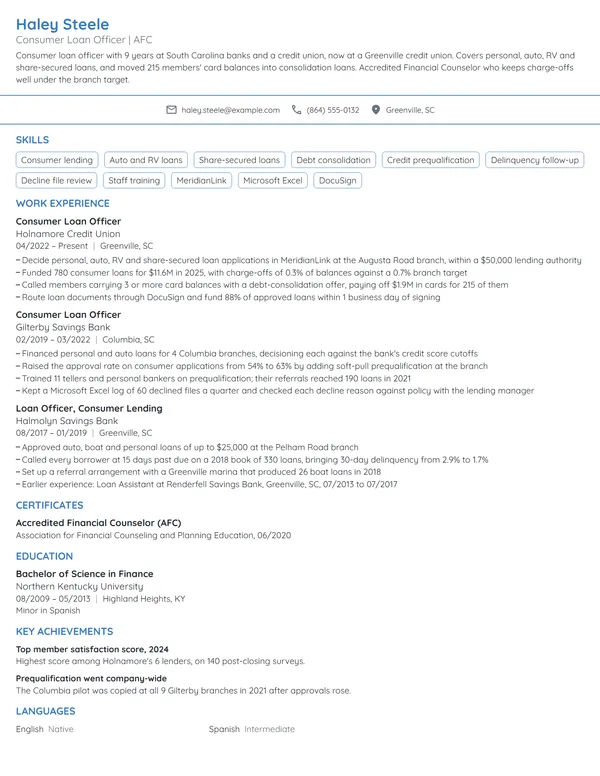
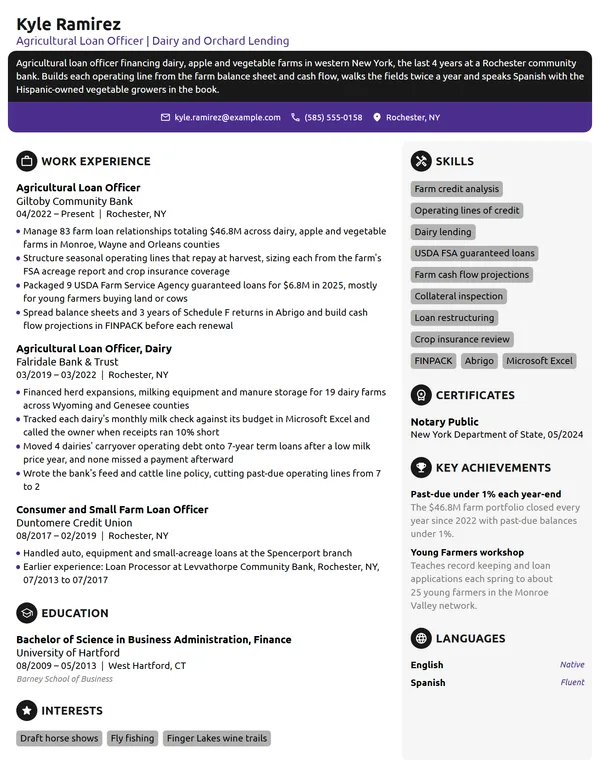
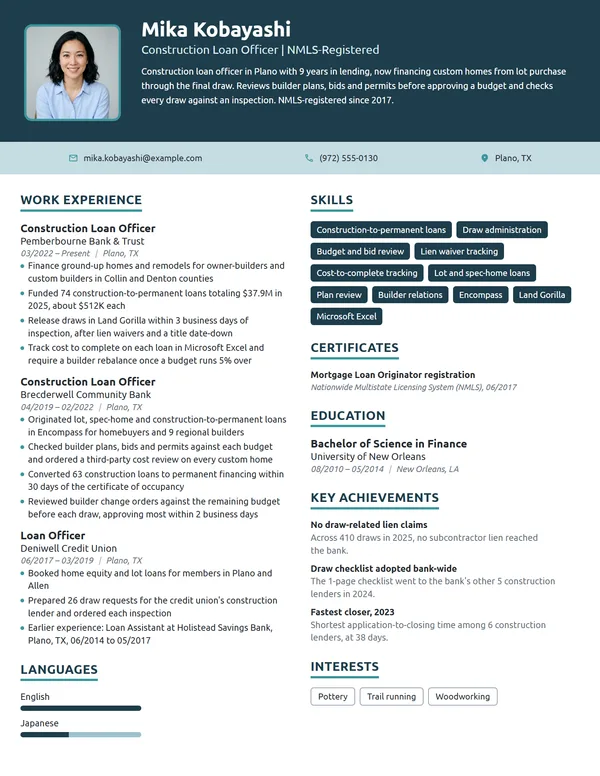
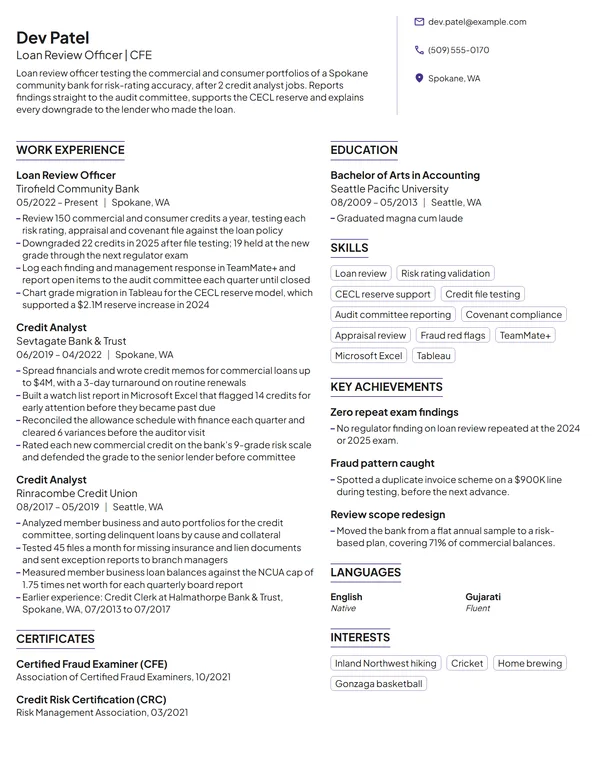
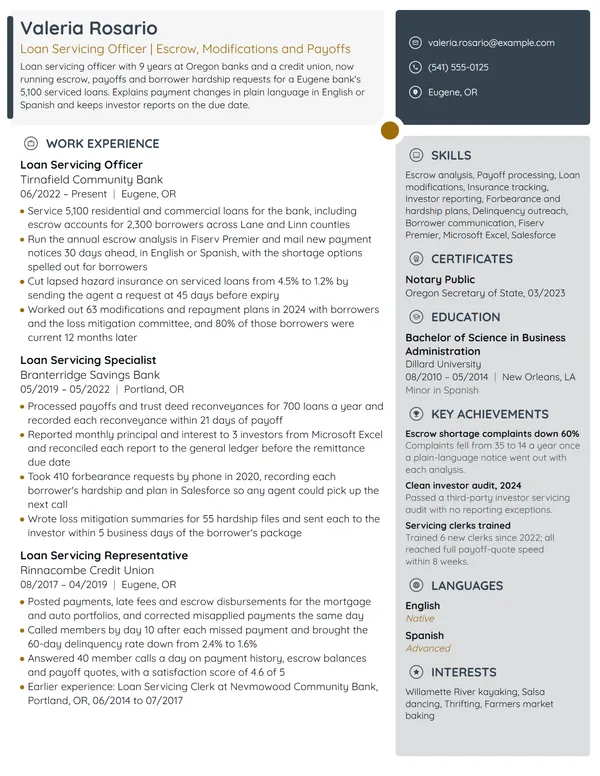
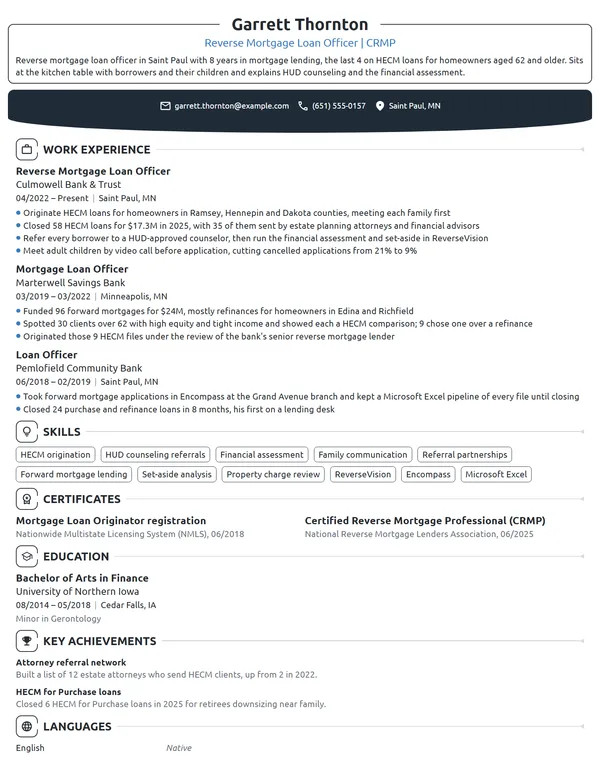
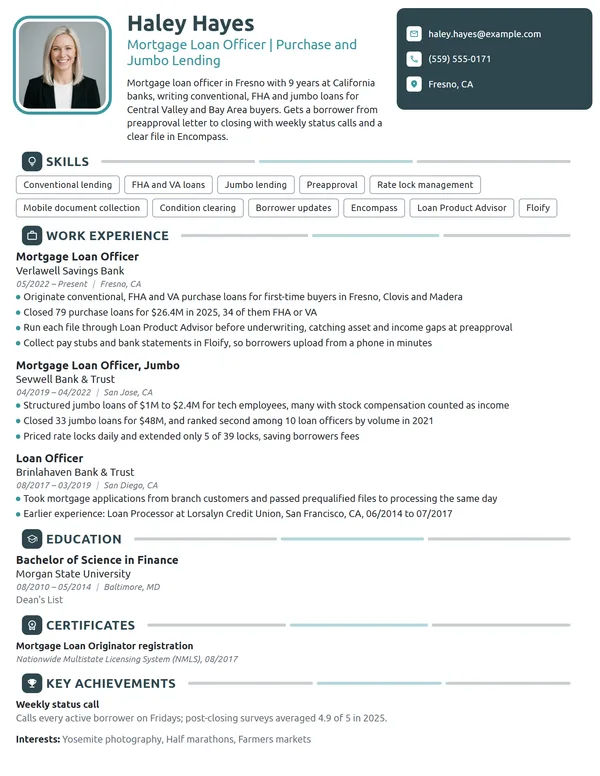
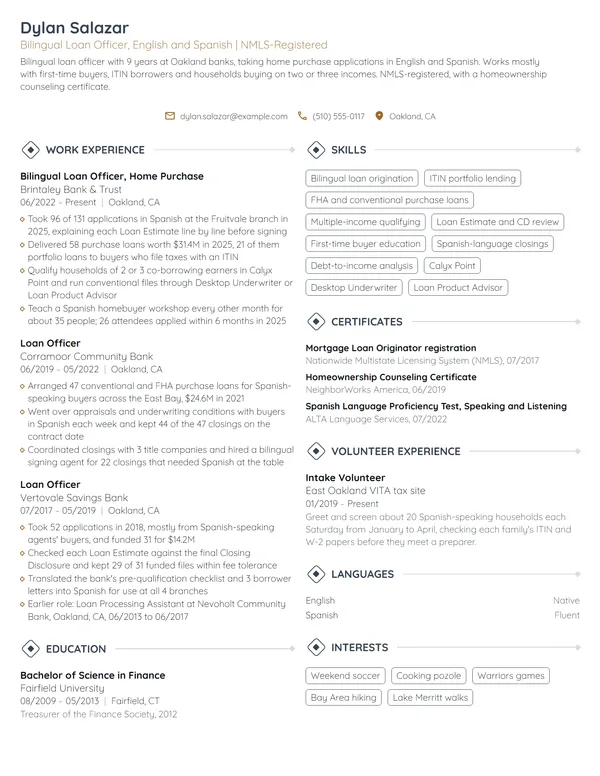
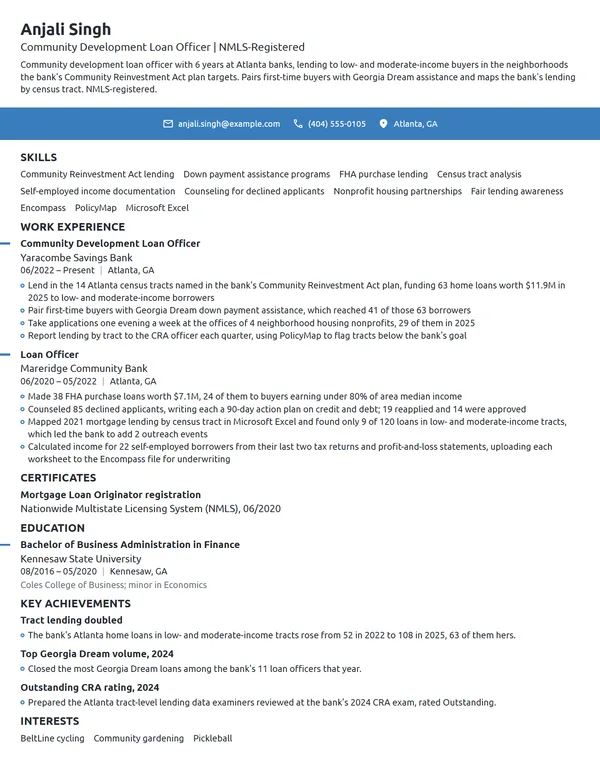
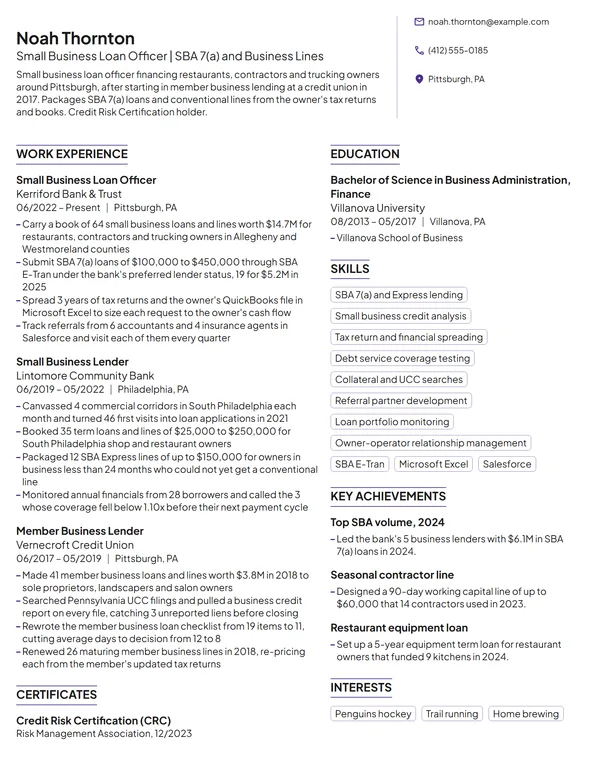
A loan officer walks borrowers from a first conversation to a funded loan. Before an interview, a lending manager checks which loans you write, how much you close in a year, how cleanly your files clear underwriting, and whether you hold the license or registration the role needs. A volume figure says little without the loan types and the days each file took. Put those numbers side by side and your production reads at a glance.
How to Write a Loan Officer Resume - Key Takeaways
- Lay out your jobs newest first (reverse-chronological) on 1 page, and go to 2 only with 10+ years or a team you led.
- Open with a 2- to 3-line summary that names your loan types, your years, your funded volume for a recent year and your NMLS status.
- Give every bullet a lending figure: loans and dollars funded, pull-through, days to close, files suspended or delinquency on what you approved.
- Put your NMLS ID once near your name, and list your license or registration first under Certificates.
- Name the loan origination system and office tools from the job ad in Skills, then show each one at work in a bullet.
- Keep borrower names and loan numbers off the page, then run the file through an ATS resume checker before you apply.
What lending managers look for in a loan officer resume
The BLS describes loan officers gathering information from applicants, verifying and analyzing their credit and income, and then approving the application or referring it to management. O*NET adds that they approve loans within set limits and send larger requests up the chain. A lending manager reads your resume for the same 3 things: how much you originate, how sound those loans turn out to be, and how far your authority reaches.
The BLS also splits the job by borrower: commercial loan officers lend to businesses, consumer loan officers fund cars, tuition and personal needs, and mortgage loan officers finance real estate. Say which of these you write in the first lines of every job, since a mortgage lender and a credit union's consumer desk look for different files. Then use these sections, in names an applicant tracking system reads cleanly:
- Name, headline (for example, Mortgage Loan Officer, NMLS-Registered) and contact details with your NMLS ID
- Summary: 2 to 3 lines below your name, with no label above it
- Work Experience, starting with your current lender
- Skills, including your loan origination system
- Certificates, with your license or registration first
- Education
- Optional: Languages if you lend in more than 1, and a Key Achievements section (swap in Volunteer Experience when that material is stronger)
Best format for a loan officer resume
Use the reverse-chronological resume format, with your current role on top and each job showing your title, the lender, the city it sits in and dates written as MM/YYYY. Lending careers tend to climb from teller, processor or trainee to loan officer, then to senior or lead roles, and newest-first order puts that climb in plain view. Career changers from sales or real estate keep this order too.
- Best for most loan officersReverse-chronologicalYour jobs, newest first, with your results under each one.Best for: A steady work history in your field
- FunctionalSkills grouped up top, with a short work history below.Best for: Gaps or very little experience
- CombinationA skills section first, then your full work history.Best for: A career change with strong skills
Fit it on 1 page when you have under 10 years in lending. Senior and lead loan officers who coach a team, manage referral channels or hold a large portfolio can use 2 pages, provided the first page carries the 2 most recent jobs and the best production figures.
| Setting | What to use |
|---|---|
| Length | 1 page; 2 only with 10+ years or a team you led |
| Job title line | Title plus lending line: Loan Officer, Residential Mortgage |
| NMLS ID | Once, in the headline or the contact line |
| Dates | Month and year as MM/YYYY, with Present on the job you have now |
| Font and margins | One readable sans serif, 10 to 12 pt, with margins of about 0.75 inch |
| Personal information | No photo for most US and Canadian lenders; no date of birth, marital status or Social Security number |
| File type | PDF, or Word if the lender's career portal asks for it |
Most US and Canadian resumes carry no photo. A lender's hiring system parses text, so keep your contact line plain and put the NMLS ID there as digits rather than inside a graphic.
Loan officer resume summary vs. objective
Ask yourself a single question: have you originated loans in your own name yet? If so, write a resume summary with your loan types, years, a recent year's volume and your NMLS status. If not, write a resume objective that names the role you want and the closest proof you have, such as processing files or selling a financial product.
Loan officer resume summary formula
Title with X years in loan types at lender type, working in loan origination system. Funded volume for a recent year, in loans and dollars. A file quality or speed result. NMLS status.
Example
Loan officer with 7 years in residential and consumer lending at a community bank, working in Calyx Point. Funded 118 loans worth $21.4M in 2025. Cleared 91% of mortgage files to close on the first underwriting pass. NMLS-registered since 2022, licensed in Illinois before that.
Don't
Results-driven loan officer passionate about helping families achieve the American dream of homeownership.
Do
Mortgage loan officer with 3 years at a credit union, writing conventional, FHA and VA purchase loans. Funded 52 loans worth $11.2M in 2025 with a 68% pull-through rate, and works with Spanish-speaking borrowers in their language.
The second version names the lender, the products, the volume, the pull-through and a language buyers ask for.
How to write loan officer work experience bullets with numbers
Your current job gets 3 or 4 bullets and each earlier one 1 to 3, all starting with a verb. Your pipeline report, your lender's scorecard and your loan origination system already hold the counts, so pull them for each year before you write. Turn every duty into one of your achievements on your resume: a loan type, a count or dollar figure, and what it led to.
| Area | What to count | Example bullet |
|---|---|---|
| Production | Loans funded, dollar volume, rank among officers | Funded 64 home loans worth $13.8M in 2025, 3rd of 9 officers in the region. |
| Pull-through | Applications taken against loans funded | Turned 72% of 150 applications into funded loans, against a branch average of 61%. |
| Speed | Days from application to closing, contract dates met | Closed purchase loans in 27 days on average and met the contract date on all 58 files. |
| File quality | Files suspended, underwriting conditions, post-closing defects | Sent 40 files to underwriting in Q2 2026 with 0 suspended for missing documents. |
| Portfolio quality | Delinquency and charge-offs on loans you approved | Held 30-day delinquency on a $9M auto loan portfolio at 0.8% for 2 years. |
| Referral sources | Agent, builder and branch partners, loans each one sent | Signed 6 builder partners who referred 38 loans in 2025. |
| Commercial credit | Deal size, credit memos, coverage ratios | Underwrote 22 small business lines of credit from $50K to $750K at a debt service coverage of 1.25x or better. |
Here is a mortgage and consumer lender's entry with those figures in place. The current job opens with volume, then shows where the business came from, how clean the files were and how fast they closed; the older job gets 1 bullet.
Work Experience
- Funded 118 residential and consumer loans worth $21.4M in 2025, up from 84 loans in 2023.
- Built a referral base of 14 real estate agents and 3 builders, who sent 47 of last year's applications.
- Cleared 91% of mortgage files to close on the first underwriting pass by collecting income and asset documents at application in Calyx Point.
- Cut average application-to-closing time from 41 to 32 days by ordering appraisals the day each rate was locked.
- Originated 73 purchase and refinance loans worth $12.9M in 2021 through 9 real estate agent partners.
Every figure above describes the officer's book, never a borrower. Leave names, addresses, credit scores and loan numbers off your resume, even when a file makes a good story.
Don't
Responsible for originating loans and building relationships with realtors.
Do
Originated 41 purchase loans in 2025; 29 came from 8 real estate agents met through weekly open-house visits.
The rewrite shows the volume and the source of the business in 1 line.
Don't
Reviewed loan applications and made credit decisions.
Do
Decided 210 consumer loan applications within a $75K lending authority and referred 18 larger requests to the credit committee.
Loan officer skills and lending software for your resume
Pick 6 to 8 hard skills for your resume from the posting, each one backed by a bullet further down. Credit analysis and income verification fit almost every loan officer; FHA and VA lending, commercial credit or auto dealer relationships go on only when you have written those loans.
Hard skills for loan officers
- Loan origination
- Credit analysis
- Income and asset verification
- Debt-to-income calculation
- Conventional, FHA and VA lending
- Consumer and auto lending
- Rate locks and pricing
- TRID disclosures
- Fair lending compliance
- Pipeline management
Soft skills lending managers value
- Explaining loan terms in plain words
- Persistence with referral partners
- Discretion with financial records
- Calm with anxious borrowers
- Follow-through on closing dates
- Self-directed prospecting
Microsoft Excel, Office and Outlook carry O*NET's in-demand flag for loan officers, and the same list names lending tools such as the 1003 Uniform Residential Loan Application, Calyx Point and the Bankers Systems Rembrandt Lending System. Write your loan origination system exactly as the posting does, whether that is Encompass, MeridianLink or Calyx Point, and put it inside a bullet as well as in Skills. For Excel, say what you build in it, such as a pipeline tracker or a debt service coverage worksheet.
NMLS license, registration and credit certifications on a loan officer resume
The BLS says mortgage loan officers must have a Mortgage Loan Originator (MLO) license, earned through prelicensing courses, a national exam, and background and credit checks. The CFPB's Regulation G draws the line by employer: an MLO who works for a bank, savings association or federally insured credit union registers with the Registry and keeps a unique identifier, the NMLS ID, instead of holding a state license. List certifications on your resume in the Certificates section, with the license or registration on the first line.
| Credential | Issued by | What it takes |
|---|---|---|
| Mortgage Loan Originator license | Your state's financial regulator, through the NMLS | Under the CFPB's Regulation H: at least 20 hours of approved pre-licensing education (3 of federal law, 3 of ethics, 2 on nontraditional mortgage lending), a test score of 75% or more, fingerprints for an FBI background check and an independent credit report. Then 8 hours of continuing education each year. |
| Mortgage Loan Originator registration | NMLS, under the SAFE Act and Regulation G | For employees of banks, savings associations and federally insured credit unions: register with the Registry and keep your unique identifier (NMLS ID). |
| Credit Risk Certification (CRC) | ProSight Financial Association (formed in 2024 from RMA and BAI) | At least 3 years of credit risk experience (5 recommended), a 120-question exam, then 45 continuing-education credits every 3 years. Suits commercial and small business lenders. |
License or registration: how to write the NMLS line
Write the exact status you hold. A license names the state regulator that issued it and the month and year; a registration names the NMLS and the month you registered. If you held a state license at a mortgage company and then moved to a bank, keep both lines with their dates so a recruiter sees an unbroken record under a single NMLS ID. A trainee who has passed the national test but holds no license yet lists the test as passed, with the date, and nothing more.
Certificates
- Mortgage Loan Originator registration, Nationwide Multistate Licensing System (NMLS), 04/2022
- Mortgage Loan Originator license, Illinois Department of Financial and Professional Regulation, held 09/2019 – 03/2022
- SAFE MLO National Test with Uniform State Content, passed 08/2019
Finance or business degree: the education section of a loan officer resume
The BLS lists a bachelor's degree, usually in business or finance, as the typical entry education for loan officers, followed by some training on the job once hired. Follow the standard rules for listing education on a resume: the degree, the school, the town it is in and the month you graduated. Add a GPA of 3.5 or above, or a credit analysis project, only in your first 2 years after school, then let your lending results take that space.
Education
GPA 3.6. Senior project: credit analysis of 3 local businesses applying for equipment loans.
A degree in economics, accounting or another field works too when your Work Experience shows lending. If you are studying for the SAFE pre-licensing course or the national test, list it under Certificates as in progress with an expected month, not under Education.
Trainee, entry-level and career-change loan officer resumes
New loan officers learn much of the job once hired, per the BLS, so a trainee posting looks for potential more than a book of business. With no lending title yet, use an entry-level resume layout: an objective, Education placed high on the page, and every piece of work that shows you can handle money, paperwork and customers. Put figures on each one, as you would on a lending job.
- Teller, member service or personal banker work: transactions a shift, accounts opened, members referred to the lending team.
- Loan processing or underwriting support: files a month, conditions cleared, days saved; see the loan processor examples for that route.
- Sales jobs: quota reached, repeat customers, financing applications you took at a car or furniture dealer.
- Finance coursework or a credit union internship: listed under Education or Work Experience, with the analysis you did and the tools you used.
Don't
Motivated recent graduate seeking a loan officer position to begin a career in finance.
Do
Finance graduate finishing the 20-hour SAFE pre-licensing course, seeking a loan officer trainee role. Handled about 300 transactions a week as a part-time teller and referred 15 members to the consumer lending desk.
Even an objective can carry a count and a credential status.
Coming from real estate, car sales or another bank role, keep reverse-chronological order and use the first bullets of your current job for the lending-adjacent work: financing conversations, credit applications, documents gathered. A career-change resume that leads with those tasks reads like a step, not a jump. Explain the move in a letter instead: these finance cover letter examples state a switch in 2 or 3 sentences.
Loan Officer resume FAQ
Should I put my NMLS number on my resume?
Yes, for any mortgage role. Put your NMLS ID once in the headline or contact line, where an employer can copy it straight into NMLS Consumer Access. Then list your license or registration with its issuer and date as the first line under Certificates.
Do you need a license to be a loan officer?
For mortgage lending, yes, in one of 2 forms. The BLS says mortgage loan officers need an MLO license, while under the CFPB's Regulation G an originator at a bank, savings association or federally insured credit union registers with the NMLS instead. For consumer or commercial lending, follow what the job ad asks for.
How do I show loan volume on a resume?
Give both the count and the dollars for a named year, such as 60 loans worth $12M in 2025, and say which loan types they were. Add 1 more figure that shows quality or speed, such as pull-through or days to close, so the volume reads as sound business.
How long should a loan officer resume be?
1 page for most loan officers. Move to 2 pages only with 10+ years, several lending lines or a team you coached, and keep your 2 latest jobs and strongest production figures on page 1.
Can I become a loan officer without a finance degree?
Yes. The BLS names a bachelor's degree, most often in business or finance, as the usual entry point, but banks and mortgage companies also hire from teller, processing and sales jobs. On your resume, lead with the lending-adjacent work you have done and any licensing progress.
How do I write a loan officer trainee resume with no lending experience?
Start with an objective that names the trainee role and your best proof, such as teller or sales results. Move Education up the page, list the SAFE pre-licensing course or the national test under Certificates once you have started, and give every past job a figure.
Should I put my income or commission on a loan officer resume?
No. Leave pay and commission splits for the interview, and show production in loans and dollars funded instead. For salary talks, the BLS reports that the median annual wage for loan officers was $76,690 in May 2025.
Next steps
Choose the example nearest your lending line and level, keep its order, and replace each figure with your own funded volume, pull-through and closing times. Build it in our resume builder, or pick one of our resume templates as the base, and open the letter you send with it on your strongest production number.