
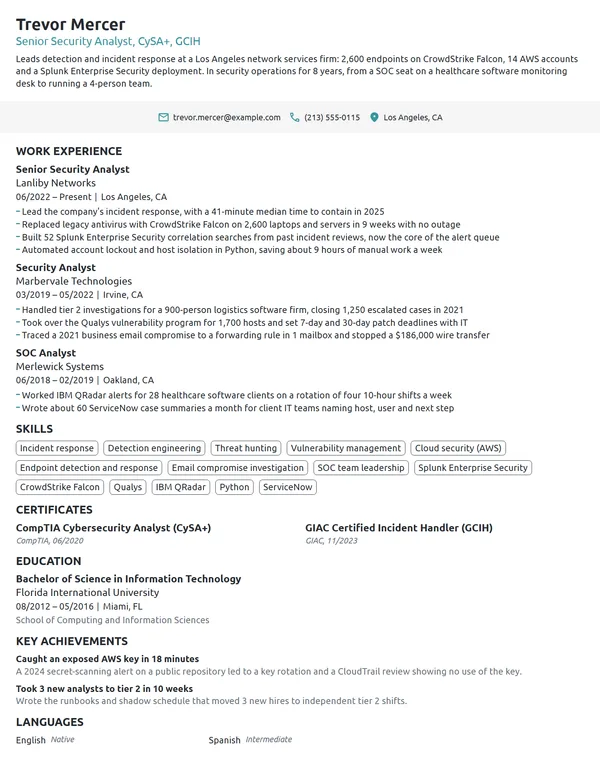
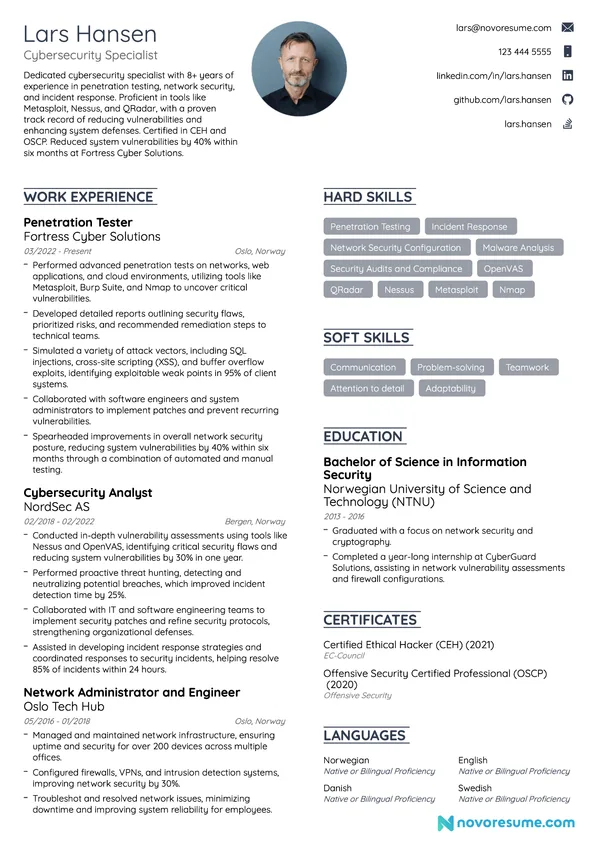
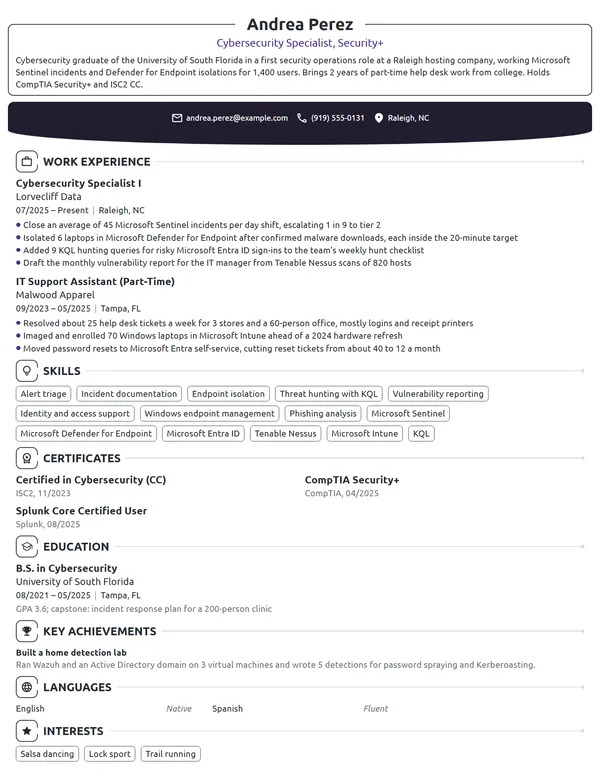
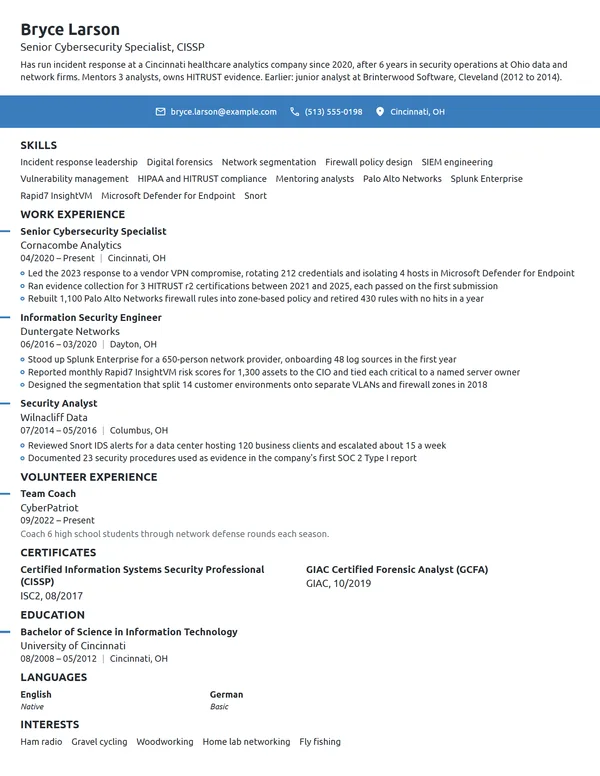
Cybersecurity hiring starts with trust: before anyone gives you access to their network, they want to see what you have defended, the tools you work in and the certifications behind your name. Acronyms alone don't earn that trust. SIEM, EDR and CISSP on a page say what you know, not what you did with it, so name each tool and then what it caught, fixed or stopped, with a number a security manager would track.
How to Write a Cybersecurity Resume - Key Takeaways
- Lay out your roles newest first (reverse-chronological) and keep to 1 page unless you have 10+ years across IT and security.
- Open with a 2- to 3-line summary that names your security area, your main tools, your best detection or remediation result and your top certification.
- Give each bullet a security number: alerts triaged, time to contain, critical vulnerabilities closed, accounts brought under MFA or audit findings fixed.
- List the SIEM, EDR, scanner and cloud platform from the job ad under Skills, then prove each one inside a bullet.
- List each certification under Certificates beside its issuer and date; if you passed the CISSP exam before 5 years of experience, write Associate of ISC2.
- If a job requires a clearance, state its level and status near the top, then check your file in an ATS resume checker before you apply.
What hiring managers look for in a cybersecurity resume
A security manager reads your resume for the size of what you protected, the tools you protected it with, and proof that your work changed something. The BLS lists monitoring networks for breaches, checking systems for vulnerabilities and preparing reports on attempted attacks as core duties for information security analysts. O*NET adds performing risk assessments, regulating access to data and documenting security policies and tests. Each of those tasks can carry a count, a time or a before-and-after figure.
Security teams also screen for fit by track. A SOC analyst, a penetration tester and a GRC analyst share a field but not a daily routine, so put the track in your headline and keep the bullets on that kind of work. Build the page from these sections:
- Name, headline with your track and top credential (for example, Security Analyst, CySA+), and contact details with a LinkedIn or GitHub link
- Summary: a short opening paragraph, 2 to 3 lines, with no heading above it
- Work Experience, newest role first
- Skills, with your SIEM, EDR, scanners and cloud platforms inside them
- Certificates, each with its issuer and month
- Education
- Optional: Key Achievements for CTF results or a home lab, Volunteer Experience, Languages
Best format for a cybersecurity resume
Pick the reverse-chronological resume format: your latest role first, each with the title, the employer, its city, and start and end months as MM/YYYY. Security careers usually climb from help desk or systems work into analyst, engineer and lead roles, and this order shows that climb at a glance. Even career changers usually do better with this order than with a combination format.
- Best for most cybersecurity rolesReverse-chronologicalYour jobs, newest first, with your results under each one.Best for: A steady work history in your field
- FunctionalSkills grouped up top, with a short work history below.Best for: Gaps or very little experience
- CombinationA skills section first, then your full work history.Best for: A career change with strong skills
Under 10 years of experience, 1 page is enough. A security architect or team lead with 10+ years, several platforms and a run of audits or incident programs can use 2 pages, as long as page 1 carries the current role and the strongest certifications. Cut old help desk detail before you cut anything security related.
| Setting | What to use |
|---|---|
| Length | 1 page; 2 only past 10 years in IT and security |
| Dates | MM/YYYY start and end months; Present on your current role |
| Headline | Track plus credential: Security Analyst, CySA+ or Penetration Tester, CEH |
| Security clearance | Level and status in the headline or summary, such as Active Secret clearance, only when the posting asks |
| Links | LinkedIn, plus GitHub if it holds your own scripts, detections or write-ups |
| Photo, date of birth, SSN | No photo on most US and Canadian resumes; leave date of birth and SSN off |
| File type | PDF, or Word if the employer's portal requires it |
Most US and Canadian resumes carry no photo, so give the top of the page to your headline, your strongest certifications and, where a posting asks, your clearance line.
Cybersecurity resume summary vs. objective
The test is simple: if you have held a security or IT job, write a resume summary with your track, your tools, one result and your best certification. If your security work so far comes from courses, labs and an internship, write a resume objective that names the role you want and the proof you have. Either way, draft it after your bullets and take its number from one of them.
Cybersecurity resume summary formula
Title with X years in IT, SOC, cloud or GRC work, working in SIEM, EDR or scanner. One detection, response or remediation win and its number. Certifications, plus clearance if the job asks.
Example
Security analyst with 6 years in IT and security operations, the last 3 in a credit union SOC, working in Splunk Enterprise and Tenable Nessus. Led containment on 31 confirmed incidents in 2025, none of which reached member data. CompTIA Security+ and CySA+, with the CISSP exam scheduled for 2027.
Don't
Passionate cybersecurity professional with a strong understanding of threats, seeking to protect an organization's critical assets.
Do
SOC analyst with 3 years at a managed security provider, monitoring 40 client networks in Microsoft Sentinel. Escalated 210 confirmed incidents in 2025 with a 12-minute median time to triage. CompTIA Security+ and CySA+.
Track, scale, tool, result and credentials, all in 3 sentences.
How to write cybersecurity work experience bullets with numbers
Your current role gets 3 to 4 bullets and earlier roles get 1 to 3, each starting with a verb and ending with what changed. Security work already runs on metrics such as alert volume, mean time to contain and patch windows, so most bullets can borrow a number from a dashboard you already use. Write achievements on your resume instead of the tasks from your job description, and leave out anything an NDA or your employer's policy keeps private, such as client names or the details of an unpatched flaw.
| Area | What to count | Example bullet |
|---|---|---|
| Detection | Rules written, false-positive rate, alerts per day | Wrote 26 detection rules mapped to MITRE ATT&CK and cut false positives on the top 10 alerts by 40%. |
| Incident response | Incidents handled, time to contain, systems affected | Contained a ransomware infection on 3 laptops within 35 minutes, before it reached a file server. |
| Vulnerability management | Assets scanned, critical findings, days open | Lowered the average age of critical vulnerabilities from 47 to 12 days across 3,400 endpoints. |
| Identity and access | Accounts reviewed, MFA coverage, privileged accounts | Removed 380 stale accounts in a quarterly access review and moved 45 admin accounts into a PAM vault. |
| Compliance and audit | Controls mapped, findings, frameworks | Mapped 112 controls to NIST CSF and closed 7 of 9 findings before a SOC 2 Type II audit. |
| Security awareness | Staff trained, phishing click rate | Ran monthly phishing simulations for 1,100 staff and lowered the click rate from 14% to 4% in a year. |
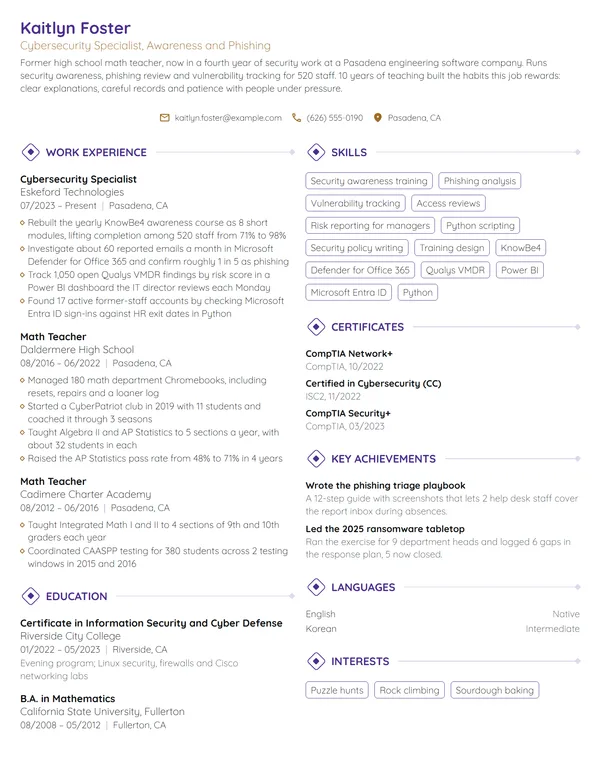
This is how a security analyst who started in systems administration might lay out 2 roles. The current job carries the detection and response work, and the older one shows the hardening experience that led to it.
Work Experience
- Triage about 140 Splunk Enterprise alerts a day for a 22-branch credit union, and cut the false-positive rate from 61% to 24% by retuning 37 correlation searches.
- Shortened phishing containment from 5 hours to 50 minutes with 4 PowerShell playbooks that disable the account and pull the message from every mailbox.
- Run weekly Tenable Nessus scans across 1,900 assets and brought critical findings past the 15-day patch window from 83 to 6.
- Enforced MFA for 640 users at 9 client firms through Microsoft 365 conditional access.
- Hardened 210 Windows servers to CIS Benchmarks Level 1, raising the average compliance score from 58% to 91%.
Don't
Responsible for monitoring the SIEM and responding to alerts.
Do
Wrote 18 Microsoft Sentinel analytics rules for impossible travel and token theft, which flagged 3 compromised accounts before any data left the tenant.
A reader learns the tool, the threat and the outcome in 1 line.
Don't
Conducted penetration tests on web applications.
Do
Ran 11 authenticated web application tests in Burp Suite Professional and reported 46 findings, 9 rated high, all retested and closed before release.
Cybersecurity skills and security tools for your resume
Choose 6 to 8 technical skills for your resume that match the posting and that your work history backs up. A defensive role leans on monitoring, response and vulnerability work; an offensive one on testing and exploitation; a GRC role on risk assessment and frameworks. Leave out skills from a track you are not applying for.
Hard skills for cybersecurity roles
- Security monitoring and alert triage
- Incident response
- Vulnerability management
- Threat hunting
- Identity and access management (IAM)
- Firewall and network security
- Cloud security (AWS, Azure)
- Endpoint detection and response (EDR)
- Risk assessment
- Python and PowerShell scripting
Soft skills security managers value
- Calm communication during an incident
- Clear written reports
- Explaining risk to non-technical staff
- Judgment under time pressure
- Discretion with sensitive data
- Curiosity about how attacks work
Name your tools with your skills, then show each one at work in a bullet. O*NET's in-demand list for information security analysts includes Splunk Enterprise, Tenable Nessus, MITRE ATT&CK, Microsoft PowerShell, Python, Amazon Web Services, Microsoft Azure and Linux, and lists Microsoft Active Directory as a hot technology. If the posting names CrowdStrike Falcon, Microsoft Sentinel, Wireshark or Burp Suite and you have used it, copy that exact product name rather than a category such as EDR or SIEM.
Security+, CISSP and other cybersecurity certifications on a resume
The BLS writes that many employers prefer information security analysts who hold a security certification, so list certifications on your resume in their own Certificates section with the issuer and the month you earned each one. Security+ is the usual first credential, and CompTIA lists it against DoD 8140 work roles such as cyber defense analyst and incident responder, which matters for government and contractor jobs. CISSP and CISM come later, because both require years of experience.
| Credential | Issued by | What it takes |
|---|---|---|
| CompTIA Security+ | CompTIA | Exam SY0-701: up to 90 questions in 90 minutes, passing score 750 on a 100 to 900 scale. Recommended first: Network+ and 2 years of security or systems administrator work. |
| Certified in Cybersecurity (CC) | ISC2 | No work experience required. ISC2 aims it at entry- and junior-level roles, career changers and students. |
| Certified Ethical Hacker (CEH) | EC-Council | Official EC-Council training, or 2 years of information security experience with a $100 application; a 125-question, 4-hour exam. |
| CISSP | ISC2 | 5 years of cumulative full-time experience in 2 or more of the 8 CISSP domains. A related degree or an approved credential can cover up to 1 year. |
| CISM | ISACA | 5 years of information security management experience across at least 3 of the 4 CISM domains, gained in the 10 years before you apply. |
Passed the CISSP exam without 5 years of experience?
ISC2 lets you sit the exam early: pass it and you become an Associate of ISC2, with 6 years to earn the 5 years of experience. Write Associate of ISC2 under Certificates with the month you passed, and keep CISSP out of your headline until ISC2 grants the full certification. A scheduled exam goes on the list too, marked as scheduled with its month.
Certificates
- CompTIA Security+, CompTIA, 05/2021
- CompTIA CySA+, CompTIA, 10/2024
- CISSP, ISC2, exam scheduled 03/2027
How to list a cybersecurity or computer science degree
The BLS describes a bachelor's in a computer science field as the typical requirement for information security analysts, though some enter with only a high school education plus industry training and certifications. In O*NET's survey of the occupation, 53% of respondents said a bachelor's degree is required, 23% a post-baccalaureate certificate and 13% an associate's degree. Follow the standard way of listing education on a resume: the degree name, the school and its city, then the month you graduated.
Within 2 to 3 years of graduating, add a line of security coursework or a capstone; after that, the degree line alone is enough. A bootcamp or a university certificate in cybersecurity goes under Education too, with the school's name and the month you finished. A degree in an unrelated subject still belongs on the page, since many postings ask for a bachelor's degree in any field plus certifications.
Education
Coursework: network security, operating systems, applied cryptography.
Entry-level and career-change cybersecurity resumes
Many analysts start outside security. Many have worked in an IT department first, the BLS says, often as a network and computer systems administrator, so help desk and systems roles count as relevant experience. With no full-time security job yet, use an entry-level resume layout: an objective, Education and Certificates near the top, then the evidence below, counted the way a job would be.
- Help desk and IT support: tickets resolved, password resets moved to self-service, endpoints imaged or patched.
- SOC or IT internships: alerts triaged per shift, playbooks followed, reports written for a senior analyst.
- Capture the Flag competitions: team placing and number of teams, listed under Key Achievements.
- Home lab: what you built (a SIEM, an Active Directory domain, a firewall) and what you detected in it, also under Key Achievements.
- Coursework and certificates, under Education and Certificates: labs with real tools, a capstone and the CC or Security+.
Don't
Motivated IT graduate looking for an entry-level cybersecurity position to grow my skills.
Do
Cybersecurity graduate with CompTIA Security+ and a 12-week SOC internship at a regional hospital network, seeking a Tier 1 analyst role. Triaged about 30 alerts a shift under a senior analyst.
Proof belongs in an objective too: a credential, a setting and a count.
Moving in from teaching, the military, finance or another field, stay with newest-first order and open with a summary that names your security training and the skills that carry over, such as training users, writing procedures or working under audit rules. A career-change resume works best when the bullets under your last job lead with the tasks closest to security, and your certificate program and certifications sit high on the page. Explain the switch in your cover letter instead: our IT cover letter examples show how to tie past work to a technical role in a short paragraph.
Cybersecurity resume FAQ
Do I need a degree to get a cybersecurity job?
Not always, but most employers expect one, usually in a computer science field. Without a degree, lead with certifications, IT experience and lab work.
Which certification should I put on an entry-level cybersecurity resume?
CompTIA Security+ is the usual first choice, and ISC2's Certified in Cybersecurity (CC) needs no work experience at all. Put whichever you hold under Certificates, beside its issuer and month, and add a scheduled exam with its month if you are close.
Can I write CISSP on my resume if I passed the exam but lack the experience?
No. ISC2 makes you an Associate of ISC2 until you have the 5 years of experience, and you have 6 years to earn it. Write Associate of ISC2 with the month you passed under Certificates, and add CISSP to your headline once ISC2 grants it.
How do I list a security clearance on a cybersecurity resume?
Write its level and status, such as Active Top Secret, in your headline or summary, and only when the job is with a government agency or a contractor that requires one. Leave out investigation details, case numbers and anything about the work it gave you access to.
How long should a cybersecurity resume be?
1 page for most candidates under 10 years of experience. Security leads and architects with a longer record of platforms, audits and incident programs can use 2 pages, as long as page 1 holds the current role and the top certifications.
Where do a home lab and CTF results go on a cybersecurity resume?
Under Key Achievements, with a number in each line: your team's placing out of how many teams, or what your lab ran and what you caught in it. If the lab taught you a tool the posting names, use that tool again in your summary.
Should I include a GitHub link on a cybersecurity resume?
Only if the profile holds your own work, such as detection rules, scripts, tool contributions or CTF write-ups. Put it in the contact line beside LinkedIn, and check that nothing in it exposes an employer's code, network details or client data.
How much do information security analysts make?
Information security analysts earned a median of $129,180 a year in May 2025, according to BLS wage data. Keep salary off the resume itself; pay depends on your track, your certifications, your clearance and where you work.
Next steps
Choose the example closest to your track and level, follow its layout, and swap every figure for your own alerts, incidents, scans and audit results. Build it in our resume builder, or pick one of the resume templates, and pair it with a letter naming the environment you protect and your strongest number.