

Most resumes get less than 20 seconds of attention. According to Novoresume's survey of HR professionals, 74% of recruiters skim a resume in 20 seconds or less before deciding whether to keep reading. 34.5% make that call in under 10 seconds.
That means your resume has one job: get a recruiter to stop skimming and start reading.
This guide walks you through every section of a resume, step by step. You'll learn what to include, how to format it, how to tailor it for the job you want, and what's actually getting candidates filtered out before anyone reads their qualifications.
Want to follow along as you build? Use Novoresume's resume builder and apply these principles in real time.
Want to get started on your resume right away? Use our professional resume builder and follow along as you read our article!
Choose a resume template to get started.
Resume Writing 101: The Essentials
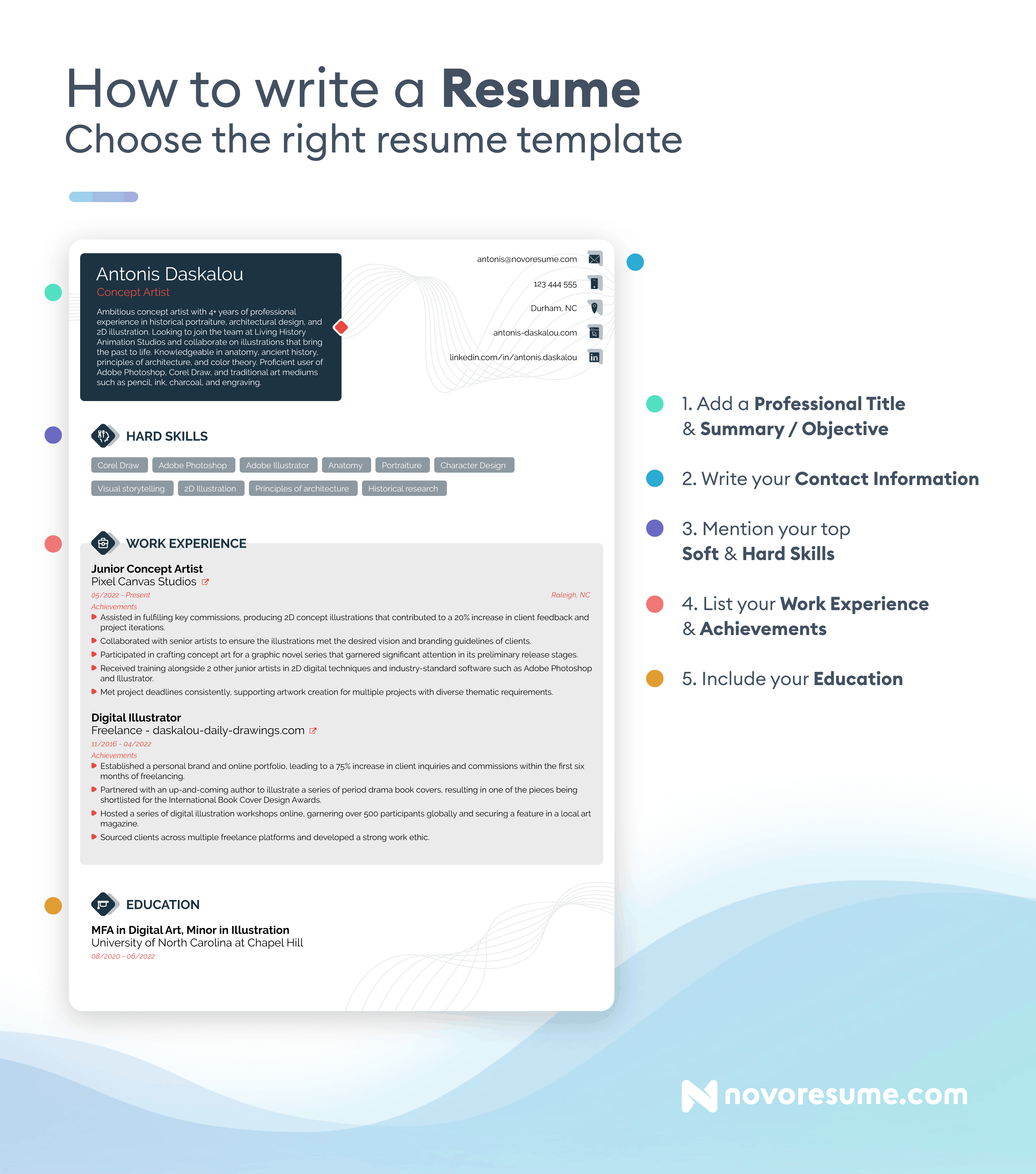
We’ll cover how to write your resume, section by section, using current best practices.
#1. Contact Information
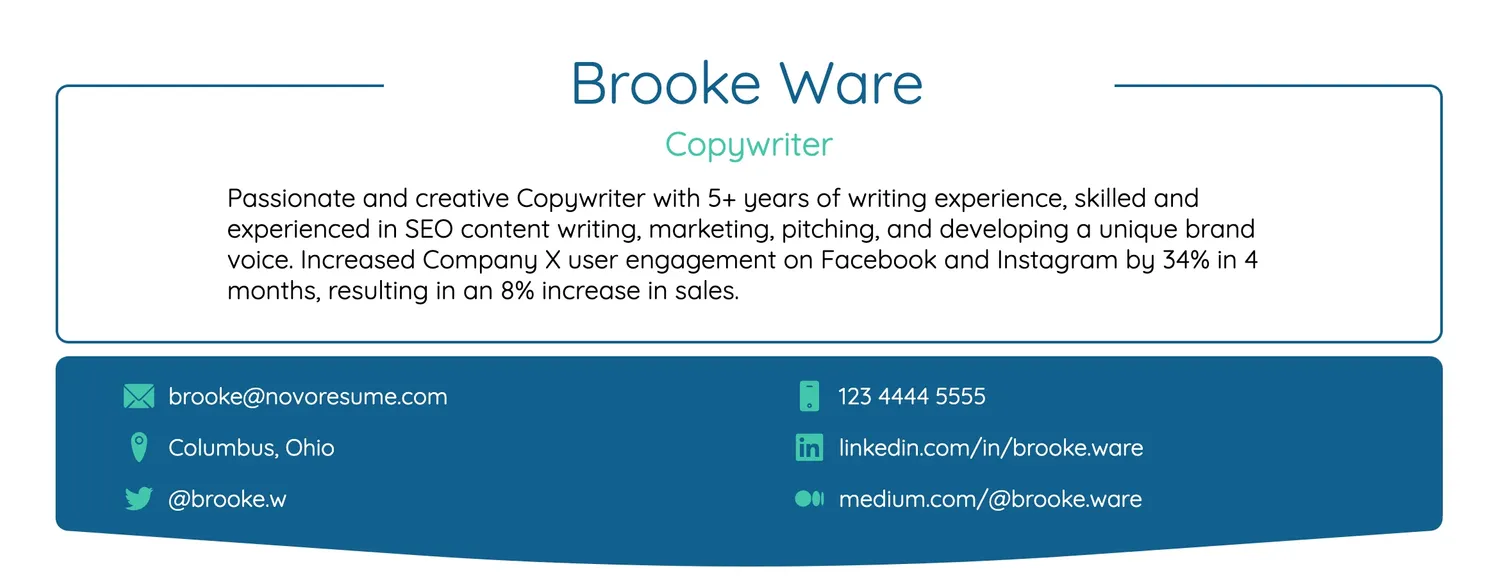
First, you should add your contact details to your resume header. It’s pretty straightforward, but crucial to get right because the hiring manager needs to reach you easily. A single typo can mean a missed opportunity.
Here’s what to include:
Contact Information Must-Haves
- Full name
- Professional email address
- Phone number
- Location (city and state/country)
- Relevant links (LinkedIn, Github, portfolio, etc.)
#2. Resume Summary or Objective
Since 74% of recruiters skim a resume in 20 seconds or less (Novoresume HR Survey, n=203), your summary needs to do a lot of work fast. It's usually the first thing a hiring manager reads after the job title, and it sets the tone for everything below it.
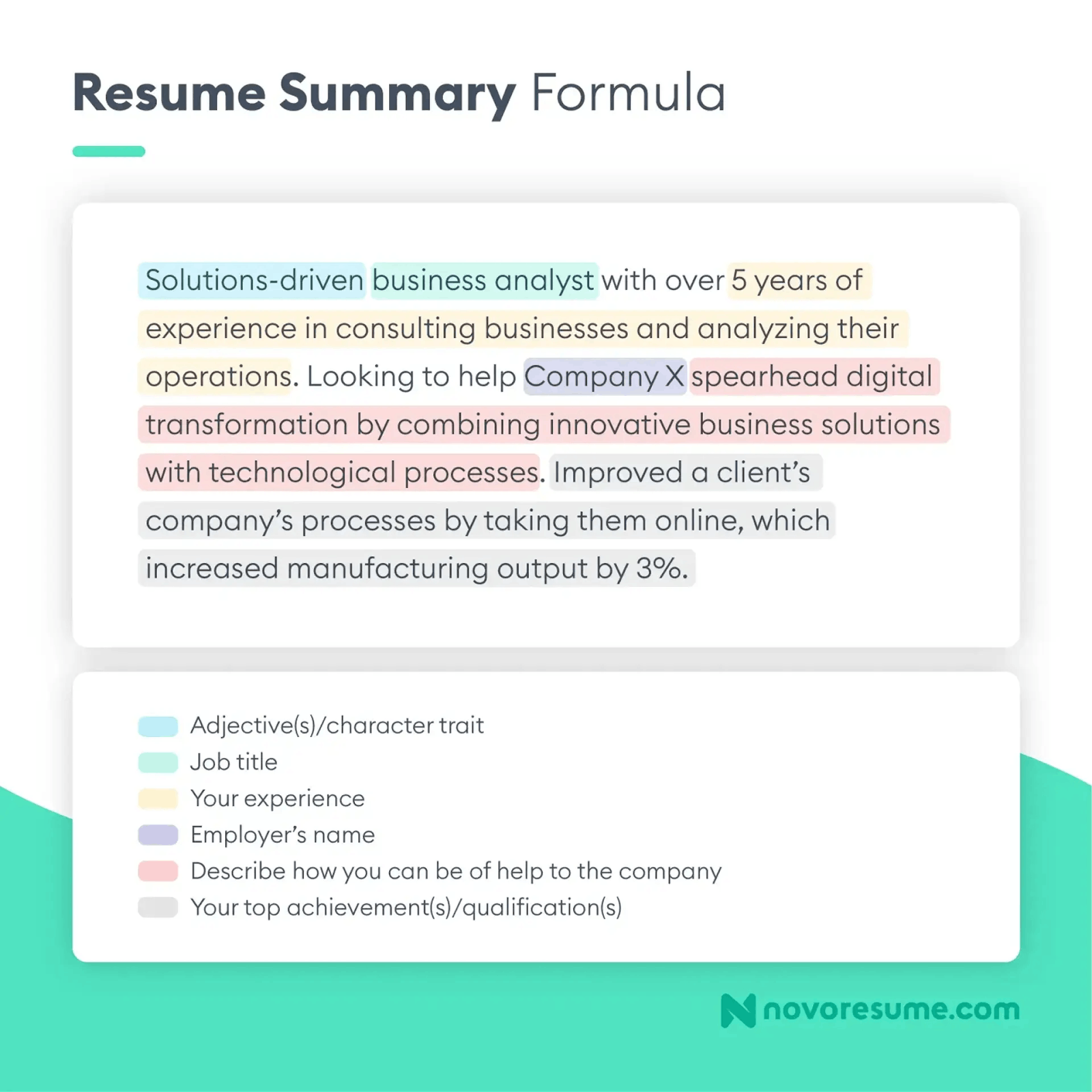
If you already have professional experience, you can write a resume summary that highlights your unique skills and relevant achievements. Here’s an example:
However, if you’re just starting your career, changing fields, or returning after a long employment gap, try writing a resume objective instead. It should focus on your relevant skills, career goals, and how they relate to the role.
💡
Expert Opinion: Resume Summary
“The resume summary is arguably the most important section: your selling pitch. It isn't just a recap of what you do; it's a positioning statement. People need to think of this as the headline of their personal brand. You need to write something that will tell a recruiter why you make sense for this specific role at this specific time. If your summary could fit on someone else's resume, it's not specific.”
— John Hendrick von Ahlen, Managing Director & Co-founder, JobLeads
#3. Work Experience
Work experience is the first section 79% of recruiters go to when they open a resume (Novoresume HR Survey, n=203). Not the summary. Not the skills list. Your track record is where the hiring decision gets made.
The most common mistake in this section is listing what you were responsible for instead of what you actually achieved. Recruiters already know what a project manager or sales rep does day to day. What they can't find anywhere else in your application is your specific impact.
Here's the difference:
❌ "Responsible for managing social media accounts and writing content."
✅ "Grew LinkedIn following from 4,200 to 18,000 in 8 months by launching a weekly industry insights series, which increased inbound leads from social by 34%."
The formula is: what you did + the measurable result + how you did it. Every bullet should be able to answer the question: so what?
Start by:
Work Experience Basics
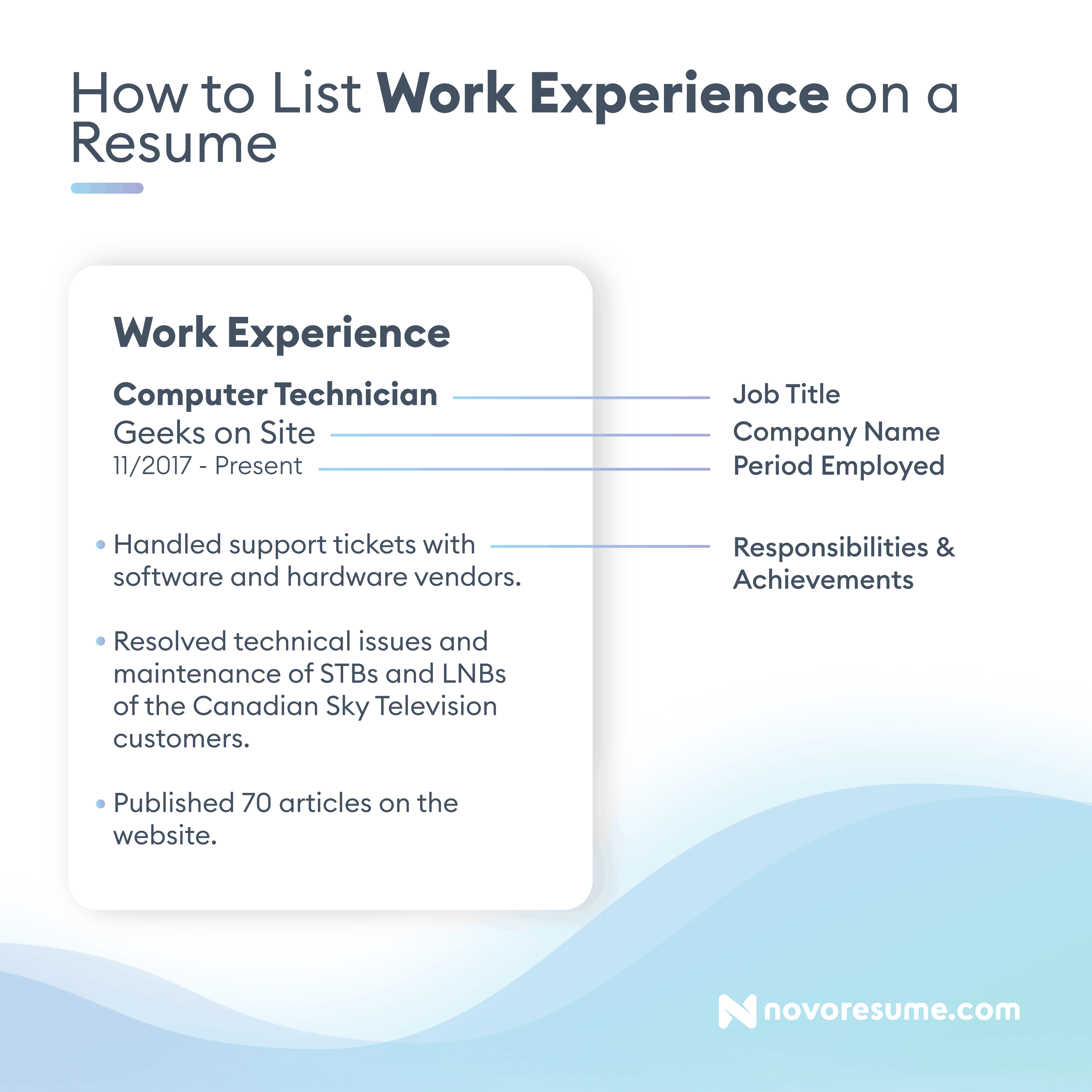
- Listing roles in reverse-chronological order, with your most recent job first.
- Including your job title, the company’s name, location, and a brief description if it’s not well known.
- Specifying your dates of employment; the mm/yyyy format is usually enough.
- Describing four to six achievements and responsibilities per role; use bullet points to keep them neat.
- Quantifying achievements whenever possible gives you credibility and shows employers the impact you’ve had at your previous job.
Here’s a real-life example:
💡
Expert Opinion: Achievements on Your Resume
“When listing achievements, tie them back to the context you improved, not just the end result. Instead of just saying "Increased efficiency by 30%," write: "Rebuilt an internal workflow that previously required 10 manual steps, reducing it to 3 and increasing efficiency by 30%." This shows ownership and problem-solving, not just outcomes.”
— Sergei Fitsak, Managing Director, Fintech Expert, Softjourn
#4. Relevant Skills
Your skills are the next most important thing the hiring manager will look for. In fact, work experience and skills make up 90% of the hiring decision.
This is where you want to mention all the know-how that makes you the perfect candidate for the job. List at least six different hard and soft skills, but make sure they’re relevant to the role, and your resume needs both.
Hard skills are specific, measurable abilities that you can learn over time. They range from coding to knowing how to cook Thai cuisine.
Soft skills are a mix of interpersonal abilities and personality traits. They affect how you work and interact with others while on the job.
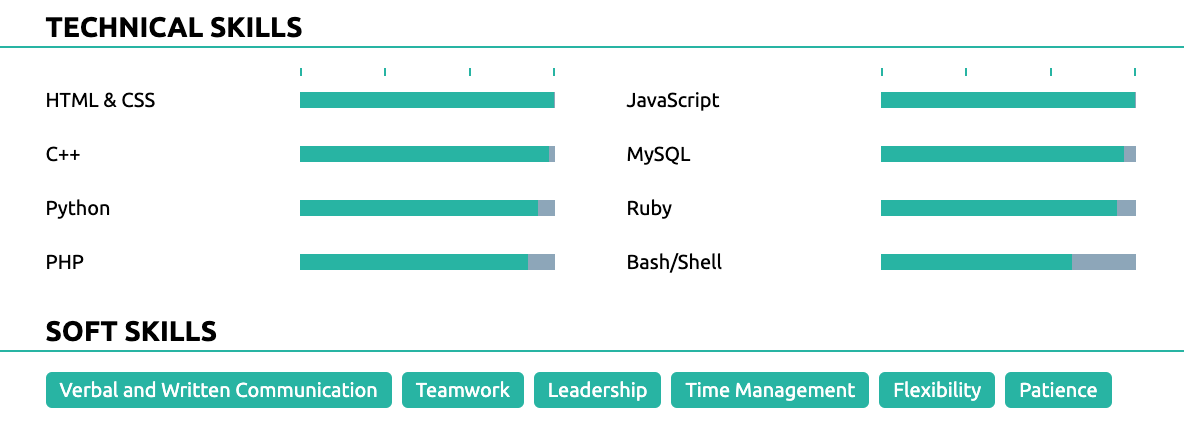
Here’s an example in action:
💡
Pro Tip:
Which skills should you mention on your resume for your field? Check out our list of 101+ essential skills for inspiration!
#5. Education
Your education section should be short and sweet. List your highest level of education first, and skip high school if you already have a higher education.
Education Basics
- List your degree’s full name, including the level and major.
- Add the school’s name, location, and dates attended.
- If you haven’t graduated yet, list your expected graduation date.
- Honors and distinctions always look good on your resume, so include them here.
- Don’t list your GPA unless it’s over 3.5 and you’re a recent graduate.
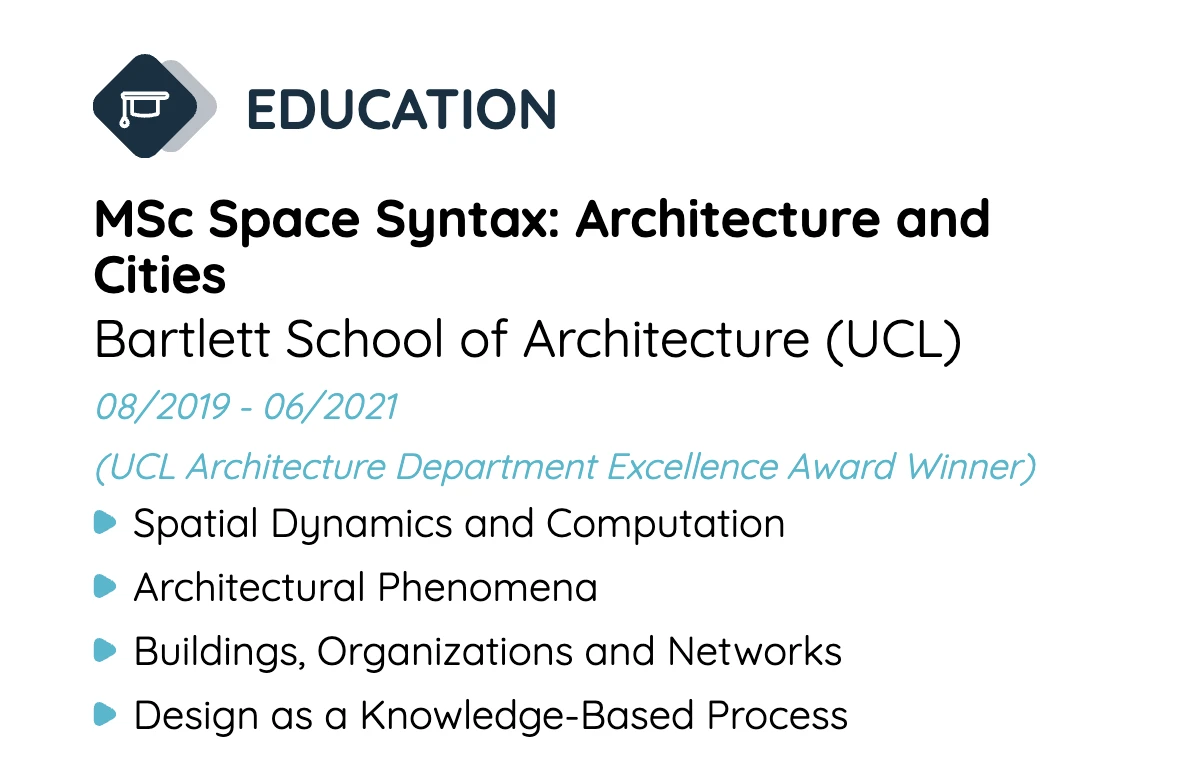
Here’s what an education section looks like in practice:
💡
Expert Opinion: Education on Your Resume
“If you didn’t graduate from college, you can still list the experience, but without listing the degree. For example, if you attended two years of college for business but didn’t graduate, you could list it as follows: Business Administration Coursework – ABC University.”
— Dr. Heather Rothbauer-Wanish, Certified Professional Resume Writer, Feather Communications
#6. Optional Sections
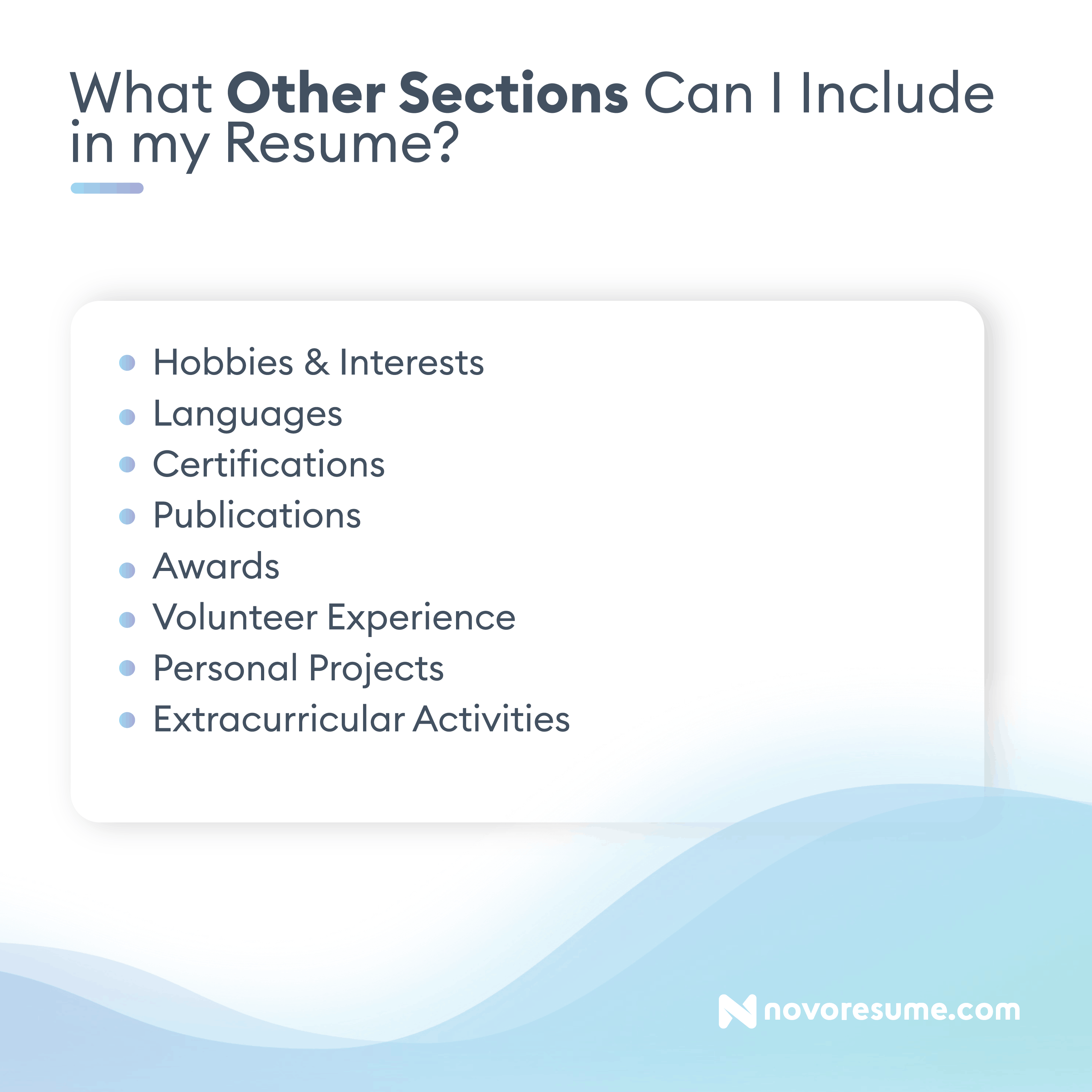
If you have some leftover space, there are a few optional sections you can choose from to boost your resume!
Certifications
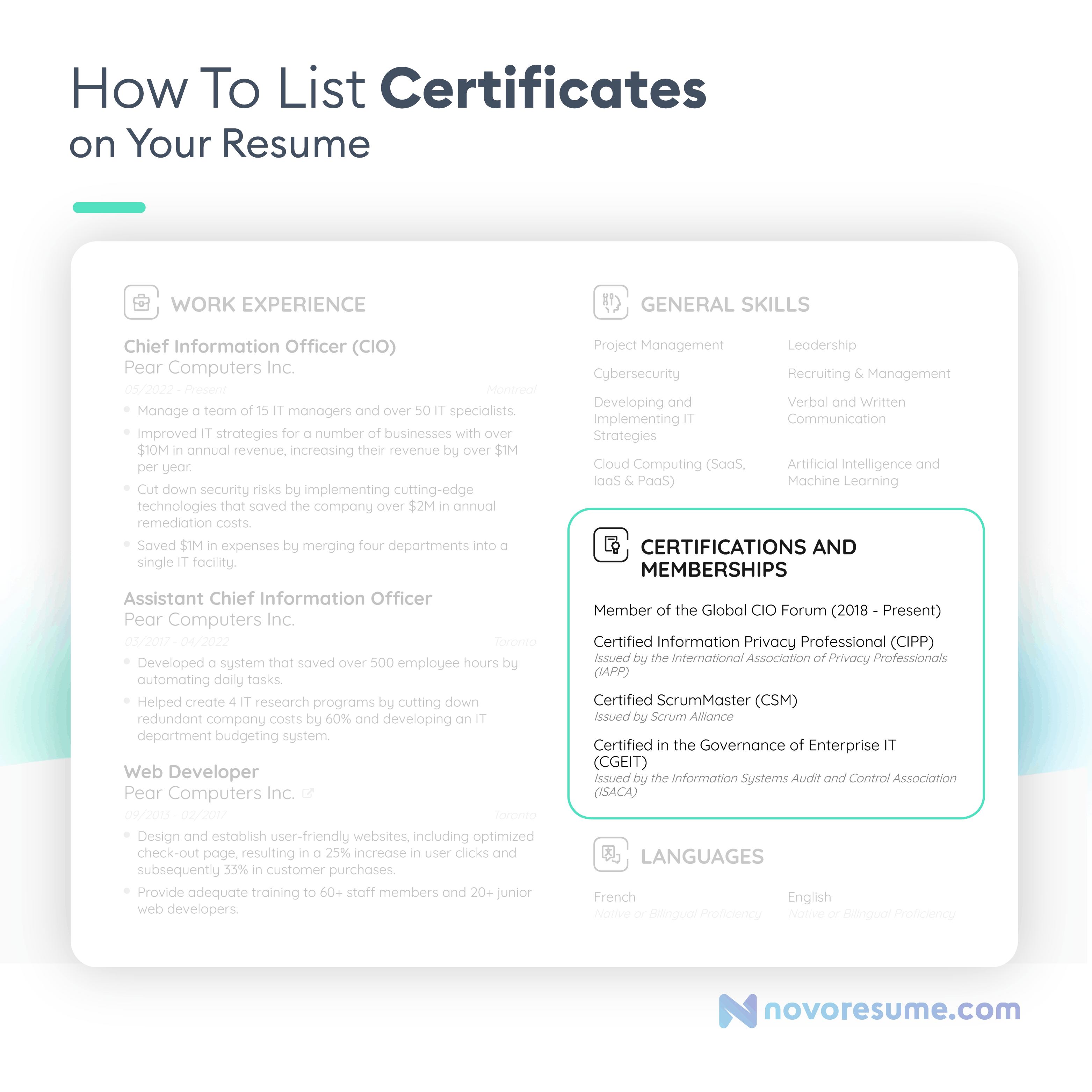
Hiring managers love candidates who invest in themselves, and that’s exactly what they see when you list certifications on your resume.
Certifications can also show employers how much expertise you have.
For example, if you’re a Microsoft Cloud Engineer and you specialize in Microsoft Technologies, you should definitely include all essential certifications on your resume, such as the Azure Solutions Architect Expert.
Awards and Recognitions
There’s no harm in showing off a little on your resume. After all, you want to be a candidate who shines above the rest.
For example, if you’ve been recognized for your contributions to data science or received a hard-to-come-by scholarship, mention it in your resume. Just keep your entries relevant to the field you’re applying to.
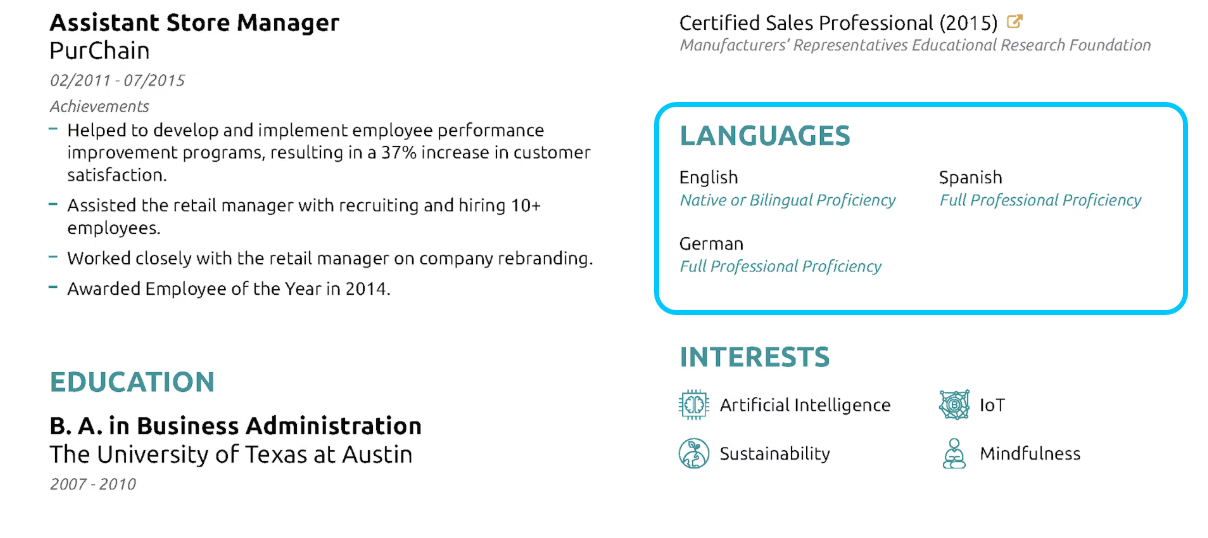
Languages
Are you bilingual? Or even better – multi-lingual? You should always mention that on your resume!
Even if the position doesn’t require you to know a specific language, it can still be helpful at some point. At the end of the day, it’s always better to know more languages than fewer.
To list languages in your resume, just write them down and assign them the appropriate level:
- Native
- Fluent
- Proficient
- Intermediate
- Basic
You can also use the Common European Framework of Reference for Languages (CEFRL) or the American Council on the Teaching of Foreign Languages (ACTFL) proficiency scales.
Other Optional Sections
- Hobbies and interests. This section isn’t a game-changer, but it can help the hiring manager see who you are as an individual. If you listed “teamwork” as one of your skills, hobbies like team sports can back up your claim.
- Volunteering experience. Including volunteer experience on your resume shows hiring managers that you’re a loyal employee seeking something meaningful. So, listing your volunteer experience can boost your chances of getting hired, especially if you have little to no work experience.
- Publications. Whether you’re a freelance writer or a distinguished academic, publications are always impressive. If you have any published works (online or in an academic journal), you can add them to your resume. Just make sure to include a link so the hiring manager knows where to check your work!
- Projects. Whether they’re university class projects or part-time entrepreneurial endeavors, they’re relevant. Hiring managers love employees who do cool work in their free time, so projects are always a great section to add to your resume.
- Extracurricular activities. These are a great way to show potential employers your skills and give them insight into you as a person. Different clubs and after-school projects can help you gain real-life skills and considerably increase your chances of landing your first job after college.
What Is the Best Template for a Resume?
The best template for a resume is one that's ATS-friendly, uses a clean layout, and puts your content front and center. A great template should make your resume easier to read, not harder, so avoid anything with heavy graphics, icons, or complex multi-column designs that applicant tracking systems can't parse.
Here's what to look for when picking a resume template:
- Simple, structured formatting. Stick to clearly defined sections with standard headings like "Work Experience," "Skills," and "Education." ATS software scans for these headings, and creative alternatives like "Where I've Made an Impact" can confuse the system and get your resume filtered out.
- Readable fonts and balanced white space. Templates that cram too much into one page are just as bad as ones that waste space. Look for a layout that gives your content room to breathe without pushing you onto a second page.
- PDF-friendly output. Your template should hold its formatting when saved as a PDF. If columns shift or text overlaps when you export it, that template isn't reliable.
- Easy customization. You'll need to tailor your resume for every job application, so pick a template that makes editing quick. If changing one bullet point breaks the entire layout, move on.
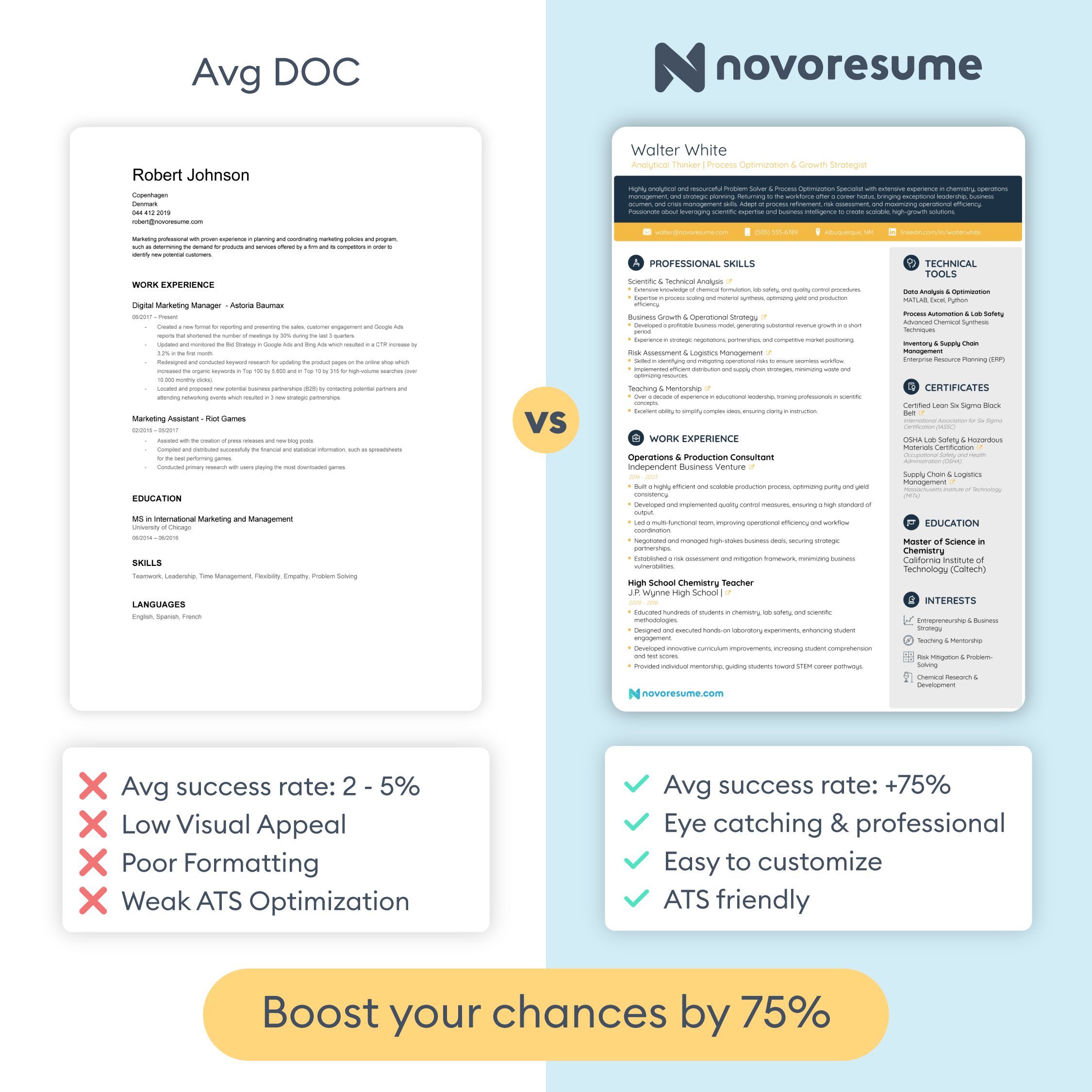
A lot of job seekers spend hours trying to build a resume from scratch in Word or Google Docs, only to end up fighting margins and spacing instead of focusing on their actual content. Using a professionally designed, ATS-tested resume template saves you that hassle and gives your application a polished look from the start.
Tips to Take Your Resume to the Next Level
You know what to do with the most important resume sections; now, you just have to put your resume together correctly.
#1. Which Resume Format Do Most Employers Prefer?
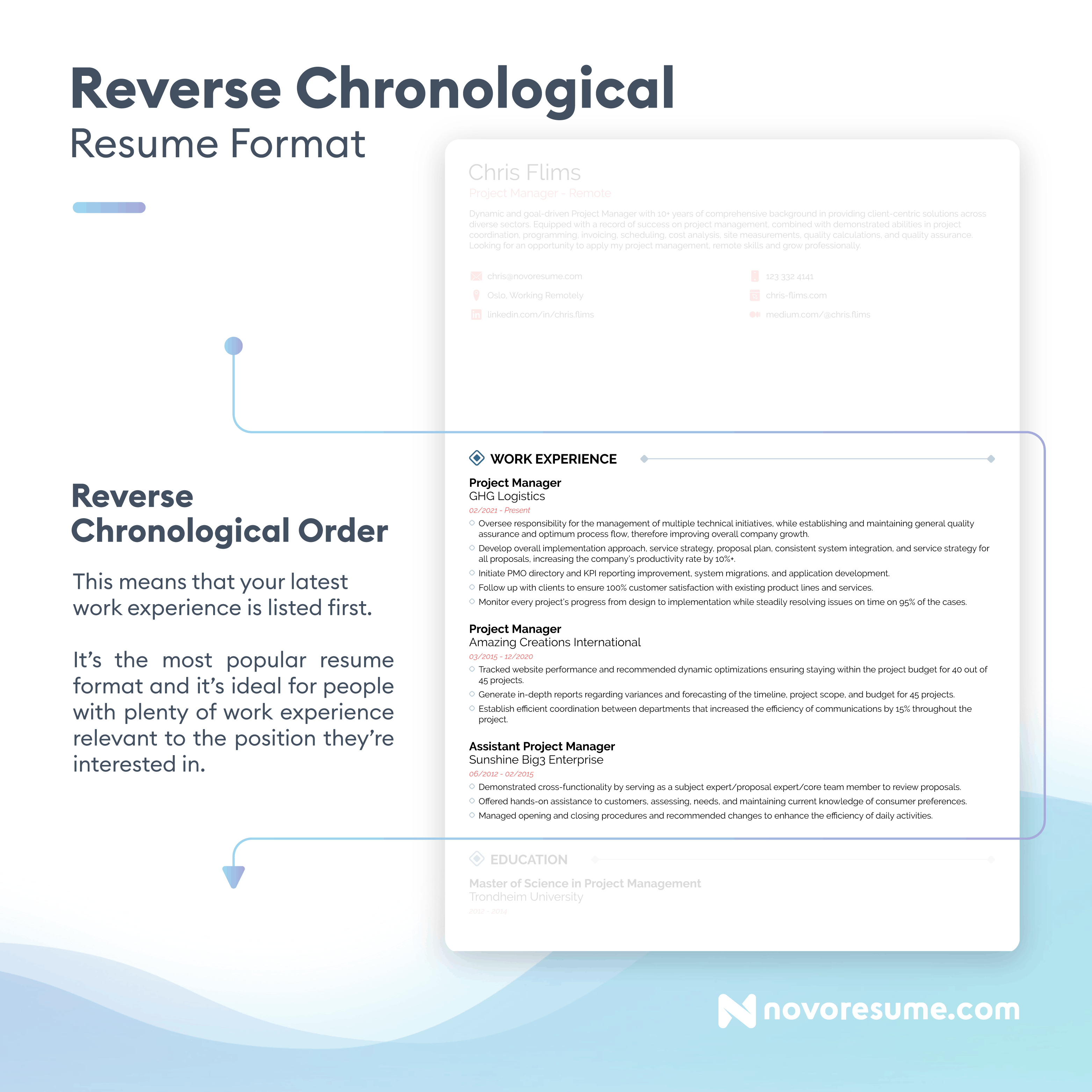
Most employers prefer the reverse-chronological resume format. It lists your most recent job first and works backward, making it easy for hiring managers and applicant tracking systems to quickly assess your career progression. In fact, we recommend it in 99% of cases.
Before you start filling in the contents of your resume, you have to make sure it will highlight your strengths. So, start by picking one of the three resume formats out there:
- Reverse-chronological. The standard choice for every field, it centers on work experience.
- Functional. Focusing more on skills than work experience, it’s a good choice for a career change or after an employment gap.
- Combination. The best choice for experienced job seekers with a very diverse skill set, it’s useful if you’re applying for a role that requires expertise in several different fields.
In 99% of cases, we recommend you stick to the reverse-chronological resume format. It’s the most popular format and what hiring managers expect to see. Here’s a glance:
#2. Fix the Layout
Your resume’s layout determines its overall look, including whether it’s easy to ignore or impressive.
Resume Layout Must-Haves
- Stick to one page unless you have less than 15 years of relevant experience.
- Use clear section headings and a readable font so it’s easy to navigate.
- Adjust the margins and line spacing so you have balanced white space.
- Save it as a PDF file unless the employer specifically requests otherwise.
Even better, you can just use one of our professional resume templates to save yourself the hassle.
Try one for free and see for yourself how it compares to an average text editor resume:
#3. Tailor Your Resume to Each Job Ad
Tailoring is what sets an amazing resume apart from an okay one. Hiring managers don’t need to know about every job you’ve ever worked at or every single skill that you have, just what’s relevant to the role you’re applying for.
Let’s take a look at an example of a job ad:
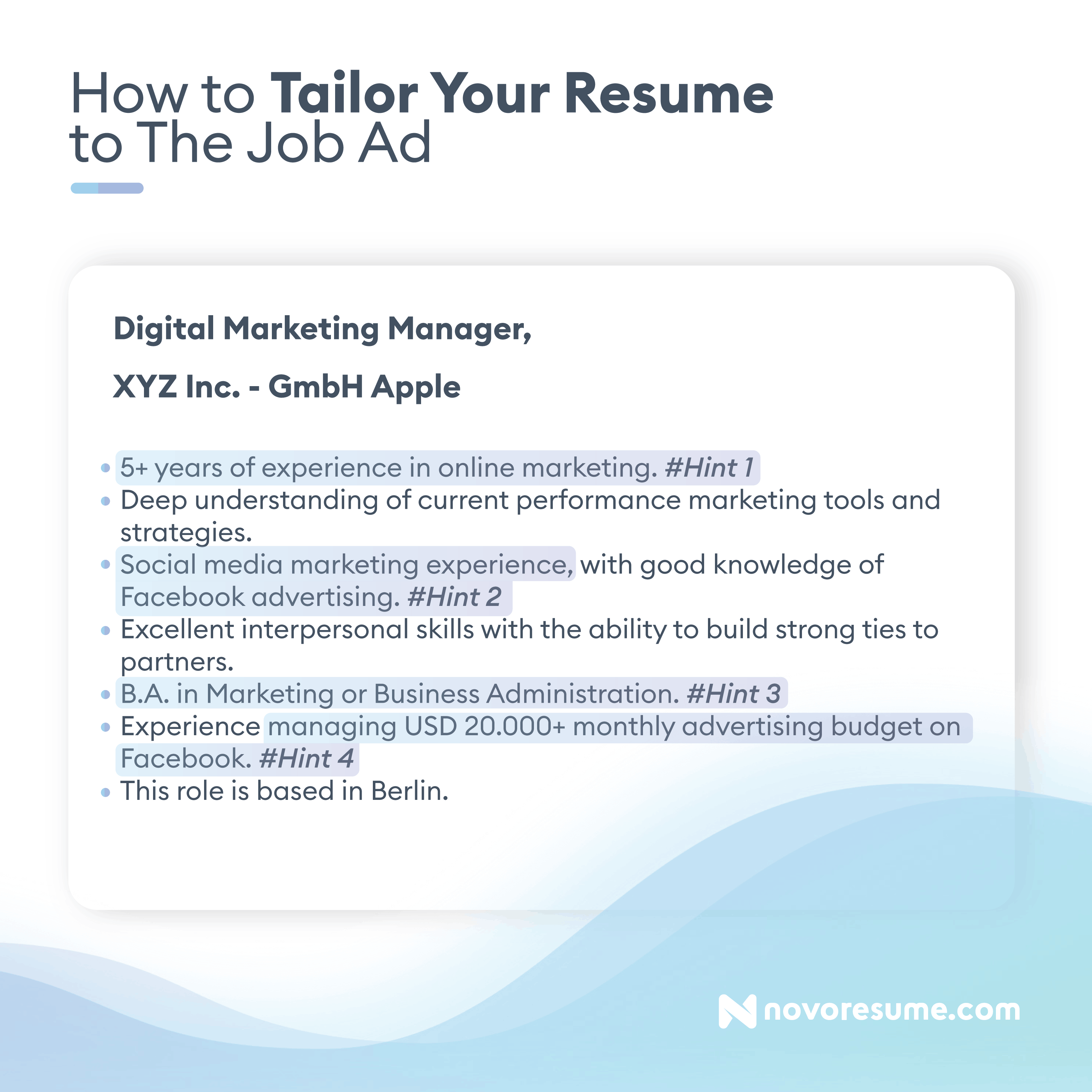
To tailor your resume accordingly, you just need to mention how you meet each of these requirements in your resume. Include them in your resume summary, work experience, and other relevant sections.
Mentioning these keywords from the ad will also help you get past the applicant tracking system (ATS) and increase your chances of getting an interview.
💡
Pro TIp:
Want to make sure your resume formatting passes the ATS test? Choose one of our tried and tested ATS-friendly resume templates, and you’ll be good to go!
#4. Use AI Effectively
AI is now part of how most people write resumes, and there's nothing wrong with that. But how you use it matters.
According to Novoresume's survey of 1,000 US workers, 27.2% have skills listed on their resume or LinkedIn that they can only perform with significant AI assistance. Another 22.4% have used AI in real time during a live job interview. Recruiters have noticed: 86.2% of hiring professionals surveyed by Novoresume say they've caught an applicant lying on a resume.
The problem isn't using AI. The problem is using it to paper over gaps that will show up the moment you're in a room with someone.
Use AI to get unstuck, sharpen your phrasing, and match keywords to the job description. Then go back through the output and make it yours: add your actual numbers, your specific context, your real experience. A resume that passes the ATS and falls apart in a phone screen is worse than no optimization at all.
Novoresume's AI resume builder is built for this. It's powered by Anthropic (Claude) and trained exclusively on our database of resume writing advice, so the suggestions it gives you are grounded in what actually works, not generic filler.
💡
Expert Opinion: Using AI for Your Resume
“Write the initial horrible draft with AI, and then paraphrase in your own words. It always depends on the wording. No one is going to write “spearheaded initiatives” or “facilitate cross-functional collaboration.” You are saying that you built a dashboard that has helped the ops team save 10 hours per week because that is how human beings would actually describe what they do.”
— Mircea Dima, CTO / Software Engineer, AlgoCademy
#5. No Experience? No Problem!
Your resume can still stand out even if you’ve never had a job before. You just need to focus on what you do have: education, skills, and non-work experiences that show initiative, learning, and responsibility.
Here’s how to do it right:
No Experience Resume Must-Haves
- Use a resume objective to summarize your career goals, academic background, and relevant skills in two to three sentences.
- Highlight your education first, including any relevant coursework, projects, or achievements.
- Showcase transferable skills you’ve gained from school or extracurriculars.
- Add any internships or volunteering since they count as practical experience and proof of your abilities and motivation.
- Keep things concise and tailored to the job; every line should connect back to the role you’re applying for.
What Are the 3 C's of a Resume?
The three C's of a resume are Clear, Concise, and Compelling. These three principles should guide every word on your resume, from your summary to your skills section. If any part of your resume fails one of these checks, it's working against you.
Clear means your resume is easy to read and navigate. Use simple language, consistent formatting, and logical section headings so a hiring manager can find what they need in seconds. If a recruiter has to re-read a bullet point to understand what you did, you've already lost their attention.
Concise means cutting everything that doesn't earn its spot. Filler phrases like "responsible for various tasks" or listing every job you've had since high school will dilute your strongest selling points. Stick to one page, focus on your most relevant experience, and make every line count.
Compelling means showing results, not just listing duties. Anyone can write "managed social media accounts," but writing "grew Instagram engagement by 47% in six months through a new content strategy" tells employers exactly what you bring to the table.
Before you submit your next application, read through your resume and ask yourself: is every section clear, concise, and compelling? If something doesn't pass all three, rework it or remove it.
7 More Expert Resume Tips
✅ Mention any promotions from your previous jobs. Use the work experience entries for them to focus on the achievements that helped you earn them.
✅ Describe your achievements using Laszlo Bock’s formula: accomplished X as measured by Y by doing Z. This way, your work experience can go the extra mile and show the hiring manager what you can bring to the table.
✅ Don’t use personal pronouns like “I” or “me,” and don’t refer to yourself by name. Stick to a slightly altered third person, like “managed data integrity at XYZ Inc.” instead of “he managed data integrity at XYZ Inc.”
✅ Add a strategic pop of color to headings, bullet points, or key elements you want to highlight. It can help your resume stand out, but don’t overdo it. You want the information to be more impressive than the color palette.
✅ Make sure your resume is optimized for mobile viewing. Most hiring managers use their mobile phones as often as desktop computers, so save your resume to a PDF file and make sure your formatting stays intact across any device.
✅ Rename the resume file you plan to send to include your name and the name of the position you’re applying for. It’s a small detail that can become a crucial mistake if you forget it.
✅ Use a tool like DocSend to track your resume. You’ll get a notification any time someone opens your resume, and you can see how long they spend reading it.
7 Most Common Resume Mistakes to Avoid
❌ Typos and grammar errors show carelessness and a lack of attention to detail. Always proofread and double-check your contact info.
❌ Showing responsibilities instead of results doesn’t help your application stand out. Employers already know what your role involves based on the job title, and they would rather know what you achieved instead.
❌ Overused buzzwords like “hardworking” or “team player” add no value. You need to back up every claim on your resume with evidence, so focus on action verbs and accomplishments.
❌ Not tailoring your resume is probably the most common mistake. Sending a generic resume for every job tells recruiters you’re not serious because you couldn’t bother to adjust your summary, skills, and experience for the role.
❌ Irrelevant information works against you. Unrelated jobs, outdated skills, and personal details like age or marital status distract from what matters.
❌ Overly complex designs and messy layouts make your resume hard to read. Stick to one page, clear headings, and professional fonts.
❌ Over 82% of companies use ATS in their hiring process, according to Novoresume's survey of HR professionals. Use an ATS-friendly template and include relevant keywords from the job description. Not as a stuffing exercise, but because matching the language of the role makes your resume easier to parse and more relevant to screen.
FREE Resume Checklist
Are you already done with your resume? Let’s see how it holds up!
Go through our checklist for perfecting your resume and see where you stand!
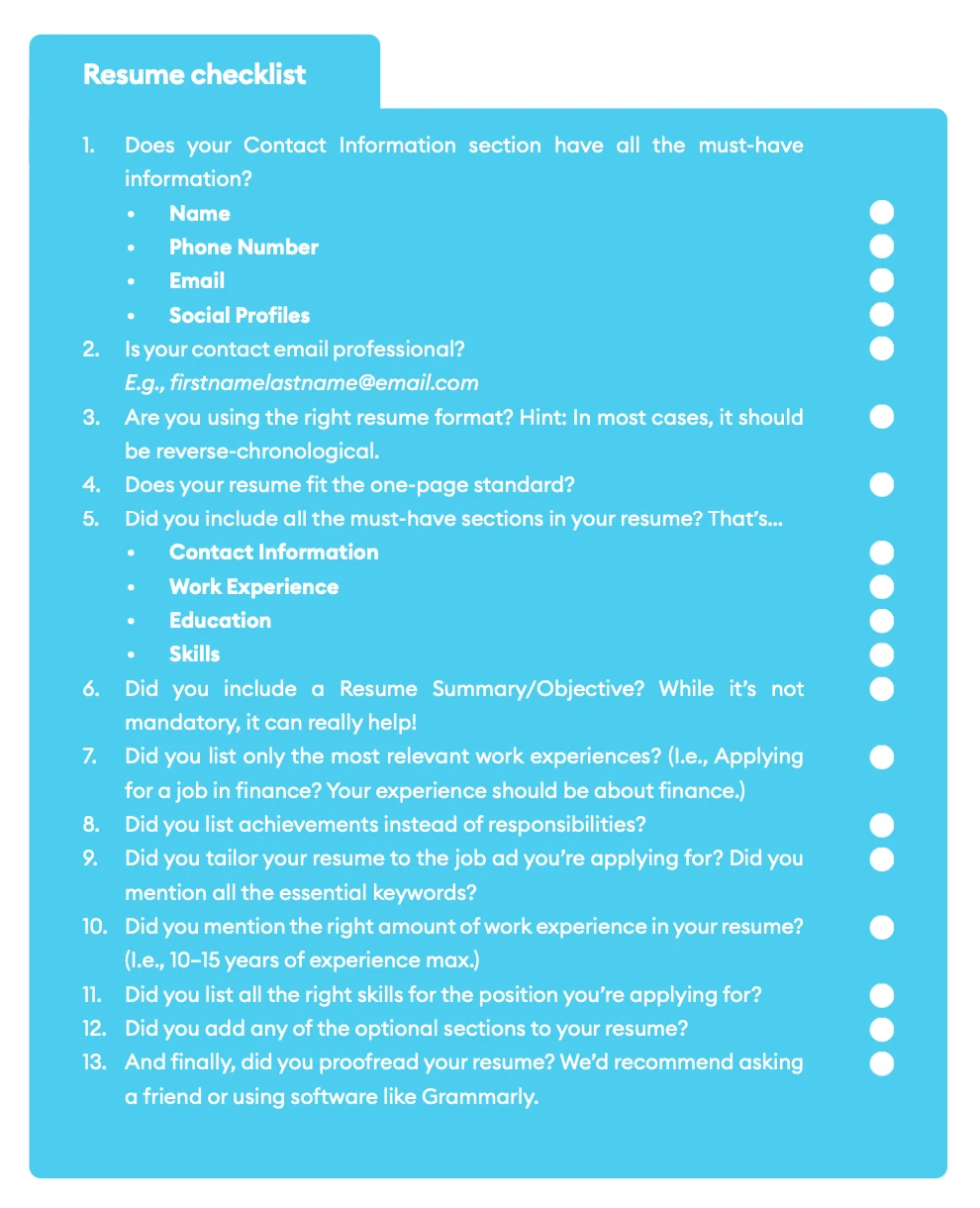
If you missed some points, just go through your resume again and perfect it.
And if you ☑’d everything – congrats! You’ve learned all there is to know about writing a resume, and you’re good to go with your job search.
💡
Pro Tip:
Need to write a CV instead of a resume? Check out our step-by-step guide on how to write a CV with dozens of examples!
Next Steps After Your Resume
Your resume is only the first step in your job search. You need a solid job application to land your dream job.
#1. How to Write a Convincing Cover Letter
Your cover letter is your chance to speak directly to the hiring manager. Keep it short, confident, and personalized.
Just follow this structure:
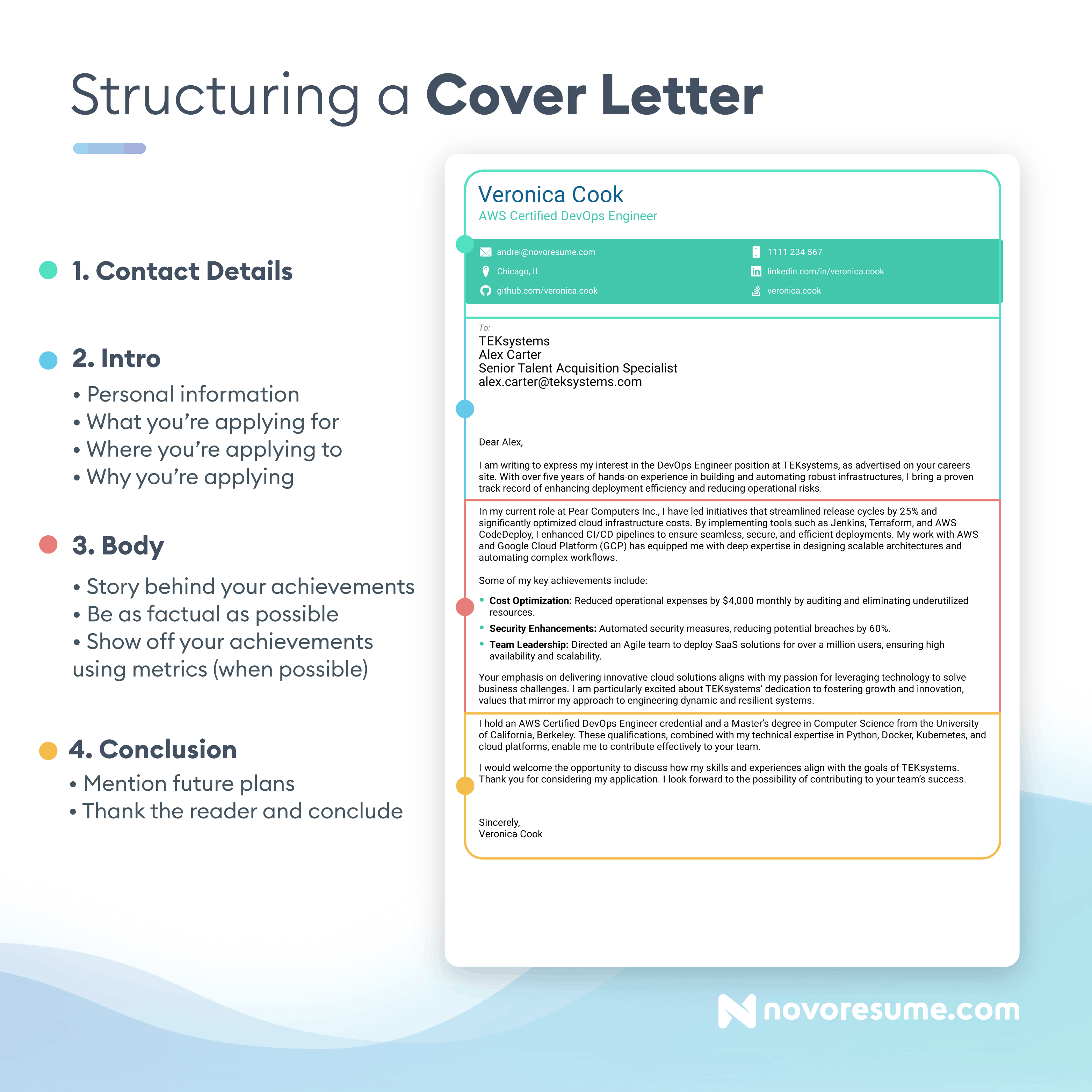
- Use a matching resume and cover letter template for a consistent application package.
- Start off strong by mentioning who you are and what makes you stand out, such as an achievement or why you’re excited about the role.
- Highlight your most relevant achievements and how they fit the company’s goals.
- Wrap it up politely by recapping your key selling points, thanking them for their time, and encouraging them to contact you.
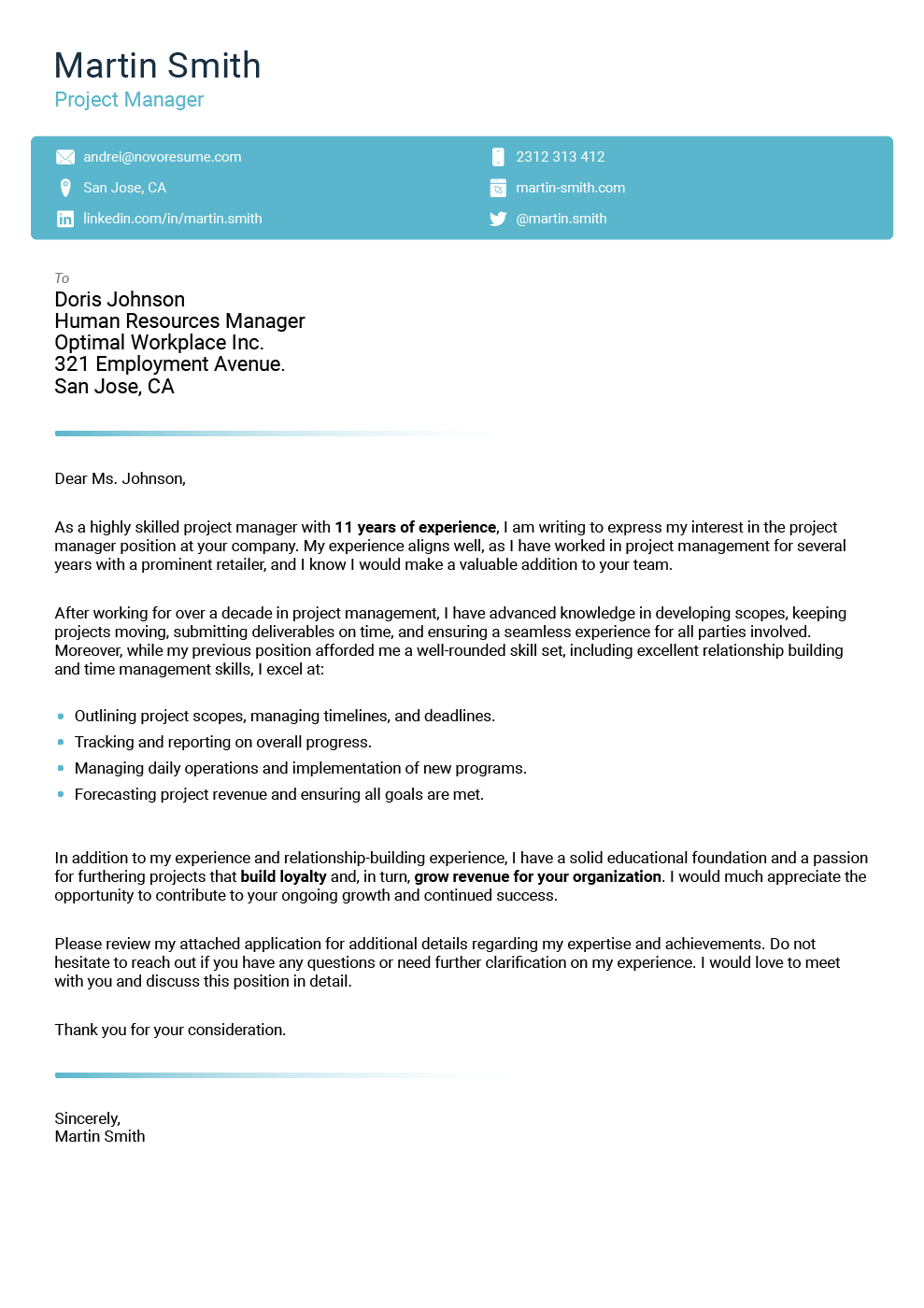
Sounds easy, right? Here’s a real-life example to drive the point home:
💡
Pro Tip:
Do you need more help perfecting your cover letter? Check out these cover letter examples for all professions.
#2. How to Ace Your Next Interview
There’s only one thing left now: getting ready for the job interview.
Job Interview Basics
- Research the company and understand its mission, culture, and products.
- Practice answering common interview questions and prepare examples to answer them.
- Use the STAR (Situation, Task, Action, Result) method to answer any question effectively.
- Dress appropriately and arrive early to make a good first impression.
- Follow up afterward with a short thank-you email to reinforce your interest.
FAQs on How to Make a Resume
Do you still have some questions about making a resume? Check out the answers to the most frequently asked questions below!
Key Takeaways
And that’s a wrap!
If you’ve followed all of our advice until now, congrats! You’re probably an expert on how to make a resume.
Let’s go through some of the most important lessons we’ve learned so far:
- Use the right resume builder to make the process as smooth as possible. You don’t want to mess around with formatting for hours before even starting to work on your resume!
- Focus on your achievements over responsibilities. This can help you stand out from other applicants, especially if you back up your claims with data.
- Include all the must-have sections, such as the resume summary, work experience, education, and skills. Then, leverage optional sections if you have leftover space.
- Tailor your resume for the job you’re applying for. Everything listed on your resume should be relevant to the specific job you’re applying for, and you should write a new resume for every new job application.
- Take the time to perfect your cover letter. It’s an important part of your application, so make sure you pay attention to it!
Related posts

Resume & CV Writing Tips
Writing your first job resume? This guide shows you exactly what to include (even with no work history), plus real examples for teens, students, and recent grads.

Resume & CV Writing Tips
Novoresume vs. Resume.io: a direct comparison of ATS compatibility, pricing, AI features, and what you actually get for free. Here's which one is worth your time.

Resume & CV Writing Tips
First job hunt and no experience to list? This 2026 guide shows you exactly what to put on a resume with no work history, plus real examples and recruiter-backed tips.