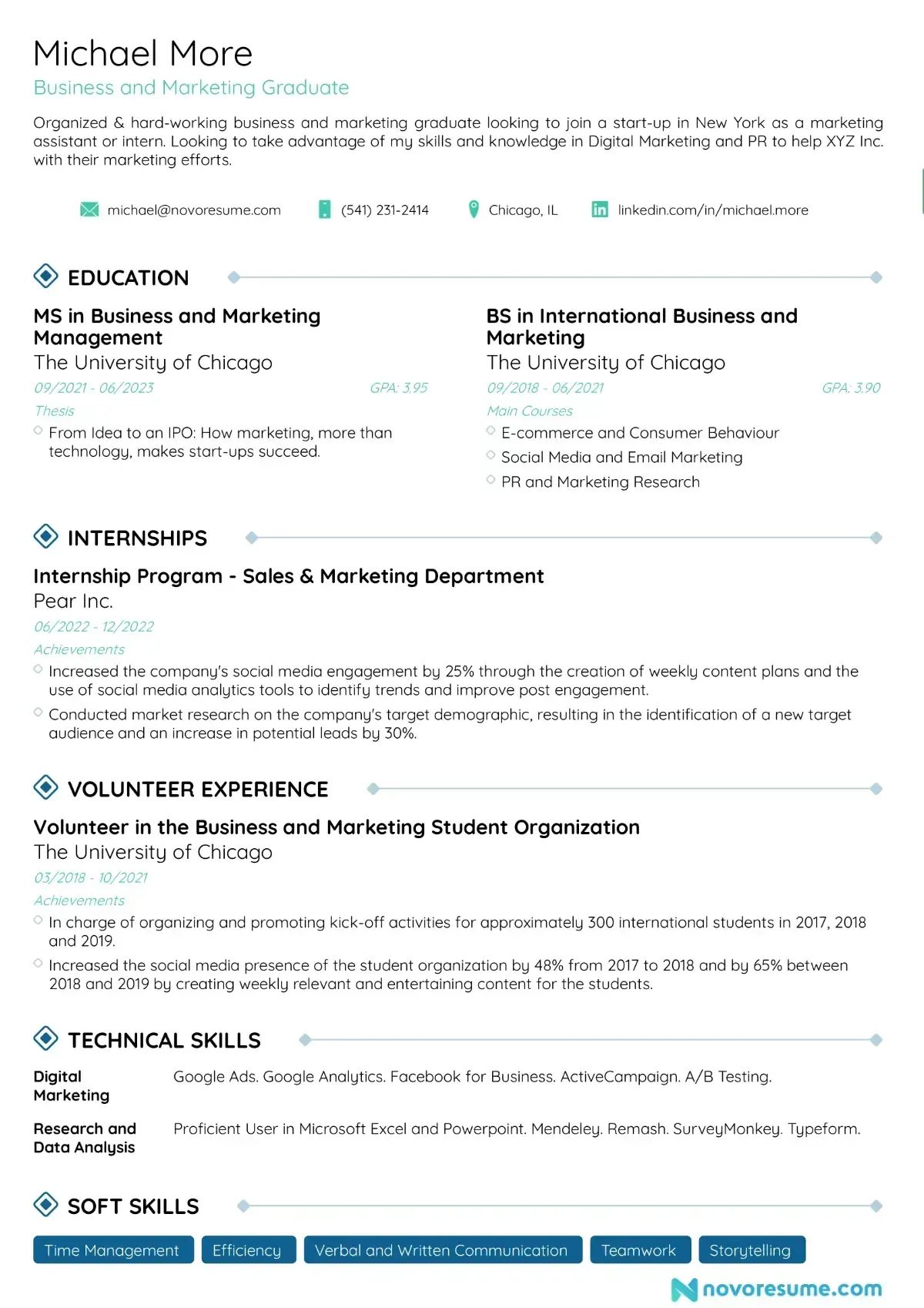
Writing a resume with no work experience isn't about padding a blank page, it's about restructuring what you already have. Your education, coursework, projects, volunteer work, and extracurriculars can carry a full one-page resume on their own, and for entry-level roles that's exactly what recruiters expect.
In our survey of 203 HR professionals, 74% said they skim a resume in 20 seconds or less and 82% use an applicant tracking system to screen candidates before a human reads a word. That means two things for a no-experience resume: lead with your strongest sellable asset (usually education or a specific skill) and use a format the ATS can actually parse.
This guide walks you through it section by section, with real examples for high school students, college students, and recent grads.
Here's what's inside:
- The best resume format when you have no work experience
- What to put in your header, summary, and education sections
- 4 sections that replace work experience (and how to fill them)
- How to pick skills that actually get you interviewed
- 3 full no-experience resume examples
- Common mistakes and a full FAQ
What Makes a No-Experience Resume Work in 2026
The no-experience resume plays by different rules than a mid-career resume. You're not selling track record, you're selling potential, and you have roughly 20 seconds to prove it.
Based on our research with HR professionals and 1,000 US workers, here's what actually moves the needle:
- 74% of recruiters skim a resume in 20 seconds or less. Your top third is doing most of the work. For no-experience resumes, that's almost always your education plus a strong summary.
- 82% use an ATS to screen resumes before a human sees them. Fancy graphics, text inside images, and non-standard headings get filtered out. Every template on Novorésumé is built to pass ATS parsing.
- The most common rejection reason isn't lack of experience. Recruiters told us it's poor relevance signaling, applicants listing every part-time job and extracurricular without tying any of it to the role they actually want.
Takeaway: pick a reverse-chronological format, lead with education, and cut anything that doesn't support the role you're applying, exactly as in the example below:

How to Format Your Resume [with No Work Experience + Examples]
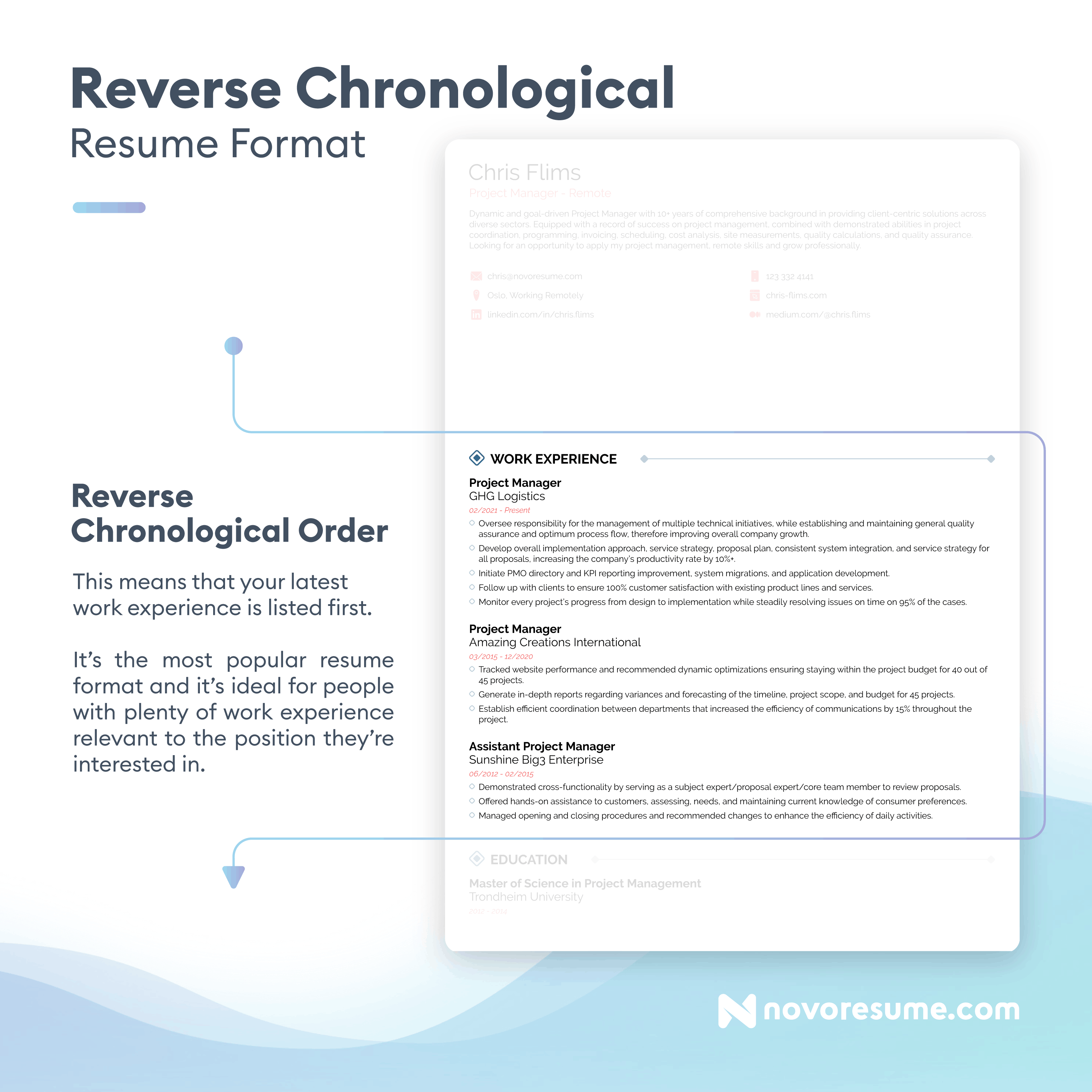
For a no-experience resume, use the reverse-chronological format. It lists your most recent experience first, which for you means education, then internships, projects, volunteer work, and extracurriculars. It's also the format most ATS systems were built to parse, which matters when 82% of recruiters use one.

Your reverse-chronological no-experience resume has five sections:
- Header (contact information and resume summary)
- Education
- Internships, extracurriculars, projects, volunteer work (these replace work experience)
- Skills
- Optional: languages, certifications, awards, hobbies
Start With Your Resume Header
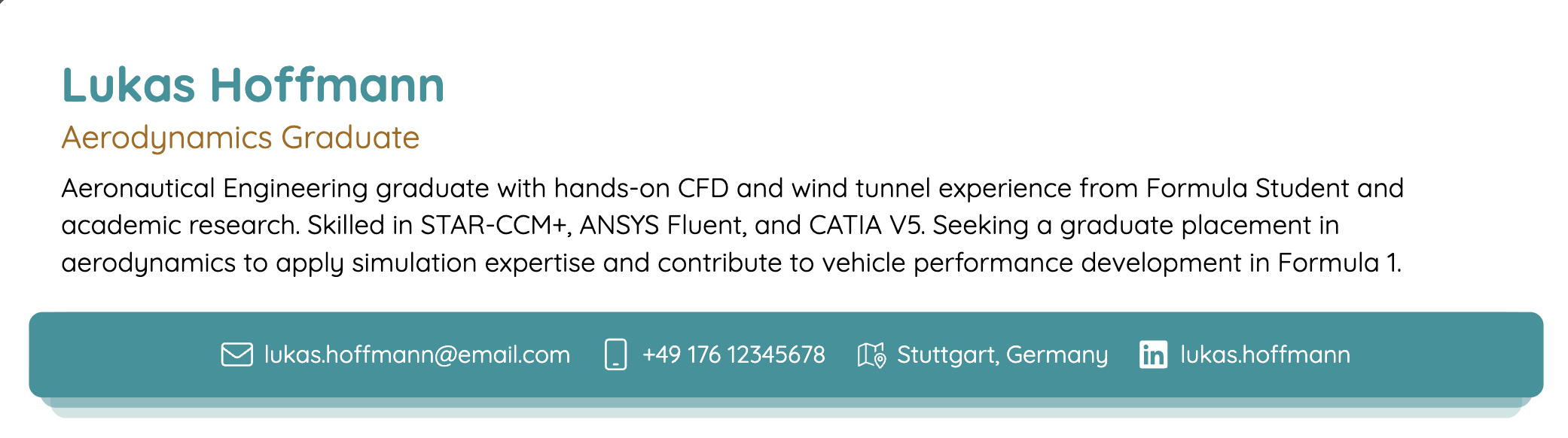
Your resume header includes your contact information and your resume statement.
Put Down Your Contact Information
Just like the name suggests, the first thing you add to your header is your personal and contact information.
It’s the easiest part to get right, just keep it short and to the point.
In your contact information section, mention the following:
- First and Last Name
- Phone Number
- E-mail Address
- A link to a professional profile (e.g. LinkedIn) or personal webpage (if you have one)
Make sure to use a professional-sounding E-mail.
I.e. something along the lines of .”
You’re sure to leave a wrong impression if you use an email you created back in preschool (“hotshot999@hotmail.com”).
Pro Tip
Make sure to double-check, triple-check your contact information. After all, the recruiter can’t contact you if you have a typo in your phone number.
Write a Short Resume Summary
A resume summary is two or three sentences at the top of your resume that tells the recruiter who you are, what you bring, and what role you want. For no-experience resumes, it replaces the old "resume objective" format, which recruiters have been ignoring for years.
A good no-experience summary includes:
- Your field of study or current stage (high school senior, CS sophomore, recent marketing grad)
- One or two specific skills or achievements tied to the role
- The role and company you're applying to
Example:
"Recent Communications graduate with practical experience coordinating cross-functional university projects and writing for a 12,000 reader student publication. Applying for the Secretary role at XYZ Inc. to bring strong organization, writing, and multitasking skills to a fast-paced team."
Two sentences, specific numbers, named target role. That's the pattern.
Emphasize Your Education

With no work experience, education moves to the top of your resume. Include:
- Name of the degree
- Name of the institution
- Years attended (or expected graduation date)
- Location of the institution (optional)
- GPA (only if 3.5 or above)
- Honors (optional)
- Relevant coursework (optional)
- Study abroad or exchange programs (optional)
If you studied at a well-known university, put the institution name before the degree to catch the recruiter's eye faster.
Now, let’s go through some real-life examples:
If you’re a college graduate:
BA in Computer ScienceTufts UniversityMedford and Somerville, Massachusetts10/2021 - 06/2024Magna Cum Laude- 3.87 GPA
- Exchange Program in Greenville, NY
If you’re a college student:
University of the Arts LondonBA in Interior Design10/202 - Ongoing
If you’re a High School graduate:
Westwood HighBoston, MassachusettsClass of 2026
Education Section Q&A
Still have some questions about the education section? Worry not, we’re about to give you all the answers!
Do I include my GPA? Only if it's 3.5 or above. Below that, leave it off and let coursework and honors carry the section.
Should I include coursework? Yes, if it's relevant to the role. Four to six courses is enough. Skip the intro-level stuff (no one cares about Maths 101).
Do I mention my degree if I dropped out? If you studied for two or more years, yes. List it as "coursework toward [degree]." A single semester isn't worth the line.
Do I mention my high school degree? Only if it's your highest level of education. Once you have any college coursework, drop the high school entry.
4 Sections to Replace Work Experience [With Examples]
Now that you’ve listed your education, it’s time to fill that work experience gap in your resume.
Your education section is doing a lot of heavy lifting, but it can't fill a full page alone. These four sections are what turn a half-empty resume into a full one.
Because here are four sections you can use instead:
1) Internships
Have you done an internship that is relevant to the position you are applying for?
Now’s the time to mention it.
Here is how you add an internship to your resume:
First, place the Internship section right after the education section.
Title it: Internships
Second, write your internship title and role. Be specific.
If your internship was in the marketing department, instead of just “Intern”, say “Marketing Intern”.
Third, put down the company name, location, and duration of the internship - in that order.
Here’s what you should have so far:
Marketing InternFull PictureNew York, NY09/2025 - 12/2025
One more step:
Last, add a list of responsibilities you had as an intern in bullet point form.
If you have any tangible achievements, even better! Write those in as well.
Finally, tailor both the responsibilities and achievements to the role you’re applying for.
Here’s how that looks in practice:
You used to be an Advertising Intern.
Scenario 1
You’re applying for the position of Social Media Assistant.
Here’s how you would put down your internship entry:
Internships
Marketing Intern
Full Picture Company
New York, NY
09/2025 - 12/2025
- Analyzed various social media platforms for trending content
- Managed company social media accounts
- Posted interested content on company Facebook page, increasing engagement by 25%
The listed responsibilities and achievements are directly connected to the Social Media Assistant job requirements.
Scenario 2
You’re applying for a Content Writer position. Take a look at the same entry now:
Internships
Marketing Intern
Full Picture Company
New York, NY
09/2025 - 12/2025
- Assisted the Marketing Manager in writing press releases and new blog posts, which increased web traffic by 25%.
Notice how the internship title remains the same.
But in this case you’re applying for a Content Writer position, so you are highlighting your writing experience instead.
For more examples, check out our full guides to an internship resume and how to write a cover letter for an internship.
2) Extracurricular activities
Extracurricular activities show recruiters something your GPA can't: that you can manage time, lead people, and commit to something outside of class. Both matter. In our HR survey, recruiters consistently ranked "demonstrated initiative outside the classroom" as a stronger signal than grades alone for entry-level hires.
List extracurriculars like this:
- Title of the section: Extracurricular Activities
- Name of the organization or team
- Your role
- Time period
- Noteworthy awards or achievements
And here’s what this would look like on a resume:
Extracurricular ActivitiesPublic Speaking ClubVice-President09/2018 - 09/2019- Organized 10+ public speaking lectures
- Brought in speakers from all over the state
- Conducted public speaking workshops
3) Volunteering Experience
Volunteering shows dedication and passion to apply yourself.
And there’s nothing recruiters love more than a committed employee.
Whether you spend your free time in a soup kitchen, or you helped collect trash in the countryside, you can mention it in your resume!
But how do you list volunteering experience?
- Title of the section: Volunteering Experience
- Name of the organization
- Location
- Time period
- Relevant tasks and achievements (bullet points)
Let’s check out an example:
Volunteering ExperienceGrand Archive Library VolunteerWashington, D.C08/2017 - 02/2019- Performed secretarial activities, such as sorting mail, filing documents, answering phone calls, and taking messages.
- Led a poetry reading event twice a month.
4) Projects
In this section, you can add any relevant projects you were part of during your time in school or at an internship.
Your capstone project, graduation thesis, or research project go here.
No need for work experience!
You can also mention any other type of project you’ve worked on in school, including:
- Business project for a real-life client
- Mock website you created in Web Design 101
- Fake magazine you created as a capstone project
- Market research you did as part of your graduation thesis
- Software you developed in Software Engineering class
...And so on!
Here’s how you put them down:
- Title of the section: Projects
- Project name
- Project type
- Related organization
- Time period
- Relevant responsibilities and achievements (optional)
Projects
Online Privacy and Social Media: a Journalistic Study of Facebook and Cambridge AnalyticaJournalism Capstone ProjectHarvard University09/2018 - 11/2018
And here’s a law school example:
Projects
U-VisaIn-House Pro Bono ProjectColumbia Law School11/2018 - 03/2019- Completed a full petition for U nonimmigrant status, interviewed legal persons and drafted affidavits.
If you have anything physical to back up your project with, feel free to include a link.
For example, if you’re a developer, you could include a link to your GitHub profile.
Pick Skills That Recruiters Can Actually Verify

Your no-experience resume should lean heavily on hard skills, not soft skills. Hard skills are verifiable (you either know Python or you don't). Soft skills like "leadership" or "critical thinking" are claims a recruiter can't check on a resume, which is why they've stopped carrying much weight.
To pick the right hard skills, read the job description and mirror the tools, software, and technical skills listed. If the ad asks for Adobe Photoshop, Premiere Pro, and Illustrator, those are the exact terms to put on your resume. This also helps with ATS screening, since the system is often matching literal keywords.
For a creative internship with these requirements:
- Video editing experience (Premiere, After Effects)
- UI design experience
- Photo editing experience (Photoshop)
- Photography experience
- Experience with Adobe Illustrator
Your skills section would look like this:
For soft skills, only include two or three, and only ones backed up somewhere else in your resume (a "teamwork" claim makes sense if your volunteer work shows you led a team of 10).
ℹ️
Pro Tip:
Not sure which skills to mention? Check out our article on 150+ must-have skills for all sorts of professions!
How AI and ATS Systems Screen No-Experience Resumes
Most entry-level resumes get screened twice before a recruiter sees them: once by an applicant tracking system that parses the file, and increasingly once by an AI tool that ranks candidates on fit.
In our Pollfish survey of 1,000 US workers, more than half said they believe AI now plays a role in how their resume is reviewed, and that's backed up by what we're seeing in the HR data (82% of recruiters in our survey use an ATS). For a no-experience resume, that means:
- Use a standard format. Reverse-chronological parses cleanly. Functional and creative layouts often don't.
- Use standard section headings. "Work Experience," "Education," "Skills" — not "Where I've Been" or "My Journey."
- Avoid text inside images. ATS can't read it. Your header, section titles, and skills all need to be actual text.
- Match keywords from the job description. If the ad says "Adobe Illustrator," write "Adobe Illustrator," not "Illustrator" or "Adobe software."
- Stick to common fonts. Arial, Calibri, Helvetica, or Georgia. Custom fonts can render as gibberish in some systems.
Every Novorésumé template is built against these rules, which is why our users consistently report higher response rates on entry-level applications.
Other Sections You Could Include in a No-Experience Resume
A resume without experience does have one advantage: extra space.
You can use this space to create other sections that highlight how awesome you are!
Here are some sections you could include:
- Hobbies and Interests. Add flair to your resume by showing your genuine passion and interest in the industry.
- Languages. Most companies these days are pretty international and appreciate an extra language skill or two. Be mindful not to over-exaggerate your proficiency, though. Only knowing how to ask “¿Donde está la biblioteca?” doesn’t warrant a Spanish entry on your resume.
- Awards & Certifications. Do you have any fancy pieces of paper that show you’re smart? Maybe it’s an award for a terrific essay in a competition, or a certificate from an online course. Whichever the case may be, awards and certifications show that you’re a winner, so definitely include them in their own respective section.
Need Inspiration? 3 No Work Experience Resume Samples
Do you still have questions or don’t know where to begin?
That’s when a resume sample comes in handy.
It provides you with a predetermined format.
It also helps you picture how your no-experience resume is supposed to look like.
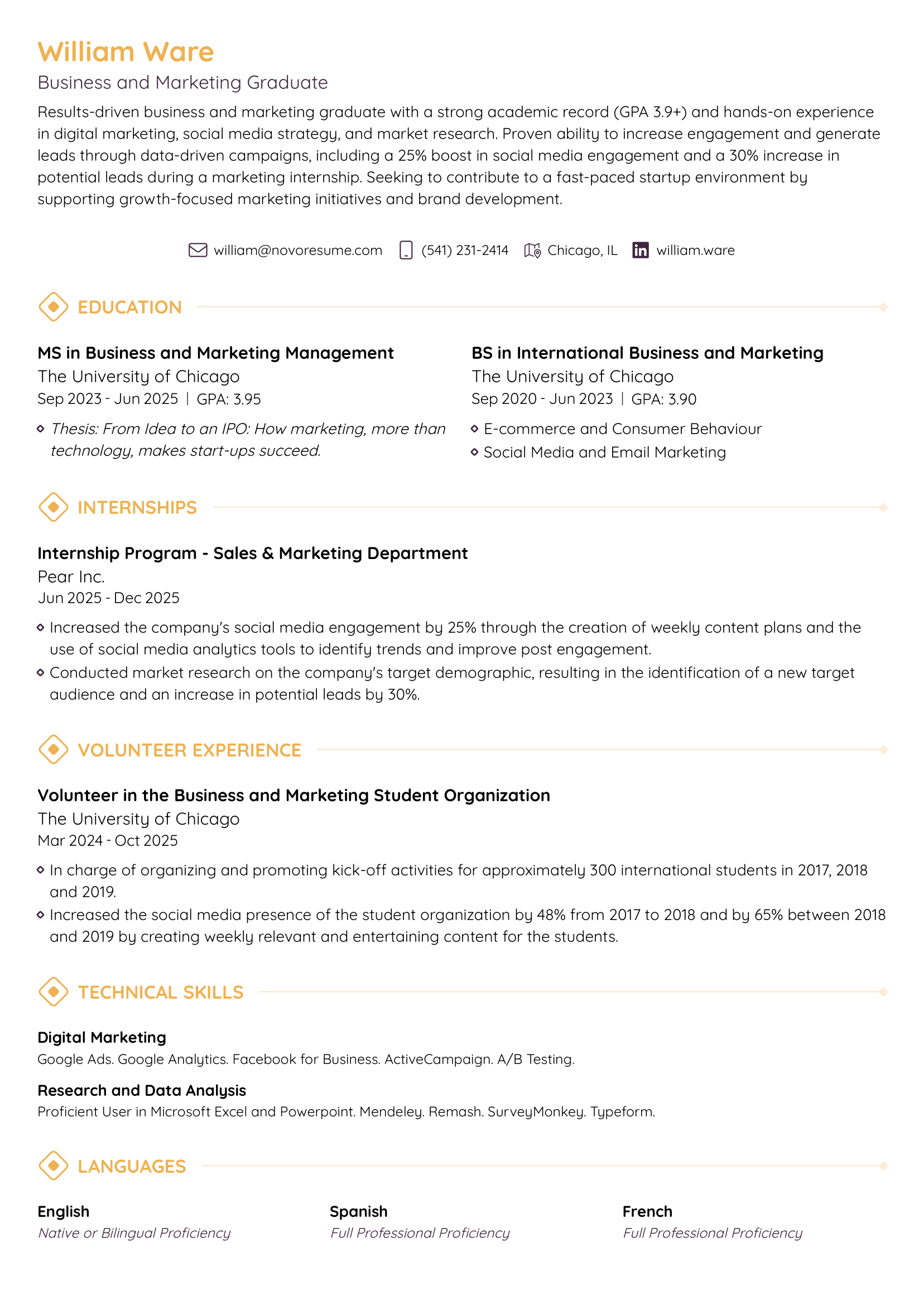
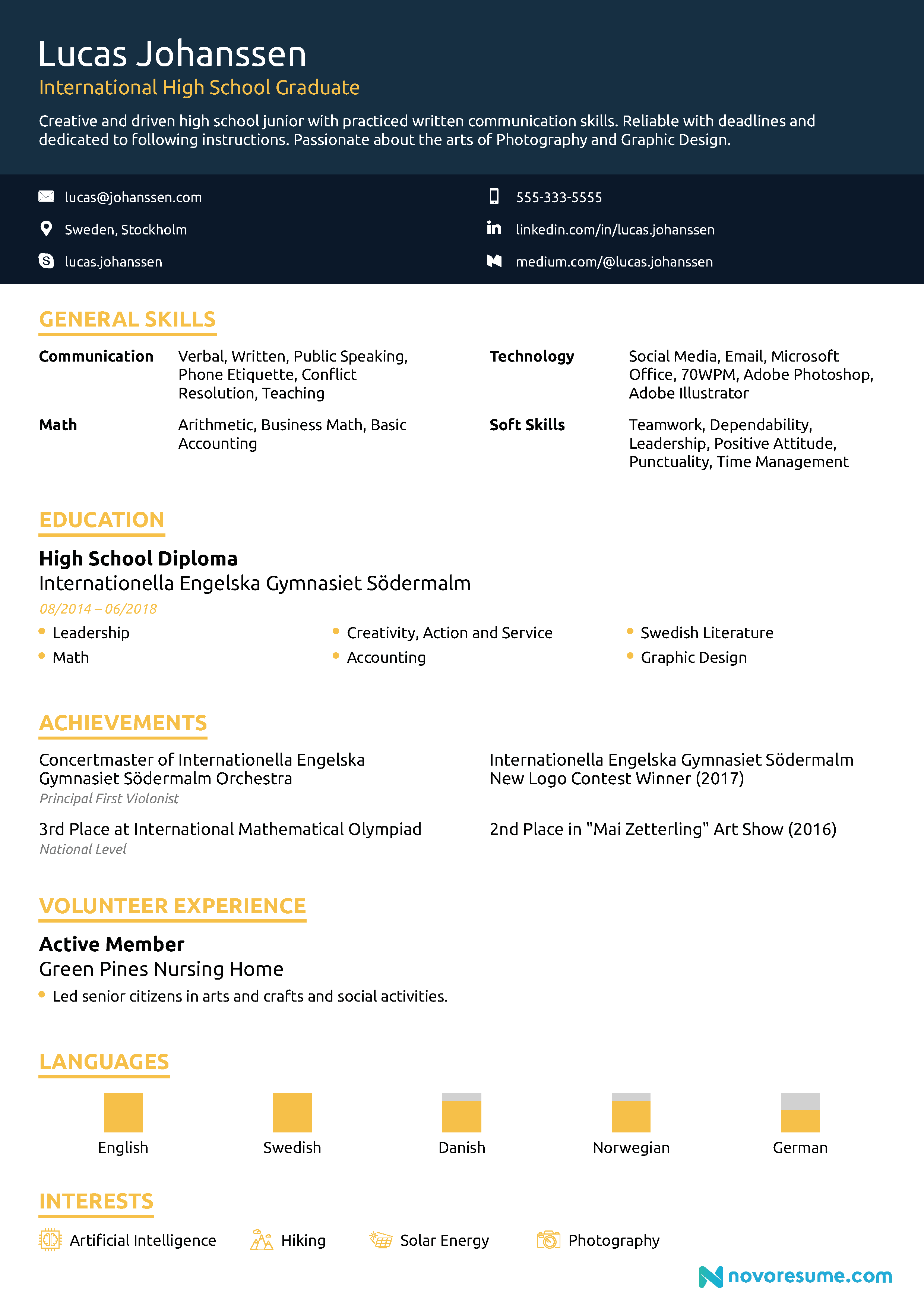
Here are three full no-experience resume examples you can model yours on. Each one shows a different stage (high school, undergraduate, recent grad) and a different way to fill a page without paid work history.
No Work Experience Resume Example

Business Student Resume Sample
High-school Student Resume Sample
5 Common No-Experience Resume Mistakes (And How to Fix Them)
1. Writing a resume objective instead of a summary. Objectives are out. Use a two to three sentence summary that names the role you want and one specific thing that qualifies you for it.
2. Listing every job you've ever had. Babysitting from freshman year of high school doesn't belong on a software engineering internship application. Keep what's relevant and cut the rest.
3. Leaving GPA off when it's strong. 3.5 and above should go on the resume. Below that, let coursework carry the section.
4. Using a photo. In the US, UK, Canada, and Australia, resume photos invite hiring bias and can get filtered by some ATS systems. Skip it unless you're applying in a country where photos are standard (mainland Europe, most of Latin America, parts of Asia).
5. Going to two pages. For no-experience candidates, one page is the rule. If you're overflowing, your sections are too padded. Cut high school entries once you're in college, and cut the first retail job once you've done an internship.
Match It With a Cover Letter
Your resume shows what you've done. Your cover letter explains why it matters for this specific job. For no-experience candidates, the cover letter is where you can actually make the case — the resume just gets you past the filter.
Keep the cover letter structure image (Image 3) — it's strong.
A good no-experience cover letter covers four things:
- Who you are and what you're applying for
- One specific reason this company and role fit you
- One concrete example from your education, projects, or volunteer work that proves the fit
- A short close asking for the interview
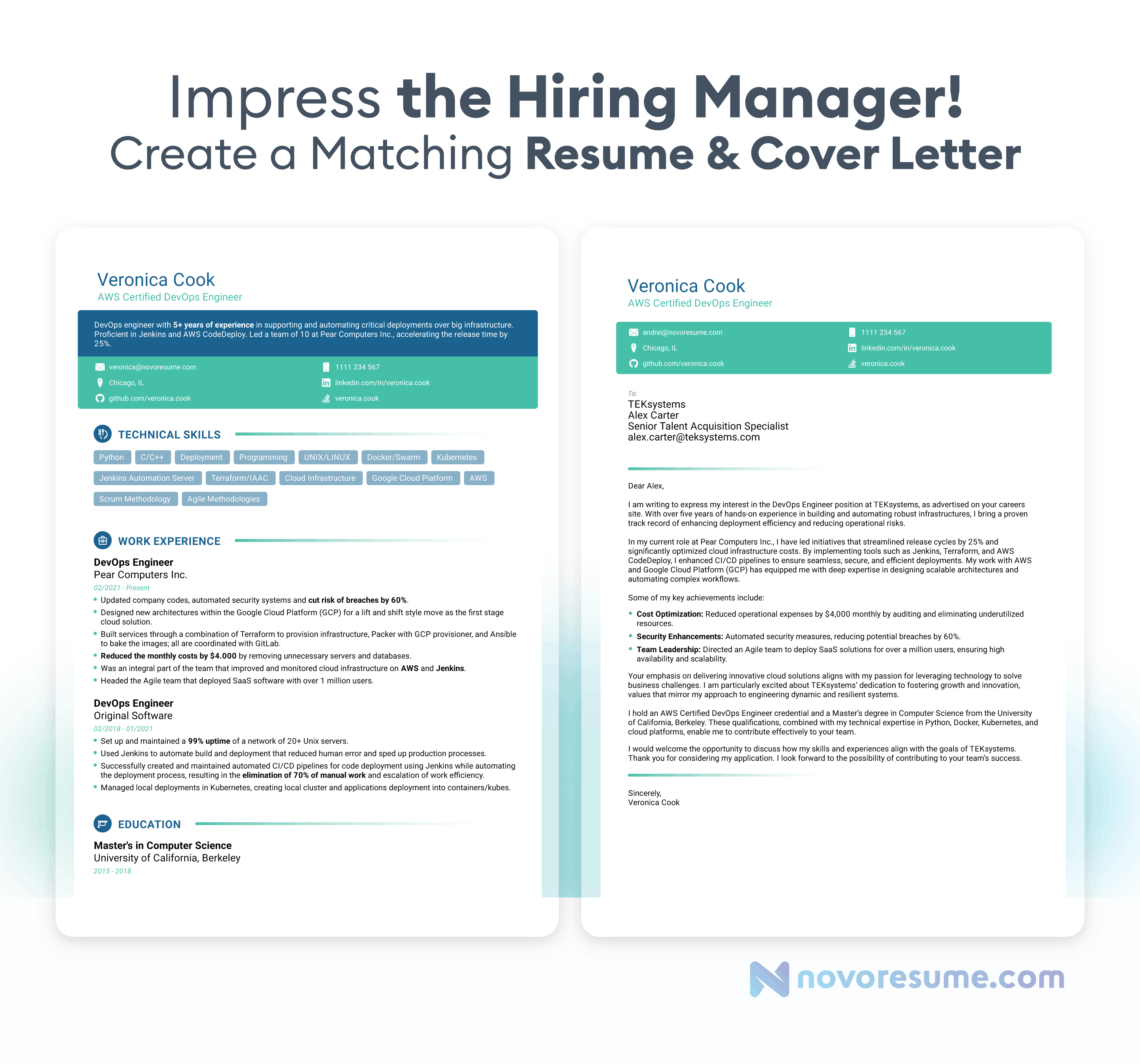
For a full walkthrough, see our guide on how to write a cover letter.

No-Experience Resume FAQ
Key Takeaways
The short version:
- Use the reverse-chronological format. It's what 82% of ATS systems are built to parse.
- Lead with education. Put relevant coursework, honors, and GPA (if 3.5+) right below the degree.
- Replace work experience with internships, projects, volunteer work, and extracurriculars.
- Lean on hard skills pulled directly from the job description. Soft skills only count if something else in the resume backs them up.
- Keep it to one page, use standard section headings, and match it with a targeted cover letter.
When you're ready to build yours, start with a template from the Novorésumé builder. Every template is ATS-compatible and designed around the research in this guide.
Related Resume Examples
- Internship Resume
- High School Resume
- Research Assistant Resume
- College Resume
- Students and Graduates Resume
- Teacher Resume
Recommended Readings: