100+ AI Hiring Statistics for 2026 (New Survey Data)
100+ AI hiring statistics for 2026: employer adoption, AI resumes and cover letters, interview cheating, and detection rates, from our four 2026 surveys.


Novoresume got people hired at
























Key Findings
- 99% of hiring managers now use AI somewhere in the hiring process, and 77% of HR teams use it regularly (Insight Global; HireVue).
- On the other side of the desk: 42.6% of job seekers used AI the last time they updated their resume, and 46.8% used it on their last cover letter, per our 2026 surveys.
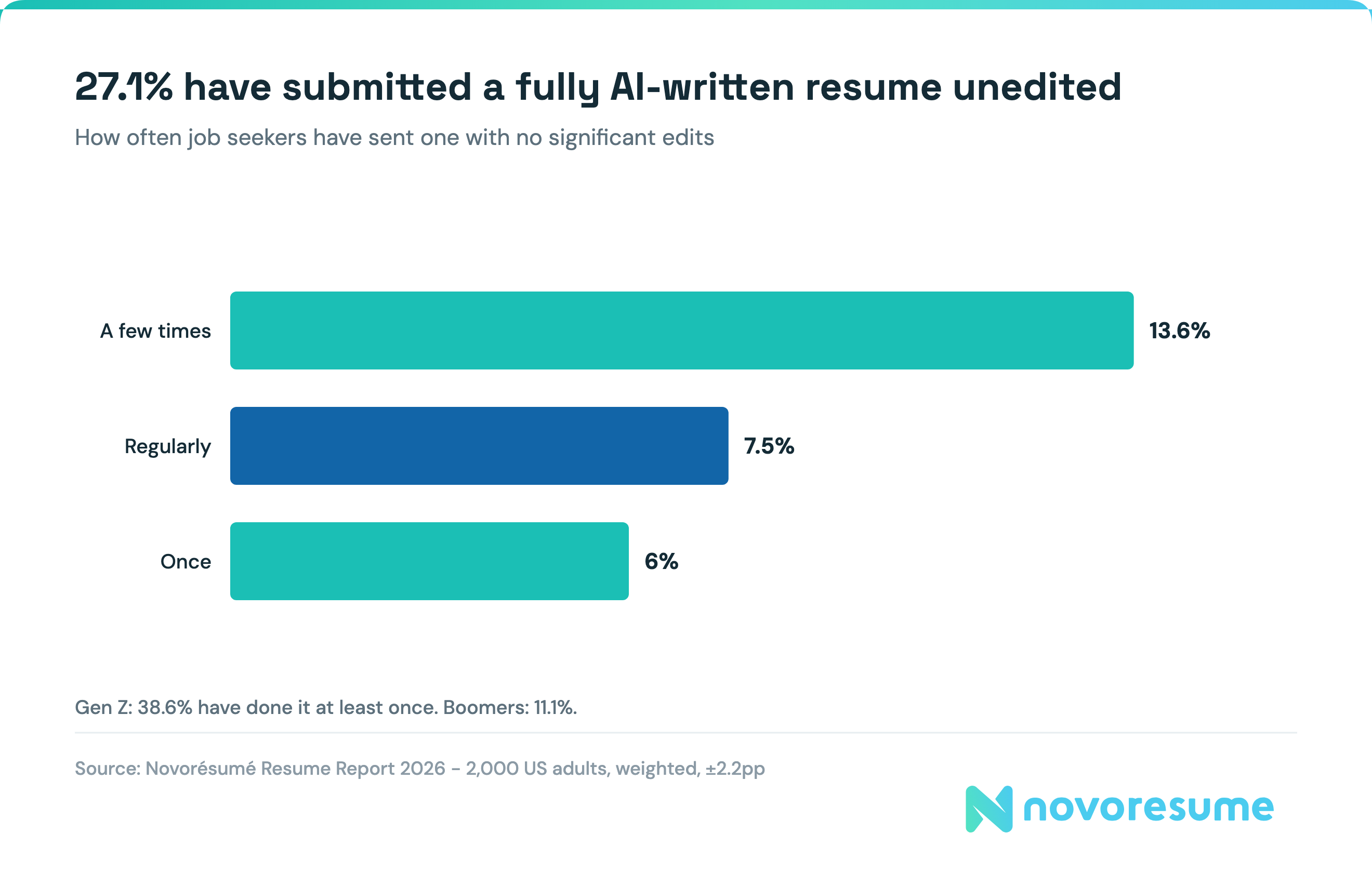
- 27.1% of job seekers have submitted a fully AI-written resume without a single edit. Among Gen Z, it's 38.6%.
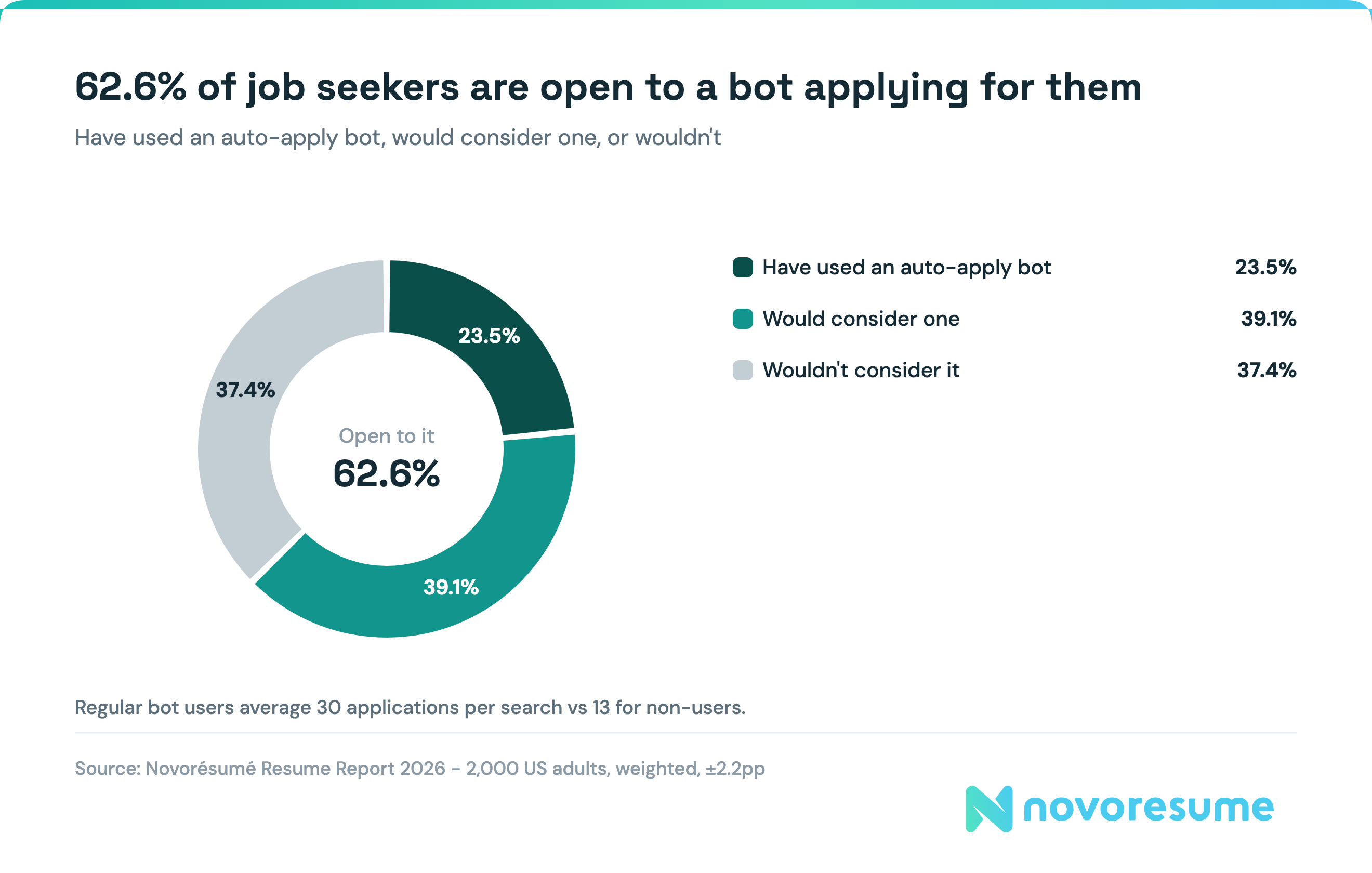
- 23.5% of job seekers have let an auto-apply bot send applications on their behalf, and 62.6% are at least open to the idea, per our 2026 Resume Report.
- 88% of hiring managers believe they can tell when application materials are AI-written, and 91% have caught or suspected AI-driven misrepresentation (Insight Global; Greenhouse).
- 22.4% of AI-using workers have had AI whisper answers to them during a live video interview, and of those, 13.6% landed their current job that way, per our AI Workplace Study.
- Job seekers who use AI frequently receive offers at more than twice the rate of AI avoiders: 76% vs 33% (ZipRecruiter).
- 63% of job seekers have faced an AI interview, and 51% never heard back after completing one (Greenhouse).
- Early-career workers in the most AI-exposed occupations have seen a 16% relative employment decline since late 2022 (Stanford, on ADP payroll data).
- The famous "75% of resumes are rejected by ATS before a human sees them" has no study behind it. What employers actually admit: 88% say their screening filters vet out qualified candidates (Harvard Business School).
How Many Employers Use AI in Hiring and Recruitment?
- 99% of hiring managers use AI in some capacity in the hiring process, and 98% report significant efficiency improvements from it (Insight Global, surveying 1,005 US hiring managers).
- 77% of HR teams now use AI regularly (HireVue, surveying 3,100+ hiring managers, 2026). The trend line behind it: 58% in 2024, 72% in 2025 (HireVue).
- Asked at the organization level, adoption reads lower: 51% of organizations use AI to support recruiting (SHRM, surveying 2,040 HR professionals).
- What they use it for, per SHRM: writing job descriptions (66% of AI-using recruiters), screening resumes (44%), automating candidate searches (32%), customizing job postings (31%), and applicant communication (29%).
- 53% of US recruiters say they've handed most resume screening to AI or ATS tools, but only 21% are very confident those systems aren't rejecting qualified candidates, and 8% admit they don't know what their AI prioritizes (Greenhouse, November 2025).
- 82% of HR professionals use an applicant tracking system in some capacity during screening, per our Hiring Landscape survey of 200+ HR professionals.
- 65% of employers use AI in hiring overall, and 59% specifically use it for resume screening; 94% of AI users say it improved their hiring (TestGorilla, surveying 1,084 hiring decision-makers).
- 37% of talent acquisition professionals are actively integrating or experimenting with generative AI, up from 27% a year earlier, and teams using it report saving about 20% of their work week (LinkedIn, Future of Recruiting 2025).
- 89% of AI-using HR professionals cite time savings as the main payoff (SHRM).
- The direction of travel is one-way: 77% of organizations plan to increase AI use in hiring (Workday), and 67% of talent acquisition leaders plan to increase tech spend (Employ, Recruiter Nation 2025).
How Many Job Seekers Use AI to Apply for Jobs?
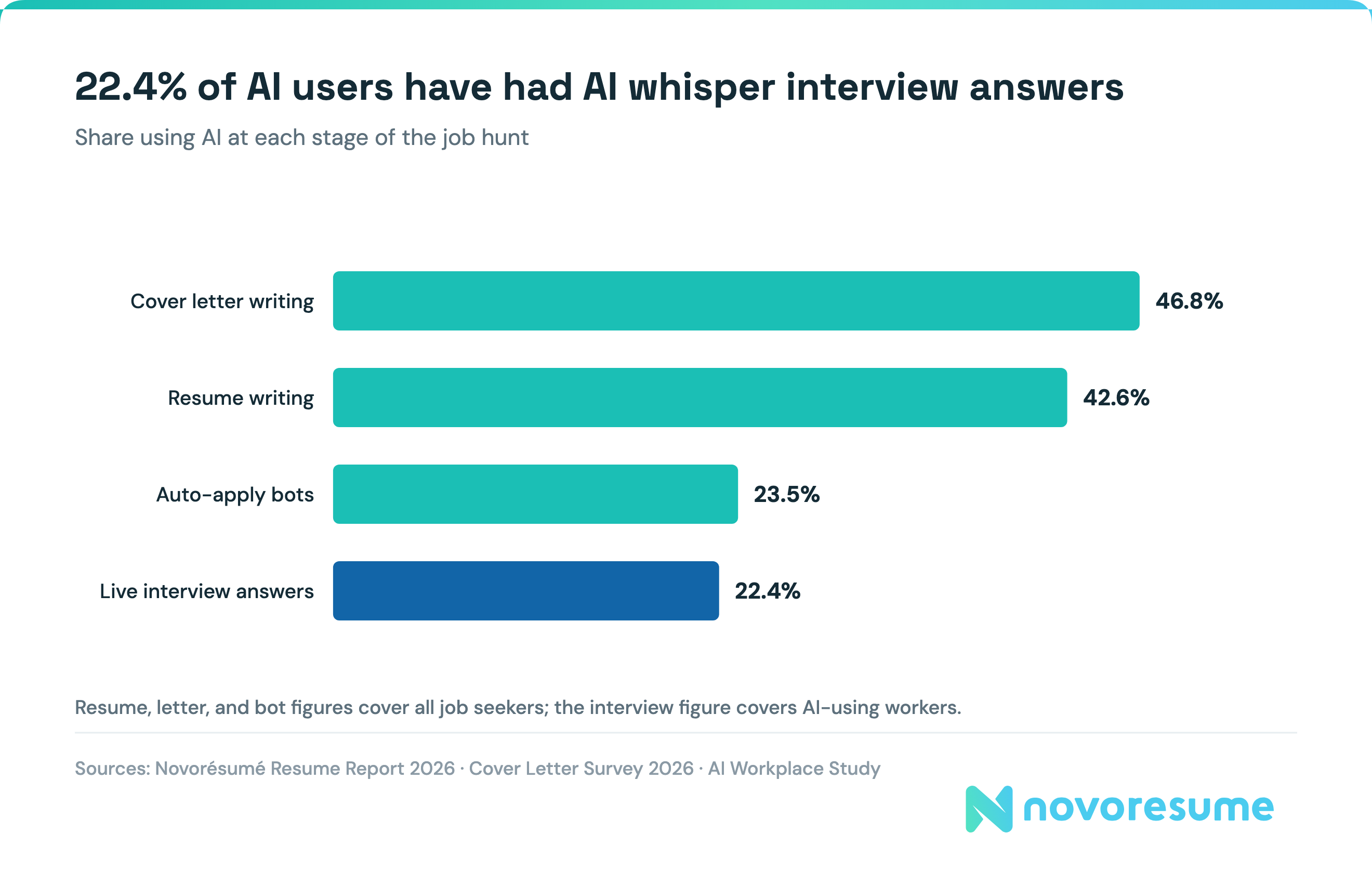
- 42.6% of job seekers used AI the last time they updated their resume, per our 2026 Resume Report of 2,000 US adults.
- External trackers agree on the curve: 74% of US candidates use AI somewhere in the job hunt (Greenhouse), two in three job seekers use AI in the search, up from roughly one in four in 2023 (ZipRecruiter), and 39% used AI during the application process itself, most commonly for resume text (54%) and cover letters (50%) (Gartner, surveying 3,290 candidates).
- 46.8% used AI on their most recent cover letter, and 23.5% have let an auto-apply bot send applications for them (our 2026 surveys; both broken down in their own sections below).
- The pipeline is fully AI-native: 85% of Class of 2026 college seniors use AI tools, up 31 points in two years (Handshake).
- Volume is a tactic of its own: 49% of US job seekers apply to more positions purely to beat automated filters, and 40% have used hidden prompts in applications to try to fool AI screeners (Greenhouse).
How Much of the Resume Is AI Writing Now?
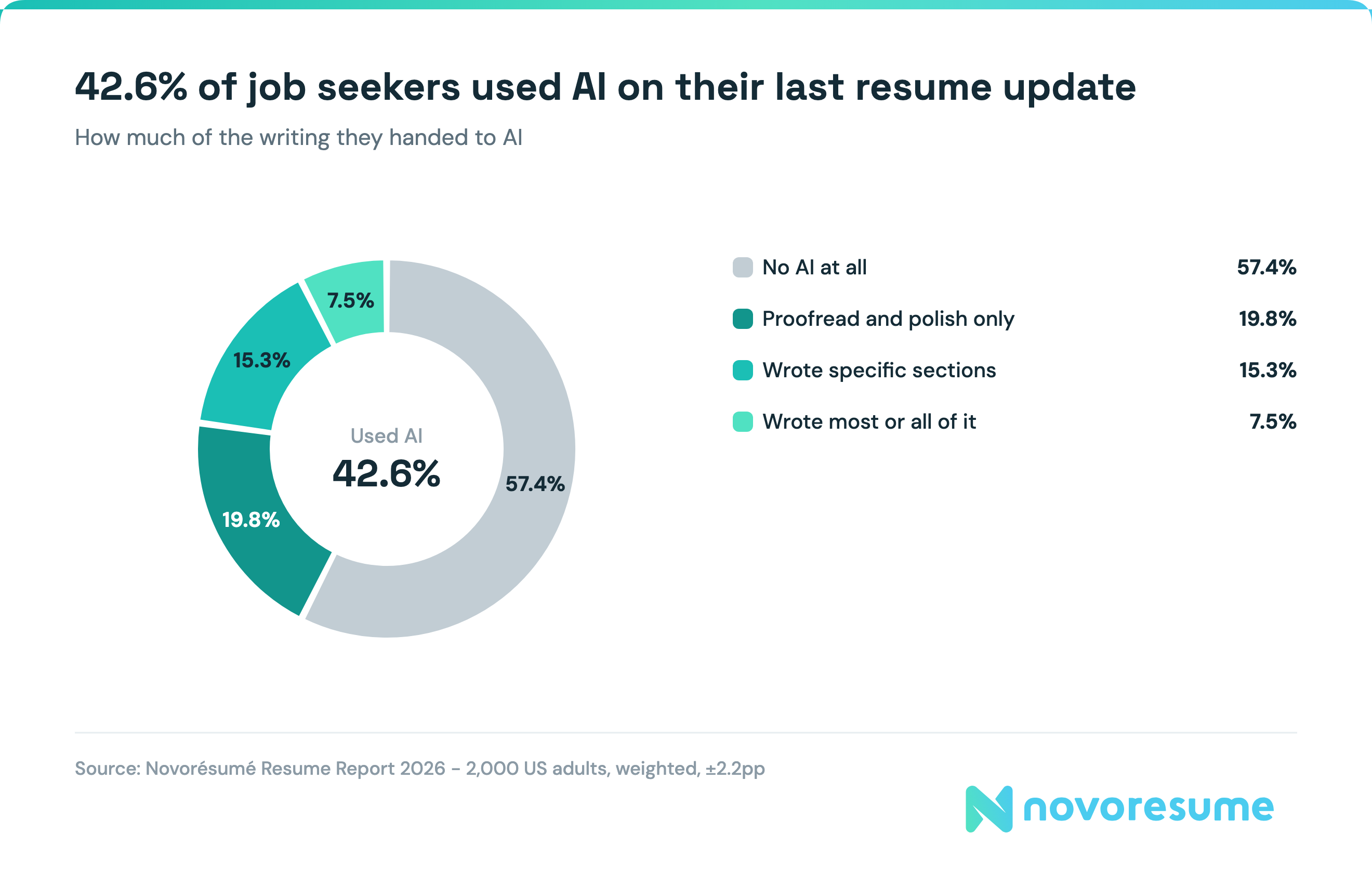
- 57.4% of job seekers didn't use AI at all on their last resume update; 19.8% used it only to proofread or polish; 15.3% had it write specific sections like the resume summary or bullet points; 7.5% let it write most or all of the document (our 2026 Resume Report).
- AI resume use falls cleanly by generation: Gen Z 55.8%, Millennials 47.6%, Gen X 34.1%, Boomers 24.5% (our 2026 Resume Report).
- Men hand the resume to a machine more readily than women: 48.2% vs 37.2% (our 2026 Resume Report).
- 13.6% of resumes are now made in an AI chatbot outright, which means chatbots have overtaken dedicated resume builders (10.6%) as a creation tool. The traditional route still leads: 57.1% start from a Word, Google Docs, or Canva template (our 2026 Resume Report).
- Gen Z is 2.5x more likely than Boomers to have generated their resume in an AI chatbot: 18.8% vs 7.5% (our 2026 Resume Report).
- The synthetic touch now extends to the photo: 1.8% of US resumes carry an AI-generated headshot, which works out to nearly 1 in every 12 resume photos (our 2026 Resume Report).
Are Job Seekers Using AI on Cover Letters Too?
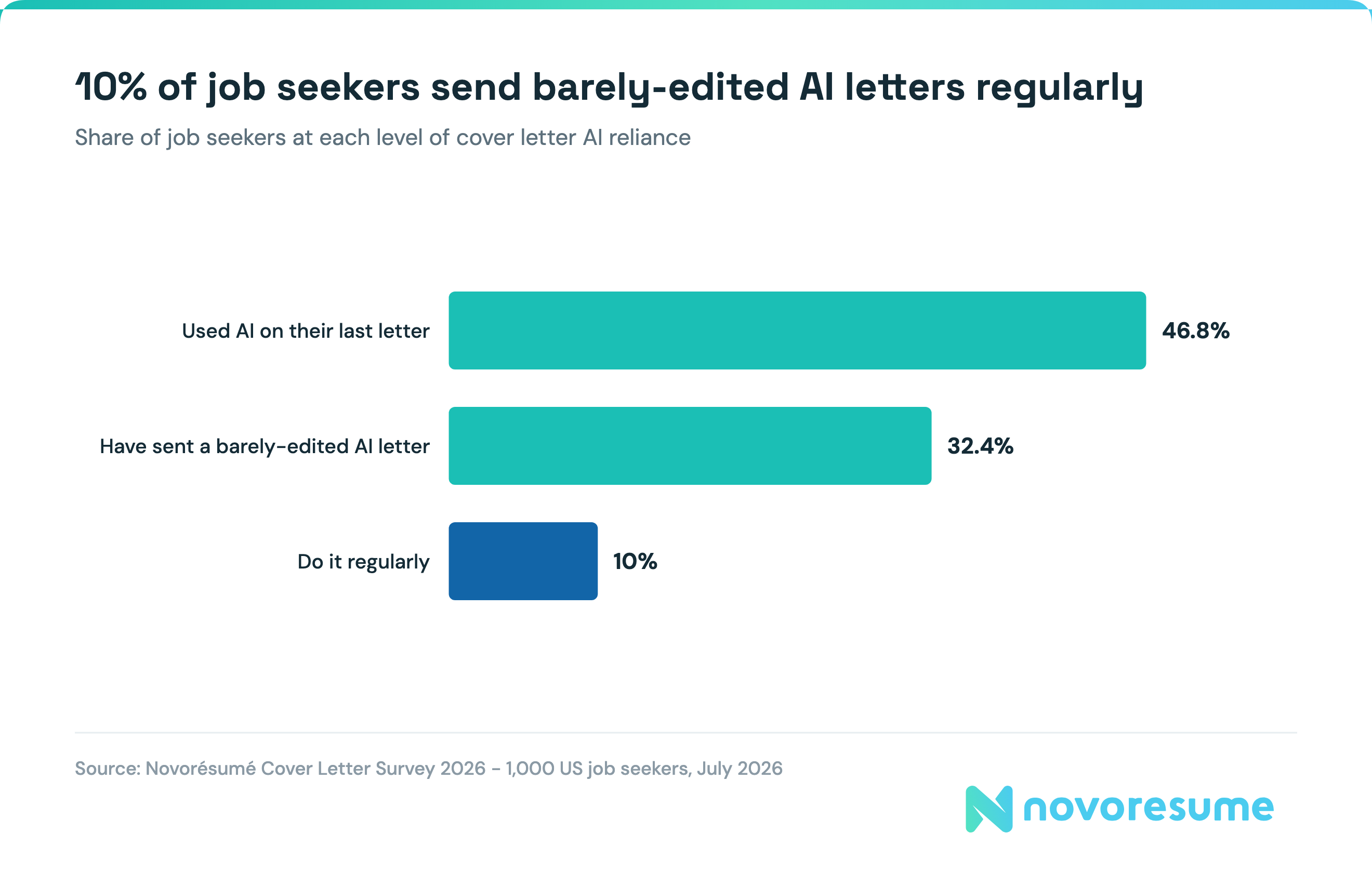
- 46.8% of job seekers used AI to some extent on their last cover letter, per our Cover Letter Survey 2026 of 1,000 US job seekers.
- The split behind that number: 16.5% used AI only for proofreading, 18.5% had it write some sections, and 11.8% had it write all or most of the letter. In other words, for 30.3% of job seekers, AI did some or all of the actual writing (our Cover Letter Survey 2026).
- 32.4% have submitted a cover letter written almost entirely by AI, with little or no editing, at least once. 14.7% have done it a few times, and 10% do it regularly (our Cover Letter Survey 2026).
- 13.4% of job seekers believe an AI-assisted cover letter helped them land a real job, and another 23.7% think it might have (our Cover Letter Survey 2026).
- The letter is also a filter people opt out of: 47.3% of job seekers have skipped applying to at least one job because it required a cover letter. Among Gen Z, 55.6% (our Cover Letter Survey 2026).
- The effort calculation rests on a misread: job seekers believe only about 1 in 5 hiring managers reads cover letters (20.8%), while roughly 60% of HR professionals say they actually read them (our Cover Letter Survey 2026; our Hiring Landscape survey).
- Among recently hired workers who used generative AI in their search, 21% used it to draft a cover letter (ZipRecruiter, Survey of New Hires).
Does Using AI Actually Get People Hired?
- Job seekers who use AI frequently received at least one offer at more than twice the rate of AI avoiders: 76% vs 33% (ZipRecruiter, Q1 2026).
- Tailoring is where AI earns its keep. Asked who or what customizes their resume for each role: 59.7% of job seekers do it manually, 20.8% use AI, 7.1% use a builder's auto-tailor feature, 2.2% pay someone else, and 10.1% don't customize at all (our 2026 Resume Report).
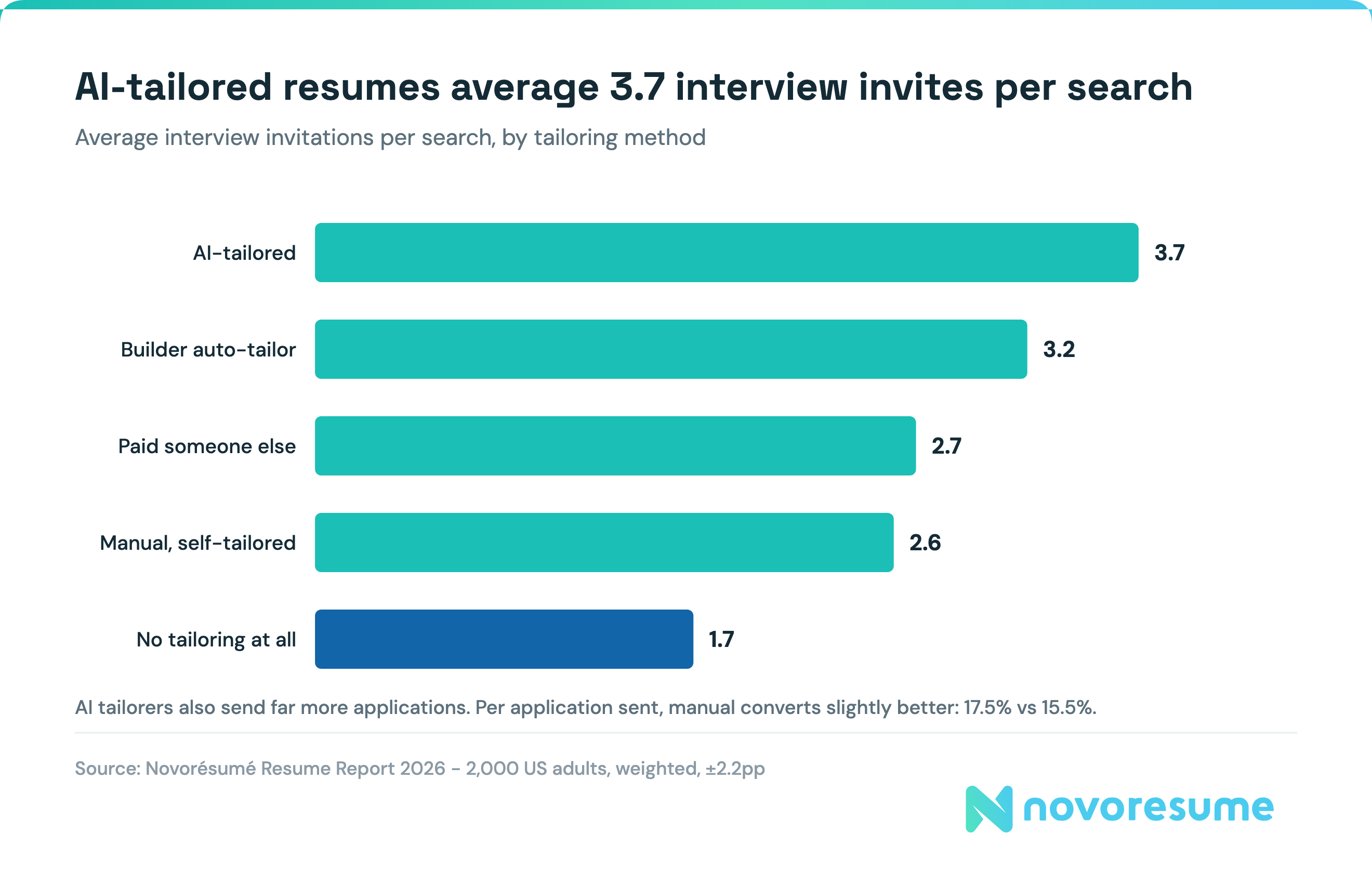
- AI-tailored resumes lead the invitation count: 3.7 interview invites per search, against 3.2 for builder auto-tailoring, 2.7 for paid help, 2.6 for manual tailoring, and 1.7 for people who don't tailor at all (our 2026 Resume Report).
- The AI lead comes from volume, not effectiveness: AI tailors send 24.0 applications per search against 14.8 for manual tailors, and on a per-application basis, manual tailoring converts slightly better, 17.5% vs 15.5% (our 2026 Resume Report).
- Any tailoring beats none by a wide margin: people who don't customize walk away with zero interviews 25.4% of the time, versus 6.5% for AI tailors (our 2026 Resume Report).
- Skill with the tools is becoming a credential in its own right: 71% of business leaders would rather hire a less experienced candidate with AI skills than a more experienced one without them (Microsoft and LinkedIn, Work Trend Index).
- The advantage keeps compounding after the hire: 15.3% of AI-using workers have been promoted at least partly on AI-created output, rising to 26.5% for Gen Z, per our AI Workplace Study of 1,000 US full-time workers.
- The line into fabrication is measurable too: 2.9% of job seekers admit using AI to invent work experience entirely (our 2026 Resume Report).
AI is a speed tool, not a strategy. Manual tailoring still edges AI tailoring per application in our data, and the difference shows in the editing. The 76% offer rate for frequent AI users isn't magic. It's volume plus polish, in the hands of people who still edit.
How Many Job Seekers Use Auto-Apply Bots?
- 23.5% of job seekers have used an auto-apply bot or AI agent to submit resumes to postings on their behalf: 5.7% tried one once, 10.6% have used one a few times, and 7.1% use one regularly (our 2026 Resume Report).
- Another 39.1% haven't used one but would consider it, meaning 62.6% of the workforce is at least open to delegating the application itself to a machine. Only 37.4% rule it out (our 2026 Resume Report).
- Bot use is steeply generational: 32.4% of Gen Z have used one, against 28.5% of Millennials, 16.4% of Gen X, and 10.5% of Boomers (our 2026 Resume Report).
- The economics show declining returns: regular bot users apply to an average of 30 jobs and get 4.2 interviews, while non-users apply to 13 and get 2.4. That's more than double the applications for about 70% more interviews (our 2026 Resume Report).
- The bot crowd also cuts corners elsewhere: 71.7% of bot users admit to a lie on their resume, versus 26.8% of non-users (our 2026 Resume Report).
Can Employers Tell When Applications Are AI-Written?
- 88% of hiring managers say they can tell when candidates used AI to write their resume or cover letter, and 54% say they care (Insight Global). Of those who care: 36% read AI use positively, 24% as low effort, 23% as keyword gaming, and 17% as impersonal.
- 91% of US hiring managers have caught or suspected AI-driven misrepresentation from candidates, and 61% now run software to detect AI use (Greenhouse, November 2025).
- Meanwhile, 27.1% of job seekers have submitted a resume written entirely or almost entirely by AI with no significant edits: 6.0% once, 13.6% a few times, and 7.5% regularly. Among Gen Z, it's 38.6%; among Boomers, 11.1% (our 2026 Resume Report).
- 74% of hiring managers worry more about fake credentials than they did a year ago (Greenhouse).
- AI-generated applications are jamming the machine they were built to beat: 67% of HR leaders say they've slowed the hiring process, 84% report heavier workloads from reviewing them, and 42% spend more time per application (Robert Half, surveying 2,000+ US hiring managers).
- The response is more scrutiny, not less: 38% of hiring managers are adding interviews per candidate, and 65% say verifying candidate skills has become harder (Robert Half).
- Screening strain, itemized: 48% of hiring managers struggle to distinguish qualified from unqualified candidates, 42% cite application volume, 41% struggle to detect AI-generated applications, and 34% of recruiters spend up to half their week filtering junk applications (Greenhouse).
The detection numbers flatter everyone. 88% of hiring managers say they can spot AI writing, while 27.1% of job seekers have already slipped an unedited AI resume past them. Both sides are bluffing, and that's why verification is moving back into the room: more in-person rounds, more skills tests, more receipts.
How Common Are AI Interviews in 2026?
- 63% of job seekers have experienced an AI interview, up 13 percentage points in six months (Greenhouse, surveying 2,950 candidates, May 2026).
- 70% were never clearly told upfront that AI would evaluate them, and 21% only discovered it mid-interview (Greenhouse).
- 38% of candidates have abandoned a hiring process because it included AI interviews, and after completing one, 51% never heard back at all (Greenhouse).
- Only 30% of candidates are open to AI-led interviews, and only 31% were told in advance they'd face one (Gartner).
- 45% of graduate-degree holders have completed AI-analyzed video interviews, and 32% of first-time job seekers have faced fully automated interviews (ZipRecruiter, Q1 2026).
- 33% of job seekers have abandoned applications that required a one-way video interview (CareerPlug).
- 57% of candidates believe AI-interview disclosure should be legally required (Greenhouse).
Is AI Cheating in Live Interviews the New Normal?
- 22.4% of AI-using workers admit AI has whispered answers to them during a live video interview, and of those, 13.6% landed their current job that way (our AI Workplace Study).
- 27.2% of AI-using workers list skills on their resume or LinkedIn that they can only perform with significant AI assistance, and for 13.1% that covers several skills. Among Gen Z workers, it's 36.8% (our AI Workplace Study).
- 20% of professionals admit secretly using AI during job interviews, and 55% believe it has become the new norm (Blind, polling 3,617 US professionals).
- Only 19% of US candidates say using AI in a live interview crosses an ethical line (Greenhouse).
- 36% of candidates admit using AI to alter their appearance, voice, or background in video interviews (Greenhouse).
- Full impersonation is measurable now: 6% of candidates admit to interview fraud, and Gartner projects 1 in 4 candidate profiles worldwide will be fake by 2028.
- Employers see it: 81% of Big Tech interviewers suspect AI cheating in remote interviews, and about a third have caught someone (interviewing.io).
- 31% of managers have interviewed candidates later revealed to be fake identities, 35% have seen someone other than the listed applicant join a virtual interview, and 23% report fraud losses over $50,000 in the past year (Checkr, surveying 3,000 US managers).
- 62% of managers agree job seekers are now better at faking identities with AI than HR teams are at detecting it (Checkr).
- The correction is physical: 39% of hiring managers run more in-person interviews specifically to verify identity, 62% of candidates say an in-person requirement makes them MORE likely to apply, and half of FAANG interviewers expect Big Tech to return to in-person rounds (Greenhouse; Gartner; interviewing.io).
- Legitimate AI prep, for contrast, is mainstream and uncontroversial: 45% of job seekers use AI to prepare for interviews (Greenhouse), including structured prompt work that no employer objects to.
Is AI Screening Costing People Jobs?
- The claim that "75% of resumes are rejected by ATS before a human sees them" has no published study behind it; it traces to a defunct vendor's 2012 press quote. The related "99% of Fortune 500 use ATS" figure comes from a proprietary tally with unclear methodology. Neither belongs in journalism.
- What employers actually admit is worse: more than 90% use screening software to make the first cut, and 88% acknowledge that qualified candidates get vetted out because they don't match exact job-description criteria. The researchers estimate 27 million such "hidden workers" in the US (Harvard Business School with Accenture, the landmark 2021 study).
- The verified version of the modern fear: 53% of recruiters have handed most screening to AI or ATS tools while only 21% are very confident those systems aren't rejecting qualified people (Greenhouse). On the candidate side, the practical fix is ATS-aware resume writing, not keyword stuffing; you can also test how your resume parses with our free ATS resume checker.
- The employment effect is now measurable at the entry level: workers aged 22-25 in the most AI-exposed occupations saw a 16% relative employment decline since late 2022, driven by a collapse in hiring rather than layoffs (Brynjolfsson, Chandar & Chen, Stanford Digital Economy Lab, on ADP payroll records; November 2025 revision - widely cited versions still say 13%, which was the August draft).
- The squeeze concentrates where AI automates rather than augments; experienced workers in the same occupations kept growing (Stanford).
- Context from the wider funnel: the average posting now draws 244 applications (Greenhouse platform data). Only 7.6% of applicants pass the first interview stage, which is the funnel every screening decision above feeds into (Greenhouse).
Do Candidates Trust AI in Recruitment?
- Only 26% of job applicants trust AI to evaluate them fairly, and 32% worry AI could auto-fail their applications (Gartner, surveying 2,918 candidates).
- 25% trust employers less if they use AI to evaluate candidates (Gartner).
- Only 41% of hiring teams fully trust their own AI tools (HireVue, 2026).
- 47% of workers fear AI benefits the company more than themselves (Randstad, surveying 27,062 workers).
- The bias question splits both ways: 57% of workers believe AI in hiring could reduce racial and ethnic bias, up 6 points year over year (HireVue, 2025), even as researchers keep documenting hidden bias in AI-driven hiring systems.
- Where AI adoption is handled openly, sentiment flips: workers who say AI improved their job satisfaction outnumber those who say it reduced it by roughly 6 to 1 (The Conference Board).
- Even Gen Z, the most AI-fluent cohort, is souring on AI in hiring contexts: employed Gen Zers are 3x as likely to say AI's workplace risks outweigh its benefits (48% vs 15%), a pattern that runs through our Gen Z workplace statistics (Gallup, with the Walton Family Foundation).
- Regulators are moving with the sentiment: the EU AI Act classifies hiring among high-risk AI uses, and New York City already requires bias audits for automated employment decision tools.
Methodology
- Our 2026 Resume Report: 2,000 US adults aged 18-64, surveyed May 2026 via Pollfish, census-weighted, margin of error ±2.2 percentage points.
- Our Cover Letter Survey 2026: 1,000 US job seekers aged 18-64, surveyed July 2026 via Pollfish across two waves.
- Our AI Workplace Study: 1,000 US full-time workers, surveyed February 2026 via Pollfish, census-balanced; AI-behavior questions were asked of the 858 AI users in the sample.
- Our Hiring Landscape survey: 200+ HR professionals, including recruiters, HR managers, and executives, updated in 2026.
Sources
External sources, cited inline:
Sources
- Insight Global, 2025 AI in Hiring Survey (1,005 US hiring managers), fieldwork October 2024
- HireVue, Global AI in Hiring Reports, 2025 (4,000+ respondents) and 2026 (3,100+ hiring managers) editions
- SHRM, 2025 Talent Trends (2,040 HR professionals), February 2025
- Greenhouse, 2025 AI in Hiring Report (4,100+ respondents), November 2025; AI interview candidate survey (2,950 candidates), May 2026; The Hire Standard Benchmark Report (platform data), March 2026
- Gartner, candidate survey press releases (AI trust, application AI use, interview fraud, offer trends), July 2025 and June 2026
- TestGorilla, The State of Skills-Based Hiring 2025 (2,160 respondents), April 2025
- LinkedIn, Future of Recruiting 2025 (1,271 recruiting professionals)
- Microsoft & LinkedIn, Work Trend Index (31,000 workers, 31 countries), 2024
- ZipRecruiter Economic Research, Q1 2026 Job Seeker Confidence Survey; Survey of New Hires, Q1 2024
- Robert Half, AI-generated applications survey (2,000+ US hiring managers), March 2026
- Blind, AI-in-interviews poll (3,617 US professionals), April 2025
- interviewing.io, Big Tech interviewer survey (67 FAANG-class interviewers), October 2025
- Checkr, The Hiring Hoax (3,000 US managers), September 2025
- CareerPlug, 2025 Candidate Experience Report
- Brynjolfsson, Chandar & Chen (Stanford Digital Economy Lab), Canaries in the Coal Mine (ADP payroll data), November 2025 revision
- Harvard Business School & Accenture, Hidden Workers: Untapped Talent (2,275 executives), September 2021
- Handshake Network Trends, Class of 2026 report, April 2026
- Gallup with the Walton Family Foundation, Gen Z AI survey (1,572 respondents), April 2026
- The Conference Board, Job Satisfaction 2026, June 2026
- Randstad, Workmonitor 2026 (27,062 workers), January 2026
- Workday, Global Workforce Report, September 2024; Employ, 2025 Recruiter Nation Report, October 2025
 Add Novoresume as a preferred source on Google
Get more resume writing tips, career insights, and job search advice in your personalized Google search results.
Related posts

Words and adjectives to describe yourself in interviews, on your resume, and in bios. Grouped by trait, with worked answers and the 10 words to avoid.

90+ Gen Z workplace statistics for 2026: workforce share, the entry-level squeeze, AI, tenure, money, and the management myths. From 20+ primary sources.

80+ job interview statistics for 2026: AI interviews, funnel odds, ghosting, and offer rates. From our own 2026 surveys plus 17 verified primary sources.