Updated on June 15, 2026
The Resume Report 2026: 60+ Statistics on American Resumes
Read 60+ statistics on how Americans write, customize, and submit resumes today, and what it means for job seekers.


Novoresume got people hired at
























We surveyed 2,000 U.S. adults to find out how the American resume has changed in the AI era: how long workers spend writing one, who (or what) does the writing, how often they tailor it, what they put in it that isn't quite true, and how that all translates into actual interview invitations (and in some cases, lost jobs).
Read on to learn the essential resume statistics for 2026.
Key Findings
- More than 4 in 10 Americans (42.6%) used AI tools the last time they updated their resume, including 7.5% who let AI write most or all of it.
- More than 1 in 4 workers (27.1%) have submitted a fully AI-generated resume to a job without making a single edit.
- People who send the same resume to every job are 3x more likely to walk away from a job search with zero interview invitations than those who customize each time.
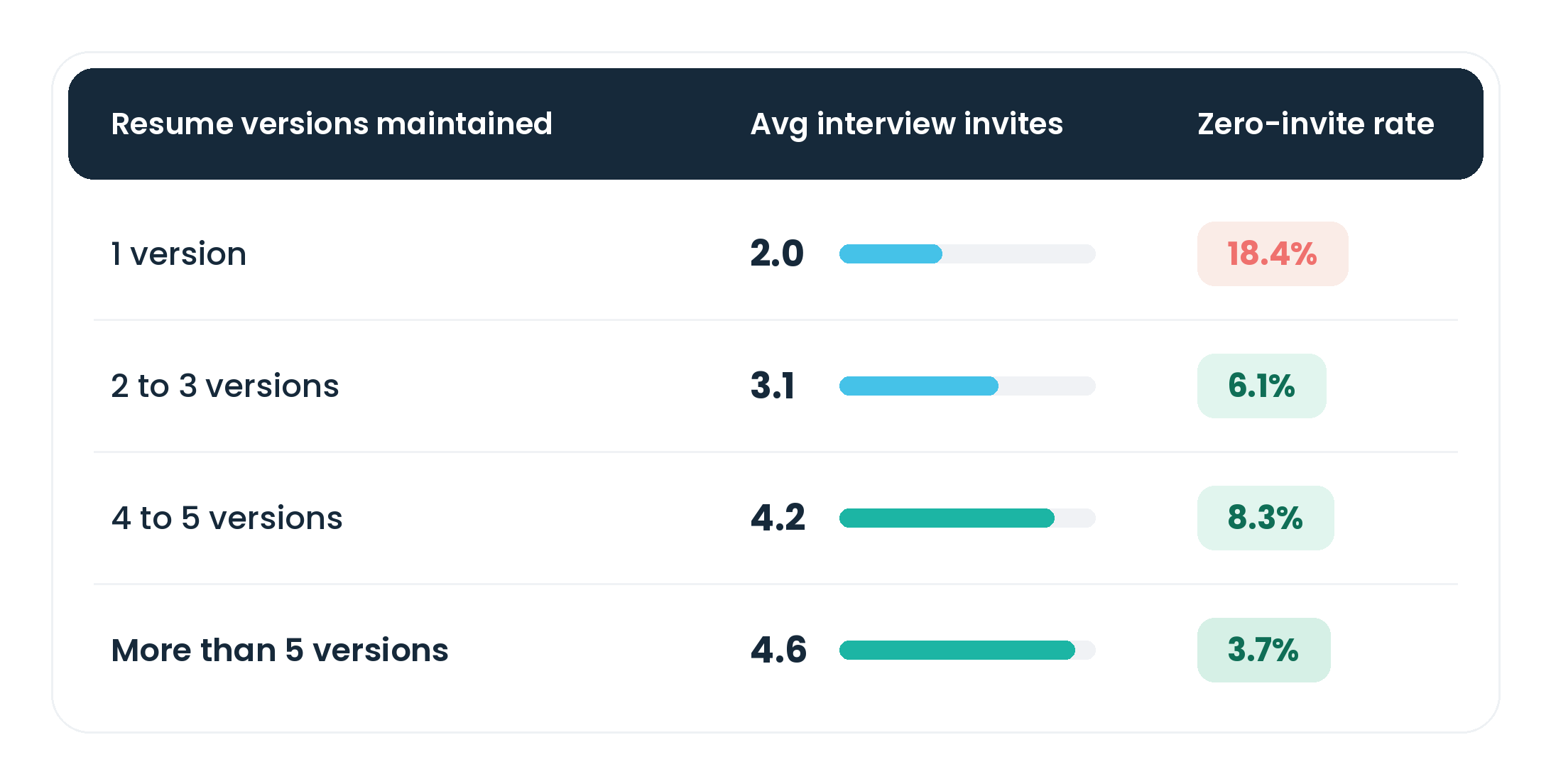
- Workers who maintain a single resume version receive an average of 2.0 interview invitations per search and are 18.4% likely to receive zero invitations. Workers with 2-3 versions get 3.1 invites and have just a 6.1% zero-invite rate. Workers with 4 or more versions get 4.2+ invites, more than double the single-version crowd.
- 1 in 3 Americans (37.3%) admits to having put something inaccurate on their resume, including 1 in 16 (6.1%) who say they have listed a job that didn't exist or was significantly fabricated.
- People who let AI write most, or all of their resume are 3x more likely to admit to lying on it than people who used no AI at all (74.8% vs 24.6%).
- 3.1% of all American workers say a resume lie has cost them a job, but among workers who let AI write most or all of their resume, 1 in 4 (25.2%) have lost a job over something on it. The same crowd is 8x more likely than non-AI users to have been confronted by a recruiter or employer about their resume.
- 23.5% of Americans have used an auto-apply bot or AI agent to submit their resumes to job postings on their behalf, and 71.7% of bot users also admit to a resume lie.
- 1.8% of American resumes now include an AI-generated headshot, which is 8.6% of all resumes with a photo.
- Americans applied to an average of 16.6 jobs in their last search and received 2.8 interview invitations, but the average masks a huge volume gap: Gen Z averages 21.9 applications per search, while Boomers average 8.9.
- People who maintain four or more versions of their resume get more than 2x as many interview invites as people who maintain a single version (4.2 vs 2.0).
- Men admit to lying on their resume at significantly higher rates than women (45.3% vs 29.6%), and are nearly 3x more likely to have lost a job because of it (4.6% vs 1.6%).
How Americans Write Their Resumes
The typical American resume is short, simple, and made in a familiar app.
40.6% of workers say their current resume is exactly one page long. Another 10.6% have a resume that's less than a page. 39.5% have a 2-page resume, 6.8% have 3 pages, and only 2.5% have anything longer than that. Roughly half the country (51.2%) fits their working life on a single side of paper or less.
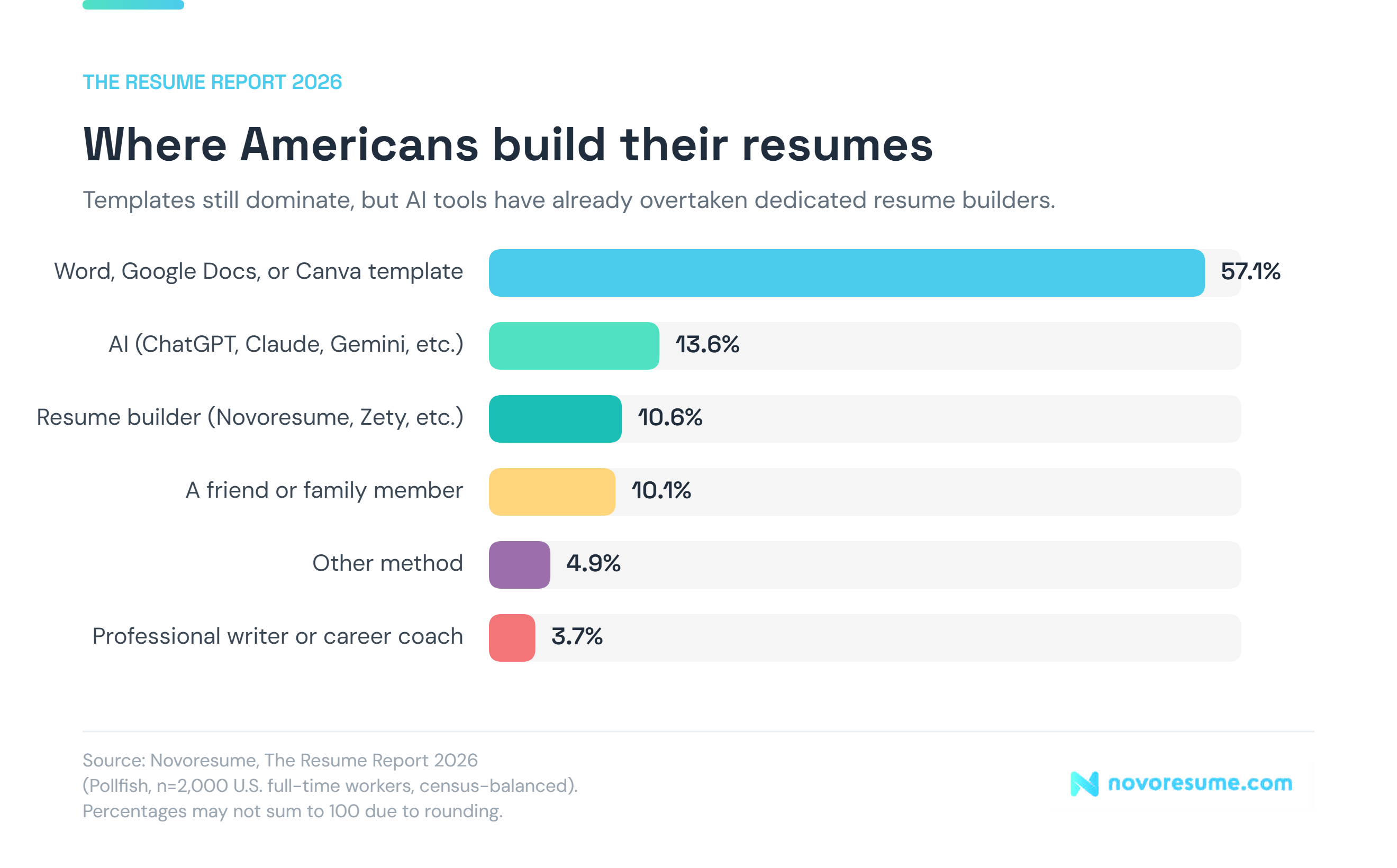
Where Americans build their resumes:
- 57.1% used a Word, Google Docs, or Canva template
- 13.6% used AI (ChatGPT, Claude, Gemini, or similar)
- 10.6% used a resume builder (Novoresume, Zety, or similar)
- 10.1% asked a friend or family member to make it for them
- 3.7% worked with a professional resume writer or career coach
- 4.9% used some other method
Gen Z is more than twice as likely as Boomers to have used AI to generate their resume (18.8% vs 7.5%).
Time spent on the most recent resume update:
- 10.8% spent less than 15 minutes
- 23.5% spent 15 to 30 minutes
- 33.9% spent 30 minutes to 1 hour
- 24.1% spent 1 to 3 hours
- 4.3% spent 3 to 8 hours
- 3.4% spent more than 8 hours
Most Americans (68.2%) spend an hour or less updating their resume. Only 7.7% spend more than 3 hours.
Here’s how many versions of a resume Americans maintain:
- 39.4% maintain a single version
- 50.4% maintain 2 to 3 versions
- 7.3% maintain 4 to 5 versions
- 1.9% maintain more than 5
- 1.0% generate a new one for every application using AI
Gen Z and Millennials are noticeably more likely to maintain multiple versions: 32.0% of Gen Z and 36.1% of Millennials stick to a single version, compared to 43.3% of Gen X and 53.7% of Boomers.
The version count maps directly to interview success. Workers who maintain a single resume version receive an average of 2.0 interview invitations per search and are 18.4% likely to receive zero invitations. Workers with 2-3 versions get 3.1 invites and have just a 6.1% zero-invite rate. Workers with 4 or more versions get 4.2+ invites, more than double the single-version crowd.
AI Has Quietly Taken Over the Resume
AI is now a routine part of resume writing for nearly half of American workers, and the more involved AI gets, the bigger the implications.
How Americans used AI the last time they updated their resume:
- 57.4% didn't use AI at all
- 19.8% used AI only to proofread or polish what they wrote
- 15.3% had AI write specific sections (summary, bullet points, etc.)
- 7.5% had AI write most or all of it
In total, 42.6% of Americans used AI in some form to build their most recent resume. That number didn't exist three years ago.
Men are noticeably more comfortable handing the resume over to a machine: 48.2% of men used AI tools, compared to 37.2% of women. Men are 2x as likely as women to have let AI write most or all of their resume (10.0% vs 5.0%).
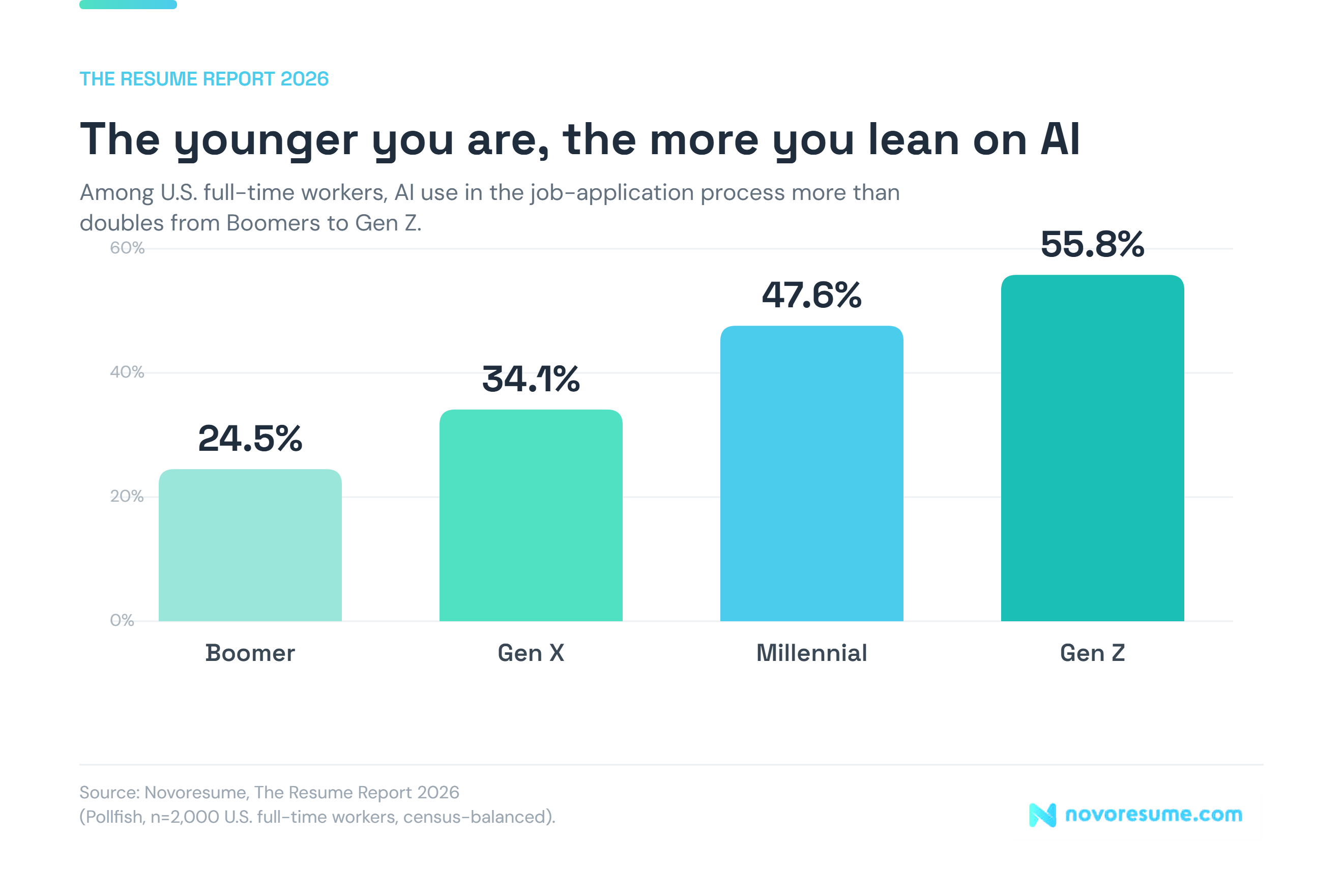
The generational split is even sharper:
- Gen Z: 55.8% used AI in some form
- Millennial: 47.6%
- Gen X: 34.1%
- Boomer: 24.5%
Beyond using AI as an assistant, a striking number of workers have actually submitted fully AI-generated resumes to real employers.
27.1% of Americans say they have submitted a resume to a real job that was written entirely or almost entirely by AI with no significant edits:
- 6.0% have done it once
- 13.6% have done it a few times
- 7.5% do it regularly
Gen Z leads here too: 38.6% have submitted a fully AI-written resume to a real job. Among Boomers, only 11.1% have.
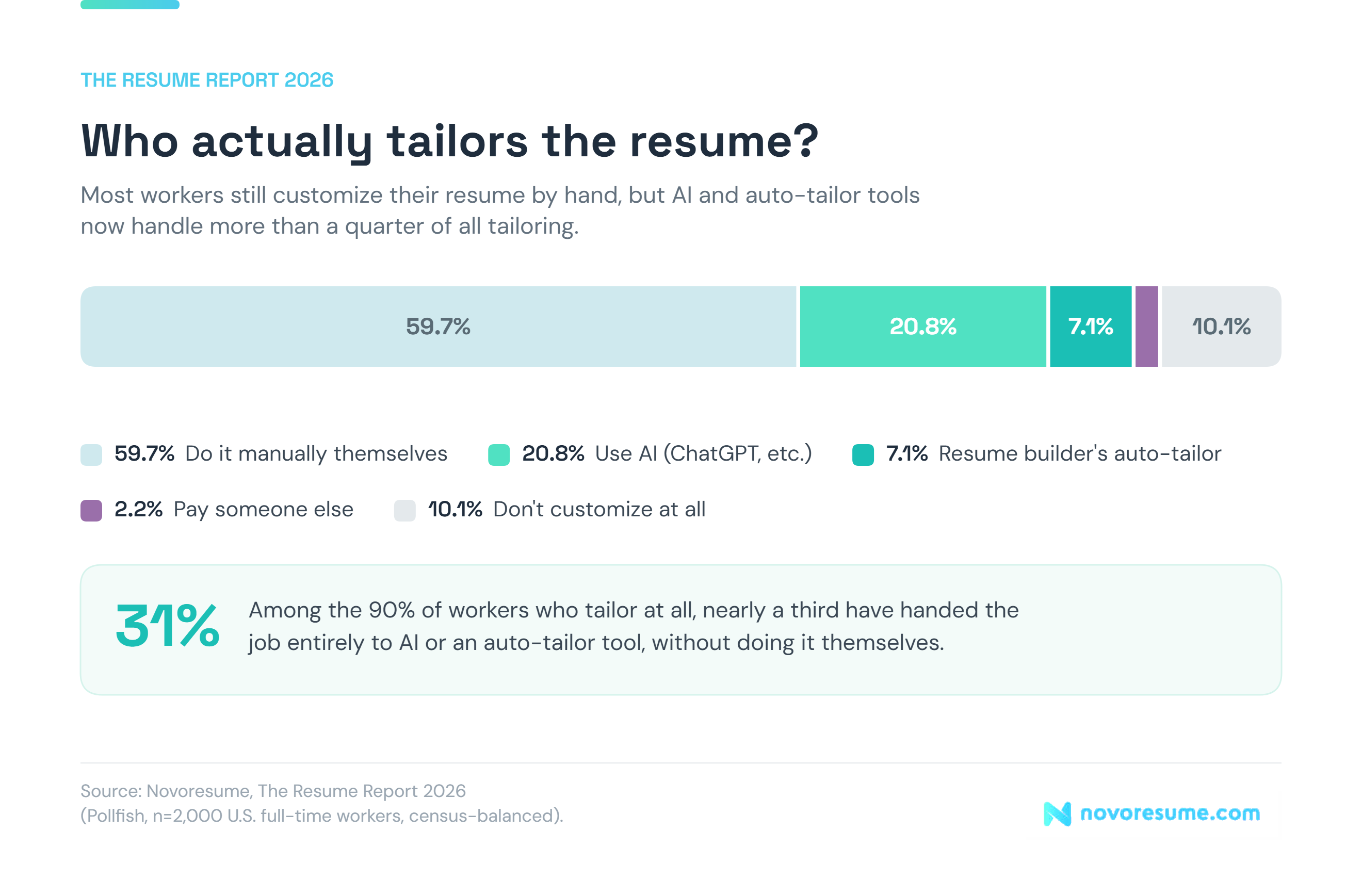
When workers do tailor their resume for specific roles, AI is increasingly doing that work for them. Asked who or what does the customizing, 59.7% of American workers say they do it manually themselves, 20.8% use AI (ChatGPT, etc.) to tailor it, 7.1% use a resume builder's auto-tailor feature, 2.2% pay someone else (a resume writer, friend, or agency), and 10.1% don't customize at all.
Among the 90% of workers who do tailoring, roughly 31% have outsourced tailoring to AI or an auto-tailor tool and have not done it themselves.
The Personalization Gap (And Why It Mostly Disappears for Gen Z)
The most actionable finding in the survey concerns how often workers customize their resumes.
How often Americans customize their resume for the specific role they're applying to:
- 25.7% customize it every time
- 29.9% customize it for most applications
- 19.9% customize it for a few important applications
- 24.4% send the same resume to every job
A quarter of Americans (24.4%) never tailor at all, and the cost shows up directly in interview rates.
Just 1 in 16 Americans who customize their resume for every application walks away from a job search with zero interview invites (6.4%). Among workers who send the same resume to every job, the rate is more than 1 in 5 (20.5%). The "same resume" crowd is roughly 3x more likely to walk away from a search empty-handed.
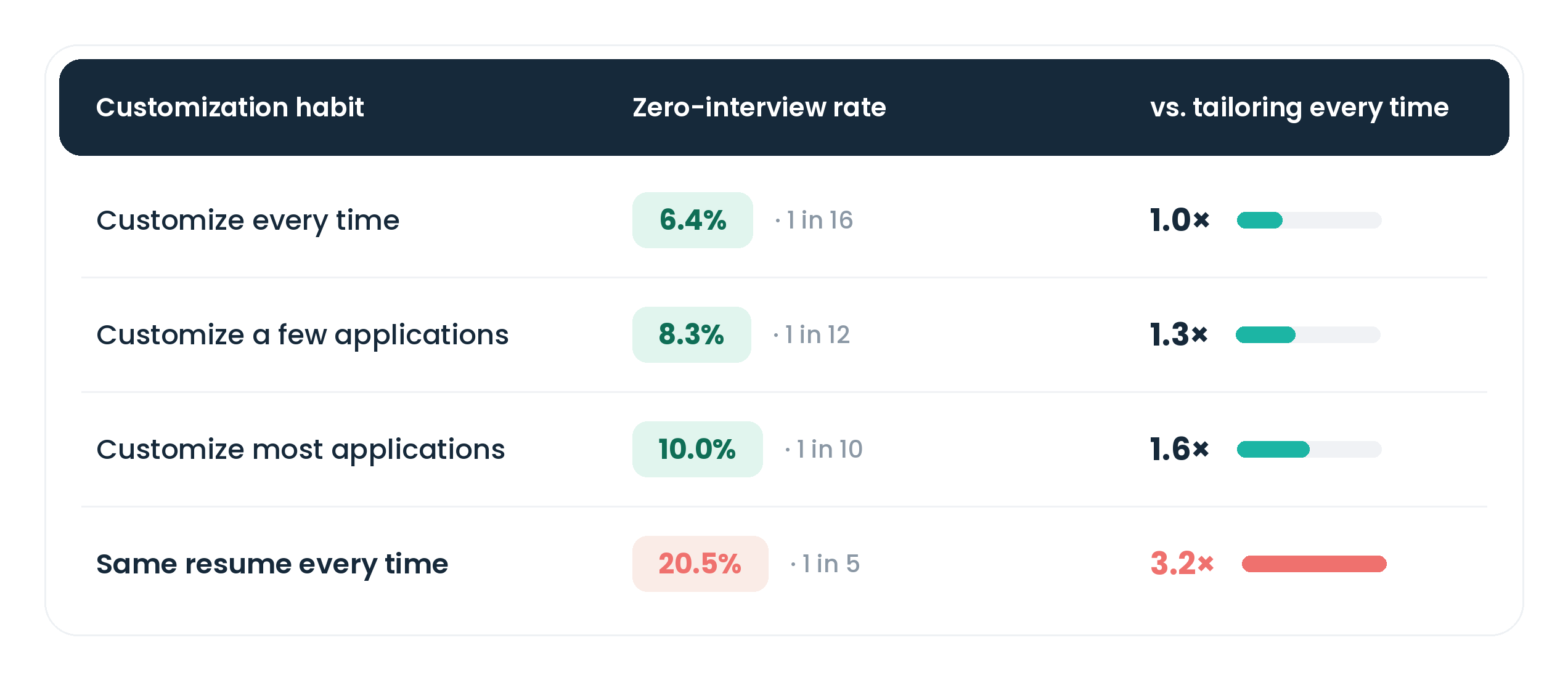
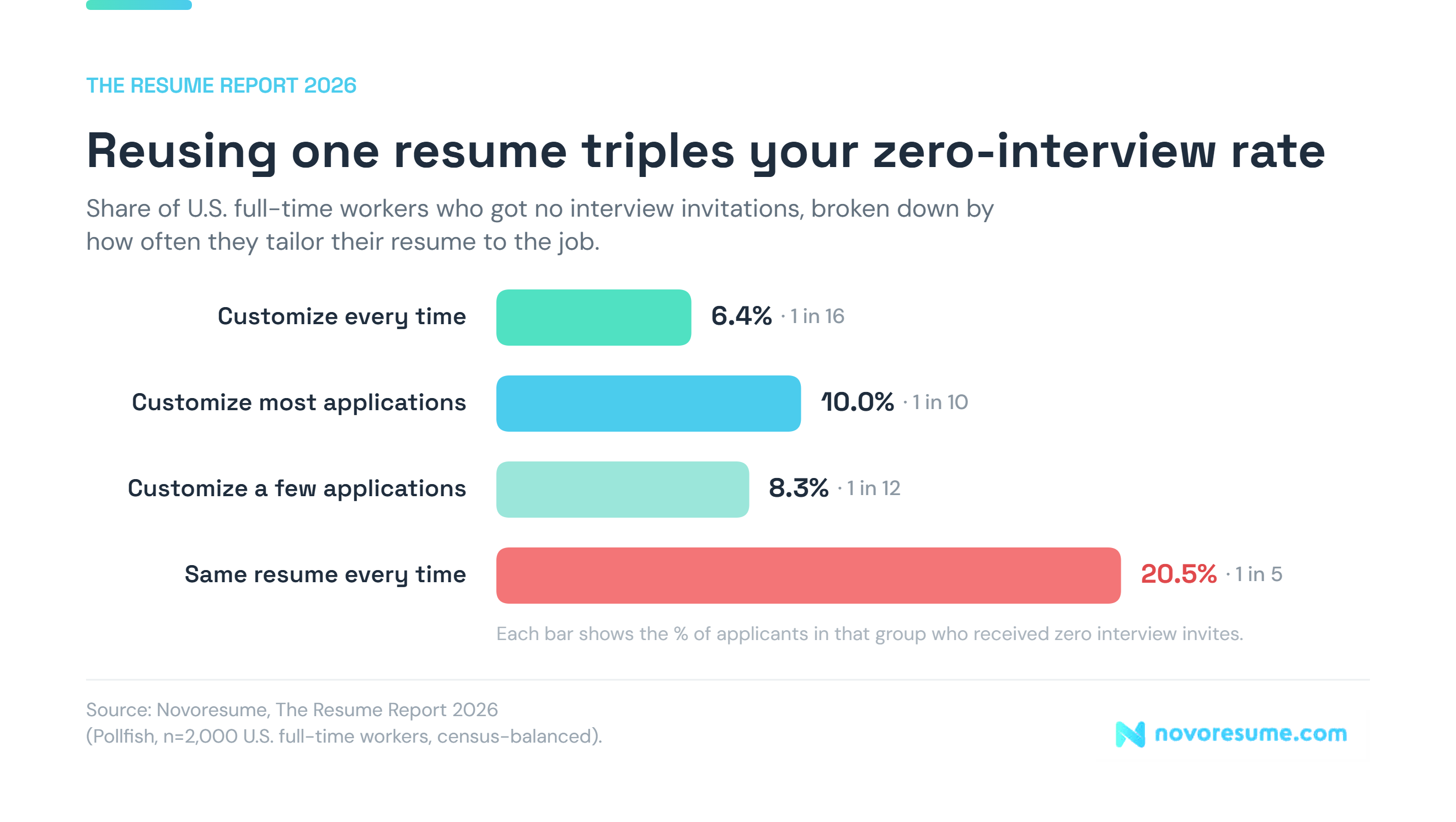
This isn't an artifact of application volume. Even when limited to workers who applied to 25 or fewer jobs in their last search, the same gap holds: 22.5% of the same-resume group got zero invites versus 6.9% of the every-time customizers.
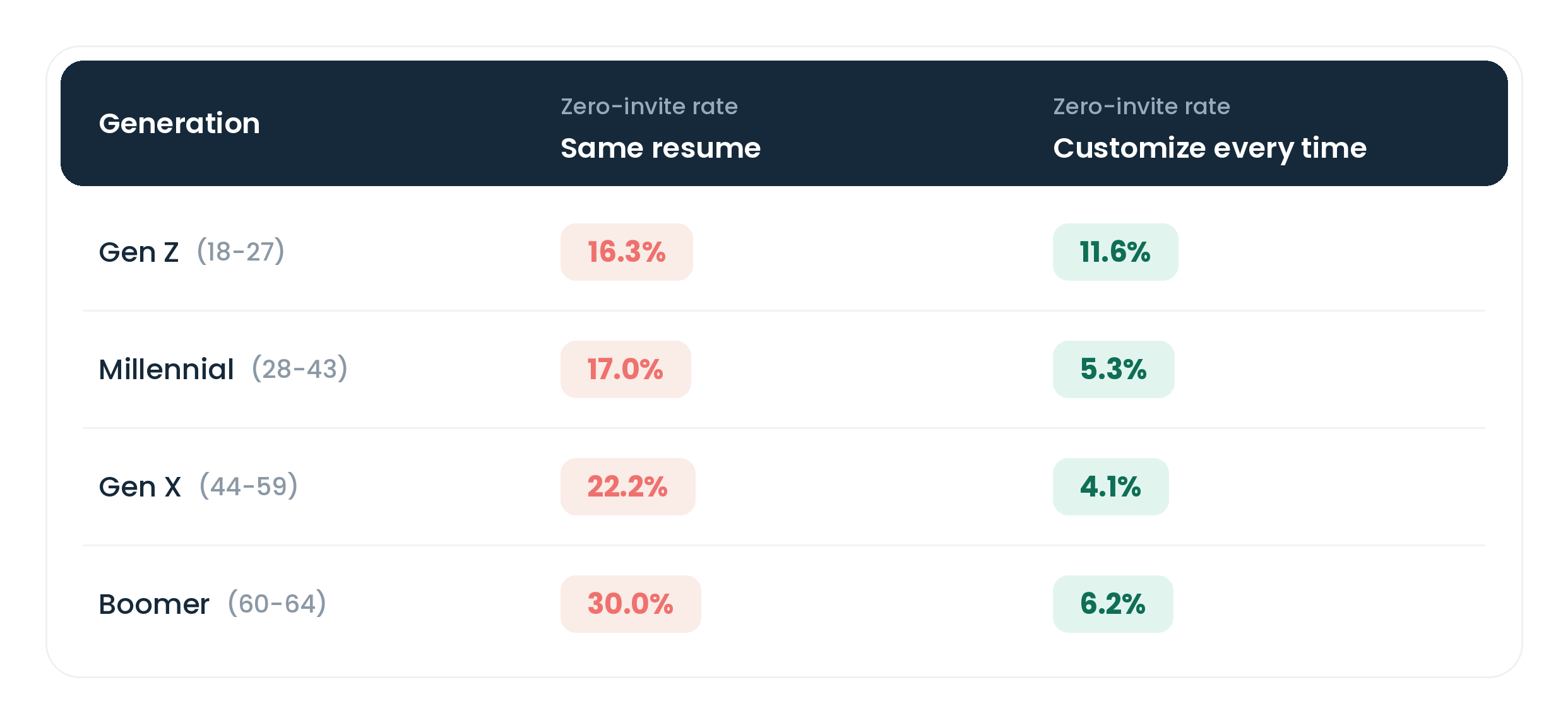
The personalization payoff scales sharply with age. Among Gen X workers, just 1 in 24 every-time customizers walk away with zero invites (4.1%). For Gen X workers who send the same resume, it's roughly 1 in 4 to 1 in 5 (22.2%). Boomers see a nearly identical pattern (6.2% versus 30.0%). For Gen Z, the gap nearly disappears: roughly 1 in 9 customizers gets zero invites, compared with 1 in 6 non-customizers.
Why does the personalization payoff shrink to almost nothing for Gen Z? Several factors stack up. Gen Z applies in much higher volume (an average of 21.9 jobs per search versus 8.9 for Boomers), is more than 2.5x as likely to use an AI tailoring service (36.3% versus 13.4% of Boomers), and is applying overwhelmingly to entry-level roles where there's simply less specialized experience to differentiate one application from the next. When your strongest resume bullets are coursework, internships, and side projects, there isn't much to customize.
Older workers, by contrast, have decades of varied roles, projects, and accomplishments. The right customization swaps in the bullet that matches the job posting. The wrong customization, or none at all, sends a senior accountant's resume to a role that wanted a financial analyst, and gets ignored.
There's also a notable pattern when you look at who or what is doing the customizing:
- AI-tailored resumes: 24.0 average applications, 3.7 average invites, 6.5% zero-invite rate
- Resume builder auto-tailor: 22.8 average applications, 3.2 average invites, 7.3% zero-invite rate
- Manually self-tailored: 14.8 average applications, 2.6 average invites, 11.1% zero-invite rate
- Paying someone else to tailor: 12.1 average applications, 2.7 average invites, 9.0% zero-invite rate
- Don't tailor at all: 8.7 average applications, 1.7 average invites, 25.4% zero-invite rate
AI-tailored applicants receive more interview invitations per search than manually tailored applicants, but the gap stems from volume, not effectiveness. On a per-application basis, manual tailoring slightly edges out AI (17.5% interview rate per application vs 15.5%). The real takeaway: any form of tailoring beats no tailoring by a wide margin.
The Job Search by the Numbers
Americans applied to an average of 16.6 jobs in their last active search and received an average of 2.8 interview invitations.
Here’s to how many jobs Americans applied to in their last search:
- 65.2% applied to 1 to 10 jobs
- 19.5% applied to 11 to 25 jobs
- 8.2% applied to 26 to 50 jobs
- 3.5% applied to 51 to 100 jobs
- 2.0% applied to 101 to 250 jobs
- 1.6% applied to more than 250 jobs
Here’s how many interview invites they received:
- 11.3% got zero interview invites
- 45.8% got 1 to 2
- 33.4% got 3 to 5
- 7.0% got 6 to 10
- 1.3% got 11 to 15
- 1.2% got more than 15
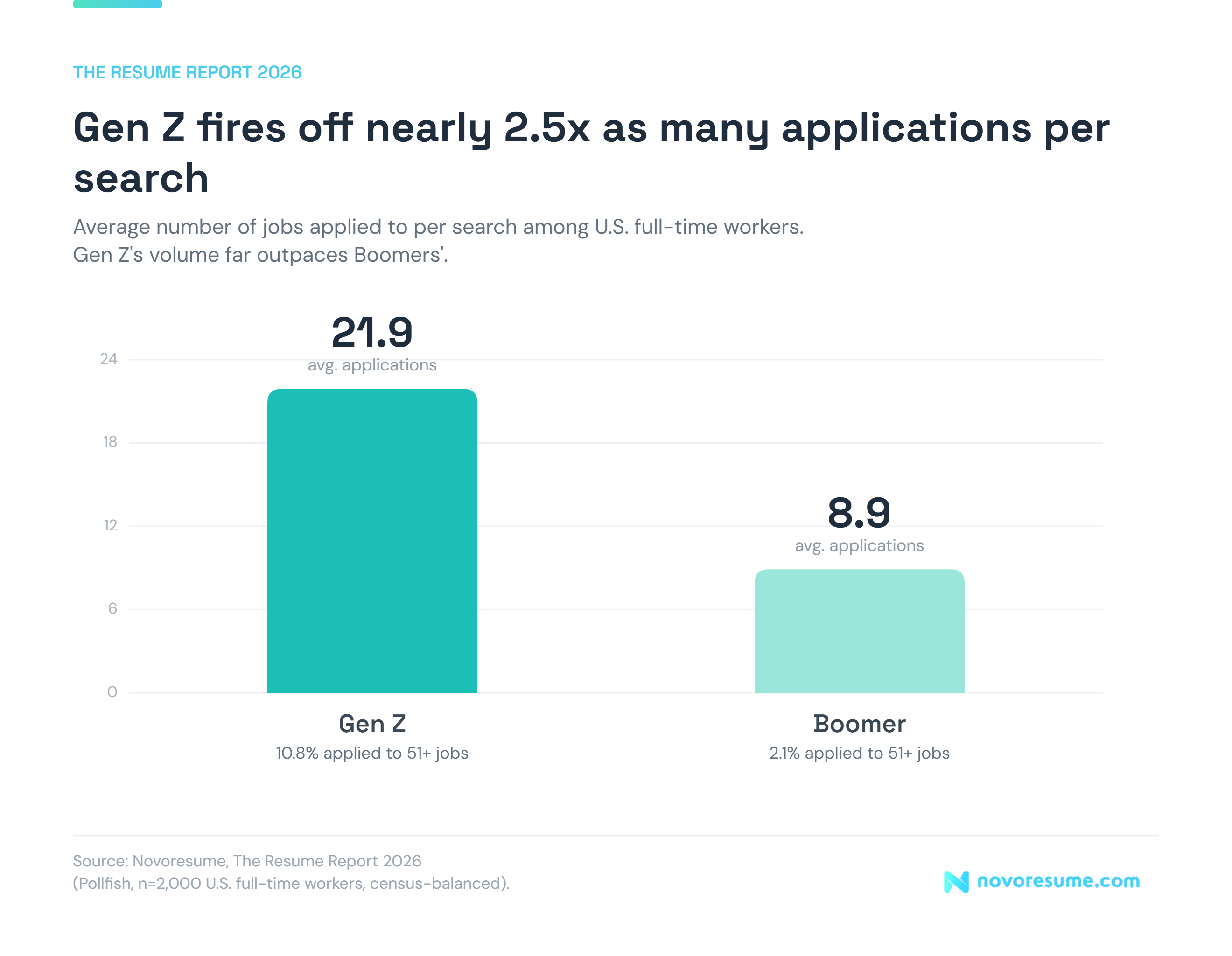
Search volume varies sharply by generation. Gen Z averages 21.9 applications per search, with 10.8% applying to 51 or more jobs. Boomers average 8.9 applications, with only 2.1% applying to 51 or more.
This is how long the most recent job search took:
- 37.0% landed an offer in less than a month
- 30.9% took 1 to 3 months
- 13.2% took 3 to 6 months
- 5.5% took 6 to 12 months
- 2.5% took more than a year
- 10.8% are still looking
Workers who send the same resume to every job spend significantly longer in their searches: 22.1% have been searching for 6 months or longer (including those still looking), compared to 15.7% of workers who customize every application.
The Rise of the Auto-Apply Bot
Nearly a quarter of Americans (23.5%) have already used an automated tool to apply to jobs on their behalf, the kind of service that uses AI agents or browser extensions to submit a resume to dozens or hundreds of postings at once.
Auto-apply bot adoption:
- 5.7% have tried one once
- 10.6% have used one a few times
- 7.1% use one regularly
- 39.1% haven't used one but would consider it
- 37.4% wouldn't consider using one
That means 62.6% of American workers are at least open to letting a bot apply to jobs for them, even as the practice remains controversial among hiring managers.
Bot use is highly generational:
- Gen Z: 32.4% have used an auto-apply bot
- Millennial: 28.5%
- Gen X: 16.4%
- Boomer: 10.5%
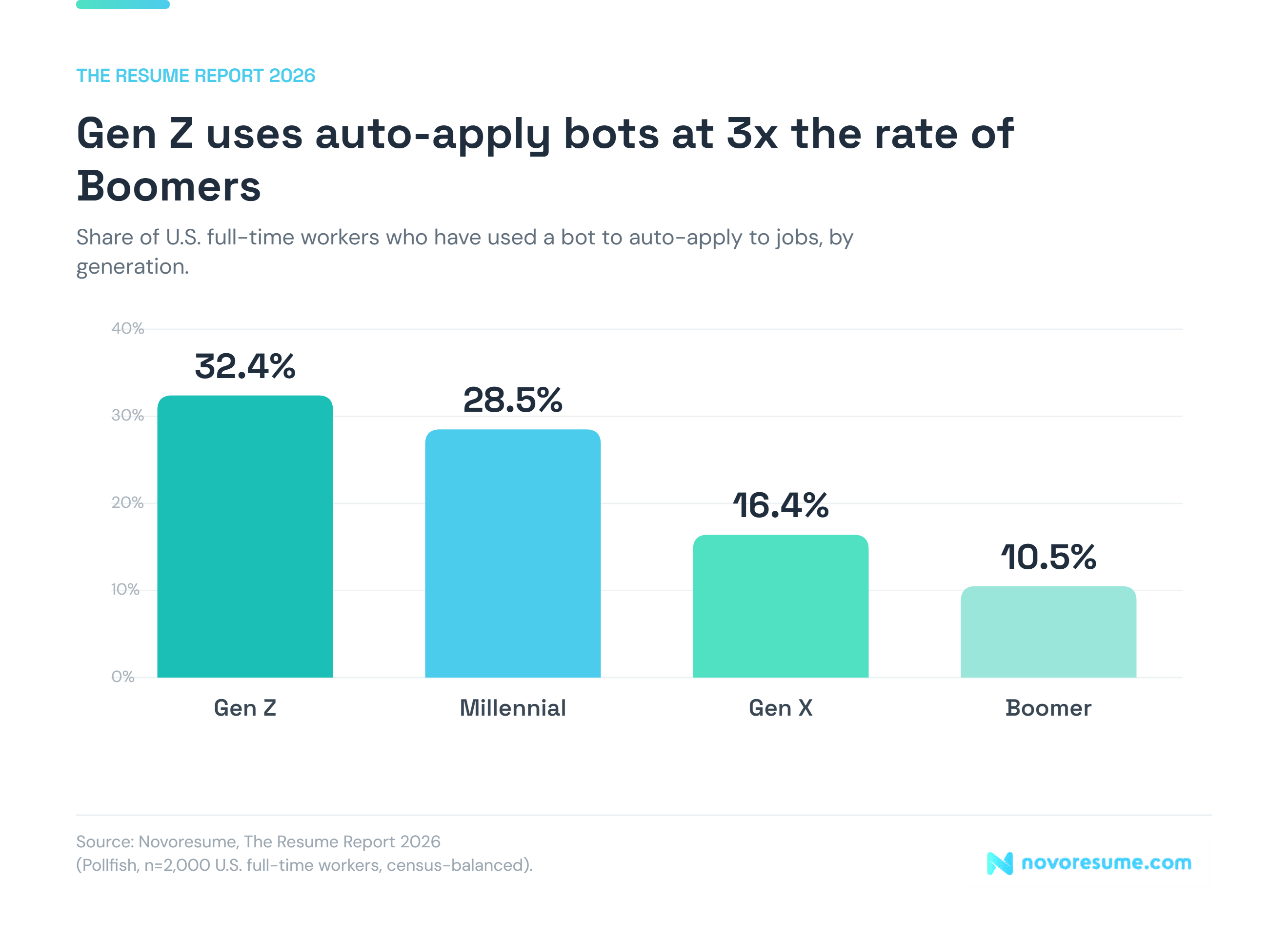
Regular bot users apply to an average of 30 jobs and get 4.2 interviews, while non-users apply to an average of 13 jobs and get 2.4 interviews. Bot users apply at more than 2x the rate of non-users but get only about 70% more interviews, a clear sign of declining returns from automated mass applications.
1 in 3 Americans Has Lied on Their Resume
- 18.9% have hidden or shortened an employment gap by adjusting dates
- 14.3% have inflated their years of experience
- 12.6% have exaggerated a job title beyond what they officially held
- 10.7% have listed a skill they can't actually perform without significant help
- 6.8% have claimed a degree, certification, or credential they don't actually have
- 6.6% have claimed accomplishments or projects that weren't really theirs
- 6.1% have listed a job that didn't exist or was significantly fabricated
- 2.9% have used AI to generate fake experience, accomplishments, or credentials
That last one means roughly 6 million Americans have explicitly used AI to invent things on their resume.
Multi-lie behavior is more common than expected: 21.2% admit to two or more separate types of resume misrepresentation, and 12.2% admit to three or more.
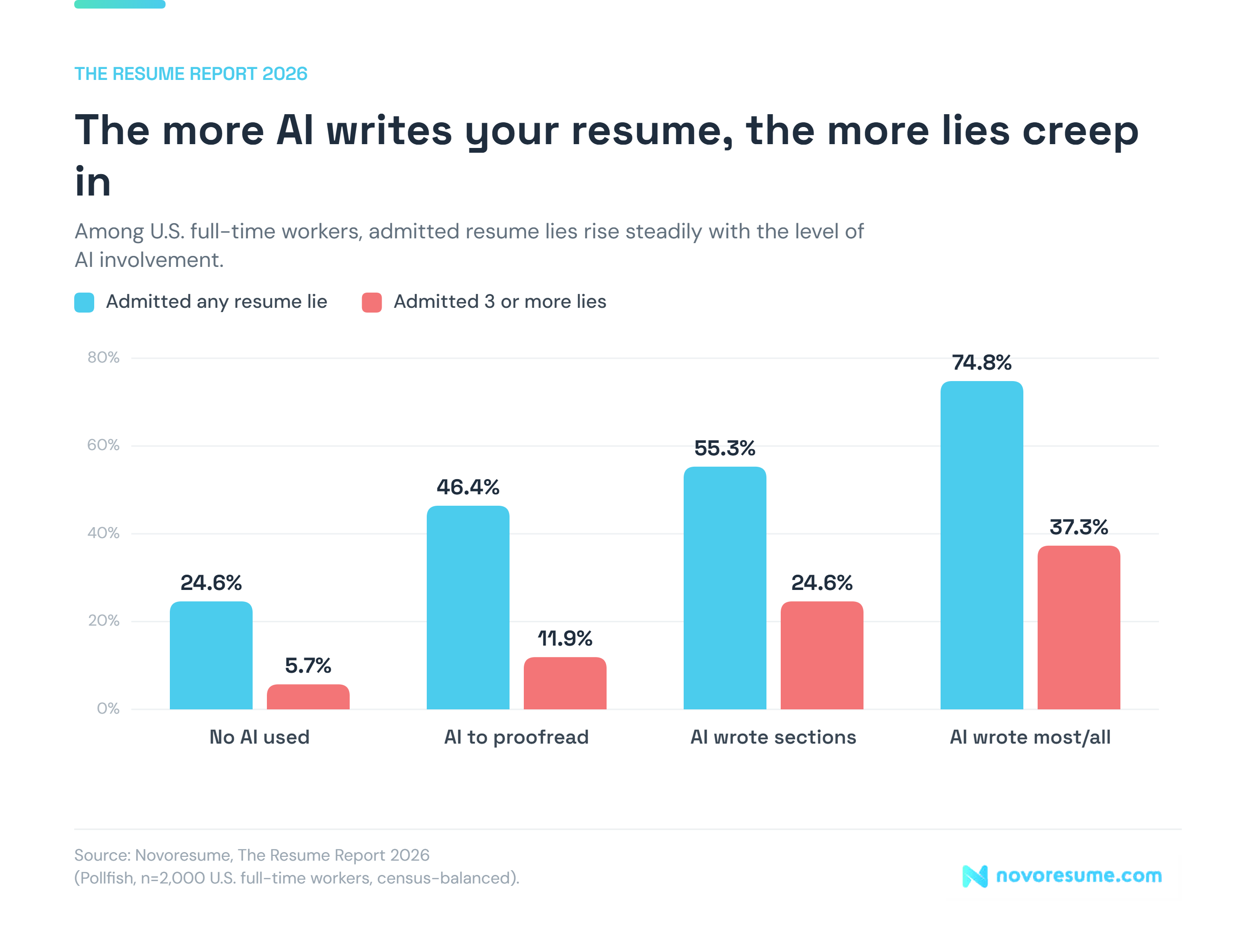
The biggest predictor of lying is AI involvement. The more AI does the writing, the more likely the worker is to have included something inaccurate:
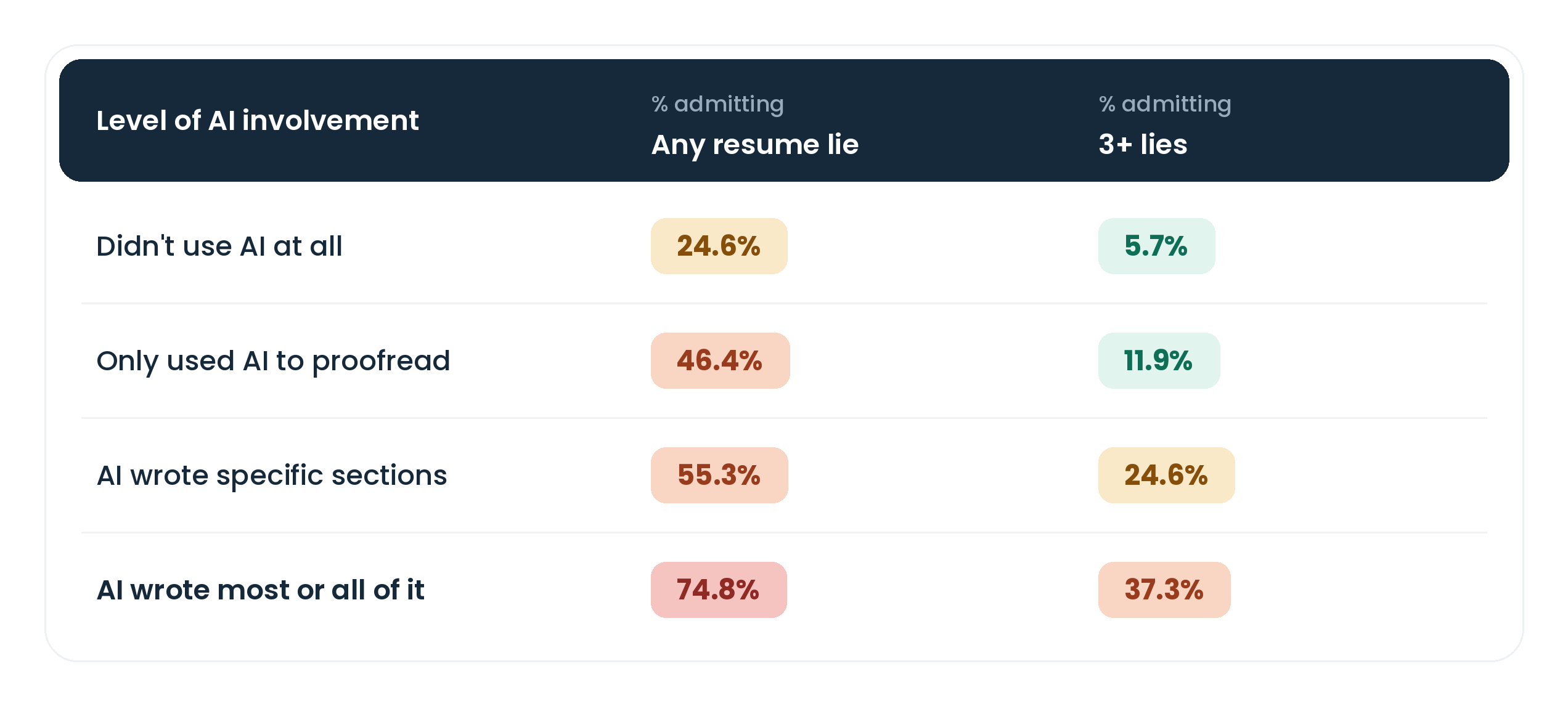
People who let AI write most, or all of their resume are 3x more likely to admit a lie than people who used no AI at all, and 6.5x more likely to admit three or more lies.
A related pattern appears in fully AI-submitted resumes. Among workers who say they have submitted an entirely AI-written resume to a real job a few times, 67.6% admit to a resume lie. For workers who do this regularly, the rate is 75.7%. Among workers who have never done this, only 25.9% admit to a lie.
Auto-apply bot users show the same pattern. 71.7% of workers who have ever used an auto-apply bot admit to having told a resume lie, compared with 26.8% of workers who have never used one.
The Gender Gap on Resume Honesty
45.3% of men admit a resume lie compared to 29.6% of women, a 15.7-point gap. On specific items, men are 3x more likely than women to admit they have claimed accomplishments that weren't theirs (10.0% vs 3.3%) and more than 2x as likely to admit to inflating their years of experience (19.7% vs 9.0%). Men are also 2.4x more likely to admit using AI to generate fake credentials (4.1% vs 1.8%).
Which Lies Each Generation Tells
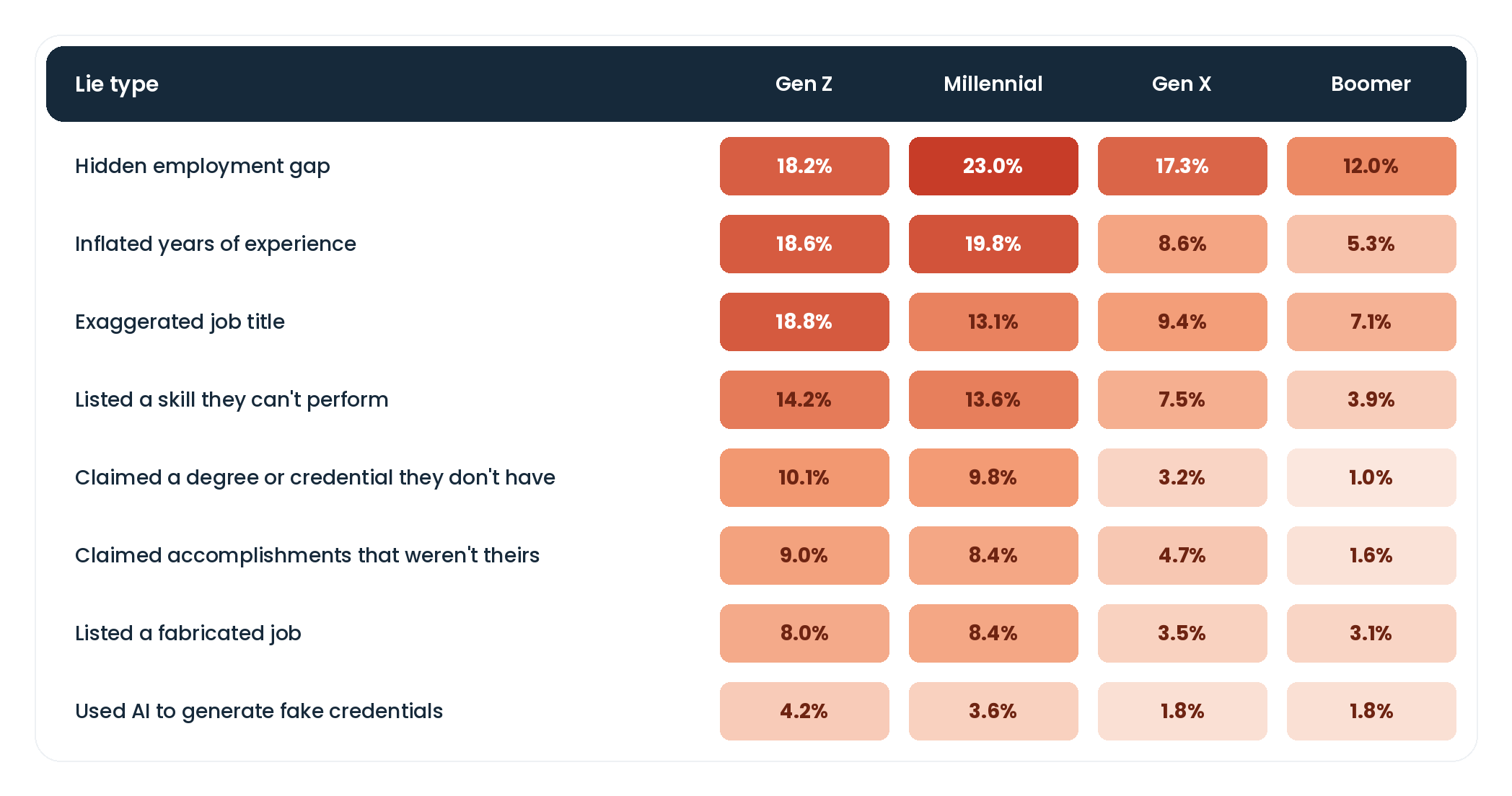
A few patterns pop out. Gen Z is 10x more likely than Boomers to claim a degree they don't have (10.1% vs 1.0%), the single sharpest generational divergence in the survey. Millennials lead on hidden employment gaps (23.0%) and inflated years of experience, the kinds of mid-career embellishments that come from trying to paper over disrupted careers. Gen Z dominates the "outright fabrication" categories: exaggerated titles, claimed credentials, and AI-generated fake content.
Long Searches Bring Out Dishonesty
The longer a job search runs, the more likely the worker is to have lied somewhere on their resume:
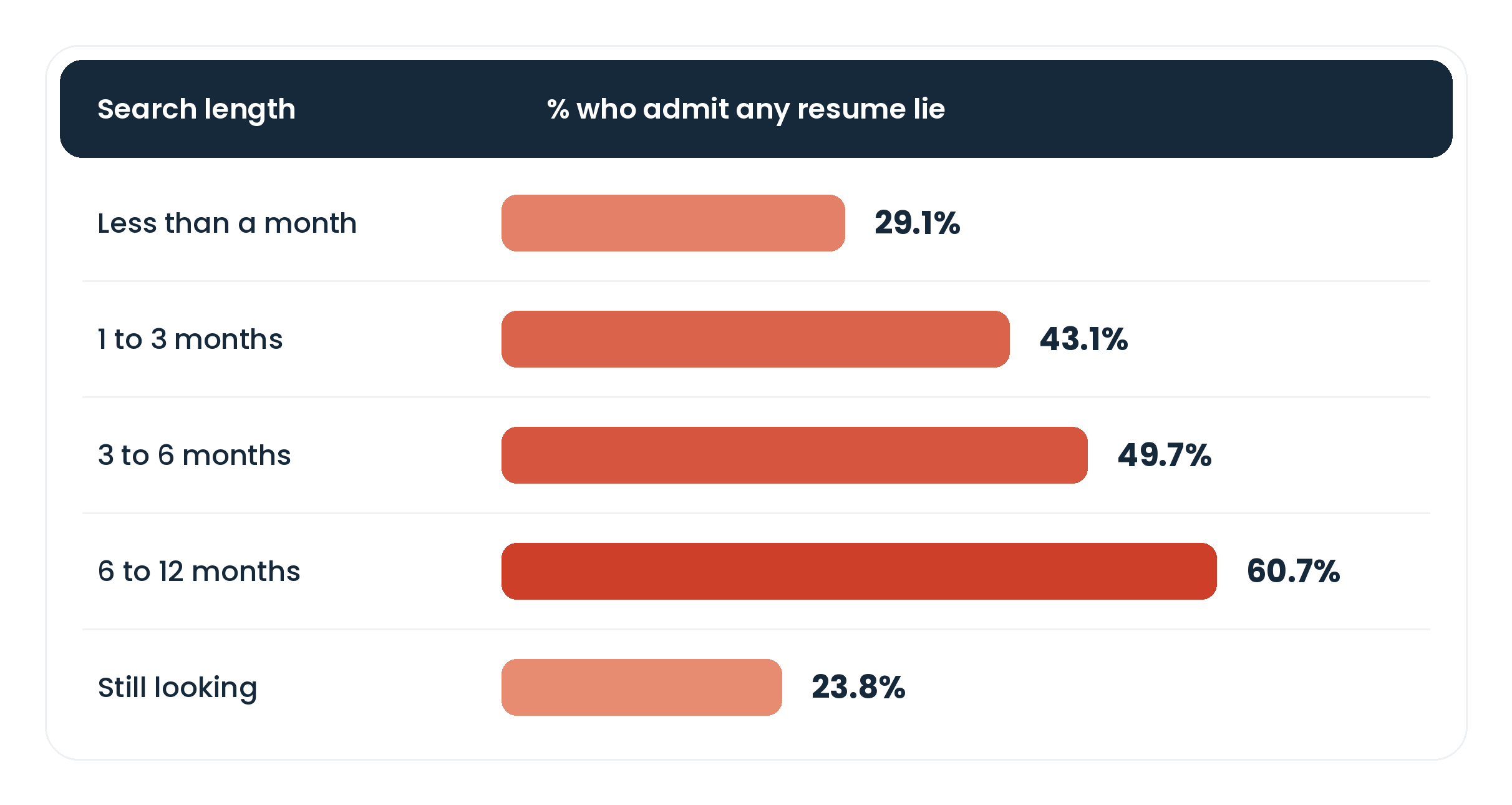
Workers in 6-to-12-month searches admit to lying on their resumes at more than 2x the rate of workers who landed offers in under a month. The mid-search drift toward embellishment is one of the cleanest patterns in the data. Workers who are still actively looking show the lowest lie rate (23.8%), which fits a story in which most embellishment is added in response to a stalling search rather than being there from day one.
How the Resume Was Made Predicts Honesty
- Worked with a professional resume writer: 51.4% admit a lie
- Used a resume builder (Novoresume, Zety): 49.3%
- Used AI to generate it: 54.9%
- Used a Word, Google Docs, or Canva template: 33.1%
- Asked a friend or family member: 31.0%
The cleanest interpretation: workers who outsource the writing (to AI, software, or a professional) are far more likely to have something inaccurate end up on the page.
There's also a small income gradient: lower-income workers admit lies at higher rates (43.3% under $25k vs 31.5% in the $75k-$100k bracket), though AI use is roughly even across income brackets.
When You Get Caught
The most consequential question in the survey asked whether an employer, recruiter, or interviewer had ever questioned or confronted the respondent about something inaccurate on their resume.
15.8% of all Americans say they've been confronted at some point. And 3.1% of all Americans (roughly 6.4 million workers aged 18 to 64) say a resume lie has cost them a job.
Among workers who admit to any resume lie, 37.5% have been confronted by an employer or recruiter about it, and 8.0% have lost a job as a result.
The AI gradient on getting caught is even steeper than the gradient on lying itself.
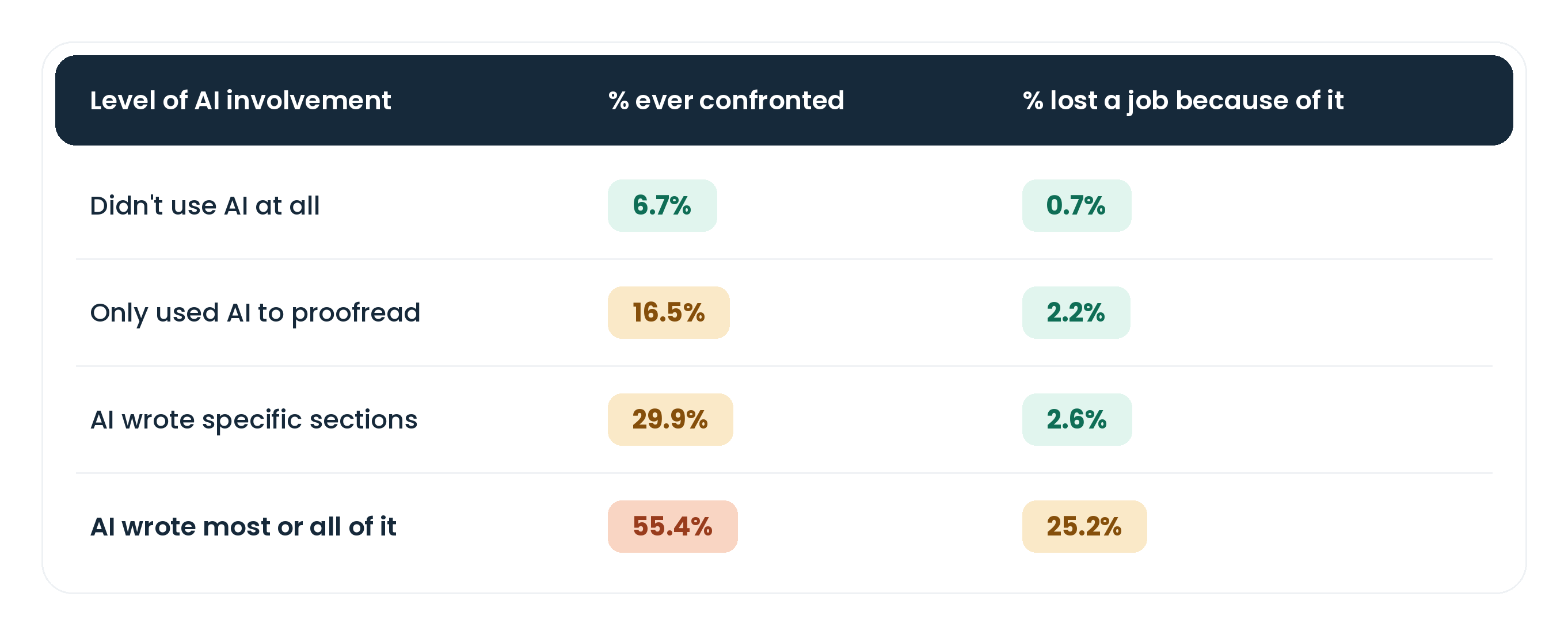
1 in 4 workers who let AI write most or all of their resume have lost a job over something on it, a rate ~37x higher than workers who didn't use AI at all.
The same compounding shows up for workers who submit entirely AI-written resumes. Workers who submit AI resumes regularly: 24.7% have lost a job over a confrontation, vs 0.5% of workers who have never submitted an AI-only resume.
Bot users tell the same story: 11.9% of workers who have ever used an auto-apply bot say they've lost a job because of a resume issue, vs 0.4% of non-bot users. Among the 50.6% of bot users who have been confronted, the most common scenarios involve either fabricated credentials surfacing during background checks or claimed skills falling apart in technical interviews.
The gender gap in getting caught mirrors the gender gap in lying. Men are 2x as likely as women to have been confronted about a resume lie (20.6% vs 11.2%), and nearly 3x as likely to have lost a job over one (4.6% vs 1.6%).
The Photo Question
- 79.2% of resumes have no photo
- 10.2% include a real professional headshot
- 8.8% include a real casual or selfie-style photo
- 1.8% include an AI-generated headshot
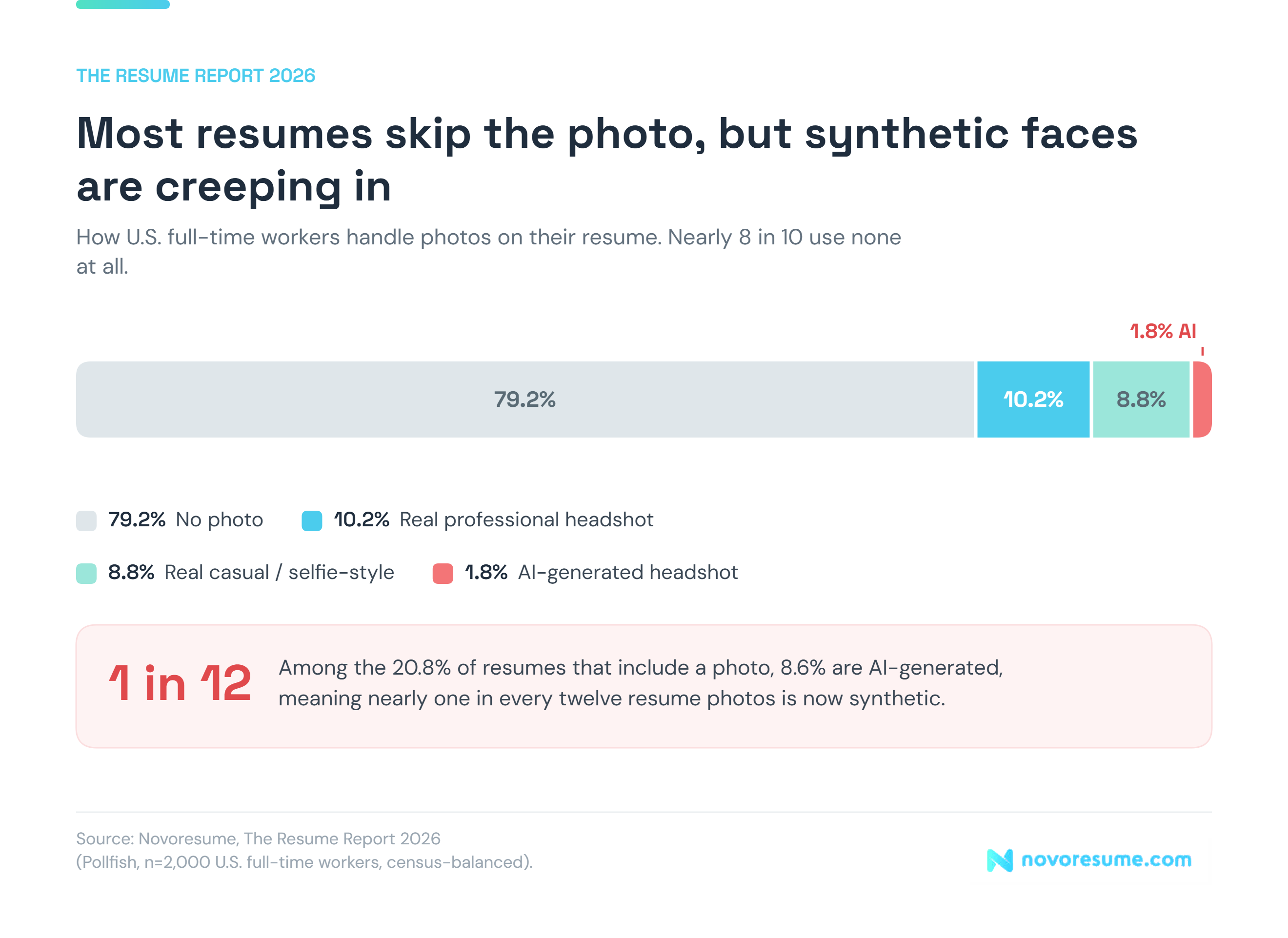
Among the 20.8% of resumes that do have a photo, 49.2% are real professional headshots, 42.2% are real casual or selfie-style photos, and 8.6% are AI-generated. That last number means nearly 1 in every 12 resume photos in America is now a synthetic image.
The AI-generated headshot is most common among Gen Z (3.8% of resumes) and Millennials (1.5%). Men are more likely than women to include any photo (25.6% vs 16.1%), and almost twice as likely to use a professional headshot specifically (13.6% vs 7.0%).
Workers who include a photo on their resume also admit to lying on it at much higher rates: 28.3% of no-photo resume owners admit a lie, versus 66.0% of those with a real professional headshot, 76.3% of those with a casual photo, and 83.3% of those with an AI-generated headshot. The AI-headshot subgroup is small (n ≈ 36 weighted), but the pattern across all photo categories is consistent: photos and resume embellishment travel together.
Demographic Notes
The full survey of 2,000 U.S. adults was weighted to be representative of the U.S. population by age and gender. After weighting, the sample is 50.7% female and 49.3% male, with a median age of 40. The generational breakdown is 22.9% Gen Z (18-27), 33.3% Millennials (28-43), 33.7% Gen X (44-59), and 10.1% Boomers (60-64).
By household income: 22.3% earn under $25,000, 19.8% earn $25k to $50k, 19.2% earn $50k to $75k, 11.1% earn $75k to $100k, 19.7% earn $100k to $200k, and 5.1% earn $200,000 or more.
By education: 25.1% are high school graduates, 17.9% have completed some college, 8.6% have an Associate's degree, 24.7% have a Bachelor's degree, 10.2% have a Master's, and 1.8% have a Doctorate or PhD.
By region: 40.8% live in the South, 21.5% in the Northeast, 20.9% in the Midwest, and 11.3% in the West.
Methodology
Novoresume surveyed 2,000 U.S. adults aged 18 to 64 in May 2026, using Pollfish as the survey platform. Responses were weighted to be representative of the U.S. population by age and gender. The margin of error is approximately ±2.2 percentage points at the 95% confidence level for the full sample. Generational subgroups range from n=180 (Gen Z) to n=878 (Gen X), giving margins of error from approximately ±3.3 points (Gen X, Millennial) to ±7.3 points (Gen Z). Smaller subgroups, such as workers with AI-generated headshots (n ≈ 27 unweighted), carry wider margins of error and should be interpreted as directional.
All percentages reported are weighted. Averages of applications and interview invitations throughout this article exclude the top-most open-ended buckets ("More than 250 applications" and "More than 15 interview invites") to avoid distortion from unbounded, heavy-tailed responses. Questions about resume lying (Q13) and confrontation (Q14) were administered with explicit assurances of anonymity to minimize social desirability bias, though some underreporting of sensitive items should still be assumed.
 Add Novorésumé as a preferred source on Google
Get more resume writing tips, career insights, and job search advice in your personalized Google search results.
Related posts
Resume & CV Writing Tips
Technical skills for your resume across 17 fields, from Epic and CAD to GA4 and Python, with a copyable skills-block format and honest skill tiers.

Resume & CV Writing Tips
40+ resume objective examples for students, career changers, and 22 situations, with the 3-part formula and HR survey data on when objectives actually help.
Resume & CV Writing Tips
Resume summary examples across 26 fields, every one quantified, plus the 4-part formula, the no-experience version, and what recruiters scan first.