Updated on August 3, 2026
Cover Letter Statistics 2026: 90+ Fresh Stats
Cover letter statistics from our July 2026 survey of 1,000 US job seekers. How many use AI, skip applications, tailor every letter, and what HR really reads.


Novoresume got people hired at
























Most published cover letter statistics predate ChatGPT. Job seekers still face the same questions with every application: does anyone read this, is AI safe to use, and can I skip it?
So we ran our own study. In July 2026, we surveyed 1,000 US job seekers about how they really handle cover letters.
This page leads with that data, supported by our own HR survey and research from Harvard Business Review, Insight Global, and ZipRecruiter.
About our study: 1,000 US job seekers aged 18 to 64 were surveyed by Novorésumé via Pollfish in July 2026. Every respondent applied for a job or wrote a cover letter within the past two years. Unless another source is named, every statistic on this page comes from this survey. Full methodology at the end of the article.
The Most Important Cover Letter Statistics
If you only have a minute, these are the numbers that matter:
- 47.3% of job seekers have skipped applying to at least one job because it required a cover letter.
- Job seekers are split down the middle on whether cover letters should exist: 42.6% want them scrapped, 41.4% say they're still useful, and 16% have no strong opinion.
- 49% of job seekers dislike or outright hate writing cover letters. Only 13.6% enjoy it.
- Just 20.8% of job seekers believe hiring managers read most cover letters. In reality, about 60% of HR professionals say they read them.
- 46.8% of job seekers used AI to some extent in their last cover letter. 53.2% wrote it entirely on their own.
- 32.4% have submitted a cover letter written almost entirely by AI, with little or no editing, at least once.
- 13.4% believe an AI-assisted cover letter helped them land a real job. Another 23.7% think it might have.
- 73.4% of job seekers tailor their cover letters in some way. Only 10.6% send the same letter to every job.
- 16% of job seekers don't write cover letters at all.
- Only 11.1% say the cover letter is the part of applying they dread most. The interview leads at 33.1%.
- 57.2% say a cover letter definitely or maybe changed whether they got a job.
- A majority of Gen Z job seekers (55.6%) have skipped a job because of a cover letter requirement, compared with 38.6% of Gen X.
- 88% of hiring managers claim they can tell when candidates use AI in their application materials, according to Insight Global.
How Do Job Seekers Really Feel About Cover Letters?
Cover letters have a reputation as the most hated part of the job hunt. Our data says the resentment is real, but it's not universal:
- 13.6% of job seekers enjoy writing cover letters.
- 37.4% don't mind it.
- 34% dislike it.
- 15% hate it.
What Part of Applying for a Job Do People Dread the Most?
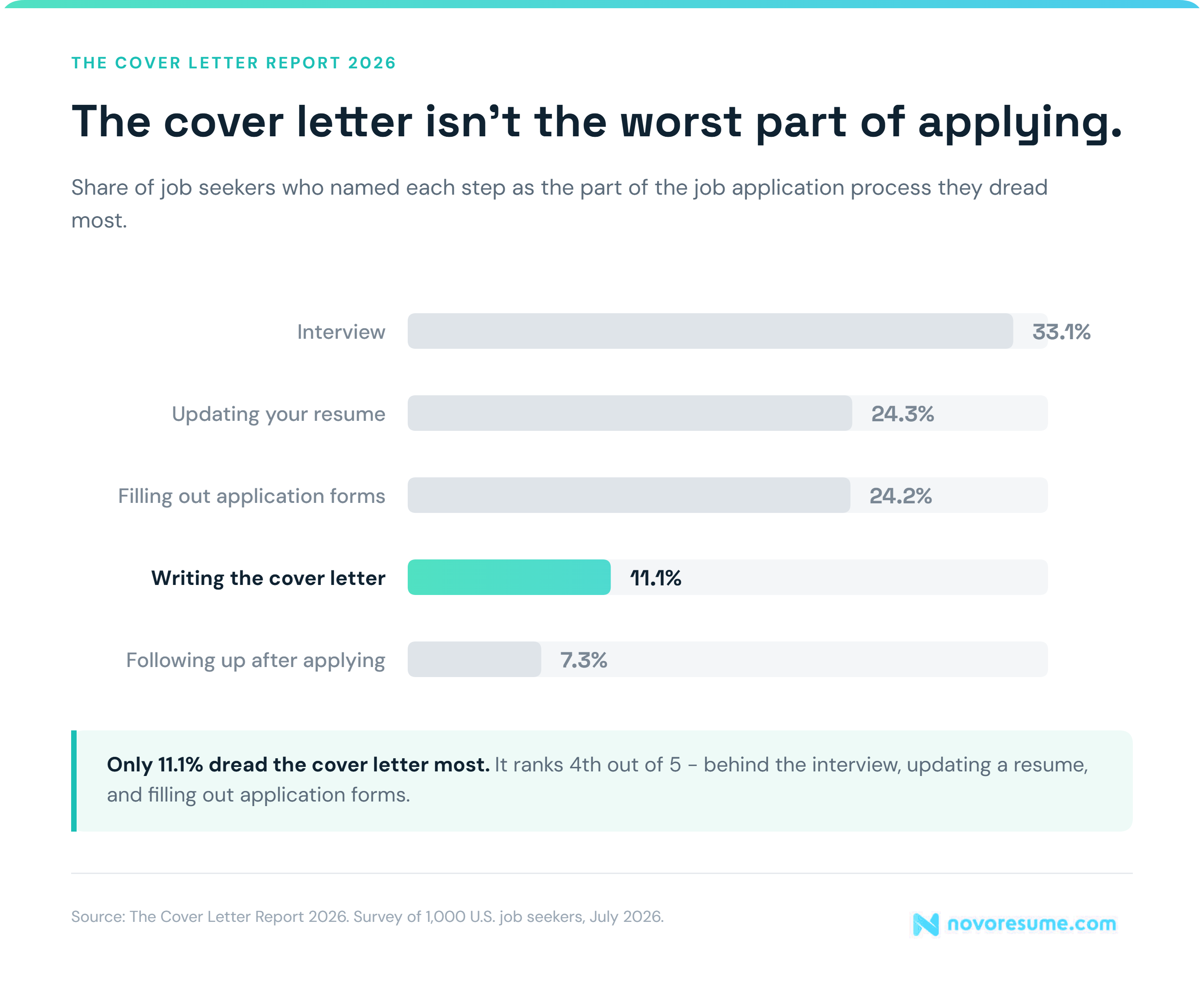
Here's the twist nobody expects. When we asked job seekers which part of the application process they dread most, the cover letter came in second to last:
- The interview: 33.1%
- Updating your resume: 24.3%
- Filling out application forms: 24.2%
- Writing the cover letter: 11.1%
- Following up after applying: 7.3%
For all the online complaining, only about 1 in 9 job seekers name the cover letter as their biggest pain point. Application forms, the step that often just re-enters your resume field by field, cause more dread than the letter itself.
Nearly Half of Job Seekers Have Skipped a Job Over a Cover Letter
We asked job seekers if they've ever decided not to apply for a job because it required a cover letter:
- 52.7% have never skipped a job over a cover letter.
- 26.4% have done it a few times.
- 11.9% do it often.
- 9% have done it once.
Add it up, and 47.3% of job seekers have walked away from at least one job because of a cover letter requirement. For candidates, there's a flip side: every requirement that thins the field means less competition for the people who do apply. If you're unsure whether a listing genuinely expects one, our guide on whether you need a cover letter breaks it down by situation.
Should Cover Letters Still Be Required?
We put the existential question to job seekers directly: should cover letters still be required when applying for jobs?
- 42.6% say no, they're outdated and should be scrapped.
- 41.4% say yes, they're still useful.
- 16% have no strong opinion.
A 1.2-point gap. After years of "cover letters are dead" articles, almost as many job seekers defend them as want them gone.
Part of the reason may be personal experience. When we asked whether a cover letter ever actually changed whether they got a job:
- 21.2% say yes, definitely.
- 36% say maybe.
- 30.9% say it made no difference.
- 11.9% aren't sure.
That's 57.2% of job seekers who believe a cover letter definitely or possibly changed their hiring outcome. Harvard Business Review reached a similar conclusion from the employer side: even as fewer companies formally require cover letters, a well-written letter still sets candidates apart, especially when experience alone doesn't tell your story.
Do Hiring Managers Actually Read Cover Letters?
Job seekers are deeply skeptical that anyone reads their cover letters. We asked how many hiring managers they think actually read them:
- 20.8% believe most hiring managers read them.
- 45% think some do.
- 24.6% believe few or none do.
- 9.6% have no idea.
Now compare that to what the hiring side told us. In our Hiring Landscape survey of 200+ HR professionals:
- About 60% of HR professionals read cover letters: 39.6% read them after the resume, and 21.3% read them first.
- 39.4% don't read them at all.
- HR managers are the most reliable readers. Only 22.9% skip cover letters, and 33.3% read the letter before the resume.
- Recruiters are the least likely to read them, with 52.8% skipping them entirely.
The gap is the story: job seekers think the read rate is a fifth. It's actually three-fifths. The nuance is who's reading. If your application goes to an in-house HR manager, your letter will probably be read, possibly first. If it goes to an agency recruiter, it's a coin flip at best.
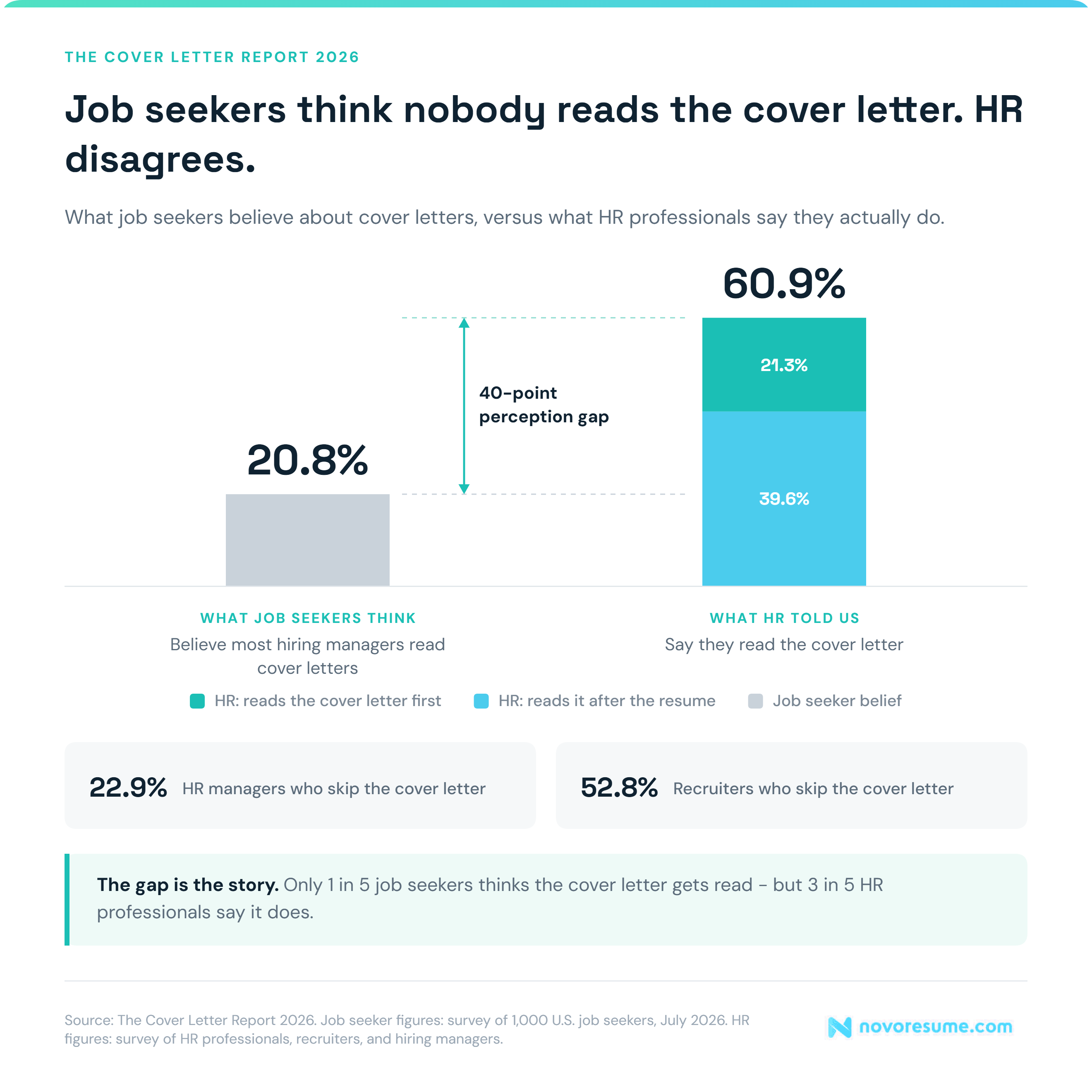
Job seekers systematically underrate the read rate. Only a fifth of candidates think hiring managers read most cover letters, but about 60% of the HR professionals we surveyed read them, and a third of HR managers read the letter before they ever open your resume. That mismatch is an opportunity. Much of your competition is either skipping the letter or phoning it in because they believe nobody looks. A tailored half-page letter is the cheapest tiebreaker left in the application process.
How Do Job Seekers Tailor Their Cover Letters?
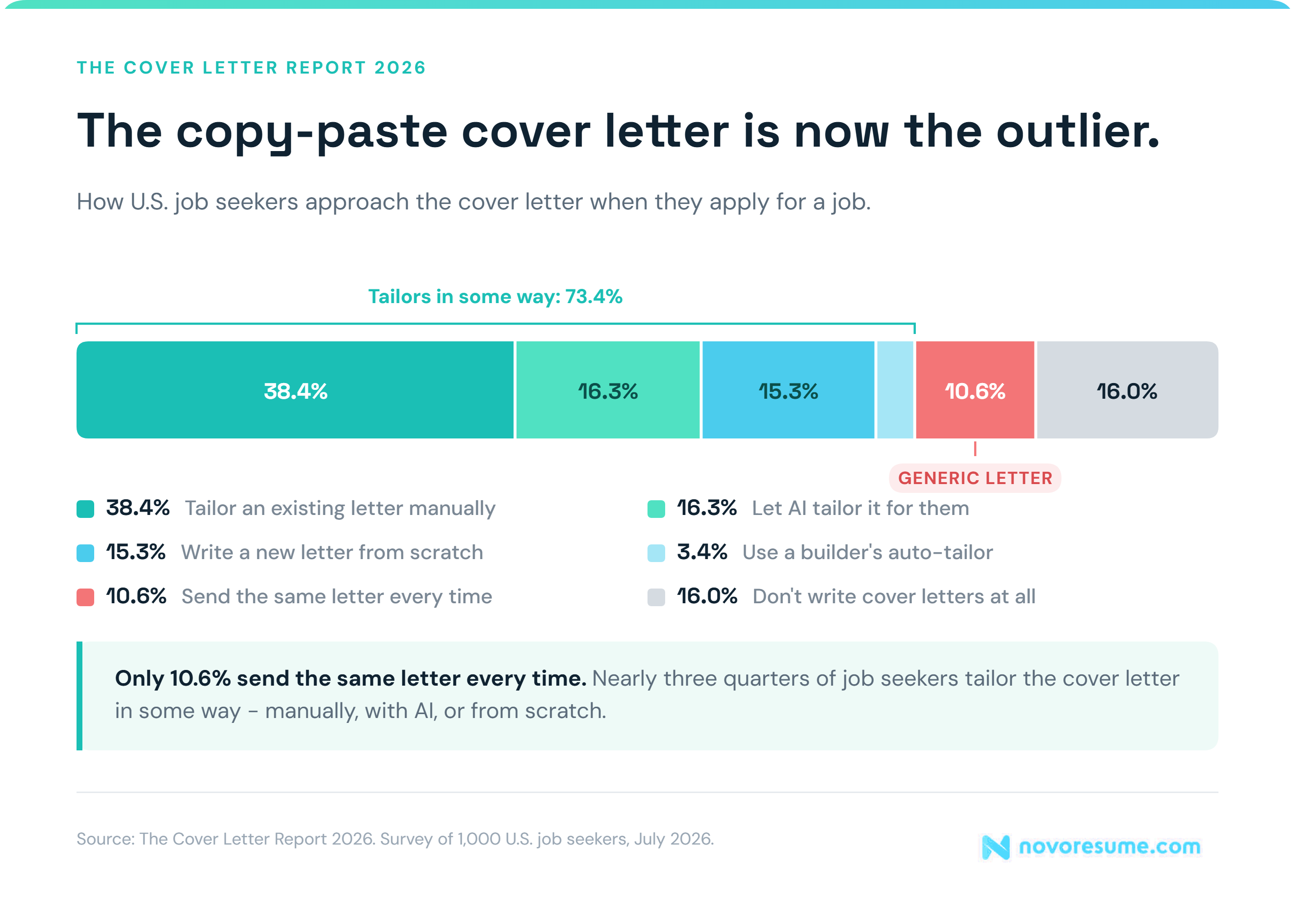
Tailoring is where good intentions meet deadline reality. Here's how job seekers say they actually handle it:
- 38.4% tailor an existing letter manually for each job.
- 16.3% use AI to tailor it.
- 15.3% write a new letter from scratch for every application.
- 10.6% send the same cover letter to every job.
- 3.4% use a builder's auto-tailor feature.
- 16% don't write cover letters at all.
Among people who write cover letters, the overwhelming majority customize: 73.4% of all job seekers tailor in some way, whether by hand, with AI, or from scratch. The truly generic, copy-paste-everywhere letter is now a minority behavior at 10.6%.
That matters because generic letters are exactly what gets flagged. If you need a starting point that's faster than a blank page but still specific to the role, work from real cover letter examples in your field rather than a one-size-fits-all template text.
AI and Cover Letter Statistics
AI has changed cover letters more in three years than in the previous thirty. Here's where things actually stand.
How Many Job Seekers Use AI to Write Cover Letters?
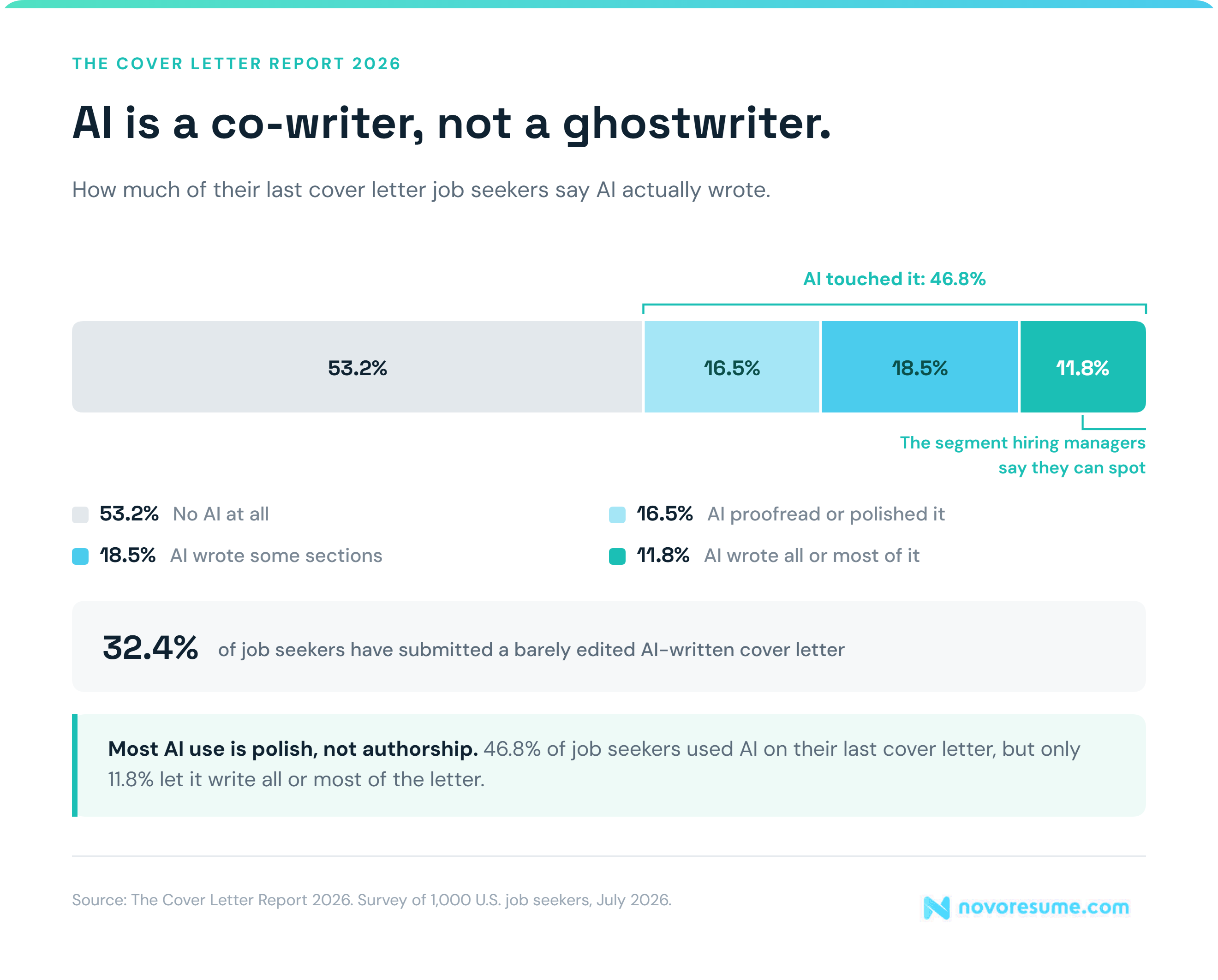
We asked job seekers how much of their last cover letter AI wrote:
- 53.2% didn't use AI at all.
- 18.5% had AI write some sections.
- 16.5% used AI only for proofreading or polishing.
- 11.8% had AI write all or most of it.
In other words, 46.8% of job seekers had AI involved in their most recent cover letter, and for 30.3%, AI did some or all of the actual writing. External data points in the same direction: ZipRecruiter's Survey of New Hires found that among recently hired workers who used generative AI in their search, 21% used it to draft a cover letter.
How Many People Submit AI Cover Letters Without Editing Them?
Using AI for a draft is one thing. Sending its output untouched is another. We asked if job seekers have ever submitted a cover letter written almost entirely by AI, with little or no editing:
- 67.6% never have.
- 14.7% have done it a few times.
- 10% do it regularly.
- 7.7% have done it once.
So 32.4% of job seekers have shipped a nearly pure AI letter at least once, and 1 in 10 does it as a habit.
Can Hiring Managers Tell When AI Wrote Your Cover Letter?
They certainly believe they can. In Insight Global's 2025 AI in Hiring survey of 1,005 hiring managers, 88% said they can tell when candidates use AI in their applications, cover letters, or resumes.
Whether they care is less clear-cut. In the same survey, 54% of hiring managers said they would care if a candidate used AI. Among those who do care, the reactions cut both ways:
- 36% read it as a positive signal of AI and technology skills.
- 24% see it as the candidate not putting in the effort.
- 23% view it as keyword optimization for applicant tracking systems.
- 17% say it feels impersonal.
The takeaway: AI use itself isn't the dealbreaker. Obvious, unedited AI text is, because it lands in the "no effort" bucket alongside classic cover letter mistakes like typos and wrong company names.
Do AI Cover Letters Actually Get People Hired?
The most surprising number in our survey: we asked job seekers if they believe they've landed a job, current or past, at least partly thanks to a cover letter AI helped them write.
- 13.4% say yes.
- 23.7% say maybe.
- 28.6% say no.
- 34.3% haven't used AI for cover letters.
More than 1 in 8 job seekers now credit an AI-assisted cover letter with a real job, and over a third (37.1%) think it might at least have helped. Among people who have actually used AI for cover letters, the believers outnumber the skeptics.
Use AI for the first draft, never the final one. One in ten candidates now submits AI cover letters with no editing, and that's exactly the text hiring managers say they can spot: fluent, generic, and interchangeable. Keep the structure AI gives you, then replace every generic claim with something only you can say, a named project, a number, a reason you want this company specifically. Our survey shows AI-assisted letters are landing people jobs. The edit is what keeps yours from sounding like everyone else's
Cover Letter Statistics by Generation and Demographics
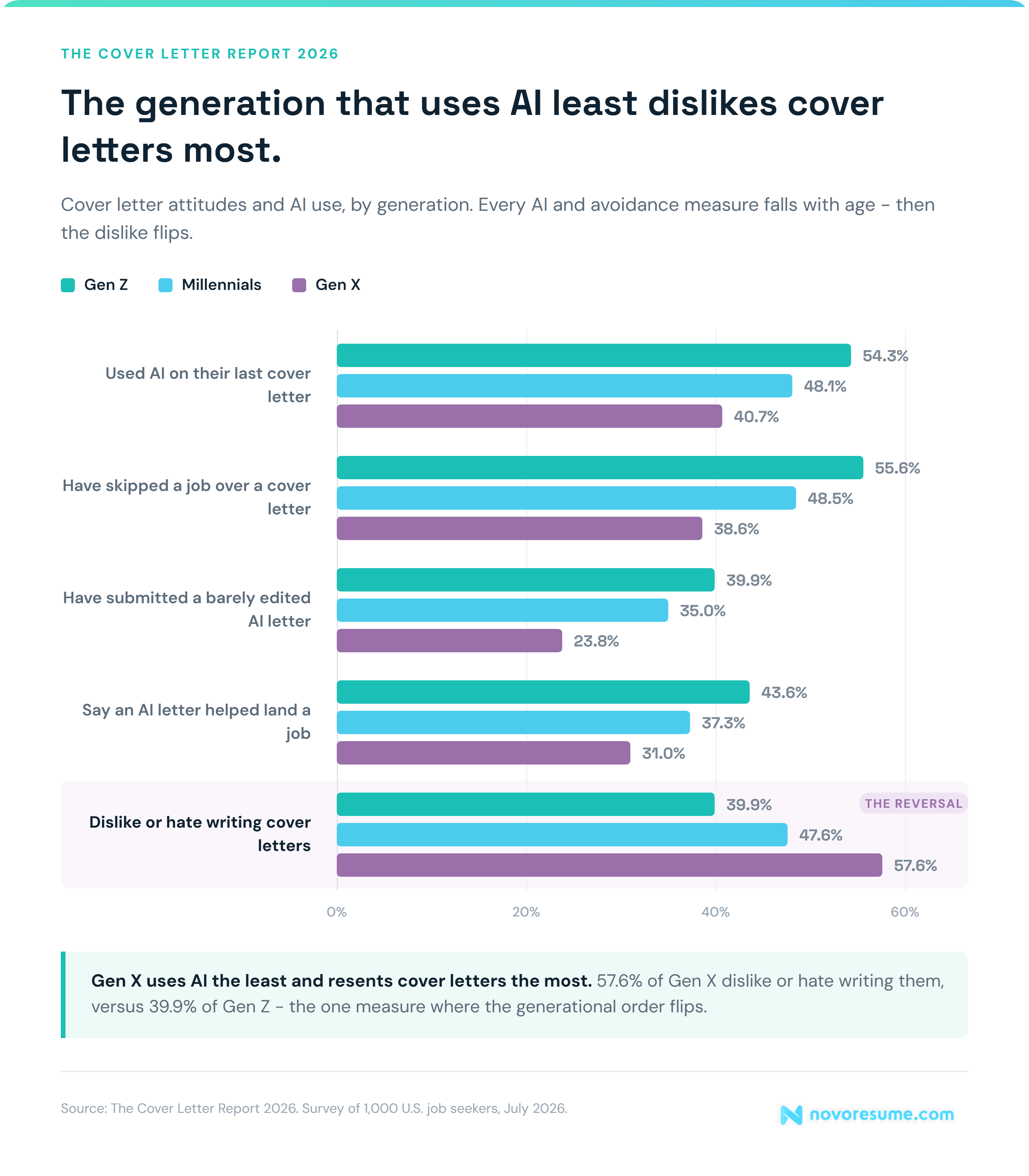
Because we collected full demographics, we can show who is actually driving these trends. The generational cuts below use survey-time ages: Gen Z (18 to 29, n=243), Millennials (30 to 45, n=437), and Gen X (46 to 61, n=290).
Cover Letter Statistics by Generation and Demographics
-
Used AI on their last cover letter
Have submitted a barely edited AI letter
Have skipped a job over a cover letter
Dislike or hate writing cover letters
Say an AI letter helped land a job (yes or maybe)
Gen Z
54.3%
39.9%
55.6%
39.9%
43.6%
Millenials
48.1%
35%
48.5%
47.6%
37.3%
Gen X
40.7%
23.8%
38.6%
57.6%
31%
A few patterns stand out:
- AI adoption is a clean generational gradient. 54.3% of Gen Z used AI on their last cover letter, versus 48.1% of Millennials and 40.7% of Gen X. Gen Z is also more than twice as likely as Gen X to have had AI write all or most of their last letter (17.7% vs 8.3%).
- A majority of Gen Z have skipped a job because of a cover letter. 55.6% have walked away from at least one application, compared to 38.6% of Gen X.
- Older job seekers hate cover letters more and write them less. 57.6% of Gen X dislikes or hate writing them, versus 39.9% of Gen Z. And 21% of Gen X don't write cover letters at all, nearly double Gen Z's 11.5%.
- Belief in cover letters is highest among the young. 65% of Gen Z say a cover letter definitely or maybe changed a hiring outcome for them, dropping to 51.7% among Gen X. 18.5% of Gen Z credits an AI-assisted letter for a real job, more than double Gen X's 8.3%.
- Skepticism about readership is universal. Roughly the same share across generations, 20 to 22%, believe hiring managers read most cover letters. The generations disagree about everything except this.
Gender shows its own split. Men are more than twice as likely as women to say they enjoy writing cover letters (20.1% vs 8.1%), more likely to have used AI on their last letter (51.1% vs 43.2%), and more likely to have submitted a barely edited AI letter at least once (38.2% vs 27.5%).
Employment status may be the most consequential cut. Job seekers who are temporarily unemployed, the group sending the most applications under the most pressure, are the least equipped: only 30.3% used AI on their last cover letter (versus 53.5% of the employed full-time), 28.6% don't write cover letters at all (versus 12.7%), and 61.3% dislike or hate writing them. The candidates who most need every edge are the ones most likely to skip both the tool and the letter.
What These Statistics Mean for Your Next Application
Reading the data as a job seeker, four moves follow directly from the numbers:
- Write the letter, especially when it's optional. 47.3% of your competition have skipped the cover letter requirement, and 16% never write one. About 60% of HR professionals read them. The math favors the people who show up with one.
- Tailor it, but don't start from zero. 73.4% of applicants customize in some way, so a generic letter now stands out for the wrong reasons. Tweaking a strong base letter per job is the norm, and it's enough.
- Let AI draft, never send unedited. 88% of hiring managers claim they can spot AI-generated text, and among the 54% who care, a quarter read unedited output as low-effort. Edit your specifics before sending.
- Keep it short. Attention is a scarce resource. Half a page of specific, tailored content beats a full page of filler. Our guide on how long a cover letter should be has the exact benchmarks.
If the writing itself is what makes you one of the 47.3%, that's a solvable problem. Follow our step-by-step guide on how to write a cover letter, and the whole thing takes about 15 minutes. Or skip the blank page entirely: our Cover Letter Builder gives you a professional, matching-design letter with guided content for every section, so "requires a cover letter" stops costing you applications.
Methodology
The Novorésumé Cover Letter Survey was fielded through the Pollfish survey platform in two waves, on July 2 and July 9, 2026, reaching a combined 1,000 US respondents aged 18 to 64. All respondents were screened for recent job-search activity: wave one (n=100) had written a cover letter within the past two years, and wave two (n=900) had applied for a job within the past two years. Over half of wave two (54.2%) had applied within the past three months.
All questions were single-select. Results are reported unweighted, and percentages may not sum to exactly 100 due to rounding. Generational figures use survey-time age bands: Gen Z 18 to 29 (n=243), Millennials 30 to 45 (n=437), Gen X 46 to 61 (n=290). Respondents aged 62 and older (n=30) are included in overall figures but excluded from generational comparisons due to sample size. Employer-side figures come from our separate Hiring Landscape survey of 200+ HR professionals, linked above.
FAQ about Cover Letters
Sources
- Novorésumé Cover Letter Survey 2026. Survey of 1,000 US job seekers aged 18 to 64, fielded via Pollfish in July 2026. Original data, this page.
- Novorésumé, The Hiring Landscape 2025. Original survey of 200+ HR professionals, including HR managers, talent acquisition specialists, and recruiters.
- Insight Global, 2025 AI in Hiring Survey Report. Survey of 1,005 US hiring managers, conducted with Atomik Research, October 2024.
- ZipRecruiter Economic Research, Survey of New Hires. Quarterly survey of 1,500+ recently hired US workers, Q1 2024.
- Harvard Business Review, Cover Letters Still Matter, Even If They're Not Required, March 2025.
 Add Novorésumé as a preferred source on Google
Get more resume writing tips, career insights, and job search advice in your personalized Google search results.
Related posts

Cover Letter Writing Tips
How to address a cover letter with or without a name, plus 26 salutation examples, what to avoid, and how to handle multiple recipients or a large company.

Cover Letter Writing Tips
Do I need a cover letter in 2026 or are cover letters a thing of the past already? Read our article to find out when you need a cover letter!
Cover Letter Writing Tips
Learn how to write a job-winning cover letter in this detailed article! Check out our guide and cover letter examples for different professions.