Updated on April 2, 2026
100+ Statistics on AI Replacing Jobs: Key Data and Trends
Explore the latest statistics on AI replacing jobs across industries and roles. See what the data means for your career and the labor market.


Novoresume got people hired at
























AI is changing the way people find, perform, and lose their jobs, and the numbers behind that shift are staggering.
Forecasts range from a net gain of 78 million jobs by 2030 to 300 million roles worldwide exposed to automation. Meanwhile, AI-driven layoffs in the US remain modest, and workers with AI skills earn up to 56% more than those without them.
For job seekers, employers, and policymakers, making sense of those numbers is the hard part. Here are 100+ AI and employment statistics and trends shaping 2026.
Let’s dive in!
11 Key AI and Employment Statistics
AI's effect on employment is one of the defining economic questions of the decade. The data point to mass unemployment, rapid disruption, new roles, and growing inequality between those who adapt and those who don't.
Here are the statistics that define the big picture:
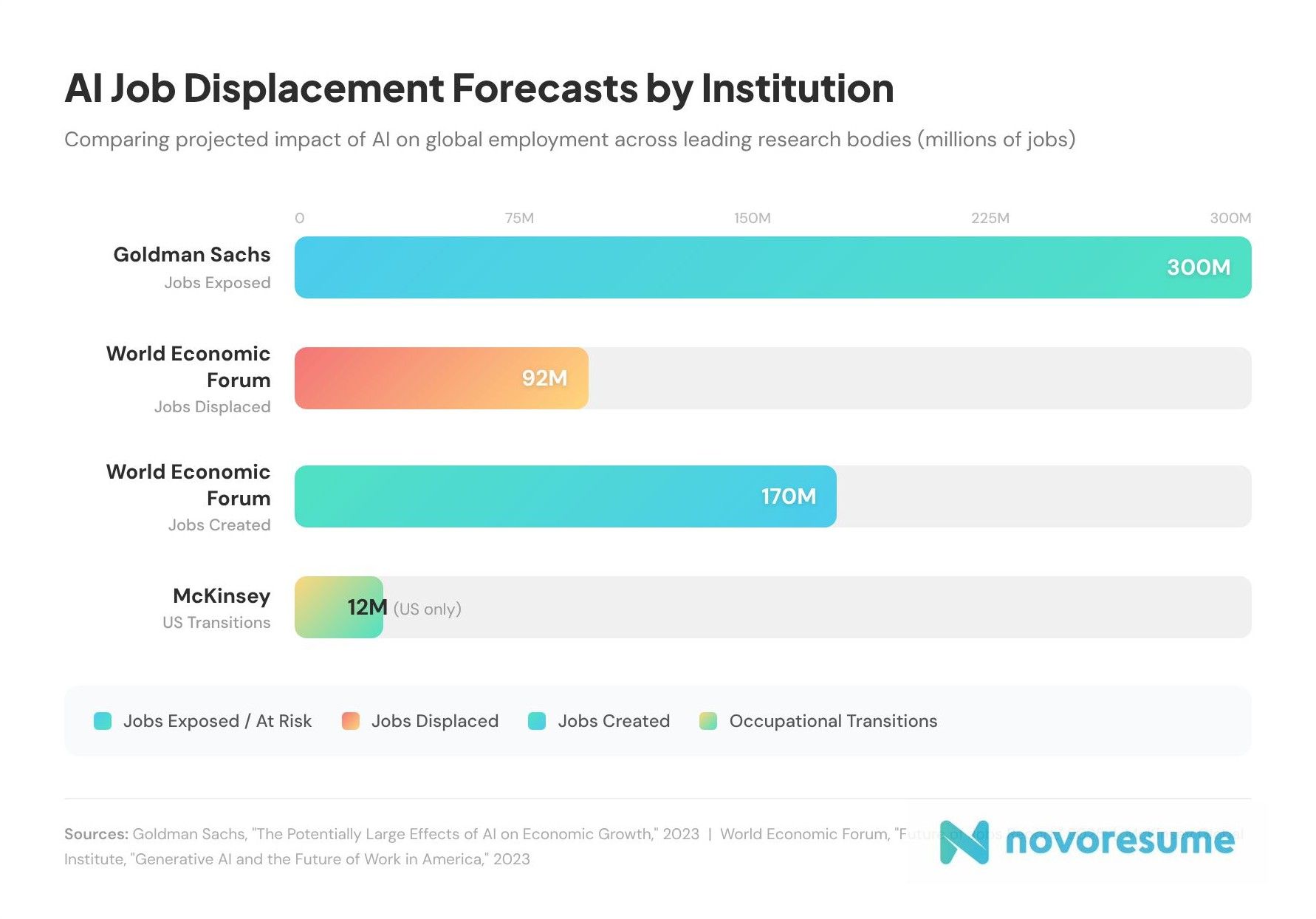
- AI could displace 92 million jobs globally by 2030, but it could also create 170 million new ones, a net gain of 78 million jobs.
- 300 million full-time jobs worldwide are at risk of automation from generative AI.
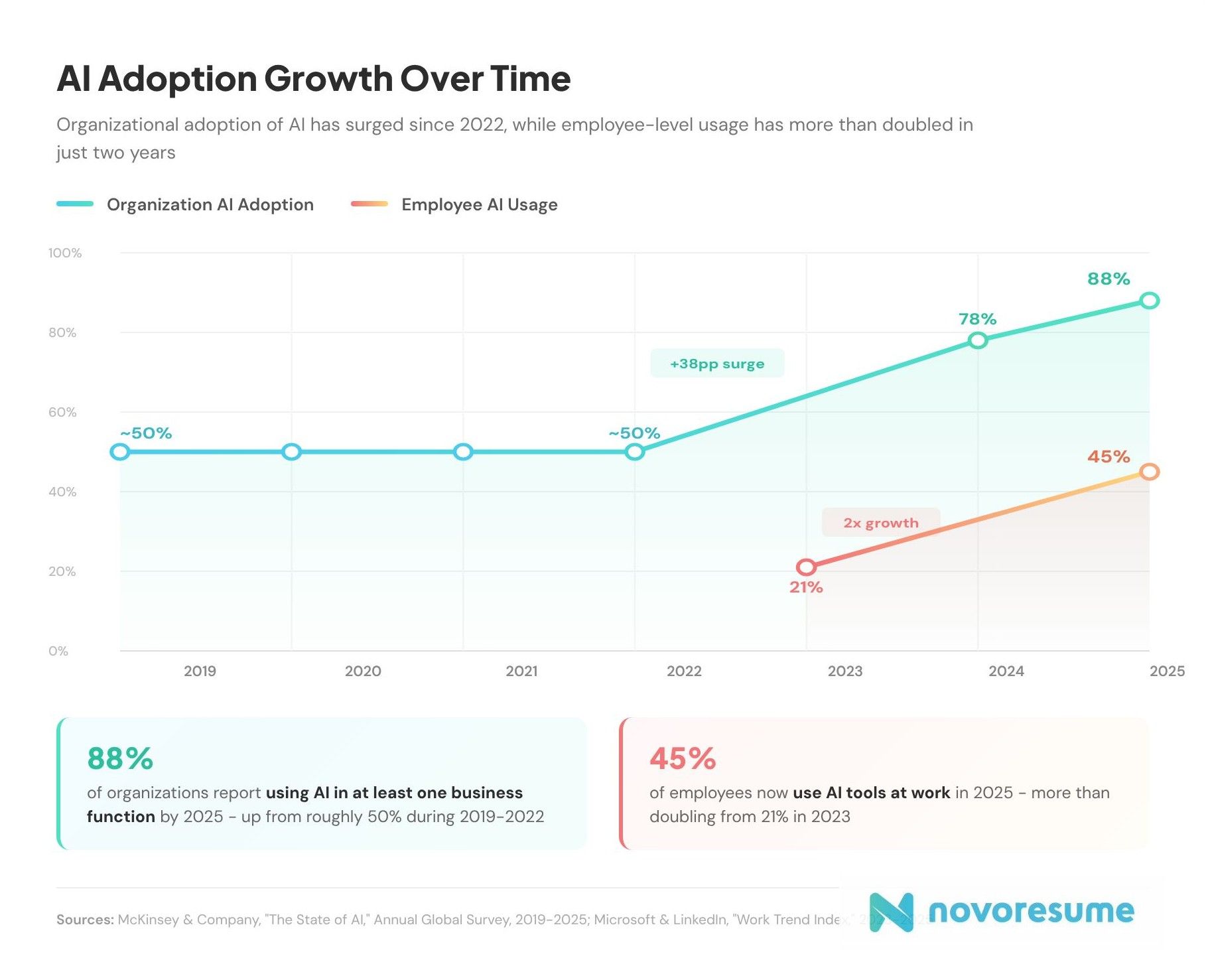
- 88% of organizations now use AI in at least one business function.
- 46% of US workers aged 18 and older reported using AI at work by mid-2025.
- 40% of global employment is exposed to AI, with ~60% exposure in advanced economies and ~26% in low-income countries.
- 52% of workers are worried about AI's impact on the workplace.
- Workers with AI skills now command a 56% wage premium over peers in identical roles without those skills. That's up from 25% the previous year, more than doubling in just 12 months.
- 41% of employers worldwide plan to reduce their workforce over the next five years due to AI.
- Only 5% of organizations provide AI training at scale, even though 94% of workers say they're ready to learn generative AI skills.
- One-third of all US jobs created in the last 25 years didn't exist before, showing how quickly the labor market reinvents itself.
13 AI Job Displacement Forecasts
The fear that AI will take modern jobs is widespread, and the major institutions tracking AI's impact on employment agree that the disruption will be massive. But they disagree sharply on the scale, timeline, and net outcome.
These projections from Goldman Sachs, McKinsey, the World Economic Forum, and the IMF give you the full picture:
- Goldman Sachs estimates that two-thirds of US occupations are exposed to some degree of AI, and that 25% of all US work tasks are automatable.
- Their analysis projects that 7% of US jobs could be fully replaced by AI, 63% could be complemented by AI, and 30% would remain unaffected.
- A 2025 Goldman update moderated that view: current adoption levels put only 2.5% of US employment at immediate risk of displacement.
- McKinsey found that 60-70% of employees' work time could be automated - up from a prior estimate of roughly 50%.
- Without generative AI, automation could handle 21.5% of US work hours by 2030. With it, that figure rises to 30%.
- McKinsey projects an additional 12 million occupational transitions in the US by 2030.
- The World Economic Forum's 2025 report projects that 170 million new jobs will be created and 92 million displaced by 2030. That's a sharp reversal from the WEF's 2023 edition, which forecast a net loss of 14 million jobs by 2027.
- 86% of employers surveyed by the WEF expect AI to transform their business by 2030.
- The IMF estimates ~60% of jobs in advanced economies are exposed to AI, compared to ~26% in low-income countries. Of the jobs exposed in advanced economies, roughly half may benefit from AI integration, while the other half face a genuine risk of displacement.
- 14% of employees globally are expected to be forced to change careers due to AI by 2030.
- The US alone is projected to have 30% of its jobs automated by 2030.
12 Documented AI Job Losses
Despite the alarming forecasts, confirmed AI-driven layoffs remain far smaller than projected. Most companies are reducing their workforce in anticipation of AI, not in response to proven automation, and some are already reversing course.
Here's what the hard data shows:
- Challenger, Gray & Christmas recorded approximately 4,600 AI-attributed job cuts in 2023, 12,700 in 2024, and 54,836 in 2025. That's a cumulative total of roughly 71,800 AI-driven job losses in the US over three years.
- In context, 2025's AI-attributed layoffs accounted for about 4.5% of the year's total of 1.2 million announced cuts.
- Those 54,836 AI-linked cuts amount to just 0.03% of the 160-million-strong US workforce.
- In the first half of 2025, nearly 55,000 US job cuts were directly attributed to AI.
- Salesforce cut approximately 4,000 customer support positions in 2025, with its CEO stating that headcount fell from 9,000 to 5,000 due to AI agents.
- Amazon eliminated 14,000 corporate roles in October 2025 and another 16,000 in January 2026.
- IBM announced plans to replace roughly 7,800 back-office roles with AI over five years.
- Microsoft cut approximately 15,000 jobs through 2025, with over 40% of those roles targeting software engineers.
- An HBR survey of 1,006 global executives found that while 60% of organizations had reduced headcount in anticipation of AI, only 2% had made large layoffs tied to proven AI implementation.
- 55% of employers that made AI-driven layoffs now regret the decision, and projections suggest half of those workers will be quietly rehired.
- After Klarna cut its workforce from 5,500 to 3,400 and claimed its AI chatbot had replaced 700-800 agents, customer satisfaction declined, prompting the company to reverse course publicly.
10 Industries and Occupations Most Affected by AI
The pattern of AI vulnerability breaks from traditional automation. Where robots and earlier technology hit manufacturing and blue-collar work hardest, generative AI disproportionately targets white-collar, educated, higher-paid workers.
Here's how AI risk breaks down by sector and role:
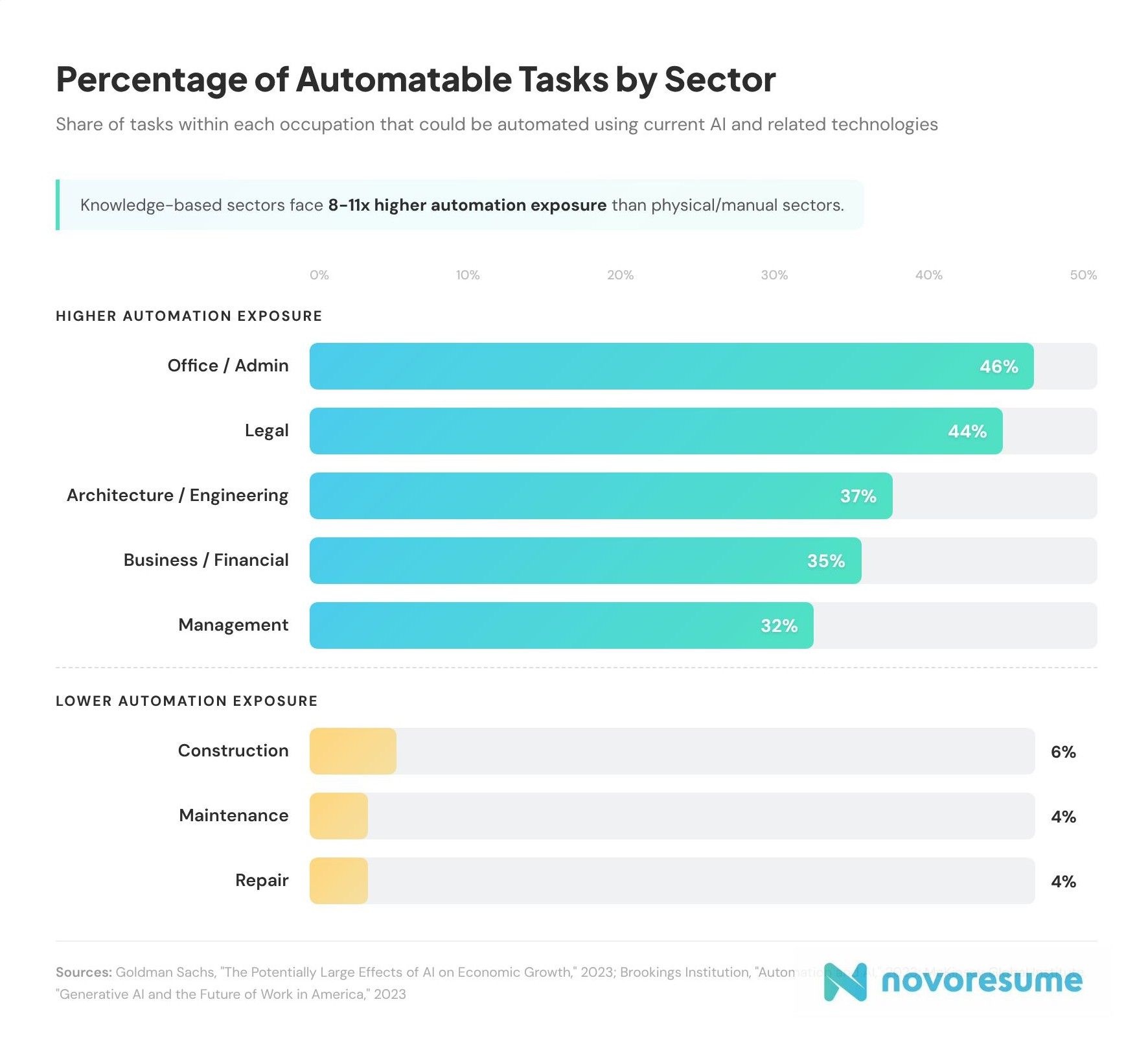
- Office and administrative support roles have the highest share of automatable tasks at 46%.
- Legal occupations follow at 44%, architecture and engineering at 37%, and business and financial operations at 35%.
- The least exposed sectors include construction (6%), building and grounds maintenance (4%), and installation and repair (4%).
- More than 30% of all US workers could see at least half their tasks disrupted by generative AI.
- In banking, 54% of jobs have high automation potential, with loan-processing automation projected to increase from 35% today to 80% by 2030.
- Assembly line employment is expected to decline from 2.1 million to 1.0 million by 2030.
- Oxford Economics predicts that up to 20 million manufacturing jobs could be replaced globally by 2030.
- Workers aged 22-25 in AI-exposed occupations experienced a 13% decline in employment from late 2022 to mid-2025.
- Software developers aged 22-25 experienced a nearly 20% decline in employment from their peak in late 2022.
- The share of software development jobs requiring three years or less experience dropped from 43% to 28% between 2018 and 2024.
9 Statistics on AI's Impact on Entry-Level Employment
Entry-level positions face unique pressure from AI. As companies automate routine tasks once handled by junior employees, the traditional pathway into many careers is narrowing, with younger workers feeling the effects first.
- Entry-level hiring at the 15 largest tech companies fell 25% from 2023 to 2024.
- The share of data analysis roles requiring three years or less experience dropped from 35% to 22% over the same period.
- 39% of business leaders say entry-level roles have already been reduced due to AI-driven efficiency gains.
- 61% of Gen Z workers worry that AI will make it harder for younger generations to enter the workforce by automating entry-level tasks.
- Younger workers are 129% more likely than older workers to worry that AI will make their jobs obsolete.
- By the end of 2026, 20% of organizations are expected to use AI to eliminate more than 50% of middle-management positions.
- Unemployment among 20- to 30-year-olds in tech-exposed occupations has risen by nearly 3 percentage points since early 2025.
- Fully remote workers are 42% more likely to believe AI will disrupt their job.
- By 2028, one in four candidate profiles worldwide is projected to be fake, driving stricter verification requirements.
10 Gender and Demographic Disparities in AI Displacement
AI's impact is not evenly distributed. Women, workers primarily affected by the gender wage gap, and those in administrative roles, face disproportionate risk. It’s a pattern that differs sharply from past waves of automation, which hit male-dominated manufacturing hardest.
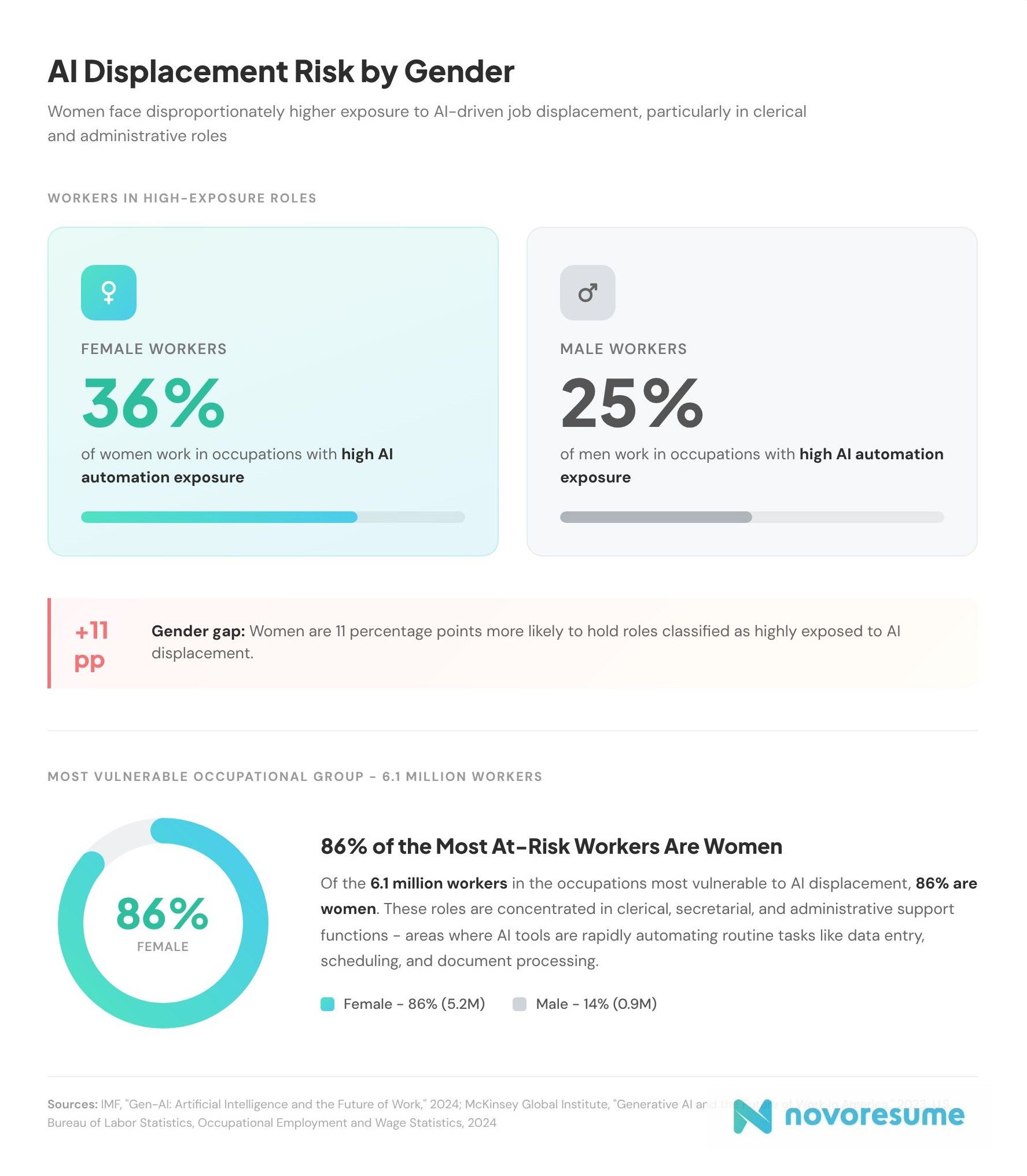
- 36% of female workers are in occupations where AI could save 50% or more of task time, compared with 25% of male workers.
- 37.1 million US workers sit in the top quartile of AI exposure, but 26.5 million of these have strong adaptive capacity.
- The most vulnerable group, 6.1 million workers with both high exposure and low adaptive capacity, is 86% female. These vulnerable workers are concentrated in office clerk, secretary, and administrative assistant roles.
- 5.5% of employment in high-income countries is directly affected by automation, compared with just 0.4% in low-income countries.
- In Latin America, 26-38% of jobs are exposed to generative AI, while only 2-5% are at risk of full automation.
- Clerical work across all economies accounts for nearly a quarter of tasks with high exposure, with more than half at medium exposure.
- Workers in lower-wage jobs are up to 14 times more likely to need to change occupations than those in higher-paying roles.
- Men are more likely than women to receive AI training at work (46% vs. 38%), widening the preparedness gap.
- The IMF's AI Preparedness Index ranked Singapore, the US, and Denmark as the most prepared countries for AI-driven labor shifts.
9 AI Wage Premium and Economic Impact Statistics
The economic projections around AI range from modest to transformative, depending on who's doing the math. But one trend is consistent across all estimates: workers who can use AI tools are outperforming those who can't in pay, while those who can't risk falling behind.
- Goldman Sachs projects a 7% global GDP boost (~$7 trillion) from AI over 10 years.
- PwC estimates that AI could contribute $15.7 trillion to global GDP by 2030, with China benefiting most (a 26% boost to GDP), followed by North America (14.5%).
- McKinsey estimates generative AI alone could add $2.6-4.4 trillion annually to the global economy.
- Wages in AI-exposed industries grow twice as fast as in non-exposed industries: 16.7% versus 7.9%.
- PwC's analysis of nearly one billion job ads found productivity growth in AI-exposed industries nearly quadrupled, from 7% to 27%, between 2018 and 2024.
- Companies' AI investment is expected to reach $2 trillion by the end of 2026.
- Early enterprise case studies show productivity gains of 25-30% from AI adoption.
- MIT economist Daron Acemoglu (2024 Nobel laureate) offers a more conservative view: only ~5% of tasks will be profitably automated in the next decade, yielding roughly ~1% GDP growth.
- Recruitment statistics show the AI hiring technology market alone is projected to reach $1.12 billion by 2030, up from $661 million in 2023.
11 Worker Sentiment and AI Anxiety Statistics
Workers are caught between opportunity and fear. Adoption is surging, but so is anxiety, and the two trends are running in parallel rather than canceling each other out.
- 52% of US workers worry about AI's impact on the workplace.
- 32% believe AI will lead to fewer job opportunities, while only 6% expect more opportunities.
- 60% of workers across OECD countries are concerned about losing their jobs to AI within a decade.
- Worry about job obsolescence jumped from 15% in 2021 to 22% in 2023, with the sharpest shift among college-educated workers (from 8% to 20%).
- 63% of Gen Z workers worry that AI will eliminate jobs. Yet 58% of Gen Z say they're excited about AI's potential in the workplace.
- 71% of Americans oppose using AI in hiring to make final decisions.
- Only 26% of job candidates trust AI to evaluate them fairly.
- Job seekers are accepting 23% fewer job offers than before the AI boom – the proportion accepting offers dropped from 74% in 2023 to 51% in 2025.
- 79% of candidates want transparency when AI is used in hiring.
- 66% of US adults said they would not apply for a job that uses AI in hiring decisions.
9 AI Adoption and Training Statistics
AI adoption is outpacing most organizations' training programs. The gap between how many workers use AI and how many receive formal training represents one of the biggest workforce risks over the next few years.
- 88% of organizations use AI in at least one business function, up from 78% a year earlier.
- 45% of US employees use AI at work at least a few times a year, up from 21% in 2023.
- 75% of knowledge workers use AI tools, with 78% bringing their own tools without formal company approval.
- Only 8.7% of US firms reported using AI as of mid-2025, reflecting that large firms adopt first and skew the broader organizational data.
- In the EU, 41% of large enterprises (250+ employees) had adopted AI by 2024, compared with just 11% of small businesses.
- 94% of workers say they're ready to learn generative AI skills, and 95% see value in working with AI. Yet only 5% of organizations provide AI training at scale.
- 63% of employers cite skills gaps as their top barrier to transformation.
- 39% of workers' key skills will need to change by 2030.
7 Statistics About AI and the Future of Employment
The data points toward a labor market that's splitting rather than simply shrinking. New roles, new skill requirements, and new regulations are all reshaping what employment looks like – and the pace is only accelerating.
- By 2030, 94% of recruitment processes are expected to incorporate AI in some form.
- 75% of surveyed companies expect to adopt AI by 2027, and 70% plan to hire workers with AI-related skills.
- Half of today's work activities could be automated between 2030 and 2060, with a midpoint around 2045, roughly a decade earlier than previous estimates.
- Over 30% of Microsoft's code is now written by AI.
- 89% of HR leaders expect AI to reshape jobs in 2026.
- Patent applications for remote work technologies are rising, indicating continued innovation in how and where people work alongside AI.
- One-third of all US jobs created in the last 25 years didn't exist before; this trend is expected to accelerate as AI job creation opens entirely new categories of work.
Conclusion
The data is more nuanced than the headlines suggest. Actual AI-driven job losses remain a fraction of what forecasters predict. Still, the disruption is real, particularly for entry-level workers, women in administrative roles, and anyone without access to AI training.
At the same time, workers who build AI skills are earning more and advancing faster than their peers.
If you're planning your next career move or shaping workforce strategy, these statistics should help you make sharper decisions about what's ahead.
For more advice, check out the rest of our career blog!
 Add Novorésumé as a preferred source on Google
Get more resume writing tips, career insights, and job search advice in your personalized Google search results.
Related posts

Job Interviews & Find A Job
Words and adjectives to describe yourself in interviews, on your resume, and in bios. Grouped by trait, with worked answers and the 10 words to avoid.

Job Interviews & Find A Job
100+ AI hiring statistics for 2026: employer adoption, AI resumes and cover letters, interview cheating, and detection rates, from our four 2026 surveys.

Job Interviews & Find A Job
90+ Gen Z workplace statistics for 2026: workforce share, the entry-level squeeze, AI, tenure, money, and the management myths. From 20+ primary sources.