Updated on March 24, 2026
Will AI Take My Job? Statistics & Sentiments for 2026
Worried that AI will take your job? Discover the latest stats and tips to future-proof your career!


Novoresume got people hired at
























"Will Artificial Intelligence take my job?" It's a question millions of workers are asking, from software developers and customer service reps to lawyers, writers, and factory workers.
The future of your job depends on your role, your industry, and your willingness to adapt. AI is already reshaping the labor market, but the reality is more complex than the headlines suggest. Some jobs are disappearing, but many more are being created.
To help you understand where things stand, we've listed over 150 statistics on AI's impact on jobs, displacement, job creation, wages, reskilling, and industry-specific trends.
Let's get into it!

Getting started on your resume? Use our professional resume builder to create it in minutes!
Choose a resume template to get started.
13 Key AI and Employment Statistics
Before we get into the specifics, here are the most important numbers you should know about AI and jobs. These statistics show where the labor market stands now and where it's heading.
- 92 million jobs are projected to be displaced globally by 2030, while 170 million new roles will be created – a net increase of 78 million jobs.
- 57% of U.S. work hours could be automated using existing technologies.
- Only 5.4% of firms had formally adopted generative AI as of early 2024.
- 54.6% of U.S. adults ages 18-64 are now using generative AI – up 10 points from the year before.
- 45% of U.S. employees reported using AI to complete tasks at work by Q3 2025, up from 40% in Q2 2025.
- 52% of U.S. workers are worried about the future impact of AI in the workplace.
- 71% of Americans fear that AI could permanently put people out of work.
- Workers with AI skills earn a 56% wage premium compared to workers without AI skills in the same role.
- 59% of the global workforce will need to reskill or upskill by 2030.
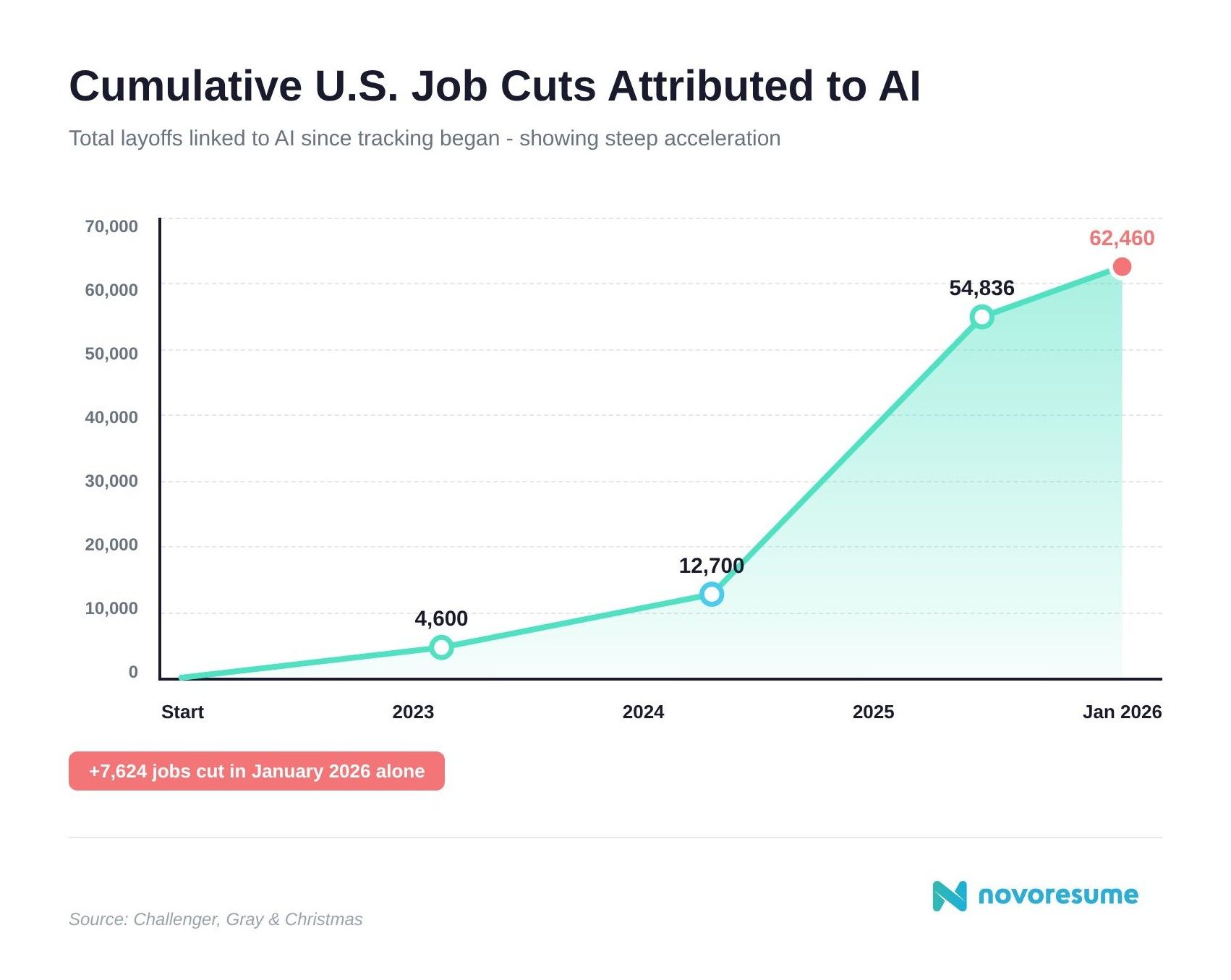
- AI-attributed layoffs in the U.S. reached 54,836 announced job cuts in 2025 – but that represents less than 5% of all U.S. job cuts that year.
- 78% of organizations reported using AI in at least one business function in 2024, up from 55% the year before and 20% in 2017.
- By 2036, AI is expected to result in more than 500 million net new human jobs globally.
- The U.S. economy added 499,000 nonfarm payroll jobs in Q1 2025, and the unemployment rate sits between 4.0% and 4.2% – suggesting no AI jobs crisis has materialized yet.
16 AI Job Displacement Statistics
The fear behind "will AI take my job?" is grounded in real projections. Major institutions have been modeling how many jobs could be affected, and the numbers are large – though they vary widely depending on who's doing the analysis and what assumptions they use.
These are the most widely cited projections on potential job losses:
- 300 million full-time jobs globally could be exposed to automation by generative AI, with one-quarter to one-half of their workload replaceable.
- 7% of U.S. jobs could be replaced entirely by AI.
- 6.1% of U.S. jobs - about 10.4 million - will be lost by 2030 due to AI and automation. That's more than the 8.7 million jobs lost during the Great Recession.
- AI can already do the work of 11.7% of the U.S. labor market, representing $1.2 trillion in wages.
- 27% of jobs across OECD countries are in occupations at high risk of automation.
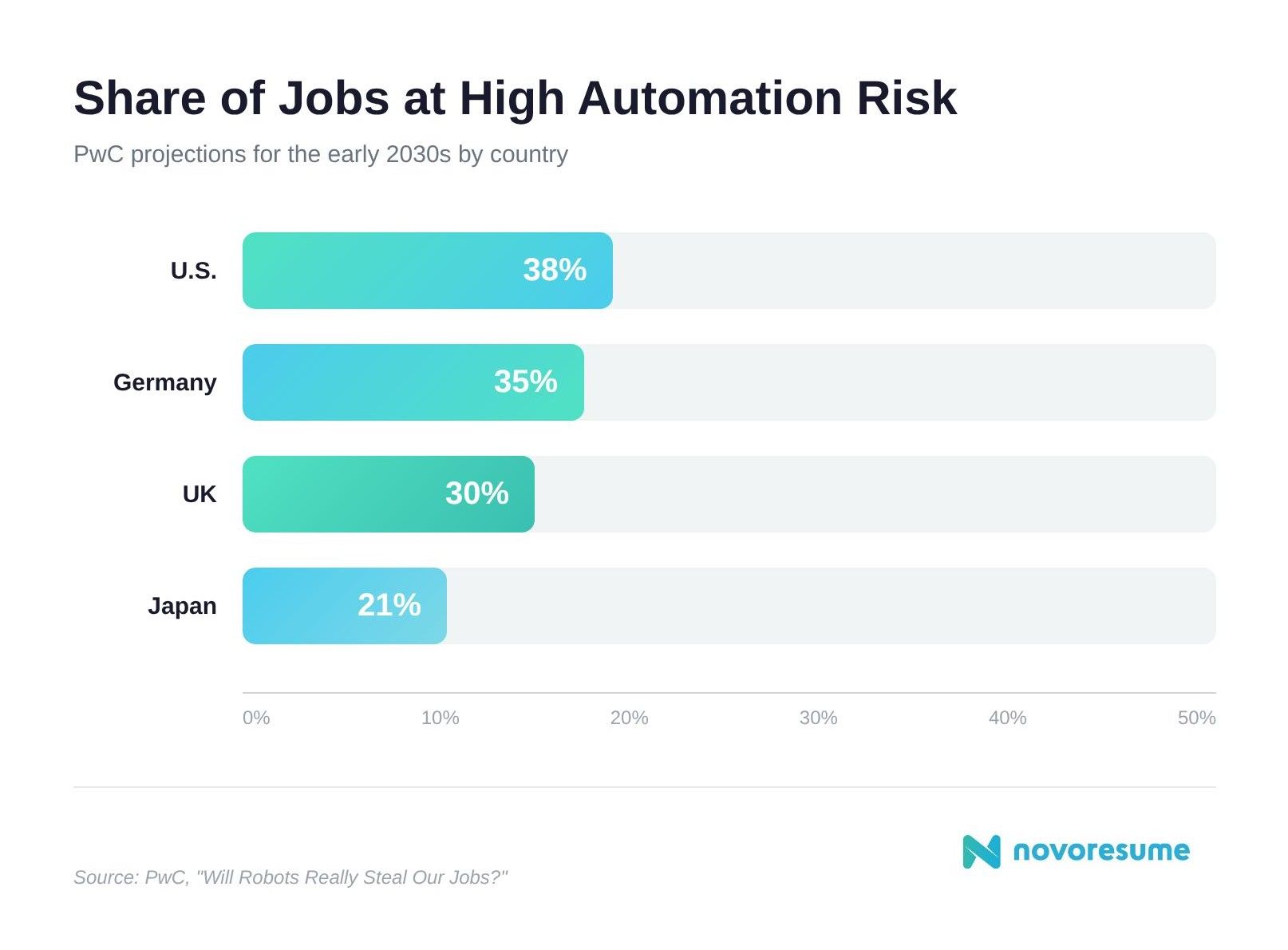
- 38% of U.S. jobs are at high risk of automation by the early 2030s. For the UK, that figure is 30%. For Germany, 35%. For Japan, 21%.
- 22% of jobs globally will experience disruption by 2030.
- 80% of the U.S. workforce could have at least 10% of their tasks affected by large language models, while 19% of workers could see at least 50% of their tasks affected.
- 12 million Americans may need a career change by 2030; 25% more than projected just two years earlier.
- At least 14% of employees globally could need to change careers due to AI, digitization, and robotics by 2030.
- 40% of all working hours could be impacted by large language models, with 44% in the U.S. and 47% in the UK falling within scope.
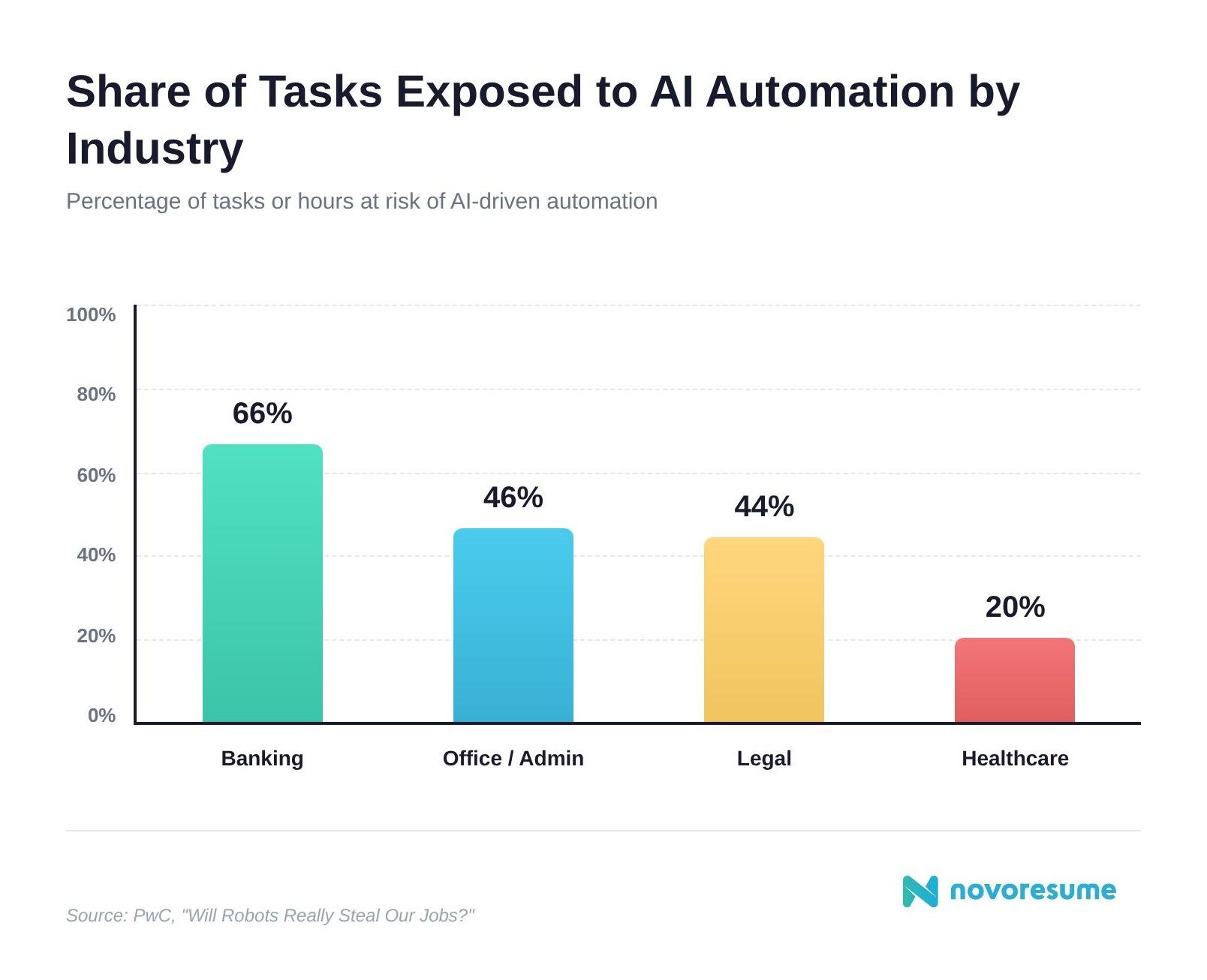
- 46% of tasks in the administrative sector and 44% in the legal sector could become automated.
- Almost 40% of global employment is exposed to AI. About 60% of jobs in advanced economies, 40% in emerging markets, and 26% in low-income countries may be affected.
- More than 30% of all U.S. workers could see at least 50% of their occupation's tasks disrupted by generative AI.
- AI will strongly influence 20% of U.S. jobs over the next five years – nearly four times the impact projected in 2023. Agentic AI is now responsible for 50% of AI-related job losses, up from 29% in 2023.
- 39% of key skills required on the job will change by 2030, accelerating skills obsolescence across nearly every industry.
14 AI Job Creation Statistics
AI is also generating entirely new categories of work. Every major report projecting job losses also projects job gains, as AI-driven job creation is increasing. In most scenarios, the gains outpace the losses.
- 170 million new roles are projected to be created by 2030, compared with 92 million displaced, representing a net increase of 78 million jobs.
- By 2036, AI will result in more than 500 million net new human jobs globally.
- Through 2026, AI's impact on global jobs is expected to remain neutral, with jobs lost roughly equaling jobs created. After 2028, AI is predicted to create more jobs than it destroys.
- 70% of organizations plan to hire people with new AI-related skills.
- 60% of today's workers are employed in occupations that did not exist in 1940.
- 68% of the fastest-growing roles in the U.S. did not exist 20 years ago.
- AI and machine learning specialists are expected to see a 40% jump in demand, while data analysts and scientists could see a 30-35% increase, adding about 2.6 million jobs combined.
- Healthcare is expected to add about 5.5 million new jobs through 2030.
- The green transition is expected to create 34 million additional jobs by 2030.
- The fastest-growing job titles by 2030 include big data specialists, fintech engineers, AI/ML specialists, software developers, and security management specialists.
- In Q1 2025, there were 35,445 AI-related positions across the U.S., and a 25.2% increase from Q1 2024. The median annual salary for AI roles is $156,998.
- In 2024, AI created about 119,900 direct jobs (8,900 AI development roles plus over 110,000 data center construction jobs).
- Projections estimate that 20 to 50 million new AI-related jobs will be created globally by 2030.
- Nurse practitioners are projected to grow by 52% from 2023 to 2033.
- 20 Industry-Specific AI Impact Statistics
AI's impact on jobs isn't spread evenly across the economy. Some industries face major disruption, while others are largely unaffected; where you work matters.
Finance and Banking
- 66% of hours worked in banking have a high potential to be transformed by AI, the highest among sectors.
- AI agent automation accounts for 92% of the contribution rate in finance and insurance, the highest among sectors.
- Banks could see pretax profits rise by 12-17% by 2027, totaling $180 billion from AI.
- Employment of bank tellers is projected to decline by 15% from 2023 to 2033, resulting in about 51,400 fewer jobs.
Office and Administrative Support
- 46% of office and administrative support employment is exposed to AI automation, the highest of any U.S. industry.
- Demand for office support jobs is projected to decline by about 18% through 2030. Demand for clerks could drop by 1.6 million jobs, and administrative assistants by 710,000.
- By the end of 2026, 20% of organizations will use AI to flatten their hierarchy, eliminating more than 50% of current middle-management positions.
Customer Service
- AI chatbot adoption is expected to save businesses $8 billion annually in operational costs.
- Employment for early-career customer service workers fell nearly 11% from their November 2022 peak to July 2025.
Manufacturing and Transportation
- Industrial robots now account for 44% of repetitive manufacturing tasks worldwide.
- 1.7 million manufacturing jobs have been lost since 2000 due to automation.
- Global robot density stands at 162 units per 10,000 employees, up from 7 units per 10,000 employees 7 years ago.
- The U.S. trucking industry could lose 1.5 to 5 million professional driving jobs by 2030 as autonomous vehicles advance.
Healthcare and Retail
- The share of automated work hours in healthcare is 20%, the lowest among major sectors.
- Cashier employment is projected to decline by 11%, a reduction of 353,100 jobs from 2023 to 2033.
- 830,000 retail salesperson jobs are projected to decline through 2030.
Technology and Legal
- Employment for the youngest software developers was 20% below its late-2022 peak as of July 2025.
- Three-quarters of developers now use AI coding assistants.
- By 2030, 0% of IT work will be done by humans without AI. 75% will be done by humans augmented with AI, and 25% by AI alone.
- 73% of lawyers plan to integrate generative AI into their work within the next year.
10 Statistics on AI's Impact on Young and Entry-Level Workers
Younger workers and entry-level roles are among the first to feel the effects of AI adoption. Recent recruitment statistics paint a challenging picture for those just entering the workforce.
- Workers aged 22-25 in AI-exposed occupations experienced a 13% decline in employment from late 2022 to mid-2025.
- Software developers aged 22-25 experienced a nearly 20% decline in employment from their late-2022 peak.
- Entry-level hiring at the 15 largest tech companies fell 25% from 2023 to 2024.
- Younger workers are 129% more likely to worry that AI will make their jobs obsolete than those over 65.
- The share of jobs requiring 3 years or less of experience dropped sharply between 2018 and 2024 in AI-exposed fields: software development fell from 43% to 28%, data analysis from 35% to 22%, and consulting from 41% to 26%.
- Organizations could automate 30% of entry-level work hours.
- Unemployment for 20- to 24-year-olds with bachelor's degrees increased from 5.2% (2018-2019) to 6.2% recently.
- 49% of Gen Z job seekers believe AI has reduced the value of their college education.
- Big Tech companies reduced new graduate hiring by 25% in 2024 compared to 2023.
- January 2025 saw the lowest job openings in professional services since 2013 – a 20% year-over-year drop.
13 AI Layoff Statistics
AI layoff numbers are growing, but AI still accounts for a small fraction of overall job cuts. Some analysts believe companies are "AI-washing" layoffs that would have happened anyway.
- AI was cited for 54,836 announced U.S. layoffs in the full-year 2025.
- Since 2023, when AI first appeared as a reason for workforce reductions, it has been linked to 71,825 job cuts through the end of 2025.
- In January 2026, an additional 7,624 layoffs were attributed to AI, bringing the cumulative total since 2023 to 79,449.
- AI-attributed layoffs of about 55,000 in 2025 represent less than 5% of all U.S. job cuts that year. Total U.S. job cuts in 2025 reached about 1.22 million – the highest since 2020.
- 2025 AI-related layoffs were more than 12 times the number attributed to AI just two years earlier in 2023.
- The global technology sector eliminated 244,851 jobs in 2025.
- U.S. employers announced just 497,151 planned hires through November 2025, down 35% from 2024 and the lowest year-to-date total since 2010.
- Salesforce reduced its customer support workforce by about 4,000, with the CEO stating AI handles up to 50% of the company's work. Klarna shrank headcount by about 40% before admitting it "went too far" and rehired humans.
- Amazon cut 14,000 jobs in October 2025. CEO Andy Jassy said the company would "need fewer people doing some of the jobs that are being done today" due to AI.
- IBM confirmed AI chatbots had taken over the jobs of "a few hundred" HR workers.
- However, 55% of employers are expected to regret laying off workers due to AI, and half of AI-attributed layoffs will be quietly rehired.
- A late-2024 survey found that 95% of firms reported that AI had no net impact on their employment.
- AI-related cuts represent a "mere 4.5% of total reported job losses," and some companies may be citing AI to justify cuts driven by other business factors.
13 Worker Sentiment and AI Anxiety Statistics
Beyond the displacement projections, worker anxiety is rising, even among those already using AI tools.
- 52% of U.S. workers are worried about AI's future impact in the workplace.
- 71% of Americans fear AI could "put people out of work permanently."
- 57% of U.S. adults said the rise in AI is a significant source of stress – up from 49% the year before.
- Young adults ages 18-34 are the most stressed: 65% reported stress related to AI, up from 52% the prior year.
- Students are especially anxious: 78% said AI is a significant source of stress, up from 45% the previous year.
- 38% of U.S. workers worry AI may make some or all of their job duties obsolete. Among those worried, 51% reported their work negatively impacts their mental health, compared to 29% of those not worried.
- 53% of workers worried that using AI would make them look replaceable, while 52% were reluctant to admit to using AI for important tasks.
- 50% of employees said it was "not at all likely" that AI will eliminate their job within five years – that's down from about 60% in 2023.
- 32% of workers think AI will lead to fewer job opportunities for them in the long run.
- 36% of workers feel hopeful about AI in the workplace, while 33% feel overwhelmed.
- 47% of Gen Z use generative AI weekly. However, 41% of Gen Zers feel anxious about AI, while 36% feel excited.
- 3 in 5 workers in the OECD manufacturing and finance sectors are concerned about losing their jobs to AI over the next 10 years.
- On the other hand, 4 in 5 workers (80%) who currently use AI report that it has improved their performance at work.
14 AI Skills Gap and Reskilling Statistics
Workers who learn to work with AI are better positioned; those who don't face growing risk. But the reskilling gap is wide, and most employers aren't doing enough to close it.
- 59% of the global workforce, about 59 out of every 100 workers, will need reskilling or upskilling by 2030. Of those, 11 out of 100 are unlikely to receive training, putting over 120 million workers at medium-term risk.
- 63% of employers cite the skills gap as the most significant obstacle to business transformation.
- 77% of employers say they are committed to reskilling employees to work alongside AI.
- 85% of employers prioritize upskilling as a workforce strategy, but only 28% of tech-focused organizations are planning to invest in upskilling programs over the next 2-3 years.
- 66% of leaders say they would not hire someone without AI skills, making it essential for candidates to include AI skills on their resumes. Yet only 39% of users have received AI training from their companies, and only 25% of companies expect to offer it this year.
- 71% of leaders would rather hire a less experienced candidate with AI skills than a more experienced candidate without them.
- 35% of workers describe their AI skills as "nonexistent," and 54% struggle to know when and how to use AI tools.
- Demand for "AI fluency" in U.S. job postings has grown sevenfold since 2023.
- LinkedIn members adding AI skills to their profiles increased by 142%. AI tools for job seekers now include resume optimization, interview preparation, and skills assessment platforms that help candidates stand out.
- Skills in AI-exposed jobs are changing 66% faster than in less-exposed occupations.
- Generative AI will require 80% of the engineering workforce to upskill through 2027.
- By 2030, 50% of essential job skills will differ from those required in 2016, and generative AI is expected to push that to 68%.
- The role of Head of AI has tripled over the past five years and grown by more than 28% in 2023.
- There are 1.4 million unfilled tech positions in the current market, and a projected worldwide shortage of 11 million healthcare workers by 2030.
12 AI Wage and Salary Impact Statistics
AI isn't just affecting who has a job; it's reshaping how much they earn. Workers with AI skills command a premium, and AI is also narrowing the gap between high- and low-performing workers.
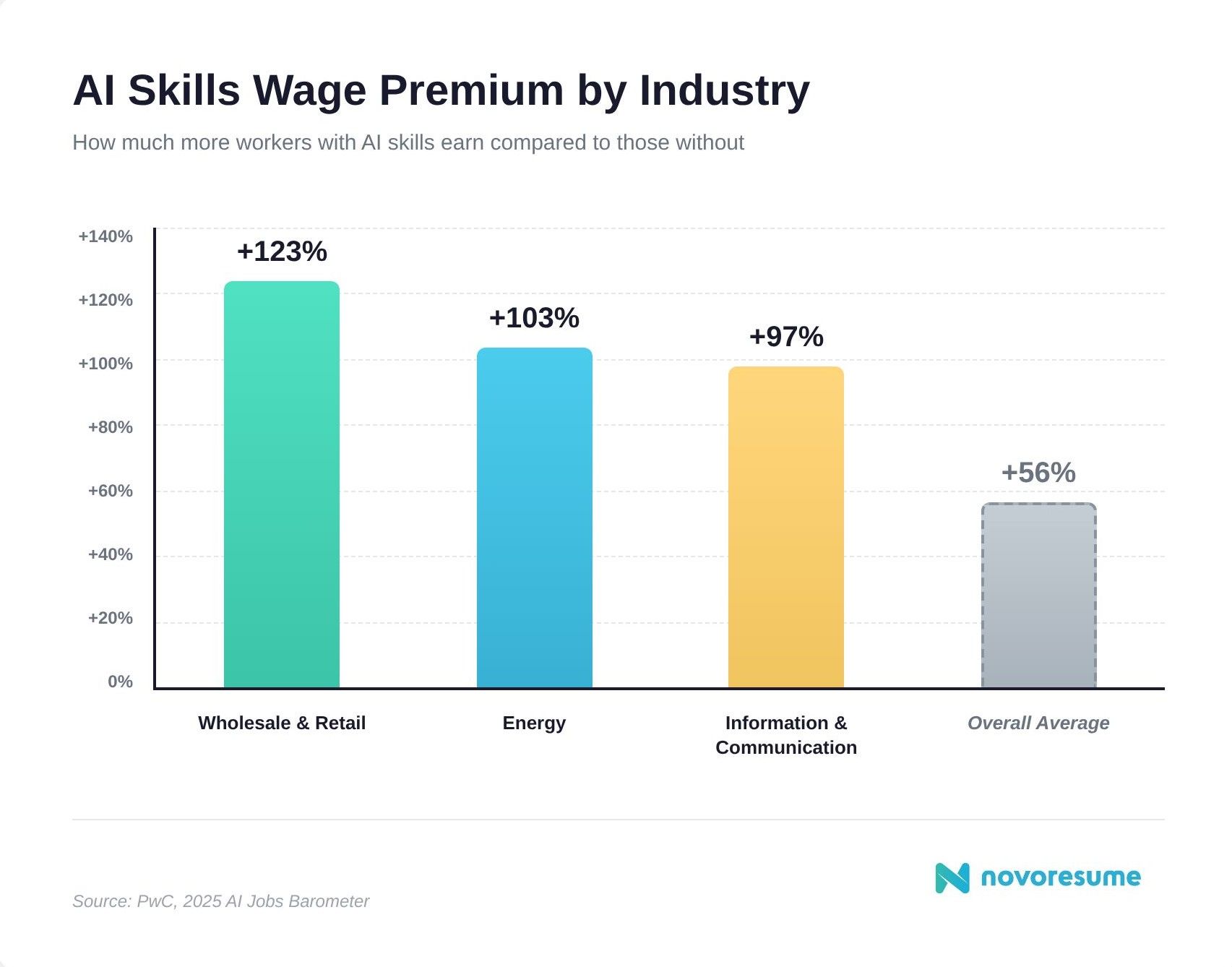
- Workers with AI skills earn a 56% wage premium over workers without AI skills in the same occupation, double the 25% premium observed the prior year. Every industry analyzed pays wage premiums for AI skills, making AI proficiency a compelling career development priority.
- AI-specific wage premiums by industry: wholesale and retail trade at +123%, energy at +103%, and information and communication at +97%.
- Wages are growing twice as fast in industries more exposed to AI versus those less exposed.
- Freelancers with generative AI modeling skills earn up to 22% more hourly than traditional AI/ML roles.
- The median annual salary for AI-related roles in the U.S. is $156,998.
- Degree requirements for AI-augmented jobs fell 7 percentage points (from 66% to 59%) between 2019 and 2024.
- UK-focused research found a 23% wage premium for AI skills, surpassing the value of master's degrees (13%) but trailing PhD-level compensation (33%).
- AI assistance in customer service increased productivity by 14% on average, with a 34% improvement for novice and low-skilled workers but minimal impact on experienced workers.
- ChatGPT compressed the productivity distribution, benefiting low-ability workers more and decreasing inequality between workers.
- A 2025 working paper found generative AI "substantially reduces wage inequality while raising average wages by 21%" through augmentation and automation. Welfare improvements were equivalent to permanent wage gains of 26-34% for most workers.
- However, the IMF warned: "In most scenarios, AI will likely worsen overall inequality." Workers who can use AI could see disproportionate income gains.
- Freelancers in occupations most exposed to generative AI saw a 2% decline in monthly contracts and a 5% drop in monthly earnings following the release of ChatGPT.
12 AI Productivity Statistics
One reason AI adoption is accelerating is the measurable productivity gains it delivers. These results are pushing companies to adopt AI faster, and they're part of why the labor market is shifting.
- AI could increase global annual GDP by 7% (about $7 trillion) over 10 years and boost U.S. labor productivity growth by 1.5 percentage points per year.
- Generative AI could add $2.6 trillion to $4.4 trillion annually to the global economy across 63 use cases analyzed. 75% of that value falls in four areas: customer operations, marketing/sales, software engineering, and research and development.
- Workers using generative AI saved 5.4% of their work hours in the prior week, implying a 1.1% increase in aggregate productivity for the entire workforce. Workers are 33% more productive per hour when using generative AI.
- GitHub Copilot users completed tasks 55.8% faster (71 minutes versus 161 minutes for the control group). Less experienced programmers benefited more.
- ChatGPT reduced writing task time by 40% and improved output quality by 18%.
- Using generative AI reduced the average time to complete 18 common work tasks by more than 60%.
- Since GenAI's proliferation in 2022, productivity growth in AI-exposed industries nearly quadrupled, rising from 7% (2018-2022) to 27% (2018-2024). AI-exposed industries now see three times the revenue growth rate per employee.
- 90% of AI users say it helps save time, 85% say it helps them focus on important work, and 84% say it helps them be more creative.
- 42% of organizations report cost reductions from implementing AI, and 59% report revenue increases.
- AI agents and robots could add about $2.9 trillion per year to the U.S. economy by 2030 if workflows are redesigned.
- U.S. private AI investment grew to $109.1 billion in 2024, nearly 12 times China's $9.3 billion.
- AI could contribute up to $15.7 trillion to global GDP by 2030.
12 Statistics on Projected Timeline of AI’s Impact on Employment
The impact of AI on jobs won't occur all at once; it will unfold over years and decades. Here are the projected timelines.
Short-Term (2025-2027)
- AI's impact on global jobs will remain neutral through 2026; jobs lost will roughly equal jobs created.
- By the end of 2026, 20% of organizations will use AI to eliminate more than 50% of middle-management positions.
- By 2027, AI in hiring and recruitment will be standard; 75% of hiring processes will include certifications or tests for AI proficiency.
- About 75% of companies expect to adopt AI by 2027.
- 82% of executives plan to adopt AI agents within the next 1-3 years.
Medium-Term (2028-2032)
- By 2028, AI is predicted to create more jobs than it destroys.
- By 2030, 92 million jobs will be replaced and 170 million created globally, for a net gain of 78 million.
- About 27% of current work hours in Europe and 30% in the U.S. could be automated by 2030, with generative AI accelerating this pace.
- Fully autonomous trucking is expected to reach viability by 2032. Level 4 urban self-driving car pilots are also projected for 2032.
Long-Term (2033+)
- By 2036, AI will result in more than 500 million net new human jobs globally.
- AI could boost labor productivity by up to 40% and double annual economic growth rates by 2035 in 12 developed economies.
- AI is projected to increase productivity and GDP by 1.5% by 2035, nearly 3% by 2055, and 3.7% by 2075.
Conclusion
AI will displace millions of roles, but it's also projected to create even more. The workers most at risk are those in routine administrative, customer service, and entry-level roles, while those with AI skills are commanding higher wages and stronger job security.
Workers who invest in AI literacy and reskilling will have an upper hand – those who ignore the shift risk falling behind.
For more advice, check out the rest of our career blog!
 Add Novorésumé as a preferred source on Google
Get more resume writing tips, career insights, and job search advice in your personalized Google search results.
Related posts

Personal Development
100+ job satisfaction statistics for 2026: record-high satisfaction, sliding engagement, AI effects, burnout, and RTO. From 16 primary sources + our data.

Personal Development
Looking to take your career to the next level? We’ve compiled all the best career tips from industry experts as well as examples you'll need to help you!

Personal Development
Learn about the common causes and signs of stress in the workplace and find out how to reduce it and improve your well-being.