88 AI Job Creation Statistics and Trends for 2026
Discover 88 AI job creation statistics for 2026, including new roles, salary premiums, skills gaps, and industry growth driven by artificial intelligence.


Novoresume got people hired at
























10 Key AI Job Creation Statistics
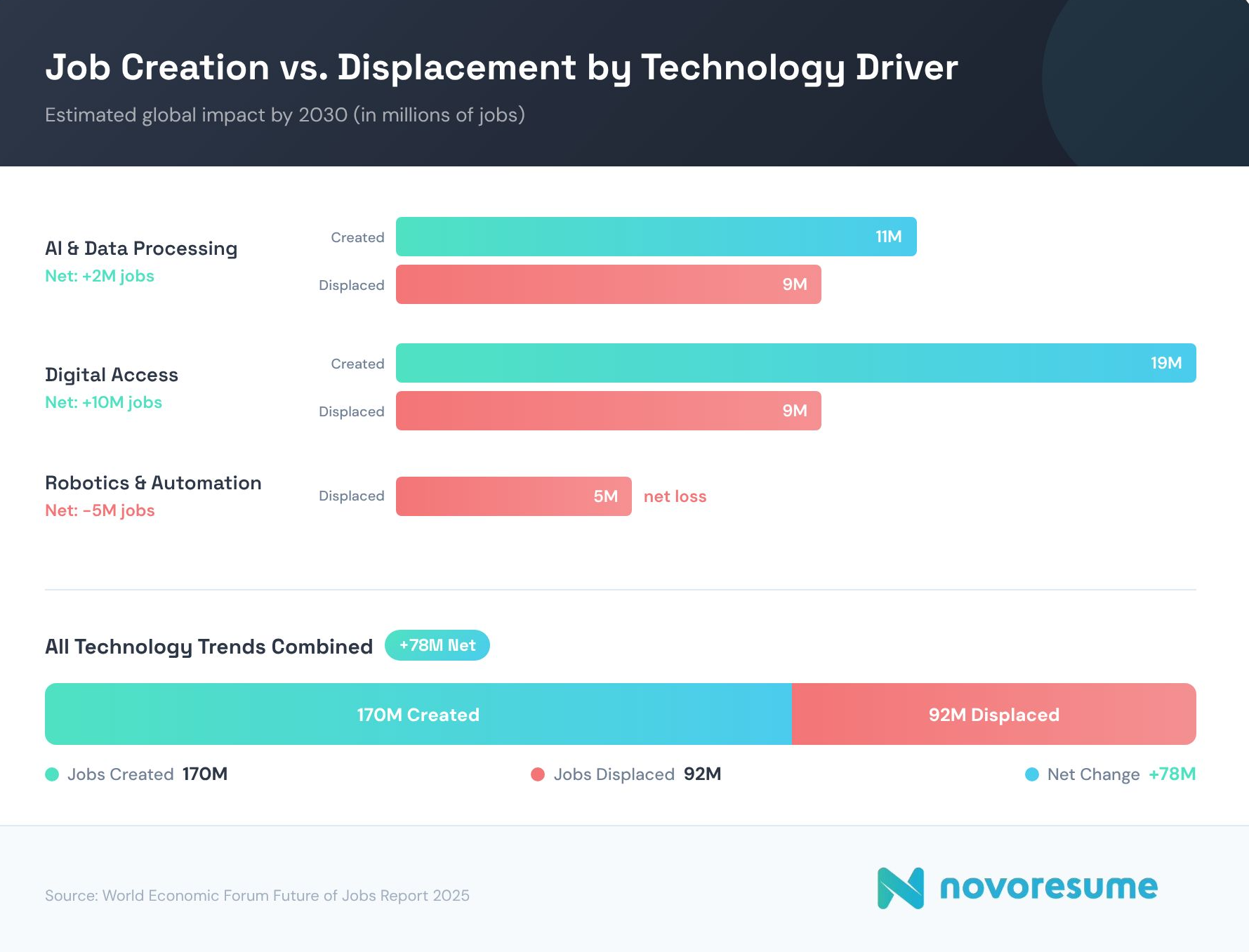
- AI and data processing are expected to create 11 million new roles by 2030, while displacing 9 million - a net gain of 2 million jobs in that category alone, according to the World Economic Forum's Future of Jobs Report 2025.
- Overall, 170 million new jobs are projected to be created and 92 million displaced by 2030, resulting in a net increase of 78 million jobs globally (WEF Future of Jobs Report 2025).
- 86% of employers expect AI and information processing technologies to transform their business by 2030 (WEF Future of Jobs Report 2025).
- In Q1 2025, there were 35,445 AI-related positions across the U.S. - a 25.2% increase from Q1 2024, based on data from Veritone and Aspen Tech Labs.
- The median annual salary for AI roles in Q1 2025 reached $156,998 (Veritone / Aspen Tech Labs).
- Jobs requiring AI skills grew 3.5 times faster than general job postings, according to PwC's 2025 Global AI Jobs Barometer, which analyzed close to a billion job ads from six continents.
- Job availability grew 38% in roles more exposed to AI between 2019 and 2024 (PwC 2025 Global AI Jobs Barometer).
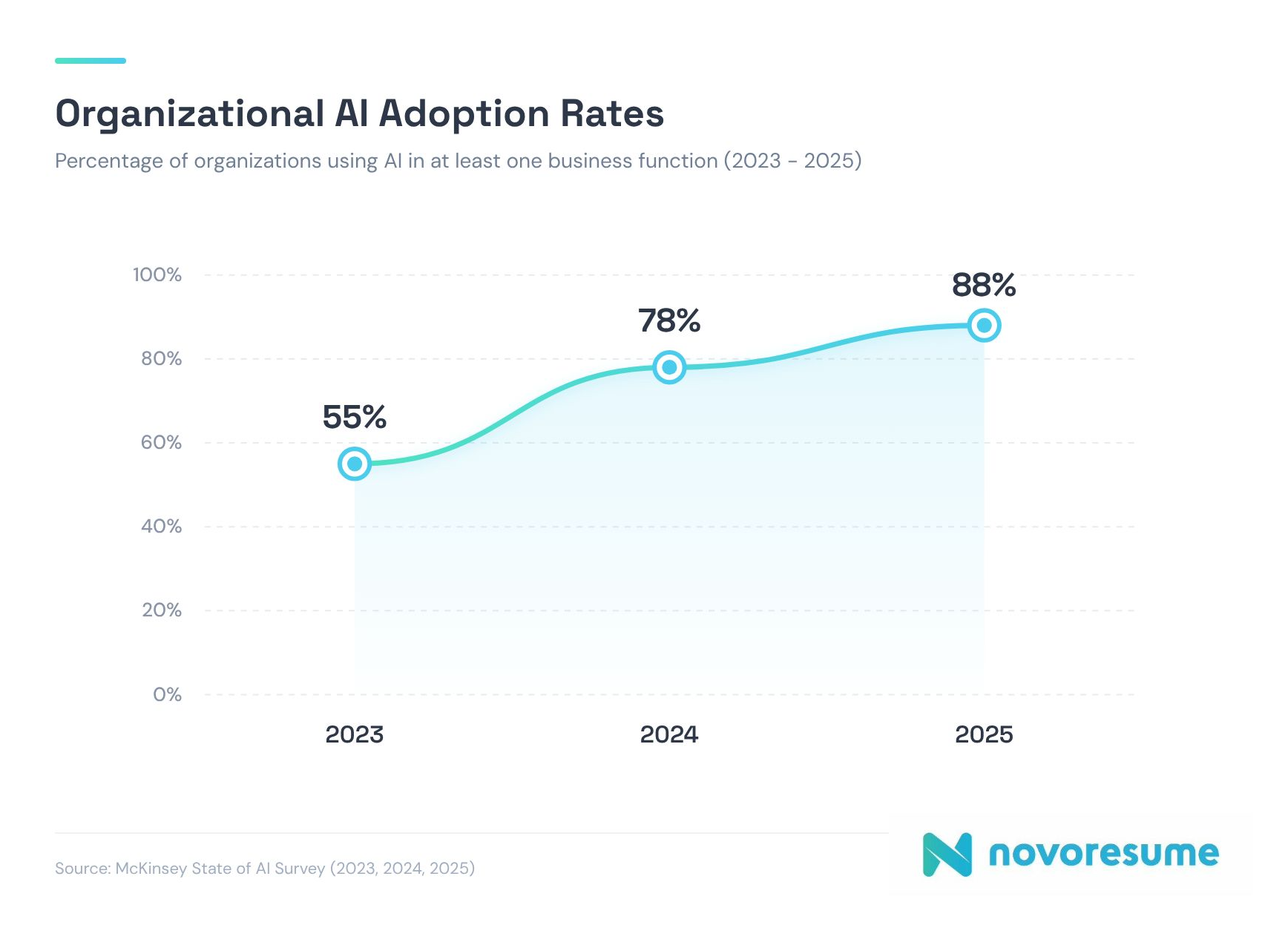
- 88% of organizations now use AI in at least one business function, up from 78% the prior year (McKinsey State of AI 2025).
- The BLS projects computer and information technology occupations to grow much faster than average from 2024 to 2034, with about 317,700 openings projected each year (U.S. Bureau of Labor Statistics).
- Computer occupations are on track to grow 11.7% from 2023 to 2033, compared to 4.0% across all jobs (BLS Employment Projections). Note: Updated BLS 2024-2034 projections show 12.4% growth for computer occupations vs. 3.1% for all jobs.
9 AI Job Creation vs. Displacement Statistics
- AI could eliminate 92 million jobs by 2030. However, it could also create 170 million new ones - a net gain of 78 million jobs (WEF Future of Jobs Report 2025).
- 41% of employers worldwide plan to reduce their workforce over the next five years, with AI automating tasks (WEF Future of Jobs Report 2025).
- Up to 14% of employees globally may need to change careers due to AI and digitization by 2030. McKinsey Global Institute's scenarios range from near-zero to 14%, depending on adoption speed, with 14% being the upper-bound estimate.
- Goldman Sachs Research estimates that just 2.5% of U.S. employment would be at risk of displacement if current AI use cases were expanded, with AI-related innovation potentially displacing 6-7% of employment temporarily.
- Current technologies could theoretically automate about 57% of U.S. work hours, but this measure reflects technical potential rather than the inevitable loss of jobs (McKinsey Global Institute, 2025).
- In 2025, nearly 55,000 U.S. job cuts were directly attributed to AI. However, AI was cited in only around 4.5% of all job losses (Challenger, Gray & Christmas).
- Entry-level hiring at the 15 largest tech companies fell 25% from 2023 to 2024 (Stanford Digital Economy Lab).
- Workers aged 22-25 in AI-exposed occupations experienced a 13% decline in employment from late 2022 to mid-2025 (Stanford Digital Economy Lab).
- Workers aged 18-24 are 129% more likely than those over 65 to worry AI will make their jobs obsolete (SurveyMonkey).
10 AI Wages and Salary Premium Statistics
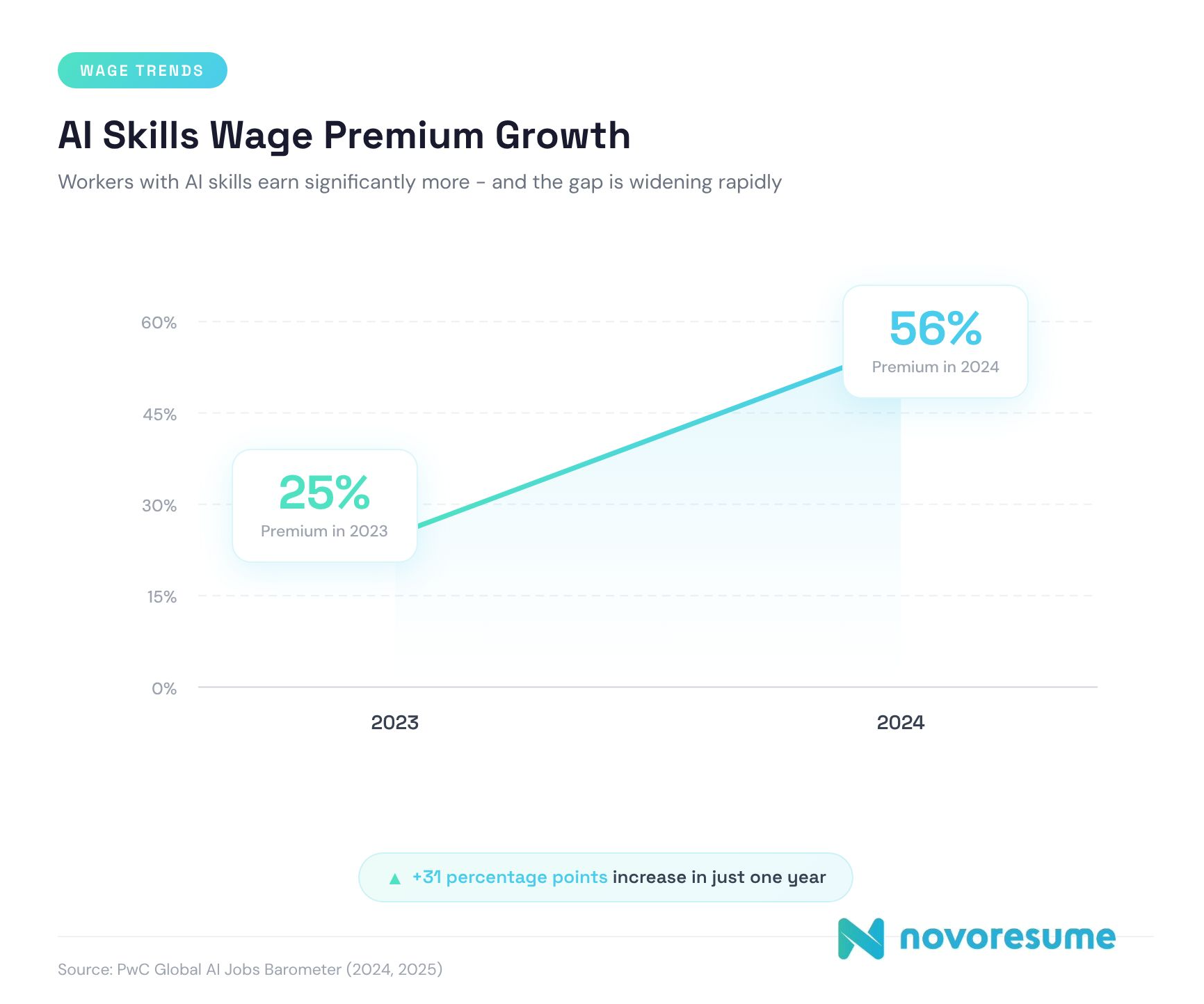
- Workers with AI skills earn an average wage premium of 56% over similar roles without those skills. That's up from 25% the previous year, more than doubling (PwC 2025 Global AI Jobs Barometer).
- Wages are growing twice as fast in industries more exposed to AI compared to less exposed industries (PwC 2025 Global AI Jobs Barometer).
- Jobs requiring AI skills advertise a 28% premium, equivalent to nearly $18,000 more per year, based on Lightcast's analysis of 1.3 billion job postings.
- Professionals with multiple AI competencies see salary premiums of up to 43% (Oxford Internet Institute).
- AI-skilled workers in the UK earn a 23% wage premium - surpassing the value of a master's degree at 13% (Oxford Internet Institute).
- The median annual salary for AI jobs reached $160,056 in April 2024, up from $144,986 the year prior (Veritone / Aspen Tech Labs).
- Entry-level AI roles average $50,000 to $80,000, while senior specialized positions in big tech can exceed $500,000 annually (PwC / industry salary data).
- Professionals with generative AI expertise can expect an average salary of around $174,727 per year (365 Data Science / industry reports).
- Industries most exposed to AI saw 3x higher revenue per employee growth (27%) than those least exposed (9%) (PwC 2025 Global AI Jobs Barometer).
- AI-exposed industries have seen nearly 5x (4.8x) higher labor productivity growth since 2022 (PwC 2024 Global AI Jobs Barometer).
11 Fastest-Growing AI Job Roles Statistics
- The three fastest-growing jobs in percentage terms are big data specialists, fintech engineers, AI engineers, and machine learning specialists (WEF Future of Jobs Report 2025).
- AI/Machine Learning Engineer is the fastest-growing AI title, with 13.1% growth quarter-over-quarter and 41.8% growth year-over-year (Veritone / Aspen Tech Labs, Q1 2025).
- Mentions of AI in U.S. job listings surged by 56.1% in 2025, building on 120.6% growth in 2024 and 114.8% in 2023 (Autodesk AI Jobs Report 2025, in partnership with GlobalData).
- AI Engineer roles grew 143.2% year over year. Prompt Engineer roles grew 135.8%, and AI Content Creator roles grew 134.5% (Autodesk AI Jobs Report 2025).
- The BLS projects employment of data scientists to grow 36% from 2023 to 2033, far outpacing the average for all occupations (U.S. Bureau of Labor Statistics). Note: Updated 2024-2034 BLS projections show 33.5% growth.
- Employment of software developers is projected to increase 17.9% between 2023 and 2033 (BLS). Note: Updated 2024-2034 BLS projections show 15% growth.
- AI trainers, ethicists, and explainability experts are emerging roles created directly by AI adoption (National University / BLS).
- Job postings mentioning "agentic AI" grew by 985% between 2023 and 2024 (McKinsey / industry data).
- The global prompt engineering market is projected to grow at a compound annual growth rate of nearly 33% from 2024 to 2030 (industry research).
- The three AI job titles with the most current openings are Data Scientist, AI/Machine Learning Engineer, and Big Data Engineer (Veritone / Aspen Tech Labs, Q1 2025).
- Design has overtaken technical expertise as the most in-demand skill in AI-related job postings, reflecting the growing need for human-centered thinking in AI development (Autodesk AI Jobs Report 2025).
10 AI Skills Gap and Upskilling Statistics
- 39% of workers' existing skill sets are expected to be transformed or become outdated between 2025 and 2030 (WEF Future of Jobs Report 2025).
- 85% of employers plan to prioritize workforce upskilling to address these changes (WEF Future of Jobs Report 2025).
- 77% of employers are committed to reskilling and upskilling employees to work alongside AI (WEF Future of Jobs Report 2025).
- 63% of employers cite skills gaps as the primary barrier to business transformation (WEF Future of Jobs Report 2025).
- Skills demanded by employers are changing 66% faster in AI-exposed occupations than in the least exposed roles. That rate is up from 25% the year prior (PwC 2025 Global AI Jobs Barometer).
- Over 90% of global enterprises are projected to face critical skills shortages by 2026, with sustained skills gaps risking $5.5 trillion in losses from global market performance (IDC).
- 94% of CEOs and CHROs identify AI as their top in-demand skill, yet only 35% of leaders feel they have prepared employees effectively for AI roles (IDC).
- 1 in 10 job postings now explicitly require AI skills - a figure that has tripled since 2023 (Gallup).
- 44% of employers report offering upskilling programs, but only 33% of employees confirm having access (TriNet / EdAssist, 2025).
- Employer demand for formal degrees is declining for all jobs, but especially for AI-exposed jobs. The percentage of AI-augmented jobs requiring a degree fell 7 percentage points between 2019 and 2024, from 66% to 59% (PwC 2025 Global AI Jobs Barometer).
8 AI Investment and Market Size Statistics
- Worldwide spending on AI is forecast to total $2.52 trillion in 2026 - a 44% increase year-over-year (Gartner).
- AI investments in 2025 reached $225.8 billion, surpassing all previous records (Stanford AI Index 2025).
- AI companies made up about 48% of total equity funding in 2025, despite representing only 23% of total deals (Stanford AI Index 2025).
- Enterprise AI spending surged from $1.7 billion to $37 billion between 2023 and 2025 (Menlo Ventures).
- $73 billion flowed to AI startups in Q1 2025 alone - accounting for nearly 60% of all global venture capital (industry data).
- In 2025, 79% of all AI funding went to U.S.-based companies. The San Francisco Bay Area alone raised $122 billion (Crunchbase).
- 92% of firms plan to increase their AI budgets within the next three years (McKinsey State of AI 2025).
- 88% of organizations anticipate generative AI budget increases in the next 12 months, with 62% expecting increases of 10% or more (Wharton 2025 AI Adoption Report).
9 AI Adoption and Workforce Usage Statistics
- 88% of organizations report using AI in at least one business function, up from 78% in 2024 and 55% two years before that (McKinsey State of AI 2025).
- 79% of companies regularly use generative AI, up from 33% in 2023 (McKinsey State of AI 2025).
- 46% of U.S. workers aged 18 and older reported using AI at work by mid-2025 (SHRM).
- 75% of knowledge workers use AI tools, often without waiting for formal company rollouts (Microsoft / LinkedIn Work Trend Index).
- Worker access to AI rose by 50% in 2025 (Menlo Ventures).
- 82% of workers use generative AI at least weekly (up 10 points year-over-year), and 46% use it daily (up 17 points) (Wharton 2025 AI Adoption Report).
- 50% of developers now use AI coding tools daily, rising to 65% in top-quartile organizations (Menlo Ventures).
- 55% of organizations are already providing AI skills training. Of those, 64% plan to increase that investment (LinkedIn Workplace Learning Report 2025).
- Despite the broad adoption trend, only about 1 in 5 U.S. firms indicates that it uses AI regularly as of mid-2025, suggesting that widespread but shallow usage coexists with deep integration in a smaller group (J.P. Morgan/Federal Reserve).
7 AI Productivity and Business Impact Statistics
- Studies show AI productivity gains of about 10-25% in typical knowledge work tasks such as writing, researching, and programming (Stanford AI Index 2025).
- Productivity growth has nearly quadrupled in industries most exposed to AI since 2022 (PwC 2025 Global AI Jobs Barometer).
- Two-thirds of organizations report productivity gains from AI implementation (Menlo Ventures).
- 89% of employees agree that generative AI enhances their skills (Wharton 2025 AI Adoption Report).
- Three out of four leaders see positive returns on their generative AI investments (Wharton 2025 AI Adoption Report).
- AI-powered code completion tools grew to a $2.3 billion market, with half of developers now using them daily (Menlo Ventures).
- Companies with dedicated AI teams launch new products 30% faster than those without (McKinsey Workforce Transformation Report).
8 AI Job Creation by Region and Industry Statistics
- Asia leads global AI hiring growth, with job listings growing 94.2% year over year, outpacing North America at 88.9%. South America trails at 63.4% (Autodesk AI Jobs Report 2025).
- The United States holds 29.4% of all new AI job postings globally (Aura 2025 Industry Benchmarking Report).
- The healthcare industry has seen a 40% increase in job postings for AI specialists since 2020 (Deloitte).
- Technology companies lead AI recruitment adoption at 89%, followed by financial services at 76% and healthcare at 62% (SHRM 2025 Talent Trends).
- AI-related job postings on LinkedIn grew by 38% between 2020 and 2024, making it one of the fastest-growing categories on the platform (LinkedIn Future of Work Report 2025).
- More than half of all AI jobs in 2025 appeared outside the traditional tech sector (industry analysis).
- Consulting is among the most flexible fields for AI work, with 18% of consulting jobs being hybrid and 14% fully remote (Robert Half).
- 69% of employers plan to recruit talent skilled in AI tool design and enhancement (WEF Future of Jobs Report 2025).
6 AI Job Creation by Demographics Statistics
- In every country analyzed, more women than men hold AI-exposed roles, meaning the skills pressure facing women will be higher as those roles evolve (PwC 2025 Global AI Jobs Barometer).
- Men are more likely than women to receive AI training at work - 46% compared to 38% (PwC 2025 Global Workforce Hopes & Fears Survey).
- Only 49% of employees feel equipped for their roles in 2025, down from 59% in 2024. Gen Z confidence dropped 20 points to just 39% (TriNet / EdAssist, 2025).
- 34% of employees admit they feel unprepared for the changes AI may bring to their jobs (Bright Horizons/Harris Poll, 2025).
- 79% of employees report feeling pressure to keep learning new skills (Bright Horizons / Harris Poll, 2025).
- 84% of international employees receive organizational support to learn AI skills, compared to just 51% of U.S. employees, suggesting that American workers may need to take greater personal responsibility for building AI competencies (Microsoft/LinkedIn Work Trend Index).
Frequently Asked Questions
Conclusion
 Add Novorésumé as a preferred source on Google
Get more resume writing tips, career insights, and job search advice in your personalized Google search results.
Related posts

Words and adjectives to describe yourself in interviews, on your resume, and in bios. Grouped by trait, with worked answers and the 10 words to avoid.

100+ AI hiring statistics for 2026: employer adoption, AI resumes and cover letters, interview cheating, and detection rates, from our four 2026 surveys.

90+ Gen Z workplace statistics for 2026: workforce share, the entry-level squeeze, AI, tenure, money, and the management myths. From 20+ primary sources.