Las Vegas isn't just for bachelor parties anymore.
We built a 10-factor index scoring 70 major US cities on the things that actually matter to remote workers: cost of living, internet speed, walkability, weather, safety, coworking access, coffee culture, airport connectivity, and entertainment. After crunching the data, Las Vegas came out on top, beating trendy remote work hubs like Austin (#10), San Francisco (#11), and Denver (#21).
For remote workers and job seekers evaluating where to base themselves, this data cuts through the noise. The cities with the loudest "come work remotely here" marketing aren't always the ones that score best on the fundamentals.
Here's what we found.
10 Key Findings From the US Digital Nomad Index
- Las Vegas, NV ranks #1 overall with a composite score of 6.39/10 - driven by below-average cost of living, 210 sunny days per year, strong airport connectivity, and the highest coffee shop density in the top 10.
- The top 3 cities are all in the Sun Belt or tropics: Las Vegas (NV), El Paso (TX), and San Juan (PR). Affordable living and year-round sunshine outweigh their walkability limitations.
- Chattanooga, TN (#9) has the fastest internet of any city in the index at 186.4 Mbps - a direct result of its pioneering municipal fiber network - and costs 11% below the national average to live in.
- Austin, TX, barely cracks the top 10 at #10. Its cost of living has climbed to 3% above the national average, and the average 1BR rent of $1,450/month drags down what was once a budget-friendly remote work hub.
- San Francisco (#11) has the best coworking density and walkability in the index but is torpedoed by the most expensive rent in the sample - $2,400/month for a 1-bedroom.
- Seattle lands at #56 - one of the biggest gaps between reputation and ranking. Just 58 sunny days per year, $1,800 rent, and a cost of living 18% above average put it near the bottom.
- New York (#33) scores a perfect 10/10 for both airport connectivity and entertainment but ranks in the bottom half because it's the most expensive city in the index (cost of living index: 128).
- El Paso, TX (#2) is the cheapest city in the continental US in our sample, with 1BR rent averaging just $800/month and the third-fastest internet speed (178.3 Mbps). It also has the lowest violent crime rate in the top 10.
- 7 of the top 10 cities have a cost of living at or below the national average. The exceptions - Washington DC (#5), Miami (#6), and Philadelphia (#7) - compensate with walkability, airport access, and entertainment.
- The bottom 5 cities are Spokane (WA), Boise (ID), Albuquerque (NM), Memphis (TN), and Des Moines (IA) - held back by slow internet, limited airport options, or high crime rates relative to what they offer.
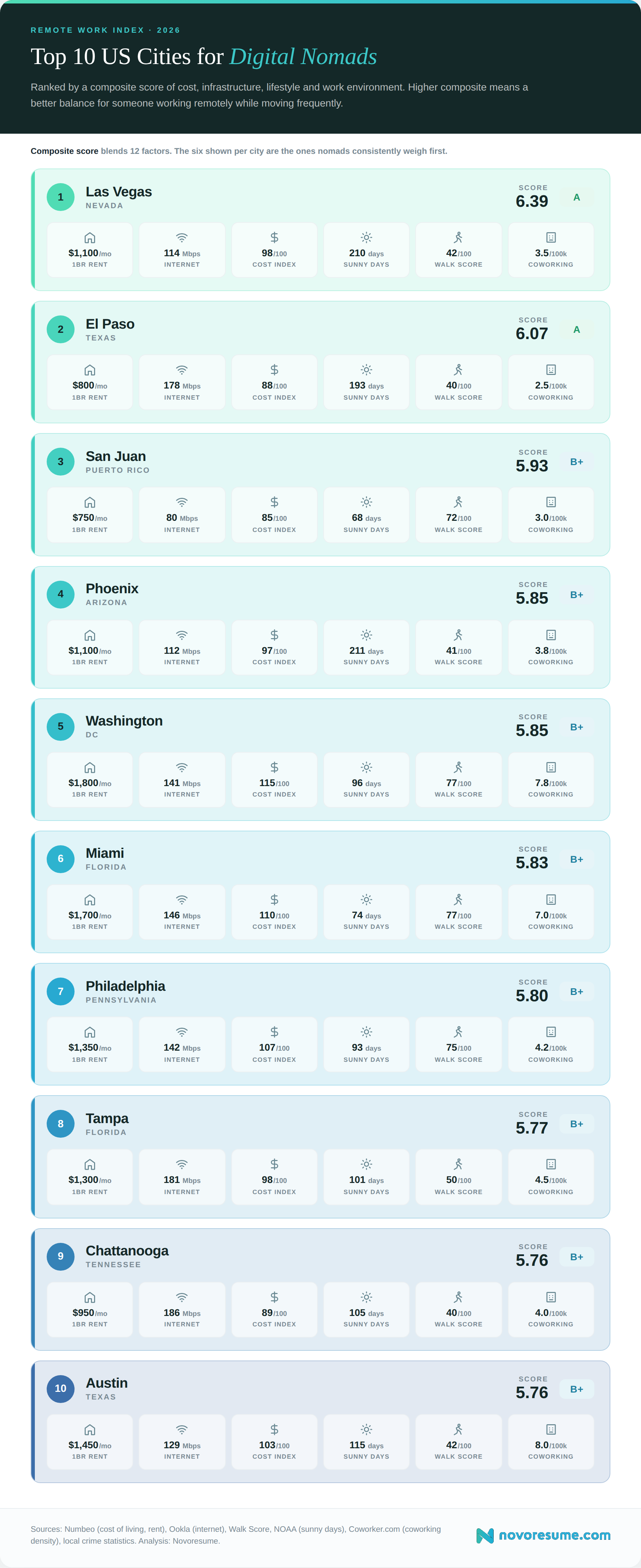
Full Top 10 US Cities for Digital Nomads
Here's how the top 10 cities stack up, with their standout metrics:
The gap between #1 (6.39) and #20 (5.57) is less than a full point, which tells you something: there's no single "perfect" city. Every destination involves trade-offs, and Las Vegas wins because it performs consistently well across the board rather than dominating any single factor.
Why Las Vegas Ranks #1
Las Vegas scores above average on 7 of 10 factors. Cost of living sits 2% below the national average. Average 1BR rent is $1,100 - roughly half what you'd pay in San Francisco or New York. It gets 210 sunny days per year (second only to Phoenix in the index). Harry Reid International Airport offers direct flights to most major US cities and increasingly to international destinations. And coffee shop density ranks among the highest in the country at 25.9 per 100k residents.
Where it falls short: walkability (Walk Score: 42) and coworking density (3.5 per 100k). It's a car-dependent city, and the coworking scene hasn't kept pace with its growing remote-worker population.
For nomads who prioritize affordability, weather, and connectivity over walkability, the numbers work.
The Best Budget Cities for Remote Work
Three cities stand out for offering the most value per dollar:
El Paso, TX (#2) is the cheapest mainland city in the index. At $800/month average rent and a cost of living 12% below the national average, it's hard to beat on economics. It also benefits from very fast broadband (178.3 Mbps - fourth -fastest in the index), 193 sunny days, and the lowest violent crime rate in the top 10 at 278 per 100k. The trade-off: limited entertainment, almost no coworking infrastructure, and low walkability.
San Juan, PR (#3) offers something no mainland city can - US territory status with tropical living. It's the cheapest city in the full index (CoL: 85, rent: $750/month) and the most walkable in the top 5 (Walk Score: 72). Airport connectivity is strong, with direct flights to most East Coast hubs. The downside: internet speed is the slowest in the top 10 at 80 Mbps.
Chattanooga, TN (#9) is the internet speed champion. The city's publicly owned fiber network delivers 186.4 Mbps average speeds - the fastest of any city in the index, a legacy of EPB's pioneering 10-gig municipal broadband. Combined with living costs 11% below the national average and rent at $950/month, Chattanooga arguably offers the best internet-to-dollar ratio for any remote worker in America.
The Overrated: Cities That Rank Lower Than You'd Think
Some of the most talked-about remote work destinations don't hold up on the data.
Denver, CO (#21) is frequently cited as a top remote work city, but a cost of living 7% above average, $1,500/month rent, and middling internet speed (108 Mbps) push it down. It compensates with strong entertainment and coworking access, but the economics have shifted since the pandemic-era migration wave.
Portland, OR (#30) has the highest coffee shop density in the entire index (27.8 per 100k) and a strong entertainment scene, but its cost of living is now 11% above the national average, rent is $1,400, and the city gets just 68 fully sunny days per year.
Nashville, TN (#39) is held back by a violent crime rate of 1,124 per 100k - one of the highest in the index. Rent sits at $1,400 and the cost of living hovers near the national average. Its entertainment (9/10) and airport scores (7/10) are strong, but the safety concerns weigh it down.
Seattle, WA (#56) is the biggest gap between reputation and data. It's one of the most expensive cities in the index (CoL: 118, rent: $1,800), has the fewest sunny days of any city in the 70-city sample (58), and scores average on internet speed despite being home to major tech companies.
Where Each Factor Matters Most
Breaking the index into individual factors shows which cities lead in specific areas:
- Best internet speed: Chattanooga, TN (186.4 Mbps), Tampa, FL (180.5 Mbps), St. Petersburg, FL (180.5 Mbps), El Paso, TX (178.3 Mbps), Orlando, FL (171.0 Mbps)
- Most walkable: San Francisco (88.7), New York (88.0), Boston (82.8), Chicago (77.2), Washington DC (76.7)
- Cheapest to live: San Juan, PR (CoL: 85), Memphis, TN (87), Buffalo, NY (87), El Paso, TX (88), Cleveland, OH (88)
- Sunniest: Phoenix, AZ (211 days), Mesa, AZ (211), Las Vegas, NV (210), El Paso, TX (193), Sacramento, CA (188)
- Safest: Scottsdale, AZ (153 per 100k), Madison, WI (256), El Paso, TX (278), Fort Collins, CO (273), San Juan, PR (est. 300)
- Best airport connectivity: Atlanta, Chicago, Dallas, Houston, Los Angeles, New York (all 10/10)
- Best coffee culture: Portland, OR (27.8 per 100k), Las Vegas, NV (25.9), San Diego, CA (20.8), Denver, CO (20.5), Seattle, WA (20.1)
- Best entertainment and dining: New York (10/10), Washington DC (10/10), New Orleans (10/10), followed by Austin, Charleston, Miami, Nashville, and San Francisco (9/10)
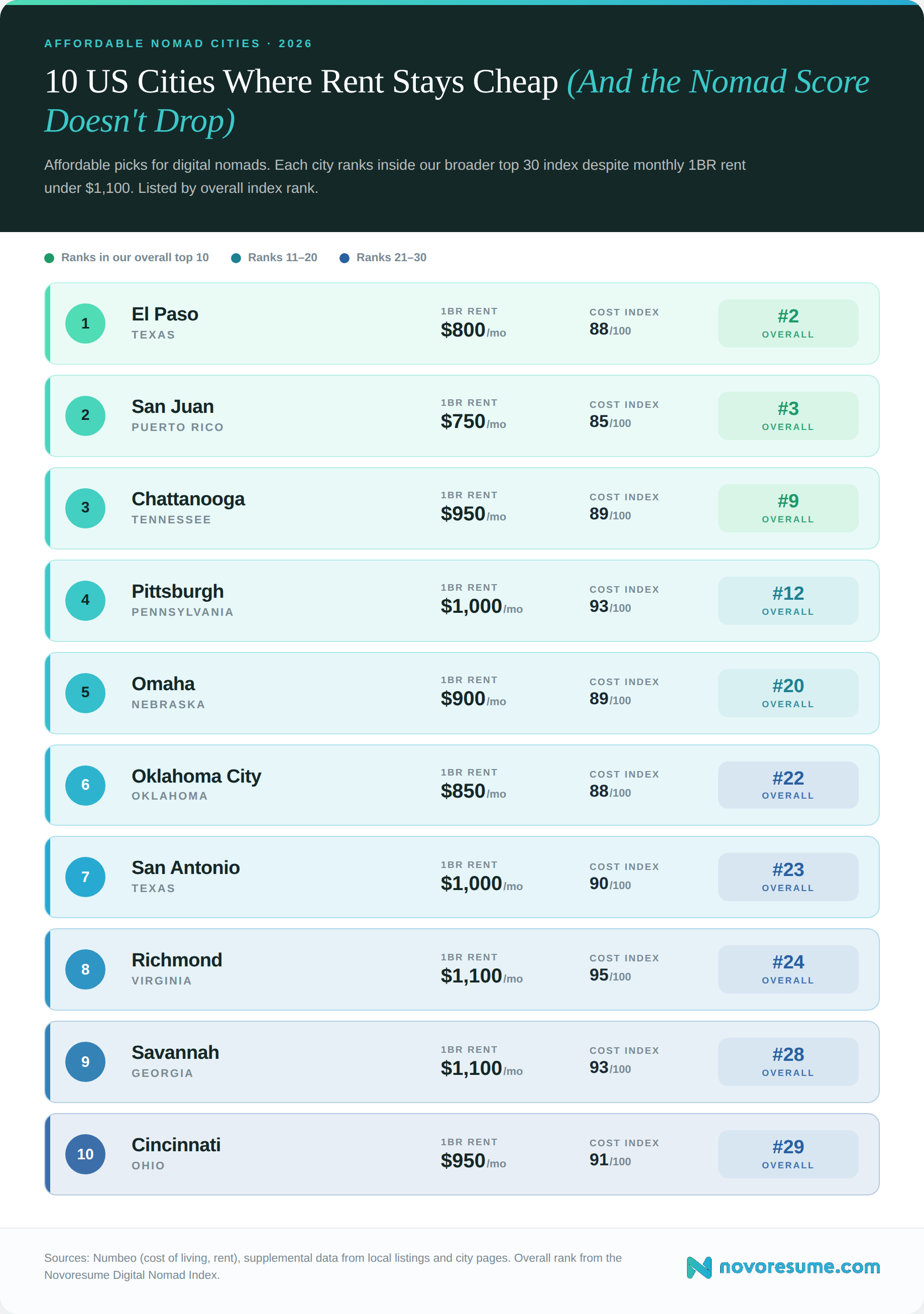
The Budget Shortlist: 10 Affordable Cities That Still Score Well
If you're optimizing purely for cost while maintaining a decent quality of life, these are the 10 cheapest cities in the index that still score 5.0+ overall:
What Remote Job Seekers Should Take From This
For anyone searching for remote-friendly roles or deciding where to base themselves while working remotely, a few practical takeaways from the data:
The cost advantage of mid-size cities is real. The top-scoring affordable cities (El Paso, Chattanooga, Pittsburgh, Omaha) offer rents $500-$1,600/month cheaper than coastal hubs while scoring competitively on internet speed and safety. That difference compounds quickly - $12,000-$19,000/year in rent savings alone.
Internet speed varies more than most people realize. The gap between the fastest city (Chattanooga, 186 Mbps) and the slowest (Boise, 55 Mbps) is more than 3x. For remote workers whose jobs depend on stable, fast connections - video calls, large file transfers, cloud-based tools - this factor alone can eliminate otherwise attractive cities.
"Best city for digital nomads" lists that don't weigh cost heavily are misleading. A city can score well on lifestyle factors but be economically unsustainable for the average remote worker earning a median salary. Our index weights cost of living (15%) and rent (12%) as the two highest individual factors for this reason.
Check the full data before making decisions. The spreadsheet with all 70 cities, 10 raw data points, and normalized scores is available for download. Your priorities might differ from our weighting - someone who doesn't care about weather but needs top-tier walkability would get a very different ranking.
Methodology
We selected 70 US cities based on population (generally 100,000+), geographic diversity, and relevance to remote work. Each city was scored on 10 factors, normalized to a 0-10 scale using min-max normalization across the sample, and combined into a weighted composite score.
- Cost of Living Index (15%) - BEA Regional Price Parities, normalized to national average = 100
- Average 1-Bedroom Rent (12%) - HUD Fair Market Rent data and Zillow Observed Rent Index
- Internet Speed (15%) - Metro-level broadband speeds from HighSpeedInternet.com
- Walk Score (10%) - City-level walkability index from WalkScore.com
- Sunny Days per Year (10%) - NOAA climate normals (1991-2020)
- Violent Crime Rate (8%) - FBI Uniform Crime Report, violent crimes per 100k population
- Coworking Density (8%) - Coworker.com listings per 100k residents
- Coffee Shop Density (7%) - WalletHub and Clever Real Estate per-capita data
- Airport Connectivity (8%) - FAA traffic data and OAG Megahub Rankings, scored 1-10
- Entertainment & Dining (7%) - Restaurant density (Rent.com), bar density (Newsweek), foodie rankings (US News)
Cost and crime metrics were inverted so lower values = higher scores (cheaper and safer = better). Weights were based on published survey data on remote worker location priorities.
Data collected March-April 2026.


























 Add Novorésumé as a preferred source on Google